
- Home
- »
- Network Security
- »
-
Application Security Market Size, Industry Report, 2033GVR Report cover

Application Security Market (2026 - 2033) Size, Share & Trends Analysis By Component (Solution, Services), By Solution, By Service, By Testing Type, By Deployment, By Enterprise Size, By End Use, By Region, And Segment Forecasts
Market Size, 2025
$10.6BMarket Estimate, 2026
$12.6BMarket Forecast, 2033
$42.1BCAGR, 2026–2033
18.8%Application Security Market Summary
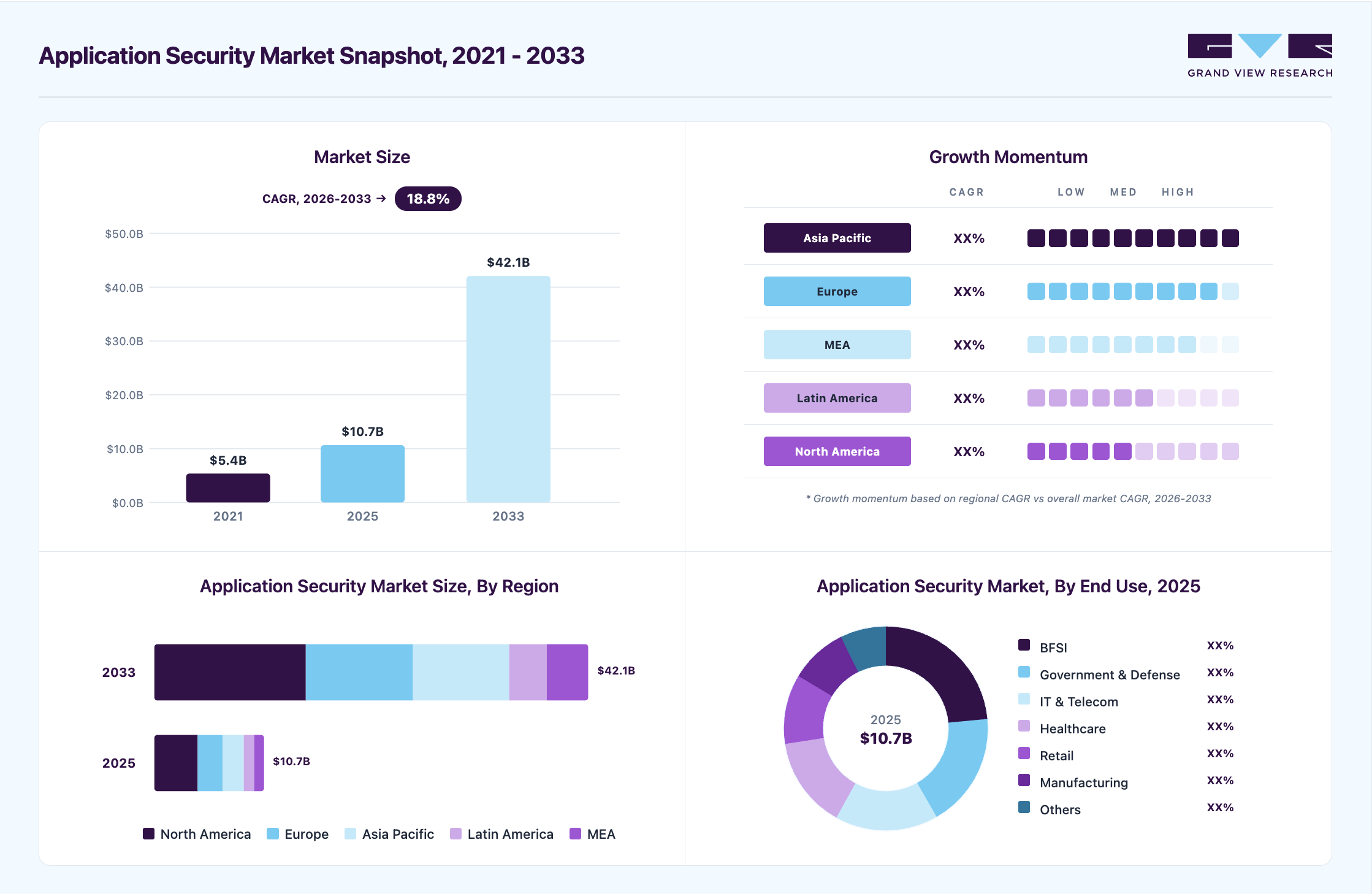
The global application security market size was valued at USD 10.6 billion in 2025 and is projected to grow from USD 12.6 billion in 2026 to USD 42.1 billion by 2033, at a CAGR of 18.8% from 2026 to 2033. The North America application security market held the largest share of 39.4% of the global market in 2025. The growth is driven by the surge in cyberattacks targeting web and mobile applications as organizations increasingly digitize operations.
 Source: Grand View Research, IR Documents, Primary Interviews, Paid DatabasesTo learn more about this report,
 Download Free Sample Report
 Key Market Trends & Insights
- By component: Solution segment held the largest revenue share of 67.2% in 2025.
- By testing type: SAST segment held the largest revenue share in 2025.
- By end use: BFSI segment is expected to grow significantly from 2026 to 2033.
Regional Highlights
- Largest regional market: North America (39.4% revenue share, 2025)
- Fastest-growing regional market: Asia Pacific (highest CAGR, 2026-2033)
- By country: The application security industry in the U.S. is expected to grow significantly from 2026 to 2033.
Market Size & Forecast
- Market size in 2025: USD 10.6 Billion
- Estimated market size in 2026: USD 12.6 Billion
- Projected market size by 2033: USD 42.1 Billion
- CAGR (2026-2033): 18.8%
Three ways to get this report
Buy it, customize it, or ask a question.Ask an Analyst
Analyst response in 1 business day
- AccessReport author, directly
- Reply timeWithin 1 working day
- No sales callDirect answer only
- FormatEmail reply
- CostFree, no cost
Get the Full Report
What the study covers
- FormatsPDF · Excel · Dashboard
- Timeline2026–2033 annual, 2025 base
- Coverage20+ countries, 5 regions
- Companies10+ key players profiled
Customize the Report
20% free customization
- IncludeCountries, segments, points
- TailorTo your product definition
- ExtendDeeper competitor detail
- OrA fully bespoke study
- Turnaround5–10 working days
This has heightened the need for robust security solutions that can detect, prevent, and remediate vulnerabilities across development and production environments. The surge in sophisticated cyber threats targeting applications is the most significant growth driver for the application security industry. As organizations increasingly adopt digital platforms, attackers are exploiting vulnerabilities in web and mobile applications to gain unauthorized access and steal sensitive data. This growing threat landscape has prompted enterprises to invest heavily in application security solutions such as web application firewalls, runtime application self-protection (RASP), and static/dynamic application security testing (SAST/DAST).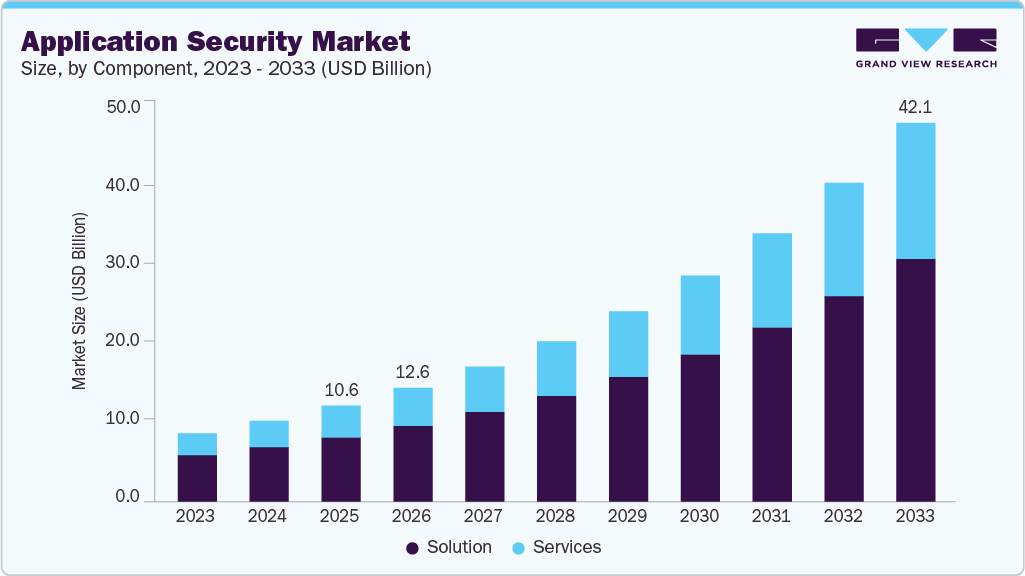 To learn more about this report, Download Free Sample Report
 The accelerated shift toward cloud computing, SaaS-based applications, and microservices architectures has expanded the attack surface for businesses. With applications being deployed across hybrid and multi-cloud environments, ensuring consistent security across these platforms has become critical. Consequently, companies are integrating cloud-native application protection platforms (CNAPPs) and DevSecOps practices to secure their applications throughout the development lifecycle. According to the 2025 State of Cloud Security Report by Orca Security, multi-cloud adoption has become the new standard, with 55% of organizations now utilizing two or more cloud providers. This widespread shift toward hybrid and multi-cloud environments has significantly increased the complexity of maintaining consistent security policies, visibility, and compliance across platforms. The report highlights that as businesses scale their cloud operations, many struggle with misconfigurations, identity management, and vulnerability monitoring.
The exponential rise in mobile and web applications across various industries, including banking, healthcare, and retail, is also fueling market growth. As these applications handle high volumes of financial and personal information, developers are prioritizing secure coding practices and integrating security testing earlier in the development process. This has led to a surge in demand for integrated security testing tools and continuous monitoring solutions.
Market Dynamics
The increasing use of AI-powered applications, cloud platforms, APIs, and connected digital systems is becoming a major driving factor for the application security market. Organizations are rapidly integrating AI models, automation tools, and intelligent applications into their business operations to improve efficiency and customer experience. However, these interconnected environments also create new security challenges, such as unauthorized access, data leakage, vulnerable APIs, and threats targeting AI models and runtime environments. As cyberattacks become more advanced and complex, businesses are investing heavily in application security solutions that can provide continuous monitoring, threat detection, vulnerability management, and protection across the entire application lifecycle. This growing need to secure modern applications and AI ecosystems is significantly accelerating demand in the application security market.
For instance, in March 2026, Wiz launched its AI Application Protection Platform (AI-APP) to help organizations secure AI applications across infrastructure, data, models, agents, and runtime environments. The platform was introduced to address increasing security risks associated with interconnected AI systems by offering unified visibility, contextual risk analysis, and threat detection capabilities for vulnerabilities, unauthorized access, and sensitive data exposure. This development highlights how technology providers are expanding advanced security solutions specifically for AI-driven environments. As enterprises continue adopting AI technologies on a large scale, the demand for comprehensive application security platforms is expected to grow further, supporting overall market expansion.
One of the major restraint factors for the application security market is the growing complexity of cyber threats and the difficulty organizations face in effectively securing modern applications. Businesses today operate across cloud environments, mobile applications, APIs, and AI-driven platforms, which significantly expands the attack surface. Many organizations rely on traditional or fragmented security systems that are unable to detect advanced attacks in real time. In addition, limited cybersecurity expertise, integration challenges, and high implementation costs make it difficult for companies, especially small and medium-sized enterprises, to fully adopt advanced application security solutions. These challenges reduce the effectiveness of security investments and can slow market growth despite increasing cybersecurity spending.
For instance, according to Verizon’s Data Breach Investigations Report 2025, basic web application attacks increased from 9% in 2024 to 12% in 2025. This rise shows that even common and well-known attack methods continue to successfully exploit vulnerabilities in business applications. The increasing number of such attacks highlights the ongoing struggle organizations face in maintaining strong application security despite deploying security tools and frameworks. This situation demonstrates that gaps in implementation, monitoring, and skilled security management remain significant challenges for the market. As cyber threats continue evolving faster than many organizations can respond, these operational and technical difficulties may restrain the growth of the application security market to some extent.
Market Concentration & Characteristics
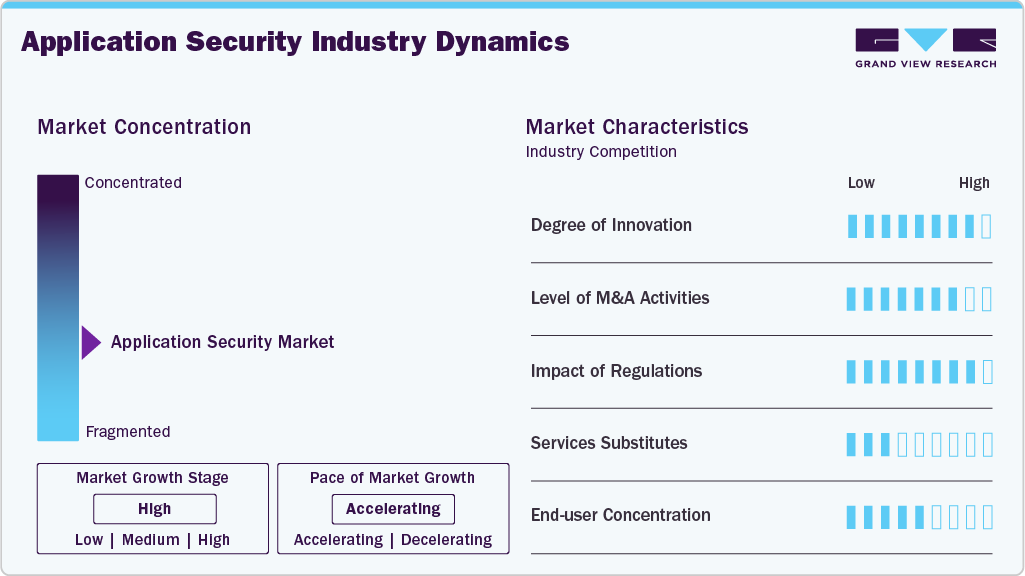
The application security market is moderately fragmented, with the presence of both established cybersecurity companies and emerging specialized vendors competing across different security segments. Large technology providers offer integrated application security platforms, while newer companies focus on advanced areas such as API security, cloud-native application protection, DevSecOps, and AI-driven threat detection. The market is highly dynamic and innovation-focused, as vendors continuously develop new solutions to address evolving cyber threats, secure modern applications, and support increasingly complex IT environments. Companies are also actively involved in partnerships, acquisitions, and product expansions to strengthen their technological capabilities and increase market presence.
 To learn more about this report, Download Free Sample Report
 The market is experiencing strong and accelerating growth due to the rapid adoption of cloud computing, AI applications, digital transformation strategies, and increasing cybersecurity concerns across industries. Regulatory requirements related to data privacy and cybersecurity compliance are further encouraging organizations to invest in advanced application security solutions. At the same time, application security has become a critical business requirement because organizations have limited alternatives for protecting sensitive applications, APIs, and enterprise data from sophisticated cyberattacks. Demand for these solutions is expanding across multiple sectors including BFSI, healthcare, government, retail, manufacturing, and IT & telecom, creating broad-based market opportunities globally.
Component Insights
The solution segment dominated the application security market, accounting for a 67.2% revenue share in 2025. As organizations adopt DevSecOps practices, there is a significant shift toward integrating security tools directly into continuous integration and deployment (CI/CD) pipelines. Application security solutions that integrate seamlessly with DevOps workflows enable real-time scanning, automated testing, and faster remediation of security flaws. The early embedding of security in development has led to an increased demand for automated and developer-friendly application security solutions.
The services segment is anticipated to grow at a significant CAGR during the forecast period. The widespread adoption of multi-cloud and hybrid IT infrastructures has made it difficult for businesses to maintain consistent application security policies across diverse platforms. Professional and consulting services are witnessing rising demand as enterprises seek expert guidance on cloud-native security architecture design, policy integration, and risk assessment. Service providers offering cloud and API security assessments are thus becoming critical partners in securing distributed applications.
Solution Insights
The web application security segment dominated the application security industry, accounting for the largest revenue share in 2025. The rapid surge in web application vulnerabilities and sophisticated cyberattacks, such as SQL injection, cross-site scripting (XSS), and session hijacking, has become a major driver for the web application security solution segment. As businesses increasingly depend on web-based platforms for operations, attackers are exploiting these entry points to access confidential data. This growing threat landscape is pushing enterprises to adopt advanced Web Application Firewalls (WAFs), bot management systems, and runtime protection solutions to safeguard their online assets.
The mobile application security segment is anticipated to grow at a significant CAGR during the forecast period. The exponential increase in mobile app usage across banking, e-commerce, healthcare, and social platforms has made mobile applications a prime target for cybercriminals. Attacks such as malware injection, data leakage, code tampering, and insecure data storage are becoming more common. Moreover, modern mobile application security solutions are increasingly leveraging AI and machine learning to identify behavioral anomalies, detect zero-day vulnerabilities, and automate threat responses.
Service Insights
The professional services segment dominated the application security market, accounting for the largest revenue share in 2025. With the increase in application-layer attacks, organizations are increasingly outsourcing incident response, forensic analysis, and remediation services to professional service providers. These services enable organizations to quickly identify, contain, and mitigate security breaches, thereby reducing the potential business impact. The complexity and criticality of timely response continue to drive the adoption of professional application security services.
The managed services segment is expected to grow at a significant CAGR over the forecast period. The migration of applications to cloud-native and hybrid architectures increases the complexity of security management. Managed services offer centralized monitoring and protection across multiple platforms, ensuring consistent security policies, automated patching, and real-time threat detection. This capability is critical for enterprises with distributed applications, boosting the segment’s growth.
Testing Type Insights
The static application security testing (SAST) segment dominated the market, accounting for the largest revenue share in 2025. SAST solutions enable organizations to identify security flaws during the early stages of software development by analyzing source code, bytecode, or binaries. Early detection reduces the risk of deploying vulnerable applications and lowers remediation costs compared to fixing issues post-production. As enterprises prioritize proactive security measures, the adoption of SAST continues to grow rapidly.
The dynamic application security testing (DAST) segment is expected to grow at a significant CAGR over the forecast period. DAST solutions analyze applications during runtime to identify security flaws that cannot be detected in static code analysis, such as authentication issues, session management flaws, and input/output validation problems. As organizations increasingly deploy complex web and mobile applications, the ability to detect vulnerabilities in a live environment is driving demand for DAST solutions.
Deployment Insights
The on-premise segment dominated the application security industry, with the largest revenue share in 2025. Organizations deploying application security solutions on-premises benefit from full control over configuration, customization, and security policies. Enterprises with complex IT environments or sensitive data often prefer on-premise deployments to tailor security solutions to their unique requirements. This demand for highly customizable and controllable security infrastructure continues to drive growth in the on-premise deployment segment.
The cloud segment is expected to grow at a significant CAGR during the forecast period. Enterprises are increasingly migrating applications to public, private, and hybrid cloud environments to enhance scalability, agility, and operational efficiency. Cloud deployment of application security solutions allows organizations to protect workloads across diverse cloud platforms without the complexity of managing on-premise infrastructure. The surge in cloud adoption is a key driver for this segment.
Enterprise Size Insights
The large enterprises segment dominated the market, accounting for the largest revenue share in 2025. Large enterprises often operate complex IT environments with multiple web, mobile, and cloud applications running across hybrid and multi-cloud architectures. Securing these extensive and interconnected systems requires advanced application security solutions, including SAST, DAST, RASP, and CNAPPs. The complexity and scale of operations drive large enterprises to invest heavily in comprehensive security platforms to protect sensitive data and maintain business continuity.
The small & medium enterprises segment is expected to grow at a significant CAGR during the forecast period. Many SMEs are digitally transforming by adopting e-commerce platforms, cloud applications, and mobile apps to reach customers and streamline operations. The expansion of digital assets increases the attack surface, making application security solutions essential for preventing data breaches, fraud, and service disruptions.
End Use Insights
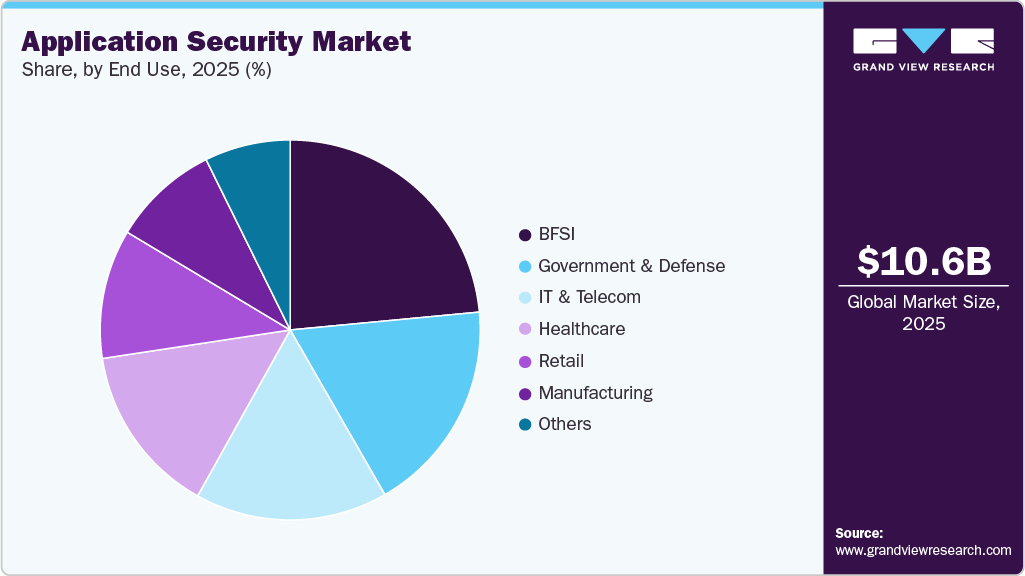
The BFSI segment dominated the application security market, accounting for a revenue share of over 20.0% in 2025. BFSI organizations are prime targets for cybercriminals due to the high value of financial and personal data. Threats such as account takeover, phishing, API attacks, and ransomware have become increasingly sophisticated and frequent. This has driven BFSI enterprises to adopt advanced application security solutions, including Web Application Firewalls (WAFs), Runtime Application Self-Protection (RASP), and AI-powered threat detection to protect sensitive financial assets.
 To learn more about this report, Download Free Sample Report
 The healthcare segment is expected to grow at a significant CAGR over the forecast period. Healthcare organizations handle large volumes of personal health information (PHI), making them prime targets for cyberattacks. Threats such as ransomware, data breaches, and unauthorized access can have severe consequences, including patient harm and legal penalties. This drives healthcare providers to adopt advanced application security solutions, including web/mobile security tools, WAFs, and RASP, to protect sensitive patient data.
Regional Insights
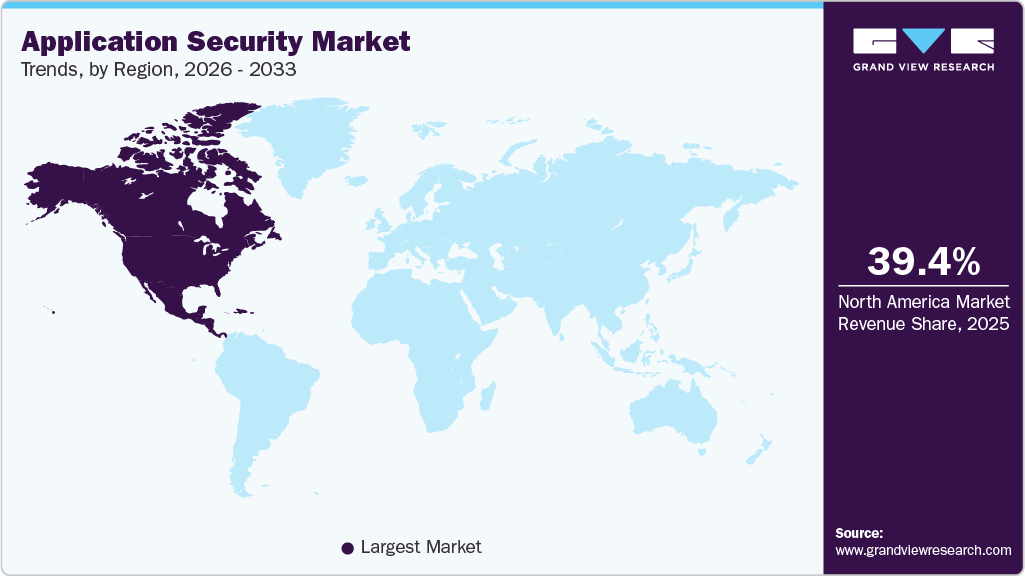
The application security market in North America dominated the global market with the largest revenue share of 39.4% in 2025, driven by the high adoption of cloud computing and multi-cloud environments among enterprises. Organizations are increasingly deploying hybrid architectures, which expands the attack surface and creates demand for cloud-native application security solutions and integrated threat intelligence platforms.
 To learn more about this report, Download Free Sample Report
 U.S. Application Security Market Trends
The application security industry in the U.S. is expected to grow significantly at a CAGR of 16.1% from 2026 to 2033, driven by stringent regulatory compliance and cybersecurity standards. Frameworks such as PCI DSS, HIPAA, and CCPA require robust security for web and mobile applications, encouraging organizations to adopt advanced SAST, DAST, and RASP solutions to maintain compliance and protect sensitive customer data.
Europe Application Security Market Trends
The Europe application security industry is anticipated to register considerable growth from 2026 to 2033 due to the increasing focus on data privacy and GDPR compliance. Enterprises are investing in application security solutions that ensure secure handling of personal data, implement real-time monitoring, and provide audit-ready reports to avoid penalties and reputational damage.
The UK application security market is expected to grow rapidly in the coming years, driven by digital transformation initiatives across the banking, healthcare, and retail sectors, which will increase the adoption of application security solutions. Organizations expanding their web and mobile presence require continuous application monitoring, API security, and vulnerability management to safeguard critical business processes.
The application security market in Germany held a substantial market share in 2025, driven by the strong adoption of Industry 4.0 technologies in the manufacturing and industrial sectors. Industrial applications, IoT-connected systems, and smart manufacturing platforms necessitate robust application security solutions to prevent intellectual property theft, operational disruptions, and cyber espionage.
Asia Pacific Application Security Market Trends
The Asia Pacific held a significant share of the global market in 2025, largely due to the rapid adoption of mobile and digital payment platforms in emerging economies. High smartphone penetration and the expansion of e-commerce have increased the demand for mobile and web application security solutions to protect consumer data and prevent fraud.
The Japan application security market is expected to grow rapidly in the coming years, driven by advanced technological infrastructure and enterprise-level automation drive the market. Organizations are increasingly integrating DevSecOps practices and AI-powered security analytics into their software development lifecycle, accelerating demand for automated SAST, DAST, and runtime protection solutions.
The application security market in China held a substantial revenue share in 2025, due to government initiatives promoting the digital economy and smart city projects. Enterprises and public sector organizations are deploying large-scale web and mobile applications, which require comprehensive security solutions, including cloud-native protection, API security, and continuous threat monitoring, to ensure data integrity and service continuity.
Key Application Security Company Insights
Key players operating in the application security industry are Checkmarx Ltd.; IBM Corporation; Synopsys, Inc.; F5, Inc.; Open Text Corporation; andHCL Technologies. The companies are focusing on various strategic initiatives, including new product development, partnerships & collaborations, and agreements to gain a competitive advantage over their rivals. The following are some instances of such initiatives.
-
In September 2025, F5, Inc. announced plans to acquire CalypsoAI, a leading provider of enterprise AI security solutions. CalypsoAI’s platform, known for real-time threat protection, scalable red teaming, and robust data security, will be integrated into F5’s Application Delivery and Security Platform (ADSP), enhancing its ability to secure AI inference and offering enterprises a comprehensive solution for safe deployment of generative and agentic AI.
-
In April 2025, Checkmarx Ltd. launched an application security posture management (ASPM) solution directly within popular integrated development environments (IDEs). The cloud-based Checkmarx One platform enhances developer workflows by simplifying vulnerability prioritization and remediation without disrupting daily tasks. New features include pre-commit secrets scanning in the IDE to reduce redundant fixes and safeguard sensitive data, as well as integration with JFrog Artifactory to ensure secure code delivery and compliance in private registries.
-
In April 2025, Synopsys, Inc. introduced Polaris Assist, an AI-powered application security assistant built into the Synopsys Polaris Software Integrity Platform. By combining cutting-edge Large Language Model (LLM) technology with Synopsys’ security expertise and the extensive open source data from Black Duck, Polaris Assist provides developers and security teams with concise vulnerability summaries, practical recommendations, and AI-suggested code fixes, enabling faster and more secure software development.
Key Application Security Companies:
The following are the leading companies in the application security market. These companies collectively hold the largest market share and dictate industry trends.
- CAST Software
- Checkmarx
- Cisco Systems, Inc.
- F5, Inc.
- GitLab
- HCL Technologies Ltd
- IBM Corporation
- Open Text Corporation
- Onapsis
- Rapid7
- Synopsys, Inc.
- Veracode
- VMware
- WhiteHat Security
Competitive Benchmarking
Operating Strategies
Competitive Edge
Weaknesses
Mature Players: IBM Corporation; Cisco Systems, Inc.; Synopsys, Inc.; Open Text Corporation; F5, Inc.; HCL Technologies Ltd
- Focus on integrated application security platforms combined with cloud, AI, and enterprise security services.
- Expand market presence through acquisitions, strategic partnerships, and long-term enterprise contracts.
- Strong global customer base with established brand recognition and large-scale cybersecurity portfolios.
- High R&D investments and broad product integration capabilities across enterprise IT environments.
- Complex product ecosystems may increase deployment and management challenges for customers.
- Higher pricing structures can limit adoption among small and medium-sized enterprises.
Emerging Players: Checkmarx; GitLab; Onapsis; Rapid7; Veracode; WhiteHat Security
- Focus on cloud-native security, DevSecOps integration, and AI-driven vulnerability detection solutions.
- Target niche and high-growth security segments such as API security, runtime protection, and continuous testing.
- Faster innovation cycles and flexible platforms designed for modern application development environments.
- Strong specialization in application security and developer-focused security automation tools.
- Limited global reach and smaller enterprise customer base compared to large established vendors.
- Dependence on partnerships and external channels for broader market expansion and scalability.
Application Security Market Report Scope
Report Attribute
Details
Market size in 2025
USD 10.6 billion
Estimated market size in 2026
USD 12.64 billion
Projected market size by 2033
USD 42.09 billion
Growth rate
CAGR of 18.8% from 2026 to 2033
Actual data
2021 - 2025
Forecast period
2026 - 2033
Quantitative units
Revenue in USD billion and CAGR from 2026 to 2033
Report coverage
Revenue forecast, company share, competitive landscape, growth factors, and trends
Segments covered
Component, solution, service, testing type, deployment, enterprise size, end use, and region
Regional scope
North America; Europe; Asia Pacific; Latin America; MEA
Country scope
U.S.; Canada; Mexico; UK; Germany; France; China; India; Japan; Australia; South Korea; Brazil; UAE; Kingdom of Saudi Arabia; South Africa
Key companies profiled
CAST Software; Checkmarx; Cisco Systems, Inc.; F5, Inc.; GitLab; HCL Technologies Ltd.; IBM Corporation; Open Text Corporation; Onapsis; Rapid7; Synopsys, Inc.; Veracode; VMware; WhiteHat Security
Customization scope
Free report customization (equivalent to 8 analysts working days) with purchase. Addition or alteration to country, regional & segment scope.
Pricing and purchase options
Avail customized purchase options to meet your exact research needs. Explore purchase options
Global Application Security Market Report Segmentation
This report forecasts revenue growth at global, regional, and country levels and provides an analysis of the latest industry trends in each of the sub-segments from 2021 to 2033. For this study, Grand View Research has segmented the application security market report based on component, solution, service, testing type, deployment, enterprise size, end use, and region:
-
Component Outlook (Revenue, USD Billion, 2021 - 2033)
-
Solution
-
Services
-
-
Solution Outlook (Revenue, USD Billion, 2021 - 2033)
-
Web Application Security
-
Mobile Application Security
-
-
Service Outlook (Revenue, USD Billion, 2021 - 2033)
-
Professional Services
-
Managed Services
-
-
Testing Type Outlook (Revenue, USD Billion, 2021 - 2033)
-
Static Application Security Testing (SAST)
-
Dynamic Application Security Testing (DAST)
-
Interactive Application Security Testing (IAST)
-
Runtime Application Self-Protection (RASP)
-
-
Deployment Outlook (Revenue, USD Billion, 2021 - 2033)
-
Cloud
-
On-premise
-
-
Enterprise Size Outlook (Revenue, USD Billion, 2021 - 2033)
-
Large Enterprises
-
Small & Medium Enterprises
-
-
End Use Outlook (Revenue, USD Billion, 2021 - 2033)
-
BFSI
-
Retail
-
IT & Telecom
-
Healthcare
-
Manufacturing
-
Government & Defense
-
Others
-
-
Regional Outlook (Revenue, USD Billion, 2021 - 2033)
-
North America
-
U.S.
-
Canada
-
Mexico
-
-
Europe
-
UK
-
Germany
-
France
-
-
Asia Pacific
-
China
-
India
-
Japan
-
South Korea
-
Australia
-
-
Latin America
-
Brazil
-
-
Middle East & Africa
-
UAE
-
Saudi Arabia
-
South Africa
-
-
Delivered Customizations
This report has been delivered with the following In-depth customizations
Client Request
Customization Delivered
Value Adds
Requested a detailed regional outlook for the Middle East & Africa application security market, including adoption trends and regulatory landscape analysis.
- Added segment-level analysis of Developed country-level assessment for UAE, Saudi Arabia, and South Africa
- Included regional regulatory framework assessment related to data protection and application security compliance
- Helped identify high-growth regional opportunities and demand hotspots
- Supported regional expansion and partnership planning
- Improved understanding of compliance-driven security spending trends
Required a dedicated GTM strategy analysis for targeting small and medium-sized businesses (SMBs) in the application security market.
- Developed pricing and deployment benchmarking for application security solutions
- Added customer buying behavior analysis for SMB-focused security adoption
- Included channel partner and managed security service provider (MSSP) strategy assessment
- Enabled development of a cost-effective market penetration strategy
- Helped optimize sales and channel distribution approach
- Improved targeting of high-potential SMB customer segments
Requested inclusion of a dedicated analysis on the API security segment within the application security market.
- Added market sizing and forecast for API security solutions
- Included vendor benchmarking focused on API threat detection and runtime protection capabilities
- Integrated use case analysis for BFSI, healthcare, and e-commerce industries
- Provided deeper visibility into one of the fastest-growing security segments
- Supported product development and investment prioritization decisions
- Helped identify industry-specific API security demand patterns and opportunities
Frequently Asked Questions About This Report
Solution offering led the market and accounted for more than 67.2% of the global revenue in 2025. This dominance was driven by enterprises’ increasing need for integrated, end-to-end application security solutions that proactively identify and remediate vulnerabilities across complex, cloud-native and DevOps environments.
The rising frequency and sophistication of cyberattacks targeting web and mobile applications, rapid adoption of cloud computing, microservices, and DevOps practices, which increases application complexity and expands the attack surface. Thus, driving the market demand of the application security market.
North America dominated with a 39.4% revenue share in 2025.
The professional services segment held the largest revenue share in 2025.
The large enterprises segment dominated the market and accounted for the largest revenue share in 2025.
BFSI segment held the largest share (over 20.0%) in 2025.
The global application security market size was valued at USD 10.6 billion in 2025 and is estimated at USD 12.6 billion for 2026.
The global application security market is expected to grow at a CAGR of 18.8% from 2026 to 2033, reaching USD 42.1 billion by 2033.
Key players include CAST Software; Checkmarx; Cisco Systems, Inc.; F5, Inc.; GitLab; HCL Technologies Ltd.; IBM Corporation; Open Text Corporation; Onapsis; Rapid7; Synopsys, Inc.; Veracode; VMware; WhiteHat Security.
The on-premise segment dominated the application security industry, with the largest revenue share in 2025.
About the Author(s)
Network Security Research Team
Technology · Network SecurityThis report was authored by the network security research team at Grand View Research - comprising two research analysts, one senior research analyst, and one industry expert - with specialized expertise in the network security segment of the technology industry. All findings are based on proprietary technology databases, executive interviews, and regulatory analysis, subject to internal peer review prior to publication.
Last Updated:
Speak to Analyst

Customize this report to your needs - add regions, segments, or data points, with 20% free customization.
Or view our licence options:


ISO 9001:2015 & 27001:2022 Certified
We are GDPR and CCPA compliant! Your transaction & personal information is safe and secure. For more details, please read our privacy policy.


