
- Home
- »
- Medical Devices
- »
-
Arteriovenous Fistula Devices Market Size Report, 2033GVR Report cover

Arteriovenous Fistula Devices Market (2026 - 2033)
Size, Share & Trends Analysis Report By Type (AVF Creation Devices, AVF Monitoring Devices, AVF Maintenance Devices), By End Use (Hospitals, Ambulatory Surgical Centers, Dialysis Centers), By Region, And Segment Forecasts
Market Size, 2025
$388.2MMarket Estimate, 2026
$415.4MMarket Forecast, 2033
$666.7MCAGR, 2026–2033
7.1%Arteriovenous Fistula Devices Market Summary
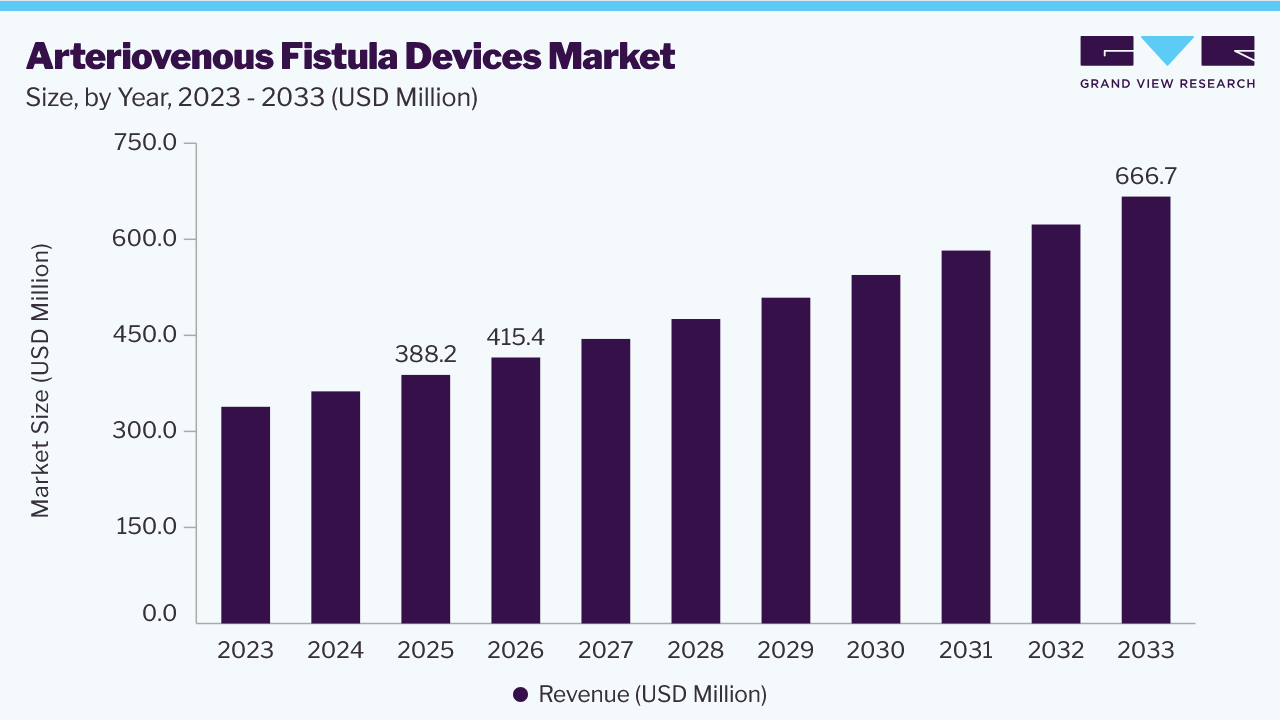
The global arteriovenous fistula devices market size was valued at USD 388.2 million in 2025 and is projected to grow from USD 415.4 million in 2026 to USD 666.7 million by 2033, at a CAGR of 7.1% from 2026 to 2033. North America dominated the global market, accounting for the largest revenue share of 45.0% in 2025. The market is expected to grow due to several factors, including the rising prevalence of end-stage renal disease (ESRD) and the resulting increase in the number of patients requiring hemodialysis.
Key Market Trends & Insights
- By type: The AVF creation segment held the largest market share of approximately 50.0% in 2025.
- By end-use: The hospitals segment accounted for the largest market revenue share in 2025.
Regional Highlights
- Largest regional market: North America (45.0% revenue share, 2025)
Market Size & Forecast
- Market size in 2025: USD 388.2 Million
- Estimated market size in 2026: USD 415.4 Million
- Projected market size by 2033: USD 666.7 Million
- CAGR (2026-2033): 7.1%
Prism AI by Grand View Research Free to tryAsk a question about the arteriovenous fistula devices marketTry asking✓Every figure cited from GVR research Prefer the report? Download free sample →
The National Institute of Diabetes and Digestive and Kidney Diseases (NIDDK) reports that approximately 786,000 individuals in the U.S. are living with ESRD (end-stage renal disease). Among these, 71% are undergoing dialysis treatment, while the remaining 29% have received kidney transplants.An arteriovenous fistula (AVF) occurs when an artery and a vein directly connect, causing abnormal blood flow. These connections can be surgically created for individuals who require dialysis treatment. AVFs serve as a long-term access point for hemodialysis in people with ESRD. By increasing blood flow, AVFs make dialysis easier and help remove waste products from the body.
 Source: Grand View Research, IR Documents, Primary Interviews, Paid DatabasesTo learn more about this report,
 Download Free Sample Report
AVF devices are considered the preferred option for vascular access due to their durability, lower risk of infection, and superior long-term outcomes compared to alternatives such as catheters or arteriovenous grafts. These devices are crucial for establishing vascular access for ESRD patients and for facilitating efficient, effective hemodialysis treatments. For instance, hemodialysis is the most widely used method of kidney replacement therapy worldwide, accounting for approximately 69% of all kidney replacement therapy and 89% of all dialysis procedures.
In addition, as per the CDC, Chronic Kidney Disease (CKD) is more prevalent among individuals aged 65 years or older, with a rate of 38%. In comparison, the incidence of CKD is lower in people aged 45-64 years (12%) and even lower in those aged 18-44 years (6%). This data indicates that CKD is more prevalent among the aging population, leading to increased demand for AVF devices. The expanding dialysis patient population, particularly among older individuals, underscores the growing need for efficient, effective vascular access via AVFs.
Furthermore, key players in the AVF device market are actively undertaking strategic initiatives to drive market expansion. For instance, in January 2023, Alucent Biomedical Inc. was dedicated to developing and commercializing the innovative AlucentNVS technology for the treatment of vascular disease. The company announced the commencement of its ACTIVATE AVF study, which aims to evaluate the safety and feasibility of AlucentNVS for Arteriovenous Fistula (AVF) in individuals with ESRD.
The AlucentNVS therapy is specifically designed to expedite and enhance the physiological and functional maturation of AVF devices. If proven effective, this therapy could enable more patients to access regular and life-saving dialysis treatments at an earlier stage and with greater reliability. These technological advancements are crucial in driving market growth by enhancing patient outcomes and reducing complications associated with AVF procedures. As a result, the demand for innovative AVF devices is fueled, creating a positive market trend.
Market Dynamics
The arteriovenous fistula devices industry is growing as the number of patients with chronic kidney disease and end-stage renal disease requiring hemodialysis increases. The increasing elderly population and higher prevalence of diabetes and hypertension are further driving demand for dialysis access procedures. AVF is preferred over other vascular access options because it offers better long-term performance and a lower risk of infection.
However, the arteriovenous fistula devices industry faces challenges such as high fistula failure rates, long maturation time, and the need for skilled surgical expertise. Despite these limitations, advancements in minimally invasive AVF creation techniques and improved device technologies are supporting market growth. Expanding healthcare infrastructure and increasing adoption of dialysis services in emerging economies are creating additional growth opportunities.
The increasing prevalence of chronic kidney disease (CKD) and end-stage renal disease (ESRD) is a major driver of the arteriovenous fistula devices industry. CKD has become a significant global health concern due to the rising incidence of diabetes, hypertension, obesity, and age-related health conditions. According to the World Health Organization report published in April 2026, approximately 674 million people worldwide are living with chronic kidney disease (CKD). As kidney disease progresses to ESRD, patients require long-term dialysis treatment to perform the functions of damaged kidneys. This has led to a growing demand for reliable vascular access solutions, creating favorable conditions for the adoption of AVF devices.
Arteriovenous fistulas are widely recognized as the preferred vascular access option for hemodialysis because they provide better long-term performance and lower complication rates than other access methods, such as central venous catheters and arteriovenous grafts. AVFs offer improved blood flow, reduced infection risk, and longer durability, making them a cost-effective and clinically effective solution for both healthcare providers and patients. As a result, hospitals, dialysis centers, and healthcare professionals increasingly recommend fistulas for patients undergoing long-term dialysis treatment. The continuous expansion of dialysis infrastructure, particularly in developing regions, is further increasing the number of AVF creation procedures.
A major restraint in the arteriovenous fistula devices industry is the high cost of AVF creation procedures and the limited availability of skilled healthcare professionals to perform them. AVF creation is a specialized surgical procedure that requires experienced vascular surgeons or interventional specialists, advanced diagnostic imaging, and continuous patient monitoring to ensure successful fistula maturation. These requirements increase the overall cost of treatment and can create barriers to widespread adoption, particularly in cost-sensitive healthcare systems.
Patients often require preoperative vascular assessments, postoperative follow-up visits, and, in some cases, additional interventions to address complications such as stenosis, thrombosis, or inadequate maturation. These added costs increase the financial burden on hospitals, dialysis centers, and patients.
The shortage of trained vascular access specialists further restricts market growth. Many developing countries and rural areas face challenges in accessing qualified surgeons and specialized dialysis care facilities. This can lead to delays in AVF creation procedures and reduce the overall number of patients receiving fistulas as their preferred vascular access for hemodialysis. In some cases, healthcare providers may rely on alternative access methods, such as central venous catheters, because they are easier to place and more widely available.
Analyst Perspective
The arteriovenous fistula devices industry is growing due to the rising prevalence of chronic kidney disease and the increasing number of patients requiring hemodialysis. Furthermore, the demand for AVF devices is driven by their ability to provide reliable, long-term vascular access with fewer complications than alternative options. Technological advancements in minimally invasive AVF creation procedures and growing investments in dialysis care are further driving market growth. In addition, expanding healthcare infrastructure in emerging economies is creating new opportunities for market expansion.
Type Insights
The AVF creation segment led the market with the largest revenue share of approximately 50.0% in 2025. The increasing prevalence of ESRD and the growing number of individuals requiring dialysis treatment have created a higher demand for AVF procedures. AVF creation devices are crucial in meeting the growing demand for dialysis treatment by enabling effective vascular access, improving patient care, and enhancing the quality of life.
Key players have introduced advanced products that expedite the AVF procedure, thereby driving market growth. These innovative solutions are carefully designed to simplify and optimize AVF creation, thereby improving success rates and driving overall industry expansion. For instance, Medtronic's Ellipsys Vascular Access System can increase the number of clinicians performing vascular access procedures. This advancement can enhance patient care by reducing the time required for fistula formation and reducing complications associated with temporary catheter access.
The AVF monitoring device segment is expected to grow at a significant CAGR over the forecast period. AVF monitoring devices play a significant role in assessing the function and health of arteriovenous fistulas used in hemodialysis. Moreover, as the number of individuals with AVFs continues to rise, effective monitoring devices are crucial for proper functioning and early detection of complications.
Several innovative products have been introduced in the AVF monitoring device segment to meet these demands. This factor is expected to drive market growth over the forecast period. For instance, the Transonic Hemodialysis Monitor system is a notable product that provides non-invasive blood flow measurements and access to recirculation measurements, enabling clinicians to optimize AVF function. In addition, in January 2024, Sonavex announced successful clinical study results for its EchoMark and EchoSure technologies and initiated the MAFASA randomized controlled trial. This development highlights ongoing innovation in AVF monitoring technologies and is expected to support the market growth during the forecast period.
End Use Insights
The hospital segment led the market with the largest revenue share of approximately 55.0% in 2025. The hospital segment plays a crucial role in driving the market growth, particularly in hemodialysis treatments. In the U.S., Medicare and most other health plans typically cover three weekly hemodialysis treatments. This coverage ensures that hospitals can perform many hemodialysis procedures, often requiring AVF procedures. The increasing demand for hemodialysis treatments, supported by insurance coverage, drives greater hospital demand for AVF devices. As a result, the hospital segment is a key driver of market growth for AVF devices.
The ambulatory surgical center segment is expected to experience at a substantial CAGR over the forecast period. These centers provide outpatient surgical services, including AVF procedures, which offer a convenient and cost-effective alternative to hospitals. The demand for AVF creation and monitoring has risen, and ASCs have emerged as a viable option for performing these procedures. ASCs align with the shift towards value-based healthcare and cost containment, as they deliver high-quality care at a lower cost than hospitals. In addition, advancements in AVF technologies, including minimally invasive techniques and improved success rates, have made AVF procedures more feasible in ambulatory surgical centers.
Regional Insights
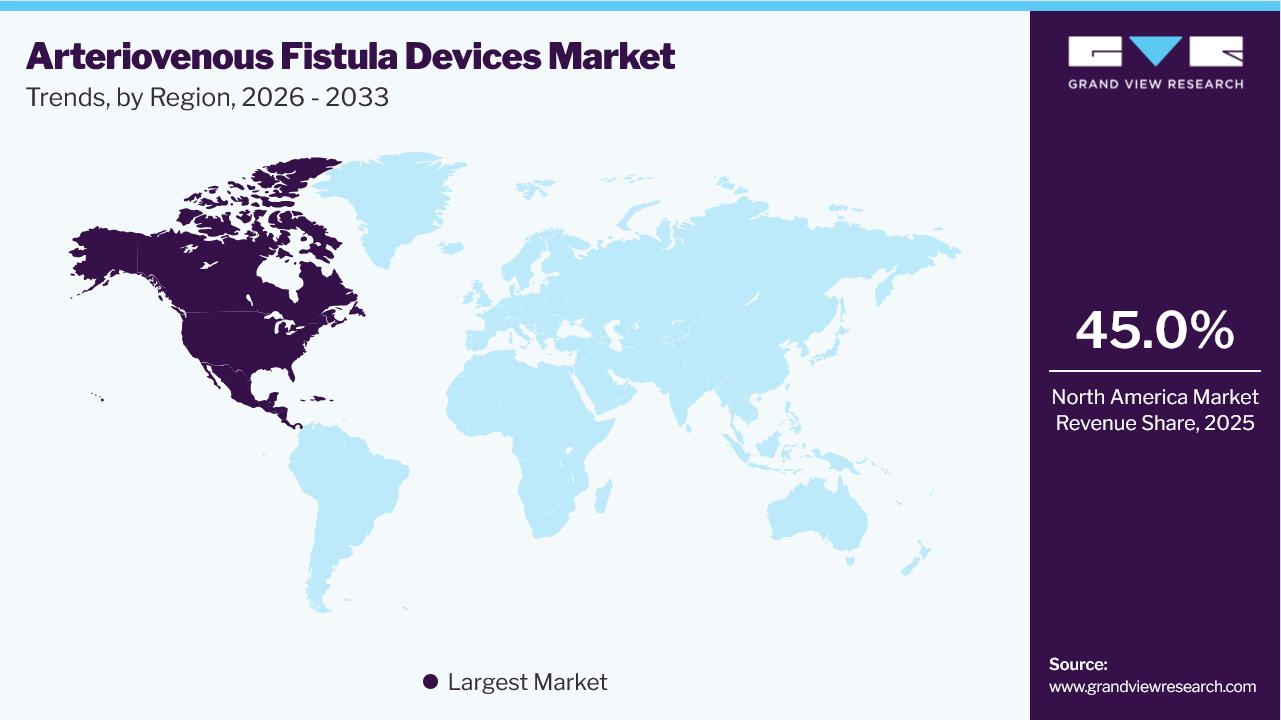
North America dominated the global arteriovenous fistula devices market with the largest revenue share of more than 45.0% in 2025. North America has a significant burden of kidney disease, and AVF devices play a crucial role in providing vascular access for hemodialysis. The rising demand for AVF procedures and the emphasis on improving patient outcomes are driving growth in the regional market. According to the American Kidney Fund, Inc., the prevalence of kidney disease is rapidly increasing, posing a concerning trend. For instance, kidney disease affects more than 15% of American adults, which is equivalent to more than one in seven individuals. In total, approximately 37 million Americans are affected by kidney disease. Moreover, the presence of key players and favorable healthcare policies also contributes to the market growth in North America.
 To learn more about this report, Download Free Sample Report
Asia Pacific Arteriovenous Fistula Devices Market Trends
The arteriovenous fistula devices market in the Asia Pacific is expected to witness at a significant CAGR during the forecast period. This growth is attributed to the increasing prevalence of ESRD and the rising number of individuals requiring hemodialysis treatment. The region has witnessed a significant rise in kidney disease cases, creating a demand for AVF procedures and devices. In addition, the growing healthcare infrastructure and investments in advanced medical technologies, including AVF devices, have improved access to these procedures. Moreover, the focus on enhancing patient outcomes and healthcare quality, along with the presence of key market players and research and development activities, further contribute to the market growth in the region.
Key Arteriovenous Fistula Devices Company Insights
Key players are introducing advanced products at affordable prices to increase their market share and implementing strategic initiatives, such as acquisitions, mergers, and collaborations, to maximize their market dominance.
Key Arteriovenous Fistula Devices Companies
The following key companies have been profiled for this study on the arteriovenous fistula devices market:
-
Medtronic
-
BD
-
Teleflex Incorporated
-
Fresenius Medical Care AG
-
B. Braun SE
-
Polymed
-
NxStage Medical, Inc.
-
Laminate Medical Technologies Ltd.
Recent Development
-
In March 2025, Houston Methodist Hospital launched a groundbreaking clinical trial to improve outcomes for patients who require arteriovenous fistulas (AVFs) for hemodialysis access. The study evaluates innovative approaches to enhance fistula maturation and long-term functionality.
-
In September 2024, XS Innovations secured USD 1.2 million in seed funding to accelerate the development of its Dynamic AVF vascular access device for hemodialysis patients. This investment will support the advancement of XS Innovations’ Dynamic AVF, an innovative vascular access device designed to reduce common complications associated with hemodialysis treatment.
Arteriovenous Fistula Devices Market Report Scope
Report Attribute
Details
Market size in 2025
USD 388.2 million
Estimated market size in 2026
USD 415.4 million
Projected market size by 2033
USD 666.7 million
Growth rate
CAGR of 7.1% from 2026 to 2033
Base year for estimation
2025
Historical data
2021 - 2024
Forecast period
2026 - 2033
Quantitative units
Revenue in USD million/billion, and CAGR from 2026 to 2033
Report coverage
Revenue forecast, company ranking, competitive landscape, growth factors, and trends
Segments covered
Type, end-use, region
Regional scope
North America; Europe; Asia Pacific; Latin America; MEA
Country scope
U.S.; Canada; Germany; UK; France; Italy; Spain; Denmark; Sweden; Norway; China; Japan; India; South Korea; Australia; Thailand; Brazil; Mexico, Argentina; South Africa; Saudi Arabia, UAE; Kuwait
Key companies profiled
Medtronic; BD; Teleflex Incorporated; Fresenius Medical Care AG; B. Braun SE; Polymed; NxStage Medical, Inc.; Laminate Medical Technologies Ltd.
Customization scope
Free report customization (equivalent up to 8 analysts working days) with purchase. Addition or alteration to country, regional & segment scope.
Pricing and purchase options
Avail of customized purchase options to meet your exact research needs. Explore purchase options
Global Arteriovenous Fistula Devices Market Report Segmentation
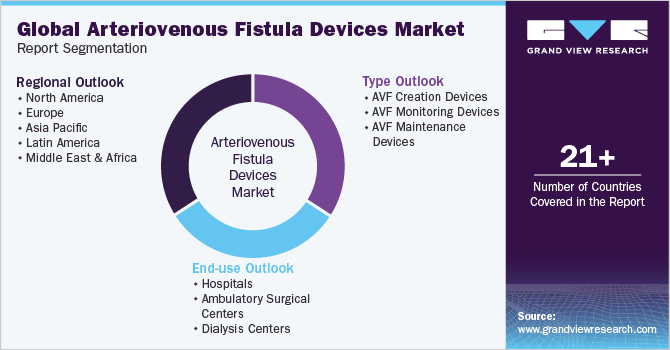
This report forecasts revenue growth at the regional and country levels and provides an analysis of the latest industry trends and opportunities in each of the sub-segments from 2021 to 2033. For this study, Grand View Research has segmented the global arteriovenous fistula devices market report based on type, end-use, and region:
 To learn more about this report, Download Free Sample Report
-
Type Outlook (Revenue, USD Million, 2021 - 2033)
-
AVF Creation Devices
-
Surgical Instruments
-
Vascular Grafts
-
Angioplasty Balloons
-
Others
-
-
AVF Monitoring Devices
-
Doppler Ultrasound
-
Pressure Monitoring Systems
-
Others
-
-
AVF Maintenance Devices
-
Central Venous Catheters
-
Stents
-
Others
-
-
-
End Use Outlook (Revenue, USD Million, 2021 - 2033)
-
Hospitals
-
Ambulatory Surgical Centers
-
Dialysis Centers
-
-
Regional Outlook (Revenue, USD Million, 2021 - 2033)
-
North America
-
U.S.
-
Canada
-
-
Europe
-
UK
-
Germany
-
France
-
Italy
-
Spain
-
Denmark
-
Sweden
-
Norway
-
-
Asia Pacific
-
Japan
-
China
-
India
-
South Korea
-
Australia
-
Thailand
-
-
Latin America
-
Brazil
-
Mexico
-
Argentina
-
-
Middle East & Africa
-
South Africa
-
Saudi Arabia
-
UAE
-
Kuwait
-
-
Frequently Asked Questions About This Report
The global arteriovenous (AV) fistula devices market size was valued at USD 388.2 million in 2025 and is estimated at USD 415.4 million in 2026.
The global arteriovenous fistula devices market is expected to grow at a CAGR of 7.1% from 2026 to 2033 to reaching USD 666.7 million
North America dominated the global market, accounting for the largest revenue share of 45.0% in 2025.
Some key players operating in the arteriovenous fistula devices market include Medtronic, BD, Teleflex Incorporated, Fresenius Medical Care AG & Co. KGaA., B. Braun SE, Polymedicure, NxStage Medical, Inc., Laminate Medical Technologies,
Hospital segment dominated the container security market with a share of 50.0% in 2025, while ambulatory surgical center is the fastest-growing segment.
About the Author(s)
Medical Devices Research Team
Healthcare · Medical DevicesThis report was authored by the medical devices research team at Grand View Research - comprising two research analysts, one senior research analyst, and one industry expert - with specialized expertise in the medical devices segment of the healthcare industry. All findings are based on proprietary healthcare databases, executive interviews, and regulatory analysis, subject to internal peer review prior to publication.
Last Updated:
Speak to Analyst

Customize this report to your needs - add regions, segments, or data points, with 20% free customization.
Or view our licence options:


ISO 9001:2015 & 27001:2022 Certified
We are GDPR and CCPA compliant! Your transaction & personal information is safe and secure. For more details, please read our privacy policy.


