
- Home
- »
- Next Generation Technologies
- »
-
AI Avatar Market Size, Share & Trends Report, 2026-2033GVR Report cover
![AI Avatar Market (2026 - 2033)Report]()
AI Avatar Market (2026 - 2033)
Size, Share & Trends Analysis Report By Platform (Digital Humans, Stylized Avatars), By Application (Virtual Influencers, AI Companions), By Type (Interactive Avatars, Non-Interactive Avatars), By Verticals, By Region, And Segment Forecasts
Market Size, 2025
$808.4MMarket Estimate, 2026
$1,081.2MMarket Forecast, 2033
$7,900.0MCAGR, 2026–2033
32.9%AI Avatar Market Summary
The global AI avatar market size was valued at USD 808.4 million in 2025 and is projected to grow from USD 1,081.2 million in 2026 to USD 7,900.0 million by 2033, at a CAGR of 32.9% from 2026 to 2033. North America dominated the market, accounting for a revenue share of 38.3% in 2025.

Key Market Trends & Insights
- By platform: Digital humans segment dominated the market with a revenue share of 46.6% in 2025.
- By application: Avatar-based online customer service segment held the largest market share of 33.1% in 2025.
- By type: Interactive avatars segment held the largest market share of 68.4% in 2025.
- By verticals: Media & entertainment segment held the largest market share of 20.6% in 2025.
Regional Highlights
- Largest regional market: North America (38.3% revenue share, 2025)
- Fastest-growing regional market: Asia Pacific (highest CAGR, 2026-2033)
- By country: The U.S. held the largest market share in 2025
Market Size & Forecast
- Market size in 2025: USD 808.4 Million
- Estimated market size in 2026: USD 1,081.2 Million
- Projected market size by 2033: USD 7,900.0 Million
- CAGR (2026-2033): 32.9%
Three ways to get this report
Buy it, customize it, or ask a question.Get the Full Report
What the study covers
- FormatsPDF · Excel · Dashboard
- Timeline2026–2033 annual, 2025 base
- Coverage20+ countries, 5 regions
- Companies10+ key players profiled
Customize the Report
20% free customization
- IncludeCountries, segments, points
- TailorTo your product definition
- ExtendDeeper competitor detail
- OrA fully bespoke study
- Turnaround5–10 working days
Ask Prism AI
A cited answer in seconds
- Corpus30K studies, 1.2M points
- ScopeAll markets, not just this
- CitationTraced to report & table
- HonestySays "not covered" if so
- SpeedSeconds, not days
This market expansion is driven by enterprises, which are increasingly integrating these avatars into customer service, sales, education, and healthcare to deliver personalized, always-available interactions. The rapid adoption of generative AI and digital-first customer engagement strategies is driving demand for AI avatars across industries. Organizations are increasingly deploying AI avatars to automate customer interactions, deliver personalized communication, create multilingual content, and enhance employee training while reducing production costs. Advances in large language models, speech synthesis, facial animation, and real-time rendering have significantly improved the realism and scalability of AI avatars. Growing investments in virtual assistants, digital humans, and immersive user experiences across enterprise and consumer applications continue to accelerate market expansion.
The increasing demand for scalable digital content production is creating strong opportunities for AI avatar platforms across marketing, media, and corporate communications. Businesses are using AI avatars to produce videos quickly, maintain consistent brand messaging, and localize content for global audiences without repeated studio recordings. This approach reduces production time and operational expenses while enabling faster campaign execution. As organizations expand their digital outreach, AI avatars are becoming an integral part of content creation and audience engagement strategies.
The growing adoption of AI-powered virtual assistants across customer-facing industries is supporting market expansion. Enterprises are leveraging interactive avatars to provide round-the-clock customer support, simplify complex service interactions, and improve user engagement through natural conversations. Increasing cloud adoption and improvements in AI infrastructure have made avatar deployment more accessible for businesses of all sizes. As companies focus on enhancing customer experience while improving operational efficiency, AI avatars are becoming a valuable enterprise technology.
Market Dynamics
The rapid growth of digital marketing, social media platforms, and online learning has significantly increased the need for high-quality content that can be produced quickly and at scale. AI avatars enable organizations to create professional videos without traditional filming, reducing production time and costs while maintaining consistent messaging across multiple campaigns. Businesses are also expanding their global reach by using AI avatars to localize video content into multiple languages with synchronized voiceovers and realistic lip movements. This capability allows organizations to engage diverse audiences more effectively, improve content accessibility, and accelerate the delivery of personalized communications, making AI avatar platforms an increasingly valuable solution across industries.
Developing highly realistic AI avatars requires significant investment in advanced technologies such as generative AI, computer vision, speech synthesis, motion capture, and real-time rendering. Integrating these capabilities into a seamless platform demands specialized expertise, strong computing infrastructure, and continuous model optimization, increasing both development time and implementation costs. Organizations must also regularly update avatar models to improve accuracy, natural interactions, and compatibility with evolving AI technologies. These challenges can limit adoption, particularly among small and medium-sized enterprises with constrained technology budgets. In addition, integrating AI avatars with existing enterprise systems, ensuring consistent performance across platforms, and maintaining high-quality user experiences add further technical complexity, slowing large-scale deployment in some industries.
Organizations are increasingly seeking personalized, interactive customer experiences, creating significant opportunities for AI-powered digital humans across industries. AI avatars can deliver natural, context-aware conversations, multilingual assistance, and consistent support across digital channels, helping businesses improve customer satisfaction and engagement. Advancements in generative AI, large language models, and real-time speech technologies are enabling digital humans to provide highly customized interactions based on individual user preferences and behaviors. As enterprises continue to prioritize customer experience as a competitive differentiator, the adoption of AI-powered digital humans is expected to expand across retail, banking, healthcare, hospitality, and public services.
Market Concentration & Characteristics
The AI avatar industry demonstrates a very high degree of innovation, driven by rapid advancements in generative AI, large language models, speech synthesis, facial animation, and real-time rendering technologies. Vendors continuously enhance avatar realism, emotional expression, personalization, and multilingual communication capabilities. Ongoing investments in AI research and product development are expected to sustain innovation throughout the forecast period.
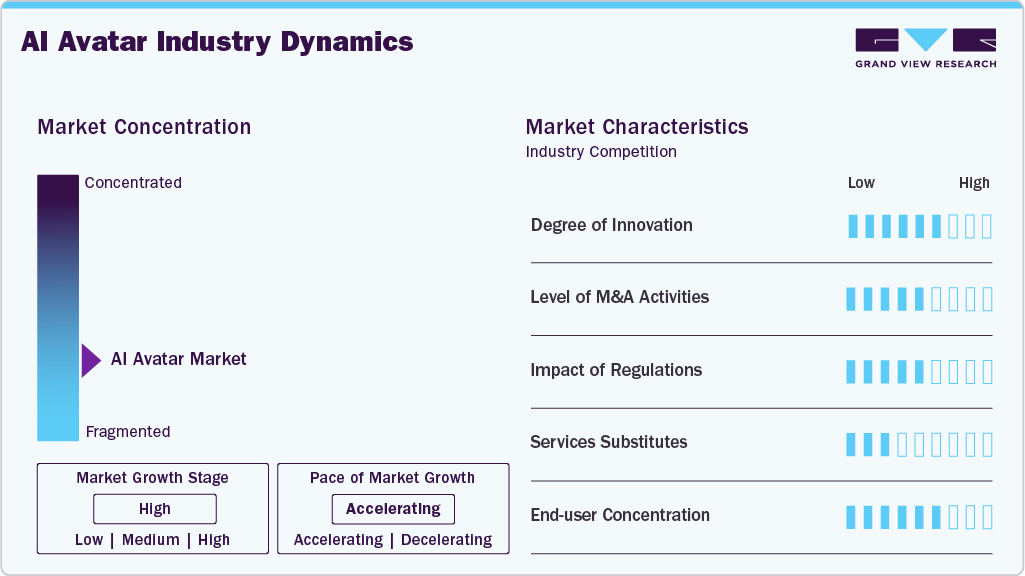
The AI avatar industry faces a relatively low to moderate threat from substitutes, as conventional video production, human presenters, and traditional chatbots cannot fully replicate the scalability, personalization, and interactive capabilities offered by AI avatars. Although these alternatives remain suitable for certain use cases, organizations are increasingly adopting AI avatars to improve efficiency, reduce production costs, and provide continuous digital engagement. This differentiation limits the impact of substitute technologies on long-term market growth.
Analyst Perspective
The AI avatar industry is entering a phase where enterprise adoption is shifting from experimental deployments to business-critical digital engagement, driven by the convergence of generative AI, multimodal models, and real-time conversational intelligence. The strongest competitive advantage is expected to belong to vendors that combine lifelike avatars, natural-language interaction, multilingual communication, and seamless enterprise integration into a single platform. As organizations increasingly prioritize scalable customer engagement, workforce training, content creation, and virtual assistance, AI avatars are evolving from standalone video-generation tools into intelligent digital representatives embedded across business workflows. The long-term value proposition lies in delivering personalized, context-aware interactions that improve user engagement, operational efficiency, and measurable business outcomes across multiple industries.
Platform Insights
The digital humans segment led the market in 2025, accounting for 46.6% of global revenue, driven by growing enterprise demand for realistic virtual assistants that support customer engagement, employee training, and digital communication. Organizations are adopting digital human platforms to provide natural, multilingual, and interactive experiences across customer service, healthcare, banking, education, and retail applications. For instance, in March 2026, D-ID introduced V4 Expressive Visual Agents, an advanced digital human platform designed for real-time conversations powered by large language models and enterprise video creation.
The 3D & metaverse avatars segment is the fastest-growing segment during the forecast period, as organizations expand investments in immersive digital experiences across virtual workplaces, gaming, retail, and education. Enterprises are integrating realistic 3D avatars to improve user interaction, collaboration, and brand engagement within virtual environments. For instance, in August 2025, AVATAi introduced an AI-powered 3D presentation platform, enabling enterprises to create interactive presentations with digital human avatars that combine photorealistic 3D avatars, multilingual communication, and real-time audience interaction.
Application Insights
The avatar-based online customer service segment led the market with the largest revenue share of 33.1% in 2025. The avatar-based online customer service segment is experiencing strong growth as organizations increasingly adopt digital customer engagement solutions to deliver instant, personalized, and multilingual support. Their ability to handle high volumes of customer interactions while maintaining consistent communication. For instance, in July 2026, DS Brand introduced an AI-powered customer service model featuring avatar-based digital interactions to improve customer engagement. It combines conversational AI with virtual human capabilities to deliver personalized assistance, streamline query resolution, and support consistent customer experiences.
The AI companions segment is expected to grow at the fastest CAGR during the forecast period, as consumers increasingly seek personalized, conversational, and emotionally responsive digital interactions across mobile and web platforms. The growing adoption of mental wellness, lifestyle assistance, entertainment, and personal productivity applications. For instance, in November 2025, Genies introduced its AI Companion Talent Creation Tools, enabling celebrities, athletes, and talent organizations to create and manage AI-powered digital identities for personalized fan interactions across entertainment, gaming, and digital platforms.
Type Insights
The interactive avatars segment led the market, with the largest revenue share of 68.4% in 2025, driven by organizations that are increasingly prioritizing real-time, personalized digital interactions across customer service, education, healthcare, and enterprise communication. These avatars enable natural conversations through speech, text, and facial expressions, improving user engagement and service efficiency. For instance, in June 2026, FinTech Studios introduced AI-powered interactive avatars that enable users to engage in natural conversations, automate multi-step workflows, and generate personalized briefings, newsletters, and AI-generated video content from real-time intelligence sources.
The non-interactive avatars segment is growing significantly in the coming years, due to its extensive use in marketing, corporate communications, e-learning, and digital content production. Organizations increasingly adopt pre-rendered AI avatars to create consistent, multilingual videos while reducing production time and operational costs. These avatars enable efficient delivery of training materials, product demonstrations, and brand communications without requiring live presenters. The growing demand for scalable content creation across enterprises continues to support the expansion of this segment.
Verticals Insights
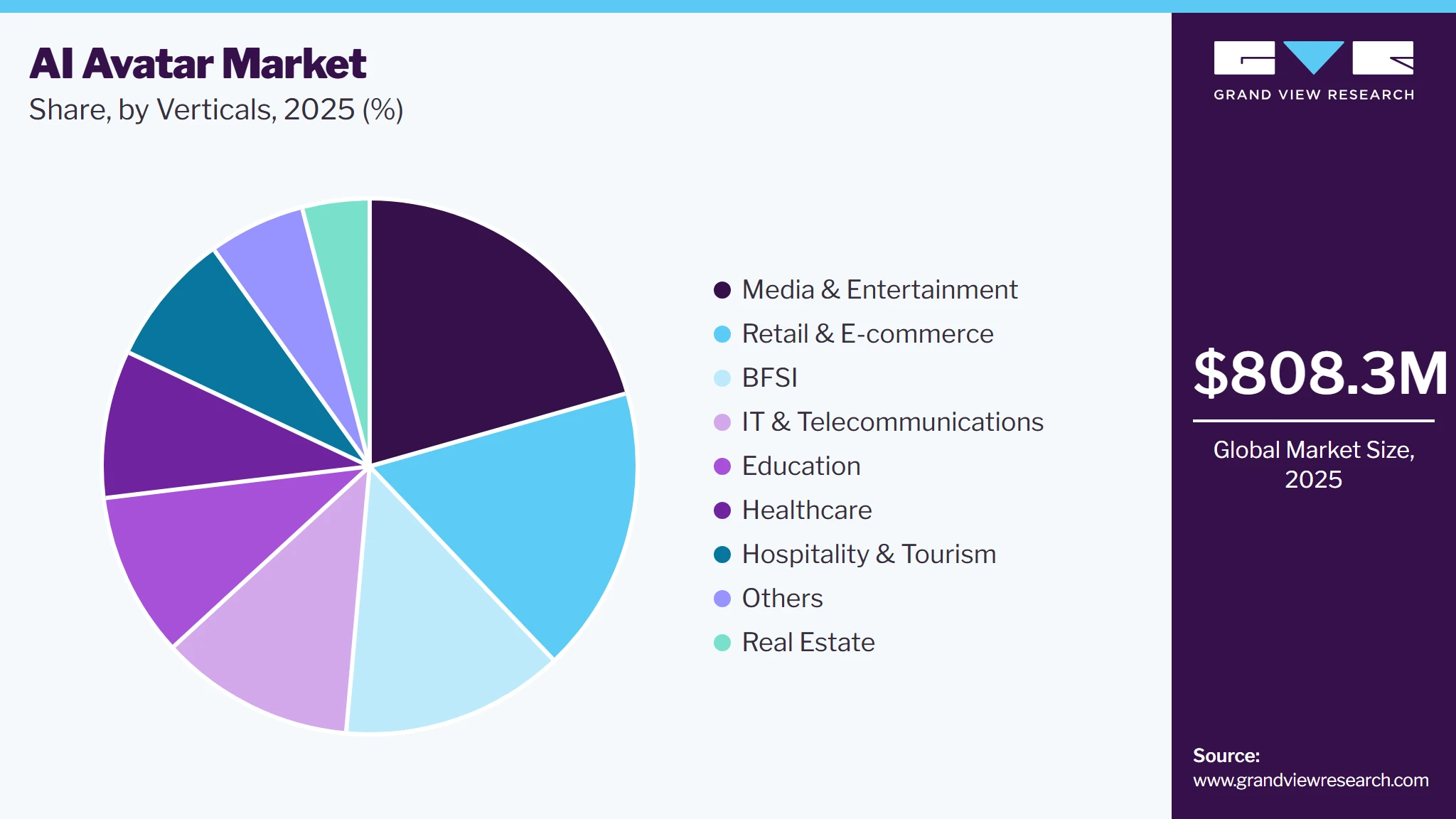
The media & entertainment segment led the market with the largest revenue share of 20.6% in 2025, driven by the growing use of digital humans for content creation, virtual presenters, gaming, advertising, and social media engagement. AI avatars enable studios, broadcasters, and creators to produce high-quality multilingual content with shorter production cycles and lower operational costs. For instance, in August 2025, AKOOL launched its Holographic Avatar Display Series, combining AI avatars with transparent displays for in-person interactions across sectors like retail, healthcare, and education, highlighting the growing use of AI avatars for customer engagement.
The healthcare segment is anticipated to exhibit the fastest CAGR over the forecast period. This segment is driven by healthcare providers adopting digital humans to improve patient communication, virtual consultations, and health education. AI avatars support multilingual interactions, appointment guidance, medication awareness, and post-treatment engagement, enhancing accessibility and patient experience. For instance, in July 2026, Prime Craft Media launched an AI-avatar content engine designed exclusively for healthcare professionals, enabling physicians to create multilingual digital avatars that generate educational and patient-facing content from a single recording session.
Regional Insights
North America dominated the AI avatar market, with the largest revenue share of 38.3% in 2025, driven by widespread enterprise adoption of generative AI in customer service, corporate training, and digital marketing. Strong investments in AI software platforms and cloud infrastructure support the rapid deployment of advanced avatar solutions across industries. The presence of major technology innovators and high spending on digital transformation further accelerates market expansion.

U.S. AI Avatar Market Trends
The AI avatar market in the U.S. held the largest share of North America in 2025. The market is supported by the early commercialization of generative AI technologies and strong adoption across media, entertainment, healthcare, and enterprise communication. Organizations are increasingly integrating AI avatars into business workflows to improve productivity, automate content creation, and enhance customer engagement. Continuous innovation by AI platform providers and technology companies drives frequent product advancements.
Europe AI Avatar Market Trends
The AI avatar market in Europe is driven by increasing adoption of AI-powered multilingual communication solutions across enterprises operating in diverse linguistic markets. Organizations are integrating AI avatars to improve employee training, public services, and customer engagement while maintaining consistent communication across countries. The region's focus on responsible AI development encourages investment in transparent and trustworthy avatar technologies. Rising enterprise digitization across manufacturing, finance, and education supports continued adoption.
Asia Pacific AI Avatar Market Trends
The AI avatar market in the Asia Pacific is anticipated to register the fastest CAGR over the forecast period, due to expanding digital content creation, increasing smartphone penetration, and rising demand for AI-powered creator tools. Businesses across e-commerce, entertainment, and online education are integrating AI avatars to deliver localized, interactive digital experiences to large consumer populations. The rapid expansion of digital economies and growing investments in AI startups contribute to wider technology adoption. Increasing demand for scalable content production continues to drive market growth.
Key AI Avtar Company Insights
Some key players in the market include AKOOL, HeyGen, Synthesia, DeepBrain AI, and others.
-
AKOOL develops AI-powered visual content creation solutions that enable organizations to produce high-quality videos, digital avatars, and interactive media for enterprise and creative applications. Its platform includes AI avatar video generation, streaming avatars, talking avatars, video translation, face swap, text-to-speech, and voice cloning capabilities, supporting use cases across marketing, training, customer engagement, and education. The company also provides AI support agents and holographic avatar solutions for interactive digital experiences. Its technology combines computer vision and generative AI to simplify video production and personalized content creation at scale.
-
Synthesia provides an AI avatar platform that enables organizations to create professional videos using realistic digital presenters without the need for cameras, studios, or production crews. The platform supports multilingual video creation, customizable AI avatars, voice generation, screen recording, and collaborative editing for corporate communications, employee training, sales enablement, and learning content. It offers a library of AI avatars along with custom avatar creation to help organizations maintain consistent digital communication across global audiences. The platform integrates with enterprise workflows to streamline video production while reducing time and production costs.
Key AI Avatar Companies:
The following key companies have been profiled for this study on the AI avatar market
-
AKOOL
-
Colossyan
-
DeepBrain AI
-
D-ID
-
HeyGen
-
Hour One
-
Soul Machines
-
Synthesia
-
Tavus
-
UneeQ
Competitive Benchmarking
Category
Operating Strategies
Competitive Edge
Weakness
Established Players (Synthesia; HeyGen; D-ID; Soul Machines; DeepBrain AI)
Focus on enterprise customers through scalable SaaS platforms and long-term commercial partnerships.
Continuously expand AI avatar capabilities with multilingual support, custom avatars, and workflow integrations.
Strong brand recognition supported by large enterprise customer bases and mature product portfolios.
Advanced AI technologies delivering high-quality avatars with reliable security, compliance, and scalability.
Premium pricing may limit adoption among startups and small businesses.
Large product ecosystems can increase implementation complexity and deployment timelines.
Emerging Players (AKOOL; Colossyan; Tavus; UneeQ; Hour One)
Target niche applications through specialized AI avatar solutions and industry-focused offerings.
Expand market presence through rapid product innovation and strategic technology partnerships.
Agile development enables faster feature releases and greater product customization.
Competitive pricing and flexible deployment options appeal to small and mid-sized enterprises.
Limited global brand visibility and smaller enterprise customer portfolios compared with established vendors.
Lower financial and operational scale may affect expansion into highly regulated and large enterprise markets.
Recent Developments
-
In March 2026, DeepBrain AI introduced Interactive AI Video Agents for enterprise environments, expanding its AI avatar platform to include conversational digital agents that enable real-time interactions across customer service, employee assistance, and business operations. The solution combines generative AI with enterprise knowledge systems to deliver contextual responses and automate routine workflows through natural conversations.
-
In June 2025, HeyGen launched AI Studio, an AI-powered video editor that combines scriptwriting, avatar generation, voice customization, gesture control, scene editing, and collaboration tools in a unified workspace. The platform enables creators and enterprises to produce professional-quality videos with greater creative control, realistic previews, and integrated editing features, supporting faster content production and multilingual video creation.
-
In May 2025, AKOOL partnered with Amazon Web Services (AWS) to showcase a real-time AI avatar experience at AWS Summit India, demonstrating an interactive digital representative integrated with AWS Bedrock and hosted on AWS infrastructure. The AI avatar engaged attendees by answering event- and AWS-related queries using approved language models, natural expressions, and contextual responses.
-
In June 2024, Synthesia introduced an AI avatar of NVIDIA CEO Jensen Huang during his COMPUTEX 2024 keynote, created using its EXPRESS-1 model to deliver highly realistic facial expressions, voice synchronization, and natural gestures. The demonstration highlighted advancements in AI-generated digital humans for enterprise communication and multilingual content creation, showcasing the ability to produce lifelike video presentations with enhanced emotional realism.
AI Avatar Market Report Scope
Report Attribute
Details
Market size value in 2025
USD 808.4 million
Market size value in 2026
USD 1,081.2 million
Revenue forecast in 2033
USD 7,900.0 million
Growth rate
CAGR of 32.9% from 2026 to 2033
Actual data
2021 - 2025
Forecast period
2026 - 2033
Quantitative units
Revenue in USD million/billion and CAGR from 2026 to 2033
Report coverage
Revenue forecast, company ranking, competitive landscape, growth factors, and trends
Segments covered
Platform, application, type, verticals, region
Regional scope
North America; Europe; Asia Pacific; Latin America; MEA
Country scope
U.S.; Canada; Mexico; UK; Germany; France; China; India; Japan; South Korea; Australia; Brazil; Saudi Arabia; South Africa; UAE
Key companies profiled
AKOOL; Colossyan; DeepBrain AI; D-ID; HeyGen; Hour One; Soul Machines; Synthesia; Tavus; UneeQ
Customization scope
Free report customization (equivalent up to 8 analysts working days) with purchase. Addition or alteration to country, regional & segment scope.
Pricing and purchase options
Avail customized purchase options to meet your exact research needs. Explore purchase options
Global AI Avatar Market Report Segmentation
This report forecasts revenue growth at global, regional, and country levels and provides an analysis of the latest industry trends in each of the sub-segments from 2021 to 2033. For this study, Grand View Research has segmented the global AI avatar market report based on platform, type, application, verticals, and region:
-
Platform Outlook (Revenue, USD Million, 2021 - 2033)
-
3D & Metaverse Avatars
-
Digital Humans
-
Stylized Avatars
-
-
Application Outlook (Revenue, USD Million, 2021 - 2033)
-
AI Role-playing
-
Avatar-based Online Customer Service
-
Virtual Influencers
-
AI Companions
-
Others
-
-
Type Outlook (Revenue, USD Million, 2021 - 2033)
-
Interactive Avatars
-
Non-Interactive Avatars
-
-
Verticals Outlook (Revenue, USD Million, 2021 - 2033)
-
BFSI
-
Retail & E-commerce
-
IT & Telecommunication
-
Healthcare
-
Real Estate
-
Media & Entertainment
-
Hospitality & Tourism
-
Education
-
Others
-
-
Regional Outlook (Revenue, USD Million, 2021 - 2033)
-
North America
-
U.S.
-
Canada
-
Mexico
-
-
Europe
-
UK
-
Germany
-
France
-
-
Asia Pacific
-
China
-
India
-
Japan
-
Australia
-
South Korea
-
-
Latin America
-
Brazil
-
-
MEA
-
UAE
-
South Africa
-
KSA
-
-
Research Methodology
The AI avatar market figures in this report are based on a proven research process that combines executive interviews with secondary research from proprietary databases, company filings, and recognized regulatory and institutional sources. Market size is built through value-chain sizing-reconciling supply-side and demand-side estimates-and triangulated with bottom-up and top-down approaches. Every estimate passes multiple levels of expert validation before publication, with each AI avatar segment quantified using the revenue-capture definitions in the table below.
Segment Definition
Segment - Platform
Revenue capture definition
Digital Humans
Revenue is captured from AI avatars designed for realistic human interactions across customer service, healthcare, education, and enterprise communications. This segment includes subscription, licensing, and deployment revenue from conversational digital human platforms.
3D & Metaverse Avatars
Revenue is generated through platforms that create customizable 3D avatars for virtual worlds, gaming, AR/VR environments, and immersive enterprise applications. It includes software licensing, avatar creation tools, and integration services.
Stylized Avatars
Revenue is derived from cartoon, anime, artistic, and brand-specific avatar solutions used in social media, marketing, entertainment, and digital content creation. The segment includes income from avatar generation platforms, creative tools, and premium customization features.
Segment - Application
Revenue capture definition
Avatar-based Online Customer Service
Revenue is generated from AI avatars deployed for customer support, virtual reception, service inquiries, and automated assistance across websites, mobile applications, and digital service platforms.
AI Role-playing
This segment captures revenue from AI avatars used for employee training, simulation-based learning, interview preparation, sales coaching, and educational role-playing environments.
Virtual Influencers
Revenue includes AI avatars created for digital marketing, social media campaigns, brand endorsements, live streaming, and audience engagement across online platforms.
AI Companions
This segment comprises revenue from AI avatars designed for personal interaction, emotional support, conversational engagement, wellness applications, and lifestyle assistance.
Others
Revenue covers AI avatar applications in virtual events, gaming, public services, tourism, digital museums, research projects, and industry-specific use cases beyond the primary application categories.
Segment - Type
Revenue capture definition
Interactive Avatars
Revenue is generated from AI avatars capable of real-time conversations, dynamic responses, and personalized interactions across customer service, healthcare, education, and enterprise applications. Demand is supported by the increasing deployment of conversational AI and digital human platforms.
Non-Interactive Avatars
Revenue is derived from AI avatars used for pre-recorded videos, presentations, marketing campaigns, training content, and corporate communications. Growth is supported by the rising adoption of automated video production and scalable digital content creation.
Segment - Verticals
Revenue capture definition
Retail & E-commerce
Revenue is generated from AI avatars used for virtual shopping assistants, product demonstrations, personalized recommendations, and customer support. Adoption is increasing as retailers focus on interactive and digital-first shopping experiences.
Real Estate
This segment captures revenue from AI avatars supporting virtual property tours, buyer inquiries, and real estate consultations. Digital engagement tools help agencies improve communication and property marketing efficiency.
Hospitality & Tourism
Revenue is driven by AI avatars providing virtual concierge services, travel assistance, booking support, and multilingual guest interactions. Hotels and tourism providers use these solutions to enhance customer service and visitor engagement.
Media & Entertainment
This segment generates revenue through AI avatars used in digital content creation, virtual presenters, gaming, advertising, and social media production. Growing demand for scalable video content supports adoption across entertainment platforms.
Education
Revenue includes AI avatars deployed for virtual instructors, interactive learning modules, and educational content delivery. Institutions use these solutions to improve learner engagement and expand access to digital education.
Healthcare
This segment captures revenue from AI avatars supporting patient communication, virtual consultations, health education, and appointment assistance. Healthcare providers adopt these solutions to improve accessibility and service efficiency.
BFSI
Revenue is derived from AI avatars used for customer onboarding, financial guidance, virtual banking assistants, and insurance support services. Financial institutions integrate these solutions to enhance digital customer interactions.
IT & Telecommunications
This segment includes revenue from AI avatars used for technical support, employee training, customer assistance, and service management. Technology providers utilize AI avatars to streamline communication across digital platforms.
Others
Revenue covers applications across government, manufacturing, legal services, and other industries using AI avatars for public engagement, internal communication, and information delivery. Expanding enterprise AI adoption continues to broaden application areas.
Estimation Model
Layer Name
Key Questions
Description
Enterprise Adoption Layer
Who uses AI avatars?
Estimate the addressable enterprise and consumer organizations adopting AI avatars across industries such as media, retail, healthcare, education, BFSI, IT, and hospitality. This establishes the potential customer base for AI avatar solutions.
Deployment Layer
How many AI avatar deployments occur?
Apply AI adoption rates and digital transformation spending to estimate the number of organizations deploying AI avatars for customer engagement, content creation, virtual assistants, employee training, and digital communication. This converts the addressable user base into active AI avatar implementations.
Application Layer
Where are AI avatars used?
Measure the distribution of AI avatar deployments across key applications, including marketing, customer service, education, healthcare, enterprise communication, virtual influencers, and entertainment. This reflects the penetration of AI avatar technology across different end-use scenarios.
Monetization Layer
How much revenue is generated?
Apply the average annual spending per deployment, considering software subscriptions, enterprise licensing, custom avatar development, API usage, implementation services, and support contracts, to estimate total market revenue.
Customization TableThis report has been delivered with the following In-depth customizations
CLIENT REQUEST
CUSTOMIZATION DELIVERED
VALUE ADDS
Market Entry & Expansion Assessment
• Regional demand sizing and forecasting
• Customer segmentation and buying behavior analysis
• Competitive landscape benchmarking
• Regulatory and distribution channel assessment
• Identified high-growth market opportunities
• Supported go-to-market strategy development
• Highlighted investment priorities and risks
• Enabled data-driven expansion planning
Technology & Innovation Assessment
• Emerging technology trend analysis
• Innovation pipeline
• Technology adoption readiness assessment
• Ecosystem and partnership mapping
• Identified future growth areas
• Supported innovation roadmap planning
• Evaluated commercialization potential
• Strengthened strategic partnership decisions
Customer & End-User Insights Study
• Consumer awareness and adoption analysis
• Purchase decision journey mapping
• Satisfaction and loyalty assessment
• Usage pattern and pain-point evaluation
• Revealed key adoption drivers and barriers
• Supported customer-centric product development
• Improved targeting and engagement strategy
• Identified opportunities for retention and upselling
Frequently Asked Questions About This Report
The global AI Avatar market size was estimated at USD 808.4 million in 2025 and is projected to grow from USD 1,081.2 million in 2026
The global AI Avatar market is expected to grow at a compound annual growth rate of 32.9% from 2026 to 2033 to reach USD 7,900.0 million by 2033
North America dominated the AI Avatar market with a share of 38.3% in 2025, due to widespread enterprise adoption of generative AI across customer service, corporate training, and digital marketing.
Asia Pacific is the fastest-growing region over the forecast period.
Avatar-based online customer service held the largest revenue share of 33.1% in 2025, while AI Companions is the fastest growing segment.
Digital Humans held the largest revenue share of 46.6% in 2025, while 3D & Metaverse Avatars is the fastest growing segment.
This market expansion is driven by enterprises, which are increasingly integrating these avatars into customer service, sales, education, and healthcare to deliver personalized, always-available interactions.
Key players include AKOOL; Colossyan; DeepBrain AI; D-ID; HeyGen; Hour One; Soul Machines; Synthesia; Tavus; UneeQ
The Interactive Avatars segment led with a 68.4% revenue share in 2025, while Non-Interactive Avatars is the significant growing segment.
About the Author(s)
Next Generation Technologies Research Team
Technology · Next Generation TechnologiesThis report was authored by the next generation technologies research team at Grand View Research - comprising two research analysts, one senior research analyst, and one industry expert - with specialized expertise in the next generation technologies segment of the technology industry. All findings are based on proprietary technology databases, executive interviews, and regulatory analysis, subject to internal peer review prior to publication.
Last Updated:
Speak to Analyst


Customize this report to your needs - add regions, segments, or data points, with 20% free customization.
Or view our licence options:


ISO 9001:2015 & 27001:2022 Certified
We are GDPR and CCPA compliant! Your transaction & personal information is safe and secure. For more details, please read our privacy policy.


