
- Home
- »
- Digital Media
- »
-
Gaming Market Size, Share & Trends Report, 2026-2033GVR Report cover
![Gaming Market (2026 - 2033)Report]()
Gaming Market (2026 - 2033)
Size, Share & Trends Analysis Report By Device (Console, Mobile, Computer), By Type (Online, Offline), By Region (North America, Europe, Asia Pacific, Latin America, Middle East & Africa), And Segment Forecasts
Market Size, 2025
$334.9BMarket Estimate, 2026
$374.8BMarket Forecast, 2033
$752.0BCAGR, 2026–2033
10.5%Gaming Market Summary
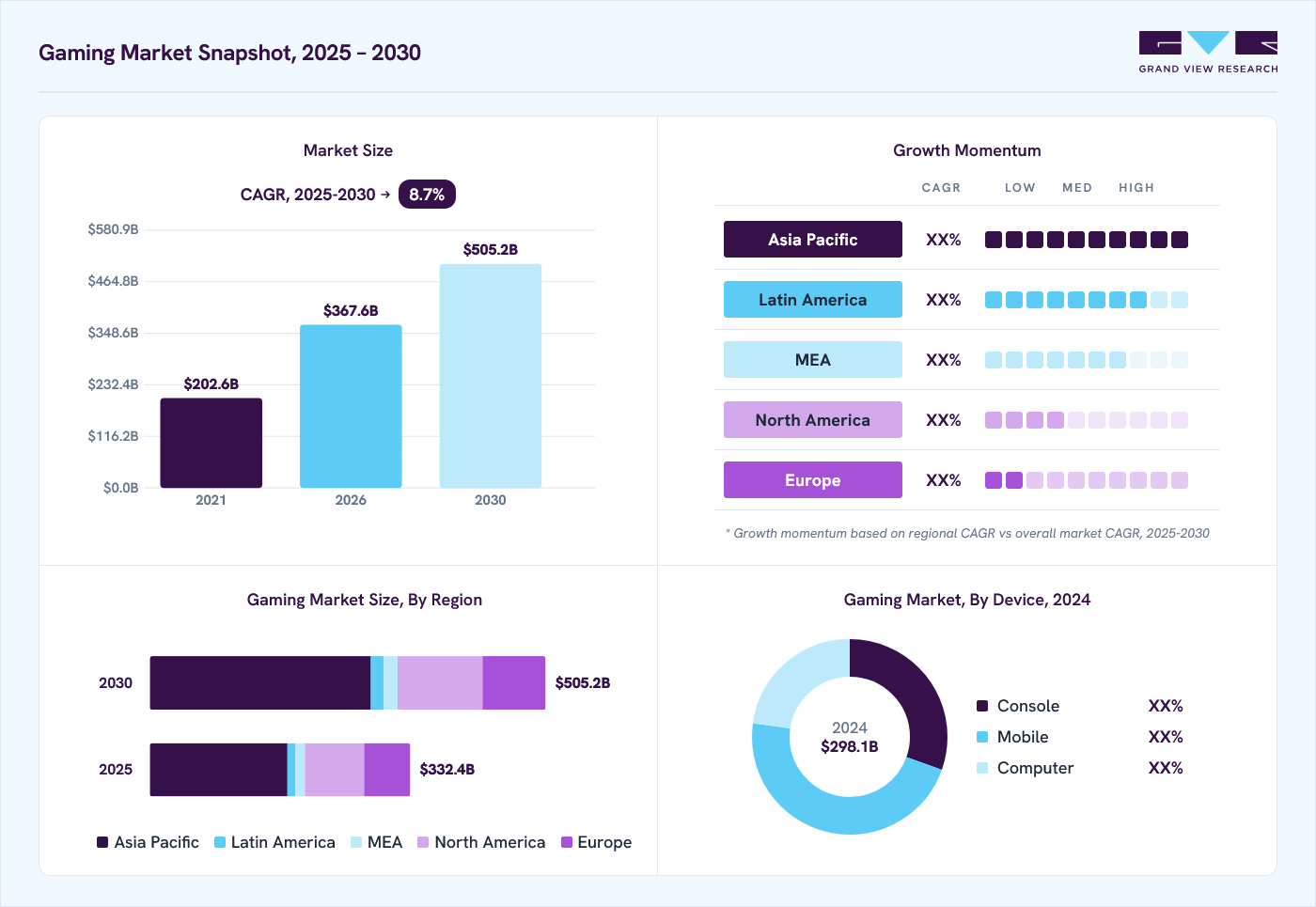
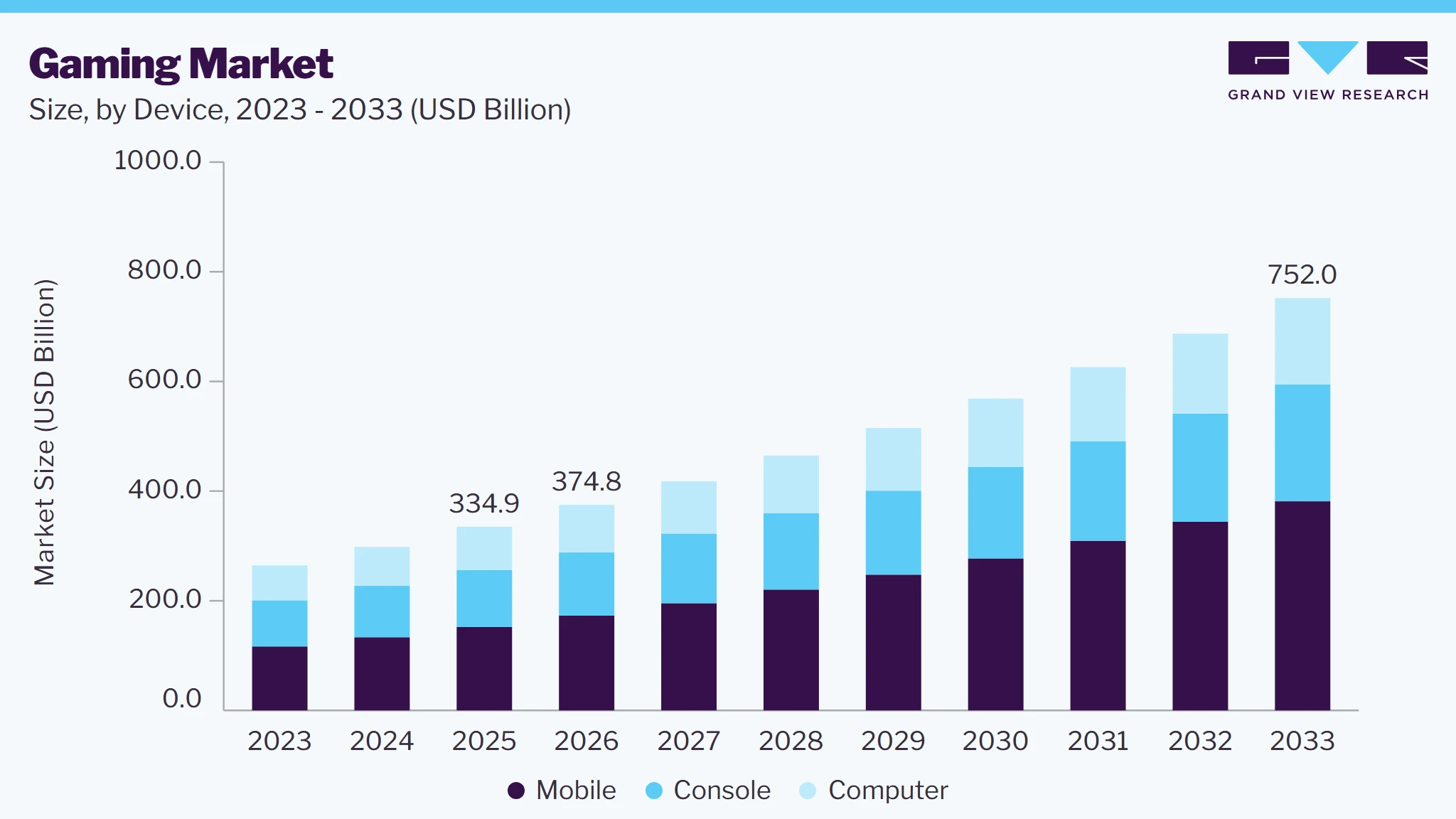
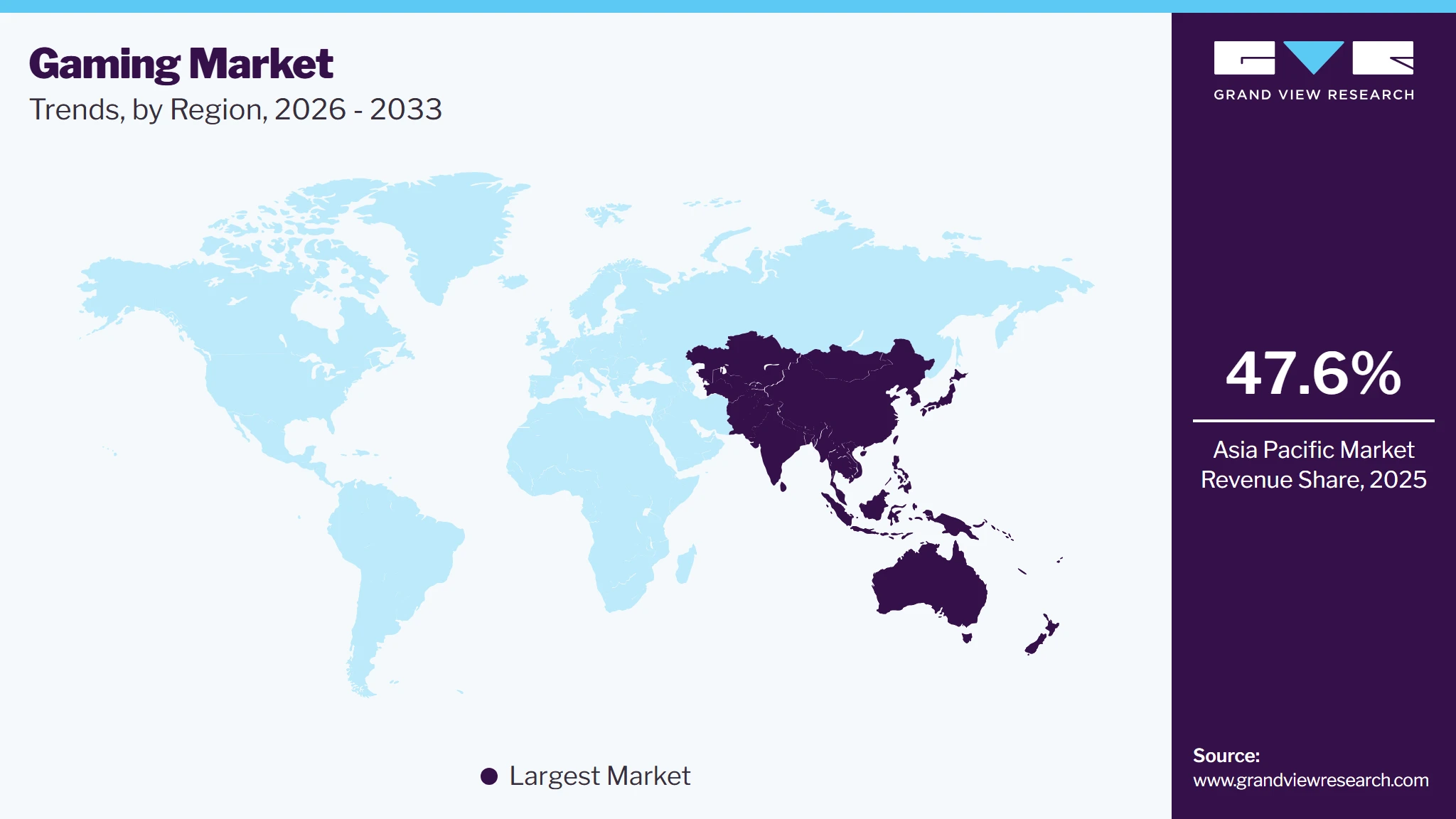
The global gaming market size was valued at USD 334.9 billion in 2025 and is projected to grow from USD 374.8 billion in 2026 to USD 752.0 billion by 2033, at a CAGR of 10.5% from 2026 to 2033. Asia Pacific dominated the market, accounting for a revenue share of 47.6% in 2025. The gaming market is driven by the rapid expansion of high-speed internet connectivity, the widespread deployment of 5G networks, and high-quality game streaming.
Key Market Trends & Insights
- By device: The mobile segment dominated the market, with a share of 45.4% in 2025.
- By type: The offline segment accounted for the largest market share of 58.6% in 2025.
Regional Highlights
- Largest regional market: Asia Pacific (47.6% revenue share in 2025)
- Fastest growing regional market: Asia Pacific (highest CAGR 12.1%, 2026-2033)
- By Country: The U.S. held the largest market share in 2025
Market Size & Forecast
- Market size in 2025: USD 334.9 Billion
- Estimated market size in 2026: USD 374.8 Billion
- Projected market size by 2033: USD 752.0 Billion
- CAGR (2026-2033): 10.5%
Rising investments by technology companies, game publishers, and telecom operators in digital gaming ecosystems are driving market expansion by improving accessibility, scalability, and content availability across multiple devices. The growing popularity of esports tournaments, live-streaming platforms, and creator-driven gaming communities is significantly increasing user engagement and monetization opportunities in the gaming market.
The industry is being transformed by subscription-based models, digital distribution platforms, blockchain technology for in-game assets, and AI-driven innovations, with a more diverse demographic of gamers driving demand, which is expected to present lucrative opportunities for the gaming industry in the coming years.
AI and machine learning are playing an increasingly important role in game development. AI is being used to enhance game design, with procedural content generation, adaptive difficulty levels, and intelligent NPC behaviors improving the overall player experience. In addition, AI-driven personalization allows games to adapt to individual players' preferences, creating more engaging and customized experiences. As AI technology continues to evolve, its application in gaming will likely expand, making games more dynamic, intelligent, and responsive to players' actions.
In addition, the rise of virtual reality (VR) and augmented reality (AR) in gaming is another significant trend. With the advancement of VR headsets like Oculus Rift and PlayStation VR, immersive gaming experiences are becoming more mainstream. AR games, such as "Pokemon GO," have also demonstrated the potential of blending the digital and physical worlds. As these technologies improve, they promise to transform how players interact with games, offering more immersive and interactive experiences that were previously unimaginable.
Furthermore, esports has also become a dominant force in the gaming industry, with a rapidly growing audience and increasing investment from major corporations and sponsors. Esports tournaments, such as the "League of Legends World Championship" and "The International" for Dota 2, attract billions of viewers globally. This has led to the rise of esports organizations, professional players, and influencers, driving new revenue streams through advertising, sponsorships, and media rights. The popularity of live-streaming platforms like Twitch and YouTube Gaming has further amplified the esports ecosystem, creating a dynamic environment for both players and fans.
Moreover, increasing mobile internet penetration, especially in emerging markets, has led to a growing demand for mobile games. Mobile gaming needs to adapt to the unique requirements of mobile platforms, including performance optimization, touch controls, and diverse device capabilities. Game engines that provide cross-platform development capabilities, allowing for games to be developed for both mobile and desktop platforms, are becoming increasingly popular in the gaming industry.
Market Dynamics
The gaming market is witnessing substantial growth driven by advancements in game development technologies, artificial intelligence, cloud computing, graphics processing capabilities, and immersive technologies such as virtual reality (VR) and augmented reality (AR). The growing demand for interactive digital entertainment, increasing penetration of smartphones and high-speed internet connectivity, and the rising popularity of online multiplayer and cross-platform gaming experiences are accelerating market expansion. The continued growth of esports, game streaming platforms, and creator-driven gaming communities is further strengthening user engagement and expanding monetization opportunities across the gaming ecosystem.
The increasing popularity of online multiplayer games is a primary driver supporting the expansion of the Gaming Market. Players are increasingly seeking interactive experiences that enable real-time competition, collaboration, and social engagement across global communities. Popular genres such as battle royale, role-playing, sports simulation, and tactical shooter games continue to attract large user bases, encouraging publishers to invest heavily in new content, live events, and community-building features that enhance player retention.
The widespread availability of high-speed internet, advanced gaming hardware, and cross-platform compatibility has significantly improved accessibility to multiplayer experiences. Additionally, the growing influence of esports tournaments, game streaming platforms, and gaming influencers is expanding audience participation and increasing consumer spending on digital content. These factors are encouraging developers to adopt live-service models, generating recurring revenue through subscriptions, downloadable content, and in-game purchases.
Increasing regulatory attention toward in-game monetization practices is emerging as a significant challenge for market participants. Governments and consumer protection authorities across various countries are examining mechanisms such as loot boxes, randomized rewards, and microtransactions due to concerns regarding transparency and consumer spending behavior. Compliance with evolving regulations often requires publishers to modify monetization systems, adjust game designs, and implement additional disclosure measures.
The regulatory landscape becomes more complex as gaming companies operate across multiple jurisdictions with varying legal requirements. Restrictions on digital purchases, age-verification measures, data privacy obligations, and content-moderation standards can increase operational costs and delay product launches. Such compliance challenges may reduce publishers' monetization flexibility, particularly for free-to-play titles that rely heavily on recurring digital purchases as a key revenue source.
The increasing integration of artificial intelligence into game development presents a significant opportunity for market participants. AI technologies are enabling developers to create more adaptive gameplay environments, intelligent non-player characters, personalized storylines, and dynamic content generation. These capabilities enhance player engagement by delivering customized experiences that respond to individual play styles, skill levels, and behavioral patterns, improving overall user satisfaction.
Artificial intelligence is also transforming game production processes by accelerating content creation, quality assurance testing, animation development, and player analytics. Developers can leverage AI-powered tools to reduce production timelines while continuously optimizing gameplay experiences after launch. As gaming companies increasingly invest in AI-driven innovation, the technology is expected to support the creation of more immersive, scalable, and personalized entertainment experiences across console, PC, mobile, and cloud gaming platforms.
Market Concentration & Characteristics
The gaming market is moderately fragmented, comprising global game publishers, console manufacturers, mobile game developers, PC gaming companies, digital distribution platforms, esports organizations, cloud gaming providers, and independent game studios. The market is expanding due to increasing consumer demand for interactive digital entertainment, rising adoption of online multiplayer gaming experiences, and growing spending on digital content, subscriptions, and in-game purchases. Strategic collaborations among game developers, technology companies, and content creators are becoming increasingly common as organizations seek to enhance player engagement and strengthen monetization capabilities. Continuous advancements in game development technologies, artificial intelligence, graphics engines, cloud infrastructure, and immersive gaming experiences are emerging as key competitive strategies across the market.
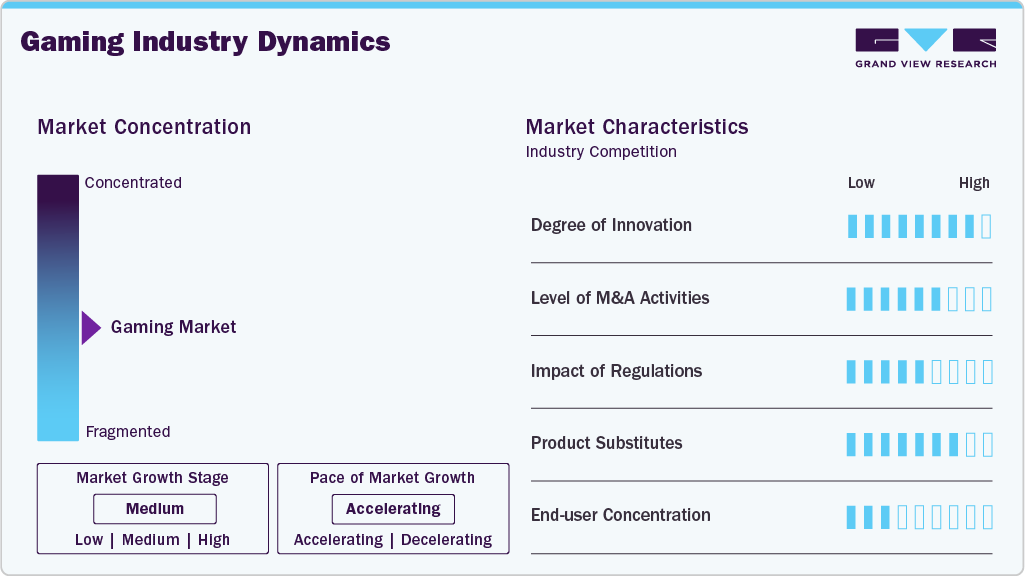
The market is characterized by a very high level of innovation, driven by ongoing developments in artificial intelligence-powered gameplay, virtual reality (VR), augmented reality (AR), advanced game engines, procedural content generation, and cross-platform gaming ecosystems. The industry is witnessing moderate merger and acquisition activity as companies seek to acquire valuable intellectual property, strengthen development capabilities, expand game portfolios, and increase their presence across high-growth gaming segments. Competition from alternative digital entertainment platforms, including video streaming services, social media applications, short-form content platforms, and other interactive media experiences, remains significant as consumers have numerous options for leisure and entertainment spending. Increasing investments in esports infrastructure, live-service gaming models, cloud-enabled gaming technologies, creator-driven content ecosystems, and next-generation gaming platforms are expected to further strengthen the competitive landscape.
Analyst Perspective
The gaming market is experiencing substantial expansion, driven by rising demand for interactive digital entertainment, ongoing advances in game development technologies, and the growing popularity of online multiplayer experiences. The ongoing investments in advanced game engines, artificial intelligence-powered development tools, immersive technologies, and next-generation gaming platforms are enabling developers to deliver more engaging and personalized gaming experiences. The rapid growth of esports, game streaming platforms, creator-driven communities, and cross-platform gaming environments is further enhancing user engagement and monetization opportunities. As internet connectivity, digital payment infrastructure, and gaming accessibility continue to improve worldwide, gaming companies are increasingly positioned to attract diverse player demographics, reinforcing long-term adoption and sustained revenue generation across the broader digital entertainment landscape.
Device Insights
Based on device, the mobile segment led the market with the largest revenue share of 45.4% in 2025 and is expected to grow at the highest CAGR over the forecast period. This surge is fueled by the widespread adoption of smartphones and tablets, coupled with advancements in mobile internet connectivity, particularly 5G technology. The convenience of gaming on the go, combined with a diverse range of game genres catering to various demographics, has made mobile gaming increasingly popular. Furthermore, innovations in game development, such as cloud gaming and cross-platform play, are enhancing the mobile gaming experience and driving user engagement.
The console segment is projected to register a significant CAGR of over 7.5% from 2025 to 2030, primarily driven by the increasing demand for high-quality gaming experiences and exclusive titles. Innovations in hardware, such as enhanced graphics and processing capabilities, are attracting both casual and hardcore gamers. In addition, the rise of online multiplayer games and subscription services such as Xbox Game Pass and PlayStation Plus are expanding the consumer base and encouraging more frequent gaming. The integration of virtual reality (VR) and augmented reality (AR) technologies is also anticipated to enhance user engagement and expand the market in the coming years.
Type Insights
Based on type, the offline segment dominated the market with the largest revenue share of 58.6% in 2025. The segment benefits from a loyal customer base that appreciates single-player experiences or local multiplayer games without the need for an internet connection. The offline market is expected to evolve through innovations in game design that enhance replay ability and user engagement. Furthermore, physical game sales remain significant in regions with limited internet access or where online payment systems are less prevalent.
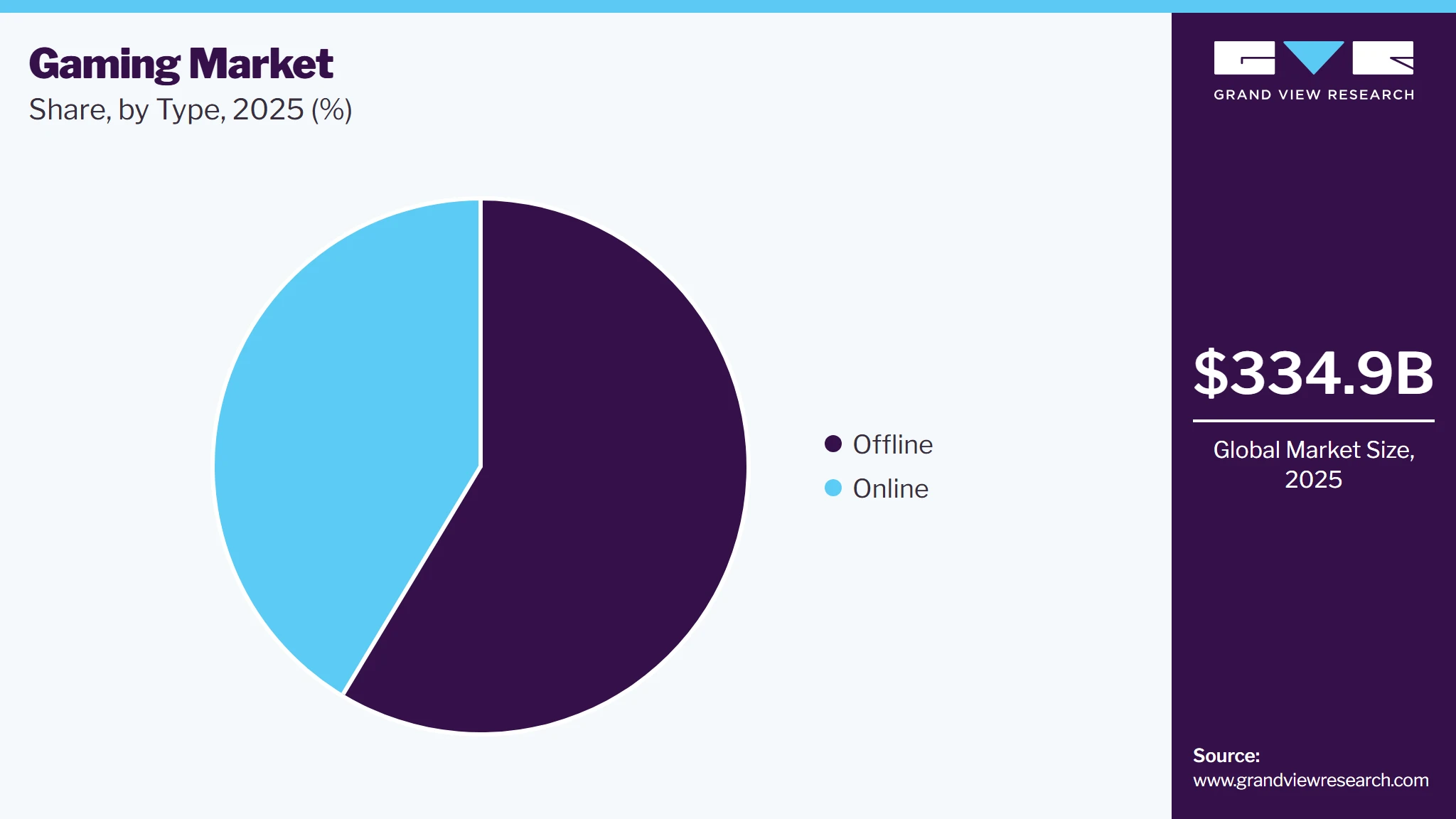
The online segment is anticipated to record the fastest CAGR from 2025 to 2030. This growth is largely attributed to increased internet penetration and the popularity of multiplayer online games. The rise of streaming services and social gaming platforms has also transformed how players interact with games, making online gaming more social and engaging. In addition, advancements in AR and VR technologies are creating immersive online experiences that attract a broader audience.
Regional Insights
North America gaming market globally with a revenue share of 23% in 2024. This expansion is driven by several key factors, including the increased affordability of gaming devices, technological advancements, and the rising popularity of mobile and free-to-play games. The region has seen a surge in mobile gaming, supported by high smartphone penetration and the rollout of 5G technology, which enhances the gaming experience with faster data speeds and lower latency. Major players in the industry are continuously innovating to capture market share, while the growing interest in e-sports is attracting new audiences and investments. In addition, startups are emerging with fresh ideas and platforms that further influence the market landscape. Overall, North America's robust economic foundation and diverse gaming ecosystem position it as a leader in the global gaming industry.
U.S. Gaming Market Trends
The U.S. gaming market held a dominant position in the North America region in 2024. The gaming industry in the U.S. is expected to grow rapidly, driven by the increasing adoption of mobile gaming, cloud gaming services, and the rise of e-sports. The COVID-19 pandemic significantly boosted engagement in immersive gaming experiences, while major companies such as Microsoft Corporation and Electronic Arts, Inc. are expanding their mobile gaming portfolios and launching new consoles.
Europe Gaming Market Trends
The Europe gaming market is expected to grow at a considerable CAGR of over 6% from 2025 to 2030. The region's growth is driven by several factors, including technological advancements, increasing internet penetration, and a strong preference for online gaming experiences. Mobile gaming is becoming increasingly popular due to widespread smartphone adoption. The rise of e-sports has also transformed the landscape, creating new revenue streams through sponsorships and tournaments that engage billions of fans.
The UK gaming market is expected to grow rapidly in the coming years. The growth of this market is driven by its strong digital infrastructure and a vibrant community of developers and gamers. Mobile gaming has emerged as a significant growth driver in recent years, supported by government initiatives like Video Games Tax Relief that enhance access to finance for developers. These measures encourage innovation within the industry while fostering a skilled workforce through educational programs aimed at developing talent in game design and programming.
The Germany gaming market held a substantial market share in 2024. Germany's government has significantly increased its investment in the industry to support startups and mid-sized developers through grants and funding initiatives aimed at fostering innovation. This support has led to a flourishing ecosystem where creativity can thrive. Console gaming remains particularly popular due to high per capita income levels and a well-developed economy that facilitates access to premium gaming experiences. These factors are expected to drive market growth in the coming years.
Asia Pacific Gaming Market Trends
Asia Pacific dominated the gaming market with the largest revenue share of 47.6% in 2025. This growth is primarily driven by the increasing popularity of mobile gaming, which accounts for a significant portion of revenue due to high smartphone penetration rates across countries like China, Japan, and India. The rise of online multiplayer games and e-sports has also contributed to this trend as competitive gaming gains traction among younger demographics.
China Gaming Market Trends
The gaming market in China held the largest share in the Asia Pacific region in 2025.
The Japan gaming market is expected to grow rapidly in the coming years. The gaming industry in Japan is driven by a combination of factors, including rising home improvement projects, growing adoption of smart homes, rapid developments in IT and wireless communication, and growing advancements in technologies such as artificial intelligence (AI) and the Internet of Things (IoT).
The gaming market in China is primarily driven by the dominance of mobile gaming in the country. With more than 70 billion gamers in the country, the user base is rapidly expanding, particularly among younger demographics who favor mobile and social gaming experiences. The rise of eSports has further propelled the gaming industry, with major tournaments and streaming platforms gaining immense popularity. Chinese game developers are thriving domestically and are also making significant inroads into international markets.
Key Gaming Company Insights
Some of the key players operating in the gaming industry include Sony Group Corporation and Microsoft Corporation, among others.
-
Sony Group Corporation is a multinational conglomerate that offers a diverse range of products and services, including electronics, gaming, entertainment, and financial services. In the gaming peripheral market, Sony has made a name for itself with its PlayStation gaming consoles and accessories. PlayStation is a line of gaming consoles developed and owned by Sony. The first PlayStation console was released in 1994, and since then, Sony has released several iterations of the console, including the PlayStation 2, PlayStation 3, PlayStation 4, and the latest PlayStation 5.
-
Microsoft Corporation is a multinational technology company that offers a wide range of software, hardware, and gaming-related products and services. In the gaming peripheral market, Microsoft Corporation has made a name for itself with its Xbox gaming consoles and accessories. Xbox is a line of gaming consoles developed and owned by Microsoft Corporation. The first Xbox console was released in 2001, and since then, Microsoft Corporation has released several iterations of the console, including the Xbox 360, Xbox One, and the latest Xbox Series X/S.
Some of the emerging market players in the gaming industry include Rovio Entertainment Corporation and Tencent Holdings, Ltd., among others.
-
Rovio Entertainment Ltd is a mobile games company known for its iconic Angry Birds franchise, which has achieved over 5 billion downloads worldwide. The company focuses on creating player-centric gaming experiences that foster joy and imagination while also expanding its brand into animations and consumer products. The company operates multiple studios across Europe and Canada, emphasizing sustainability and a commitment to diversity, equity, and inclusion within its workforce.
-
Tencent Holdings, Ltd. is a global technology conglomerate known for its diverse range of internet-related services and products. The company connects over one billion users worldwide through its popular communication platforms, including WeChat and QQ, which facilitate messaging, social networking, and various digital services. The company is also recognized as the world's largest video game vendor by revenue, with a portfolio that includes both in-house developed games and stakes in numerous gaming companies.
Key Gaming Companies:
The following key companies have been profiled for this study on the gaming market.
- Activison Blizzard, Inc.
- Apple, Inc.
- The Walt Disney Company
- Electronic Arts, Inc.
- Microsoft Corporation
- Nintendo Co., Ltd
- Rovio Entertainment Corporation
- Sega Enterprises, Inc.
- Sony Corporation
- Tencent Holdings Ltd
Competitive Benchmarking
Category
Operating Strategies
Competitive Edge
Weakness
Established Players (Sony Group Corporation, Apple, Inc., Microsoft Corporation)
- Focus on expanding multi-platform gaming ecosystems through content, technology, and distribution partnerships.
- Invest heavily in game development, live-service operations, esports, and digital platforms.
- Strong global brand recognition, extensive game portfolios, and large player communities.
- Ability to deliver premium gaming experiences supported by advanced development capabilities.
- Dependence on established franchises can limit flexibility in emerging gaming trends.
- Large organizational structures may slow content innovation and market responsiveness.
Emerging Players (Rovio Entertainment Corporation, Tencent Holdings, Ltd.)
- Focus on developing innovative gaming concepts targeting niche player communities.
- Invest in mobile-first titles, AI tools, and digital distribution channels.
- Ability to rapidly adapt gameplay features according to evolving player preferences.
- Strong innovation capabilities support unique content creation and differentiated gaming experiences.
- Limited financial resources restrict large-scale game development and marketing activities.
- Smaller player bases reduce monetization opportunities compared to established competitors.
Recent Developments
-
In November 2024, Apple, Inc. launched five new games, enhancing its family-friendly gaming service. Notable titles include Skate City: New York, Talking Tom Blast Park, and FINAL FANTASY IV (3D REMAKE), which features updated graphics and gameplay enhancements. These games are designed for various play styles, from solo experiences to multiplayer fun, and are available on multiple Apple devices without ads or in-app purchases.
-
In May 2024, Rovio Entertainment Corporation announced the launch of Angry Birds for Automotive, making the iconic game available on select cars with Google built-in, such as the Volvo EX90. Players can download the game directly from Google Play, which features cloud-saving functionality for those with a Red’s Club account, allowing them to continue their game seamlessly between mobile devices and their car's infotainment system.
-
In November 2023, Activision Blizzard launched the new mobile game Warcraft Rumble during BlizzCon 2023. This free-to-play action strategy game is now available worldwide on Android and iOS platforms, following a soft launch in select regions earlier in the year.
Gaming Market Report Scope
Report Attribute
Details
Market size in 2025
USD 334.9 billion
Estimated market size in 2026
USD 374.8 billion
Projected market size by 2033
USD 752.0 billion
Growth rate
CAGR of 10.5% from 2026 to 2033
Base year for estimation
2025
Historical data
2021 - 2024
Forecast period
2026 - 2033
Quantitative units
Revenue in USD billion, and CAGR from 2026 to 2033
Report coverage
Revenue forecast, company ranking, competitive landscape, growth factors, and trends
Segments covered
Device, type, and region
Regional scope
North America; Europe; Asia Pacific; Latin America; MEA
Country scope
U.S.; Canada; Mexico; U.K.; Germany; France; China; Japan; India; South Korea; Australia; Brazil; Saudi Arabia; UAE; Egypt; Jordan; South Africa
Key companies profiled
Activision Blizzard, Inc.; Apple, Inc.; The Walt Disney Company; Electronic Arts, Inc.; Microsoft Corporation; Nintendo Co., Ltd.; Rovio Entertainment Corporation; Sega Enterprises, Inc.; Sony Corporation; Tencent Holdings Ltd.
Customization scope
Free report customization (equivalent up to 8 analysts' working days) with purchase. Addition or alteration to country, regional & segment scope.
Pricing and purchase options
Avail customized purchase options to meet your exact research needs. Explore purchase options
Global Gaming Market Report Segmentation
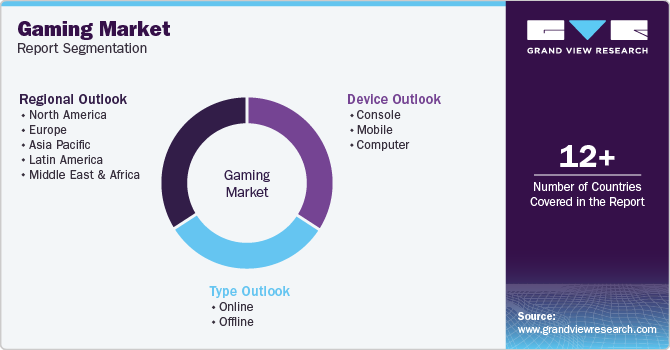
This report forecasts revenue growth at global, regional, and country levels and provides an analysis of the latest technology trends in each of the sub-segments from 2021 to 2033. For this study, Grand View Research has segmented the global gaming market report based on device, type, and region:
-
Device Outlook (Revenue, USD Billion, 2021 - 2033)
-
Console
-
Mobile
-
Computer
-
-
Type Outlook (Revenue, USD Billion, 2021 - 2033)
-
Online
-
Offline
-
-
Regional Outlook (Revenue, USD Billion, 2021 - 2033)
-
North America
-
U.S.
-
Canada
-
Mexico
-
-
Europe
-
UK
-
Germany
-
France
-
-
Asia Pacific
-
China
-
India
-
Japan
-
South Korea
-
Australia
-
-
Latin America
-
Brazil
-
-
Middle East & Africa
-
Saudi Arabia
-
UAE
-
Egypt
-
Jordan
-
-
Research Methodology
The gaming market figures in this report are based on a proven research process that combines executive interviews with secondary research from proprietary databases, company filings, and recognized regulatory and institutional sources. Market size is built through value-chain sizing - reconciling supply-side and demand-side estimates - and triangulated with bottom-up and top-down approaches. Every estimate passes multiple levels of expert validation before publication, with each gaming segment quantified using the revenue-capture definitions in the table below.
Segment Definition
Segment - Device
Revenue capture definition
Console
Revenue is generated from players who access games through dedicated gaming consoles connected to televisions or gaming displays. This segment is driven by strong demand for premium gaming experiences, exclusive game titles, advanced graphics capabilities, multiplayer functionality, and increasing consumer spending on digital downloads, subscriptions, and in-game content.
Mobile
Revenue is generated from users who play games on smartphones and tablets through downloadable applications or browser-based platforms. This segment is driven by widespread smartphone adoption, affordable internet connectivity, free-to-play business models, in-app purchases, and the growing popularity of casual, multiplayer, and competitive mobile gaming experiences.
Computer
Revenue is generated from players who access games through desktop computers and laptops across a wide range of genres and performance levels. This segment is driven by demand for immersive gameplay, esports participation, high-performance hardware capabilities, digital game distribution platforms, user-generated content, and customizable gaming experiences.
Segment - Type
Revenue capture definition
Online
Revenue is generated from games that require internet connectivity for multiplayer interaction, cloud-based services, live content updates, digital purchases, and social gaming experiences. This segment is driven by the growing popularity of esports, live-service games, cross-platform functionality, subscription services, and increasing engagement with competitive and cooperative gameplay.
Offline
Revenue is generated from games that can be played without a continuous internet connection, including single-player titles and locally installed gaming experiences. This segment is driven by consumer demand for uninterrupted gameplay, story-driven content, ownership of purchased games, and accessibility in regions with limited internet infrastructure.
Estimation Model
Layer Name
Key Question
Description
Gaming Audience Layer
Who are the potential adopters?
Identifies the total addressable player base, including casual, core, mobile, console, and PC gamers; esports participants; content creators; game stream viewers; and digital entertainment consumers seeking interactive gaming experiences across multiple platforms.
Access Enablement Layer
Who can participate in gaming activities?
Participation is influenced by factors such as smartphone penetration, availability of gaming consoles and PCs, internet connectivity, and access to digital game distribution platforms that support gaming engagement.
Platform Engagement Layer
Where are gaming experiences actively consumed?
Applies participation levels across platforms where gaming activities occur, including smartphones, tablets, gaming consoles, desktop computers, laptops, handheld gaming devices, esports platforms, digital storefronts, and online multiplayer ecosystems.
Revenue Generation Layer
How is revenue generated?
Revenue is generated through premium game sales, digital game downloads, in-game purchases, microtransactions, subscription gaming services, advertising revenue, esports sponsorships, tournament revenues, virtual goods sales, game licensing agreements, and recurring revenue from live-service gaming ecosystems.
Delivered Customizations
This report has been delivered with the following In-depth customizations
Client Request
Customization Delivered
Value Adds
Gaming Content Portfolio Optimization & Player Engagement Assessment
Conducted detailed evaluation of gaming content portfolios across mobile, PC, console, cloud, and esports ecosystems, integrating player analytics platforms, live-service gaming models, content monetization strategies, community engagement tools, and digital distribution networks to optimize user acquisition and retention.
Enables improved player engagement, strengthens content performance, increases recurring revenue opportunities, and enhances long-term user retention.
Cross-Platform Gaming Ecosystem Integration Strategy
Assessed deployment of gaming experiences across smartphones, tablets, PCs, gaming consoles, cloud gaming platforms, and connected digital ecosystems, integrating multiplayer infrastructure, subscription platforms, digital storefronts, and cross-platform progression capabilities.
Enhances platform interoperability, improves player accessibility, supports seamless gaming experiences, and strengthens user engagement across multiple devices.
AI-Driven Game Development & Live-Service Optimization Planning
Evaluated implementation of artificial intelligence-powered game development tools, player behavior analytics platforms, dynamic content generation systems, live-service management frameworks, and automated game testing solutions to improve operational efficiency and gameplay experiences.
Enables data-driven decision-making, improves content personalization, accelerates development cycles, increases player satisfaction, and supports scalable gaming operations.
Frequently Asked Questions About This Report
Asia Pacific dominated the gaming market with a share of 47.6% in 2025.
Some key players operating in the gaming market include Microsoft Corporation; Nintendo; Rovio Entertainment Corporation; NVIDIA Corporation; Valve Corporation.; PlayJam Ltd.; Bluestack Systems, Inc.; and Sony Corporation among others.
Key factors that are driving the market growth include the emergence of next-generation video game consoles, the growing number of gamers across the globe, and technological proliferation in the gaming industry.
The Asia Pacific is the fastest-growing region with a CAGR of over 12% from 2026 to 2033.
The mobile segment led with a 45.4% revenue share in 2025.
The offline segment led with a 58.6% revenue share in 2025.
The U.S. dominated the gaming market with a share of 68.6% in 2025.
The global gaming market was valued at USD 334.9 billion in 2025 and is expected to reach USD 374.8 billion in 2026.
The global gaming market is expected to grow at a compound annual growth rate of 10.5% from 2026 to 2033 to reach USD 752.0 billion by 2033.
About the Author(s)
Digital Media Research Team
Technology · Digital MediaThis report was authored by the digital media research team at Grand View Research - comprising two research analysts, one senior research analyst, and one industry expert - with specialized expertise in the digital media segment of the technology industry. All findings are based on proprietary technology databases, executive interviews, and regulatory analysis, subject to internal peer review prior to publication.
Last Updated:
Speak to Analyst


Customize this report to your needs — add regions, segments, or data points, with 20% free customization.
Or view our licence options:


ISO 9001:2015 & 27001:2022 Certified
We are GDPR and CCPA compliant! Your transaction & personal information is safe and secure. For more details, please read our privacy policy.


