
- Home
- »
- Healthcare IT
- »
-
AI In Radiology Market Size And Share Report, 2026-2033GVR Report cover

AI In Radiology Market (2026 - 2033)
Size, Share & Trends Analysis Report By Component (AI-enabled Devices, Software & Platform), By Technology (Machine Learning Algorithms), By Modality (Computed Tomography (CT), By Application, By End Use, By Region, And Segment Forecasts
Market Size, 2025
$14.6BMarket Estimate, 2026
$20.1BMarket Forecast, 2033
$193.0BCAGR, 2026–2033
38.2%AI In Radiology Market Summary
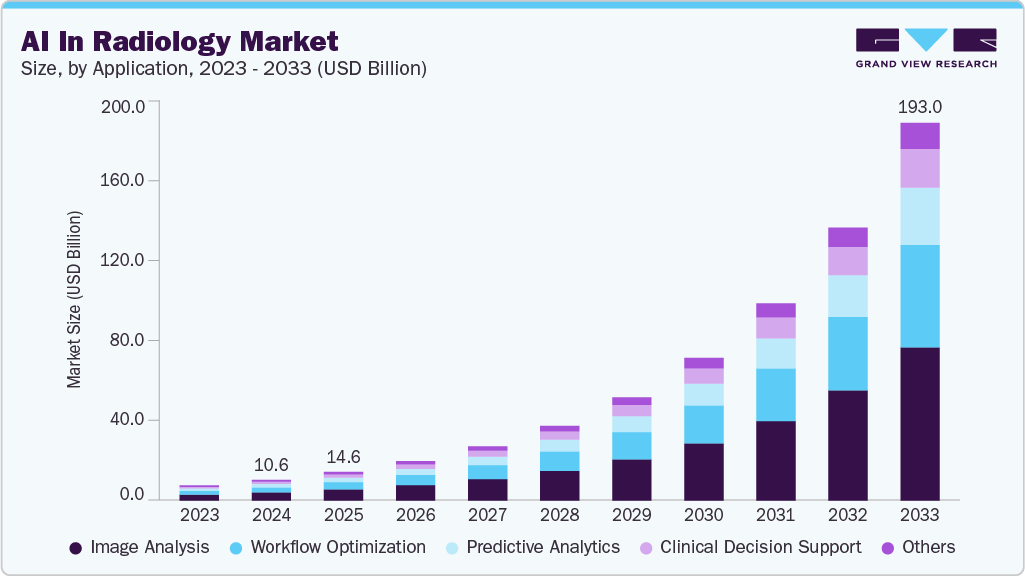
The global AI in radiology market size was valued at USD 14.6 billion in 2025 and is projected to grow from USD 20.1 billion in 2026 to USD 193.0 billion by 2033, at a CAGR of 38.2% from 2026 to 2033. The North America held the largest share of 52.5% of the global market in 2025. Rising demand for accurate, early disease detection, rapid growth in imaging volumes, and government initiatives and regulatory support are significant factors driving market growth.
 Source: Grand View Research, IR Documents, Primary Interviews, Paid DatabasesTo learn more about this report,
 Download Free Sample Report
 Key Market Trends & Insights
- By component: AI-enabled devices segment held the largest market share of 41.7% in 2025.
- By technology: Machine learning segment held the largest market share of 35.6% in 2025.
- By modality: Computed tomography segment held the largest market share of 29.7% in 2025.
- By application: Image analysis segment held the largest market share of 39.3% in 2025.
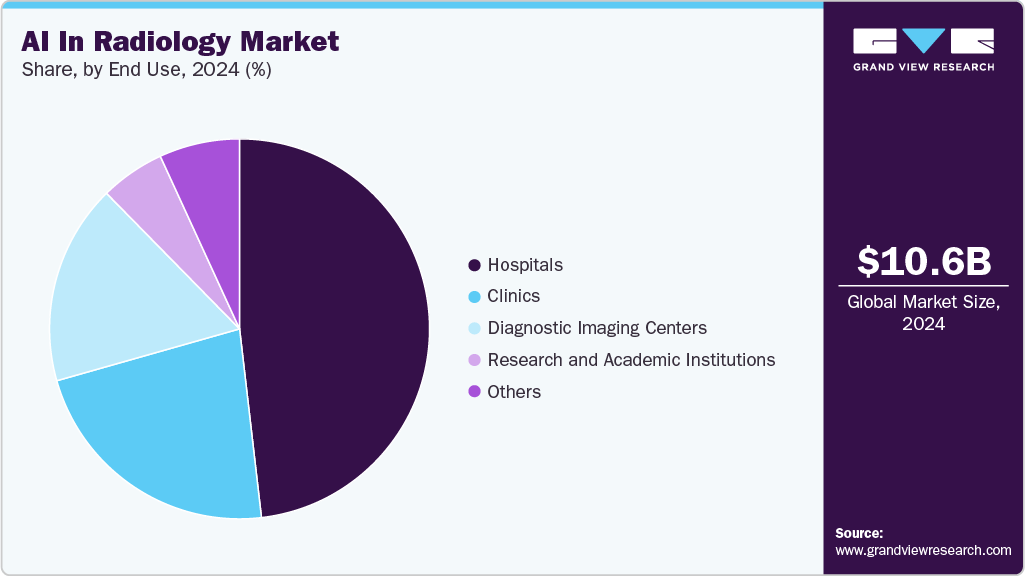
- By end use: Hospitals segment held the largest market share of 48.1% in 2025.
Regional Highlights
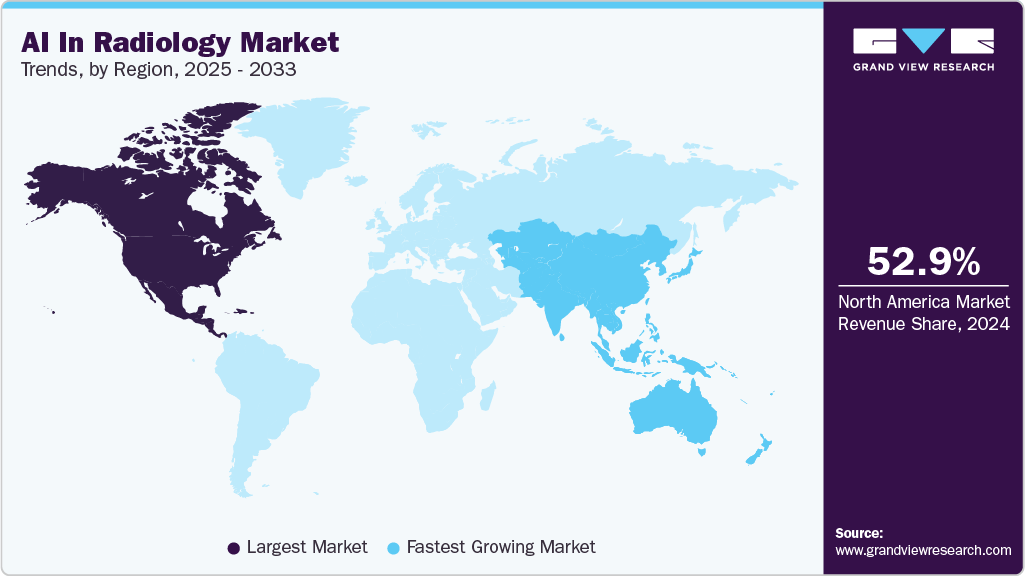
- Largest regional market: North America (52.5% revenue share, 2025)
- Fastest-growing regional market: Asia Pacific (highest CAGR, 2026-2033)
- By country: The U.S. held the largest share in 2025
Market Size & Forecast
- Market size in 2025: USD 14.6 Billion
- Estimated market size in 2026: USD 20.1 Billion
- Projected market size by 2033: USD 193.0 Billion
- CAGR (2026-2033): 38.2%
Three ways to get this report
Buy it, customize it, or ask a question.Ask an Analyst
Analyst response in 1 business day
- AccessReport author, directly
- Reply timeWithin 1 working day
- No sales callDirect answer only
- FormatEmail reply
- CostFree, no cost
Get the Full Report
What the study covers
- FormatsPDF · Excel · Dashboard
- Timeline2026–2033 annual, 2025 base
- Coverage20+ countries, 5 regions
- Companies10+ key players profiled
Customize the Report
20% free customization
- IncludeCountries, segments, points
- TailorTo your product definition
- ExtendDeeper competitor detail
- OrA fully bespoke study
- Turnaround5–10 working days
 To learn more about this report, Download Free Sample Report
In addition, the growing emphasis on cost-efficiency in healthcare delivery and technological advancements in machine learning, natural language processing, and computer vision are further fueling market growth. The section below outlines the key factors driving the growth of AI in the radiology market, highlighting rising demand for accurate and early disease detection, rapid technological advancements in AI and medical imaging, advancements in AI-driven clinical decision support and imaging solutions,supportive government initiatives, and regulatory frameworks, and increasing government funding and strategic research collaboration.Market Dynamics
Technological advancements in machine learning, natural language processing, and computer vision fuel the growth of the AI in radiology industry. Deep learning algorithms are improving in accuracy, enabling more reliable interpretation of complex imaging modalities such as CT, MRI, and PET scans. For instance, iPETcertum, developed by Claritas NucMed Technologies, received FDA 510(k) clearance in August 2025. It is an AI-powered software device that enhances PET, PET-CT, and PET-MRI scans by automating the segmentation and quantification of tumors and lesions.
Integration of large language models and generative AI supports advanced clinical decision-making and structured reporting. For instance, in February 2025, RapidAI secured FDA 510(k) clearance for Lumina 3D, an AI-powered, automated 3D imaging reconstruction solution for head and neck CTA. Lumina 3D enables near real-time, high-quality 3D vascular images, reducing manual workflow burdens and improving diagnostic speed, accuracy, and procedural planning for neuroradiologists and neurointerventionalists.
Furthermore, AI tools are increasingly designed to integrate seamlessly with PACS and electronic health record systems. These innovations provide radiologists with actionable insights, creating a more connected and efficient diagnostic ecosystem.
One primary constraint affecting the AI in radiology market is the growing concern over data privacy and security. Digital health platforms collect sensitive personal information, including medical history, lifestyle habits, and fitness data.
This information is highly sensitive and requires robust protection to prevent unauthorized access or breaches.
Any breach or unauthorized access to this information can lead to serious consequences such as identity theft or misuse of personal data.
Market Drivers And Dynamics
Rising Demand for Accurate and Early Disease Detection
The rising demand for accurate and early disease detection is a primary driver of the AI in radiology market. Chronic conditions such as cancer, cardiovascular diseases, and neurological disorders are increasing globally, necessitating advanced imaging tools for early intervention. AI-enabled image analysis enhances diagnostic accuracy by detecting subtle abnormalities that might be missed by human interpretation. Automated quantification and risk stratification further improve diagnostic confidence. These capabilities reduce variability across radiologists and support personalized treatment planning. For instance, in May 2025, GE Healthcare announced FDA 510(k) clearance for Aurora, a new dual-head SPECT/CT system, and for Clarify DL, its AI-powered Deep Learning image reconstruction technology. Aurora is designed to help clinicians see and do more and aims to expand the range of CT procedures available, with accommodations for a wide range of patients and body types, supporting streamlined workflows and versatility.
Rapid Technological Advancements in AI and Medical Imaging
Technological advancements in machine learning, natural language processing, and computer vision fuel market growth. Deep learning algorithms are improving in accuracy, enabling more reliable interpretation of complex imaging modalities such as CT, MRI, and PET scans. For instance, iPETcertum, developed by Claritas NucMed Technologies, received FDA 510(k) clearance in August 2025. It is an AI-powered software device that enhances PET, PET-CT, and PET-MRI scans by automating the segmentation and quantification of tumors and lesions. For instance, in July 2025, Royal Philips received FDA 510(k) clearance for its AI-powered MRI solution, Smartspeed Precise. This is advancing its efforts in AI-driven MR technology. This is a significant milestone towards autonomous and personalized MR. Smartspeed Precise is the first integrated dual AI solution in the industry. It can deliver scanning speeds up to 3 times faster and image quality up to 80% sharper, all with a single click.
Advancements in AI-Driven Clinical Decision Support and Imaging Solutions
Integration of large language models and generative AI supports advanced clinical decision-making and structured reporting. For instance, in February 2025, RapidAI secured FDA 510(k) clearance for Lumina 3D, an AI-powered, automated 3D imaging reconstruction solution for head-and-neck CTA. Lumina 3D enables near real-time, high-quality 3D vascular images, reducing manual workflow burdens and improving diagnostic speed, accuracy, and procedural planning for neuroradiologists and neuro-interventionalists. Furthermore, AI tools are increasingly designed to integrate seamlessly with PACS and electronic health record systems. These innovations provide radiologists with actionable insights, creating a more connected and efficient diagnostic ecosystem.
Increasing Government Funding and Strategic Research Collaboration
Governments are also funding research collaborations between academic institutions and technology providers. This ecosystem encourages innovation and fosters trust among healthcare providers. For instance, in May 2025, South Korean AI imaging company Coreline Soft secured multiple supply contracts with major organizations, including the UK NHS, Boehringer Ingelheim Taiwan, and the French National Cancer Institute. The NHS contract serves 12 hospitals in East England, including Cambridge University Hospital. As regulations mature, adoption rates are expected to rise across developed and emerging markets.
List of a few FDA-approved AI-enabled radiology medical devices/software-as-a-medical device.
Date of Final Decision
Submission Number
Device
Company
05/30/2025
K251406
BriefCase-Triage
Aidoc Medical, Ltd.
05/30/2025
K243863
Opulus Lymphoma Precision
Roche Molecular Systems, Inc.
05/29/2025
K250543
Voluson Performance 16; VolusonPerformance 18
GE Medical Systems Ultrasound and Primary Care Diagnostics
05/21/2025
K243793
EPIQ Series Diagnostic Ultrasound System; Affiniti Series Diagnostic Ultrasound System
Philips Ultrasound LLC
05/21/2025
K243762
Synapse 3D Base Tools (V7.0)
FUJIFILM Corporation
05/21/2025
K243122
uMR Omega
Shanghai United Imaging Healthcare Co., Ltd.
05/20/2025
K250370
SCENARIA View Phase 5.0
FUJIFILM Corporation
05/16/2025
K243617
uCT ATLAS Astound with uWS-CT-Dual Energy Analysis; uCT ATLAS with uWS-CT-Dual Energy Analysis
Shanghai United Imaging Healthcare Co., Ltd.
05/16/2025
K241671
6450 Ultrasound System (MyLabE80); 6450 Ultrasound System (MyLabE85)
Esaote S.p.A.
05/16/2025
K240554
InferRead Lung CT.AI
Infervision Medical Technology Co., Ltd.
05/09/2025
K251110
EPIQ Series Diagnostic Ultrasound Systems; Affiniti Series Diagnostic Ultrasound Systems
Philips Ultrasound LLC
05/08/2025
K250226
Clarius Median Nerve AI
Clarius Mobile Health Corp.
05/01/2025
K250087
Vscan Air
GE Medical Systems Ultrasound and Primary Care Diagnostics
04/30/2025
K250328
UltraExtend NX CUW-U001S V2.0 Ultrasound Image Analysis Program
Canon Medical Systems Corporation
Upgrade the report license to gain a complete analysis.
Market Concentration & Characteristics
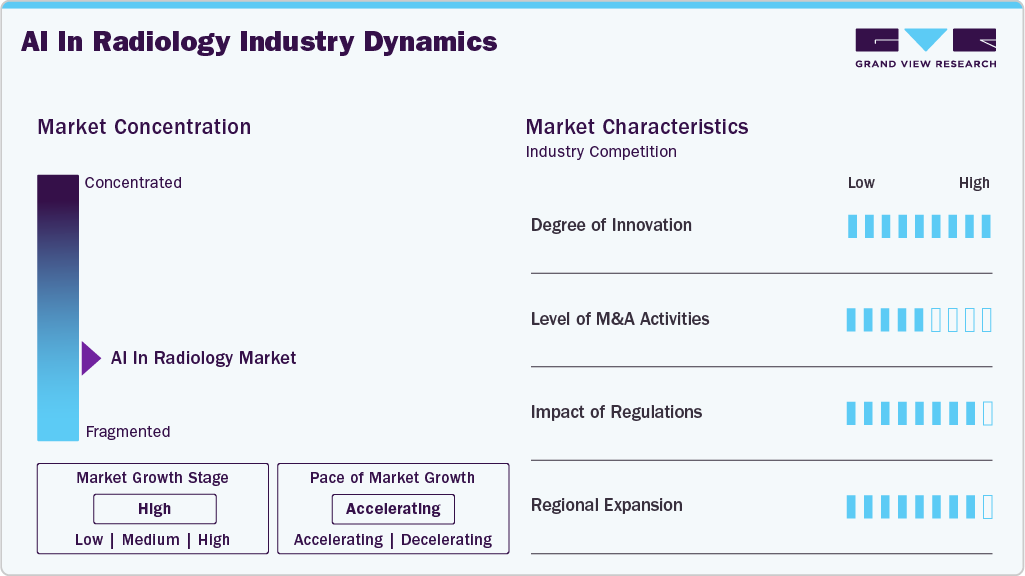
The chart below illustrates the relationship between industry concentration, industry characteristics, and industry participants, including industry competition, level of partnerships & collaboration activities, degree of innovation, impact of regulations, and regional expansion. The degree of innovation is high. The level of merger & acquisition activities is moderate. Moreover, the impact of regulations is high, and the regional expansion of industry is moderate.
AI in the radiology market is characterized by constant innovation, with a strong focus on launching new platforms and devices to leverage administrative tasks, improve diagnostic accuracy, and enhance care delivery. Prominent players are launching advanced solutions to sustain a competitive advantage. In addition, growing regulatory approvals propel market growth further. For instance, in July 2025, Philips received FDA 510(k) clearance for SmartSpeed Precise, a deep learning MRI reconstruction software. This dual AI solution delivers up to 3x faster scans and 80% sharper images across Philips’ 1.5T and 3.0T MRI systems. It integrates AI denoising, image sharpening, and the Compressed SENSE engine to enhance image quality and workflow efficiency.
 To learn more about this report, Download Free Sample Report
 “This FDA clearance is a powerful validation of Philips’ leadership in AI-powered MRI innovation. “SmartSpeed Precise reflects our commitment to continuous innovation that addresses clinicians' real-world pressures. By integrating dual AI with our proven Compressed SENSE engine, we are enabling faster, sharper, and smarter MR scans—making high-quality imaging more accessible and efficient than ever before.”
-Ioannis Panagiotelis, PhD, Business Leader, MR at Philips
The industry is experiencing a moderate level of merger and acquisition activities undertaken by several key players. This is due to the desire to gain a competitive advantage in the industry, enhance technological capabilities, and consolidate in a rapidly growing market. For instance, in May 2025, Australia-based Kailo Medical, a leader in structured reporting for medical imaging, acquired REI AI, a generative AI company. This acquisition expands Kailo’s offerings with generative AI-powered reporting tools that streamline workflows by converting dictation into structured reports, detecting errors in real-time, and generating personalized, clinically aligned impressions.
Regulations, such as HIPAA in the U.S. and the GDPR in Europe, establish standards for safeguarding patient data privacy and security. Compliance with these regulations is crucial for AI applications in healthcare to ensure the safe and secure handling of patient information, reducing the risk of data breaches and unauthorized access.
The industry is witnessing high geographical expansion. Companies within the AI in radiology industry seek geographic expansion strategies to maintain their foothold in emerging markets and attract customers from these regions. For instance, in May 2025, Lunit entered a five-year strategic partnership with Starvision Service GmbH, Germany's largest private radiology network, covering 79 locations across seven federal states. The agreement facilitates the phased rollout of Lunit's AI imaging suite, including chest X-ray and mammography, tomosynthesis, and fracture detection.
"Partnering with Starvision accelerates our vision of bringing AI-powered precision diagnostics into everyday clinical practice.”
-Brandon Suh, CEO of Lunit.
Component Insights
Based on the component, the AI-enabled devices segment held the largest market share of 41.7% in 2025. These devices support real-time image acquisition, automated analysis, and faster reporting, reducing reliance on post-processing software. Integration of AI improves the accuracy of abnormality detection, enhances image quality, and minimizes operator variability. For instance, in January 2025, Philips launched the AI-enabled CT 5300. The system features advanced AI reconstruction, cardiac motion correction, and smart workflows that enhance diagnostic accuracy, speed, and workflow efficiency. Moreover, the increasing adoption of smart imaging systems by hospitals and diagnostic centers is fueling this segment’s market growth.
The software and platform segment is expected to grow at the fastest CAGR during the forecast period. These solutions include advanced image recognition software, workflow management platforms, and cloud-based AI services integrated with PACS and RIS systems. By providing automated detection of abnormalities and risk stratification, they enhance diagnostic accuracy and efficiency. Cloud-based AI platforms facilitate remote collaboration, second opinions, and access to advanced analytics for smaller healthcare providers.
Technology Insights
Based on technology, the machine learning segment accounted for the largest revenue share of over 35.6% in 2025. Machine learning algorithms identify patterns and anomalies in imaging data with high accuracy. They support applications such as tumor detection, lesion classification, and image segmentation, improving diagnostic precision and clinical outcomes. Machine learning also aids in predictive analytics, helping clinicians anticipate disease progression. Its adaptability across modalities such as CT, MRI, and X-ray further fuels market growth.
The context-aware computing segment is anticipated to register the fastest growth from 2026 to 2033. Context-aware computing leverages patient-specific information, clinical history, and environmental factors to enhance radiological interpretations. In addition, context-aware computing optimizes workflow by tailoring imaging recommendations and follow-up actions to individual patient needs.
Modality Insights
Based on modality, the computed tomography (CT) segment held the largest revenue share of 29.7% in 2025 due to its ability to enhance image reconstruction, improve detection accuracy, and reduce radiation exposure. Advanced applications include low-dose imaging, lesion tracking across longitudinal scans, and predictive analytics for disease progression.For instance, in March 2025, GE HealthCare launched Revolution Vibe, a next-generation cardiac CT scanner with advanced AI capabilities, focused on coronary CT angiography (CCTA) and structural heart exams.
“The system is designed to encourage the broader adoption of and access to cardiac imaging, combining advanced technology with AI-powered solutions to deliver fast, accurate diagnoses and a more comfortable patient experience. It is designed to empower healthcare providers to offer the highest quality care, even in the most challenging cases."
-Jean-Luc Procaccini, president and CEO of molecular imaging and CT at GE HealthCare
The ultrasound segment is anticipated to grow at the fastest CAGR from 2026 to 2033. AI algorithms assist clinicians in identifying anatomical structures, detecting abnormalities, and reducing operator dependency. Automated measurements, such as fetal growth tracking and cardiac function analysis, improve consistency and minimize manual variability. In addition, AI-powered ultrasound solutions optimize workflows by automating reporting, guiding probe placement, and enabling remote interpretation through telemedicine platforms.
Application Insights
Based on application, the image analysis segment accounted for the largest revenue share of 39.3% in 2025. AI in image analysis helps radiologists prioritize critical cases by automating triage and flagging high-risk findings. Advanced deep learning models enable predictive insights by linking imaging data with clinical outcomes, enabling more personalized treatment planning. Cloud-based and PACS-integrated AI solutions streamline workflow by embedding analysis into existing radiology systems. Moreover, collaborations between AI startups and established imaging vendors are accelerating innovation and deployment across hospitals and diagnostic centers.
The workflow optimization segment is anticipated to grow at the fastest CAGR from 2026 to 2033. AI-powered solutions streamline the management of imaging studies by automating scheduling, prioritizing worklists, and routing cases. In addition, workflow optimization solutions integrate seamlessly with PACS, RIS, and EMR systems, ensuring smooth data exchange and reducing administrative burden, thereby further contributing to market growth.
End Use Insights
Based on end use, the hospitals segment held the largest market share of 48.1% in 2025, driven by their need to manage large patient volumes and diverse imaging modalities. Hospitals are adopting AI solutions to support diagnostic accuracy, reduce reporting backlogs, and streamline clinical decision-making. Integrating AI into radiology departments helps standardize image interpretation, reducing the risk of diagnostic errors.
 To learn more about this report, Download Free Sample Report
 The diagnostic imaging centers segment is anticipated to grow at the fastest CAGR from 2026 to 2033. Diagnostic imaging centers are increasingly adopting AI solutions to enhance efficiency, accuracy, and competitiveness. These centers handle high imaging volumes daily, making automation and advanced analytics essential for optimizing turnaround times. AI-driven tools assist radiologists by detecting anomalies, flagging urgent cases, automating routine measurements, and reducing workload pressure. In addition, diagnostic imaging centers benefit from AI integration into scheduling, workflow, and reporting processes, enabling seamless patient management.
Regional Insights
The North America AI in radiology industry accounted for the largest revenue share of 52.5% in 2025. This is attributed to the high prevalence of chronic diseases, strong reimbursement frameworks, and rapid integration of AI into digital health ecosystems. The U.S. leads with significant FDA clearances for AI-powered diagnostic and therapeutic devices, ensuring regulatory support for innovation. Moreover, rising collaborations between technology companies and healthcare providers further fuel innovation.
 To learn more about this report, Download Free Sample Report
 U.S. AI In Radiology Market Trends
The AI in radiology industry in theU.S.held the largest market share in 2025. The country has witnessed a surge in approvals for AI-powered imaging devices, reflecting robust innovation in healthcare technology. For instance, in September 2025, Tempus AI received FDA 510(k) clearance for its updated Tempus Pixel, an AI-powered cardiac imaging platform. The upgrade enables the generation of T1 and T2 inline maps, enhancing cardiac MR image analysis.
“With inline maps generated by Tempus Pixel, cardiologists and radiologists gain a comprehensive view of heart tissue, enabling deeper insights into cardiac health and helping them deliver more precise, personalized care to their patients.”
-Chris Scotto DiVetta, Senior Vice President of AI Applications at Tempus.
Europe AI In Radiology Market Trends
TheAI in radiology industry inEuropeis expected to witness significant growth during the forecast period. This is attributed to the widespread adoption of AI technologies in healthcare and increasing investments by government and private organizations. Moreover, integrating 5G with healthcare drives Europe's market by enabling faster, more reliable connectivity for advanced medical technologies. For instance, in February 2025, Philips launched SmartSpeed Precise, a next-generation MRI technology powered by dual AI engines, debuting at the European Congress of Radiology (ECR) 2025. It enables up to three times faster scans with 80% sharper images, improving diagnostic confidence and patient outcomes.
The UK AI in radiology industry is expected to grow considerably over the forecast period, owing to the robust healthcare infrastructure and increasing investments in AI technologies to enhance medical diagnosis and patient care. For instance, in February 2025, DeepHealth introduced next-generation AI-powered radiology informatics and population screening solutions at ECR 2025, aimed at improving diagnostic accuracy, workflow efficiency, and large-scale imaging analysis across healthcare systems, including Europe and the UK.
“At DeepHealth, we are harnessing the transformative power of AI to create cutting-edge solutions that are deeply rooted in real-world clinical needs, we believe that AI adoption at scale in radiology can only be achieved by embedding AI into and unifying data across clinical and operational workflows to empower radiologists and care teams that today are having to rely on disconnected devices and disparate data sources. At ECR 2025, we are excited to showcase our next-generation radiology informatics and population screening solutions designed to enhance operational efficiency, clinical confidence, and care delivery across the radiology continuum.”
- Kees Wesdorp, PhD, President and CEO of RadNet’s Digital Health division.
The AI in radiology industry in Germany held a significant market share in 2025 in the European market, attributed to increasing investments in healthcare technology and robust healthcare infrastructure. In addition, favorable government initiatives and insurance coverage, coupled with the country’s focus on integrating AI into nationwide healthcare systems, propel market growth further. In May 2025, Korean medical imaging AI companies- Lunit and Coreline Soft- secured significant supply contracts in Germany. Lunit signed a five-year agreement with Germany’s largest private radiology network, Starvision, to deploy AI solutions across 79 sites, covering chest X-ray, mammography, tomosynthesis, and fracture detection.
"While Germany, which leads the medical field in Europe, is active in the introduction of AI technology, our products are constantly expanding to key hospitals…"
- Coreline Soft CEO Kim Jin-kook.
Asia Pacific AI In Radiology Market Trends
TheAI in radiology industry in the Asia Pacificis expected to grow at the fastest CAGR over the forecast period. This growth is attributed to the rising healthcare expenditure, increasing adoption of AI in healthcare, and growing prevalence of chronic diseases. Countries such as China, Japan, South Korea, and India are leading innovation through government-backed AI healthcare policies. Moreover, collaborations between key market players expedite market growth. In February 2025, South Korea’s Coreline Soft signed an MoU with China’s Jiangsu Suhai Information Technology to jointly advance the development of AI-powered imaging technologies. The collaboration aims to enhance clinical innovation and expand commercial partnerships across the Asian healthcare market.
The India AI in radiology industry is expanding rapidly and is driven by the high prevalence of hypertension, government health initiatives, and technological innovation. Furthermore, the market is experiencing a growing adoption of AI technologies by healthcare providers in the country. For instance, in June 2025, Qure.ai was acknowledged as one of the lead companies globally for its AI-driven radiology solutions that allow for quicker and more precise analysis of medical images such as X-rays and CT scans, which is facilitating widespread diagnostic applications throughout healthcare systems.Qure.ai tools have now been deployed in more than 100 countries, and the company has 18 FDA clearances among which the greatest number belonged to lung cancer AI in the U.S which includes three new approvals in 2024.
“To be named among TIME’s 100 Most Influential Companies is an acknowledgment of a simple but urgent belief: that access to timely, high-quality diagnostics should not depend on where you live. This honor reflects the dedication of our teams and partners across continents, working to close the gap between innovation and impact. This recognition pushes us to keep advancing that future, where care begins long before crisis.”
-Prashant Warier, CEO and Founder.
The AI in radiology industry in Japan is expected to grow rapidly, owing to technological advancements, a growing geriatric population, increasing healthcare expenditure, and rapid adoption of artificial intelligence in healthcare. Moreover, increasing public and private funding, coupled with the rapid adoption of telehealth solutions, is expected to further propel market growth.For instance, in September 2025, the Tokyo Metropolitan Institute for Geriatrics and Gerontology in Japan implemented an AI-powered brain MRI analysis software by the South Korean company Neurophet.
Latin America AI In Radiology Market Trends
The AI in radiology industry in Latin America is anticipated to grow at a significant CAGR over the forecast period. This is attributed to the growing awareness about AI technologies, increasing government spending, and growing advancements in healthcare infrastructure.
Middle East And Africa AI In Radiology Market Trends
TheAI in radiology industry in the Middle East and Africa is expected to grow at a significant CAGR over the forecast period. The market is characterized by a dynamic landscape driven by the growing adoption of technologically advanced medical devices, increasing healthcare expenditures, and supportive government policies. Significant integration of AI in healthcare technology across the region contributes to market growth further. Countries such as Saudi Arabia and the UAE are integrating AI into healthcare infrastructure as part of strategic visions, including Saudi Vision 2030 and the UAE National Strategy for Artificial Intelligence 2031.
Key AI In Radiology Company Insights
Key players operating in the AI in radiology market are undertaking various initiatives to strengthen their market presence and increase the reach of their products and services. Strategies such as new product launches and partnerships play a key role in propelling market growth.
Key AI In Radiology Companies:
The following key companies have been profiled for this study on the AI in radiology market.
- Siemens Healthineers AG
- GE HealthCare
- Koninklijke Philips N.V.
- Canon Medical Systems
- Fujifilm Holdings Corporation
- Aidoc
- Tempus AI
- Lunit
- Viz.ai
- Riverain Technologies
- Qure.ai
- Infervision
Recent Developments
- In August 2025, Philips launched Transcend Plus for its EPIQ CVx and Affiniti CVx cardiovascular ultrasound systems, featuring major advancements in image quality and AI.
"Transcend Plus represents a bold leap forward in the evolution of echocardiography, reinforcing our commitment to continuous innovation, empowering clinicians with AI-driven tools that enhance confidence, accelerate decision-making, and elevate care at every stage of the cardiac journey.”
-David Handler, Business Leader, Cardiology Ultrasound at Philip
-
In June 2025, Annalise.ai’s AI-powered chest X-ray solution was implemented across Parkway Radiology’s clinics and hospital departments across Singapore. This represented a large-scale deployment of AI in clinical workflows and improved diagnostic performance across multiple hospitals and imaging centers.
-
In May 2025, Philips partnered with NVIDIA to develop a foundational AI model for MRI, leveraging NVIDIA’s advanced AI computing platform.
-
In April 2025, Subtle Medical announced a partnership with Strategic Radiology, which consists of over 2,000 radiologists, to expand and enhance access to its AI-powered SubtleELITE imaging suite across member practices w
-
In March 2025, Nawaloka Hospitals in Sri Lanka introduced South Asia’s first AI-powered Canon Vantage Orian MRI scanner. The scanner enhances imaging precision and speed using deep learning algorithms, enabling early detection of neurological, cardiovascular, musculoskeletal, abdominal, pelvic, pediatric, and cancer-related conditions.
-
In March 2025, NVIDIA and GE HealthCare announced a collaboration to advance autonomous diagnostic imaging using physical AI. The partnership integrates NVIDIA’s AI computing with GE HealthCare’s imaging expertise to develop next-generation tools.
AI In Radiology Market Report Scope
Report Attribute
Details
Market size in 2025
USD 14.6 billion
Estimated market size in 2026
USD 20.1 billion
Projected market size by 2033
USD 193.0 billion
Growth rate
CAGR of 38.2% from 2026 to 2033
Actual data
2021 - 2025
Forecast period
2026 - 2033
Quantitative units
Revenue in USD million/billion and CAGR from 2026 to 2033
Report coverage
Revenue forecast, company ranking, competitive landscape, growth factors, and trends
Segments covered
Component, technology, modality, application, end use, region
Regional scope
North America; Europe; Asia Pacific; Latin America; MEA
Country scope
U.S.; Canada; Mexico; Germany; UK; France; Italy; Spain; Denmark; Sweden; Norway; China; Japan; India; South Korea; Australia; Thailand; Brazil; Argentina; South Africa; Saudi Arabia; UAE; Kuwait
Key companies profiled
Siemens Healthineers AG; GE HealthCare; Koninklijke Philips N.V.; Canon Medical Systems; Fujifilm Holdings Corporation; Aidoc; Tempus AI; Lunit; Viz.ai; Riverain Technologies; Qure.ai; Infervision
Customization scope
Free report customization (equivalent to up to 8 analysts working days) with purchase. Addition or alteration to country, regional & segment scope.
Pricing and purchase options
Avail customized purchase options to meet your exact research needs. Explore purchase options
Global AI In Radiology Market Report Segmentation
This report forecasts revenue growth at global, regional, and country levels and provides an analysis of the latest industry trends in each of the sub-segments from 2021 to 2033. For this study, Grand View Research has segmented the global AI in radiology market report based on component, technology, modality, application, end use, and region.
-
Component Outlook (Revenue, USD Million, 2021 - 2033)
-
AI-enabled Devices
-
Software & Platform
-
Services
-
-
Technology Outlook (Revenue, USD Million, 2021 - 2033)
-
Machine Learning Algorithms
-
Deep learning
-
Supervised
-
Unsupervised
-
Others
-
-
Natural Language Processing (NLP)
-
Computer Vision Techniques
-
Context-aware Computing
-
-
Modality Outlook (Revenue, USD Million, 2021 - 2033)
-
X-ray / Radiography
-
Computed Tomography (CT)
-
Magnetic Resonance Imaging (MRI)
-
Ultrasound
-
Mammography / Tomosynthesis
-
Others
-
-
Application Outlook (Revenue, USD Million, 2021 - 2033)
-
Image Analysis
-
Workflow Optimization
-
Predictive Analytics
-
Clinical Decision Support
-
Others
-
-
End Use Outlook (Revenue, USD Million, 2021 - 2033)
-
Hospitals
-
Clinics
-
Diagnostic Imaging Centers
-
Research and Academic Institutions
-
Other
-
-
Regional Outlook (Revenue, USD Million, 2021 - 2033)
-
North America
-
U.S.
-
Canada
-
Mexico
-
-
Europe
-
Germany
-
UK
-
France
-
Italy
-
Spain
-
Denmark
-
Sweden
-
Norway
-
-
Asia Pacific
-
China
-
Japan
-
India
-
South Korea
-
Australia
-
Thailand
-
-
Latin America
-
Brazil
-
Argentina
-
-
MEA
-
South Africa
-
Saudi Arabia
-
UAE
-
Kuwait
-
-
Frequently Asked Questions About This Report
The global AI in radiology market size was estimated at USD 14.6 billion in 2025 and is expected to reach USD 20.1 billion in 2026.
The global AI in radiology market is expected to grow at a compound annual growth rate of 38.2% from 2026 to 2033 to reach USD 193.0 billion by 2033.
The AI-enabled devices segment held the largest market share of 41.7% in 2025, while the software and platform segment is fastest growing.
Some key players operating in the AI in radiology market include Siemens Healthineers AG; GE HealthCare; Koninklijke Philips N.V.; Canon Medical Systems; Fujifilm Holdings Corporation; Aidoc; Tempus AI; Lunit; Viz.ai; Riverain Technologies; Qure.ai; Infervision
Key factors that are driving the AI in radiology market are rising demand for accurate and early disease detection, rapid growth in imaging volumes, and government initiatives and regulatory support.
Hospitals segment held the largest share (over 48.0%) in 2025, while the diagnostic imaging centers segment is the fastest-growing.
The image analysis segment led with a 39.3% revenue share in 2025, while the workflow optimization segment is the fastest-growing.
The machine learning segment led with a 35.6% revenue share in 2025, while the context-aware computing segment is the fastest-growing.
North America dominated with a 52.5% revenue share in 2025.
The computed tomography (CT) segment led with a 29.7% revenue share in 2025, while the ultrasound segment is the fastest-growing.
About the Author(s)
Healthcare IT Research Team
Healthcare · Healthcare ITThis report was authored by the healthcare it research team at Grand View Research - comprising two research analysts, one senior research analyst, and one industry expert - with specialized expertise in the healthcare it segment of the healthcare industry. All findings are based on proprietary healthcare databases, executive interviews, and regulatory analysis, subject to internal peer review prior to publication.
Last Updated:
Speak to Analyst

Customize this report to your needs - add regions, segments, or data points, with 20% free customization.
Or view our licence options:


ISO 9001:2015 & 27001:2022 Certified
We are GDPR and CCPA compliant! Your transaction & personal information is safe and secure. For more details, please read our privacy policy.


