
- Home
- »
- Next Generation Technologies
- »
-
AI Shopping Assistant Market Size Report, 2025-2033GVR Report cover

AI Shopping Assistant Market (2025 - 2033)
Size, Share & Trends Analysis Report By Offering (Solution, Services), By Technology (Natural Language Processing, Machine Learning, Computer Vision), By Type (Voice, Text), By End-use, By Region, And Segment Forecasts
Market Size, 2024
$3.4BMarket Estimate, 2026
$5.4BMarket Forecast, 2033
$28.5BCAGR, 2025–2033
26.9%AI Shopping Assistant Market Summary
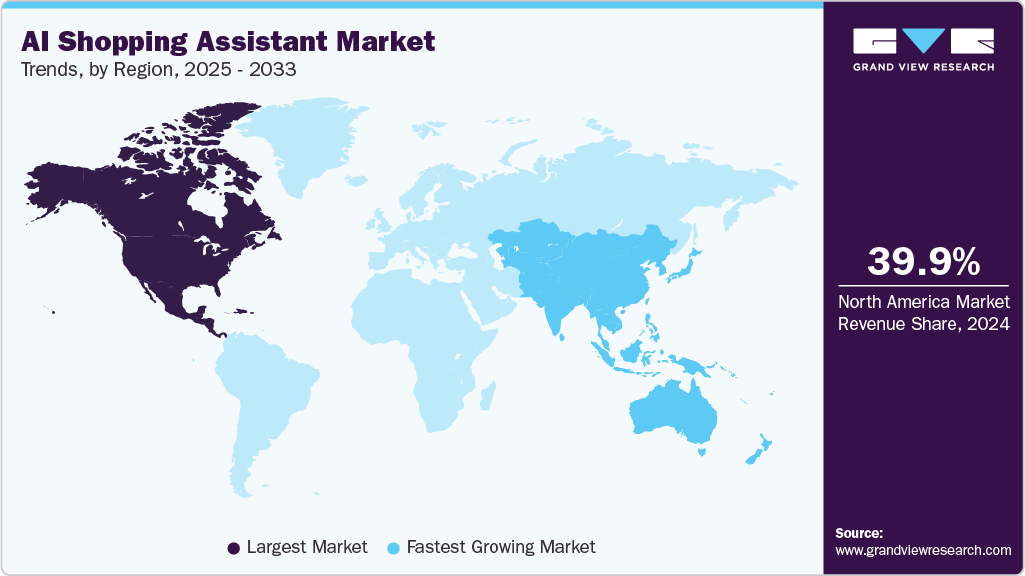
The global AI shopping assistant market size was valued at USD 3.4 billion in 2024 and is projected to grow from USD 5.4 billion in 2026 to USD 28.5 billion by 2033, at a CAGR of 26.9% from 2025 to 2033. North America dominated the market, accounting for a revenue share of 39.9% in 2024. This growth is driven by the increasing demand for personalized, real-time customer engagement across digital retail platforms, powered by advancements in natural language processing and conversational AI.
 Source: Grand View Research, IR Documents, Primary Interviews, Paid DatabasesTo learn more about this report,
 Download Free Sample Report
 Key Market Trends & Insights
- The AI shopping assistant industry in the U.S. is expected to grow at a significant CAGR over the forecast period.
- By offering, the solution segment led the market with the largest revenue share of 69.6% in 2024.
- By technology, the natural language processing (NLP) segment accounted for the largest market revenue share in 2024.
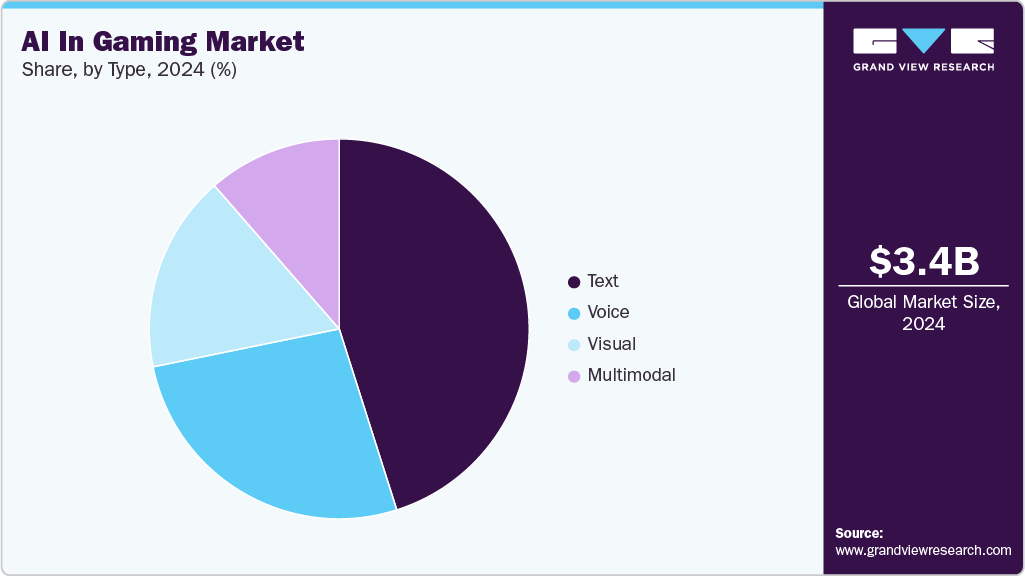
- By type, the text segment accounted for the largest market revenue share of 45.1% in 2024.
Market Size & Forecast
- 2024 Market Size: USD 3.4 Billion
- 2033 Projected Market Size: USD 28.5 Billion
- CAGR (2025-2033): 26.9%
- North America: Largest market in 2024
- Asia Pacific: Fastest Growing Market
Three ways to get this report
Buy it, customize it, or ask a question.Ask an Analyst
Analyst response in 1 business day
- AccessReport author, directly
- Reply timeWithin 1 working day
- No sales callDirect answer only
- FormatEmail reply
- CostFree, no cost
Get the Full Report
What the study covers
- FormatsPDF · Excel · Dashboard
- Timeline2025–2033 annual, 2024 base
- Coverage20+ countries, 5 regions
- Companies10+ key players profiled
Customize the Report
20% free customization
- IncludeCountries, segments, points
- TailorTo your product definition
- ExtendDeeper competitor detail
- OrA fully bespoke study
- Turnaround5–10 working days
The market growth is driven by growing consumer demand for personalized and seamless retail experiences. Increasing digitalization drives this demand by enabling customers to seek smooth, individualized, and efficient shopping journeys that traditional customer service models struggle to provide. AI shopping assistants leverage Natural Language Processing (NLP), Machine Learning (ML), and data analytics to offer real-time product recommendations, answer queries, and guide users through e-commerce platforms. Rising disposable incomes globally also contribute, as consumers look for convenient and tailored purchasing options that enhance their shopping satisfaction.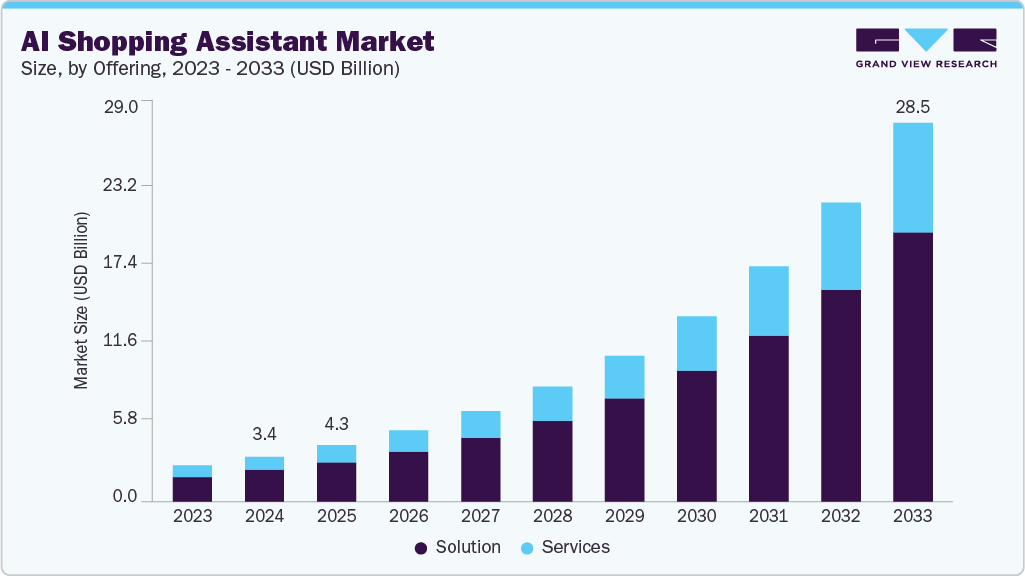 To learn more about this report, Download Free Sample Report
 Moreover, the expanding adoption of conversational AI and self-service shopping tools across industries supports the market's growth. AI shopping assistants are becoming more interactive, incorporating voice, text, and visual modes to engage customers on multiple platforms such as websites, mobile apps, and social media. Advances in generative AI and computer vision further enrich the shopping experience by enabling features such as virtual try-ons and dynamic product discovery. In addition, increasing integration of AI assistants into social commerce and omnichannel retail strategies enhances customer engagement and retention, driving broader market expansion.
Furthermore, market growth also depends on continuous innovation in AI technologies and increasing investments by major players to improve personalization and automation. For instance, in January 2025, NVIDIA Corporation introduced the NVIDIA AI Blueprint for retail shopping assistants, a generative AI reference framework aimed at revolutionizing online and in-store shopping experiences. Developed on the NVIDIA Omniverse and NVIDIA AI Enterprise platforms, this blueprint enables developers to build AI-powered assistants that complement and support human staff. The ability of AI shopping assistants to handle large volumes of customer interactions 24/7 and provide tailored solutions supports scalability for retailers. Moreover, expanding applications beyond retail into sectors such as healthcare and BFSI contribute to the market’s diversification. Despite data privacy and security challenges, ongoing efforts to address these concerns aim to build consumer trust, allowing AI shopping assistants to play a larger role in shaping the future of commerce.
Offering Insights
The solution segment led the market with the largest revenue share of 69.6% in 2024, due to its comprehensive offerings that directly address retailers' needs for AI-powered shopping assistants. These solutions include recommendation engines, virtual assistants, and voice-activated tools that integrate seamlessly with e-commerce platforms. Retailers prefer ready-to-use AI solutions that enhance customer engagement, improve conversion rates, and reduce operational costs. The ability to customize and scale these solutions across multiple channels, such as websites, mobile apps, and social media platforms, supports their widespread adoption, driving significant revenue share.
The services segment is predicted to experience at the fastest CAGR during the forecast period. Services related to AI shopping assistants, including consulting, integration, and support, gain momentum as businesses seek expert guidance to implement and optimize AI technologies. The growing complexity of AI systems and the need for ongoing maintenance, training, and customization create demand for professional services. In addition, as more enterprises adopt AI assistants, service providers expand their offerings to cover data management, analytics, and performance monitoring, contributing to the segment’s accelerated growth.
Technology Insights
The natural language processing (NLP) segment accounted for the largest market revenue share in 2024, as it enables AI shopping assistants to understand and engage with customers using natural, conversational language. This capability is fundamental for chatbots, voice assistants, and virtual agents that respond instantly to queries, product recommendations, and support. NLP allows AI systems to interpret intent, context, and sentiment, making interactions more human-like and effective. Its application spans multiple languages and dialects, broadening accessibility and enhancing user experience globally. Retailers benefit from NLP-driven assistants by reducing response times, increasing customer satisfaction, and lowering support costs. The continuous evolution of Natural Language Processing (NLP) models improves accuracy and expands use cases, solidifying its leadership in the AI shopping assistant industry.
The computer vision (CV) segment is expected to grow at the fastest CAGR during the forecast period, due to its ability to transform visual product discovery and customer engagement. CV technologies enable features such as visual search, where customers upload images to find similar products, and AR try-ons that allow virtual fitting of apparel, accessories, and cosmetics. These capabilities reduce purchase hesitation and return rates by providing more accurate product visualization. Retailers invest in CV to differentiate their offerings and meet the growing consumer demand for immersive, interactive shopping experiences. CV also supports inventory management and quality control in retail operations, further expanding its applications. Integrating CV with AI shopping assistants enhances personalization and convenience, driving rapid adoption and growth.
Type Insights
The text segment led the market with the largest revenue share of 45.1% in 2024, as it supports various applications, including chatbots on websites, messaging platforms, and in-app assistants. Text interfaces are widely accessible, easy to deploy, and familiar to users, making them a preferred initial type. These assistants handle diverse tasks such as answering product queries, assisting with order tracking, and providing personalized recommendations, improving customer engagement and satisfaction. Text-based AI assistants integrate well with existing customer service workflows, enabling automation without disrupting operations.
 To learn more about this report, Download Free Sample Report
 The multimodal segment is expected to experience at the fastest CAGR during the forecast period. Multimodal AI shopping assistants combine voice, text, and visual inputs to create more natural and flexible user experiences. This approach meets consumers' evolving expectations who prefer interacting with AI assistants using multiple channels, switching seamlessly between speaking, typing, and visual engagement. Multimodal systems enhance accessibility for diverse user groups, including those with disabilities or language barriers. They support complex shopping tasks such as product comparison, virtual try-ons, and personalized recommendations by leveraging multiple data types simultaneously. Retailers adopting multimodal AI assistants benefit from higher customer satisfaction and engagement, further supporting the growth.
End-use Insights
The retail & e-commerce segment accounted for the largest market revenue share in 2024, due to their early adoption and extensive use of AI shopping assistants to meet increasing consumer demands for personalized and efficient shopping experiences. The competitive nature of this sector drives continuous investment in AI tools that enhance product discovery, reduce cart abandonment, and increase conversion rates. AI assistants help retailers manage large product catalogs, deliver real-time support, and offer personalized promotions, creating a seamless shopping journey. The shift toward omnichannel retail strategies integrates AI assistants across physical stores, websites, and mobile apps, further expanding their impact.
The healthcare segment is anticipated to grow at the fastest CAGR during the forecast period, as these technologies expand beyond retail into patient engagement and healthcare product recommendations. AI assistants help patients navigate complex healthcare products, schedule appointments, and access personalized health information, improving overall user experience. The digitization of healthcare services and the rise of telemedicine increase the need for virtual assistants that provide timely, accurate support. AI shopping assistants in healthcare also assist with medication management and wellness product suggestions tailored to individual health profiles.
Regional Insights
North America dominated the AI shopping assistant market with the largest revenue share of 39.9% in 2024, due to its advanced technological infrastructure, high internet penetration, and early adoption of AI by major retailers and technology companies. The presence of key market players investing heavily in AI research and development drives innovation and deployment across various retail segments. Consumer demand for personalized shopping experiences and convenience supports the widespread adoption of AI assistants.
 To learn more about this report, Download Free Sample Report
 U.S. AI Shopping Assistant Market Trends
The AI shopping assistant market in the U.S. is expected to grow at a significant CAGR during the forecast period, as retailers increasingly integrate AI assistants into online and brick-and-mortar stores to enhance customer engagement and operational efficiency. High consumer awareness and acceptance of AI technologies encourage adoption across diverse retail formats. The country’s strong technology ecosystem, including leading AI research institutions and startups, accelerates innovation in AI shopping assistants. Retailers leverage AI to personalize marketing, optimize inventory management, and improve customer service, driving growth.
Europe AI Shopping Assistant Market Trends
The AI shopping assistant market in Europe is expected to grow at a significant CAGR during the forecast period, driven by increasing digital transformation initiatives among retailers and growing consumer acceptance of AI technologies. The region emphasizes responsible AI use and data privacy, which highlights consumer trust and encourages adoption. European governments and industry bodies invest in AI research and promote collaboration between technology providers and retailers to develop advanced AI shopping assistants.
Asia Pacific AI Shopping Assistant Market Trends
The AI shopping assistant market in Asia Pacific is anticipated to grow at the fastest CAGR over the forecast period, due to rapid e-commerce expansion, increasing smartphone penetration, and rising internet accessibility across emerging and developed markets. The region’s large, diverse consumer base demands localized and multilingual AI shopping assistants that cater to varied preferences and languages. Governments and private sector players invest heavily in AI infrastructure and innovation, supporting the developing and deployment of AI shopping assistants. The dynamic retail landscape, characterized by fast-growing online marketplaces and social commerce platforms, drives adoption.
Key AI Shopping Assistant Company Insights
Some key companies in the AI shopping assistant industry are Alibaba Group Holding Limited, Shopify Inc., Amazon.com, Inc., and Google LLC.
-
Google LLC is a prominent player in AI-driven shopping experiences, leveraging its advanced Gemini AI models. Its AI Mode offers hyper-personalized browsing with visual inspiration, dynamic filtering, and virtual try-on features that allow users to see apparel on themselves using uploaded photos. Google LLC's AI shopping assistant also includes an agentic checkout system that can complete purchases on behalf of users, enhancing convenience and confidence in online shopping. These innovations position Google LLC at the forefront of integrating AI to transform e-commerce and improve customer engagement.
-
Amazon.com, Inc. is a prominent player in the AI shopping assistant industry, utilizing advanced AI technologies to power personalized recommendations, virtual assistants, and voice-activated shopping through devices such as Alexa. Its AI capabilities enhance product discovery, streamline the customer journey, and support seamless transactions across its vast e-commerce ecosystem. Amazon.com, Inc.'s continuous innovation in AI-driven shopping tools strengthens its leadership by delivering tailored user experiences, reducing purchase friction, and driving higher customer satisfaction and loyalty.
Key AI Shopping Assistant Companies:
The following are the leading companies in the AI shopping assistant market. These companies collectively hold the largest market share and dictate industry trends.
- Alibaba Group Holding Limited
- Shopify Inc.
- Salesforce, Inc.
- eBay Inc.
- Google LLC
- Amazon.com, Inc.
- Meta Platforms, Inc.
- Microsoft
- Adobe Inc.
- IBM Corporation
Recent Developments
-
In July 2025, Amazon.com, Inc. expanded the availability of its AI-powered shopping assistant, Rufus, by launching it on a desktop-based web interface. Initially introduced in India in August 2024 exclusively through mobile apps, this rollout allows users to access Rufus via desktop, enhancing the shopping experience by providing real-time product recommendations, comparisons, and personalized assistance. Rufus leverages Amazon.com, Inc.'s extensive product catalog and information from across the web to help customers make more informed purchase decisions. The assistant remains in beta, with ongoing improvements based on user feedback to refine its responses and capabilities.
-
In July 2025, Wildberries, a prominent e-commerce platform in Eurasia, initiated pilot testing of an AI-powered assistant designed to enhance the shopping experience on its marketplace. Integrated within the Wildberries mobile application, the AI chatbot is currently accessible to a select group of test users, with plans for a broader deployment to the entire user base. This development aligns with the growing trend among leading e-commerce companies to leverage AI technologies for customer support, streamlined product discovery, and improved decision-making during online shopping.
-
In June 2025, Google LLC introduced Doppl, an experimental AI-powered shopping assistant that lets users virtually try on clothing and explore various styles through digital or animated representations. Launched for users in the U.S., Doppl leverages advanced computer vision and Machine Learning (ML) technologies to provide an immersive and interactive shopping experience, facilitating more informed fashion choices and reducing the need for physical trials. This initiative reflects Google LLC's ongoing efforts to integrate AI into retail, enhancing personalization and convenience in online shopping.
AI Shopping Assistant Market Report Scope
Report Attribute
Details
Market size in 2024
USD 3.4 billion
Estimated market size in 2026
USD 5.4 billion
Projected market size by 2033
USD 28.5 billion
Growth rate
CAGR of 26.9% from 2025 to 2033
Base year for estimation
2024
Historical data
2021 - 2023
Forecast period
2025 - 2033
Quantitative units
Revenue in USD million/billion and CAGR from 2025 to 2033
Report coverage
Revenue forecast, company ranking, competitive landscape, growth factors, and trends
Segments covered
End-use, type, offering, technology, region
Regional scope
North America; Europe; Asia Pacific; Latin America; MEA
Country scope
U.S.; Canada; Mexico; Germany; UK; France; China; India; Japan; Australia; South Korea; Brazil; UAE; South Africa; KSA
Key companies profiled
Alibaba Group Holding Limited; Shopify Inc.; Salesforce, Inc.; eBay Inc.; Google LLC; Amazon.com, Inc.; Meta Platforms, Inc.; Microsoft; Adobe Inc.; IBM Corporation
Customization scope
Free report customization (equivalent up to 8 analysts working days) with purchase. Addition or alteration to country, regional & segment scope.
Pricing and purchase options
Avail customized purchase options to meet your exact research needs. Explore purchase options
Global AI Shopping Assistant Market Report Segmentation
This report forecasts revenue growth at the global, regional, and country levels and provides an analysis of the latest industry trends in each of the sub-segments from 2021 to 2033. For this study, Grand View Research has segmented the global AI shopping assistant market report based on offering, technology, type, end-use, and region:
-
Offering Outlook (Revenue, USD Million, 2021 - 2033)
-
Solution
-
Services
-
-
Technology Outlook (Revenue, USD Million, 2021 - 2033)
-
Natural Language Processing (NLP)
-
Machine Learning (ML)
-
Computer Vision (CV)
-
Others
-
-
Type Outlook (Revenue, USD Million, 2021 - 2033)
-
Voice
-
Text
-
Visual
-
Multimodal
-
-
End-use Outlook (Revenue, USD Million, 2021 - 2033)
-
BFSI
-
Retail & E-Commerce
-
Healthcare
-
Travel & Hospitality
-
Media & Entertainment
-
Others
-
-
Regional Outlook (Revenue, USD Million, 2021 - 2033)
-
North America
-
U.S.
-
Canada
-
Mexico
-
-
Europe
-
Germany
-
UK
-
France
-
-
Asia Pacific
-
China
-
Japan
-
India
-
South Korea
-
Australia
-
-
Latin America
-
Brazil
-
-
Middle East and Africa (MEA)
-
UAE
-
KSA
-
South Africa
-
-
Frequently Asked Questions About This Report
The global AI shopping assistant market size was valued at USD 3.4 billion in 2024 and is estimated at USD 5.4 billion for 2026.
The global AI shopping assistant market is expected to grow at a CAGR of 26.9% from 2025 to 2033, reaching USD 28.5 billion by 2033.
Some key players operating in the AI shopping assistant market include: Alibaba Group Holding Limited; Shopify Inc.; Salesforce, Inc.; eBay Inc.; Google LLC; Amazon.com, Inc.; Meta Platforms, Inc.; Microsoft; Adobe Inc.; IBM Corporation
Key factors driving market growth include the increasing demand for personalized, real-time customer engagement across digital retail platforms, powered by advancements in natural language processing and conversational AI.
North America dominated with a revenue share of 39.9% in 2024. This growth is driven by the rising adoption of AI-driven personalization tools across retail and e-commerce platforms, enhancing customer engagement and operational efficiency.
About the Author(s)
Next Generation Technologies Research Team
Technology · Next Generation TechnologiesThis report was authored by the next generation technologies research team at Grand View Research - comprising two research analysts, one senior research analyst, and one industry expert - with specialized expertise in the next generation technologies segment of the technology industry. All findings are based on proprietary technology databases, executive interviews, and regulatory analysis, subject to internal peer review prior to publication.
Last Updated:
Speak to Analyst

Customize this report to your needs - add regions, segments, or data points, with 20% free customization.
Or view our licence options:


ISO 9001:2015 & 27001:2022 Certified
We are GDPR and CCPA compliant! Your transaction & personal information is safe and secure. For more details, please read our privacy policy.


