
- Home
- »
- Advanced Interior Materials
- »
-
ASEAN Environmental Test Chamber Market Report, 2035GVR Report cover

ASEAN Environmental Test Chamber Market (2027 - 2035)
Size, Share & Trends Analysis Report By Product (Temperature & Humidity Chamber, Thermal Shock Test Chamber), By Business Model (Product, Service), By Application, By End Use, By Country, And Segment Forecasts
Market Size, 2026
$36.3MMarket Estimate, 2027
$38.4MMarket Forecast, 2035
$64.0MCAGR, 2027–2035
6.6%ASEAN Environmental Test Chamber Market Summary
The ASEAN environmental test chamber market size was valued at USD 36.3 million in 2026 and is projected to grow from USD 38.4 million in 2027 to USD 64.0 million by 2035, at a CAGR of 6.6% from 2027 to 2035. Market is driven by expanding manufacturing activities across the automotive, electronics and semiconductors, aerospace, battery manufacturing, and telecommunications industries, which are intensifying the need for comprehensive product testing and quality assurance. Increasing requirements for product durability, operational reliability, and performance validation under varying temperature, humidity, and thermal cycling conditions are accelerating the adoption of environmental test chambers.
Key Market Trends & Insights
- By product: Temperature & humidity chamber segment accounted for the largest revenue share 41.2% in 2026.
- By business model: Service segment is projected to grow at the fastest CAGR of 7.1% over the forecast period
- By application: Research and development (R&D) segment is expected to register the fastest CAGR of 7.3% over the forecast period.
- By end use: Semiconductor & electronics segment held the largest market share of 39.3% in 2025.
Market Size & Forecast
- Market Size in 2026: USD 36.3 Million
- Estimated Market Size in 2027: USD 38.4 million
- Projected Market Size by 2035: USD 64.0 million
- CAGR (2027-2035): 6.6%
Prism AI by Grand View Research Free to tryAsk a question about the ASEAN environmental test chamber marketTry asking✓Every figure cited from GVR research Prefer the report? Download free sample →Additionally, rising investments in advanced manufacturing facilities and stringent quality standards are encouraging manufacturers to strengthen testing infrastructure. Growing emphasis on regulatory compliance, product development, and early failure detection is also reinforcing the integration of environmental simulation technologies across industrial testing processes.
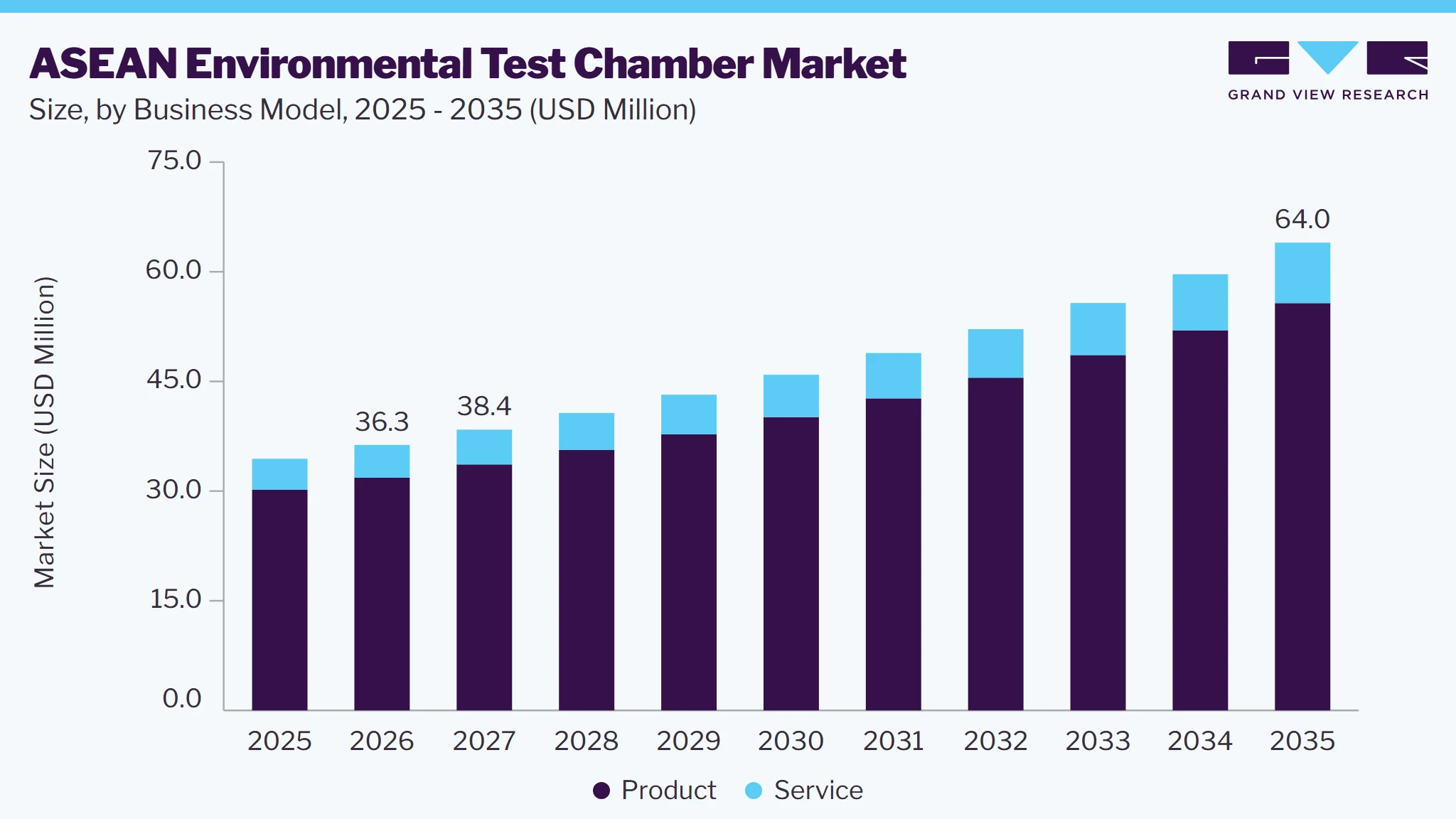 Source: Grand View Research, IR Documents, Primary Interviews, Paid DatabasesTo learn more about this report,
 Download Free Sample Report
Market Dynamics
The ASEAN environmental test chamber market is witnessing growth amid expanding industrial manufacturing, rising quality assurance requirements, and increasing investments in advanced testing infrastructure. The market is characterized by growing demand for precise temperature and humidity control, thermal cycling, accelerated stress testing, and automated monitoring capabilities across electronics and semiconductors, automotive, aerospace, and battery manufacturing. Equipment procurement is also influenced by capital expenditure, energy consumption, calibration requirements, and maintenance costs.
The expansion of electronics and semiconductor manufacturing across ASEAN is strengthening demand for environmental test chambers, as manufacturers increasingly prioritize component reliability and performance validation. Semiconductor devices, electronic assemblies, and circuit components undergo rigorous testing under varying temperature and humidity conditions to assess operational stability and identify potential failures. Investments in semiconductor fabrication, electronics assembly, and advanced manufacturing facilities across Singapore, Malaysia, Thailand, and Vietnam are generating demand for specialized testing infrastructure, particularly temperature, humidity, and thermal cycling chambers.
High procurement and operating costs remain a constraint on environmental test chamber adoption, particularly among small and medium-sized enterprises and independent testing laboratories. Advanced systems incorporating precise environmental controls, automated monitoring, and specialized testing capabilities require substantial initial investment. Moreover, electricity consumption, periodic calibration, and maintenance expenditures increase the overall cost of ownership, potentially delaying equipment upgrades and limiting the penetration of sophisticated testing systems among cost-sensitive end users.
The expansion of electric vehicle production and battery manufacturing across ASEAN is creating opportunities for specialized environmental testing solutions. Battery cells, modules, and packs require rigorous evaluation under varying temperature and humidity conditions to establish thermal stability, operational reliability, and performance consistency. Increasing investments in regional battery production and electric vehicle supply chains are creating scope for advanced temperature chambers, thermal cycling systems, and battery-specific environmental testing configurations. This presents manufacturers with opportunities to expand their application portfolios and address the evolving validation requirements of the regional electric mobility industry.
Market Concentration & Characteristics
The ASEAN environmental test chamber market exhibits a fragmented competitive structure, characterized by the coexistence of multinational equipment manufacturers, specialized technology providers, and regional suppliers. Competitive positioning is largely determined by technological expertise, engineering capabilities, product customization, precision engineering, and the breadth of application-specific solutions. The relatively diverse supplier base, coupled with varying technical requirements across industrial verticals, contributes to a competitive environment in which differentiation and specialized product capabilities remain central to market positioning.
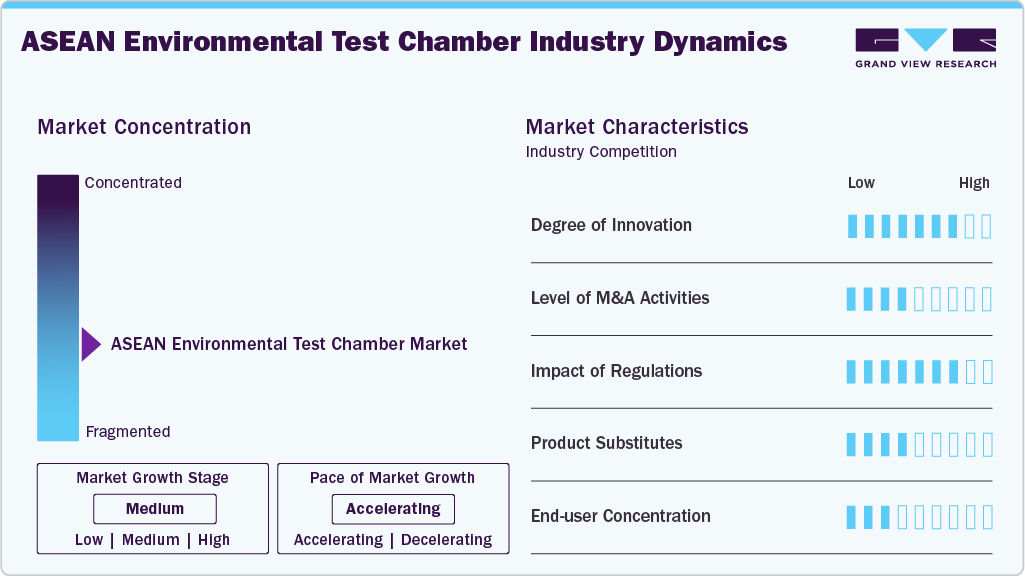 To learn more about this report, Download Free Sample Report
Technological advancement and product differentiation constitute important dimensions of competitive positioning, particularly as end-use industries increasingly require sophisticated environmental simulation capabilities. Manufacturers are progressively enhancing chamber configurations through precise temperature and humidity regulation, thermal shock simulation, accelerated stress testing, and integrated monitoring capabilities to address increasingly complex product validation requirements. Additionally, advancements in energy efficiency, automation, and testing precision are strengthening the technological differentiation of market participants, while evolving industrial quality benchmarks continue to elevate performance expectations.
The market's operating environment is increasingly influenced by stringent product certification requirements, international testing protocols, and industry-specific compliance frameworks, necessitating greater precision and consistency in environmental simulation processes. The specialized engineering requirements of these systems, alongside the technical limitations of alternative testing approaches, reinforce the relevance of dedicated chamber solutions across critical industrial applications.
Analyst Perspective
The ASEAN environmental test chamber market is gaining traction amid expanding manufacturing capabilities, industrial diversification, and increasing emphasis on product reliability and quality assurance. Growth in semiconductor and electronics, automotive, battery manufacturing, aerospace, and pharmaceutical industries is strengthening the requirement for controlled environmental simulation across product development, qualification, and production processes. Increasing product complexity and stringent performance specifications are encouraging the adoption of temperature and humidity chambers, thermal shock systems, walk-in chambers, and vibration testing equipment. Singapore and Malaysia benefit from established semiconductor manufacturing ecosystems, while Thailand and Vietnam are witnessing expanding automotive and electronics production activities. Indonesia's developing battery and electric vehicle supply chain is also creating opportunities for specialized testing infrastructure.
Product Insights
The temperature & humidity chamber segment accounted for the largest revenue share of 41.2% in 2026. The segment's leading position is attributable to its extensive application in evaluating product performance under controlled temperature and humidity conditions across semiconductor & electronics, automotive, and pharmaceutical industries. Increasing emphasis on product reliability, quality assurance, and compliance with stringent testing standards continues to sustain segment demand.
The thermal shock test chamber segment is projected to register the fastest CAGR of 7.1% over the forecast period. Growth is primarily attributable to increasing requirements for assessing the durability of electronic components, automotive parts, and battery systems under rapid temperature fluctuations. The expansion of semiconductor manufacturing and electric vehicle production across ASEAN is further accelerating the adoption of thermal shock testing equipment.
Business Model Insights
The product segment held for the largest revenue share of 87.7% in 2026. Its leading position reflects the capital-intensive nature of environmental testing infrastructure and the requirement for specialized chambers across manufacturing and quality-control facilities. Semiconductor, automotive, and electronics manufacturers continue to invest in advanced testing equipment to evaluate product reliability and meet industry-specific performance standards.
The service segment is projected to register the fastest CAGR of 7.1% over the forecast period. Growth is attributable to increasing requirements for equipment installation, calibration, preventive maintenance, repair, and technical support. The growing installed base of environmental test chambers across industrial facilities is also generating recurring demand for specialized after-sales services.
Application Insights
The production & inspection segment dominated for the largest revenue share of 61.6% in 2026. Its leading position is primarily attributable to the extensive utilization of environmental test chambers for quality assurance, product validation, and reliability assessment during manufacturing processes. Increasing production volumes across semiconductor & electronics, automotive, and battery manufacturing industries are contributing to segment expansion.
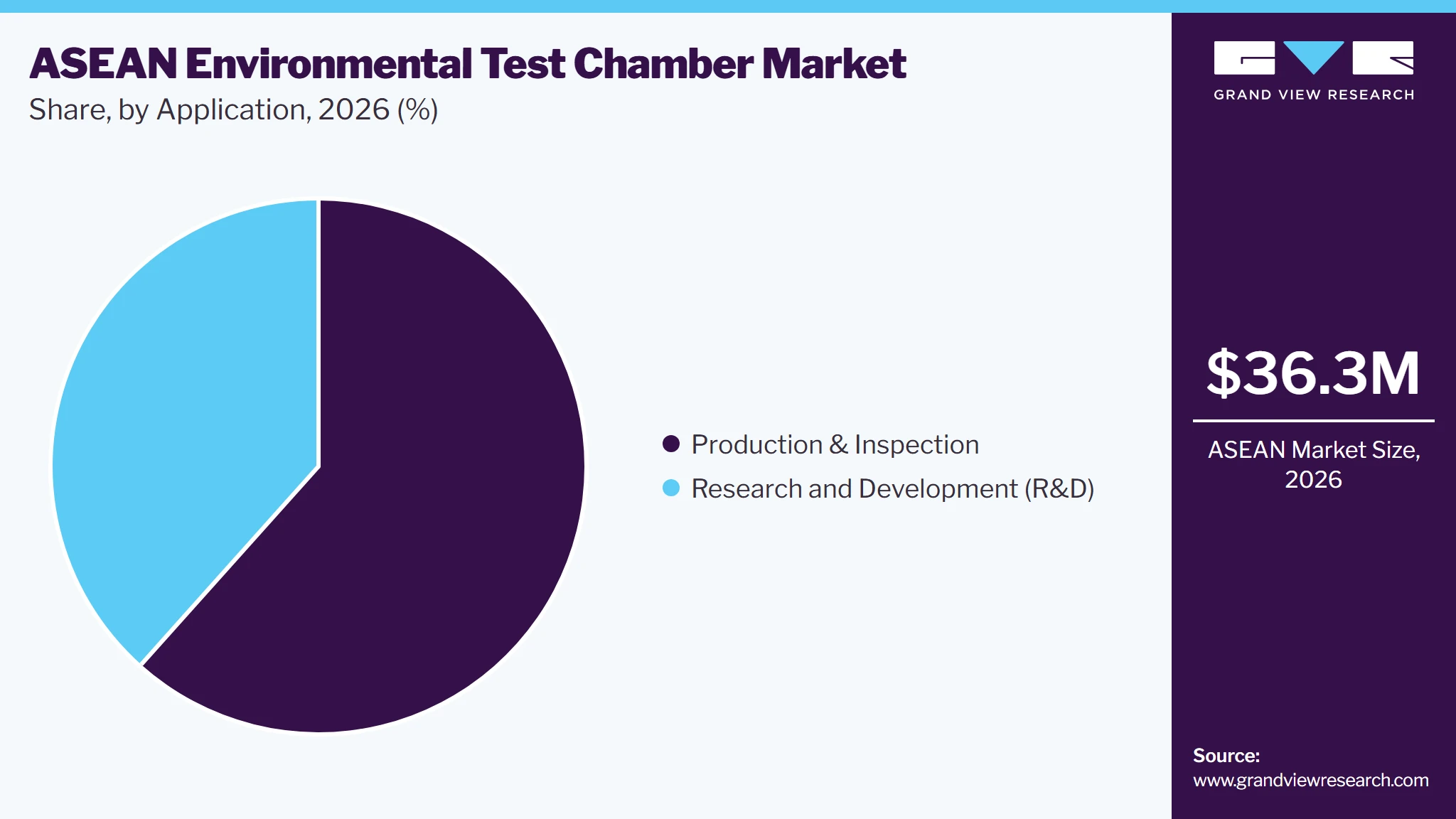 To learn more about this report, Download Free Sample Report
Research and development is expected to register the fastest growth during the forecast period, supported by increasing investments in advanced product development, semiconductor technologies, battery innovation, and next-generation electronic components. Manufacturers are expanding R&D capabilities to develop products with improved performance, durability, and operational efficiency, increasing the need for specialized environmental testing equipment. The growing complexity of electronic devices, EV battery systems, and advanced materials is encouraging the use of environmental test chambers during prototype development, material evaluation, and product qualification. Additionally, investments in research laboratories, engineering centers, and advanced manufacturing technologies across ASEAN are expected to create further growth opportunities for this segment.
End Use Insights
Semiconductor & electronics segment held the largest revenue share of 39.3% in 2026, supported by the region's established semiconductor manufacturing, electronics assembly, and component production industries. The increasing production of integrated circuits, printed circuit boards, sensors, and advanced electronic devices is driving the need for environmental testing during product qualification and manufacturing inspection. Manufacturers rely on temperature and humidity chambers, thermal shock systems, and vibration testing equipment to assess component reliability and identify potential failures under varying operating conditions. The expansion of semiconductor fabrication, assembly, testing, and packaging activities, along with increasing adoption of AI, 5G, and high-performance computing technologies, is further supporting demand from this segment.
Battery manufacturing is expected to register the fastest growth at CAGR of 7.2% over the forecast period, driven by increasing investments in electric vehicle production, lithium-ion battery manufacturing, and energy storage systems across ASEAN. Battery manufacturers require specialized environmental testing equipment to evaluate cell performance, thermal stability, durability, and safety under different temperature and humidity conditions. The growing development of battery production facilities and integrated EV supply chains is increasing the need for thermal shock, temperature cycling, and vibration testing systems.
Country Insights
Thailand Environmental Test Chamber Market Trends
Thailand represents an important market for environmental test chambers in ASEAN, supported by its established automotive manufacturing base and expanding semiconductor, electronics, and electric vehicle industries. The country's growing focus on advanced manufacturing, industrial automation, and technology development is increasing the need for specialized testing equipment across manufacturing and R&D facilities. Environmental test chambers are used to support component qualification, product reliability assessment, and quality inspection, particularly in automotive electronics, battery systems, semiconductor components, and electrical equipment. The expansion of domestic manufacturing capabilities and increasing participation of global companies in high-technology industries are creating opportunities for environmental testing equipment suppliers.
Vietnam Environmental Test Chamber Market Trends
Vietnam is projected to register the fastest CAGR of 7.3% in the ASEAN environmental test chamber market over the forecast period, supported by the expansion of its electronics manufacturing industry, growing semiconductor investments, and increasing participation in global manufacturing supply chains. The country's manufacturing sector includes production of electronic components, smartphones, computers, semiconductor devices, and electrical equipment, creating demand for specialized testing systems. Environmental test chambers are used by manufacturers and component suppliers to assess product reliability, conduct temperature and humidity testing, and identify potential failures during product development and production inspection. The growing presence of multinational electronics and semiconductor companies is also encouraging investments in advanced testing infrastructure and quality assurance capabilities.
Malaysia Environmental Test Chamber Market Trends
Malaysia accounted for the largest revenue share of 25.4% of the ASEAN environmental test chamber market in 2026, driven by its well-established semiconductor and electronics manufacturing ecosystem, increasing investments in advanced packaging, and expanding high-technology production activities. The country is a major hub for semiconductor assembly, testing, and packaging, with a strong presence of multinational electronics manufacturers and component suppliers. The increasing complexity of semiconductor devices, automotive electronics, and industrial electronic systems is creating a greater need for precise environmental testing during product development and manufacturing. Temperature and humidity chambers, thermal shock systems, and vibration chambers are particularly relevant for component qualification, accelerated reliability testing, and quality inspection. Malaysia's focus on strengthening domestic semiconductor capabilities and moving toward higher-value manufacturing activities is expected to create additional opportunities for advanced testing equipment suppliers.
Indonesia Environmental Test Chamber Market Trends
Indonesia presents growing opportunities for the environmental test chamber market, supported by the expansion of its automotive, electronics, semiconductor, and battery manufacturing industries. The country's focus on strengthening domestic manufacturing capabilities and increasing its participation in global technology supply chains is encouraging investments in advanced production and testing infrastructure. Environmental test chambers are relevant for evaluating electronic components, automotive systems, battery cells, and industrial equipment during product development and manufacturing. The expansion of EV production, battery manufacturing, and semiconductor-related activities is creating opportunities for specialized testing equipment across industrial and research facilities.
Philippines Environmental Test Chamber Market Trends
The Philippines represents a promising market for environmental test chambers, supported by its established semiconductor assembly, testing and packaging (ATP) industry and growing electronics manufacturing capabilities. The country has a strong presence of semiconductor manufacturers, electronics component suppliers, and outsourced manufacturing service providers involved in integrated circuit packaging, printed circuit board assembly, and electronic systems manufacturing. These activities create demand for environmental testing equipment to support component qualification, product reliability assessment, and manufacturing quality control. The increasing development of advanced electronics, automotive components, communication equipment, and industrial instrumentation is further creating opportunities for specialized temperature and humidity chambers, thermal shock systems, and vibration testing equipment
Singapore Environmental Test Chamber Market Trends
Singapore's environmental test chamber market is distinguished by its advanced semiconductor fabrication, aerospace engineering, biomedical manufacturing, and precision technology industries. The presence of technologically sophisticated production facilities and research institutions is sustaining requirements for high-precision environmental simulation systems capable of supporting stringent product qualification procedures. Investments in advanced semiconductor technologies, aerospace components, and biomedical research are increasing the complexity of testing requirements, particularly concerning temperature stability, humidity control, and environmental stress assessment. The country's emphasis on high-value manufacturing and engineering research is reinforcing demand for technologically advanced testing configurations.
Key ASEAN Environmental Test Chamber Company Insights
Some of the key players operating in the market include ESPEC CORP, Weiss Technik, and BINDER GmbH.
-
ESPEC CORP. is an established Japanese engineering company specializing in environmental testing and reliability evaluation equipment. The company has developed a global presence through subsidiaries and sales and service networks across North America, Europe and Asia. It is publicly listed on the Tokyo Stock Exchange and operates across environmental test equipment, energy device testing and semiconductor-related equipment. Its long operating history and international presence position it among the established players in the environmental test chamber industry.
-
Weiss Technik is a German industrial technology company and part of the Schunk Group, a global technology group. The company specializes in environmental simulation and air-conditioning technology, serving industrial and scientific applications. Its development has been shaped by the integration of established businesses, including Vötsch, a pioneer in environmental simulation technology founded in 1929. Weiss Technik has an international operating presence, with subsidiaries and production and service facilities across several markets covering Asia Pacific, Europe, Africa, North America, and Latin America. Its established engineering capabilities and global network support its position in the environmental test chamber industry.
Key ASEAN Environmental Test Chamber Companies
-
ESPEC CORP
-
Weiss Technik
-
BINDER GmbH
-
Thermotron Industries
-
GUANGDONG KOMEG INDUSTRIAL CO., LTD
-
Suga Test Instruments Co.,Ltd
-
Obsnap Instruments Sdn Bhd
-
Letotronics
-
Vietnam Wujinglang Technology Co., Ltd.
-
Dongling Technologies Co., Ltd
Competitive Benchmarking
Category
Operating Strategies
Competitive Edge
Weakness
Established Players (e.g., ESPEC Corporation, Weiss Technik, BINDER GmbH, Thermotron Industries, Suga Test Instruments Co., Ltd.)
- Focus on continuous product innovation and development of advanced environmental testing systems.
- Expand global distribution networks and strengthen technical support and after-sales services.
- Offer customized testing solutions for semiconductor, automotive, aerospace, and electronics industries.
- Strong international brand recognition and established customer relationships.
- Broad product portfolios covering temperature, humidity, thermal shock, and vibration testing.
- Extensive technical expertise and established global distribution networks.
- Relatively higher equipment procurement and installation costs.
- Longer delivery timelines for customized testing systems.
- Higher operating costs associated with advanced testing technologies.
Emerging & Regional Players (e.g., Guangdong KOMEG Industrial Co., Ltd., Obsnap Instruments Sdn. Bhd., Letotronics, Vietnam Wujinglang Technology Co., Ltd., Dongling Technologies Co., Ltd.)
- Focus on cost-effective and application-specific environmental testing equipment.
- Strengthen regional distribution partnerships and direct customer relationships.
- Expand product portfolios to address growing demand from electronics and industrial manufacturing.
- Competitive pricing and flexible customization capabilities.
- Greater responsiveness to regional customer requirements.
- Potential advantages in localized technical support and delivery.
- - Comparatively lower international brand recognition.
- - Limited global distribution and service infrastructure.
- - Relatively fewer resources for advanced technology development and large-scale expansion.
Recent Developments
-
In June 2026, ESPECT CORP launched the GSH-64V Bench-Top Temperature & Humidity Chamber in Thailand, which is a compact, space-saving environmental test chamber featuring a 64-liter test volume and high-precision temperature control ranging from -40°C to +150°C alongside a 20% to 98% RH humidity range. Designed for research, quality evaluation, and reliability testing, it combines remote monitoring capabilities with an LCD touch control panel utilizing BT(H)C and PID control to maintain strict temperature stability and efficient heating/cooling rates.
-
In March 2026, KOMEG launched its KFH-1000SF4W0 Ultra-Low Temperature Test Chamber, achieving a minimum temperature of -90°C, extending beyond the conventional -70°C limit of standard environmental test chambers. The 1,000-litre chamber offers a temperature range of -90°C to +180°C, a linear cooling rate of 4°C/min, temperature fluctuation of ±0.5°C and temperature uniformity of ≤2°C at -90°C. Featuring an advanced cascade refrigeration system, vacuum insulation and programmable temperature profiles, the equipment targets extreme-environment testing applications across aerospace, new energy battery research and biological sample preservation.
ASEAN Environmental Test Chamber Market Report Scope
Report Attribute
Details
Market Size in 2026
USD 36.3 million
Estimated market Size in 2027
USD 38.4 million
Revenue forecast in 2035
USD 64.0 million
Growth Rate
CAGR of 6.6% from 2027 to 2035
Base year for estimation
2026
Historical data
2023 - 2025
Forecast period
2027 - 2035
Quantitative units
Revenue in USD million and CAGR from 2027 to 2035
Report coverage
Revenue forecast, company market position analysis, competitive landscape, growth factors, and trends
Segments covered
Product, business model, application, end use, country
Country Scope
Thailand, Vietnam, Malaysia, Indonesia, Philippines, Singapore
Key companies profiled
ESPEC Corporation; Weiss Technik; BINDER GmbH; Thermotron Industries; Guangdong KOMEG Industrial Co., Ltd.; Suga Test Instruments Co., Ltd.; Obsnap Instruments Sdn. Bhd.; Letotronics; Vietnam Wujinglang Technology Co., Ltd.; Dongling Technologies Co., Ltd.
Customization scope
Free report customization (equivalent up to 8 analysts working days) with purchase. Addition or alteration to country, regional & segment scope.
Pricing and purchase options
Avail customized purchase options to meet your exact research needs. Explore purchase options
ASEAN Environmental Test Chamber Market Report Segmentation
This report forecasts revenue growth at country levels and provides an analysis of the latest industry trends in each of the sub-segments from 2023 to 2035. For this study, Grand View Research has segmented the ASEAN environmental test chamber market report based on product, business model, application, end use and country.
-
Product Outlook (Revenue, USD Million, 2023 - 2035)
-
Temperature & Humidity Chamber
-
Thermal Shock Test Chamber
-
Walk-in Chamber
-
Vibration Chambers
-
Other
-
-
Business Model Outlook (Revenue, USD Million, 2023 - 2035)
-
Product
-
Service
-
-
Application Outlook (Revenue, USD Million, 2023 - 2035)
-
Research and Development (R&D)
-
Production & Inspection
-
-
End Use Outlook (Revenue, USD Million, 2023 - 2035)
-
Semiconductor & Electronics
-
Automotive
-
Battery Manufacturing
-
Aerospace
-
Telecom & Communications
-
Medical & Pharmaceutical
-
Others
-
-
Country Outlook (Revenue, USD Million, 2023 - 2035)
-
Thailand
-
Vietnam
-
Malaysia
-
Indonesia
-
Philippines
-
Singapore
-
Research Methodology
The ASEAN environmental test chamber market figures in this report are based on a proven research process that combines executive interviews with secondary research from proprietary databases, company filings, and recognized regulatory and institutional sources. Market size is built through value-chain sizing-reconciling supply-side and demand-side estimates-and triangulated with bottom-up and top-down approaches. Every estimate passes multiple levels of expert validation before publication, with each ASEAN environmental test chamber segment quantified using the revenue-capture definitions in the table below.
Segment Definition
Product
Revenue Capture Definition
Temperature & Humidity Chamber
Revenue generated from the sale of environmental chambers designed to simulate controlled temperature and humidity conditions for product reliability, stability, and performance testing.
Thermal Shock Test Chamber
Revenue generated from the sale of thermal shock chambers designed to subject test specimens to rapid temperature transitions to evaluate thermal resistance and material integrity.
Walk-in Chamber
Revenue generated from the sale of walk-in environmental chambers designed for large-scale testing of components, equipment, and assemblies under controlled temperature and humidity conditions.
Vibration Chambers
Revenue generated from the sale of vibration testing chambers and integrated systems designed to evaluate product resistance to mechanical vibration and environmental stress.
Other
Revenue generated from the sale of specialized environmental testing chambers, including altitude, corrosion, climatic, and other application-specific simulation systems.
Business Model
Revenue Capture Definition
Product
Revenue generated from the sale of environmental test chambers, associated testing equipment, integrated systems, and replacement components.
Service
Revenue generated from installation, commissioning, calibration, preventive maintenance, repair, validation, and technical support services for environmental test chambers.
Application
Revenue Capture Definition
Research and Development (R&D)
Revenue generated from the sale of environmental test chambers deployed in research and development activities to assess material characteristics, product performance, and reliability under simulated environmental conditions.
Production & Inspection
Revenue generated from the sale of environmental test chambers utilized in manufacturing processes, quality assurance, production inspection, and product reliability verification.
End Use
Revenue Capture Definition
Semiconductor & Electronics
Revenue generated from the sale of environmental test chambers used to evaluate the reliability, thermal stability, and performance of semiconductor devices, electronic components, and circuit assemblies.
Automotive
Revenue generated from the sale of environmental test chambers used to assess the durability, reliability, and environmental resistance of automotive components, vehicle electronics, and associated systems.
Battery Manufacturing
Revenue generated from the sale of environmental test chambers used to evaluate battery performance, thermal stability, operational reliability, and safety under controlled environmental conditions.
Aerospace
Revenue generated from the sale of environmental test chambers used to validate the performance, durability, and environmental resistance of aerospace components, materials, and electronic systems under extreme operating conditions.
Telecom & Communications
Revenue generated from the sale of environmental test chambers used to assess the reliability and environmental resilience of telecommunications infrastructure, networking equipment, and communication devices.
Medical & Pharmaceutical
Revenue generated from the sale of environmental test chambers used for stability testing, performance evaluation, and reliability assessment of medical devices, pharmaceutical products, and related equipment.
Others
Revenue generated from the sale of environmental test chambers across other industries, including defense, energy, industrial manufacturing, and consumer goods
Estimation Model
Layer Name
Key Question
Description
End-Use Industry Demand Assessment Layer
Which industrial sectors underpin demand for environmental test chambers?
Evaluates demand across semiconductor and electronics, automotive, battery manufacturing, aerospace, telecommunications, and medical and pharmaceutical industries. The assessment incorporates regional manufacturing activity, capital expenditure, production capacity expansion, industrial infrastructure development, and industry-specific product qualification requirements across ASEAN economies.
Environmental Testing Requirements Assessment Layer
What testing specifications determine chamber requirements across industrial applications?
Examines the adoption of environmental testing across research and development, production, and inspection activities. The analysis considers temperature and humidity cycling, thermal shock exposure, vibration testing, climatic simulation, product qualification protocols, and reliability assessment requirements, accounting for variations in testing specifications across end-use industries.
Equipment Adoption & Replacement Assessment Layer
How do equipment adoption, utilization, and replacement patterns influence market demand?
Assesses the adoption of temperature and humidity chambers, thermal shock test chambers, walk-in chambers, vibration chambers, and other specialized systems. The evaluation incorporates installed equipment base, chamber capacity, technological specifications, automation levels, utilization rates, equipment replacement cycles, and recurring requirements for calibration, maintenance, and technical support.
Revenue & Market Estimation Layer
What is the revenue potential across product categories, business models, applications, and end-use industries?
Quantifies market revenue across product, service, application, end-use, and country segments by integrating equipment installations, average selling prices, replacement demand, service contracts, and industry-specific testing requirements. Market estimates are developed through a hybrid top-down and bottom-up methodology, supported by historical trend analysis, primary research, statistical modeling, and cross-validation of country-level and segment-level estimates.
Delivered Customizations
This report has been delivered with the following In-depth customizations
Client Request
Customization Delivered
Value Adds
Competitive Benchmarking
A comprehensive competitive benchmarking assessment was conducted covering environmental test chamber manufacturers and suppliers operating across the ASEAN market. The assessment examined product portfolios, including temperature and humidity chambers, thermal shock chambers, walk-in chambers, and vibration chambers, alongside technical specifications, testing capabilities, application suitability, distribution networks, and strategic developments.
Enabled stakeholders to evaluate competitive positioning, benchmark product capabilities, identify technological differentiation, and formulate effective product development and market positioning strategies.
Regional Segmentation
A detailed country-level assessment was conducted across Thailand, Vietnam, Malaysia, Indonesia, the Philippines, and Singapore, examining demand in relation to manufacturing investments, industrial development, semiconductor and electronics production, automotive manufacturing, and battery industry expansion.
Provided insights into country-specific demand patterns, regional market potential, and industrial investment trends, supporting geographic prioritization, market expansion, and resource allocation decisions.
Opportunity Assessment
A comprehensive opportunity assessment was undertaken across product, application, and end-use segments by evaluating manufacturing capacity expansion, environmental testing requirements, product reliability standards, industrial automation, and demand for advanced testing infrastructure. Opportunities were examined across temperature and humidity chambers, thermal shock systems, walk-in chambers, and vibration testing equipment.
Enabled stakeholders to identify high-potential product and end-use segments, assess emerging demand across ASEAN economies, prioritize technological development, and strengthen market-entry, expansion, and investment strategies.
Frequently Asked Questions About This Report
The ASEAN environmental test chamber market was valued at USD 36.3 million in 2026 and is estimated to reach USD 38.4 million in 2027.
The ASEAN environmental test chamber market is projected to grow at a CAGR of 6.6% from 2027 to 2035, reaching USD 64.0 Million by 2035.
Semiconductor & electronics segment held the largest revenue share of 39.3% in 2026 and battery manufacturing segment is second fastest growing market
The production & inspection segment dominated for the largest revenue share of 61.6% in 2026 while research and development segment is expected to be the fastest-growing market.
The temperature & humidity chamber segment dominated the product segment with a revenue share of 41.2% in 2026, driven by its extensive application in evaluating product performance under controlled temperature and humidity conditions across semiconductor & electronics, automotive, and pharmaceutical industries.
Key players include ESPEC Corporation; Weiss Technik; BINDER GmbH; Thermotron Industries; Guangdong KOMEG Industrial Co., Ltd.; Suga Test Instruments Co., Ltd.; Obsnap Instruments Sdn. Bhd.; Letotronics; Vietnam Wujinglang Technology Co., Ltd.; Dongling Technologies Co., Ltd.
The market is driven by the expansion of electronics and semiconductor manufacturing, automotive and battery production, rising quality assurance requirements, stringent testing standards, increasing investments in advanced manufacturing facilities, and growing demand for product reliability and environmental simulation testing.
The product segment held for the largest revenue share of 87.7% in 2026.
About the Author(s)
Advanced Interior Materials Research Team
Advanced Materials · Advanced Interior MaterialsThis report was authored by the advanced interior materials research team at Grand View Research - comprising two research analysts, one senior research analyst, and one industry expert - with specialized expertise in the advanced interior materials segment of the advanced materials industry. All findings are based on proprietary advanced materials databases, executive interviews, and regulatory analysis, subject to internal peer review prior to publication.
Last Updated:
Speak to Analyst

Customize this report to your needs - add regions, segments, or data points, with 20% free customization.
Or view our licence options:


ISO 9001:2015 & 27001:2022 Certified
We are GDPR and CCPA compliant! Your transaction & personal information is safe and secure. For more details, please read our privacy policy.


