
- Home
- »
- Consumer F&B
- »
-
Asia Pacific Food Away from Home Market Size Report, 2033GVR Report cover

Asia Pacific Food Away from Home Market (2026 - 2033) Size, Share & Trends Analysis Report By Type [Hospitality (Full-Service Restaurants, Quick Service Restaurants), Catering (Workplace, Healthcare, Education, Services)], By Country, And Segment Forecasts
Market Size, 2025
$1,807.9BMarket Estimate, 2026
$1,925.0BMarket Forecast, 2033
$2,725.9BCAGR, 2026–2033
5.1%Asia Pacific Food Away From Home Market Summary
The Asia Pacific food away from home market was valued at USD 1,807.89 billion in 2025 and is expected to grow from USD 1,924.95 billion in 2026 to USD 2,725.92 billion by 2033, growing at a CAGR of 5.1% from 2026 to 2033. The market is primarily driven by rapid urbanization and changing consumer lifestyles that favor convenience and dining out.
Key Market Trends & Insights
- By type, the hospitality market held the largest share of 94.2% in 2025.
- By type, the catering market is expected to grow at a CAGR of 3.5% from 2026 to 2033.
Market Size & Forecast
- 2025 Market Size: USD 1,807.89 Billion
- 2033 Projected Market Size: USD 2,725.92 Billion
- CAGR (2026-2033): 5.1%
- China: Largest market in 2025
- India: Fastest growing market
Prism AI by Grand View Research Free to tryAsk a question about the asia pacific food away from home marketTry asking✓Every figure cited from GVR research Prefer the report? Download free sample →
The growing working population, especially in urban areas, has increased demand for quick-service restaurants and ready-to-eat options. Additionally, the expansion of food delivery platforms and evolving taste preferences toward diverse cuisines further fuel market growth. The market is further supported by the expansion of tourism and hospitality sectors, which increases demand for dining services across diverse formats. According to the data published in April 2026, food is now one of the top three reasons people travel in Asia in 2026, with many prioritizing culinary experiences over traditional sightseeing. Leading this shift, Taiwan, Vietnam, and South Korea attract visitors through authentic local cuisine, food tours, and immersive dining experiences.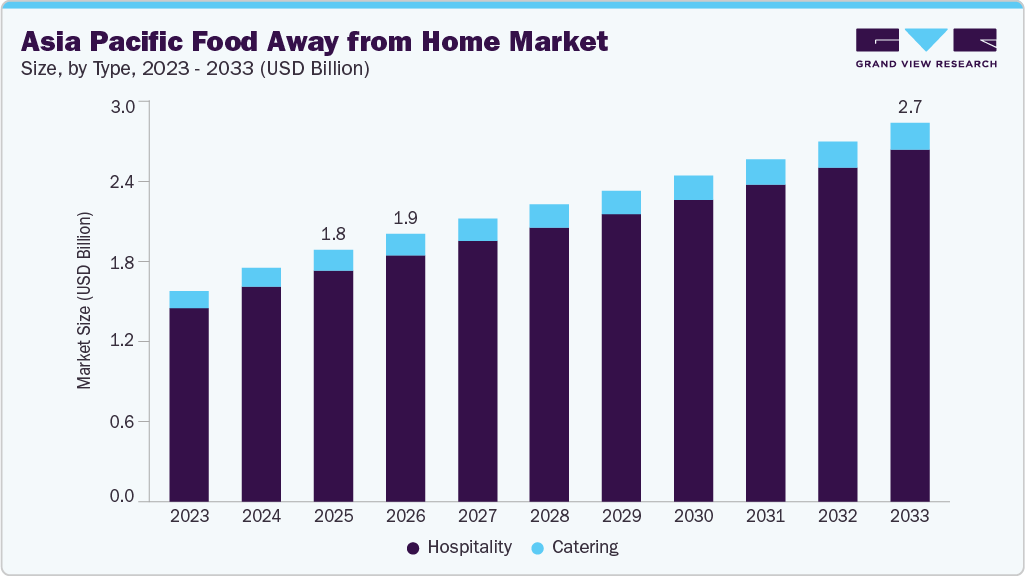 Source: Grand View Research, IR Documents, Primary Interviews, Paid DatabasesTo learn more about this report,
 Download Free Sample Report
Moreover, growing investments in infrastructure and commercial spaces have enabled the proliferation of food courts, cafés, and casual dining outlets. Additionally, shifting social habits, such as frequent gatherings and celebrations outside the home, continue to strengthen consumption in this segment.
The Asia Pacific food away from home market is also influenced by the increasing focus on menu innovation and customization to suit local tastes and dietary preferences. The adoption of sustainable practices, such as eco-friendly packaging and waste reduction, is gaining importance among both consumers and foodservice providers. Partnerships between food brands and delivery aggregators are enhancing visibility and expanding customer reach across urban and semi-urban areas. In November 2025, foodpanda partnered with ride-hailing services across Asia to offer integrated benefits to pandapro subscribers, aiming to enhance convenience and everyday value. This collaboration reflects a broader strategy to expand its ecosystem beyond food delivery by linking transport and lifestyle services across multiple Asian markets.
Furthermore, the integration of technology such as cloud kitchens and AI-driven demand forecasting is reshaping operational efficiency and service quality.
The Asia Pacific food away from home market is also shaped by evolving consumer expectations around speed, hygiene, and overall dining experience. Increased awareness of health and wellness has encouraged foodservice providers to introduce more balanced and ingredient-transparent offerings. The popularity of flexible dining formats, such as grab-and-go and hybrid dine-in models, is improving accessibility for time-constrained consumers. Additionally, stronger brand engagement through loyalty programs and personalized promotions is helping build repeat customer behavior.
Market Dynamics
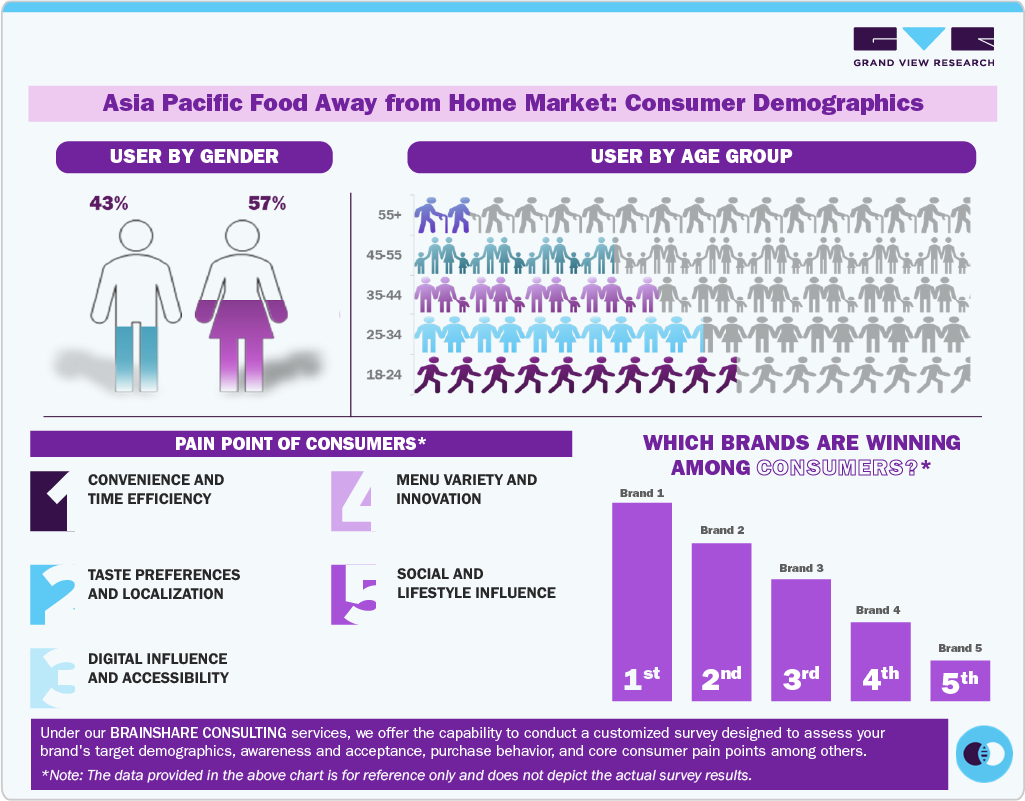
The expanding working population in the Asia Pacific, particularly in urban areas, is increasing the number of consumers with limited time for home cooking. As more people engage in full-time employment and longer working hours, the demand for convenient meal solutions continues to rise. This shift is driving higher consumption of quick-service restaurants, ready-to-eat meals, and grab-and-go food options. Busy lifestyles are encouraging consumers to prioritize speed and accessibility over traditional home-prepared meals. As a result, convenience-oriented food services are becoming a key growth driver for the Food Away from Home market.
In addition, Gen Z in India is further strengthening out-of-home dining demand through experience-led consumption behavior. According to the data published in May 2026, more than 60% of Gen Z consumers dine out at least once a week, indicating strong and consistent engagement with the restaurant sector. Their preferences are increasingly influenced by unique, experience-focused, and concept-driven dining formats rather than purely functional eating occasions.
Growing at-home consumption alternatives are acting as a restraint for the Food Away from Home market as more consumers opt for convenient in-home dining solutions. The availability of ready-to-cook meal kits, improved grocery delivery services, and high-quality packaged foods is making home dining more appealing. These options allow consumers to enjoy convenience similar to restaurants while avoiding the cost of eating out. As a result, some frequency of restaurant visits is being replaced by in-home meal preparation and consumption. This shift limits overall growth potential for the Food Away from Home market despite rising convenience-driven demand.
 To learn more about this report, Download Free Sample Report
Type Insights
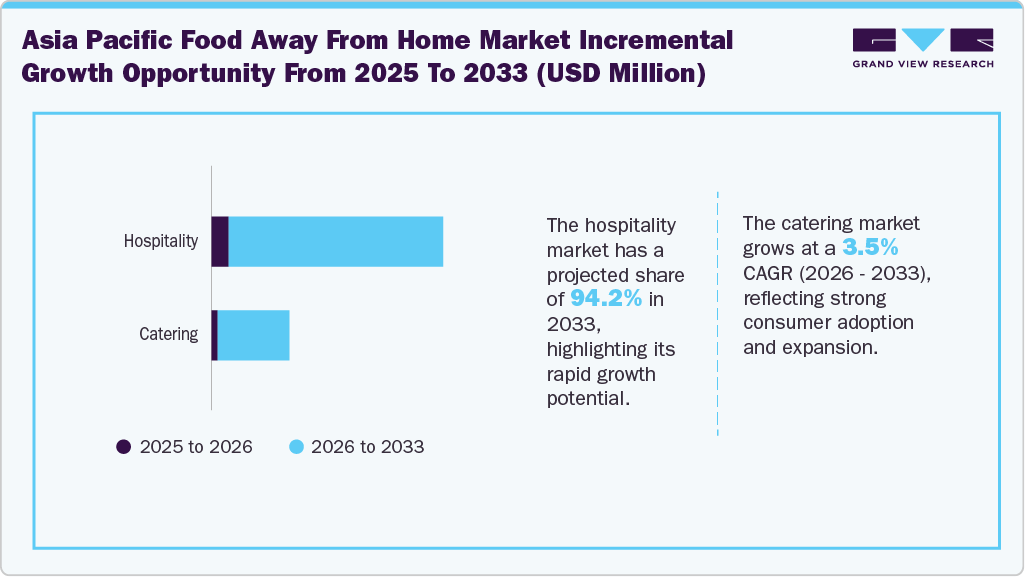
The hospitality market accounted for the largest share of 94.2% of the revenue in 2025. The Asia Pacific food away from home market in the hospitality segment is driven by the expansion of hotels, resorts, and experiential stays catering to both business and leisure travelers. Rising demand for premium dining experiences within hotel rooms is prompting hotels to diversify their food offerings. Increased focus on integrated services, where food becomes part of the overall guest experience, is also strengthening this segment. Additionally, partnerships with celebrity chefs and curated menus are enhancing the appeal of in-house dining options.
 To learn more about this report, Download Free Sample Report
The catering industry is projected to grow at a CAGR of 3.5% from 2026 to 2033. The Asia Pacific food away from home market in the catering segment is supported by the growing number of corporate events, conferences, and large-scale social functions. Outsourcing food services by institutions such as offices, schools, and healthcare facilities is further boosting demand. Emphasis on standardized meal quality and timely large-volume service is making professional caterers more essential. Moreover, the rising preference for customized and themed event menus is creating additional opportunities for service providers.
Country Insights
The Asia Pacific food away-from-home market is experiencing significant growth, driven by evolving consumption patterns that increasingly favor convenience-oriented meal solutions. A growing preference for diverse culinary experiences is encouraging frequent visits to foodservice outlets across different formats. The rapid expansion of organized foodservice networks is also improving consistency and accessibility for consumers. In addition, stronger integration of digital platforms streamlines ordering and enhances overall service efficiency.
China Food Away-From-Home Market Trends
The China food away-from-home market accounted for a share of 45.9% of the revenues in 2025. The market is driven by strong urban consumer demand and a fast-paced lifestyle that encourages frequent external dining. The widespread adoption of mobile payment ecosystems has made transactions seamless across foodservice outlets. In February 2026, Alipay announced that its AI Pay system processed over 120 million transactions in a single week in China, showing rapid adoption of AI-enabled and contactless digital payments across retail and foodservice ecosystems. The surge reflects how deeply AI-driven, seamless payment systems are being integrated into everyday consumer transactions, including dining and food ordering platforms. Moreover, the continuous expansion of modern retail dining formats and branded chains is improving accessibility and standardization. Additionally, cultural emphasis on social dining occasions continues to support consistent consumption in this segment.
India Food Away-From-Home Market Trends
The India food away from home market is anticipated to grow at the fastest CAGR of 6.3% during the forecast period. The India food away-from-home market is supported by a young demographic profile with increasing preference for eating out and ordering in. The rapid growth of organized food delivery platforms is transforming how consumers access meals across urban and semi-urban regions. Rising disposable income levels are enabling greater discretionary spending on food experiences. Furthermore, the popularity of quick-service formats and street food modernization is broadening the consumer base. According to the data published in March 2026, Swiggy, Zomato, and Magicpin saw food delivery growth rebound during October-December, 2025, driven by festive demand, affordability-led pricing, and rising users, especially in smaller cities. Zomato’s growth accelerated while Swiggy’s GOV rose 20.5% with strong order volumes and expanding transacting users.
Japan Food Away-From-Home Market Trends
The Japan food away from home market is expected to grow at a CAGR of 5.5% during the forecast period. The Japan food away-from-home market is influenced by a strong culture of convenience-oriented dining and high demand for quality and precision in food offerings. Extensive availability of compact dining formats such as vending-based meals and small eateries supports daily consumption needs. Technological integration in ordering and service systems enhances efficiency and customer experience. Additionally, an aging population is encouraging growth in ready-to-eat and nutritionally balanced foodservice options.
Key Asia Pacific Food Away from Home Company Insights
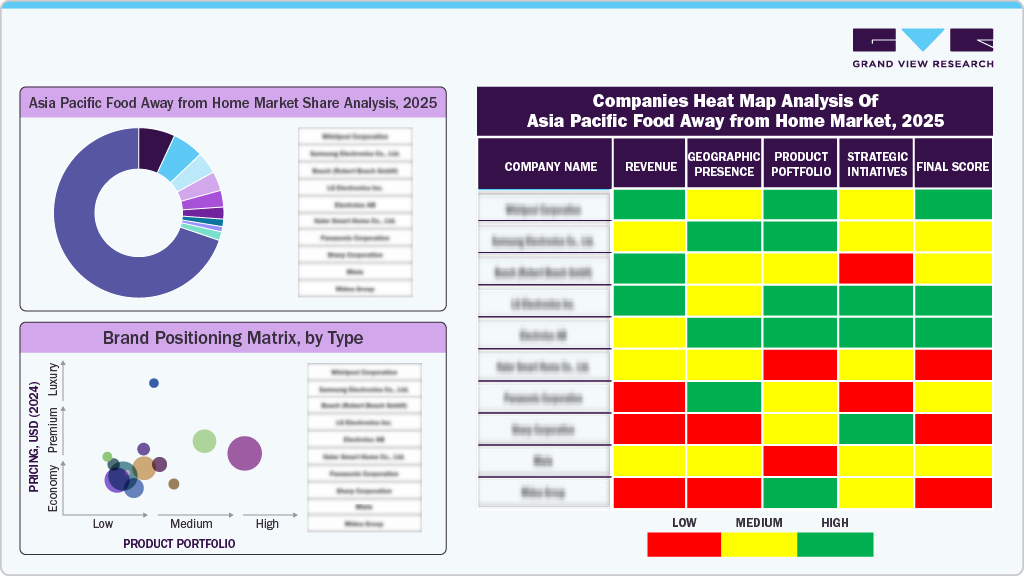
The Asia Pacific food away from home industry is highly competitive, with global chains such as McDonald’s, Starbucks Coffee Company, Yum! Brands, and Domino’s maintaining strong regional footprints through extensive store networks and brand recognition. At the same time, regional leaders like Jollibee Foods Corporation, Yum China, and local quick-service operators are strengthening their positions through localized menus and pricing strategies.
Institutional foodservice providers such as Sodexo and Compass Group also play a key role, especially in corporate and large-scale catering operations. Overall, market share is shaped by a mix of international scalability, regional adaptability, and strong franchise-based expansion models.
Digital-first foodservice aggregators and cloud kitchen operators are also reshaping competitive dynamics by enabling asset-light expansion and faster market penetration. Local players continue to gain traction by leveraging deep understanding of regional taste preferences and price sensitivity. Strategic partnerships, acquisitions, and franchise collaborations remain key approaches for companies aiming to strengthen their presence across diverse markets in the Asia Pacific food away from home industry.
 To learn more about this report, Download Free Sample Report
Key Asia Pacific Food Away from Home Companies:
-
Yum China Holdings (KFC, Pizza Hut, Taco Bell)
-
Domino’s Pizza
-
McDonald's
-
Starbucks Coffee Company
-
Compass Group PLC
-
Sodexo S.A
-
Aramark Corporation
-
Elior Group
-
Restaurant Brands International Inc.
-
Sysco Corporation
Recent Developments
-
In February 2026, Swiggy expanded its “Food on Train” service with IRCTC across India, now reaching about 152 railway stations to improve passenger convenience during journeys. The expansion includes wider menu options, pre-ordering features, and delivery directly to train seats at selected stops.
-
In January 2026, Alibaba upgraded its Qwen AI app to expand beyond conversation into an “agentic” system capable of performing real-world tasks such as ordering food, making payments, and booking travel directly within the interface. The update deepens integration with Alibaba’s ecosystem, including services such as Taobao, Alipay, and travel platforms, enabling users to complete end-to-end actions without switching apps.
-
In November 2025, foodpanda partnered with ride-hailing services across Asia to offer integrated benefits to pandapro subscribers, aiming to enhance convenience and everyday value. This collaboration reflects a broader strategy to expand its ecosystem beyond food delivery by linking transport and lifestyle services across multiple Asian markets.
Asia Pacific Food Away from Home Market Report Scope
Report Attribute
Details
Market value size in 2026
USD 1,924.95 billion
Revenue forecast in 2033
USD 2,725.92 billion
Growth rate
CAGR of 5.1% from 2026 to 2033
Actual data
2021 - 2025
Forecast period
2026 - 2033
Quantitative units
Revenue in USD Million, and CAGR from 2026 to 2033
Report coverage
Revenue forecast, company ranking, competitive landscape, growth factors, and trends
Segments covered
Type, country
Country scope
China; Japan; India; Australia & New Zealand; South Korea; Vietnam; Thailand
Key companies profiled
Yum China Holdings (KFC, Pizza Hut, Taco Bell); Domino’s Pizza; McDonald's; Starbucks Coffee Company; Compass Group PLC; Sodexo S.A.; Aramark Corporation; Elior Group; Restaurant Brands International Inc.; Sysco Corporation
Customization scope
Free report customization (equivalent up to 8 analysts’ working days) with purchase. Addition or alteration to country, regional & segment scope.
Pricing and purchase options
Avail customized purchase options to meet your exact research needs. Explore purchase options
Asia Pacific Food Away from Home Market Report Segmentation
This report forecasts revenue growth at the regional and country levels and provides an analysis of the latest industry trends and opportunities in each of the sub-segments from 2021 to 2033. For the purpose of this study, Grand View Research has segmented the Asia Pacific food away from home market report on the basis of type and country.
-
Type Outlook (Revenue, USD Million, 2021 - 2033)
-
Hospitality
-
Full Service Restaurants
-
Casual Dining
-
Premium Dining
-
-
Quick Service Restaurants
-
Large Global Fast Food Brand
-
Traditional Takeaway & Delivery
-
Café & Coffee Specialist
-
Food to go Specialties
-
-
Pubs & Bars
-
Tenanted & Leased
-
Managed
-
Freehouse
-
-
Accommodation
-
Hotels
-
Beds & Breakfast
-
Holiday Camps
-
Caravan Parks
-
Youth Hostels
-
-
Leisure
-
Visitors Attraction
-
Entertainment
-
Sports stadia & track
-
Sports Club & Gym
-
Event & Mobile Caterers
-
On Board Travel
-
-
-
Catering
-
Workplace
-
Manufacturing
-
Finance & Professional
-
Other Workplace
-
-
Healthcare
-
State Hospital
-
Private Hospital
-
Care Home
-
Day Centers
-
-
Education
-
State School
-
Independent School
-
Further Education
-
Special School
-
Nurseries
-
-
Services
-
Government Services
-
-
-
-
Country Outlook (Revenue, USD Million, 2021 - 2033)
-
China
-
Japan
-
India
-
Australia & New Zealand
-
South Korea
-
Vietnam
-
Thailand
-
Delivered Customizations
This report has been delivered with the following In-depth customizations
Client Request
Customization Delivered
Value Adds
Asia Pacific Food Away from Home (FAFH) Demand & Consumption Pattern Analysis
Comprehensive assessment of out-of-home eating behavior across Asia Pacific, covering urban working population, Gen Z consumers, and middle-income households. Analysis includes dining frequency, spending patterns, impulse dining, and shift toward convenience-led formats such as QSRs, cafés, food courts, and grab-and-go outlets.
Identify key demand drivers across consumer segments and support development of targeted pricing, menu, and format strategies for different dining occasions and income groups.
Digital Foodservice Ecosystem & Delivery Platform Penetration Assessment
Evaluation of food delivery adoption, cloud kitchen expansion, and integration of foodservice with super apps across Asia Pacific markets. Covers aggregator dominance, platform-driven restaurant visibility, loyalty programs, and hybrid dine-in + delivery business models.
Enable brands to optimize omnichannel strategies, improve last-mile efficiency, and strengthen partnerships with delivery aggregators to increase market reach and order frequency.
Tourism, Experience-Led Dining & Regional Consumption Trends Benchmarking
Analysis of tourism-driven food demand and experiential dining growth across key Asia Pacific destinations. Includes rising importance of culinary tourism, local cuisine exploration, Gen Z preference for unique dining concepts, and increasing spend on premium dining experiences.
Identify high-value tourism corridors and experience-led dining opportunities to design differentiated restaurant concepts and enhance revenue from non-resident consumers and leisure segments.
Frequently Asked Questions About This Report
The Asia Pacific food away from home market is expected to grow at a compound annual growth rate (CAGR) of 5.1 % from 2026 to 2033 to reach USD 2,725.92 billion by 2033.
The Asia Pacific food away from home market size was estimated at USD 1,807.89 billion in 2025 and is expected to reach USD 1,924.95 billion in 2026.
By type, the hospitality market accounted for the largest share of 94.2% in 2025, driven by the growing number of hotels, resorts, and experience-focused accommodations serving both corporate and leisure travelers.
Some key players operating in the Asia Pacific food away from home market include Yum China Holdings (KFC, Pizza Hut, Taco Bell), Domino’s Pizza, McDonald's, Starbucks Coffee Company, Compass Group PLC, Sodexo S.A., Aramark Corporation, Elior Group, Restaurant Brands International Inc., and Sysco Corporation.
Key factors driving growth in the Asia Pacific food away from home market include rapid urbanization and changing consumer lifestyles that favor convenience and dining out. The expansion of quick-service restaurants, food delivery platforms, and international food chains has also increased market accessibility and variety.
About the Author(s)
Consumer F&B Research Team
Consumer Goods · Consumer F&BThis report was authored by the consumer f&b research team at Grand View Research - comprising two research analysts, one senior research analyst, and one industry expert - with specialized expertise in the consumer f&b segment of the consumer goods industry. All findings are based on proprietary consumer goods databases, executive interviews, and regulatory analysis, subject to internal peer review prior to publication.
Last Updated:
Speak to Analyst

Customize this report to your needs - add regions, segments, or data points, with 20% free customization.
Or view our licence options:


ISO 9001:2015 & 27001:2022 Certified
We are GDPR and CCPA compliant! Your transaction & personal information is safe and secure. For more details, please read our privacy policy.


