
- Home
- »
- Clothing, Footwear & Accessories
- »
-
Asia Pacific Underwear Market Size And Share Report, 2033GVR Report cover

Asia Pacific Underwear Market (2026 - 2033)
Size, Share & Trends Analysis Report By Gender (Women, Men), By Distribution Channel (Department Stores, Supermarkets, Online, Underwear Shop), By Country (China, Hong Kong, Taiwan, South Korea), And Segment Forecasts
Market Size, 2025
$28.3BMarket Estimate, 2026
$30.4BMarket Forecast, 2033
$51.6BCAGR, 2026–2033
7.9%Asia Pacific Underwear Market Summary
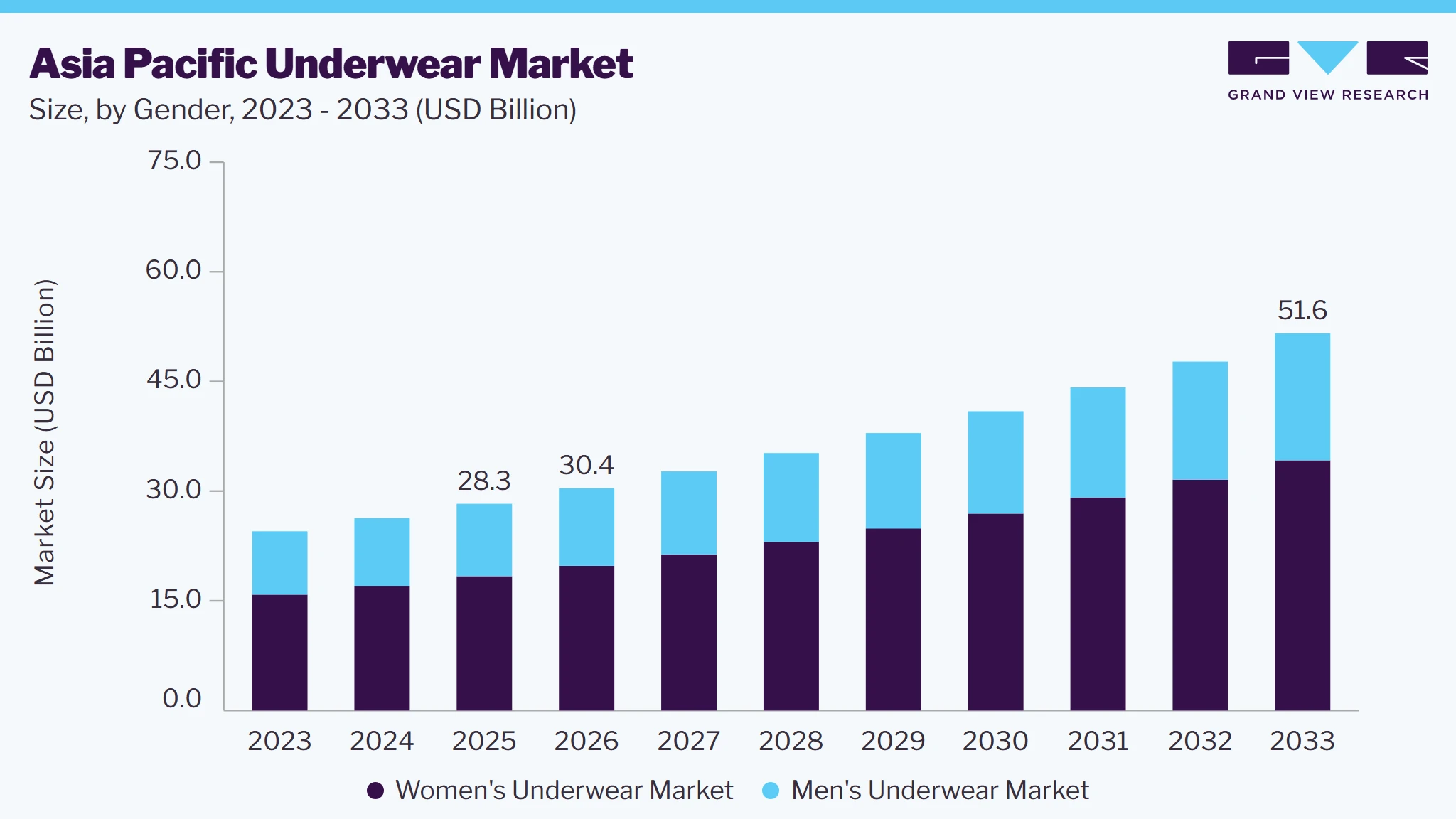
The Asia Pacific underwear market size was valued at USD 28.3 billion in 2025 and is projected to grow from USD 30.4 billion in 2026 to USD 51.6 billion by 2033, at a CAGR of 7.9% from 2026 to 2033. The market is experiencing strong growth, driven by rising demand for comfortable, functional, and fashion-oriented underwear across urban and digitally connected consumers in the region. This growth is further supported by rising disposable incomes, rapid urbanization, and increasing consumer awareness of comfort, hygiene, and fashion.
Key Market Trends & Insights
- By gender: Women's underwear segment held the largest market share of 64.9% in 2025.
- By distribution channel: Department stores segment held the largest market share of 25.7% in 2025.
Market Size & Forecast
- Market size in 2025: USD 28.3 Billion
- Estimated market size in 2026: USD 30.4 Billion
- Projected market size by 2033: USD 51.6 Billion
- CAGR (2026-2033): 7.9%
Prism AI by Grand View Research Free to tryAsk a question about the asia pacific underwear market✓Every figure cited from GVR research Prefer the report? Download free sample →
Consumers are shifting toward premium innerwear that offers enhanced comfort, breathable fabrics, seamless designs, and functional features. The growing influence of e-commerce, social media, and fashion-conscious younger populations is further accelerating demand for branded and premium underwear across countries such as China, India, Japan, and South Korea.The market is also witnessing a notable shift toward technologically advanced and sustainable underwear products. Brands are increasingly introducing moisture-wicking, antimicrobial, temperature-regulating, and eco-friendly innerwear made from recycled fibers, bamboo, and organic cotton to meet evolving consumer preferences. In February 2025, Wacoal India unveiled its Spring/Summer 2025 (SS'25) collection, featuring lightweight, breathable, and comfort-focused lingerie designed for warmer climates. The launch reflects the growing consumer preference for functional innerwear that combines innovative fabrics, comfort, and premium design across the Asia Pacific. This trend highlights the industry's growing emphasis on product innovation, performance-oriented fabrics, and premiumization as key factors influencing consumer purchasing decisions across the region.
 Source: Grand View Research, IR Documents, Primary Interviews, Paid DatabasesTo learn more about this report,
 Download Free Sample Report
In the Asia Pacific, urban style-conscious consumers are increasingly driving underwear purchases. In markets like Seoul and Shanghai, women buy lingerie and shapewear that complements outerwear such as high-waist pants and crop tops, while men choose boxer briefs with bold prints and logos for casual layering. Brands like Aimer and Triumph have tapped into this trend by offering collections designed for visible style, not just basic coverage.
Functional comfort for climate and lifestyle is another critical driver. Hot and humid regions such as Southeast Asia have fueled demand for breathable, moisture-wicking fabrics, while countries like Japan and South Korea see high adoption of stretchable, seamless designs suitable for office wear and commuting. Jockey India and Wacoal Japan have leveraged this by introducing region-specific fabric technologies that meet both comfort and durability needs.
Digital influence and social commerce are transforming buying behavior. Platforms like Tmall, Lazada, Shopee, and Xiaohongshu allow consumers to explore domestic and international brands, view real-life styling by influencers, and access limited collections quickly. Campaigns such as Wacoal’s influencer-led seasonal launches in China or Adore Me’s men’s underwear debut online have successfully created buzz, enabling brands to reach urban and semi-urban consumers beyond traditional retail channels.
Market Dynamics
The Asia-Pacific underwear industry is primarily driven by rising consumer demand for comfortable, functional, and premium innerwear across rapidly urbanizing economies such as China, India, Japan, and South Korea. Rising disposable incomes, greater health and hygiene awareness, and evolving fashion preferences are encouraging consumers to purchase underwear made from breathable, moisture-wicking, seamless, and stretchable fabrics. The expansion of e-commerce platforms, direct-to-consumer brands, and social media marketing has further improved access to branded products, particularly among younger, digitally connected consumers. In addition, innovations in sustainable materials, antimicrobial fabrics, and climate-adaptive designs support premiumization and drive recurring purchases across men's, women's, and children's underwear categories.
The widespread availability of low-cost counterfeit and unorganized underwear products remains a key restraint for the Asia Pacific underwear industry. Price-sensitive consumers in several emerging economies often opt for inexpensive local brands and counterfeit products, limiting the penetration of premium and branded innerwear. In addition, fluctuations in raw material prices, particularly for cotton and synthetic fibers, increase manufacturing costs and create pressure on established brands. Intense competition from regional manufacturers and limited consumer willingness to pay premium prices in rural and semi-urban markets continue to challenge revenue growth and brand differentiation across the region.
Analyst Perspective
The Asia Pacific underwear market is evolving from a basic apparel category into a value-driven, innovation-led market, supported by growing consumer preference for premium, functional, and sustainable innerwear. Consumer purchasing decisions are increasingly influenced by factors such as comfort, fabric technology, fitness, and durability, prompting brands to invest in breathable, moisture-wicking, antimicrobial, and eco-friendly materials. The rapid expansion of e-commerce platforms, direct-to-consumer brands, and omnichannel retail strategies is improving product accessibility and strengthening brand engagement across the region. In addition, younger consumers are driving demand for fashion-forward and performance-oriented underwear that aligns with evolving lifestyle preferences, while rising disposable incomes and premiumization trends continue to support long-term market growth across the Asia Pacific.
Brand Share Analysis
 To learn more about this report, Download Free Sample Report
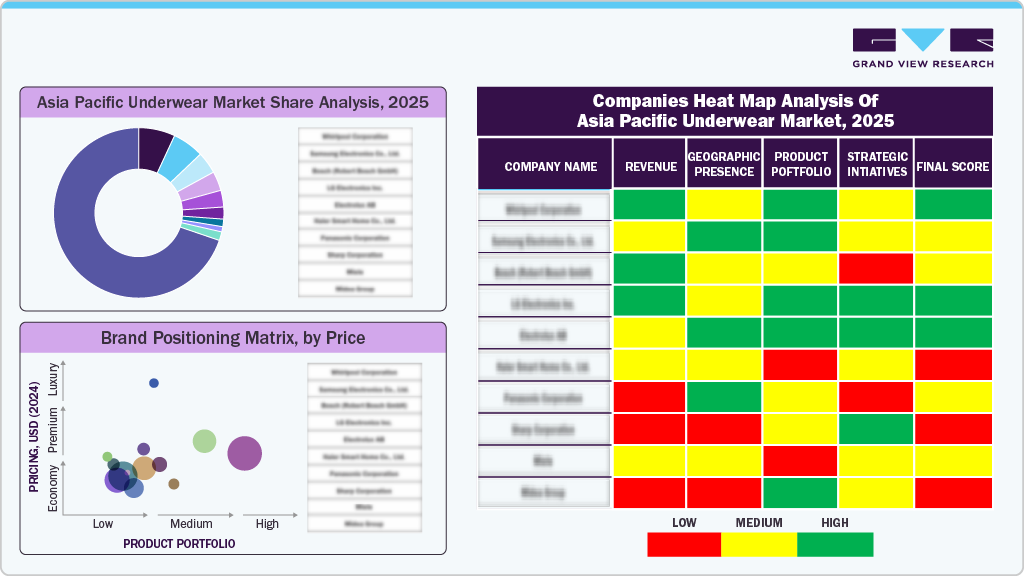
A mix of strong regional manufacturers, global apparel brands, and rapidly growing digital-first labels, each serving distinct consumer needs across price, comfort, and fashion segments, drives the Asia Pacific underwear market.
-
Established regional leaders: Wacoal, Aimer, Triumph, BYC - dominate the market through deep local presence, extensive physical retail networks, and product ranges tailored to regional body types and cultural preferences.
-
Global mass brands: Jockey, Uniqlo, Hanes - perform strongly in everyday basics, leveraging affordability, consistent quality, and wide availability across department stores and multi-brand outlets.
-
Premium and fashion-focused brands: Victoria’s Secret (APAC), Peach John, Sabina - target urban consumers with stylish lingerie, shapewear, and trend-driven collections, especially in markets like Japan, China, and South Korea.
-
Digital-native and local players: Neiwai (China), Zivame (India), HerRoom Asia - gain traction through e-commerce platforms, influencer marketing, and direct-to-consumer models, appealing to younger, digitally engaged shoppers.
Consumer Insights
 To learn more about this report, Download Free Sample Report
-
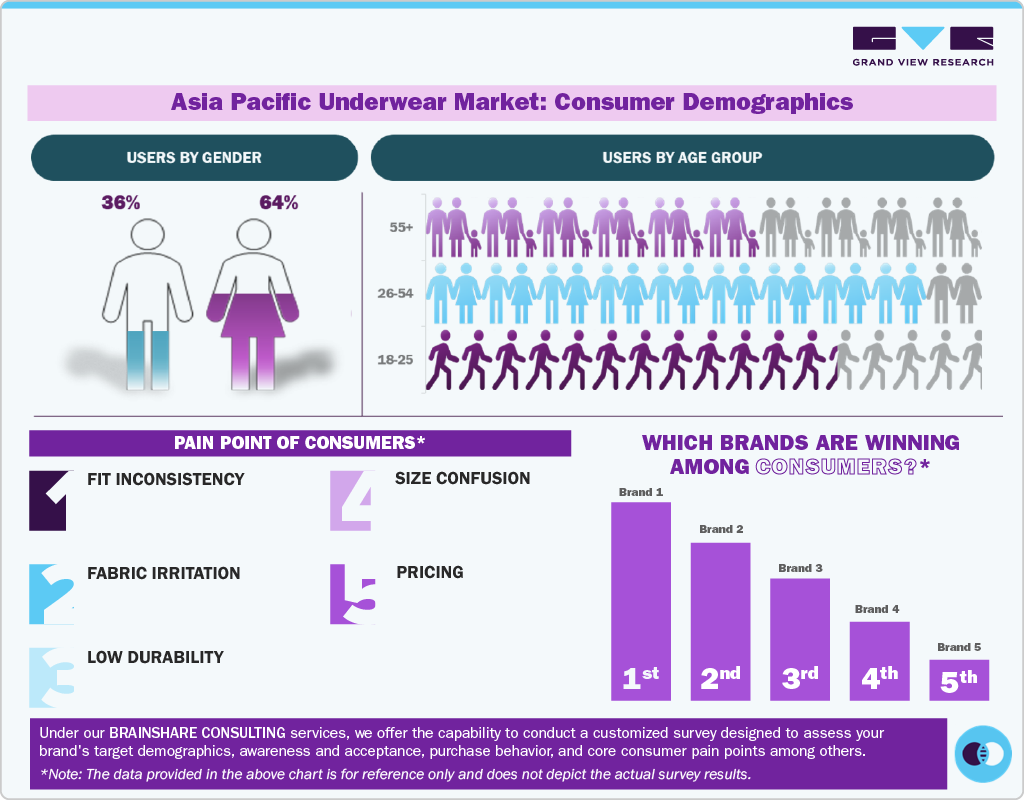
Users by Gender: Women dominate the Asia Pacific underwear market as they purchase more frequently across multiple categories such as lingerie, shapewear, and everyday innerwear. Female consumers also exhibit higher brand engagement, particularly in urban markets such as China, Japan, and South Korea.
-
Users by Age Group: The 26-54 age group forms the core consumer base, driven by working professionals and repeat buyers seeking comfort and durability. The 18-26 segment is more trend-driven and influenced by social media, while the 55+ group focuses mainly on comfort-oriented, loose-fitting products.
-
Consumer Pain Points: Fit inconsistency and size confusion remain major issues due to a lack of standard sizing across brands. Fabric irritation and low durability are common in hot and humid climates, making breathability and long-term comfort key purchase factors.
-
Winning Brands: Wacoal, Aimer, Triumph, Uniqlo, and Jockey lead the market by offering region-specific fits, reliable quality, and strong availability through both physical retail and digital platforms.
Gender Insights
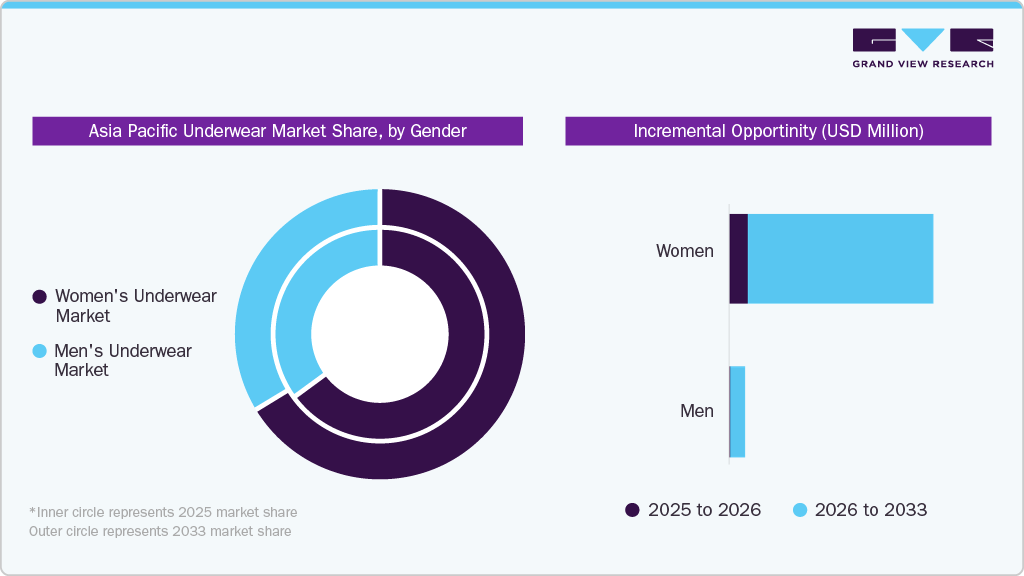
The women's underwear segment led the market with the largest revenue share of 64.9% in 2025, driven by strong demand for lingerie, shapewear, and everyday essentials. Female consumers in cities such as Shanghai, Seoul, and Tokyo increasingly seek products that combine comfort with style, prompting brands like Aimer, Triumph, and Wacoal to introduce diverse, trend-focused collections.
 To learn more about this report, Download Free Sample Report
The men's underwear segment is expected to grow at the fastest CAGR of 7.3% from 2026 to 2033, as male consumers become more conscious of personal grooming, comfort, and the quality of everyday wear. Increasing adoption of performance innerwear for work, sports, and travel, along with rising preference for breathable and well-fitted products, is driving repeat purchases, particularly in urban markets such as China, India, Japan, and South Korea.
Distribution Channel Insights
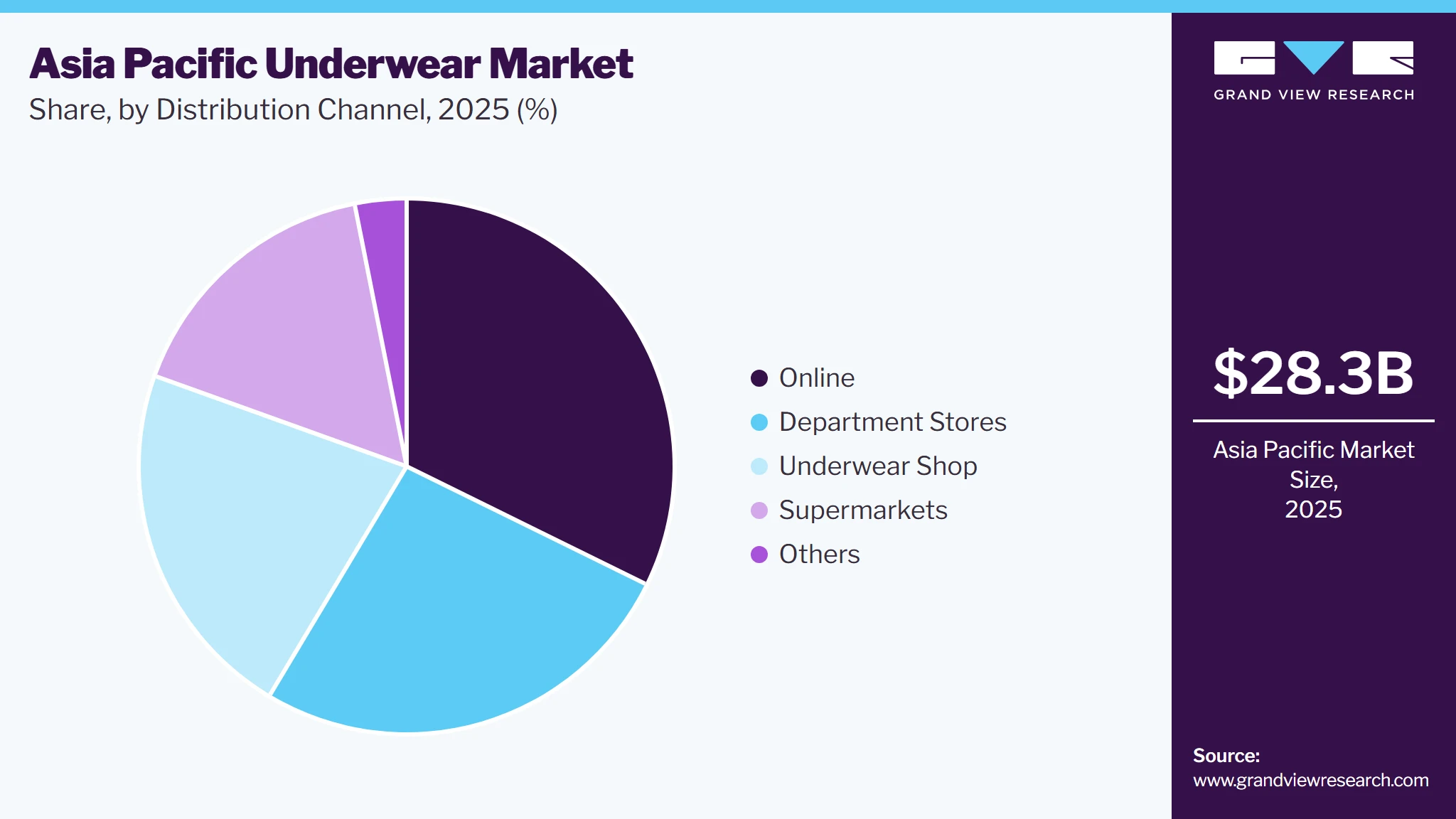
The department stores segment led the market with the largest revenue share of 25.7% in 2025, primarily driven by brand trust and in-store experience. Consumers prefer department stores for intimate apparel because they associate these outlets with quality assurance, authenticity, and access to established domestic and international brands. The presence of trained sales staff and fitting assistance also plays a key role, especially in markets like Japan, South Korea, China, and Australia, where consumers value personalized service and proper sizing when purchasing innerwear.
 To learn more about this report, Download Free Sample Report
The online segment is expected to grow at the fastest CAGR of 9.0% from 2026 to 2033. Online platforms allow consumers to browse and purchase underwear from the comfort of their homes, which is particularly valuable for those in busy urban centers or remote areas with limited access to physical stores. This convenience has driven the popularity of platforms like Lazada, Shopee, and Rakuten, which cater to a diverse customer base across the Asia-Pacific.
Country Insights
China Underwear Market Trends
China dominated the Asia Pacific underwear market with the largest revenue share of 54.7% in 2025, reflecting the country's large population, high urbanization, and rapidly growing adoption of branded and premium underwear. Digital platforms such as Tmall and Xiaohongshu further boost product visibility and accessibility, enabling both domestic and international brands to efficiently reach urban and digitally connected consumers.
Japan Underwear Market Trends
The underwear market in Japan is shaped by consumers’ preference for high-quality everyday essentials that emphasize precision fit, understated design, and long product life rather than fast-changing fashion trends. The country's aging population is driving demand for supportive and easy-to-wear innerwear that enhances comfort and mobility, creating opportunities for manufacturers to develop age-specific collections. At the same time, retailers are expanding gender-neutral and lifestyle-oriented product lines to address changing consumer preferences among younger demographics. The market also benefits from Japan's well-established retail infrastructure, where department stores, specialty apparel chains, and convenience-driven omnichannel services continue to play a significant role in maintaining strong penetration of branded underwear across the country.
South Korea Underwear Market Trends
The underwear market in South Korea is evolving as consumers increasingly seek innerwear that aligns with the country's minimalist fashion trends and fast-changing apparel cycles. Domestic brands such as BYC, TRY (Ssangbangwool), and Good People are strengthening their product portfolios with lightweight seasonal collections, while fashion retailers, including Musinsa and SPA brands, are expanding their private-label innerwear to capture younger consumers. The market is also witnessing rising demand for homewear-integrated underwear as hybrid work and single-person households continue to influence purchasing behavior. In addition, South Korea's highly developed mobile commerce ecosystem and live-commerce platforms are accelerating new product launches and limited-edition collaborations, enabling brands to respond quickly to fashion trends and changing consumer preferences.
India Underwear Market Trends
The underwear market in India is expected to grow at the fastest CAGR over the forecast period, driven by rising awareness of personal hygiene, comfort, and lifestyle-oriented innerwear among men and women alike. Urban consumers are increasingly shifting from unorganized local alternatives to branded products, supported by expanding retail networks, aggressive digital marketing, and growing acceptance of premium and functional underwear across major cities and Tier 2 markets. The market is undergoing rapid transformation as consumers shift from the large unorganized sector to branded products, driven by rising disposable incomes, growing fashion awareness, and greater emphasis on personal hygiene. Aspirational consumers in Tier I, Tier II, and emerging Tier III cities are increasingly purchasing premium innerwear that offers improved fit, comfort, and durability. Demand across the innerwear market is expanding beyond basic essentials to include athleisure-inspired underwear, seamless lingerie, premium bras, trunks, boxer briefs, and shapewear, reflecting changing lifestyle preferences among younger consumers.
Key Asia Pacific Underwear Companies
-
Wacoal Holdings Corp.
-
Aimer Group
-
Triumph International
-
Jockey
-
Uniqlo
-
Sabina
-
BYC Co., Ltd.
-
Lux Industries Ltd.
-
Rupa & Co. Ltd.
-
Dollar Industries Ltd.
Competitive Benchmarking
Category
Operating Strategies
Competitive Edge
Weakness
Established Players (Wacoal Holdings Corp.; Aimer Group; Triumph International; Jockey; Uniqlo; BYC Co., Ltd.)
- Expand product portfolios through innovation in comfort, seamless, and functional innerwear, strengthen omnichannel retail and e-commerce presence, invest in celebrity endorsements and brand campaigns, expand across emerging Asia Pacific markets, and adopt sustainable materials and manufacturing practices.
- Strong brand recognition, extensive retail and distribution networks, diversified product portfolios, advanced fabric technologies, high consumer trust, and an established presence across major Asia-Pacific countries.
- High operating and raw material costs, intense competition from regional and private-label brands, pricing pressure in value-conscious markets, and slower response to rapidly changing fashion trends.
Emerging Players (Sabina; Lux Industries Ltd.; Rupa & Co. Ltd.; Dollar Industries Ltd.)
- Focus on expanding regional distribution networks, strengthening online and direct-to-consumer (DTC) sales channels, introducing affordable and value-oriented product ranges, investing in digital marketing and brand awareness campaigns, and targeting underserved urban and rural consumer segments.
- Competitive pricing, strong regional market presence, agile product development, expanding e-commerce reach, and a deep understanding of local consumer preferences.
- Limited international brand recognition, smaller global distribution footprint, lower investment capacity for premium product innovation, and comparatively narrower product portfolios than established multinational brands.
Recent Developments
-
In June 2026, Ubras celebrated its 10th anniversary by expanding its comfort apparel ecosystem and supporting the release of China's first Free-Size Knitted Bra Industry Standard (FZ/T 73084-2025). The initiative highlights the industry's growing emphasis on comfort-driven innovation, product standardization, and technological advancement, reinforcing China's position as a leading market for functional and premium intimate apparel.
-
In February 2025, Wacoal India unveiled its Spring/Summer 2025 (SS'25) collection, introducing the new Bliss by Wacoal BASICS range along with the ZOE Non-Wired T-Shirt Bra and Dreamy Curves Push-Up Bra. The collection features lightweight, breathable lingerie with moisture-wicking rice-knit fabric, double-perforated cups, and seamless designs to enhance comfort during warmer climates. This launch reflects the growing industry focus on functional fabric innovation, premium comfort, and fashion-forward innerwear, catering to the evolving preferences of consumers across the Asia Pacific underwear market.
-
In 2025, Dollar Industries announced the upcoming launch of a new innerwear collection under its "Coming This Spring" campaign. The initiative reflects the company's focus on expanding its product portfolio with innovative designs and enhanced comfort, reinforcing the growing emphasis on premiumization and evolving consumer preferences in the underwear market.
Asia Pacific Underwear Market Report Scope
Report Attribute
Details
Market size in 2025
USD 28.3 billion
Estimated market size in 2026
USD 30.4 billion
Projected market size by 2033
USD 51.6 billion
Growth rate
CAGR of 7.9 % from 2026 to 2033
Base year for estimation
2025
Historical data
2021 - 2024
Forecast period
2026 - 2033
Quantitative units
Revenue in USD million/billion, and CAGR from 2026 to 2033
Report coverage
Revenue forecast, company ranking, competitive landscape, growth factors, and trends
Segments covered
Gender, distribution channel, country
Country scope
China; Hong Kong; Taiwan; South Korea; Indonesia; Philippines; Vietnam; Thailand; Malaysia; Singapore; India
Key companies profiled
Wacoal Holdings Corp.; Aimer Group; Triumph International; Jockey; Uniqlo; Sabina; BYC Co., Ltd.; Lux Industries Ltd.; Rupa & Co. Ltd.; Dollar Industries Ltd.
Customization scope
Free report customization (equivalent up to 8 analysts working days) with purchase. Addition or alteration to country, regional & segment scope.
Pricing and purchase options
Avail customized purchase options to meet your exact research needs. Explore purchase options
Asia Pacific Underwear Market Report Segmentation
This report forecasts revenue growth at the country levels and provides an analysis of the latest industry trends and opportunities in each of the sub-segments from 2021 to 2033. For this study, Grand View Research has segmented the Asia Pacific underwear market report based on the gender, distribution channel and country:
-
Gender Outlook (Revenue, USD Million, 2021 - 2033)
-
Men
-
Women
-
-
Distribution Channel Outlook (Revenue, USD Million, 2021 - 2033)
-
Department Stores
-
Supermarkets
-
Underwear Shop
-
Online
-
Company Owned Website
-
E-commerce
-
-
Others
-
-
Regional Outlook (Revenue, USD Million, 2021 - 2033)
-
China
-
Hong Kong
-
Taiwan
-
South Korea
-
Indonesia
-
Philippines
-
Vietnam
-
Thailand
-
Malaysia
-
Singapore
-
India
-
Research Methodology
The Asia Pacific underwear marketfigures in this report are based on a proven research process that combines executive interviews with secondary research from proprietary databases, company filings, and recognized regulatory and institutional sources. Market size is built through value-chain sizing-reconciling supply-side and demand-side estimates-and triangulated with bottom-up and top-down approaches. Every estimate passes multiple levels of expert validation before publication, with eachAsia Pacific underwearsegment quantified using the revenue-capture definitions in the table below.
Segment Definition
Segment - Gender
Revenue capture definition
Men's Underwear
This segment covers the revenues generated through the sales of men's underwear across the Asia Pacific underwear market. It includes products designed for comfort, performance, and everyday use, such as briefs, boxers, boxer briefs, trunks, vests, undershirts, and thermal innerwear. Growth is supported by rising demand for breathable, antimicrobial, stretchable, and performance-oriented fabrics, as well as increasing premiumization in men's innerwear. Examples: Jockey boxer briefs, UNIQLO AIRism boxer briefs, Calvin Klein trunks, Hanes briefs, and Lux Cozi vests.
Women's Underwear
This segment covers the revenues generated through the sales of women's underwear across the Asia Pacific underwear market. It includes products designed for everyday wear, comfort, support, and fashion, such as bras, panties, shapewear, camisoles, bralettes, sports bras, and thermal innerwear. Demand is driven by the increasing preference among women for premium, seamless, moisture-wicking, and sustainable innerwear. Examples: Wacoal full-coverage bras, Triumph shapewear, Jockey women's briefs, UNIQLO AIRism bras, and Calvin Klein bralettes.
Estimation Model
Layer
Key Question
Description
Consumer Base Layer
Who purchases underwear?
Identify the addressable consumer base across Asia Pacific by evaluating the adult male, female, and children’s population, along with urbanization and changing lifestyle patterns that influence innerwear consumption.
Retail Access Layer
Who can be reached through retail channels?
Assess consumers with access to organized retail, supermarkets, specialty innerwear stores, department stores, and rapidly expanding e-commerce platforms across China, India, Japan, South Korea, and Southeast Asia to determine the reachable market.
Purchase Behavior Layer
Who actively buys branded underwear?
Apply adoption rates for branded, premium, and functional innerwear based on rising fashion awareness, comfort preferences, premiumization, and increasing online shopping penetration to estimate active buyers.
Revenue Generation Layer
How much revenue is generated?
Estimate revenue by multiplying active buyers with average annual underwear consumption, considering purchase frequency, product mix (men, women, children), premiumization, and online contribution to derive the total addressable market revenue.
Frequently Asked Questions About This Report
The Asia Pacific underwear market is expected to grow at a compound annual growth rate of 7.9% from 2025 to 2033 to reach USD 51.6 billion by 2033.
Women's underwear segment held the largest market share of 64.9% in 2025, driven by strong demand for lingerie, shapewear, and everyday essentials.
Some key players operating in the Asia Pacific underwear market are Wacoal Holdings Corp., Aimer Group, Triumph International, Jockey, Uniqlo, Sabina, BYC Co., Ltd., Lux Industries Ltd., Rupa & Co. Ltd., Dollar Industries Ltd.
Key factors that are driving the Asia Pacific underwear market growth include rising disposable income and urbanization are enabling consumers to invest in premium and fashionable underwear, which is reflected in the increasing demand for quality fabrics, enhanced fit, and branded products.
The department stores segment led the market with the largest revenue share of 25.7% in 2025 while online segment is the fastest growing segment
The Asia Pacific underwear market size was estimated at USD 28.3 billion in 2025 and is expected to reach USD 30.4 billion in 2026.
About the Author(s)
Clothing, Footwear & Accessories Research Team
Consumer Goods · Clothing, Footwear & AccessoriesThis report was authored by the clothing, footwear & accessories research team at Grand View Research - comprising two research analysts, one senior research analyst, and one industry expert - with specialized expertise in the clothing, footwear & accessories segment of the consumer goods industry. All findings are based on proprietary consumer goods databases, executive interviews, and regulatory analysis, subject to internal peer review prior to publication.
Last Updated:
Speak to Analyst

Customize this report to your needs - add regions, segments, or data points, with 20% free customization.
Or view our licence options:


ISO 9001:2015 & 27001:2022 Certified
We are GDPR and CCPA compliant! Your transaction & personal information is safe and secure. For more details, please read our privacy policy.


