
- Home
- »
- Next Generation Technologies
- »
-
Augmented Reality Packaging Market Size Report 2026-2033GVR Report cover
![Augmented Reality Packaging Market (2026 - 2033)Report]()
Augmented Reality Packaging Market (2026 - 2033)
Size, Share & Trends Analysis Report By End Use (Food & Beverages, Healthcare & Pharmaceuticals, Personal Care & Cosmetics), By Region (North America, Europe, Asia Pacific, Central & South America, Middle East & Africa), And Segment Forecasts
Market Size, 2025
$361.4MMarket Estimate, 2026
$375.2MMarket Forecast, 2033
$595.8MCAGR, 2026–2033
6.8%Augmented Reality Packaging Market Summary
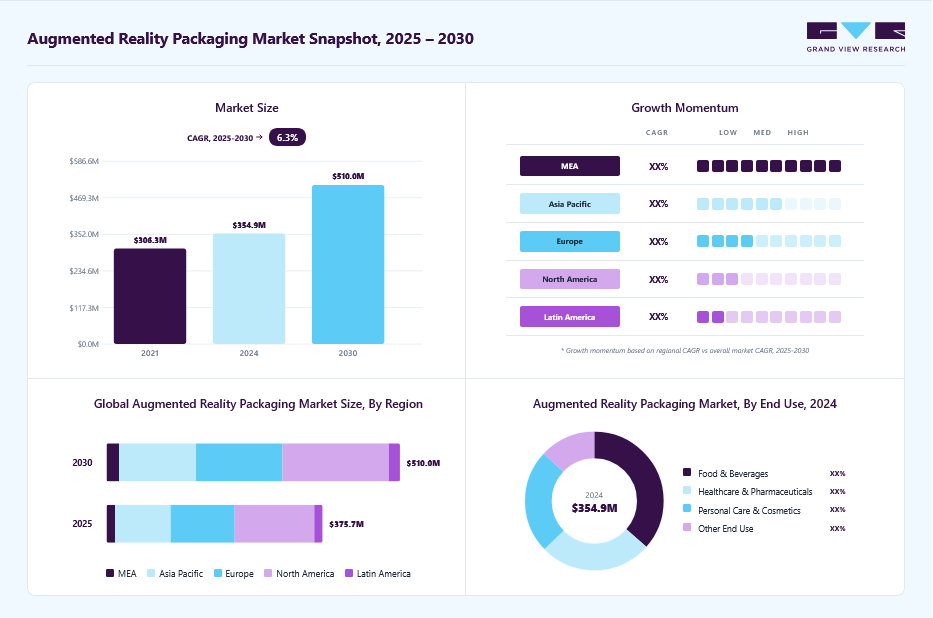
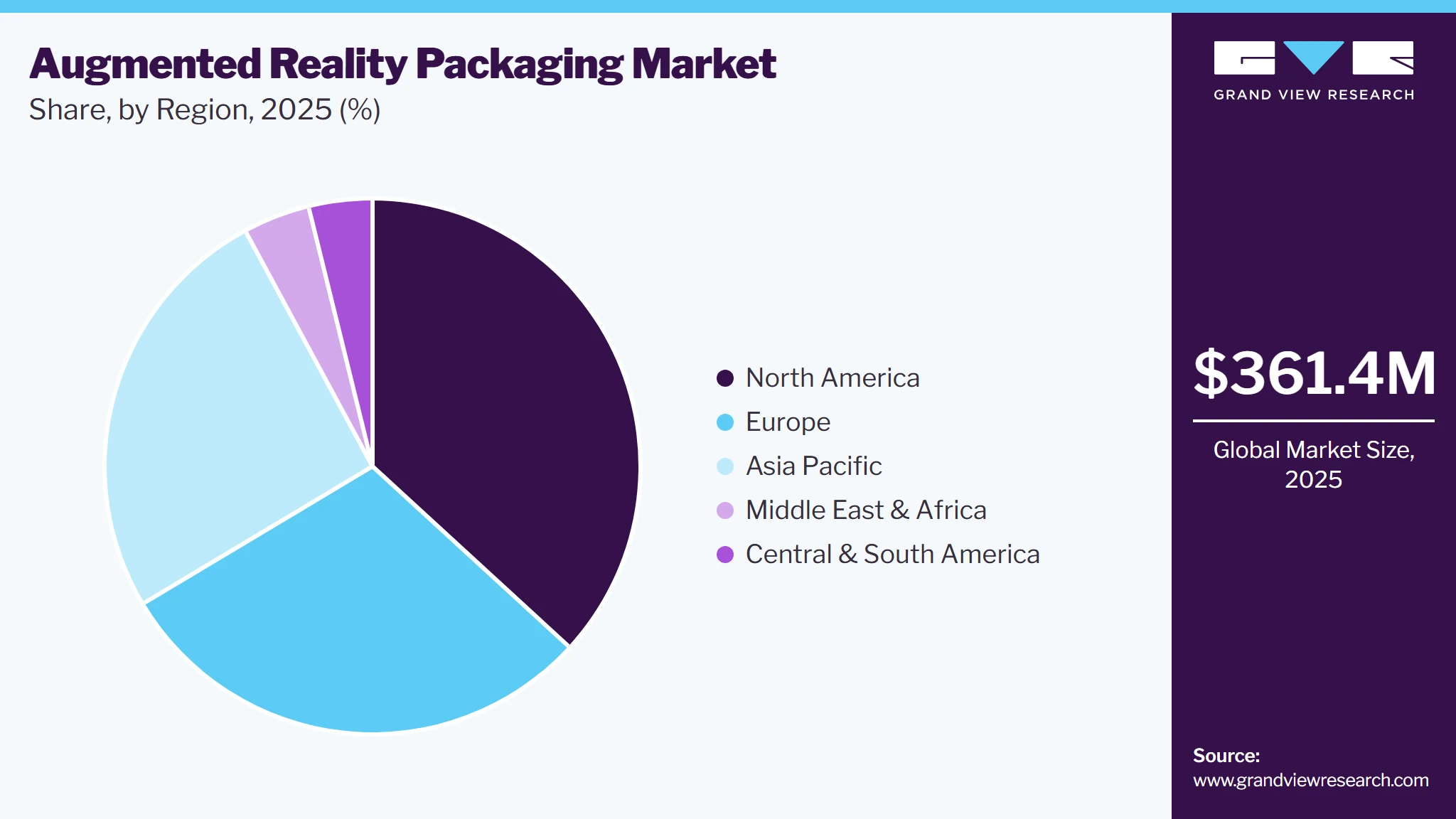
The global augmented reality packaging market size was estimated at USD 361.4 million in 2025 and is projected to grow from USD 375.2 million in 2026 to USD 595.8 million by 2033, growing at a CAGR of 6.8% from 2026 to 2033. The North America market held the largest share of 36.8% of the global market in 2025. The rising focus on sustainability is driving the adoption of AR packaging, as brands use interactive features to reduce printed materials and educate consumers on eco-friendly practices.
Key Market Trends & Insights
- By end use: The food & beverages segment led the market with the largest revenue share of 36.5% in 2025.
Regional Highlights
- Largest regional market: North America (36.8% revenue share, 2025)
- By country: The U.S. held the largest market share in 2025.
Market Size & Forecast
- Market size in 2025: USD 361.4 Million
- Estimated market size in 2026: USD 375.2 Million
- Projected market size by 2033: USD 595.8 Million
- CAGR (2026-2033): 6.8%
A growing trend in the augmented reality (AR) packaging market is the integration of artificial intelligence (AI) to enhance interactive consumer experiences. AI-driven AR applications enable brands to provide personalized content, real-time recommendations, and dynamic storytelling through product packaging.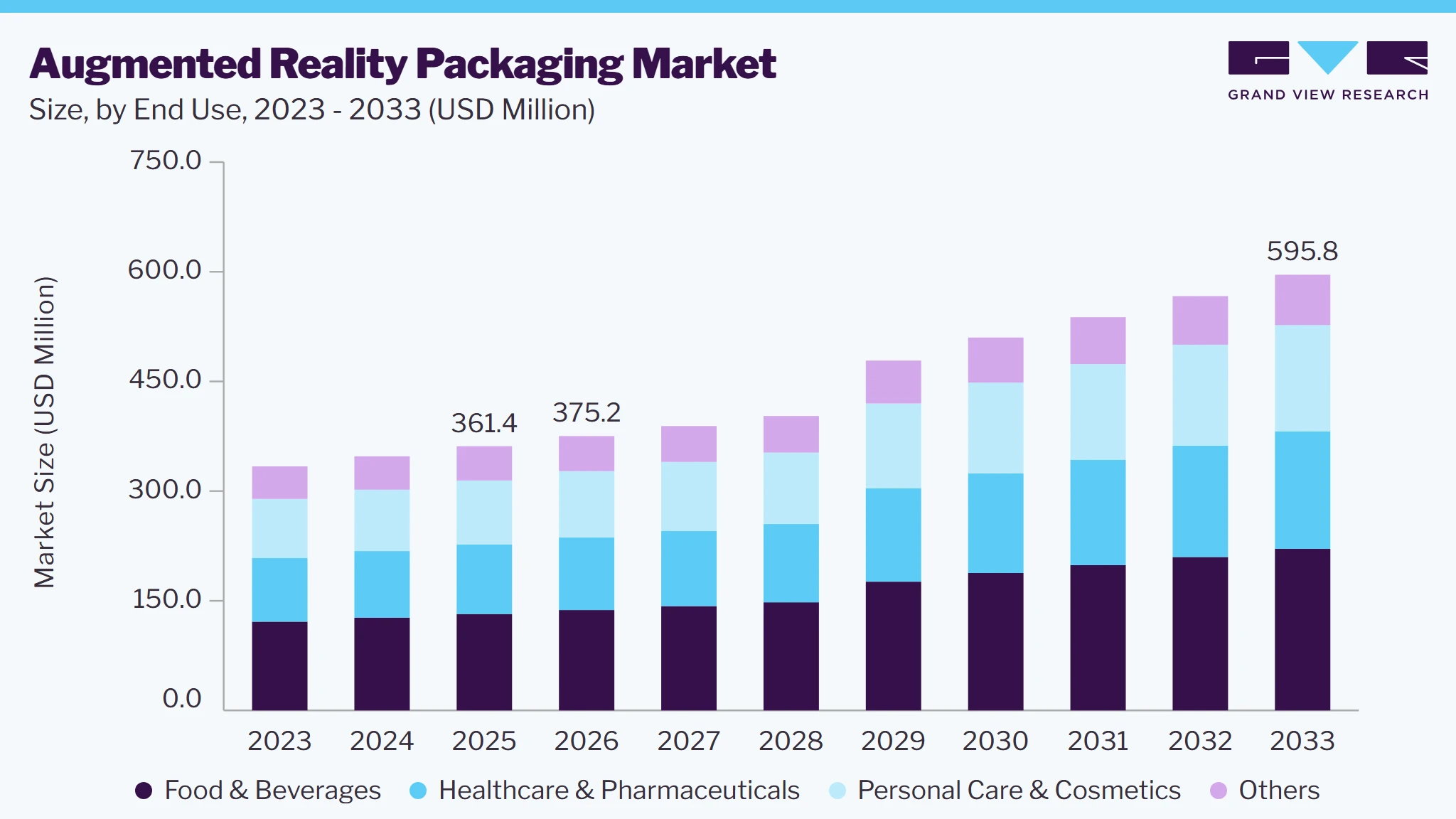
This technology is particularly gaining traction in the food & beverage and cosmetics sectors, where companies are leveraging AI-powered AR to offer ingredient traceability, virtual try-ons, and immersive brand storytelling. As brands shift towards digital-first marketing strategies, AI-enhanced AR packaging is expected to become a key differentiator, fostering deeper consumer engagement and loyalty while driving higher conversion rates.
Market Dynamics
The augmented reality packaging market is witnessing steady growth due to rising demand for interactive consumer experiences, stronger brand engagement, and increasing adoption of smart packaging solutions. Brands utilize AR-enabled packaging to deliver product information, promotional content, and personalized experiences through smartphones, enhancing customer interaction and loyalty. Market growth is further supported by advancements in AR technologies, expanding e-commerce activities, and digital marketing initiatives. While implementation costs and integration complexities remain challenges, growing investments in connected packaging and digital innovation continue to create significant opportunities for market expansion.
One of the primary drivers of the market is the growing demand for enhanced consumer engagement and interactive brand experiences. As competition intensifies across food & beverages, cosmetics, and healthcare sectors, brands are increasingly seeking innovative ways to differentiate their products and build stronger relationships with customers. Augmented reality packaging enables consumers to access immersive content such as product demonstrations, usage instructions, promotional campaigns, brand stories, and interactive games by simply scanning packaging with a smartphone. This transforms conventional packaging into a dynamic communication platform, increasing consumer attention, engagement, and brand recall.
The rapid adoption of smartphones and digital technologies has further accelerated the use of AR-enabled packaging as a marketing and customer experience tool. Consumers increasingly expect personalized, informative, and engaging interactions throughout their purchasing journey, encouraging companies to integrate digital features directly into product packaging. AR packaging also provides brands with valuable consumer insights and interaction data, enabling more targeted marketing strategies and improved customer retention. As businesses continue to prioritize customer experience and digital engagement, the demand for augmented reality packaging solutions is expected to grow significantly across multiple industries.
A significant restraint for the market is the high cost of implementation and the technical complexity associated with integrating AR features into packaging solutions. Developing interactive AR content, maintaining software platforms, and ensuring compatibility across various mobile devices require substantial investments, which can be challenging for small and medium-sized enterprises. Moreover, successful deployment often involves collaboration between packaging manufacturers, technology providers, and brand owners, increasing operational complexity and project timelines. These cost and integration challenges can limit adoption, particularly in price-sensitive markets where companies may be hesitant to invest in advanced packaging technologies without a clear return on investment.
A major opportunity for the market lies in the growing adoption of smart packaging and connected consumer ecosystems. As brands increasingly embrace digital transformation, AR-enabled packaging offers a powerful way to bridge physical products with digital content, providing consumers with real-time information, product authentication, sustainability details, loyalty programs, and personalized experiences. The expanding use of smartphones, QR codes, and connected technologies across retail, e-commerce, healthcare, and consumer goods sectors is creating favorable conditions for AR packaging adoption. As companies seek innovative ways to enhance customer engagement and collect valuable consumer insights, the integration of augmented reality into smart packaging strategies is expected to unlock significant growth opportunities worldwide.
Analyst Perspective
The augmented reality packaging market is positioned for strong growth, driven by increasing demand for interactive consumer experiences, enhanced brand engagement, and the rapid digitalization of product packaging. As brands seek innovative ways to differentiate products and strengthen customer relationships, AR-enabled packaging is gaining traction across food & beverages, healthcare, pharmaceuticals, personal care, and cosmetics sectors. The widespread adoption of smartphones, advancements in augmented reality technologies, and the growing importance of omnichannel marketing are further accelerating market expansion. Moreover, AR packaging is emerging as a valuable tool for product authentication, consumer education, and real-time engagement, creating added value beyond traditional packaging functions. Going forward, companies that can deliver seamless, scalable, and data-driven AR packaging solutions while balancing cost-effectiveness and user experience will be well positioned to capitalize on the market’s evolving growth opportunities.
End Use Insights & Trends
Based on end use, the food & beverages segment led the market with the largest revenue share of 36.5% in 2025. With growing concerns about food safety, ingredient transparency, and dietary preferences, brands are integrating AR-enabled smart labels that allow consumers to scan packaging and instantly access nutritional details, sourcing information, and allergen alerts. Additionally, leading companies are leveraging AR to create immersive brand storytelling, gamified promotions, and virtual recipe suggestions, enhancing customer engagement while driving brand loyalty. As digital-savvy consumers increasingly seek personalized and engaging interactions, AR packaging is becoming a strategic tool to differentiate products in a crowded market.
In the healthcare & pharmaceutical sector, the adoption of AR packaging is being driven by the need for better patient education and compliance monitoring. Complex medication regimens and strict adherence requirements make it essential for pharmaceutical companies to provide clear and accessible usage instructions. AR-enabled packaging allows patients to scan a product and receive step-by-step dosage guidance, potential side-effect alerts, and even interactive video demonstrations, reducing the risk of medication errors. Additionally, AR technology is being used to combat counterfeit drugs by providing instant product authentication and track-and-trace capabilities. With the growing emphasis on patient-centric healthcare and regulatory compliance, AR packaging is emerging as a critical tool for improving treatment adherence and ensuring product integrity.
Regional Insights & Trends
North America dominated the augmented reality packaging market with the largest revenue share of 36.8% in 2025. The growing integration of AR in smart retail packaging is a key driver, as brands seek to create immersive shopping experiences that bridge the gap between physical and digital retail. With major retail chains and e-commerce giants investing in omnichannel strategies, AR-enabled packaging is being used to offer virtual product trials, real-time ingredient transparency, and interactive promotions.
With governments enforcing stricter environmental policies and extended producer responsibility (EPR) regulations, businesses are turning to AR-enabled smart labels to replace traditional printed materials, thereby reducing paper waste and improving recyclability. Brands are also using AR to educate consumers on proper disposal methods and sustainability initiatives, reinforcing their commitment to eco-conscious practices. Additionally, industries like pharmaceuticals and food & beverage are leveraging AR to meet evolving labeling and traceability regulations, ensuring compliance while enhancing consumer trust through transparent product information.
U.S. Augmented Reality Packaging Market Trends
The augmented reality packaging market in U.S. held the largest share in the North America region in 2025. In the U.S., the widespread adoption of AR packaging is being driven by the dominance of tech-driven consumer engagement strategies, as companies integrate AR into their marketing and branding initiatives. With the rapid expansion of digital commerce and direct-to-consumer (DTC) models, brands are using AR packaging to deliver immersive storytelling, product tutorials, and interactive advertising. The strong presence of tech giants and innovative startups in the U.S. is also accelerating the development of advanced AR packaging solutions powered by AI, cloud computing, and 5G connectivity. As digital-savvy consumers expect more interactive and informative brand experiences, U.S. companies are investing heavily in AR packaging to enhance brand differentiation and customer loyalty.
Europe Augmented Reality Packaging Market Trends
In Europe, the adoption of AR packaging is largely driven by the increasing need for anti-counterfeiting and product authentication solutions, particularly in the pharmaceutical, luxury goods, and spirits industries. With counterfeit products causing significant financial losses and reputational damage, companies are integrating AR-based security features such as digital watermarks, holographic authentication, and blockchain-backed verification systems. These solutions allow consumers and regulators to instantly verify product authenticity by scanning AR-enabled packaging, reducing the risk of fraud and ensuring supply chain integrity. The European Union’s stringent regulatory frameworks around product safety and traceability further reinforce the demand for AR-based authentication, pushing brands to invest in secure and intelligent packaging technologies.
Asia Pacific Augmented Reality Packaging Market Trends
Asia Pacific is witnessing strong growth in the AR packaging market due to rapid digitalization and high smartphone penetration, particularly in countries like China, India, Japan, and South Korea. As mobile commerce becomes a dominant force in the region, brands are leveraging AR packaging to provide seamless digital interactions, from virtual product demonstrations to AI-driven recommendations. In industries such as beauty, personal care, and food & beverage, AR is being used to enhance customer experiences by offering personalized skincare analysis, virtual makeup trials, and interactive product storytelling. With governments and businesses heavily investing in 5G infrastructure, AR packaging solutions are becoming more accessible and reliable, further fueling their adoption across various industries in Asia Pacific.
Augmented Reality Packaging Market Companies Share & Insights
The Augmented Reality Packaging Market is highly competitive, with several key players dominating the landscape. Major companies include Vossle, SmartTek Solutions.LLC, Zappar, FlippAR, THIMM Group GmbH + Co. KG, BrandXR, and PlugXR. The augmented reality packaging market is characterized by a competitive landscape with several key players driving innovation and market growth. Major companies in this sector are investing heavily in research and development to enhance the performance, cost-effectiveness, and sustainability of their types.
Key Augmented Reality Packaging Companies:
The following key companies have been profiled for this study on the augmented reality packaging market.
-
Vossle
-
SmartTek Solutions.LLC
-
Zappar
-
FlippAR
-
THIMM Group GmbH + Co. KG
-
BrandXR
-
PlugXR
Competitive Benchmarking
Category
Operating Strategies
Competitive Edge
Weakness
Established Players (THIMM Group GmbH + Co. KG and Zappar)
- Invest in proprietary AR platforms and connected packaging technologies to deliver scalable, enterprise-grade solutions across multiple industries.
- Establish long-term partnerships with global brands, packaging manufacturers, and marketing agencies to expand market reach and customer retention.
- Strong financial resources, established brand reputation, and extensive industry experience enable large-scale project execution.
- Comprehensive solution portfolios combining packaging expertise, AR content creation, consumer engagement tools, and analytics capabilities.
- Higher operational and development costs often result in premium pricing structures.
- Larger organizational frameworks can slow innovation and reduce responsiveness to rapidly evolving market trends.
Emerging Players (Vossle, SmartTek Solutions LLC, FlippAR, BrandXR, and PlugXR)
- Focus on no-code/low-code and WebAR platforms that enable quick deployment and cost-effective implementation.
- Target small and mid-sized brands with customizable AR packaging experiences and flexible subscription-based business models.
- Greater agility and faster innovation cycles allow rapid adaptation to new technologies and customer requirements.
- Lower implementation costs and user-friendly platforms make AR packaging solutions accessible to a broader customer base.
- Limited financial resources and smaller customer networks restrict global expansion and market penetration.
- Lower brand recognition and scalability challenges can hinder competition for large enterprise and multinational contracts.
Recent Developments
-
In April 2023, Displai, an Australian AR platform, launched a program to enable augmented reality packaging. This allowed consumers to scan products with smartphones, which activated virtual experiences and provided access to product information. According to Displai, the program offered AR software, training, support, and co-marketing opportunities.
-
In October 2024, Kellanova launched a protein bar featuring augmented reality packaging to engage consumers. The AR experience is designed to motivate consumers.
Augmented Reality Packaging Market Report Scope
Report Attribute
Details
Market size in 2025
USD 361.4 million
Estimated market size in 2026
USD 375.2 million
Projected market size by 2033
USD 595.8 million
Growth rate
CAGR of 6.8% from 2026 to 2033
Base year for estimation
2025
Historical data
2021 - 2024
Forecast period
2026 - 2033
Quantitative units
Revenue in USD million/million and CAGR from 2026 to 2033
Report coverage
Revenue forecast, company ranking, competitive landscape, growth factors, and trends
Segments covered
End use, region
Regional scope
North America; Europe; Asia Pacific; Latin America; MEA
Country scope
U.S.; Canada; Mexico; Germany; UK; France; Italy; Spain; China; Japan; India; South Korea; Australia; Brazil; Argentina; Saudi Arabia; South Africa; UAE
Key companies profiled
Vossle; SmartTek Solutions.LLC; Zappar; FlippAR; THIMM Group GmbH + Co. KG; BrandXR; PlugXR
Customization scope
Free report customization (equivalent up to 8 analysts' working days) with purchase. Addition or alteration to country, regional & segment scope.
Pricing and purchase options
Avail customized purchase options to meet your exact research needs. Explore purchase options
Global Augmented Reality Packaging Market Report Segmentation
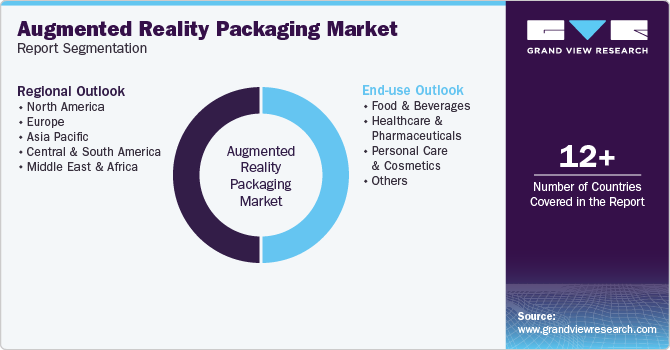
This report forecasts revenue growth at global, regional, and country levels and provides an analysis of the latest industry trends in each of the sub-segments from 2021 to 2033. For this study, Grand View Research has segmented augmented reality packaging market report based on end use, and region:
-
End Use Outlook (Revenue, USD Million, 2021 - 2033)
-
Food & Beverages
-
Healthcare & Pharmaceuticals
-
Personal Care & Cosmetics
-
Others
-
-
Regional Outlook (Revenue, USD Million, 2021 - 2033)
-
North America
-
U.S.
-
Canada
-
Mexico
-
-
Europe
-
Germany
-
UK
-
France
-
Italy
-
Spain
-
-
Asia Pacific
-
China
-
India
-
Japan
-
South Korea
-
Australia
-
-
Central & South America
-
Brazil
-
Argentina
-
-
Middle East & Africa
-
Saudi Arabia
-
UAE
-
South Africa
-
-
Research Methodology
The augmented reality packaging market figures in this report are based on a proven research process that combines executive interviews with secondary research from proprietary databases, company filings, and recognized regulatory and institutional sources. Market size is built through value-chain sizing - reconciling supply-side and demand-side estimates - and triangulated with bottom-up and top-down approaches. Every estimate passes multiple levels of expert validation before publication, with each augmented reality packaging segment quantified using the revenue-capture definitions in the table below.
Segment Definition
Segment - Product
Revenue capture definition
Food & Beverages
Revenue generated from augmented reality packaging solutions used in food and beverage products to enhance consumer engagement, provide interactive product information, support promotional campaigns, and improve brand communication. This segment includes AR-enabled packaging for packaged foods, beverages, confectionery, dairy products, and ready-to-eat meals.
Healthcare & Pharmaceuticals
Revenue generated from augmented reality packaging solutions used in healthcare and pharmaceutical products to deliver medication instructions, patient education, product authentication, dosage guidance, and regulatory information. This segment includes AR-enabled packaging for prescription drugs, over-the-counter medicines, medical devices, vaccines, and healthcare products.
Personal Care & Cosmetics
Revenue generated from augmented reality packaging solutions used in personal care and cosmetic products to offer virtual product demonstrations, beauty tutorials, ingredient information, and personalized consumer experiences. This segment includes AR-enabled packaging for skincare, haircare, fragrances, makeup, and personal hygiene products.
Others
Revenue generated from augmented reality packaging solutions used across various industries outside the primary categories, including consumer electronics, household products, pet care, automotive products, and specialty retail goods. This segment includes packaging applications focused on product information delivery, customer engagement, and brand differentiation.
Estimation Model
Layer Name
Key Question
Description
Packaging Demand Base Layer
What forms the demand base?
Identify global packaging consumption volumes across key end-use industries including food & beverages, healthcare & pharmaceuticals, personal care & cosmetics, consumer goods, and other retail sectors. This layer establishes the total addressable packaging volume that can potentially adopt augmented reality technologies and interactive packaging solutions.
Digital Adoption Penetration Layer
Where is augmented reality packaging utilized?
Estimate the penetration of augmented reality technologies within packaging applications across industries and regions. Assess adoption levels based on smartphone usage, consumer engagement trends, digital marketing investments, smart packaging initiatives, and brand willingness to implement interactive packaging experiences.
Consumer Engagement Intensity Layer
How extensively is AR packaging used?
Analyze the frequency and depth of AR-enabled interactions, including product information access, promotional campaigns, virtual experiences, product authentication, and customer engagement activities. Adoption intensity is influenced by industry requirements, consumer demographics, technological maturity, and brand marketing strategies.
Revenue Layer
How is market revenue generated?
Market revenue is quantified through the development, licensing, implementation, and maintenance of augmented reality packaging solutions, including AR content creation, software platforms, packaging integration services, analytics tools, and associated digital engagement services. Revenue is generated from recurring demand across food & beverages, healthcare, cosmetics, consumer goods, and other end-use industries seeking enhanced customer engagement and brand differentiation.
Delivered Customizations
This report has been delivered with the following In-depth customizations
Client Request
Customization Delivered
Value Adds
Regional Segmentation Analysis
Detailed market sizing, growth trends, adoption patterns, regulatory landscape, and demand assessment across North America, Europe, Asia Pacific, Latin America, and Middle East & Africa. Country-level evaluation for key markets including the U.S., Germany, U.K., China, Japan, India, and Brazil.
Enabled identification of high-growth regional markets, investment hotspots, and region-specific adoption drivers for augmented reality packaging solutions.
Cross-Segmentation Analysis
Comprehensive analysis across End uses (Food & Beverage, Healthcare & Pharmaceuticals, Personal Care & Cosmetics, Others), and Region.
Provided granular demand insights, helping stakeholders identify the most attractive application and technology combinations for targeted expansion strategies.
Opportunity Assessment
Identification and evaluation of emerging growth opportunities across sustainable AR packaging, interactive consumer engagement campaigns, e-commerce packaging applications, pharmaceutical product authentication, premium branding, and omnichannel retail experiences.
Enabled strategic decision-making by highlighting high-potential investment areas, untapped customer segments, and future revenue-generation opportunities.
Frequently Asked Questions About This Report
The global augmented reality packaging market is expected to grow at a CAGR of 6.8% from 2026 to 2033, reaching USD 595.8 million by 2033.
Key factors driving the augmented reality packaging market include increasing demand for interactive brand experiences, growing adoption of smart packaging, rising smartphone usage, advancements in AR technology, and the need for enhanced consumer engagement and product transparency.
North America dominated the augmented reality packaging market with a 36.8% revenue share in 2025.
Middle East & Africa is the fastest-growing region in the augmented reality packaging market with a CAGR of 8.2% over the forecast period.
Food & beverages segment led the augmented reality packaging market with a 36.5% revenue share in 2025.
Healthcare & pharmaceuticals is the fastest-growing end use segment in the augmented reality packaging market with a CAGR of 7.1% over the forecast period.
U.S. held the largest revenue share of 78.2% in 2025 in the augmented reality packaging market.
Key players in the augmented reality packaging market include Vossle; SmartTek Solutions.LLC; Zappar; FlippAR; THIMM Group GmbH + Co. KG; BrandXR; PlugXR.
The global augmented reality packaging market size was valued at USD 361.4 million in 2025 and is estimated at USD 375.2 million for 2026.
About the Author(s)
Next Generation Technologies Research Team
Technology · Next Generation TechnologiesThis report was authored by the next generation technologies research team at Grand View Research - comprising two research analysts, one senior research analyst, and one industry expert - with specialized expertise in the next generation technologies segment of the technology industry. All findings are based on proprietary technology databases, executive interviews, and regulatory analysis, subject to internal peer review prior to publication.
Last Updated:
Speak to Analyst


Customize this report to your needs — add regions, segments, or data points, with 20% free customization.
Or view our licence options:


ISO 9001:2015 & 27001:2022 Certified
We are GDPR and CCPA compliant! Your transaction & personal information is safe and secure. For more details, please read our privacy policy.


