
- Home
- »
- Next Generation Technologies
- »
-
Augmented Shopping Market Size & Share Report, 2033GVR Report cover
![Augmented Shopping Market (2026 - 2033)Report]()
Augmented Shopping Market (2026 - 2033)
Size, Share & Trends Analysis Report By Component (Solutions, Services), By Application (Automotive, Home Goods & Furniture, Footwear), By Region, and Segment Forecasts
Market Size, 2025
$6.9BMarket Estimate, 2026
$9.3BMarket Forecast, 2033
$73.2BCAGR, 2026–2033
34.3%Augmented Shopping Market Summary
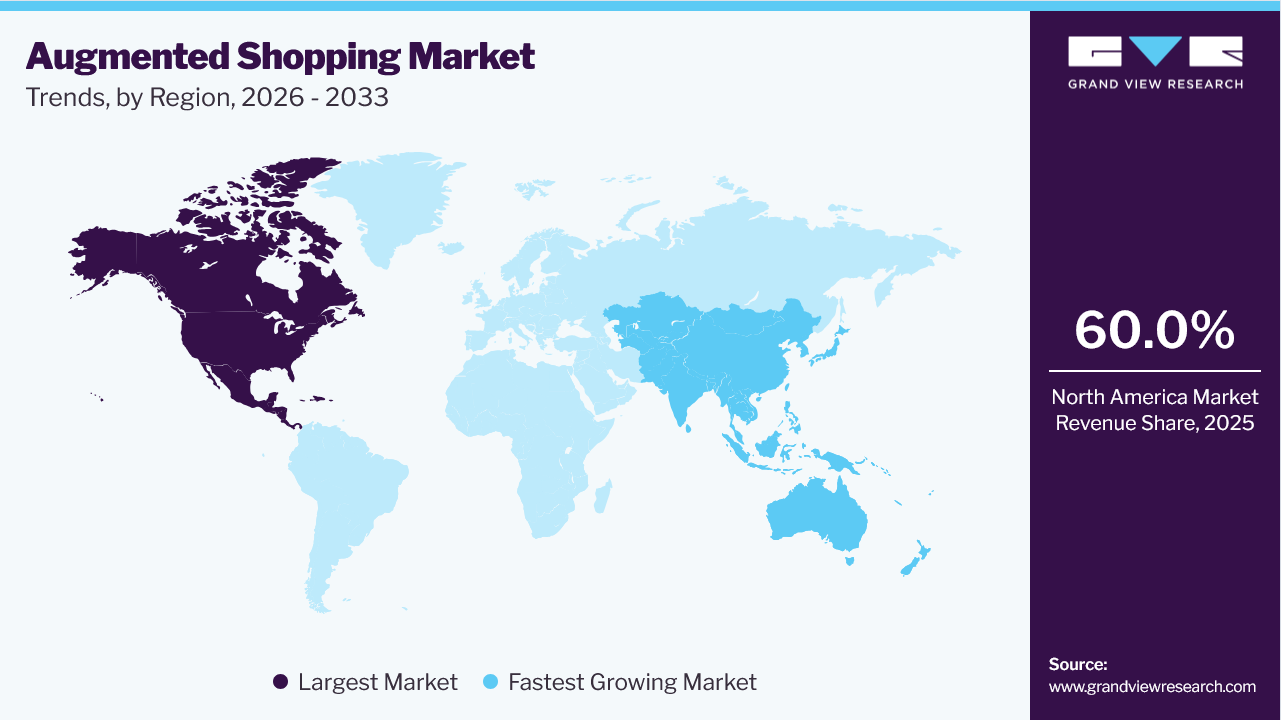
The global augmented shopping market size was valued at USD 6.9 billion in 2025 and is projected to grow from USD 9.3 billion in 2026 to USD 73.2 billion by 2033, at a CAGR of 34.3% from 2026 to 2033. North America dominated the global market, accounting for the largest revenue share of 60.0% in 2025. The increasing adoption of smartphones and mobile devices, rising Internet penetration across various regions, and innovations in Augmented Reality (AR) technology have created a strong user base for AR solutions, particularly over the past decade. For instance, the International Telecommunication Union (ITU) estimated that over 6 billion people, around 75% of the global population, were using the internet in 2025. This number is growing rapidly, particularly in developing economies such as India, Brazil, and various African economies.
Key Market Trends & Insights
- By component: The solutions component segment held the largest market share of over 65.0% in 2025.
- By application: The automotive segment held the largest market share in 2025.
Regional Highlights
- Largest regional market: North America (60.0% revenue share, 2025)
- Fastest-growing regional market: Asia Pacific (highest CAGR, 2026-2033)
Market Size & Forecast
- Market size in 2025: USD 6.9 Billion
- Estimated market size in 2026: USD 9.3 Billion
- Projected market size by 2033: USD 73.2 Billion
- CAGR (2026-2033): 34.3%
Anticipating the significant growth potential of the augmented reality (AR) shopping market, manufacturers are increasingly incorporating AR tools into their commercial shopping applications and websites. This integration allows shoppers to enjoy immersive and interactive shopping experiences. As a result, the demand for AR solutions in the retail sector is expected to rise during the forecast period.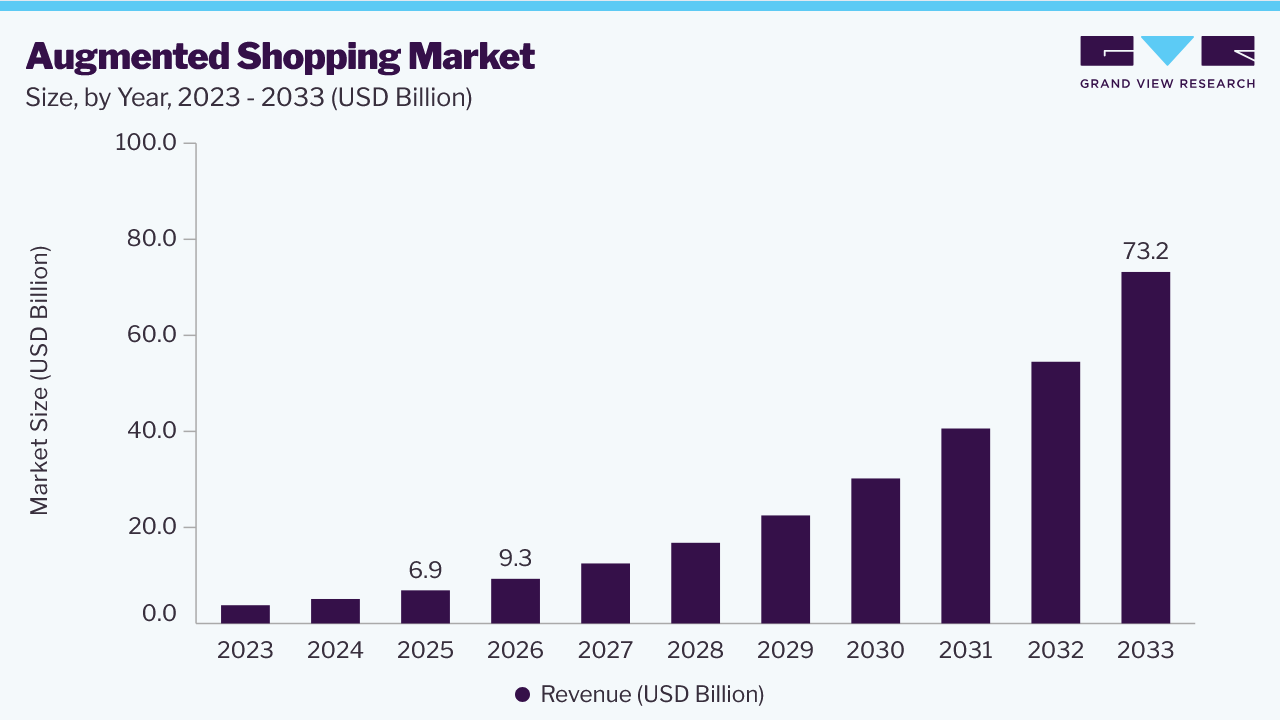
Recent advancements in AR technology, such as improved spatial mapping and marker-less tracking, have enhanced the quality and accuracy of AR experiences, leading to greater user engagement. Additionally, the rising demand for personalized and interactive shopping experiences has encouraged retailers to adopt AR solutions. These tools enable customers to virtually test products, visualize furniture placement and aesthetics in their homes, and access additional product information. For instance, the IKEA Place application allows customers to virtually place new furniture in their homes by scanning their rooms with a LiDAR scanner on their iPhones. Other industries, including automotive, footwear, and cosmetics, are also expected to steadily increase their use of AR solutions in the coming years, contributing to market growth.
The integration of AR with social media platforms such as Snapchat and Instagram, along with its growing importance in influencer marketing, has broadened its reach and appeal. Furthermore, the growing focus on sustainability and the need to reduce product return rates have highlighted AR's advantages in minimizing waste and improving purchasing decisions. For example, the beauty product platform Sephora has launched an innovative mobile application that allows customers to virtually try on makeup products. The Sephora Virtual Artist utilizes facial recognition technology to display different product shades by scanning users' faces. Similar advancements from other companies are expected to create significant growth opportunities for the AR shopping industry in the near future.
Analyst Perspective
The augmented shopping market is growing as retailers increasingly use immersive technologies to improve online and in-store customer experiences. Features such as virtual try-ons, interactive product visualization, and personalized shopping experiences are helping brands reduce purchase hesitation and improve customer engagement. Companies with strong technology capabilities, seamless platform integration, and partnerships with retailers are likely to strengthen their market position. As consumers become more comfortable with digital shopping experiences, demand is expected to favor solutions that make purchasing more convenient and interactive. Over the forecast period, competitive advantage will depend on user experience, visualization accuracy, and the ability to improve conversion rates and customer satisfaction across retail channels.
Component Insights
The solutions component dominated the market, with a revenue share of over 65.0% in 2025, driven by the growing need for comprehensive AR solutions that can be seamlessly integrated into existing e-commerce platforms, mobile apps, and physical stores. Retailers are increasingly seeking end-to-end solutions that include content creation, software development, deployment, and constant support and maintenance. For instance, in May 2025, Glance, a smart lock screen platform, launched Glance AI. It is an AI-enabled online shopping platform that provides a hyper-real visual shopping experience.
AR solutions offer a one-stop shop for retailers, providing a scalable, customizable platform tailored to their specific business needs. Furthermore, they enable retailers to leverage AR technology without requiring significant investments in in-house development and expertise, making it an attractive option for businesses of all sizes.
The services component of augmented shopping is expected to register the fastest CAGR over the forecast period, owing to the increasing demand for specialized services, which is expected to enable retailers to integrate AR technologies into their operations effectively. As Augmented Reality (AR) adoption accelerates, retailers require professional guidance on strategy development, content creation, and implementation to maximize the benefits of AR shopping experiences. The services component, comprising consulting, training, maintenance, and support, has become essential for retailers seeking to navigate the complexities of AR technology and optimize its potential. For instance, in May 2025, HCLTech, a leading global technology company, collaborated with CareAR and ServiceNow to launch an augmented reality (AR)-based infrastructure management solution. This product helps simplify IT infrastructure support, improving operational efficiency through real-time remote assistance and automation-driven workflows.
Application Insights
The automotive sector held the largest market revenue share in 2025. The presence of complex, high-value products in this industry, coupled with the need for immersive, interactive customer experiences, has created a strong foundation for AR adoption. Automobile manufacturers and dealerships have leveraged AR to enable customers to virtually explore and customize vehicles, visualize features and options, and take virtual test drives. For instance, Toyota has created an AR app that leverages machine learning and Apple's ARKit. This app lets customers easily identify their car with their phone camera and virtually add accessories without needing physical markers, creating a more engaging and convenient shopping experience. Such initiatives lead to increased customer engagement and improved sales. The automobile sector's significant investment in digital transformation and customer experience initiatives has positioned AR as a key strategy for competitive differentiation.
The footwear segment is expected to register the fastest growth rate from 2026 to 2033. The footwear industry's emphasis on style, fit, and customization is well-suited to AR technology, enabling customers to try on shoes virtually, visualize different colors and designs, and ensure a precise fit. Additionally, this sector's competitive landscape and high product return rates have driven retailers to invest in AR solutions to enhance customer satisfaction, reduce returns, and gain a competitive edge. For instance, the Nike app's Nike Fit feature uses AR to help customers find the right shoe size using their mobile camera. Many other leading footwear brands are also leveraging innovative AR solutions to engage customers, increase conversions, and drive growth.
Regional Insights
The North America augmented shopping industry dominated the global market with a revenue share of around 60.0% in 2025. It is attributed to the region's robust e-commerce landscape, high smartphone penetration rate, and strong consumer demand for innovative technologies. North America's well-established retail infrastructure and significant investments in digital transformation and customer experience initiatives have created several growth avenues for AR adoption. Additionally, the region's competitive market dynamics have driven retailers to leverage AR as a key differentiator, enhancing customer engagement and driving sales.
Asia Pacific Augmented Shopping Market Trends
The augmented shopping industry in the Asia Pacific is expected to register the fastest growth rate over the forecast period. Rapid economic growth and an increasing middle-income urban population in countries such as China, India, and Indonesia have created lucrative growth opportunities for retailers. The emergence of AR and its adoption by social media and retail giants, such as Taobao (Alibaba Group), JD.com, WeChat, and Douyin, have led to increased adoption of AR solutions among retailers. As the region's economic situation improves, a proportional rise in the adoption of innovative techniques such as AR is expected in the coming years.
The India augmented shopping industry has witnessed a substantial surge in e-commerce customers over the past decade. The India Brand Equity Foundation (IBEF) estimated that India has approximately 280 million to 300 million internet users engaged in online transactions. The e-commerce marketplace saw a 17%-22% increase in Gross Merchandise Value (GMV) in 2025 compared with the previous year. In addition, prominent players such as Amazon, Google, and Flipkart are investing heavily in the economy to capture a larger share of online customers. Furthermore, Indian companies such as Lenskart have incorporated AR technology into their shopping apps, enabling customers to choose from a variety of products. These developments have presented promising growth opportunities for the market in India.
Key Augmented Shopping Company Insights
Some key companies involved in the augmented shopping market include Zugara, Inc., Augment, and Blippar Group Limited, among others.
- Zugara, Inc. is an Augmented Reality (AR) and Virtual Reality (VR) software technology company. The company develops AR software based on ARKit & ARCore, gesture and facial recognition, mobile AR, geolocation, AR video conferencing, and motion capture technology. Zugara offers its Virtual Style Sense (VSS) technology to retail shops to enhance the customer buying experience through AR. Prominent brands such as Purina, Orange Silicon Valley, Novelis, Pepsi, Olay, AT&T, Hungry Jack’s, Coach, Nestle, and Toyota have incorporated Zugara’s Augmented Reality technology.
- Augment is a France-based company that provides AR and 3D visualization and communication solutions. The company is well known in e-commerce for its 3D solutions that convert 2D images of objects into 3D models. These ensure better customer engagement, higher sales conversion rates, and fewer product returns on e-commerce platforms. Augment offers the AR Viewer app, which supports Apple’s ARKit and Google’s ARCore. Furthermore, its dedicated AR solution has helped improve field sales efficiency for FMCG companies such as Unilever, Mondelez, Coca-Cola, and FP International.
Key Augmented Shopping Companies
The following key companies have been profiled for this study on the augmented shopping market:
-
Apple Inc.
-
Augment
-
Blippar Group Limited
-
Google LLC
-
Holition Ltd.
-
3D Cloud
-
Microsoft Corporation
-
PTC
-
ViewAR GmbH
-
Wikitude
-
Zugara, Inc.
Recent Developments
- In April 2024, Blippar Group Limited announced a strategic partnership with Arabian Business Machines (ABM) to expand the adoption of advanced augmented reality (AR) solutions in Saudi Arabia. The collaboration aimed to support regional digital transformation initiatives by enabling businesses and brands to enhance customer engagement and interactive experiences through AR technologies.
- In October 2023, 3D Cloud announced that it had received a patent for automated room design technology powered by artificial intelligence and LiDAR scanning. The software was developed to create optimized floor layouts and interior designs, offering potential applications for consumers purchasing furniture and home decor products while highlighting the growing integration of AI and AR technologies in home visualization solutions.
Augmented Shopping Market Report Scope
Report Attribute
Details
Market size in 2025
USD 6.9 billion
Estimated market size in 2026
USD 9.3 billion
Projected market size by 2033
USD 73.2 billion
Growth rate
CAGR of 34.3% from 2026 to 2033
Base year for estimation
2025
Actual data
2021 – 2024
Forecast period
2026 – 2033
Quantitative units
Revenue in USD billion and CAGR from 2026 to 2033
Report coverage
Revenue forecast, company ranking, competitive landscape, growth factors, and trends
Segments covered
Component, application, region
Regional Scope
North America; Europe; Asia Pacific; Central & South America; Middle East & Africa
Country Scope
U.S.; Canada; Mexico; UK; Germany; France; China; India; Japan; Australia; South Korea; Brazil; South Africa, UAE; Saudi Arabia
Key companies profiled
Apple Inc.; Augment; Blippar Group Limited; Google LLC; Holition Ltd.; 3D Cloud; Microsoft Corporation; PTC; ViewAR GmbH; Wikitude; Zugara, Inc.
Customization scope
Free report customization (equivalent up to 8 analysts working days) with purchase. Addition or alteration to country, regional & segment scope.
Pricing and purchase options
Avail of customized purchase options to meet your exact research needs. Explore purchase options
Global Augmented Shopping Market Report Segmentation
This report forecasts revenue growth at global, regional, and country levels and provides an analysis of the latest industry trends and opportunities in each of the sub-segments from 2021 to 2033. For this study, Grand View Research has segmented the global augmented shopping market report based on component, application, and region:
-
Component Outlook (Revenue, USD B illion, 2021 - 2033)
-
Solutions
-
Services
-
-
Application Outlook (Revenue, USD B illion, 2021 - 2033)
-
Automotive
-
Home Goods & Furniture
-
Beauty & Cosmetics
-
Apparel Fittings
-
Grocery Shopping
-
Footwear
-
Others
-
-
Regional Outlook (Revenue, USD B illion, 2021 - 2033)
-
North America
-
U.S.
-
Canada
-
Mexico
-
-
Europe
-
UK
-
Germany
-
France
-
-
Asia Pacific
-
Japan
-
India
-
China
-
Australia
-
South Korea
-
-
Latin America
-
Brazil
-
-
Middle East & Africa
-
South Africa
-
Saudi Arabia
-
UAE
-
-
Frequently Asked Questions About This Report
The global augmented shopping market size was valued at USD 6.9 billion in 2025 and is estimated at USD 9.3 billion for 2026.
Some of the key players that are a part of the augmented shopping market include Google LLC; Microsoft; Apple Inc.; Zugara, Inc.; PTC; Wikitude GmbH.; Imaginate Technologies; and Augment.
The global augmented shopping market is expected to grow at a CAGR of 34.3% from 2026 to 2033, reaching USD 73.2 billion by 2033.
The solutions component augmented shopping segment accounted for the largest revenue share of over 65.0% in 2025.
North America dominated with an approximately 60.0% revenue share in 2025.
About the Author(s)
Next Generation Technologies Research Team
Technology · Next Generation TechnologiesThis report was authored by the next generation technologies research team at Grand View Research - comprising two research analysts, one senior research analyst, and one industry expert - with specialized expertise in the next generation technologies segment of the technology industry. All findings are based on proprietary technology databases, executive interviews, and regulatory analysis, subject to internal peer review prior to publication.
Last Updated:
Speak to Analyst


Customize this report to your needs — add regions, segments, or data points, with 20% free customization.
Or view our licence options:


ISO 9001:2015 & 27001:2022 Certified
We are GDPR and CCPA compliant! Your transaction & personal information is safe and secure. For more details, please read our privacy policy.


