
- Home
- »
- Advanced Interior Materials
- »
-
Automatic Checkweighers Market Size Report, 2026-2033GVR Report cover

Automatic Checkweighers Market (2026 - 2033)
Size, Share & Trends Analysis Report By Product (In-line Checkweighers, Combination Checkweighers Systems), By Technology (Load Cell-based, Electromagnetic Force Restoration (EMFR)), By End Use, By Region, And Segment Forecasts
Market Size, 2025
$1.3BMarket Estimate, 2026
$1.4BMarket Forecast, 2033
$1.9BCAGR, 2026–2033
5.1%Automatic Checkweighers Market Summary
The global automatic checkweighers market size was valued at USD 1.3 billion in 2025 and is projected to grow from USD 1.4 billion in 2026 to USD 1.9 billion by 2033, at a CAGR of 5.1% from 2026 to 2033. Europe dominated the market, accounting for the largest revenue share of 31.9% in 2025. The market is expected to grow primarily due to increasing demand for automated quality control in manufacturing and stricter weight and packaging regulations.
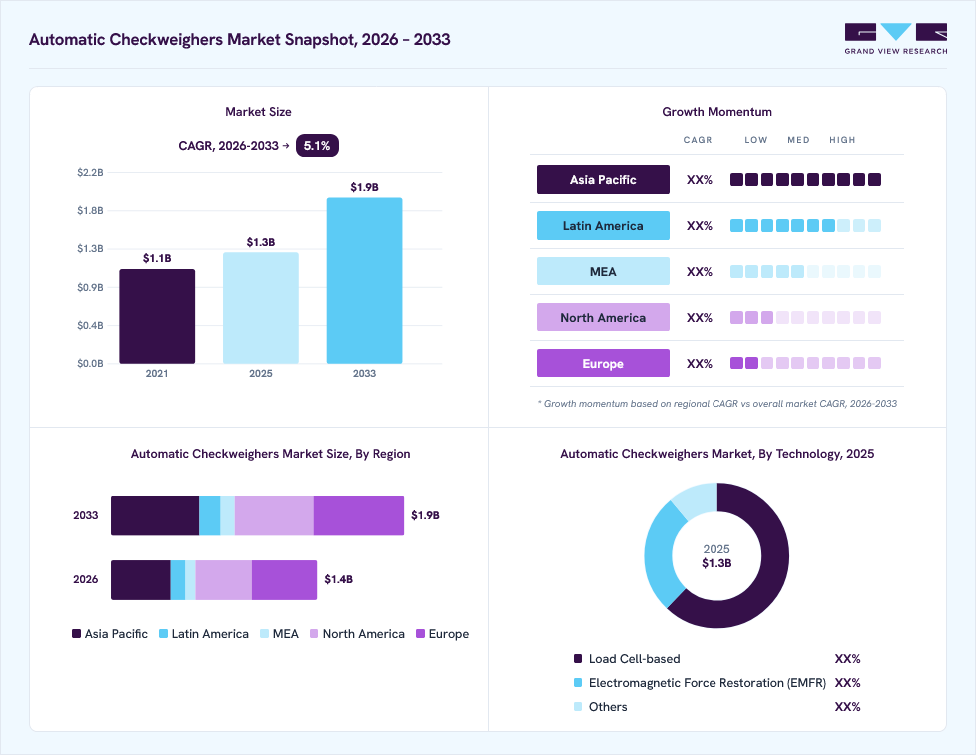 Source: Grand View Research, IR Documents, Primary Interviews, Paid DatabasesTo learn more about this report,
 Download Free Sample Report
Key Market Trends & Insights
- By product: In-line checkweighers segment led the market with the largest revenue share of 72.0% in 2025.
- By technology: Load cell-based technology segment led the market with the largest revenue share of 62.0% in 2025.
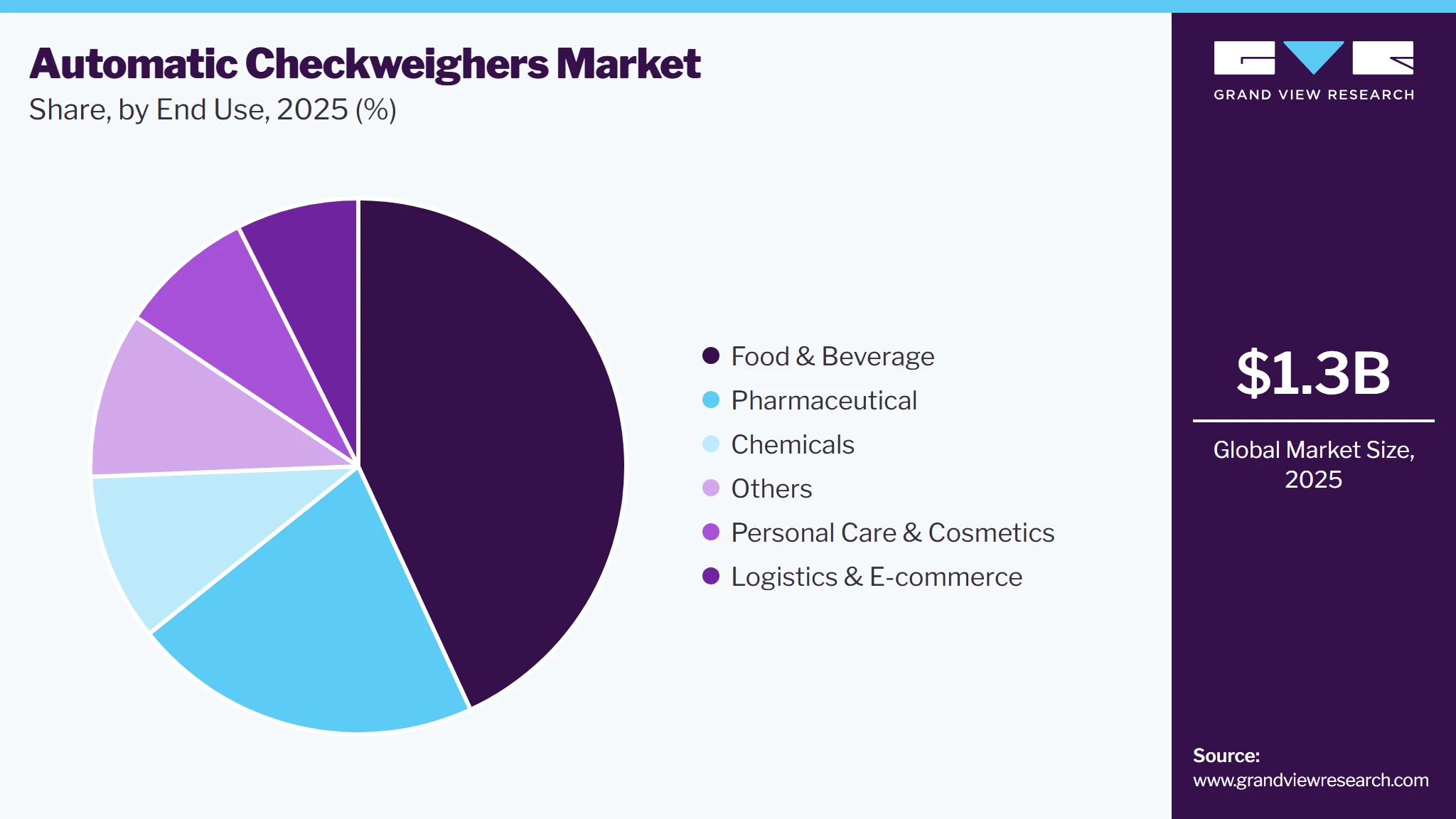
- By end use: Food & Beverage segment led the market with the largest revenue share of 43.1% in 2025.
Regional Highlights
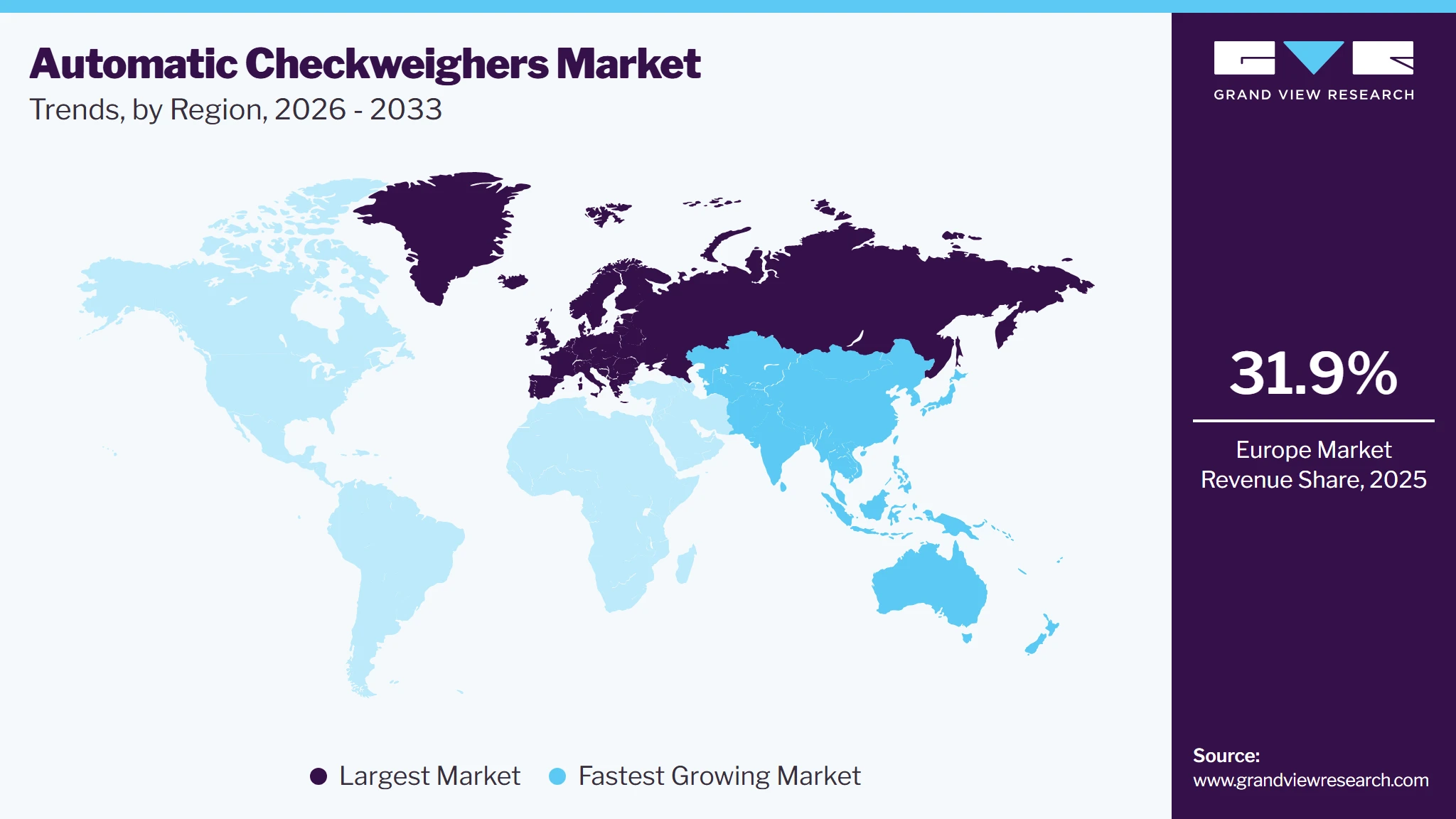
- Largest regional market: Europe (31.9% revenue share, 2025)
- Fastest-growing regional market: Asia Pacific (highest CAGR, 2026-2033)
- By country: Germany held the largest market share in 2025.
Market Size & Forecast
- Market size in 2025: USD 1.3 Billion
- Estimated market size in 2026: USD 1.4 Billion
- Projected market size by 2033: USD 1.9 Billion
- CAGR (2026-2033): 5.1%
Prism AI by Grand View Research Free to tryAsk a question about the automatic checkweighers market✓Every figure cited from GVR research Prefer the report? Download free sample →
Manufacturers across food and beverage, pharmaceuticals, chemicals, and consumer goods are adopting automatic checkweighers to verify product weights, reduce giveaway, identify underweight or overweight products, and maintain consistent production quality. Automation also enables continuous, high-speed inspection with limited manual intervention, supporting integration into modern production lines.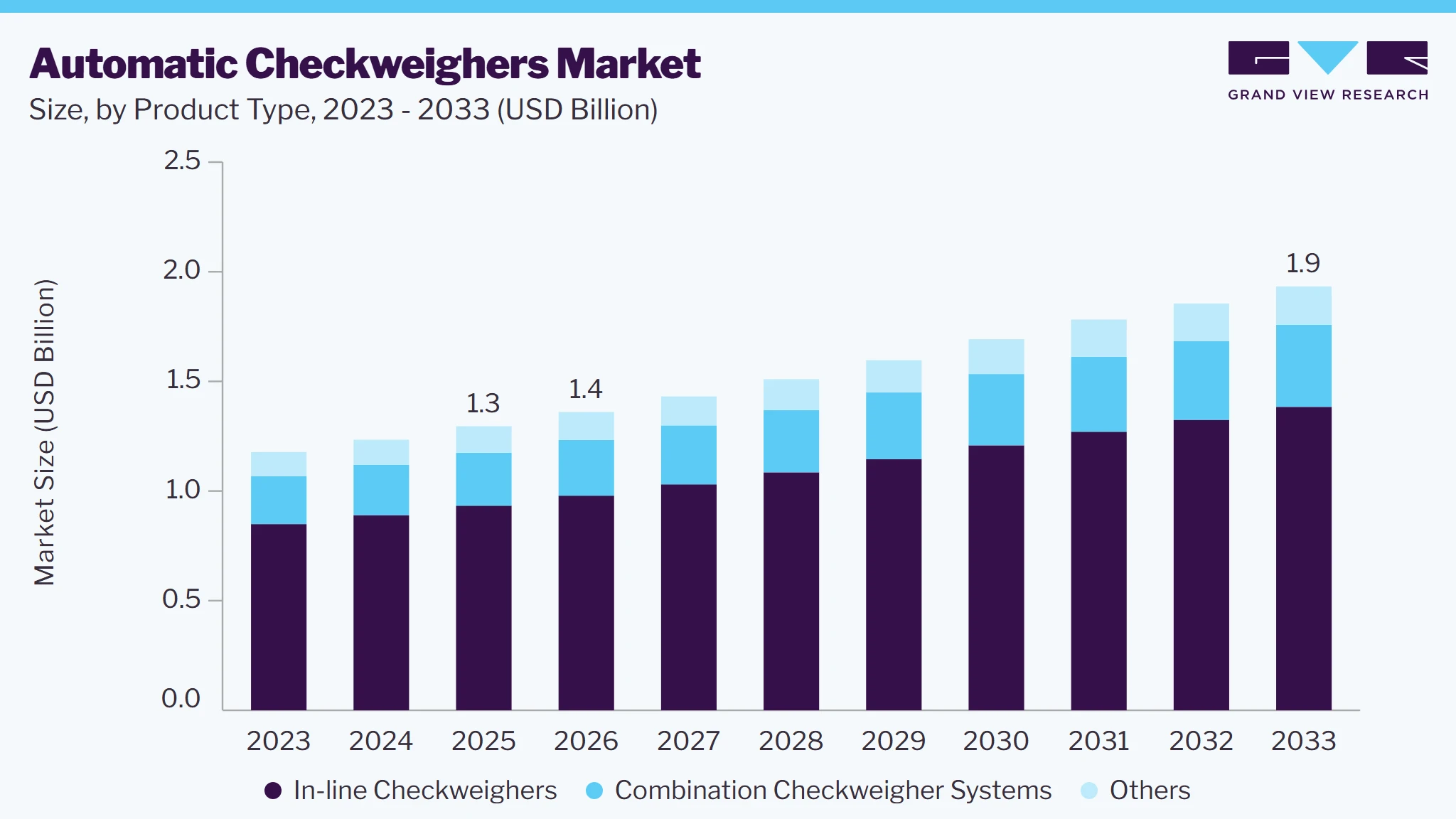 To learn more about this report, Download Free Sample Report
In addition, regulatory requirements for accurate product labeling and declared-weight compliance are encouraging manufacturers to implement automated weighing systems. As production volumes increase and manufacturers focus on minimizing material losses while maintaining compliance, demand for automatic checkweighers is expected to expand across high-speed packaging and processing operations.
Market Dynamics
The automatic checkweighers industry is influenced by increasing production automation, demand for accurate weight control, regulatory compliance, and the need to reduce product giveaway. Food and beverage, pharmaceutical, consumer goods, and logistics manufacturers are adopting automated weighing systems to maintain consistent product weights and improve inspection efficiency. High equipment costs, integration complexity, and maintenance requirements can limit adoption among smaller manufacturers. Meanwhile, developments in digital connectivity, machine vision, data analytics, and high-speed weighing technologies are creating new opportunities.
Manufacturers are replacing manual weight inspection with automated systems capable of continuously checking products at high production speeds. Automatic checkweighers improve consistency, reduce manual intervention, and identify underweight or overweight products during production. Their integration with conveyors, filling machines, packaging equipment, and reject systems further supports automated quality control. Growing investment in automated production lines is therefore increasing demand for checkweighing equipment.
Equipment costs include the weighing system, conveyors, sensors, control software, installation, calibration, and integration with existing production lines. Additional expenses may arise when customized configurations are required for specific products or operating environments. Maintenance and periodic calibration also contribute to ownership costs. These financial requirements can delay replacement of manual weighing processes or limit adoption in facilities operating with lower production volumes.
Combining checkweighers with machine vision, serialization, data analytics, industrial IoT, and cloud-based monitoring can provide manufacturers with broader quality-control capabilities. Real-time production data can support weight trend analysis, process adjustments, traceability, and predictive maintenance. Integration with existing manufacturing execution and quality management systems can further improve process visibility. Growing adoption of connected production environments is expected to support demand for digitally enabled checkweighing systems.
Market Concentration & Characteristics
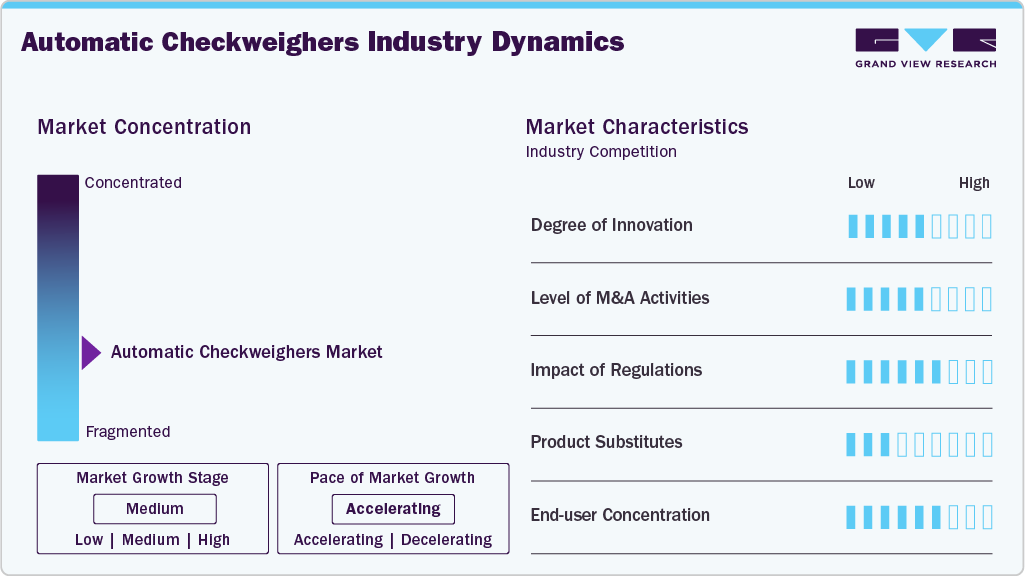
The automatic checkweighers industry is fragmented, with competition spread across global equipment manufacturers, specialized weighing-system providers, and regional suppliers. Companies differentiate through weighing accuracy, line speed, product handling capabilities, automation features, software integration, and customization. Market participants serve diverse industries, including food and beverage, pharmaceuticals, chemicals, and consumer goods. Regional manufacturers also compete through application-specific solutions, local distribution networks, installation support, and aftermarket services.
The automatic checkweighers industry has a moderate-to-high degree of innovation, driven by developments in high-speed weighing sensors, digital signal processing, machine learning, and automated reject systems. Manufacturers are integrating vision inspection, data connectivity, remote monitoring, and production-line communication. Compact designs, improved accuracy, and software-based analytics are also supporting integration with automated packaging and manufacturing systems.
 To learn more about this report, Download Free Sample Report
Regulations are shaping the automatic checkweighers industry by requiring accurate product weight measurement and compliance with declared weight and packaging standards. Requirements from legal metrology authorities influence equipment accuracy, calibration, verification, and software functionality. Food and pharmaceutical manufacturers face additional quality-control requirements, encouraging automated weight inspection. Compliance needs therefore support the adoption of checkweighers in production and packaging lines where consistent measurement and traceability are required.
Analyst Perspective
The market for automatic checkweighers is influenced by increasing production automation, demand for accurate weight verification, packaging compliance, and the need to reduce product giveaway. Food and beverage, pharmaceutical, consumer goods, and industrial manufacturers are adopting automated checkweighers for continuous quality control. Integration with filling, packaging, metal detection, vision inspection, and production-management systems is further supporting adoption. Advances in high-speed weighing, digital connectivity, and automated rejection systems are also improving the functionality of checkweighing equipment.
Product Insights
The in-line checkweighers segment led the market in 2025 due to its widespread integration into continuous production and packaging lines. These systems provide real-time weight verification without interrupting product flow, supporting high-speed operations and consistent quality control. Their adoption across food and beverage, pharmaceutical, and consumer goods industries is supported by requirements for accurate filling, reduced product giveaway, and regulatory compliance.
The combination checkweighers systems segment is expected to grow at 5.7% CAGR during the forecast period, as manufacturers seek integrated inspection capabilities within production lines. These systems combine weight measurement with technologies such as metal detection or X-ray inspection, enabling multiple quality checks through a single unit. Their compact configuration can reduce equipment footprint, simplify line integration, and lower installation requirements, supporting adoption in food processing, pharmaceutical, and packaged consumer goods applications.
Technology Insights
The load cell-based segment dominated the market in 2025 due to its established use across high-speed weighing applications. Load cells provide reliable weight measurement, durability, and compatibility with diverse product sizes and packaging formats. Their relatively simple construction and integration with conveyor systems support widespread adoption across food and beverage, pharmaceutical, logistics, and consumer goods production lines.
The Electromagnetic Force Restoration (EMFR) segment is expected to grow at 5.6% CAGR during the forecast period as manufacturers seek higher weighing accuracy for lightweight and high-value products. EMFR technology provides precise measurements with rapid response times and high sensitivity. Its suitability for pharmaceutical, laboratory, and specialized food applications supports adoption where tight weight tolerances, product consistency, and accurate dosing are important for quality control and regulatory compliance.
End Use Insights
The food & beverage segment led the market in 2025, holding 43.1% market share due to high-volume production, stringent weight-control requirements, and extensive packaged-product manufacturing. Checkweighers help verify fill weights, reduce product giveaway, and identify underweight or overweight packages without interrupting production. Their use across processed foods, beverages, dairy, bakery, and packaged products supports widespread adoption of automated weighing systems.
 To learn more about this report, Download Free Sample Report
The pharmaceutical segment is expected to grow significantly during the forecast period as manufacturers increase automation and require highly accurate weight verification for medicines and packaged products. Automatic checkweighers support consistent dosing, package completeness, and compliance with quality-control requirements. Rising pharmaceutical production, increasing use of automated packaging lines, and stricter requirements for product accuracy and traceability are supporting adoption of advanced checkweighing systems.
Regional Insights
North America automatic checkweighers industry is expected to grow significantly over the forecast period, due to increasing automation in food and beverage production. Manufacturers are replacing manual weight inspection with automated checkweighers to maintain consistent product weights during high-volume packaging. The integration of checkweighers into automated production lines enables continuous inspection without interrupting operations, supporting their adoption across food processing facilities.
U.S. Automatic Checkweighers Market Trends
The U.S. automatic checkweighers industry is growing primarily due to expanding pharmaceutical manufacturing. Pharmaceutical producers require precise weight verification during packaging and production to maintain product consistency and quality. Automatic checkweighers provide continuous weight measurement and can identify deviations without interrupting production. As pharmaceutical manufacturing capacity expands and production lines become increasingly automated, manufacturers are adopting automated checkweighing equipment to support accurate and consistent product inspection.
Asia Pacific Automatic Checkweighers Market Trends
Asia Pacific automatic checkweighers industry is expected to grow at 5.8% CAGR over the forecast period, due to expansion of food processing industries. Increasing packaged food production is encouraging manufacturers to automate weight inspection to maintain consistency across high-volume production lines. Automatic checkweighers allow continuous verification of product weights while reducing manual intervention.
China automatic checkweighers industry led the market in Asia Pacific region due to expansion of automated food manufacturing. Food producers are increasingly installing automated packaging lines to accommodate rising production volumes. Automatic checkweighers provide continuous verification of package weights and help identify deviations during production. Their integration with automated filling, packaging, and rejection equipment supports consistent production without requiring continuous manual inspection.
India automatic checkweighers industry is growing over the forecast period, due to increasing automation in food processing. Food manufacturers are upgrading production and packaging facilities to handle growing volumes and improve process consistency. Automatic checkweighers enable continuous verification of package weights and reduce reliance on manual inspection. Their integration with automated packaging lines supports consistent product output and weight control. As food processing facilities increasingly adopt automated equipment, demand for automatic checkweighers is expanding across India.
Europe Automatic Checkweighers Market Trends
Europe automatic checkweighers industry dominated the global market in 2025, due to strict product weight and packaging requirements. Manufacturers must maintain declared product weights within specified tolerances, encouraging the use of automated weighing systems for continuous verification. Checkweighers provide real-time weight measurement during packaging and help identify products outside permitted limits. These requirements are particularly relevant to food, beverage, pharmaceutical, and consumer goods manufacturers, supporting continued adoption of automated checkweighing equipment across European production facilities.
 To learn more about this report, Download Free Sample Report
Germany automatic checkweighers industry is growing primarily due to advanced manufacturing automation. German manufacturers increasingly integrate automated inspection systems into production and packaging lines to improve process control. Automatic checkweighers provide continuous weight verification and can communicate with other production equipment, supporting automated quality-control processes.
The UK automatic checkweighers industry growth is driven by automation of food packaging operations. Food manufacturers are increasingly using automated packaging lines to handle high production volumes while maintaining consistent product weights. Checkweighers provide continuous weight verification and automatically identify packages outside specified tolerances.
Middle East & Africa Automatic Checkweighers Market Trends
The Middle East & Africa automatic checkweighers industry is growing due to expansion of food processing capacity. Manufacturers are increasing production of packaged food products, creating greater requirements for automated weight verification. Checkweighers continuously measure product weights during packaging and identify packages outside specified tolerances. Their use helps maintain consistency across high-volume production lines.
The Saudi Arabia automatic checkweighers industry is driven by the food producers, which are increasing production capacity and adopting automated packaging equipment to improve manufacturing efficiency. Automatic checkweighers provide continuous weight verification during packaging, helping manufacturers maintain consistent product weights. Their integration with automated production lines reduces manual inspection requirements. As Saudi food processing facilities increasingly adopt automated packaging systems, demand for checkweighing equipment is expected to increase.
Latin America Automatic Checkweighers Market Trends
Latin America automatic checkweighers industry is growing primarily due to expansion of packaged food production. Food manufacturers are increasing production volumes and adopting automated packaging systems to maintain consistent product weights. Automatic checkweighers enable continuous weight inspection during production and help identify underweight or overweight packages. Their integration into automated packaging lines reduces manual quality-control requirements.
Brazil automatic checkweighers industry is growing due to large-scale food processing production. Brazil has extensive production of packaged food and beverage products, creating a need for continuous weight verification during high-volume packaging. Automatic checkweighers help manufacturers maintain specified product weights and identify deviations during production. Their integration with automated packaging lines supports consistent output and reduces manual inspection.
Key Automatic Checkweighers Company Insights
Some of the key players operating in the market include Minebea Intec GmbH, MULTIVAC, Thermo Fisher Scientific Inc., Mettler Toledo, Ishida Co., Ltd., Anritsu, among others.
-
Mettler Toledo is a global manufacturer of precision measurement and inspection equipment, with operations spanning weighing, product inspection, laboratory instruments, and industrial measurement systems. In the automatic checkweighers industry, the company provides checkweighing solutions for food, pharmaceutical, and other manufacturing applications. Its product portfolio includes automated weight inspection systems designed for integration with production and packaging lines, supporting weight control, quality assurance, and process monitoring.
-
Ishida Co., Ltd. is a Japanese manufacturer of weighing, inspection, and packaging equipment serving food, pharmaceutical, and other industries. Its portfolio includes automatic checkweighers designed for high-speed product weight verification on packaging lines. The company also provides combination systems integrating weighing with metal detection and other inspection technologies, supporting automated quality control, product compliance, and production-line efficiency.
Key Automatic Checkweighers Companies
The following key companies have been profiled for this study on the automatic checkweighers market.
-
Mettler Toledo
-
Ishida Co., Ltd.
-
Anritsu
-
Thermo Fisher Scientific Inc.
-
Minebea Intec GmbH
-
WIPOTEC GmbH
-
MULTIVAC
-
JBT Marel
-
Loma Systems
-
Bizerba
-
Sartorius AG
-
Yamato Corporation
-
Precia Molen
-
Avery Weigh-Tronix
-
Datalogic S.p.A.
Competitive Benchmarking
Operating Strategies
Competitive Edge
Weaknesses
Mature Players: Mettler Toledo, Ishida Co., Ltd., Anritsu, Thermo Fisher Scientific Inc., Minebea Intec GmbH, WIPOTEC GmbH, MULTIVAC, JBT Marel, Bizerba, Yamato Corporation
- Mature players focus on expanding automated weighing portfolios, integrating checkweighers with inspection and packaging systems, strengthening global distribution and service networks, and developing software-enabled solutions.
- They also emphasize customization, regulatory compliance, equipment reliability, and long-term relationships with food, pharmaceutical, and industrial manufacturers.
- Their competitive edge comes from established brands, extensive installed bases, broad product portfolios, technological expertise, and global service capabilities.
- Strong relationships with OEMs and packaging-line integrators, established manufacturing infrastructure, and experience meeting accuracy and compliance requirements provide advantages in large-scale and high-speed checkweighing applications.
- Mature players can face higher equipment and service costs because of extensive technology, engineering, and support infrastructure.
- Large organizational structures may also slow customization and product development compared with smaller suppliers. Their broad portfolios can reduce focus on highly specialized applications requiring simple, lower-cost checkweighing solutions.
Emerging Players: Loma Systems, Sartorius AG, Precia Molen, Avery Weigh-Tronix, Datalogic S.p.A.
- Emerging players generally focus on specialized checkweighing applications, competitive pricing, customized equipment, and targeted industry segments.
- They seek market expansion through regional distributors, system integrators, strategic partnerships, and technology development.
- Emerging players can compete through flexible product configurations, faster customization, lower operating costs, and focused application expertise.
- Their smaller organizational structures can support quicker responses to customer requirements. Specialized technologies, regional market knowledge, and competitive pricing can help them secure opportunities where established suppliers have limited flexibility.
- Emerging players generally have smaller installed bases, limited global distribution networks, and lower brand recognition than established competitors.
- They may also have fewer financial resources for extensive R&D, manufacturing expansion, and aftermarket support.
- Limited experience with large multinational customers can create challenges when competing for complex, high-volume projects
Recent Developments
-
In March 2026, Fortress Technology introduced the Raptor Flex automated checkweighers system to provide automated weight verification for production lines. The system supports continuous product inspection, helping manufacturers identify weight deviations and maintain consistent product specifications across high-speed food, pharmaceutical, and industrial packaging operations.
-
In May 2025, Mettler-Toledo Product Inspection updated its C31 StandardLine Checkweighers with smart production packages designed for small and mid-sized manufacturers. The packages provide greater configuration flexibility, faster system implementation, and enhanced food safety compliance.
Automatic Checkweighers Market Report Scope
Report Attribute
Details
Market size in 2025
USD 1.3 billion
Estimated market size in 2026
USD 1.4 billion
Projected market size by 2033
USD 1.9 billion
Growth rate
CAGR of 5.1% from 2026 to 2033
Base year for estimation
2025
Historical data
2021 - 2024
Forecast period
2026 - 2033
Quantitative units
Revenue in USD billion and CAGR from 2026 to 2033
Report coverage
Revenue forecast, company market position analysis, competitive landscape, growth factors, and trends
Segments covered
Product, technology, end use, and region
Regional scope
North America; Europe; Asia Pacific; Latin America; Middle East & Africa
Country Scope
U.S.; Canada; Mexico; Germany; UK; Italy; Spain; France; China; Japan; India; Australia; South Korea; Brazil; Argentina; Saudi Arabia; UAE; South Africa
Key companies profiled
Mettler Toledo; Ishida Co., Ltd.; Anritsu; Thermo Fisher Scientific Inc.; Minebea Intec GmbH; WIPOTEC GmbH; MULTIVAC; JBT Marel; Loma Systems; Bizerba; Sartorius AG; Yamato Corporation; Precia Molen; Avery Weigh-Tronix; Datalogic S.p.A.
Customization scope
Free report customization (equivalent up to 8 analysts working days) with purchase. Addition or alteration to country, regional & segment scope.
Pricing and purchase options
Avail customized purchase options to meet your exact research needs. Explore purchase options
Global Automatic Checkweighers Market Report Segmentation
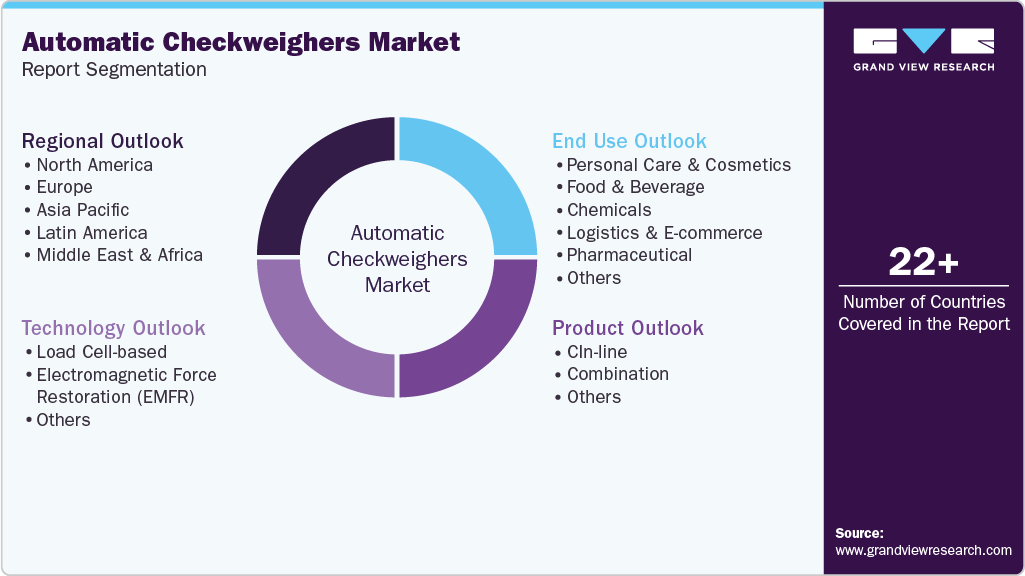
This report forecasts revenue growth at global, regional & country levels and provides an analysis on the industry trends in each of the sub-segments from 2021 to 2033. For this study, Grand View Research has segmented the global automatic checkweighers market report based on product, technology, end use, and region:
 To learn more about this report, Download Free Sample Report
-
Product Outlook (Revenue, USD Billion, 2021 - 2033)
-
In-line Checkweighers
-
Combination Checkweighers Systems
-
Others
-
-
Technology Outlook (Revenue, USD Billion, 2021 - 2033)
-
Load Cell-based
-
Electromagnetic Force Restoration (EMFR)
-
Others
-
-
End Use Outlook (Revenue, USD Billion, 2021 - 2033)
-
Personal Care & Cosmetics
-
Food & Beverage
-
Chemicals
-
Logistics & E-commerce
-
Pharmaceutical
-
Others
-
-
Regional Outlook (Revenue, USD Billion, 2021 - 2033)
-
North America
-
U.S.
-
Canada
-
Mexico
-
-
Europe
-
Germany
-
France
-
UK
-
Spain
-
Italy
-
-
Asia Pacific
-
China
-
India
-
Japan
-
South Korea
-
Australia
-
-
Latin America
-
Brazil
-
Argentina
-
-
Middle East & Africa
-
Saudi Arabia
-
UAE
-
South Africa
-
-
Research Methodology
The automatic checkweighers market figures in this report are based on a proven research process that combines executive interviews with secondary research from proprietary databases, company filings, and recognized regulatory and institutional sources. Market size is built through value-chain sizing-reconciling supply-side and demand-side estimates-and triangulated with bottom-up and top-down approaches. Every estimate passes multiple levels of expert validation before publication, with each automatic checkweighers segment quantified using the revenue-capture definitions in the table below.
Segment Definition
Segment - Product
Revenue Capture Definition
In-line Checkweighers
Revenue is derived from sale of automated checkweighers integrated into production and packaging lines for continuous product weight verification.
Combination Checkweighers Systems
Revenue is captured from sale of integrated checkweighing systems that combine weight inspection with technologies such as metal detection or X-ray inspection.
Others
Revenue is generated through sales of automatic checkweighing configurations outside the in-line and combination system categories.
Segment -Technology
Revenue Capture Definition
Load Cell-based
Revenue is captured from sale of checkweighers using load cell technology to measure product weight during manufacturing and packaging.
Electromagnetic Force Restoration (EMFR)
Revenue is derived from sale of checkweighers employing electromagnetic force restoration technology for precise product weight measurement.
Segment -End Use
Revenue Capture Definition
Personal Care & Cosmetics
Revenue is generated through the sale of automatic checkweighers used for weight verification of personal care and cosmetic products.
Food & Beverage
Revenue is captured from checkweighing systems deployed for weight control and verification sold across food and beverage production and packaging.
Chemicals
Revenue is derived from automatic checkweighers used to measure and verify packaged chemical products and materials.
Logistics & E-commerce
Revenue is generated through checkweighing systems used for automated parcel, package, and shipment weight verification.
Pharmaceutical
Revenue is captured from checkweighers used to verify pharmaceutical product weights and packaging consistency.
Others
Revenue is derived from automatic checkweighing systems deployed across other industries and applications outside the defined end-use categories.
Estimation Model
Layer No.
Layer Name
Key Question
Description
01
Production & Packaging Demand Layer
Which industries generate demand for automatic checkweighers?
The estimation begins by evaluating production and packaging volumes across food & beverage, pharmaceuticals, personal care & cosmetics, chemicals, logistics & e-commerce, and other end-use industries. Production throughput, packaging formats, quality-control requirements, and automation levels establish the base demand for automatic checkweighing systems.
02
Product & Technology Layer
Which checkweighers types and technologies drive market demand?
This layer refines demand by assessing in-line checkweighers, combination checkweighers systems, and other configurations. Demand is further evaluated across load cell-based and Electromagnetic Force Restoration (EMFR) technologies based on weighing accuracy, production speed, product characteristics, automation requirements, and line integration.
03
End-Use & Deployment Layer
What determines automatic checkweighers utilization?
Market demand is estimated through checkweighers deployment across food and beverage, pharmaceuticals, personal care and cosmetics, chemicals, logistics and e-commerce, and other industries. Production volumes, packaging line capacity, regulatory requirements, quality-control practices, product weight tolerances, and automation levels influence equipment utilization and replacement demand.
04
Revenue Layer
How is total market revenue calculated?
Revenue is estimated by aggregating spending on automatic checkweighing systems across products, technologies, end-use industries, and regional markets. Equipment shipments, average selling prices, system configurations, installation requirements, replacement demand, and integration costs are incorporated to validate the total market size.
Delivered Customizations
This report has been delivered with the following In-depth customizations
Client Request
Customization Delivered
Value Adds
Regional Segmentation
Detailed regional analysis was conducted across North America, Europe, Asia Pacific, Latin America, and the Middle East & Africa, including country-level assessment for key markets such as the U.S., Germany, China, India, Brazil, and Saudi Arabia. The study evaluated manufacturing activity, food and beverage production, pharmaceutical manufacturing, packaging automation, regulatory requirements, and investment in automated production lines influencing automatic checkweighers demand.
Helped identify regional differences in automatic checkweighers adoption, country-specific demand patterns, and markets with increasing automation requirements. The analysis also supported assessment of packaging trends, manufacturing investments, regulatory developments, and adoption of automated quality-control systems across major markets.
Competitive benchmarking
Comprehensive benchmarking was carried out for major automatic checkweighers market participants based on product portfolios, weighing technologies, weighing accuracy, line speeds, product-handling capabilities, automation features, software integration, industry coverage, manufacturing capabilities, distribution networks, and aftermarket services.
Assisted clients in understanding competitor positioning, technology capabilities, product differentiation, geographic coverage, and service offerings within the automatic checkweighers market. The study supported competitor assessment, supplier comparison, and identification of product and technology gaps.
Opportunity assessment
In-depth opportunity assessment was conducted by analyzing production automation, packaged food manufacturing, pharmaceutical production, regulatory requirements, product weight control, and adoption of integrated inspection systems. The study evaluated opportunities related to high-speed checkweighing, digital connectivity, machine vision integration, combination inspection systems, and automated packaging lines.
Enabled clients to identify markets with increasing automatic checkweighers demand and evaluate opportunities across end-use industries and technology segments. The analysis also supported assessment of automation investments, technology adoption, product development opportunities, and future demand patterns within the automatic checkweighers market.
Frequently Asked Questions About This Report
The global automatic checkweigher market size was estimated at USD 1.3 billion in 2025 and is expected to reach USD 1.4 billion in 2026.
The automatic checkweigher market, in terms of revenue, is expected to grow at a compound annual growth rate of 5.1% from 2026 to 2033 to reach USD 1.9 billion by 2033.
The in-line checkweighers segment led the market and accounted for 72.0% market revenue share in 2025.
The load cell-based segment led the market and accounted for 62.0% market revenue share in 2025.
The food & beverage segment led the market and accounted for 43.1% market revenue share in 2025.
Some of the key players operating in the automatic checkweigher include Mettler Toledo, Ishida Co., Ltd., Anritsu, Thermo Fisher Scientific Inc., Minebea Intec GmbH, WIPOTEC GmbH, MULTIVAC, JBT Marel, Loma Systems, Bizerba, Sartorius AG, Yamato Corporation, Precia Molen, Avery Weigh-Tronix, Datalogic S.p.A.
Key factors driving the automatic checkweigher market include increasing production-line automation, growing demand for accurate weight verification, stricter packaging and labeling requirements, rising adoption in food and pharmaceutical industries, and the need to reduce product giveaway while maintaining consistent product quality.
Europe region led the market and accounted for 31.9% of the global market revenue share in 2025.
Asia Pacific region is expected to grow at fastest during forecast period, accounting for 5.8% CAGR.
About the Author(s)
Advanced Interior Materials Research Team
Advanced Materials · Advanced Interior MaterialsThis report was authored by the advanced interior materials research team at Grand View Research - comprising two research analysts, one senior research analyst, and one industry expert - with specialized expertise in the advanced interior materials segment of the advanced materials industry. All findings are based on proprietary advanced materials databases, executive interviews, and regulatory analysis, subject to internal peer review prior to publication.
Last Updated:
Speak to Analyst

Customize this report to your needs - add regions, segments, or data points, with 20% free customization.
Or view our licence options:


ISO 9001:2015 & 27001:2022 Certified
We are GDPR and CCPA compliant! Your transaction & personal information is safe and secure. For more details, please read our privacy policy.


