
- Home
- »
- Advanced Interior Materials
- »
-
Automatic Distillation Analyzer Market Size Report, 2033GVR Report cover

Automatic Distillation Analyzer Market (2026 - 2033)
Size, Share & Trends Analysis Report By Technology (Fixed, Portable), By Application (Petroleum & Refining, Chemical, Food & Beverage, Pharmaceutical & Life Sciences, Automotive & Fuels Testing), By Region, And Segment Forecasts
Market Size, 2025
$865.5MMarket Estimate, 2026
$908.8MMarket Forecast, 2033
$1,291.5MCAGR, 2026–2033
5.1%Automatic Distillation Analyzer Market Summary
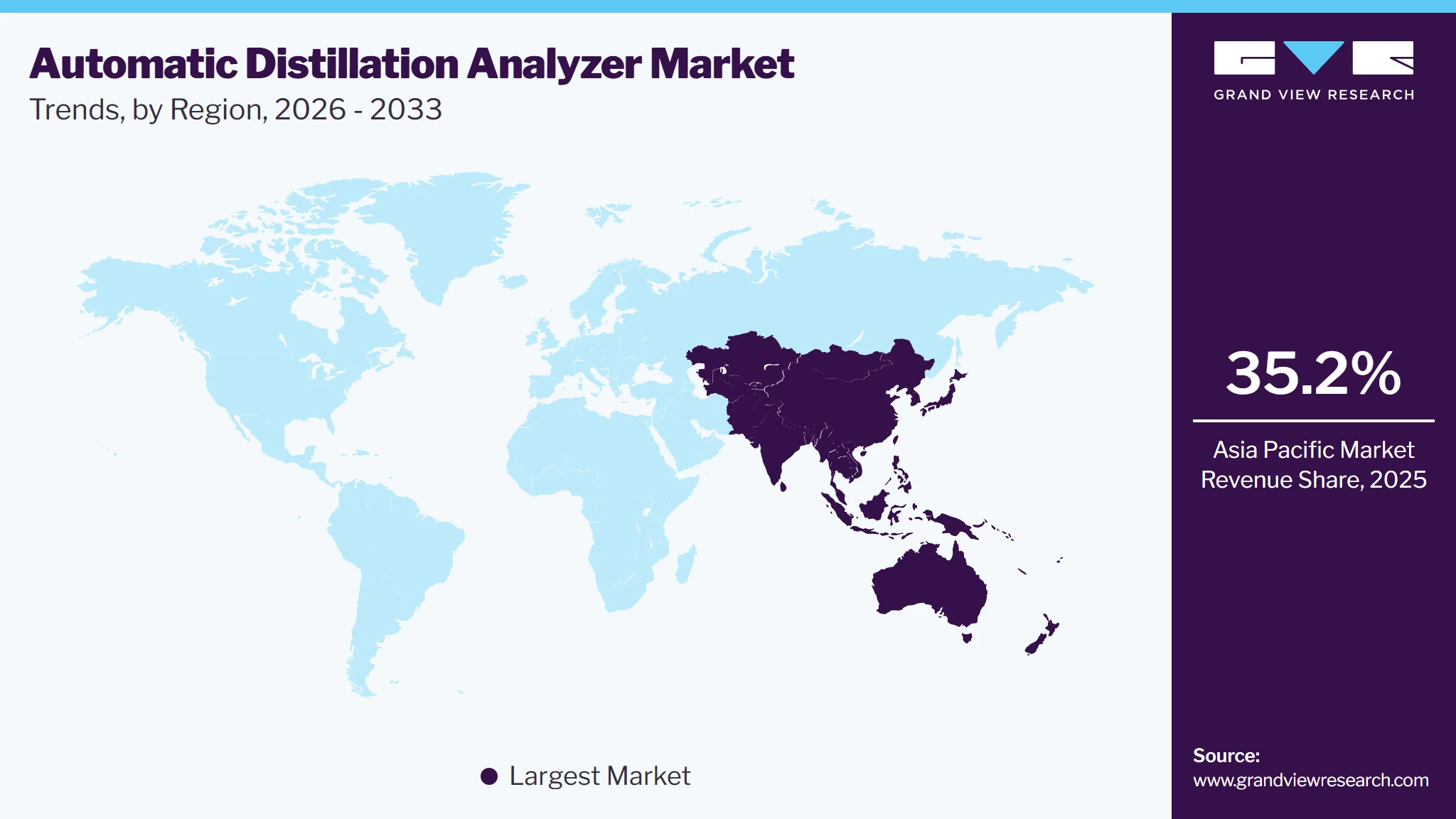
The global automatic distillation analyzer market size was valued at USD 865.5 million in 2025 and is projected to grow from USD 908.8 million in 2026 to USD 1,291.5 million by 2033 at a CAGR of 5.1% from 2026 to 2033. Asia Pacific dominated the global market, accounting for the largest revenue share of 35.2% in 2025. The global market is driven by stringent fuel quality standards, increasing refinery and petrochemical testing requirements, and the transition from manual to automated laboratory analysis.
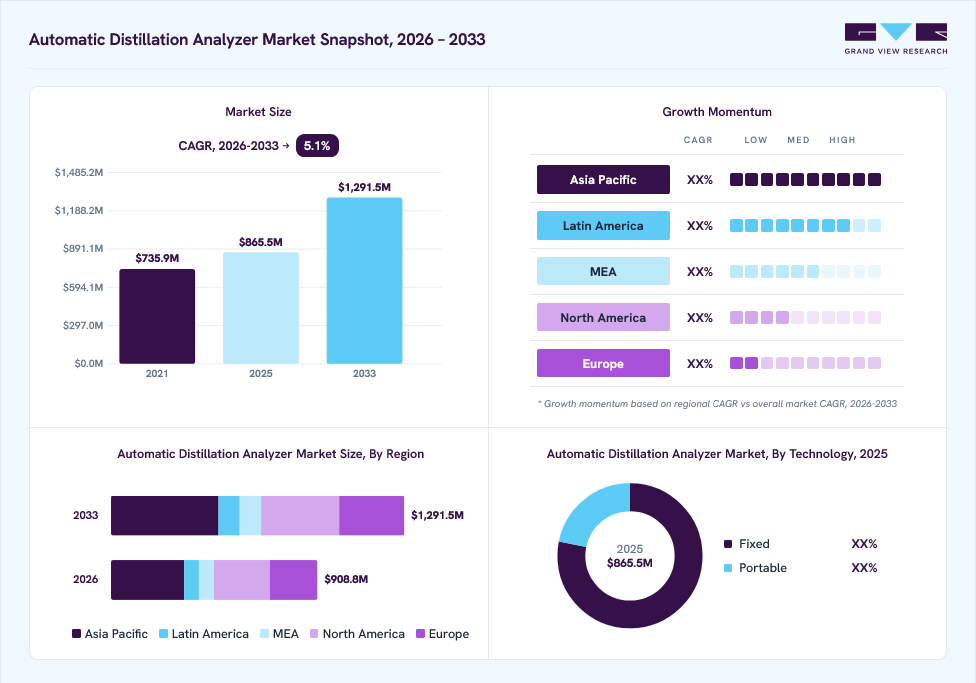 Source: Grand View Research, IR Documents, Primary Interviews, Paid DatabasesTo learn more about this report,
 Download Free Sample Report
Key Market Trends & Insights
- By technology: The portable segment is projected to grow at 5.6% CAGR during the forecast period.
- By application: The petroleum & refining segment dominated the market in 2025, holding 39.0% market share.
Regional Highlights
- Largest regional market: Asia Pacific (35.2% revenue share, 2025)
- By country: China held the largest market share in 2025.
Market Size & Forecast
- Market Size in 2025: USD 865.5 Million
- Estimated market size in 2026: USD 908.8 Million
- Projected Market Size by 2033: USD 1,291.5 Million
- CAGR (2026-2033): 5.1%
GVR research-powered AIAsk Prism AI about the automatic distillation analyzer marketGet cited answers from GVR research on market growth, segments, regulations and forecasts.Start with✓ Source-linked answers ✓ Market-specific context ✓ Traceable figuresExplore Prism AI ↗
Demand for precise boiling-range determination is increasing as laboratories prioritize testing accuracy, repeatability, and operational efficiency. Integration with digital laboratory systems and automated data management is further supporting adoption across petroleum, chemical, and industrial testing facilities. In addition, expanding applications across specialty chemicals, pharmaceuticals, environmental testing, and third-party laboratories are widening the use of automatic distillation analyzers. Demand for cleaner fuel formulations and tighter product specifications is increasing the need for reliable, frequent distillation testing, while advances in temperature control, automated sample handling, and multi-standard testing are improving instrument efficiency and suitability for application.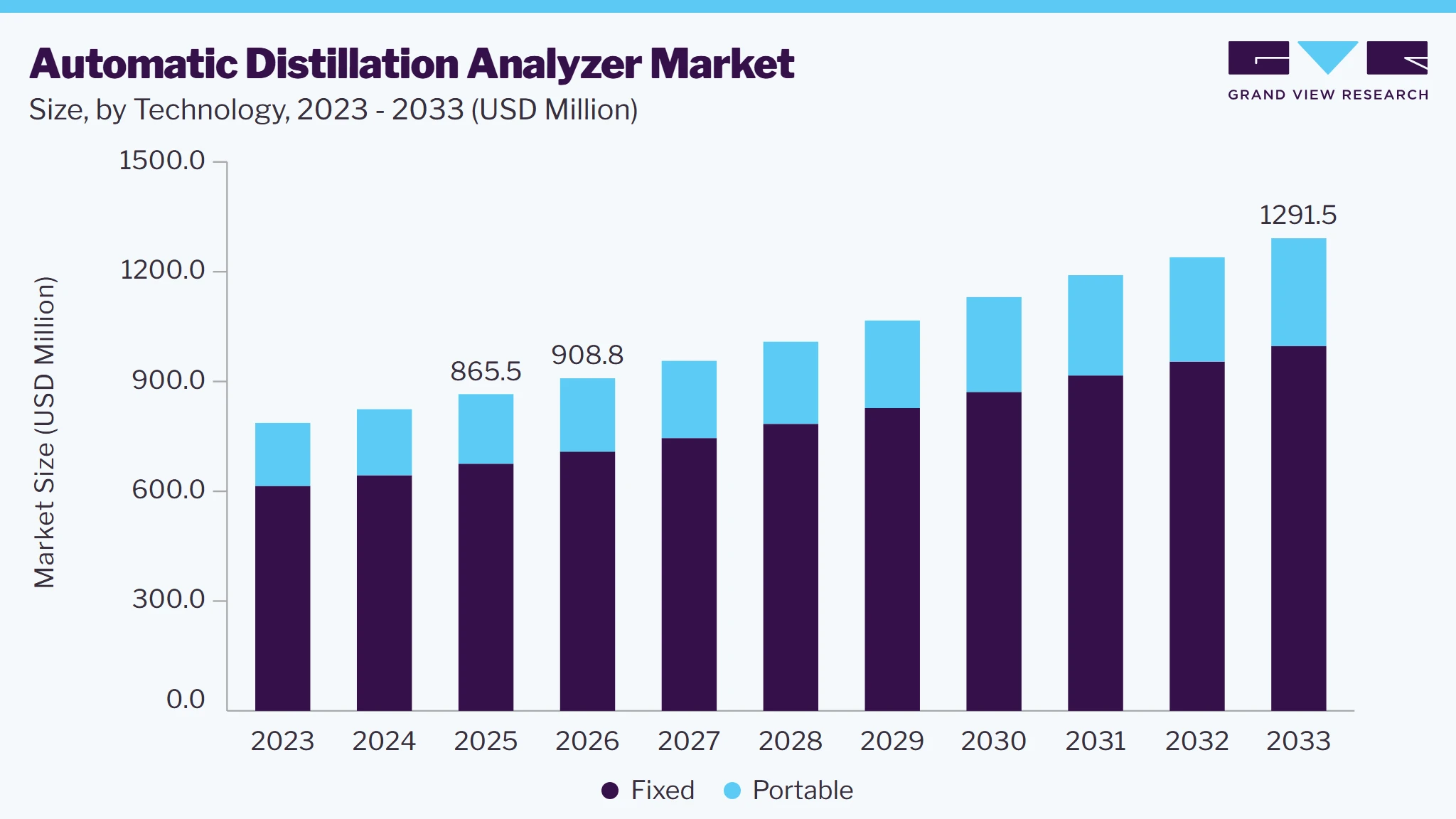 To learn more about this report, Download Free Sample Report
Market Dynamics
The market is shaped by increasing demand for standardized, automated determination of boiling characteristics across fuels, petroleum products, solvents, and chemical formulations. Manufacturers are enhancing analyzers with automated temperature control, sample handling, data acquisition, and reporting functions to improve laboratory productivity and analytical consistency. Integration with digital laboratory infrastructure is also strengthening the role of automated analyzers in routine quality-control workflows.
The market is driven by stringent fuel and product quality requirements, expanding refinery and petrochemical testing activities, and the shift from manual to automated laboratory analysis. The need for accurate boiling-range measurements, repeatable results, and compliance with established testing methods is encouraging laboratories to upgrade conventional equipment. Growing adoption of automated quality-control processes across petroleum, chemical, and third-party testing facilities is further contributing to market demand.
High acquisition costs associated with advanced automatic distillation analyzers can constrain adoption among smaller laboratories and facilities with limited capital budgets. Installation, calibration, maintenance, and operator training requirements can further increase the total cost of ownership. Differences in testing standards, sample characteristics, and laboratory infrastructure may also require application-specific configurations, limiting the suitability of standardized systems across all end users.
Growing laboratory automation and digitalization create opportunities for manufacturers to develop analyzers with enhanced connectivity, automated data management, remote monitoring, and LIMS integration. Demand for higher testing throughput and reduced operator intervention is encouraging the development of systems with automated sample handling, improved safety features, and multi-standard testing capabilities. Expansion of refinery, petrochemical, chemical, and independent testing infrastructure in emerging markets also provides opportunities for market penetration.
Market Concentration & Characteristics
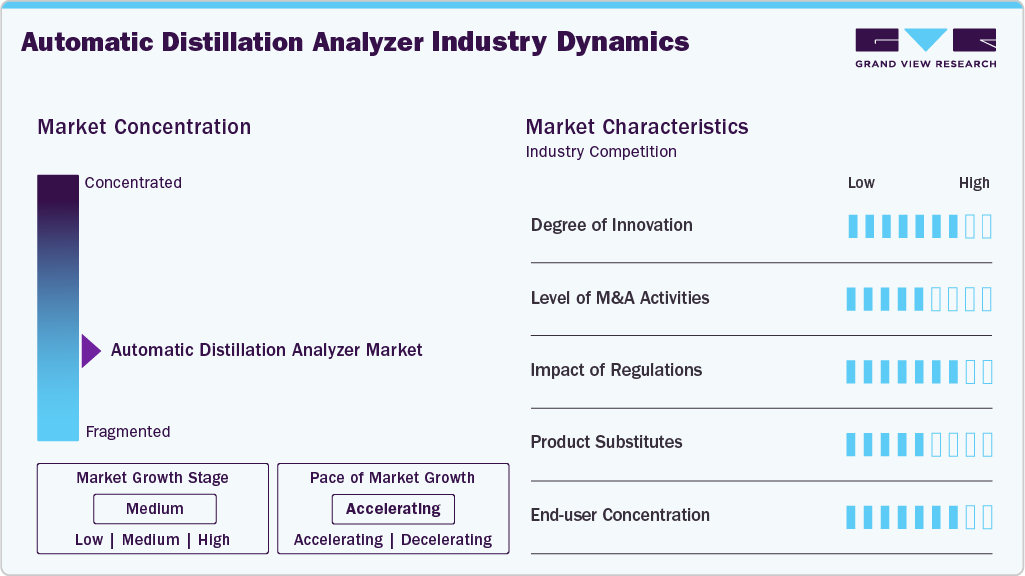
The global automatic distillation analyzer industry exhibits a moderately concentrated competitive structure, comprising specialized analytical instrument manufacturers and diversified laboratory equipment providers. Competition is shaped by instrument performance, compliance with ASTM, ISO, and regional testing standards, automation capabilities, software functionality, and technical service. Established suppliers maintain their position through broad product portfolios and application expertise, while regional manufacturers compete with customized configurations and cost-efficient solutions.
Merger and acquisition activity and strategic collaborations support portfolio expansion, technology development, and access to new application areas. Manufacturers are strengthening capabilities through partnerships with testing laboratories, petroleum and chemical companies, and technology providers to refine instrument performance and broaden distribution networks. Regulatory requirements governing fuel quality, product specifications, laboratory safety, and standardized testing also influence product development and investment priorities across the market.
 To learn more about this report, Download Free Sample Report
Product differentiation centers on measurement accuracy, repeatability, automated temperature and distillation-rate control, safety features, and compatibility with multiple testing standards. Advanced systems increasingly incorporate LIMS connectivity, automated data acquisition, pressure correction, and digital reporting to meet the requirements of modern quality-control laboratories. The level of automation, throughput capacity, and software integration differentiates conventional systems from higher-specification analyzers used in standardized testing environments.
Petroleum and fuel testing represent the principal application base, supported by demand from chemical, solvent, environmental, and research laboratories. Procurement priorities differ across end users; refineries and petrochemical facilities generally emphasize regulatory compliance, analytical reliability, throughput, and service capabilities, whereas smaller laboratories tend to focus on affordability and ease of operation. Replacement of aging instruments and laboratory modernization provide a recurring demand for equipment across established and developing markets.
Analyst Perspective
The market is expected to grow steadily, supported by increasing laboratory automation, stringent fuel quality standards, and rising demand for accurate and repeatable distillation testing across petroleum refining, chemicals, pharmaceuticals, and other industries. Automation reduces operator intervention, improves testing consistency, and enables faster data capture and reporting, strengthening adoption over manual testing methods. Asia Pacific presents strong growth opportunities due to expanding refining and petrochemical capacity and ongoing laboratory modernization. Manufacturers offering standards-compliant, reliable, digitally integrated, and cost-efficient analyzers are well positioned to benefit from replacement demand and new laboratory investments.
Technology Insights
The fixed segment dominated the market in 2025, accounting for 78.0% of revenue. Its strong adoption is attributed to extensive use in refineries, petrochemical facilities, and analytical laboratories, where stable operating conditions, standardized testing, and consistent measurement performance are required. Fixed analyzers also provide reliable integration with established laboratory and process-monitoring systems, making them suitable for continuous and high-volume testing applications.
The portable segment is projected to register the fastest CAGR during the forecast period, supported by increasing demand for on-site and decentralized analysis. Compact analyzers provide greater testing flexibility and enable rapid assessment at storage terminals, field locations, and remote industrial facilities, reducing reliance on centralized laboratory testing. Their ease of deployment and shorter analysis times are particularly valuable for applications requiring frequent testing across multiple locations. This trend is likely to encourage wider adoption of portable systems among operators seeking greater operational efficiency and real-time analytical capabilities.
Application Insights
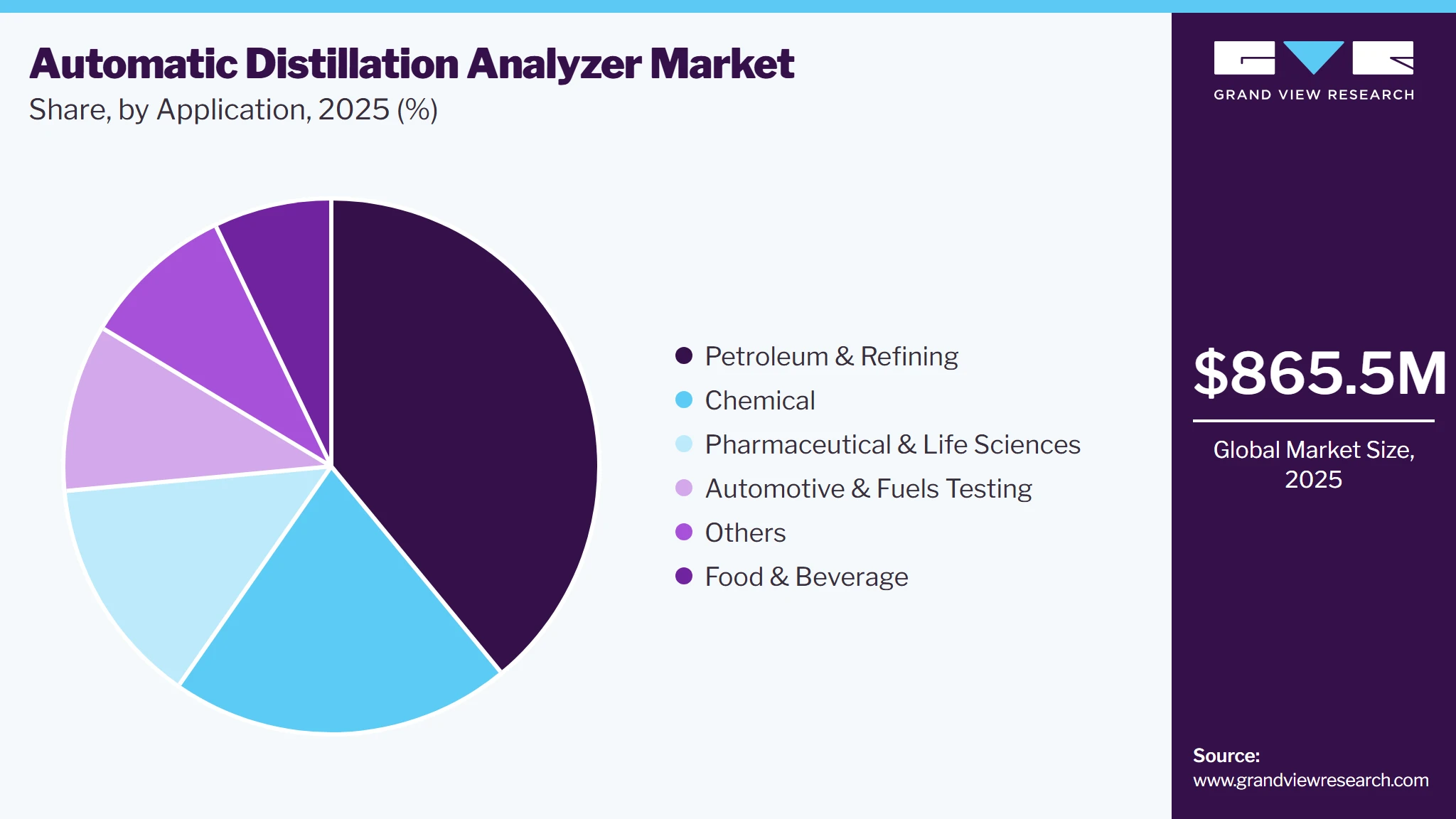
The petroleum & refining segment dominated the market in 2025, accounting for the largest share of revenue. Its dominance is attributed to the extensive use of distillation analysis to evaluate fuel properties, monitor product quality, and ensure compliance with established petroleum specifications. The segment also benefits from the integration of analyzers into refinery laboratories and process-control environments, where consistent and reliable testing is required.
 To learn more about this report, Download Free Sample Report
The food & beverage segment is projected to register the fastest CAGR of 6.1% during the forecast period, driven by increasing requirements for quality control and standardized testing of food-grade products and processing inputs. Automatic distillation analyzers can facilitate rapid and consistent analysis across production and quality-control environments. Their ability to deliver repeatable measurements can support manufacturers in maintaining product specifications and improving testing efficiency.
Regional Insights
North America represents a well-established market for automatic distillation analyzers, supported by its extensive refining, petrochemical, fuel testing, and chemical processing infrastructure. Demand is closely linked to the need for precise boiling-range determination and standardized characterization of petroleum products, fuels, solvents, and other liquid samples. Increasing laboratory automation, stringent product quality requirements, and upgrades to analytical facilities are encouraging the transition from manual distillation procedures to automated systems.
U.S. Automatic Distillation Analyzer Market Trends
The automatic distillation analyzer market in the U.S. holds a prominent position in the regional market, supported by its large refining capacity, petrochemical industry, and extensive network of commercial testing laboratories. Refineries, fuel laboratories, and chemical manufacturers are adopting automated analyzers to improve testing throughput, minimize operator involvement, and maintain consistent results. Ongoing refinery upgrades and investments in automated quality-control infrastructure are creating sustained opportunities for market expansion.
Mexico automatic distillation analyzer market is supported by its downstream petroleum industry and continued improvements in fuel-processing and testing infrastructure. Refinery modernization and efforts to strengthen fuel quality control are increasing the requirement for reliable analytical instruments capable of delivering standardized distillation measurements. Adoption across petroleum, petrochemical, and independent testing laboratories is contributing to the development of the Mexican market.
Europe Automatic Distillation Analyzer Market Trends
The automatic distillation analyzer market in Europe maintains a mature market, driven by established refining, petrochemical, chemical, and automotive fuel industries and rigorous product-quality standards. Automated distillation systems are widely used for fuel characterization, product specification testing, and laboratory quality control. Greater emphasis on laboratory efficiency, process standardization, and modernization of analytical infrastructure is supporting continued replacement of conventional testing equipment.
The UK automatic distillation analyzer market is characterized by established fuel, refining, chemical processing, and independent laboratory activities. Demand for automatic distillation analyzers is associated with petroleum product characterization, regulatory testing, and quality assurance applications. Upgrades to laboratory equipment and the continued need for standardized testing procedures are supporting adoption across industrial and commercial facilities.
The automatic distillation analyzer market in Germany represents an important market within Europe, backed by its strong chemical manufacturing sector, refining activities, and advanced industrial laboratory base. Automated distillation analyzers are used by refineries, petrochemical producers, and testing laboratories to enhance measurement consistency and laboratory productivity. Investment in industrial automation and analytical instrumentation is sustaining demand for advanced testing solutions.
Asia Pacific Automatic Distillation Analyzer Market Trends
The automatic distillation analyzer market in the Asia Pacific is emerging as an important market for automatic distillation analyzers, driven by expanding refining and petrochemical capacity, increasing fuel consumption, and the development of industrial testing infrastructure. Countries across the region are investing in refinery modernization, chemical production, and laboratory automation, creating greater requirements for reliable analytical equipment. The expansion of fuel-quality monitoring and standardized testing practices is further broadening application opportunities.
 To learn more about this report, Download Free Sample Report
China automatic distillation analyzer market represents a significant market, supported by its extensive refining, petrochemical, chemical, and fuel-processing industries. Large-scale industrial facilities and testing laboratories are incorporating automated analytical systems to improve testing efficiency, repeatability, and compliance with product specifications. Modernization of refining facilities and expansion of downstream processing capacity are supporting demand for automatic distillation analyzers.
The automatic distillation analyzer market in India is experiencing increased demand for automated distillation testing alongside expansion of its refining, petrochemical, and fuel distribution infrastructure. Refineries and testing laboratories are adopting automated systems to streamline petroleum characterization and improve measurement reliability. Investments in refinery upgrades, fuel-quality monitoring, and laboratory modernization are creating favorable conditions for market development.
Middle East & Africa Automatic Distillation Analyzer Market Trends
The automatic distillation analyzer market in MEA is supported by the region's substantial petroleum refining, crude oil processing, petrochemical, and fuel-testing activities. Demand for automatic distillation analyzers is concentrated in refineries, petrochemical plants, and quality-control laboratories where accurate characterization of petroleum fractions and finished fuels is required. Expansion of downstream processing capacity and modernization of laboratory facilities are creating opportunities for automated analytical technologies.
Saudi Arabia's automatic distillation analyzer market is significant in the region, supported by its extensive refining and petrochemical infrastructure and the continued development of downstream industries. Refineries and analytical laboratories are deploying automated testing equipment to improve product characterization, testing consistency, and operational efficiency. Investments in refining capacity, petrochemical integration, and advanced laboratory infrastructure are contributing to market growth.
Latin America Automatic Distillation Analyzer Market Trends
The automatic distillation analyzer market in Latin America is supported by its established petroleum refining, fuel distribution, petrochemical, and chemical processing industries. Demand for automatic distillation analyzers is associated with fuel-quality testing, petroleum product characterization, and laboratory modernization. Refinery upgrades and efforts to improve testing efficiency are encouraging industrial facilities and independent laboratories to adopt automated analytical systems.
Brazil automatic distillation analyzer market represents a significant market within the region, supported by its large refining network, growing petrochemical industry, and extensive fuel market. Refineries and testing laboratories use automated distillation systems to evaluate petroleum products and maintain consistency with technical specifications. Investments in downstream infrastructure, refinery modernization, and analytical laboratory capabilities are creating further opportunities for automatic distillation analyzer adoption.
Key Automatic Distillation Analyzer Company Insights
Some of the key players operating in the market include PAC L.P., Grabner Instruments, and Koehler Instrument Company.
-
PAC L.P. is a global manufacturer of analytical instruments for petroleum, fuel, and hydrocarbon testing. Its portfolio includes automated distillation systems such as OptiDist 2 and MicroDist, along with other laboratory and process analyzers. The company serves refineries, petrochemical companies, laboratories, and fuel-testing facilities worldwide.
-
Grabner Instruments, an AMETEK business, specializes in automated petroleum and fuel-testing instruments. Its portfolio includes automated distillation, vapor pressure, flash point, and fuel analysis systems, serving laboratories and on-site testing applications across the petroleum and automotive industries.
Key Automatic Distillation Analyzer Companies
The following key companies have been profiled for this study on the automatic distillation analyzer market:
-
PAC L.P.
-
Grabner Instruments
-
Koehler Instrument Company
-
Anton Paar GmbH
-
Tanaka Scientific Limited
-
Stanhope-Seta Ltd.
-
LabTech S.r.l.
-
Cannon Instrument Company
-
Estanit
-
FOSS
-
BARTEC Group
-
Optimus Instruments
-
Lazar Scientific, Inc.
-
DKK-TOA Corporation
-
Shenkai Petroleum & Chemical Equipment Co., Ltd.
Company categorization
Category
Operating Strategies
Competitive Edge
Weakness
Established Players (e.g., PAC L.P.; Grabner Instruments; Koehler Instrument Company; Anton Paar GmbH; Tanaka Scientific Limited; Stanhope-Seta Ltd.; FOSS)
- Expand automated distillation analyzer portfolios with advanced automation, high-precision measurement, portable and benchtop systems, and compliance with international testing standards.
- Invest in R&D, digital interfaces, global distribution, application support, and after-sales services.
- Strong technical expertise, established brands, broad analytical instrument portfolios, and global customer networks.
- Extensive experience serving petroleum, refining, chemical, fuel-testing, and laboratory applications.
- High R&D and manufacturing costs with complex testing-standard compliance requirements.
- Premium pricing and longer qualification cycles can limit adoption among smaller laboratories.
Emerging & Regional Players (e.g., LabTech S.r.l.; Cannon Instrument Company; Estanit; BARTEC Group; Optimus Instruments; Lazar Scientific, Inc.; DKK-TOA Corporation; Shenkai Petroleum & Chemical Equipment Co., Ltd.)
- Focus on application-specific systems, competitive pricing, customized configurations, and regional market requirements.
- Expand through distributors, partnerships, direct sales, and application-focused technical services.
- Flexible product development, specialized analytical capabilities, competitive pricing, and strong regional market knowledge.
- Ability to address niche applications and customer-specific testing requirements.
- Narrower global distribution and service networks compared with established players.
- Lower brand visibility and comparatively limited R&D resources can restrict international expansion.
Recent Developments
-
In April 2026, Shanghai Yuke Industrial introduced a new series of ASTM D86 petroleum distillation testers, including automated and multi-position configurations. The automated systems incorporate digital control, automatic temperature and volume measurement, distillation-curve generation, data storage, and report generation, supporting standardized petroleum and fuel testing in line with ASTM D86 and ISO 3405 requirements.
-
In April 2025, PAC L.P. introduced the OptiDist 2, a next-generation atmospheric distillation analyzer designed to improve precision, efficiency, reliability, and laboratory productivity. The system incorporates a patented thermosyphon cooling system, dual-optimizer heating technology, automated safety functions, touchscreen operation, and digital connectivity, while complying with ASTM, ISO, IP, DIN, and JIS standards.
Automatic Distillation Analyzer Market Report Scope
Report Attribute
Details
Market value in 2025
USD 865.5 million
Estimated market size in 2026
USD 908.8 million
Projected market size by 2033
USD 1,291.5 million
Growth rate
CAGR of 5.1% from 2026 to 2033
Historical data
2021 - 2025
Forecast period
2026 - 2033
Quantitative units
Revenue in USD million and CAGR from 2026 to 2033
Report coverage
Revenue forecast, company ranking, competitive landscape, growth factors, and trends
Segments covered
Technology, application, region
Regional scope
North America; Europe; Asia Pacific; Latin America; MEA
Country scope
U.S.; Canada; Mexico; UK; Germany; France; Italy; Spain; China; Japan; India; Australia; South Korea; Brazil; Argentina; UAE; Saudi Arabia; South Africa
Key companies profiled
PAC L.P.; Grabner Instruments; Koehler Instrument Company; Anton Paar GmbH; Tanaka Scientific Limited; Stanhope-Seta Ltd.; LabTech S.r.l.; Cannon Instrument Company; Estanit; FOSS; BARTEC Group; Optimus Instruments; Lazar Scientific, Inc.; DKK-TOA Corporation; Shenkai Petroleum & Chemical Equipment Co., Ltd.
Customization scope
Free report customization (equivalent up to 8 analysts working days) with purchase. Addition or alteration to country, regional & segment scope.
Pricing and purchase options
Avail customized purchase options to meet your exact research needs. Explore purchase options
Global Automatic Distillation Analyzer Market Report Segmentation
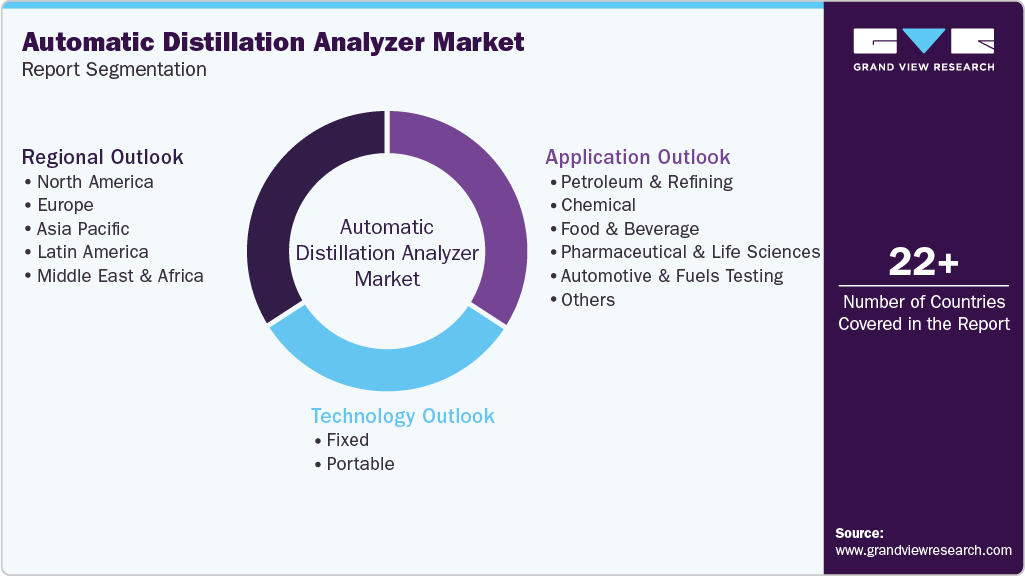
This report forecasts revenue growth at global, regional, and country levels and provides an analysis of the latest industry trends in each of the sub-segments from 2021 to 2033. For this study, Grand View Research has segmented the global automatic distillation analyzer market report based on technology, application, and region:
 To learn more about this report, Download Free Sample Report
-
Technology Outlook (Revenue, USD Million, 2021 - 2033)
-
Fixed
-
Portable
-
-
Application Outlook (Revenue, USD Million, 2021 - 2033)
-
Petroleum & Refining
-
Chemical
-
Food & Beverage
-
Pharmaceutical & Life Sciences
-
Automotive & Fuels Testing
-
Others
-
-
Regional Outlook (Revenue, USD Million, 2021 - 2033)
-
North America
-
U.S.
-
Canada
-
Mexico
-
-
Europe
-
Germany
-
Spain
-
France
-
Italy
-
UK
-
-
Asia Pacific
-
China
-
India
-
Japan
-
Australia
-
South Korea
-
Latin America
-
Brazil
-
Argentina
-
Middle East and Africa
-
Saudi Arabia
-
UAE
-
South Africa
-
-
Research Methodology
The automatic distillation analyzer market figures in this report are based on a proven research process that combines executive interviews with secondary research from proprietary databases, company filings, and recognized regulatory and institutional sources. Market size is built through value-chain sizing-reconciling supply-side and demand-side estimates-and triangulated with bottom-up and top-down approaches. Every estimate passes multiple levels of expert validation before publication, with each automatic distillation analyzer segment quantified using the revenue-capture definitions in the table below.
Segment Definition
Segment - Technology
Revenue Capture Definition
Fixed
Revenue generated from the sale of fixed automatic distillation analyzers, including the value of analyzer units and standard components supplied as part of the fixed system.
Portable
Revenue generated from the sale of portable automatic distillation analyzers, including the value of compact analyzer units and integrated components supplied with the equipment
Segment-Application
Revenue Capture Definition
Petroleum & Refining
Revenue generated from the sale of automatic distillation analyzers specifically purchased for petroleum and refining-related testing requirements.
Chemical
Revenue generated from the sale of automatic distillation analyzers purchased for chemical-sector testing and analysis requirements.
Food & Beverage
Revenue generated from the sale of automatic distillation analyzers purchased for food and beverage testing and quality-analysis requirements.
Pharmaceutical & Life Sciences
Revenue generated from the sale of automatic distillation analyzers purchased for pharmaceutical and life-science testing and analytical requirements.
Automotive & Fuels Testing
Revenue generated from the sale of automatic distillation analyzers purchased for automotive and fuel-testing requirements.
Others
Revenue generated from the sale of automatic distillation analyzers for applications outside the specified application segments.
Estimation Model
Layer Name
Key Question
Description
Laboratory Testing Demand Layer
Where are automatic distillation analyzers required?
Assess demand across petroleum and refining, chemicals, pharmaceuticals, automotive, food processing, and other laboratories. Analyze fuel quality testing, boiling range characterization, product specification verification, and quality control requirements to establish the addressable demand for automatic distillation analyzers.
Refining & Industrial Capacity Layer
Where is new equipment demand being created?
Evaluate refinery capacity, fuel production, chemical manufacturing, pharmaceutical quality-control infrastructure, and laboratory expansion. Assess new facilities, capacity additions, laboratory modernization, and replacement of manual testing equipment that create procurement opportunities for automatic analyzers.
Technology Adoption Layer
Which analyzer technologies are being deployed?
Segment demand based on analyzer configuration, automation level, application, end-use industry, and testing requirements. Assess adoption based on measurement accuracy, testing throughput, temperature control, automated sample handling, data recording, and compliance with standardized methods such as ASTM D86 and ISO 3405. Automated systems are evaluated for their ability to improve repeatability, reduce operator intervention, and streamline laboratory workflows.
Revenue Generation Layer
How much market revenue is generated?
Estimate annual shipments of automatic distillation analyzers by product type, application, end-use industry, and region. Calculate market revenue based on sales of new automatic distillation analyzers to refineries, laboratories, chemical manufacturers, pharmaceutical companies, testing facilities, and other industrial users.
Customization Table
Client Request
Customization Delivered
Value Adds
Competitive Benchmarking
Manufacturer & Product Assessment
Evaluated leading automatic distillation analyzer manufacturers based on product portfolios, fixed and portable analyzer configurations, automation capabilities, testing standards, measurement accuracy, sample-handling capabilities, R&D activities, geographic presence, strategic initiatives, and market positioning. The assessment provided insights into product differentiation, technological strengths, and competitive strategies.
Regional Segmentation
Regional Market Assessment
Assessed North America, Europe, Asia Pacific, Latin America, and Middle East & Africa based on demand for automatic distillation analyzers across petroleum & refining, chemical, food & beverage, pharmaceutical & life sciences, automotive & fuels testing, and other applications. The analysis considered refinery and laboratory infrastructure, industrial activity, fuel-quality regulations, testing standards, and adoption of automated analytical equipment.
Opportunity Assessment
Technology & Growth Opportunities
Evaluated growth opportunities associated with automated testing, portable analyzer development, enhanced measurement accuracy, digital monitoring, multi-sample testing, faster analysis, and integration with laboratory workflows. The assessment identified potential areas for product development, geographic expansion, investment, and long-term growth within the global automatic distillation analyzer market.
Frequently Asked Questions About This Report
The market is projected to grow at a CAGR of 5.1% from 2026 to 2033, and is expected to reach USD 1,291.5 million by 2033.
Asia Pacific dominated the global market, accounting for the largest revenue share of 35.2% in 2025.
Market growth is driven by increasing automation of laboratory testing, stringent fuel quality requirements, expanding refining and petrochemical activities, and the need for accurate and repeatable distillation analysis.
China dominated the country-level automatic distillation analyzer market, supported by its extensive refining and petrochemical infrastructure, expanding chemical manufacturing activities, and growing investment in laboratory automation and quality-control systems.
Key players include PAC L.P., Grabner Instruments, Koehler Instrument Company, Anton Paar GmbH, Tanaka Scientific Limited, Stanhope-Seta Ltd., LabTech S.r.l., Cannon Instrument Company, Estanit, FOSS, BARTEC Group, Optimus Instruments, Lazar Scientific, Inc., DKK-TOA Corporation, and Shenkai Petroleum & Chemical Equipment Co., Ltd.
The global automatic distillation analyzer market was valued at USD 865.5 million in 2025 and is estimated at USD 1.3 billion by 2033.
The fixed segment held the largest revenue share of 78.0% in 2025, driven by its widespread use for standardized, high-precision, and automated testing across industrial and laboratory environments.
The portable segment is projected to grow at the fastest CAGR of 5.6% during the forecast period, supported by increasing demand for flexible and on-site distillation analysis.
The petroleum & refining segment dominated the market in 2025, holding a revenue share of 39.0%, driven by the need for petroleum product characterization, fuel quality control, and refinery testing.
About the Author(s)
Advanced Interior Materials Research Team
Advanced Materials · Advanced Interior MaterialsThis report was authored by the advanced interior materials research team at Grand View Research - comprising two research analysts, one senior research analyst, and one industry expert - with specialized expertise in the advanced interior materials segment of the advanced materials industry. All findings are based on proprietary advanced materials databases, executive interviews, and regulatory analysis, subject to internal peer review prior to publication.
Last Updated:
Speak to Analyst

Customize this report to your needs - add regions, segments, or data points, with 20% free customization.
Or view our licence options:


ISO 9001:2015 & 27001:2022 Certified
We are GDPR and CCPA compliant! Your transaction & personal information is safe and secure. For more details, please read our privacy policy.


