
- Home
- »
- Next Generation Technologies
- »
-
Automation Testing Market Size & Share Report, 2026-2033GVR Report cover

Automation Testing Market (2026 - 2033)
Size, Share & Trends Analysis Report Component (Testing Type, Service), By Vertical (Healthcare, BFSI, Government, Aerospace & Defense, Energy & Utilities), By Organization Size (Large Enterprises, SMEs), By Region, And Segment Forecasts
Market Size, 2025
$32.7BMarket Estimate, 2026
$37.5BMarket Forecast, 2033
$89.0BCAGR, 2026–2033
12.9%Automation Testing Market Summary
The global automation testing market size was valued at USD 32.7 billion in 2025 and is projected to grow from USD 37.5 billion in 2026 to USD 89.0 billion by 2033, growing at a CAGR of 12.9% from 2026 to 2033. North America dominated the market, accounting for a revenue share of 39.0% in 2025. The willingness of businesses to incorporate advanced automation testing techniques, including DevOps and Agile methodologies, is the major driver encouraging consistent market growth.
Key Market Trends & Insights
- By component: The service segment led the market, accounting for over 56.0% of revenue in 2025.
- By organization size: Large enterprises dominated the market, accounting for the highest revenue share of 68.0% in 2025.
- By vertical: The BFSI segment accounted for over 15.0% of revenue in 2025.
Regional Highlights
- Largest regional market: North America (39.0% revenue share, 2025)
- Fastest-growing regional market: Asia Pacific (highest CAGR, 2026 - 2033)
- By country: The U.S. held the largest market share in 2025.
Market Size & Forecast
- Market size in 2025: USD 32.7 Billion
- Estimated market size in 2026: USD 37.5 Billion
- Projected market size by 2033: USD 89.0 Billion
- CAGR (2026-2033): 12.9%
Three ways to get this report
Buy it, customize it, or ask a question.Ask an Analyst
A direct answer, usually in 1 working day
- AccessReport author, directly
- Reply timeWithin 1 working day
- No sales callDirect answer only
- FormatEmail reply
- CostFree, no cost
Get the Full Report
What the study covers
- FormatsPDF · Excel · Dashboard
- Timeline2026–2033 annual, 2025 base
- Coverage20+ countries, 5 regions
- Companies10+ key players profiled
Customize the Report
20% free customization
- IncludeCountries, segments, points
- TailorTo your product definition
- ExtendDeeper competitor detail
- OrA fully bespoke study
- Turnaround5–10 working days
These strategies help businesses accelerate the commercialization of their software products by reducing the time spent on manual testing. As businesses increasingly rely on mobile applications, the rapid digitalization of end-user industries creates an urgent need for automated testing. Furthermore, the industry is expanding due to evolving work arrangements. Artificial intelligence (AI) and machine learning (ML) have further accelerated the shift toward automation testing. The integration of AI shortens the test lifecycle, and thus, automation testing is becoming more common in the testing industry.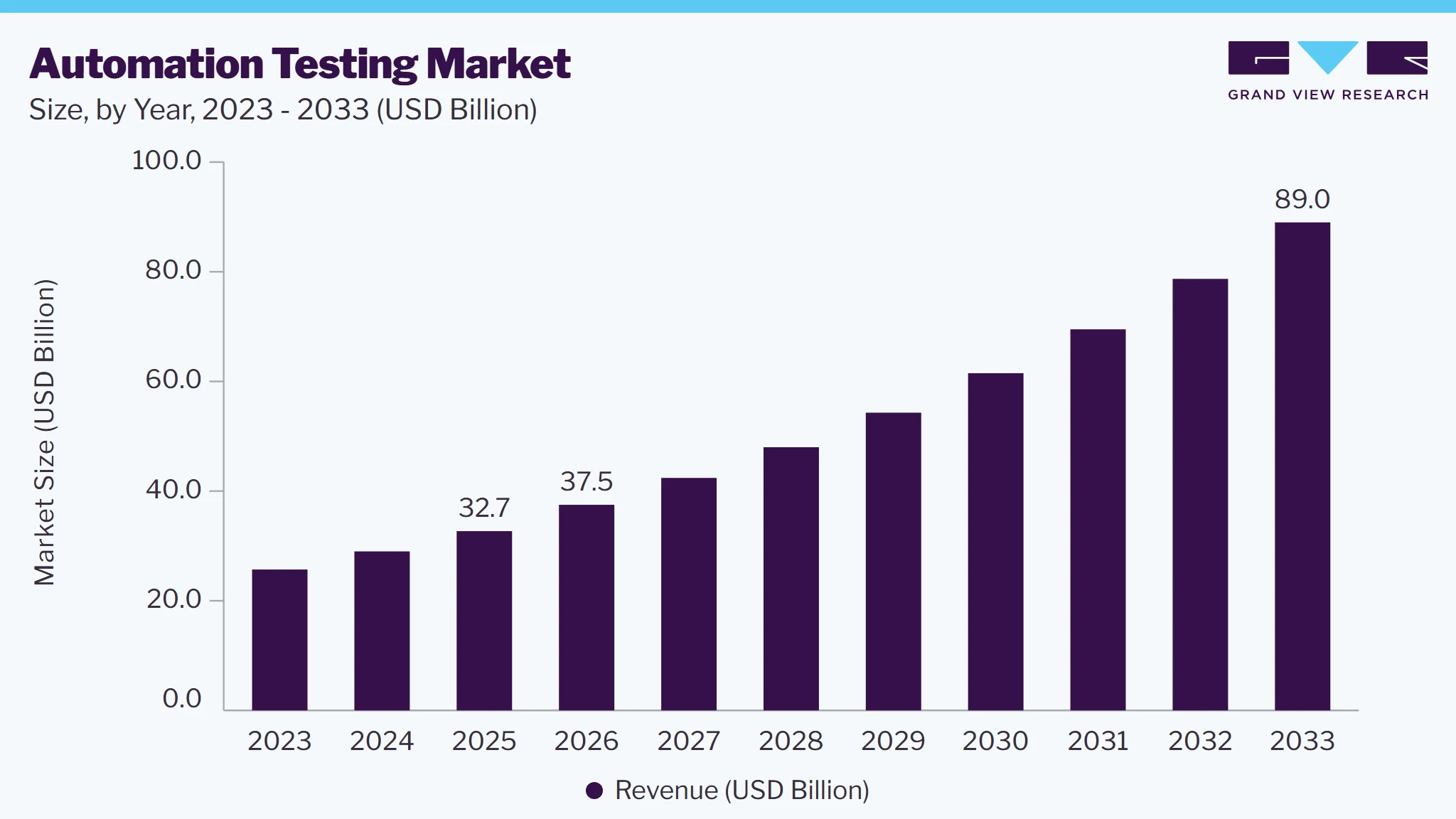 Source: Grand View Research, IR Documents, Primary Interviews, Paid DatabasesTo learn more about this report,
 Download Free Sample Report
 It is used for a variety of testing, including functional, regression, performance, and automation. The emerging adoption of cloud-based automation tools is propellingmarket growth. Owing to their affordability, flexibility, and scalability, cloud-based automation systems are preferredby SMEs and startups. Moreover, cloud-based automation testing solutions are also being greatly simplified by incorporating ML & AI, which is anticipated to support market growth.
Market Dynamics
The progressive adoption of Agile and DevOps methodologies is proving to be a major catalyst for automated software testing across organizations. Contemporary software companies update their products more frequently. The frequency can range from several updates per week to several per day. As manual software testing is unable to keep up with software updates, organizations are adopting automated testing tools to increase speed and maintain software quality.
Continuous integration (CI) and continuous deployment (CD) require automating testing procedures to improve software quality and deploy software faster. For Instance, as mentioned in the Testing in DevOps Report published in 2025, 46% of all organizations increased the speed of code deployments by at least 50% compared to the previous year, while 55% of all companies currently use AI when developing and testing new software products. In addition, 62% of organizations increased investment in automation and testing tools to launch software faster. These statistics clearly demonstrate the significance of adopting DevOps and thus contribute to market growth.
The process of automated testing requires professionals with some knowledge of scripting, automated testing, artificial intelligence testing, and DevOps. However, professionals with such skill sets are in short supply. The lack of automation testing experts is a major restraining factor for the overall market. Several organizations face issues in scouting the right talent with the requisite skills. This results in testing delays and incurring proportional costs associated with scaling automation. According to the study titled “State of Digital Quality 2025” carried out by Applause, 80% of firms were unable to conduct AI testing owing to a lack of talented staff members. This forces companies to continue their conventional testing methods and restricts the overall market growth.
A growing number of AI-based test automation frameworks are expected to offer significant opportunities for significant time savings and profitability. Agile and DevOps methodologies powered by AI hasten testing and bug identification, thereby accelerating the deployment of new software or updates. According to a 2025 survey of more than 500 enterprise QA teams, 73% reported introducing AI-based automated testing tools that improved test development speed by 80% and reduced unreliable tests by 47%. Furthermore, 89% of respondents said they plan to invest further in AI-based test automation. This highlights the lucrative business direction for AI-based test automation solutions such as autonomous testing and self-healing testing. This trend creates a strong growth opportunity for vendors offering AI-driven testing platforms, self-healing test automation, and autonomous testing solutions as organizations seek faster software releases without compromising quality.
Analyst Perspective
Companies are progressively adopting agile development, DevOps practices, and continuous integration/continuous deployment (CI/CD) pipelines across various industries. Organizations are investing in this field to accelerate software releases and improve quality through automated testing. In addition, the growing complexity of digital applications, cloud-based platforms, and mobile ecosystems is driving increased demand for advanced testing solutions and services. Integration of AI and ML to enhance testing efficiency is expected to help the market grow over the coming years.
Component Insights
Based on organization size, large enterprises dominated the market, accounting for the highest revenue share of more than 68.0% in 2025. Automation testing plays a crucial role in large enterprises with complex systems, multiple applications, and a high volume of test cases. It helps improve efficiency, reduce manual effort, increase test coverage, and ensure the quality of software applications. Developing a comprehensive test strategy is essential for automation in large enterprises. This includes identifying the right automation tools, frameworks, and methodologies based on the organization’s specific needs. Test planning should prioritize selecting test cases for automation, focusing on critical functionalities, high-risk areas, and frequently executed scenarios.
The small- and medium-sized enterprises segment is expected to register a CAGR of approximately 20.0% over the forecast period. Automation testing is becoming a crucial part of small-sized enterprises, as it helps improve testing efficiency, save time and resources, and ensure the quality of software applications. In a small-sized enterprise, where resources and time are limited, prioritizing the selection of test cases for automation-focusing on critical functionalities, high-risk areas, and frequently executed scenarios- fuels market growth. This also helps to ensure maximum coverage with minimal effort and resources.
Organization Size Insights
Based on organization size, large enterprises dominated the market and accounted for the highest revenue share of over 68% in 2022. Automation testing plays a crucial role in large enterprises with complex systems, multiple applications, and a high volume of test cases. It helps improve efficiency, reduce manual effort, increase test coverage, and ensure the quality of software applications.Developing a comprehensive test strategy is essential for automation in large enterprises. This includes identifying the right automation tools, frameworks, and methodologies based on the organization’s specific needs. Test planning should prioritize the selection of test cases for automation, considering critical functionalities, high-risk areas, and frequently executed scenarios.
The small- and medium-sized enterprises segment is expected to register a CAGR of 19.8% over the forecast period. Automation testing is a crucial part of small-sized enterprises as it helps improve the efficiency of testing processes, saves time and resources, and ensures the quality of software applications. In a small-sized enterprise, where resources and time are limited, prioritize the selection of test cases for automation—focusing on critical functionalities, high-risk areas, and frequently executed scenarios fuel market growth. This also helps to ensure maximum coverage with minimal effort and resources.
Vertical Insights
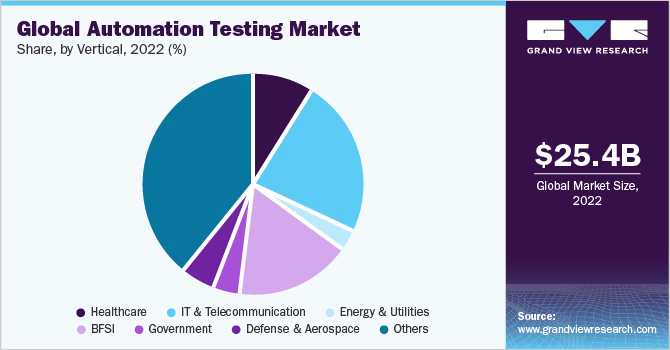
The BFSI segment accounted for over 15.0% of revenue in 2025. Adopting digitalization in the BFSI sector creates a significant demand for application software automation testing. Complex, integrated applications and legacy systems regulating mission-critical activities set the BFSI sector apart. These programs are always being updated to meet the requirements of the new technological era.
 To learn more about this report, Download Free Sample Report
 The healthcare sector is estimated to register the highest CAGR over the forecast period. Automation testing plays a crucial role in the healthcare industry, where the accuracy, reliability, and security of software applications are of utmost importance. Electronic health record (EHR) systems are central to healthcare organizations for managing patient information. Automation testing ensures the proper functioning of EHR systems, including patient registration, medical history, medication management, lab results, and interoperability with other systems. Moreover, healthcare applications often integrate with various systems and devices, including laboratory information systems, radiology systems, medical devices, and billing systems. Automation testing verifies the smooth integration of these systems, including data exchange, interoperability, and adherence to industry standards, such as HL7 or DICOM.
Regional Insights
North America dominated the market, accounting for more than 39.0% of revenue in 2025. The widespread distribution of technology suppliers is driving the market in this area. In the U.S., the popularity of smart consumer devices, such as smart TVs, home appliances, and laptops, is rising, which is driving market demand. Software, web applications, and operating systems (OS) are closely related to smart consumer electronics. The demand for test automation services in the area will rise as these smart consumer devices gain more acceptance.
 To learn more about this report, Download Free Sample Report
 The automation testing market in the Asia Pacific is anticipated to grow at a CAGR of 20.0% over the forecast period. The regional market is promising as it is home to economies including Singapore, China, India, Japan, New Zealand, and Hong Kong, all of which can significantly boost the growth of organizations that conduct automation analysis. Key economies in the Asia Pacific, such as China and India, have large consumer populations, which has a significant impact on the region's expansion. Governments are implementing regulations to hasten the adoption of cutting-edge technology, including automation, AI & ML, mobile & online apps, cloud-based services, and other innovations.
Key Companies & Market Share Insights
Prominent firms have used product launches and developments, followed by expansions, mergers and acquisitions, contracts, agreements, partnerships, and collaborations, as their primary business strategy to increase their market share. The companies have used various techniques to enhance market penetration and boost their position in the competitive industry.
Key Automation Testing Companies:
The following key companies have been profiled for this study on the automation testing market.
-
IBM Corporation
-
Apexon
-
Accenture
-
Cigniti Technologies
-
Capgemini SE
-
Microsoft
-
Tricentis
-
Keysight Technologies
-
Sauce Labs
-
Parasoft
Recent Development
-
In December 2025, UiPath partnered with Veeva through the Veeva AI Partner Program to improve software testing and validation in highly regulated industries. The partnership combines Veeva Validation Management with UiPath Test Manager to create a fully automated, digital, and audit-ready testing process. This solution helps organizations improve compliance, reduce manual work, and maintain real-time tracking of testing requirements, results, and documentation.
-
In June 2025, LambdaTest, an AI-powered testing and cloud engineering platform, partnered with Compunnel, a digital transformation solutions provider, to help businesses improve and scale their software testing processes. The partnership combines LambdaTest’s AI-driven automation tools with Compunnel’s digital engineering expertise to reduce manual testing efforts, improve software quality, and speed up application delivery.
Automation Testing Market Report Scope
Report Attribute
Details
Market size in 2025
USD 32.7 billion
Estimated market size in 2026
USD 37.5 billion
Projected market size by 2033
USD 89.0 billion
Growth rate
CAGR of 12.9% from 2026 to 2033
Historical data
2021 - 2025
Forecast period
2026 - 2033
Quantitative units
Revenue in USD billion, and CAGR from 2026 to 2033
Report coverage
Revenue forecast, company ranking, competitive landscape, growth factors, and trends
Segments covered
Component, organization size, vertical, region
Regional Scope
North America; Europe; Asia Pacific; Latin America; MEA
Country Scope
U.S.; Canada; UK; Germany; France; China; Japan; India; South Korea; Australia; Brazil; Mexico; Saudi Arabia; UAE; South Africa
Key companies profiled
IBM Corp.; Apexon; Accenture; Cigniti Technologies; Capgemini SE; Microsoft; Tricentis; Keysight technologies; Sauce Labs; Parasoft
Customization scope
Free report customization (equivalent up to 8 analysts working days) with purchase. Addition or alteration to country, regional & segment scope.
Pricing and purchase options
Avail of customized purchase options to meet your exact research needs. Explore purchase options
Global Automation Testing Market Report Segmentation
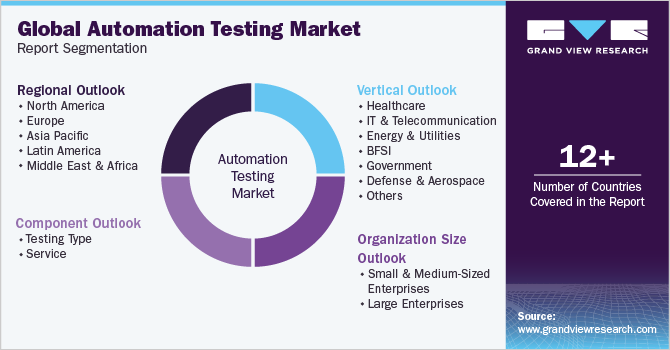
The report forecasts revenue growth at global, regional, and country levels and provides an analysis of the latest industry trends in each of the sub-segments from 2021 to 2033. For this study, Grand View Research has segmented the global automation testing market report based on component, organization size, vertical, and region:
 To learn more about this report, Download Free Sample Report
 -
Component Outlook (Revenue, USD Billion, 2021 - 2033)
-
Testing Type
-
Static Testing
-
Dynamic Testing
-
Functional Testing
-
Non-functional Testing
-
Performance Testing
-
API Testing
-
Security Testing
-
Load Testing
-
Regression testing
-
Others
-
-
-
-
Service
-
Managed services
-
Professional services
-
-
-
Organization Size Outlook (Revenue, USD Billion, 2021 - 2033)
-
Small And Medium-Sized Enterprises
-
Large Enterprises
-
-
Vertical Outlook (Revenue, USD Billion, 2021 - 2033)
-
Healthcare
-
IT & Telecommunication
-
Energy & Utilities
-
BFSI
-
Government
-
Defense And Aerospace
-
Others
-
-
Regional Outlook (Revenue, USD Billion, 2021 - 2033)
-
North America
-
U.S.
-
Canada
-
Europe
-
UK
-
Germany
-
France
-
-
Asia Pacific
-
China
-
Japan
-
India
-
South Korea
-
Australia
-
-
Latin America
-
Brazil
-
Mexico
-
-
Middle East and Africa
-
Saudi Arabia
-
UAE
-
South Africa
-
-
Frequently Asked Questions About This Report
Key players include IBM Corp.; Apexon; Accenture; Cigniti Technologies; Capgemini SE; Microsoft; Tricentis; Keysight technologies; Sauce Labs; Parasoft
The global automation testing market size was valued at USD 32.7 billion in 2025 and is estimated at USD 37.5 billion for 2026.
The global automation testing market is expected to grow at a CAGR of 12.9% from 2026 to 2033, reaching USD 89.0 billion.
North America dominated with a 39.0% revenue share in 2025.
Large enterprises dominated the automation testing market with a share of 68.0% in 2025.
About the Author(s)
Next Generation Technologies Research Team
Technology · Next Generation TechnologiesThis report was authored by the next generation technologies research team at Grand View Research - comprising two research analysts, one senior research analyst, and one industry expert - with specialized expertise in the next generation technologies segment of the technology industry. All findings are based on proprietary technology databases, executive interviews, and regulatory analysis, subject to internal peer review prior to publication.
Last Updated:
Speak to Analyst

Customize this report to your needs - add regions, segments, or data points, with 20% free customization.
Or view our licence options:


ISO 9001:2015 & 27001:2022 Certified
We are GDPR and CCPA compliant! Your transaction & personal information is safe and secure. For more details, please read our privacy policy.


