
- Home
- »
- Plastics, Polymers & Resins
- »
-
Automotive Film Market Size & Share, Industry Report, 2033GVR Report cover
![Automotive Film Market Size, Share & Trends Report]()
Automotive Film Market (2026 - 2033) Size, Share & Trends Analysis Report By Film Type (Automotive Window Films, Automotive Wrap Films), By Application (Interior, Exterior), By Vehicle (Passenger Vehicles, Commercial Vehicles), By Region, And Segment Forecasts
- Report ID: GVR-1-68038-491-8
- Number of Report Pages: 120
- Format: PDF
- Historical Range: 2021 - 2025
- Forecast Period: 2026 - 2033
- Industry: Bulk Chemicals
- Report Summary
- Table of Contents
- Interactive Charts
- Methodology
- Download FREE Sample
-
 Download Sample Report
Automotive Film Market Summary
The global automotive film market size was estimated at USD 12.8 billion in 2025 and is projected to reach USD 26.3 billion by 2033, growing at a CAGR of 9.5% from 2026 to 2033. The increasing use of advanced safety and security films in vehicles is driving the market. These films improve shatter resistance and intrusion protection, which supports compliance with stricter safety standards and rising consumer focus on passenger protection.
Key Market Trends & Insights
- North America dominated the global automotive film industry with the largest revenue share of 47.9% in 2025.
- The automotive film industry in Italy is expected to grow at a CAGR of 11.3% from 2026 to 2033.
- The automotive wrap films segment is anticipated to grow at a CAGR of 11.2% in the film type segment.
- By application, the exterior segment is expected to grow at a 9.7% CAGR in revenue from 2026 to 2033.
- The passenger vehicle segment is expected to grow at a CAGR of 9.7% from 2026 to 2033 in terms of revenue in the vehicle segment.
Market Size & Forecast
- 2025 Market Size: USD 12.8 billion
- 2033 Projected Market Size: USD 26.3 billion
- CAGR (2026 - 2033): 9.5%
- North America: Largest market in 2025
- Asia Pacific: Fastest growing market from 2026 to 2033
Automotive film demand is moving toward multifunctional, high-performance products rather than simple cosmetic tint. According to the IEA, global electric car sales exceeded 17 million in 2024, lifting the need to manage cabin heat, energy loss, and display visibility more efficiently. OEMs are also integrating films into head-up displays, sensor-compatible glazing, and light-management systems, which positions films as a functional component of vehicle design rather than only an aftermarket accessory.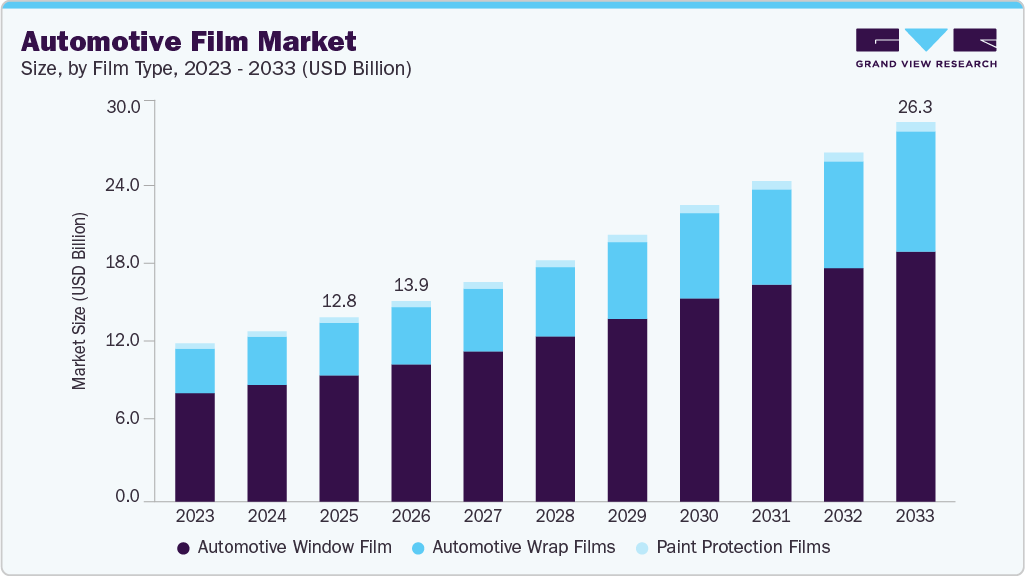
Drivers, Opportunities & Restraints
A key market driver is the growing need for occupant comfort and energy efficiency. Automotive films are used to reject heat, block UV rays, reduce glare, and lower solar load on glass, which helps limit air-conditioning demand and improves the cabin experience. Manufacturers also position advanced interlayers and window films as contributors to sound reduction, UV protection, and even fuel or electric vehicle efficiency, which supports adoption across both passenger vehicles and premium trims.
The strongest opportunity sits in the aftermarket and personalization segment. Vehicle owners are increasingly using paint protection films, wrap films, and premium window films to preserve resale value while changing color, texture, or finish. Established suppliers also promote installation training and dealer-backed application networks, which improve product quality and widen market reach. This opens room for higher-margin services in fleet branding, customization, and protection packages, especially in urban markets with dense vehicle ownership.
Regulatory compliance remains a major restraint, especially for forward glazing and front side windows. In major markets, light-transmittance rules are strict, with U.S. federal guidance and UK rules requiring high visible light transmission on windows used for driving visibility. Suppliers also state that many automotive films can only be used where allowed by law. This limits dark-tint formats, increases approval complexity, and forces installers to tailor product selection to each jurisdiction.
Market Concentration & Characteristics
The market growth stage is high, and growth is accelerating. The market exhibits fragmentation, with key players dominating the industry landscape. Major companies such as 3M, Garware Hi-Tech Films Ltd, Saint-Gobain S.A., Eastman Chemical Company, Avery Dennison Corporation, LINTEC Corporation, Ergis S.A., TORAY INDUSTRIES, INC., Johnson Window Films, Inc., Hexis S.A.S, XPEL, NEXFIL Co., Ltd, and others play a significant role in shaping the market dynamics. These leading players often drive innovation in the market by introducing new products, technologies, and materials to meet the industry's evolving demands.
The automotive film market shows a relatively high degree of innovation as suppliers are moving beyond basic tint and decoration into functional, performance-led products. Current offerings include nano-ceramic and multilayer optical films for heat and UV rejection, self-healing paint protection films for surface durability, and wrap films engineered for faster, bubble-free installation on complex vehicle shapes. Smart glass films that switch between clear and tinted states further raise the innovation bar by adding dynamic shading, privacy, and energy management.
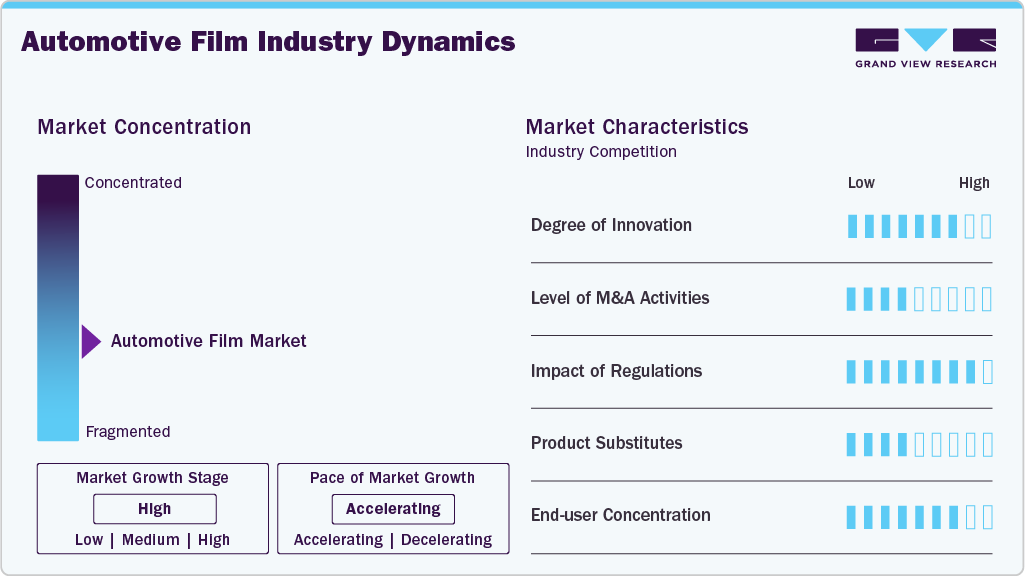
Product substitution pressure is meaningful since vehicle OEMs already offer several alternatives to aftermarket films. Factory-tinted glass, solar-control glazing, and smart glass systems can deliver heat rejection, glare reduction, and privacy at the vehicle design stage, which reduces the need for post-sale retrofits. In parallel, exterior wrap films face competition from paint technologies and OEM color customization, while paint protection films compete with harder clear-coat and coating systems. This keeps pricing discipline tight and forces film suppliers to prove a clear performance advantage.
Film Type Insights
The automotive window film segment dominated the market across film type segmentation in terms of revenue, accounting for 68.5% market share in 2025, and is forecast to grow at a 8.9% CAGR from 2026 to 2033. A major driver is the shift toward ceramic and metal-free films that deliver heat rejection, UV blocking, and glare control without affecting electronic signal performance. This matters more as vehicle cabins become more connected and screen-heavy, especially in premium trims and EVs. Manufacturers are also positioning these films as comfort upgrades that reduce air-conditioning load while improving privacy and visibility. That makes window film a functional efficiency feature, not just a styling accessory.
The automotive wrap films segment is expected to expand at a 11.2% CAGR in the automotive film market over the forecast period. Demand is being pulled by vehicle personalization, fast-change branding, and installer-friendly product systems. 3M Wrap Film Series 2080, Avery Dennison Supreme Wrapping Film, and ORAFOL ORACAL 970RA are all positioned around conformability, color depth, and easier installation, which lowers application time and supports high-end finish quality. The driver is not only about appearance. It is also the ability to deliver reversible customization with strong visual impact, which is valuable to consumers, dealers, and restyles.
Application Insights
The exterior segment dominated the market across application segmentation in terms of revenue, accounting for 54.7% market share in 2025, and is forecast to grow at a 9.7% CAGR from 2026 to 2033. Exterior film demand is rising because owners and fleets want to preserve paint quality on high-exposure surfaces. Paint protection films are increasingly used against stone chips, scratches, bug damage, road tar, stains, and UV exposure, while self-healing surfaces help maintain a fresh finish over time. That makes the product highly relevant for exposed body panels, mirrors, bumpers, and hoods. The market is also supported by the resale-value argument, since appearance retention directly influences asset value.
The interior segment is expected to expand at a 9.3% CAGR in the automotive film market over the forecast period. The key driver for interior applications is the growing need to protect and elevate high-touch cabin surfaces while keeping the design flexible. Interior films are used to decorate, cover, and protect surfaces, which supports trim customization, scratch resistance, and faster refurbishment of worn components. This is increasingly relevant in vehicles with premium dashboards, console surfaces, and display-heavy cabins. As buyers expect a more refined and durable interior, films help manufacturers and upfitters balance aesthetics with practical protection.
Vehicle Insights
The passenger vehicle segment led the market by application, accounting for 75.1% of revenue in 2025, and is projected to grow at a 9.7% CAGR from 2026 to 2033. Passenger vehicles are a strong demand center because electrification is expanding the value of solar control and comfort films. The growing EV sales globally increase the focus on cabin temperature management, privacy, and energy efficiency. Films that reject heat, block UV rays, and avoid signal interference are well aligned with connected vehicle architecture and large glass areas. That makes film adoption more visible in new passenger models and premium aftermarket fit outs.
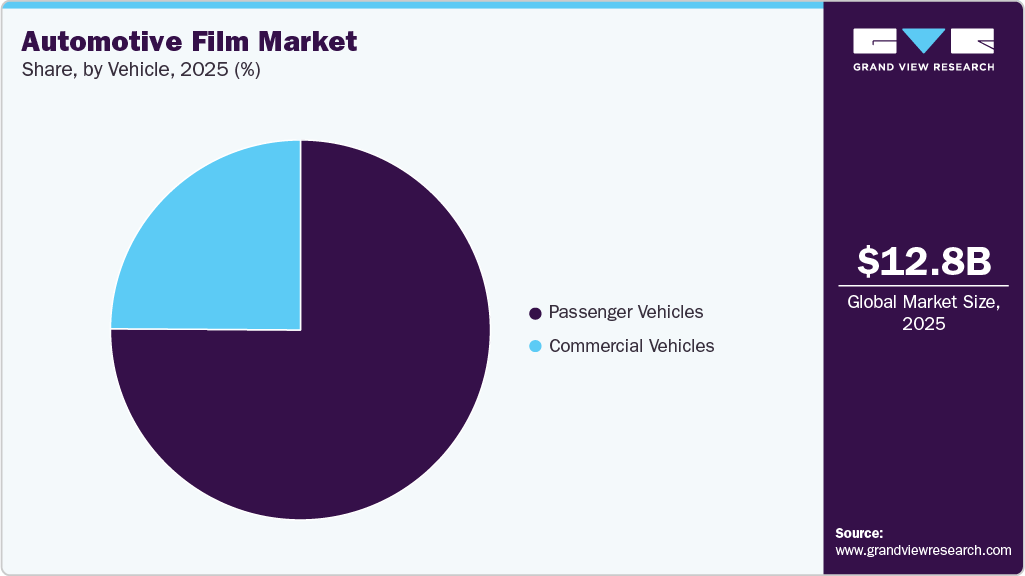
The commercial vehicles segment is expected to grow at the fastest CAGR of 9.7% over the forecast period in the automotive film market. Commercial vehicles are driven by fleet branding and operational durability. Fleet graphics are widely used as cost-effective mobile advertising, while reflective and protective films improve visibility and help keep vehicles on the road rather than in the workshop. This is important for delivery vans, service fleets, box trucks, and trailers, where downtime affects utilization and revenue. The segment benefits from materials that install quickly, withstand heavy use, and support brand consistency across large fleets.
Regional Insights & Trends
The North America automotive film industry held the largest revenue share of 47.9% in 2025. The region is expected to grow at a CAGR of 8.9% over the forecast period. North America is benefiting from a strong personalization culture and high aftermarket spending. According to SEMA, U.S. consumers spent about USD 52.65 billion accessorizing and modifying vehicles in 2024, while its 2025 outlook points to higher consumer spending and longer vehicle ownership. That supports demand for wrap films, paint protection films, and premium tint packages because buyers increasingly use film-based upgrades to refresh vehicles, protect resale value, and differentiate fleets.
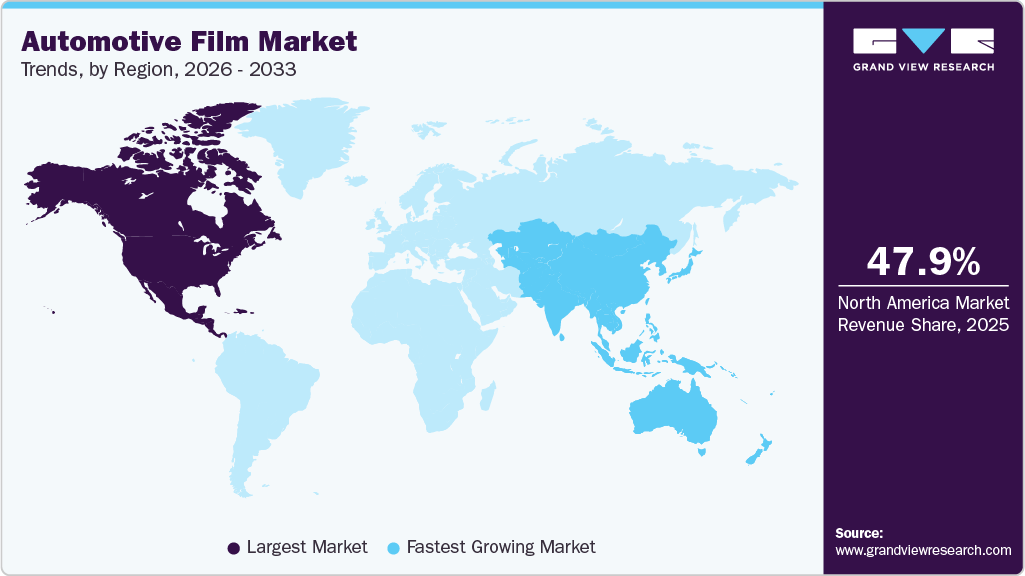
The U.S. market is supported by the concentration of electric vehicles in high-sun states. According to the AFDC, California accounts for about 35% of all U.S. electric vehicles, with Florida and Texas next, which increases exposure to heat and UV stress in large metropolitan fleets and private cars. DOE data also show plug-in EV sales reached 9.1% of U.S. light-duty sales in 2023 and 9.8% in December 2023, reinforcing demand for solar-control and protective films.
Europe Automotive Film Market Trends
Europe is being driven by the rise of battery-electric vehicles and the buildout of charging infrastructure. According to ACEA, battery-electric cars reached 17.4% of the EU market in 2025, up from 13.6% a year earlier, while the IEA said Europe’s public charging points grew more than 35% in 2024 to just above 1 million. This is supporting demand for films that improve cabin comfort, reduce solar load, and fit the larger glazing areas common in EV-focused models.
Asia Pacific Automotive Film Market Trends
Asia Pacific is driven by unmatched EV manufacturing scale and fast EV adoption. According to the IEA, China produced 12.4 million electric cars in 2024, more than 70% of global output, and its share of global electric car sales rose to almost two-thirds. The IEA also reported that India’s electric car sales increased by more than 50% in the first quarter of 2024. This scale supports OEM film integration and aftermarket films across dense urban vehicle parks.
Key Automotive Film Company Insights
The automotive film industry is highly competitive, with several key players dominating the landscape. Major companies include 3M, Garware Hi-Tech Films Ltd, Saint-Gobain S.A., Eastman Chemical Company, Avery Dennison Corporation, LINTEC Corporation, Ergis S.A., TORAY INDUSTRIES, INC., Johnson Window Films, Inc., Hexis S.A.S, and XPEL, NEXFIL Co., Ltd. The automotive film industry is characterized by a competitive landscape with several key players driving innovation and market growth. Major companies in this sector are investing heavily in research and development to enhance the performance, cost-effectiveness, and sustainability of their products.
Key Automotive Film Companies:
The following key companies have been profiled for this study on the automotive film market.
- 3M
- Garware Hi-Tech Films Ltd
- Saint-Gobain S.A.
- Eastman Chemical Company
- Avery Dennison Corporation
- LINTEC Corporation
- Ergis S.A.
- TORAY INDUSTRIES, INC.
- Johnson Window Films, Inc.
- Hexis S.A.S
- XPEL
- NEXFIL Co., Ltd
Recent Developments
-
In February 2026, Avery Dennison expanded its cast film portfolio with MPI 1903 Cast Wrapping Film. The new product is positioned as a high-gloss, multi-purpose film at a more accessible price point, which should support broader adoption in the wrap market by balancing performance, appearance, and cost sensitivity for installers and fleet users.
-
In October 2025, Avery Dennison launched Neo Matte Black Paint Protection Film, expanding its premium wet-apply color PPF portfolio. The new film adds a matte black option to the existing gloss black line, targeting installers and enthusiasts who want higher-end styling with durable surface protection and a factory-like finish.
Automotive Film Market Report Scope
Report Attribute
Details
Market size value in 2026
USD 13.9 billion
Revenue forecast in 2033
USD 26.3 billion
Growth rate
CAGR of 9.5% from 2026 to 2033
Historical data
2021 - 2025
Forecast period
2026 - 2033
Quantitative units
Revenue in USD million/billion, volume in thousand Sq. meters, and CAGR from 2026 to 2033
Report coverage
Revenue & volume forecast, competitive landscape, growth factors, and trends
Segments covered
Film type, application, vehicle, and region
Regional scope
North America; Europe; Asia Pacific; Central & South America; Middle East & Africa
Country scope
U.S.; Canada; Mexico; UK; Germany; France; Italy; Spain; Russia; Denmark; Sweden; Norway; China; India; Japan; Australia; South Korea; Indonesia; Thailand; Brazil; Argentina; South Africa; Saudi Arabia; UAE
Key companies profiled
3M; Garware Hi-Tech Films Ltd; Saint-Gobain; Eastman Chemical Company; Avery Dennison Corporation; LINTEC Corporation; Ergis S.A.; Toray Industries, Inc.; Johnson Window Films, Inc.; HEXIS S.A.S.; XPEL, Inc.; NEXFIL Co., Ltd,
Customization scope
Free report customization (equivalent to up to 8 analyst working days) with purchase. Addition or alteration to country, regional & segment scope
Pricing and purchase options
Avail customized purchase options to meet your exact research needs. Explore purchase options
Global Automotive Film Market Report Segmentation
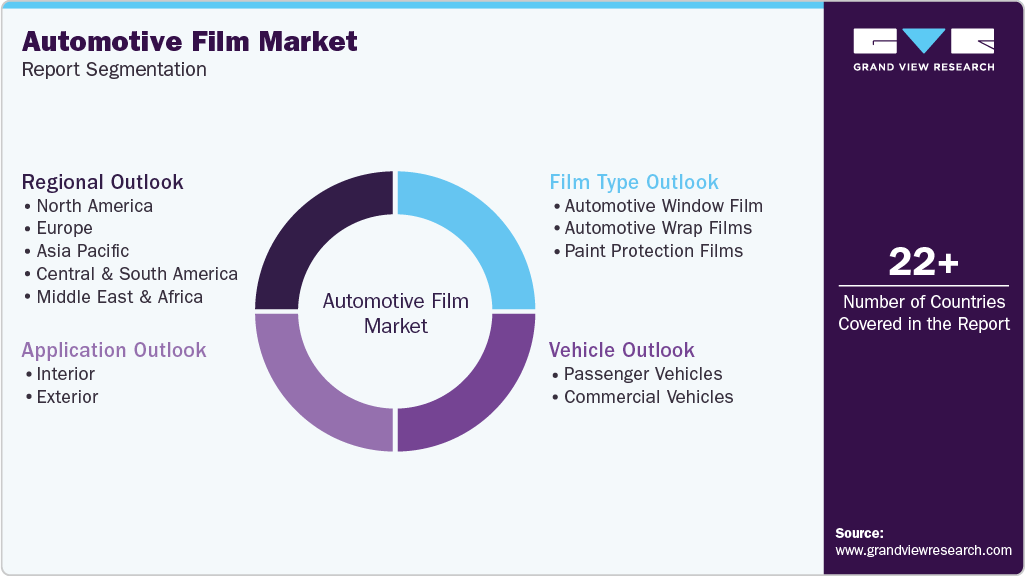
This report forecasts revenue growth at the global, regional, and country levels and provides an analysis of the latest industry trends across sub-segments from 2021 to 2033. For this study, Grand View Research has segmented the global automotive film market report based on film type, application, vehicle, and region:
-
Film Type Outlook (Volume, Thousand Sq. Meters; Revenue, USD Million, 2021 - 2033)
-
Automotive Window Film
-
Automotive Wrap Films
-
Paint Protection Films
-
-
Application Outlook (Volume, Thousand Sq. Meters; Revenue, USD Million, 2021 - 2033)
-
Interior
-
Exterior
-
-
Vehicle Outlook (Volume, Thousand Sq. Meters; Revenue, USD Million, 2021 - 2033)
-
Passenger Vehicles
-
Commercial Vehicles
-
-
Regional Outlook (Volume, Thousand Sq. Meters; Revenue, USD Million, 2021 - 2033)
-
North America
-
U.S.
-
Canada
-
Mexico
-
-
Europe
-
Germany
-
UK
-
France
-
Italy
-
Spain
-
Russia
-
Denmark
-
Sweden
-
Norway
-
-
Asia Pacific
-
China
-
India
-
Japan
-
Australia
-
South Korea
-
Indonesia
-
Thailand
-
-
Central & South America
-
Brazil
-
Argentina
-
-
Middle East & Africa
-
Saudi Arabia
-
South Africa
-
UAE
-
-
Frequently Asked Questions About This Report
b. The automotive window film segment dominated the market across film type segmentation in terms of revenue, accounting for 68.5% market share in 2025, and is forecast to grow at a 8.9% CAGR from 2026 to 2033.
b. Some key players operating in the automotive film market include 3M, Garware Hi-Tech Films Ltd, Saint-Gobain S.A., Eastman Chemical Company, Avery Dennison Corporation, LINTEC Corporation, Ergis S.A., TORAY INDUSTRIES, INC., Johnson Window Films, Inc., Hexis S.A.S, XPEL, and NEXFIL Co., Ltd.
b. The increasing use of advanced safety and security films in vehicles is driving the market. These films improve shatter resistance and intrusion protection, which supports compliance with stricter safety standards and rising consumer focus on passenger protection.
b. The global automotive film market size was estimated at USD 12.8 billion in 2025 and is expected to reach USD 13.9 billion in 2026.
b. The global automotive film market is expected to grow at a compound annual growth rate of 9.5% from 2026 to 2033 to reach USD 26.3 billion by 2033.


Share this report with your colleague or friend.
Need a Tailored Report?
Customize this report to your needs — add regions, segments, or data points, with 20% free customization.


ISO 9001:2015 & 27001:2022 Certified
We are GDPR and CCPA compliant! Your transaction & personal information is safe and secure. For more details, please read our privacy policy.
Trusted market insights - try a free sample
See how our reports are structured and why industry leaders rely on Grand View Research. Get a free sample or ask us to tailor this report to your needs.













