
- Home
- »
- Advanced Interior Materials
- »
-
Automotive Metal Stamping Market Size Report, 2026-2033GVR Report cover

Automotive Metal Stamping Market (2026 - 2033)
Size, Share & Trends Analysis Report By Process (Blanking, Embossing, Bending, Coining, Flanging), By Application (Passenger Cars), By Region, And Segment Forecasts
Market Size, 2025
$90.6BMarket Estimate, 2026
$94.1BMarket Forecast, 2033
$126.4BCAGR, 2026–2033
4.3%Automotive Metal Stamping Market Summary
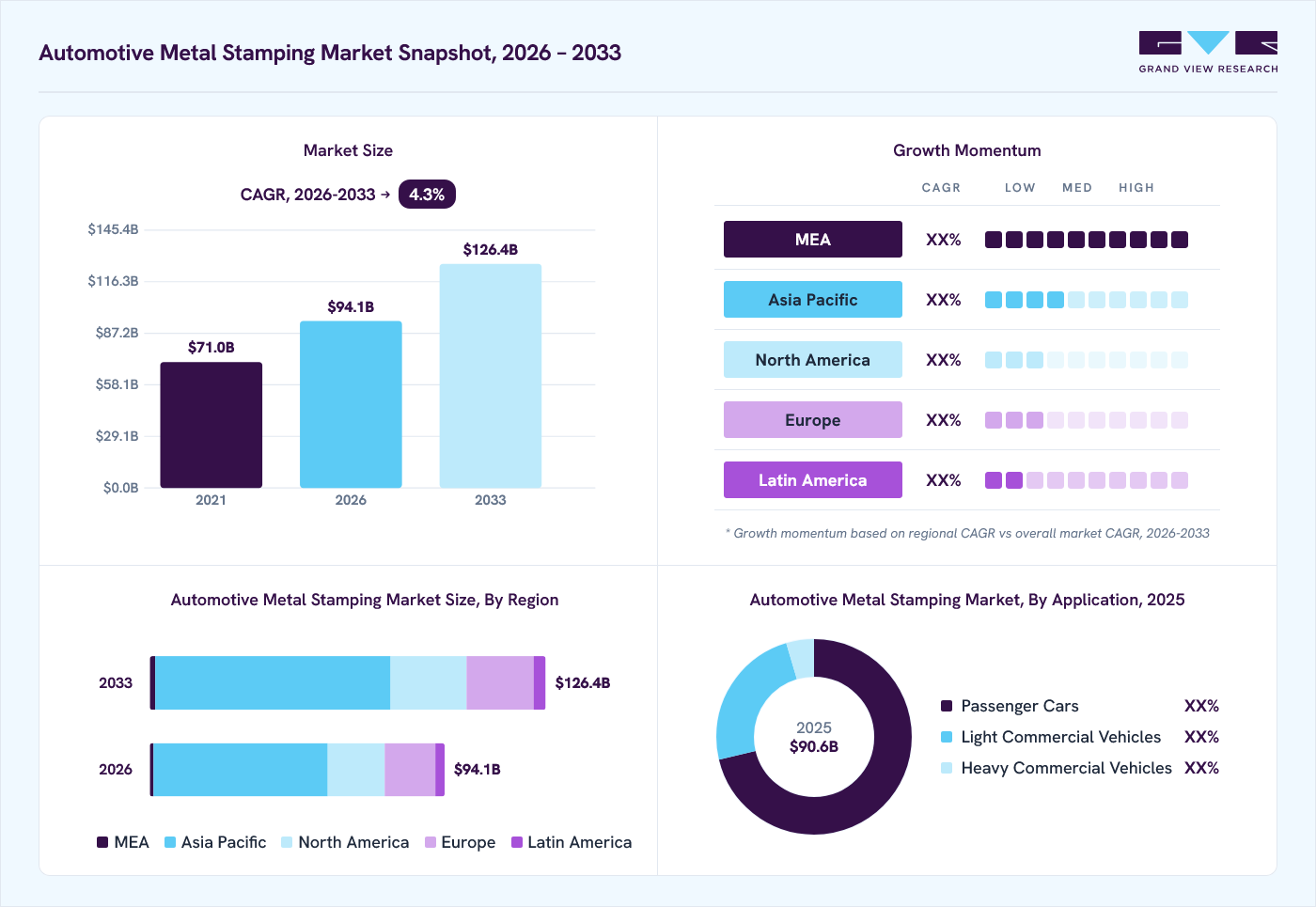
The global automotive metal stamping market size was valued at USD 90.6 billion in 2025 and is projected to grow from USD 94.1 billion in 2026 to USD 126.4 billion by 2033, growing at a CAGR of 4.3% from 2026 to 2033. Asia Pacific dominated the market, accounting for a revenue share of 54.8% in 2025. This growth is driven by the rising production of vehicles and increased demand for passenger cars globally.
 Source: Grand View Research, IR Documents, Primary Interviews, Paid DatabasesTo learn more about this report,
 Download Free Sample Report
Key Market Trends & Insights
- By process: Blanking segment dominated the market, with a revenue share of 33.1% in 2025.
- By application: Passenger cars segment held the largest market share of 71.2% in 2025.
Regional Highlights
- Largest regional market: Asia Pacific (59.0% revenue share, 2025)
- By country: China held the largest market share in 2025.
Market Size & Forecast
- Market size in 2025: USD 90.6 Billion
- Estimated market size in 2026: USD 94.1 Billion
- Projected market size by 2033: USD 126.4 Billion
- CAGR (2026-2033): 4.3%
Three ways to get this report
Buy it, customize it, or ask a question.Ask an Analyst
Analyst response in 1 business day
- AccessReport author, directly
- Reply timeWithin 1 working day
- No sales callDirect answer only
- FormatEmail reply
- CostFree, no cost
Get the Full Report
What the study covers
- FormatsPDF · Excel · Dashboard
- Timeline2026–2033 annual, 2025 base
- Coverage20+ countries, 5 regions
- Companies10+ key players profiled
Customize the Report
20% free customization
- IncludeCountries, segments, points
- TailorTo your product definition
- ExtendDeeper competitor detail
- OrA fully bespoke study
- Turnaround5–10 working days
The rising trend towards engine downsizing to improve fuel efficiency has led to a higher demand for lightweight metals such as aluminum, which are extensively used in metal stamping processes. Moreover, expanding manufacturing industries and establishing contracts between key original equipment manufacturers and automotive stamping companies boost market growth.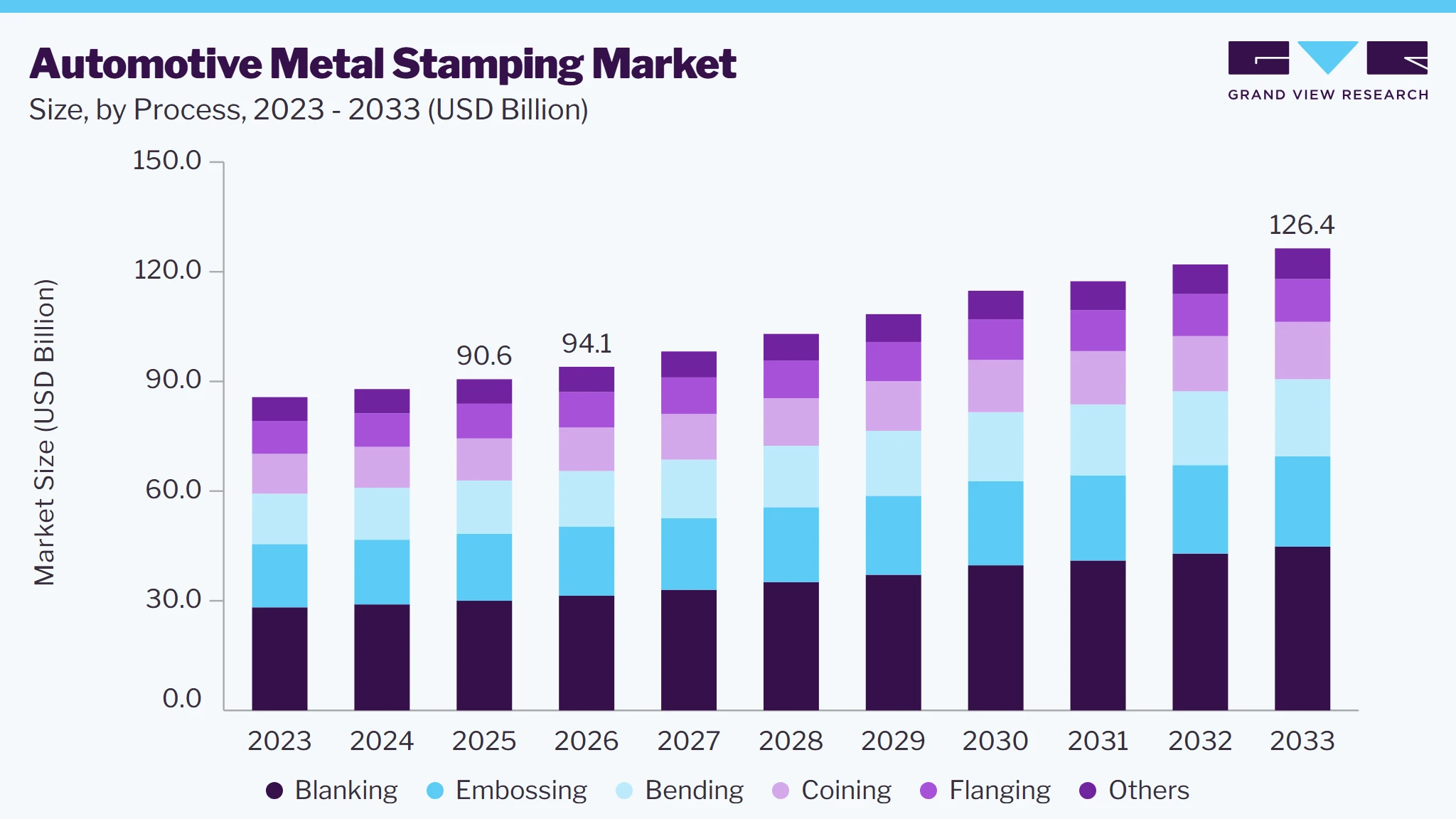 To learn more about this report, Download Free Sample Report
Technological advancements in manufacturing processes, including laser and hydraulic metal stamping, are enhancing production efficiency and cost-effectiveness, further stimulating market growth. Moreover, the increasing adoption of electric vehicles (EVs) necessitates specialized stamped components such as battery enclosures and lightweight structural parts, aligning with the industry's evolving requirements.
Market Dynamics
The automotive metal stamping market is experiencing steady growth due to increasing vehicle production, rising demand for lightweight automotive components, and the growing adoption of electric vehicles (EVs). Automakers are increasingly utilizing metal stamping processes to manufacture high-volume, precision-engineered components with improved strength, dimensional accuracy, and cost efficiency. Growing investments in automotive manufacturing facilities, advancements in stamping technologies, and stringent fuel efficiency and emission regulations are further supporting market expansion. Additionally, the increasing use of high-strength steel and aluminum in vehicle structures is driving demand for advanced metal stamping solutions across passenger and commercial vehicle segments.
The increasing focus on vehicle lightweighting is a major factor driving the automotive metal stamping market. Automakers are continuously seeking ways to reduce vehicle weight to improve fuel efficiency, extend EV driving range, and comply with stringent emission regulations. Metal stamping enables the mass production of lightweight, complex-shaped components using materials such as advanced high-strength steel (AHSS), aluminum, and other lightweight alloys. These stamped components are extensively used in body-in-white structures, chassis systems, doors, hoods, fenders, and structural reinforcements.
Furthermore, the growth of electric vehicle production is increasing the demand for precision-stamped battery enclosures, motor housing, structural supports, and lightweight body components. The ability of metal stamping processes to deliver high production volumes, consistent quality, and cost-effective manufacturing makes them essential to modern automotive production. As global vehicle production and electrification trends continue to expand, demand for automotive metal stamping is expected to remain strong throughout the forecast period.
Fluctuations in the prices of steel, aluminum, copper, and other automotive-grade metals present a significant challenge for market participants. Raw material costs account for a substantial portion of overall production expenses, and sudden price increases can adversely affect manufacturer's profitability and pricing strategies. Additionally, disruptions in global supply chains can further impact the availability and cost of metal inputs.
The rapid growth of the electric vehicle industry presents substantial opportunities for the automotive metal stamping market. EV manufacturers require lightweight and high-strength stamped components to improve battery efficiency, vehicle performance, and structural safety. This trend is accelerating the adoption of aluminum, advanced high-strength steel, and other lightweight materials in automotive manufacturing. In addition, advancements in hot stamping, servo stamping, and precision forming technologies are enabling manufacturers to produce increasingly complex and lightweight components with enhanced structural performance. Growing investments in EV production facilities, battery manufacturing plants, and next-generation vehicle platforms are creating new demand for specialized stamped parts. As vehicle electrification, lightweighting, and advanced manufacturing technologies continue to evolve, the automotive metal stamping market is expected to witness significant growth opportunities during the forecast period.
Analyst Perspective
The automotive metal stamping market is positioned for steady growth, supported by the automotive industry's increasing emphasis on lightweight vehicle architectures, manufacturing efficiency, and structural performance optimization. Metal stamping remains a critical production process for high-volume automotive components, enabling the cost-effective fabrication of complex geometries with stringent dimensional tolerances and repeatability. Market demand is being reinforced by rising production of passenger and commercial vehicles, accelerating electric vehicle adoption, and the growing utilization of advanced high-strength steel (AHSS) and aluminum alloys in body-in-white, chassis, and battery enclosure applications. While manufacturers continue to navigate challenges related to raw material price fluctuations, supply chain uncertainties, and capital-intensive tooling investments, ongoing advancements in hot stamping, servo press technologies, and automated manufacturing systems are enhancing operational efficiency and component performance.
Process Insights
Based on process, the blanking segment led the market with the largest revenue share of 33.1% in 2025 due to its widespread application and the efficiency it brings to the manufacturing process. Blanking allows for precise and consistent production of parts, reducing material waste and ensuring high-quality outcomes. This process is integral to meeting the high demand for automotive parts, driven by the growing automotive industry and the increasing production of vehicles globally.
The bending segment is expected to grow at a CAGR of 5.1% from 2025 to 2030. Bending involves deforming metal into a desired shape without altering its volume, which is essential for manufacturing components such as brackets, chassis, and frame structures. This process is critical for achieving the complex geometries required in modern automotive designs. The growth in the bending segment is propelled by advancements in bending technologies and the increasing emphasis on lightweight and fuel-efficient vehicles.
Application Insights
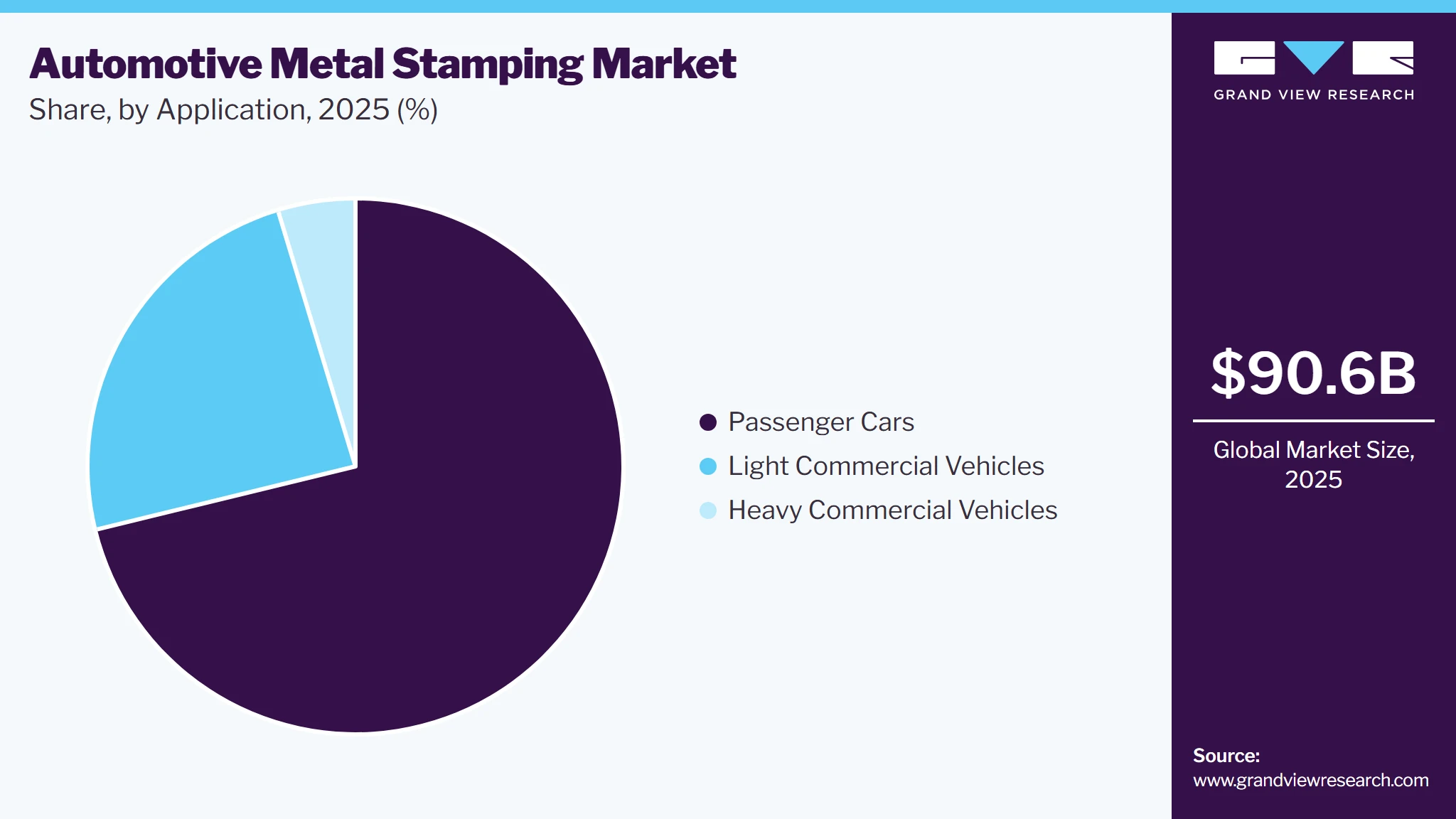
The passenger cars segment accounted for the largest revenue share of 71.2% in 2025, driven by high global production volumes and the extensive use of stamped metal components across vehicle body structures, chassis systems, doors, hoods, fenders, roof panels, and safety reinforcements. Increasing consumer demand for fuel-efficient and safer vehicles has encouraged automakers to adopt advanced high-strength steel (AHSS) and aluminum stamping technologies that reduce vehicle weight while maintaining structural integrity.
 To learn more about this report, Download Free Sample Report
The light commercial vehicles (LCVs) segment is projected to register the fastest CAGR of 4.4% during the forecast period. Growth is supported by the expansion of e-commerce, last-mile delivery services, urban logistics, and small business transportation fleets, which are driving higher production of vans and pickup trucks. Manufacturers are increasingly incorporating lightweight stamped components into LCVs to improve payload capacity, fuel efficiency, and compliance with tightening emission regulations. The growing adoption of electric light commercial vehicles is further accelerating demand for stamped battery housings, chassis components, and structural reinforcements, creating new growth opportunities for automotive metal stamping suppliers.
The heavy commercial vehicles segment is projected to grow at the fastest over the forecast period. Factors such as expanding construction and logistics industries, particularly in developing regions, drive this growth. The demand for heavy commercial vehicles, including trucks and buses, is rising due to infrastructure development and increased freight transportation. Metal stamping plays a vital role in manufacturing the robust and durable components required for these vehicles, such as chassis, frames, and axles. As the global economy continues to recover and expand, the need for efficient transportation and construction solutions fuels the growth of the heavy commercial vehicles segment.
Regional Insights
North America accounted for a 19.3% revenue share of the global automotive metal stamping market in 2025 due to the robust automotive industry in the region, characterized by a strong presence of key market players and ongoing advancements in automotive technology. Favorable government policies supporting manufacturing and technological innovation have also been critical in driving market growth.
U.S. Automotive Metal Stamping Market Trends
The U.S. dominated the North American automotive metal stamping market in 2024, driven by its substantial automotive manufacturing base and significant investments in research and development. The presence of leading automotive manufacturers, coupled with a strong focus on innovation and technology, has cemented the U.S.'s position in the market.
Europe Automotive Metal Stamping Market Trends
Europe's automotive metal stamping market is anticipated to grow steadily throughout the forecast period. The region's well-established automotive industry, characterized by leading car manufacturers and a strong emphasis on innovation and sustainability, plays a crucial role in driving market growth. Europe’s stringent emission regulations and the push for electric vehicles (EVs) are compelling manufacturers to adopt advanced metal stamping techniques to produce lighter and more efficient components.
Asia Pacific Automotive Metal Stamping Market Trends
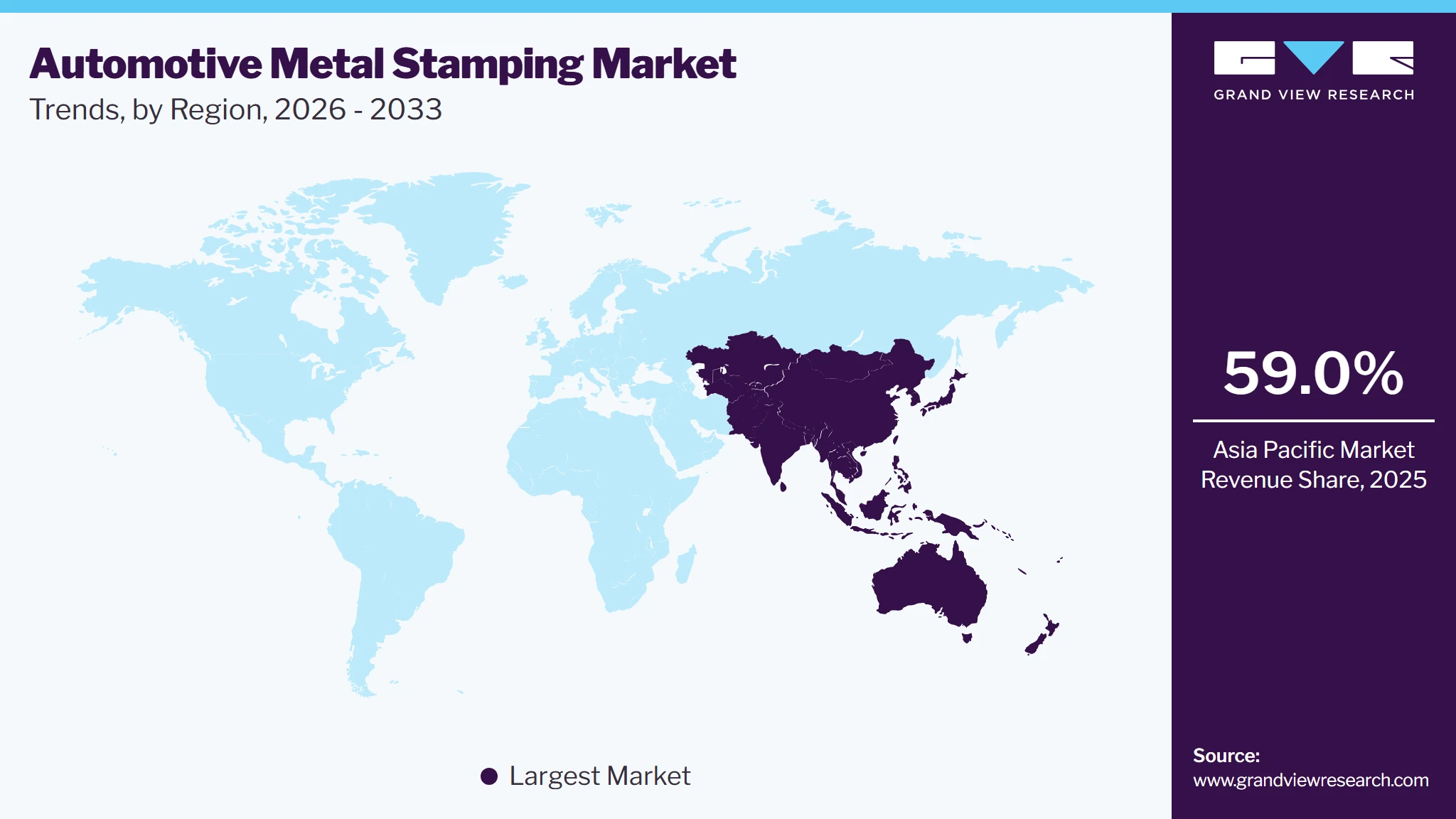
Asia Pacific dominated the automotive metal stamping market with the largest revenue share of 59.0% in 2025, owing to its growing automotive industry and rapid industrialization. China dominated the Asia Pacific market with a revenue share of 54.5% in 2025. Countries such as China, Japan, and India are key players in this market, driven by the high demand for vehicles and the expansion of manufacturing facilities. Favorable government policies, significant investments in infrastructure, and the growing trend of vehicle electrification further fuel the region's dominance. The availability of affordable labor and raw materials in the Asia Pacific also contributes to the extensive adoption of metal stamping processes, solidifying the region's leading position in the global market.
 To learn more about this report, Download Free Sample Report
Key Automotive Metal Stamping Company Insights
Some of the key companies in the automotive metal stamping market include AAPICO Hitech Public Company Limited, American Industrial Co., CAPARO, D&H Industries, Inc., FCA, Ford Motor Company, and others.
-
American Industrial Co. specializes in metal stamping for the automotive industry, offering cost-effective solutions for manufacturing parts such as fenders and hub caps. Their advanced stamping processes utilize various metals, including aluminum and steel, to produce high-volume runs of automotive components.
-
D&H Industries, Inc. offers precision metal stamping services for various automotive components. The company’s expertise includes producing parts such as body panels, chassis components, and structural elements.
Key Automotive Metal Stamping Companies:
The following key companies have been profiled for this study on the automotive metal stamping market.
-
AAPICO Hitech Public Company Limited
-
American Industrial Co.
-
CAPARO
-
D&H Industries, Inc.
-
FCA
-
Ford Motor Company
-
General Motors
-
Gestamp
-
Goshen Stamping Company
-
Kenmode, Inc.
-
Nissan Motor Co., Ltd
-
Tempco Manufacturing Company, Inc
Competitive Benchmarking
Category
Operating Strategies
Competitive Edge
Weakness
Established Players (e.g., Gestamp, AAPICO Hitech Public Company Limited, CAPARO, Ford Motor Company, General Motors)
- Primarily engaged in large-scale manufacturing of automotive metal stamped components for global vehicle manufacturers.
- Focus on expanding production capacity, automation, tooling capabilities, and geographic presence to strengthen market position.
- Invest in advanced stamping technologies such as hot stamping, servo stamping, progressive die stamping, and lightweight material processing.
- Maintain long-term supply agreements with automotive OEMs and Tier-1 suppliers while supporting vehicle electrification initiatives.
- Strong relationships with global automotive OEMs and extensive manufacturing footprints.
- Advanced engineering expertise, tooling capabilities, and high-volume production capacity.
- Ability to manufacture complex, safety-critical, and lightweight components with consistent quality standards.
- Benefit from economies of scale, established supply chains, and strong financial resources.
- High capital expenditure requirements for presses, tooling, automation systems, and plant expansion.
- Exposure to fluctuations in steel, aluminum, and other raw material prices.
- Dependence on automotive production cycles and vehicle demand trends.
- Longer development cycles and reduced flexibility in addressing low-volume niche opportunities.
Emerging & Regional Players (e.g., American Industrial Co., D&H Industries, Inc., Goshen Stamping Company, Kenmode, Inc., Tempco Manufacturing Company, Inc.)
- Focus on regional automotive markets and specialized stamped component manufacturing.
- Emphasize flexibility, customized production runs, rapid prototyping, and customer-specific solutions.
- Leverage niche expertise in precision stamping, fabrication, and low-to-medium volume production.
- Develop partnerships with regional OEMs, Tier-1 suppliers, EV manufacturers, and industrial customers.
- Greater agility in responding to evolving customer requirements and vehicle platform changes.
- Strong capability to provide customized, short-run, and prototype components.
- Faster decision-making and operational flexibility compared to larger competitors.
- Ability to serve niche automotive applications and regional supply chains efficiently.
- Limited manufacturing scale and geographic presence compared to multinational competitors.
- Lower bargaining power in raw material procurement and capital equipment acquisition.
- Greater exposure to regional economic and automotive industry fluctuations.
- Resource limitations may restrict investments in advanced technologies, automation, and international expansion.
Recent Developments
-
In June 2024, BMW Manufacturing inaugurated a cutting-edge press shop at its Spartanburg facility. The shop, capable of producing up to 10,000 components daily, is a strategic addition to the plant’s production capabilities. The new press shop plays a pivotal role in the manufacturing of the BMW X3, stamping critical exterior body parts such as doors, side panels, fenders, and liftgate.
-
In May 2024, BENTELER Group inaugurated its new plant in Bratislava, Slovakia. Strategically located near Volkswagen, the plant will serve as a key hub for supplying the dynamic European market. The plant's proximity to the customer enables efficient production, assembly, and logistics, ensuring agile and high-quality solutions.
Automotive Metal Stamping Market Report Scope
Report Attribute
Details
Market definition
The automotive metal stamping market represents the revenue generated from the sale of metal stamped components utilized in passenger cars, light commercial vehicles, and heavy commercial vehicles.
Market size in 2025
USD 90.6 billion
Estimated market size in 2026
USD 94.1 billion
Projected market size by 2033
USD 126.4 billion
Growth rate
CAGR of 4.3% from 2026 to 2033
Base year for estimation
2025
Historical data
2021 - 2024
Forecast period
2026 - 2033
Quantitative units
Revenue in USD million/billion, and CAGR from 2026 to 2033
Report coverage
Revenue forecast, company ranking, competitive landscape, growth factors, and trends
Segments covered
Process, application, region
Regional scope
North America; Europe; Asia Pacific; Latin America; Middle East & Africa
Country scope
U.S.; Canada; Mexico; Germany; UK; Italy; China; Japan; India; Brazil
Key companies profiled
AAPICO Hitech Public Company Limited; American Industrial Co.; CAPARO; D&H Industries, Inc.; FCA; Ford Motor Company; General Motors; Gestamp; Goshen Stamping Company; Kenmode, Inc.; Nissan Motor Co., Ltd; Tempco Manufacturing Company, Inc.
Customization scope
Free report customization (equivalent up to 8 analysts' working days) with purchase addition or alteration to country, regional & segment scope.
Pricing and purchase options
Avail customized purchase options to meet your exact research needs. Explore purchase options
Global Automotive Metal Stamping Market Report Segmentation
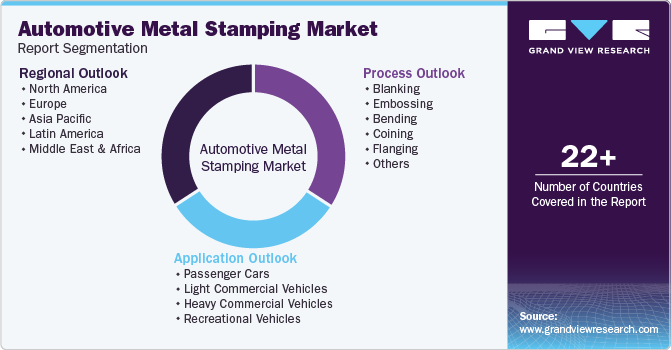
This report forecasts revenue growth at global, regional, and country levels and provides an analysis of the latest industry trends in each of the sub-segments from 2021 to 2033. For this study, Grand View Research has segmented the global automotive metal stamping market report based on process, application, and region:
 To learn more about this report, Download Free Sample Report
-
Process Outlook (Revenue, USD Million, 2021 - 2033)
-
Blanking
-
Embossing
-
Bending
-
Coining
-
Flanging
-
Others
-
-
Application Outlook (Revenue, USD Million, 2021 - 2033)
-
Passenger Cars
-
Light Commercial Vehicles
-
Heavy Commercial Vehicles
-
Recreational Vehicles
-
-
Regional Outlook (Revenue, USD Million, 2021 - 2033)
-
North America
-
U.S.
-
Canada
-
Mexico
-
-
Europe
-
Germany
-
UK
-
Italy
-
-
Asia Pacific
-
China
-
India
-
Japan
-
-
Latin America
-
Brazil
-
-
Middle East and Africa (MEA)
-
Research Methodology
The automotive metal stamping market figures in this report are based on a proven research process that combines executive interviews with secondary research from proprietary databases, company filings, and recognized regulatory and institutional sources. Market size is built through value-chain sizing - reconciling supply-side and demand-side estimates - and triangulated with bottom-up and top-down approaches. Every estimate passes multiple levels of expert validation before publication, with each automotive metal stamping segment quantified using the revenue-capture definitions in the table below.
Segment Definition
Process
Revenue Capture Definition
Blanking
This segment includes automotive metal stamped components produced through blanking operations, where flat sheet metal is cut into predetermined shapes for further processing. Revenue is generated from the sale of blanks used in automotive body panels, structural components, chassis parts, brackets, reinforcements, and various precision metal components supplied to passenger cars, commercial vehicles, and electric vehicle manufacturers.
Embossing
This segment comprises automotive metal stamped components manufactured using embossing processes to create raised or recessed features that improve structural rigidity, aesthetics, identification marking, or functional performance. Revenue is derived from the sale of embossed body panels, floor pans, door components, engine covers, interior trim parts, and decorative automotive components used across vehicle platforms.
Bending
This segment includes automotive metal stamped components formed through bending operations to achieve specific angles, profiles, and geometries. Revenue is generated from the sale of bent brackets, frames, supports, reinforcements, chassis members, seat structures, battery enclosures, and other automotive components utilized in vehicle assembly and structural applications.
Coining
This segment consists of automotive metal stamped components produced through coining processes that apply high pressure to achieve precise dimensions, fine details, and enhanced surface finishes. Revenue is generated from the sale of precision automotive parts such as gears, connectors, terminals, fastener components, sensor housing, and other critical components requiring tight tolerances and superior dimensional accuracy.
Flanging
This segment includes automotive metal stamped components manufactured using flanging operations, where sheet metal edges are bent to improve strength, facilitate joining, or enhance structural integrity. Revenue is derived from the sale of flanged body panels, door assemblies, hoods, trunk lids, fenders, roof structures, and other vehicle components requiring welding, hemming, or assembly integration.
Others
This segment comprises automotive metal stamped components manufactured through other stamping processes, including deep drawing, piercing, hemming, curling, and progressive die stamping. Revenue is generated from the sale of specialized automotive parts such as fuel tanks, battery casings, motor housing, exhaust components, transmission parts, and custom-engineered metal components used across various vehicle applications
Process
Revenue Capture Definition
Passenger Cars
This segment includes automotive metal stamped components supplied for passenger cars, including sedans, hatchbacks, SUVs, crossovers, and luxury vehicles. Revenue is generated from the sale of body structures, closures, chassis components, seating structures, battery enclosures, and various interior and exterior stamped parts used in passenger vehicle manufacturing.
Light Commercial Vehicles
This segment comprises automotive metal stamped components utilized in light commercial vehicles, including pickup trucks, vans, delivery vehicles, and light-duty utility vehicles. Revenue is derived from the sale of stamped body panels, structural assemblies, cargo-area components, chassis parts, and reinforcement structures designed for commercial transportation applications.
Heavy Commercial Vehicles
This segment includes automotive metal stamped components used in heavy-duty trucks, buses, construction vehicles, and industrial transport vehicles. Revenue is generated from the sale of heavy-gauge stamped structures, chassis members, cab panels, mounting brackets, support assemblies, and other high-strength components designed to withstand demanding operating conditions.
Recreational Vehicles
This segment consists of automotive metal stamped components supplied for recreational vehicles, including motorhomes, camper vans, travel trailers, and specialty leisure vehicles. Revenue is derived from the sale of stamped body panels, structural frameworks, interior support components, storage systems, and customized metal parts used in recreational vehicle production.
Estimation Model
Layer Name
Key Question
Description
Automotive Production Demand Base Layer
What forms the demand base?
Identify automotive metal stamping demand generated from passenger cars, light commercial vehicles, heavy commercial vehicles, recreational vehicles, and electric vehicles. Assess demand across body-in-white structures, closures, chassis systems, structural reinforcements, powertrain components, battery enclosures, and interior and exterior applications. Analyze the influence of vehicle production volumes, automotive manufacturing investments, vehicle lightweighting trends, safety regulations, and electrification on overall market demand. This layer establishes the total addressable demand for automotive metal stamping globally.
Raw Material Supply & Manufacturing Layer
Where are automotive metal stamped components produced and supplied from?
Estimate the availability and supply of automotive metal stamped components based on raw materials such as steel, advanced high-strength steel (AHSS), aluminum, stainless steel, copper, and specialty alloys. Analyze regional stamping capacities, automotive manufacturing hubs, Tier-1 and Tier-2 supplier networks, tooling capabilities, import-export activities, and distribution channels. Evaluate the role of metal stampers, automotive OEMs, contract manufacturers, and component suppliers in supplying stamped components to vehicle manufacturers globally.
Application Consumption Intensity Layer
How much automotive metal stamping is consumed?
Analyze automotive metal stamping consumption intensity across body panels, doors, hoods, roofs, fenders, chassis assemblies, structural components, seating systems, battery enclosures, motor housings, brackets, and precision automotive parts. Evaluate component usage per vehicle, material substitution trends, production volumes, vehicle platform designs, and adoption rates of lightweight materials. Consumption intensity varies based on vehicle type, safety requirements, manufacturing technology, electrification levels, and regional automotive production patterns.
Revenue Layer
How is market revenue generated?
Market revenue is quantified through the production and sale of automotive metal stamped components supplied to automotive OEMs and aftermarket channels. Revenue generation is influenced by component complexity, material type, stamping process, tooling requirements, production volumes, manufacturing costs, and vehicle demand. Growth in vehicle production, electric vehicle adoption, lightweighting initiatives, advanced stamping technologies, and increasing demand for high-strength precision-engineered components drives overall market value.
Delivered Customizations
This report has been delivered with the following In-depth customizations
Client Request
Customization Delivered
Value Adds
Regional Demand Assessment
Detailed evaluation of automotive metal stamping demand across North America, Europe, Asia Pacific, Latin America, and the Middle East & Africa. Included country-level vehicle production trends, automotive manufacturing activity, EV adoption rates, industrial growth drivers, and demand patterns by vehicle type and application.
Enabled identification of high-growth regional markets, supported geographic expansion strategies, and highlighted region-specific demand opportunities across automotive manufacturing hubs.
Competitive Benchmarking
Comparative assessment of key automotive metal stamping manufacturers based on product portfolio, manufacturing capabilities, geographic presence, customer base, technology adoption, and strategic initiatives.
Supported competitive positioning analysis, identification of industry best practices, and evaluation of market leadership strategies.
Opportunity Assessment
Identification of opportunities across electric vehicles, lightweight vehicle platforms, advanced high-strength steel (AHSS) applications, aluminum stamping, hot stamping technologies, battery enclosure manufacturing, and automotive structural components.
Assisted in prioritizing investment areas, evaluating emerging technology trends, and identifying high-potential revenue opportunities within the automotive metal stamping value chain.
Frequently Asked Questions About This Report
The automotive metal stamping market size was estimated at USD 90.6 billion in 2025 and is expected to reach USD 94.1 billion in 2026.
The automotive metal stamping market is expected to grow at a compound annual growth rate of 4.3% from 2026 to 2033 to reach USD 126.4 billion by 2033.
Based on process, the blanking segment led the market with the largest revenue share of 33.1% in 2025.
The light commercial vehicles segment is expected to grow at the fastest CAGR over the forecast period.
Some of the key vendors in the global automotive metal stamping market are AAPICO Hitech Public Company Limited; American Industrial Co.; CAPARO; D&H Industries; Inc.; FCA; Ford Motor Company; General Motors; Gestamp; Goshen Stamping Company; Kenmode, Inc.; Nissan Motor Co., Ltd; Tempco Manufacturing Company, Inc., among others.
The automotive metal stamping market is driven by increasing vehicle production, growing electric vehicle adoption, and rising demand for lightweight, high-strength automotive components. Advancements in stamping technologies and stringent fuel-efficiency and safety regulations further support market growth.
Asia Pacific dominated the automotive metal stamping market with the largest revenue share of 59.0% in 2025.
About the Author(s)
Advanced Interior Materials Research Team
Advanced Materials · Advanced Interior MaterialsThis report was authored by the advanced interior materials research team at Grand View Research - comprising two research analysts, one senior research analyst, and one industry expert - with specialized expertise in the advanced interior materials segment of the advanced materials industry. All findings are based on proprietary advanced materials databases, executive interviews, and regulatory analysis, subject to internal peer review prior to publication.
Last Updated:
Speak to Analyst

Customize this report to your needs - add regions, segments, or data points, with 20% free customization.
Or view our licence options:


ISO 9001:2015 & 27001:2022 Certified
We are GDPR and CCPA compliant! Your transaction & personal information is safe and secure. For more details, please read our privacy policy.


