
- Home
- »
- Automotive & Transportation
- »
-
Automotive Rain Sensor Market Size, Growth Report, 2026-2033GVR Report cover

Automotive Rain Sensor Market (2026 - 2033)
Size, Share & Trends Analysis Report by Vehicle Type (Passenger Vehicle, Commercial Vehicle), By Sales Channel (OEM, Aftermarket), By Region, And Segment Forecasts
Market Size, 2025
$6.0BMarket Estimate, 2026
$6.5BMarket Forecast, 2033
$10.9BCAGR, 2026–2033
7.7%Automotive Rain Sensor Market Summary
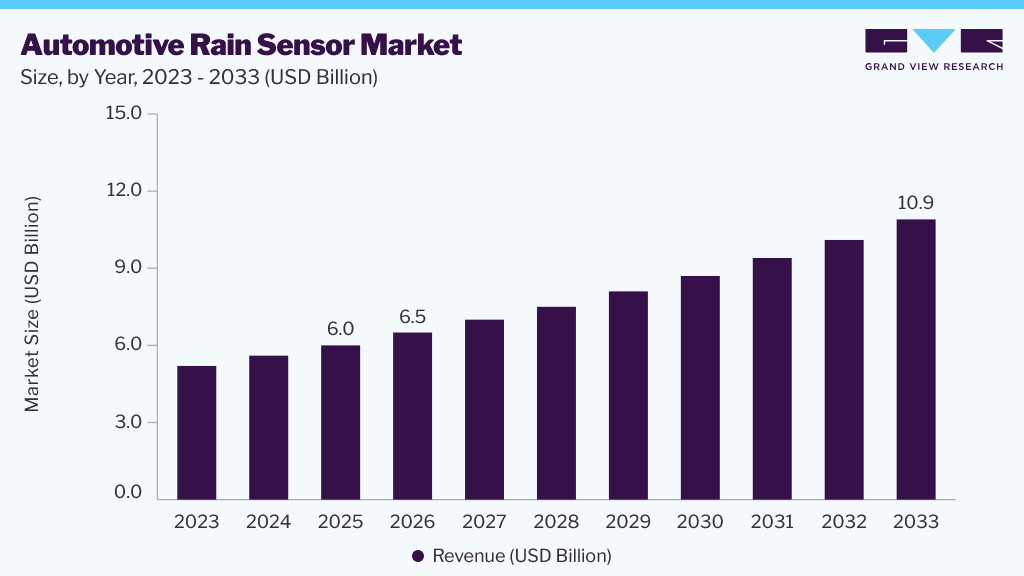
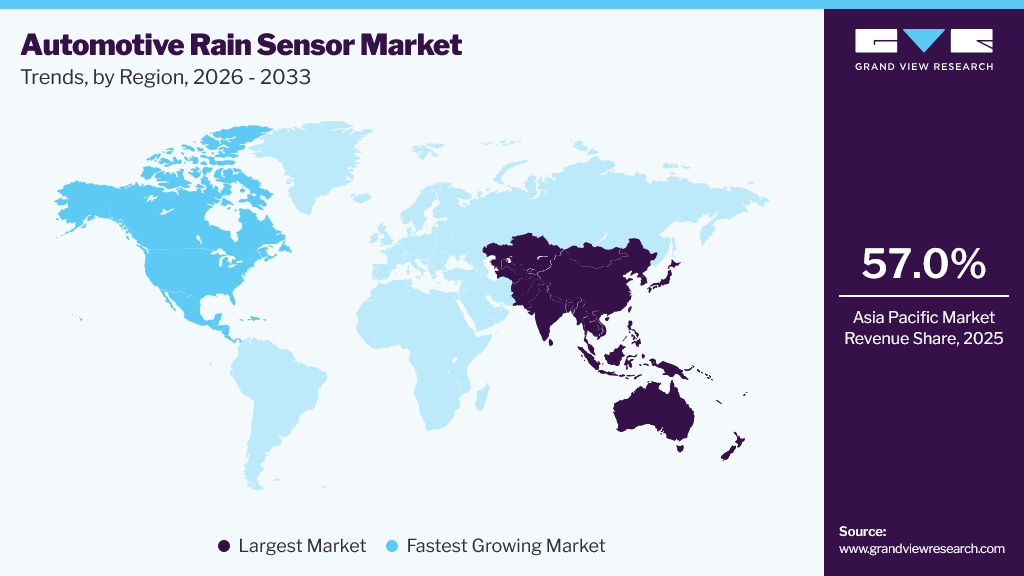
The global automotive rain sensor market size was valued at USD 6.0 billion in 2025 and is projected to grow from USD 6.5 billion in 2026 to USD 10.9 billion by 2033, at a CAGR of 7.7% from 2026 to 2033. The market in the Asia Pacific dominated the market, accounting for a revenue share of 57.0% in 2025. The increasing demand for vehicles, advancements in sensor technology, and comfort and convenience features in vehicles are contributing to market growth.
 Source: Grand View Research, IR Documents, Primary Interviews, Paid DatabasesTo learn more about this report,
 Download Free Sample Report
Key Market Trends & Insights
- By vehicle: The passenger vehicle segment dominated the market, with a revenue share of around 77.0% in 2025.
- By sales channel: The OEM segment held the largest share in 2025.
Regional Highlights
- Largest regional market: Asia Pacific (57.0% revenue share, 2025)
- Fastest-growing regional market: North America (highest CAGR, 2026-2033)
Market Size & Forecast
- Market size in 2025: USD 6.0 Billion
- Estimated market size in 2026: USD 6.5 Billion
- Projected market size by 2033: USD 10.9 Billion
- CAGR (2026-2033): 7.7%
Three ways to get this report
Buy it, customize it, or ask a question.Ask an Analyst
Analyst response in 1 business day
- AccessReport author, directly
- Reply timeWithin 1 working day
- No sales callDirect answer only
- FormatEmail reply
- CostFree, no cost
Get the Full Report
What the study covers
- FormatsPDF · Excel · Dashboard
- Timeline2026–2033 annual, 2025 base
- Coverage20+ countries, 5 regions
- Companies10+ key players profiled
Customize the Report
20% free customization
- IncludeCountries, segments, points
- TailorTo your product definition
- ExtendDeeper competitor detail
- OrA fully bespoke study
- Turnaround5–10 working days
The increasing demand for advanced driver assistance systems (ADAS) adds to the growing demand for rain sensors. Rain sensors are an integral part of ADAS and contribute to safer driving by automatically controlling the windshield wipers in response to rain. Various governments are implementing regulations that mandate the inclusion of advanced safety features in vehicles. For instance, the United Nations Economic Commission for Europe (UNECE) introduced UN Regulation No. 171 for Driver Control Assistance Systems (DCAS), which entered into force in September 2024. The regulation establishes uniform performance and safety requirements for DCAS that provide sustained lateral and longitudinal vehicle control while requiring continuous driver supervision. As vehicle manufacturers increasingly integrate ADAS technologies to comply with evolving international standards, demand for complementary sensing technologies is expected to rise.
Analyst Perspective
The automotive rain sensor market is expected to grow steadily over the coming years, driven by increasing adoption of advanced driver assistance systems (ADAS), rising vehicle safety requirements, and growing consumer preference for enhanced driving convenience. Automakers are increasingly integrating rain sensors into passenger and commercial vehicles to improve visibility and safety in extreme weather conditions by automatically activating wipers. Furthermore, improvements in the sensor capabilities and growing production of smart, premium, and electric vehicles are expected to fuel market growth. In addition, stringent regulations to adopt ADAS and the ongoing development of intelligent mobility solutions are expected to present growth opportunities for market participants over the coming years.
Vehicle Insights
The passenger vehicle segment held the largest market share of around 77.0% in 2025. Increasing population, rise in disposable income, and advancements in vehicle technology features, such as autonomous driving assistance systems, are the key factors driving the demand for passenger vehicles. With the rise in disposable incomes, the consumer demand for vehicles with comfort and convenience features such as automatic climate control, panoramic sunroof, 360° parking camera, automatic headlights, and rain-sensing wipers has increased.
The commercial vehicle segment is expected to grow at the fastest CAGR over the forecast period. The increasing demand for enhanced safety features is anticipated to drive the growth of the commercial vehicle segment. With increasing industrialization, e-commerce, infrastructure development, and the growing need for goods transportation, commercial vehicle sales have increased significantly. The rain sensors help improve road visibility by automatically activating the wipers in rain or snow. For instance, in December 2025, Fiat Professional launched the Ducato Series 2 light commercial vehicle in Australia, featuring an expanded suite of advanced driver assistance systems (ADAS), including automatic rain-sensing wipers, adaptive cruise control, and autonomous emergency braking (AEB). Such developments support the growing integration of intelligent sensing technologies in commercial vehicles.
Sales Channel Insights
The OEM segment led the market with the largest revenue share in 2025 and is expected to grow at a significant CAGR over the forecast period. The increasing production of vehicles, technological advancements, and consumer demand for improved safety features are driving the segment's growth. For instance, in June 2025, Mahindra & Mahindra introduced Level 2 ADAS in the Scorpio-N, further expanding its suite of intelligent vehicle technologies. The growing incorporation of advanced sensing technology by OEMs reflects the wider shift toward factory-fitted safety features and is expected to drive the demand for automotive rain sensor technology and other vehicular sensors over the coming years.
The aftermarket segment is expected to grow at the fastest CAGR over the forecast period. Aftermarket manufacturers and suppliers witnessed a growing demand for rain sensors from automobile manufacturers. This demand is attributed to factors such as increasing consumer awareness of safety features and the cost-effectiveness associated with rain sensor repairs. Aftermarket rain sensors are more cost-effective than OEM sensors because they are easier to repair or replace if damaged or malfunctioning.
Regional Insights
The North America automotive rain sensor industry is home to several leading automotive and technology companies that are actively investing in and developing sensor-based vehicle technologies to improve safety, automation, and driving performance. For instance, Tesla unveiled the Cybercab, a fully autonomous robotaxi concept developed without a steering wheel or pedals, demonstrating the company's continued focus on autonomous driving technologies. The increasing development of autonomous vehicles is expected to drive demand for advanced vehicle sensing technologies.
Asia Pacific Automotive Rain Sensor Market Trends
The Asia Pacific automotive rain sensor dominated the market, accounting for a revenue share of 57.0% in 2025. The region has the largest automobile market, with China and India dominating sales. The growing population, rising disposable incomes among individuals, and increasing demand for advanced safety features are driving the growth of automotive rain sensors in the region. The widespread adoption of intelligent technologies, growing production of passenger vehicles, and consumer preference for technologically enabled cars are supporting the market growth. Furthermore, government initiatives to promote automobile safety specifications and increase electric vehicles' manufacturing boost market expansion opportunities with respect to integrated sensor devices.
 To learn more about this report, Download Free Sample Report
The automotive rain sensor industry in China accounted for a notable market share in 2025. The increasing demand for electric vehicles drives the growth of automotive rain sensors in China. According to the China Association of Automobile Manufacturers (CAAM), China's automobile production and sales reached 31.3 million units and 31.4 million units, respectively, in 2024, maintaining the country's position as the world's largest automotive market. The increasing demand for sustainable transport and the reduction of carbon emissions are key factors driving the sales of electric vehicles. New vehicles are increasingly adopting advanced technologies, such as autonomous driving, automatic headlights, and rain-sensing wipers.
The India automotive rain sensor industry is anticipated to register the fastest CAGR over the forecast period. Increasing safety awareness is expected to drive the market growth for automotive rain sensors. In January 2024, Tata Motors announced the launch of Punch EV, a compact mid-sized electric SUV with automatic headlights, rain-sensing wipers, and a 360° parking camera for enhanced safety.
Europe Automotive Rain Sensor Market Trends
The automotive rain sensor industry in Europe is anticipated to grow significantly over the forecast period. Advancements in autonomous driving technologies and the increasing focus on driver safety are expected to drive market growth. For instance, in July 2024, the European Union implemented General Safety Regulation (GSR2) on the minimum safety requirements for newly approved vehicles. GSR2 mandates the use of vehicle technologies, such as intelligent speed assistance (ISA), autonomous emergency braking (AEB), lane-keeping assist (LKA), driver drowsiness alert, and reversing cameras in any new type-approved vehicle in the EU.
Key Automotive Rain Sensor Company Insights
The global automotive rain sensor market comprises established automotive parts vendors and electronics companies. These companies mostly compete on the basis of product performance, accuracy, and vehicle integration, and engage in various initiatives to secure a substantial market share. Automotive rain sensor market players are actively developing advanced technologies, leveraging optics and other sensor technologies, to enhance automotive safety and driver convenience. Moreover, market participants are pursuing geographic expansion strategies to strengthen their market position and meet the evolving requirements of automotive OEMs worldwide.
Key Automotive Rain Sensor Companies
The following key companies have been profiled for this study on the automotive rain sensor market:
-
HELLA GmbH & Co. KGaA
-
MITSUBISHI MOTORS CORPORATION.
-
Hamamatsu Photonics K.K.
-
Valeo SA
-
KOSTAL Automobil Elektrik GmbH & Co. KG
-
DENSO ELECTRONICS CORPORATION
-
TOYOTA MOTOR CORPORATION
-
Ford Motor Company
-
General Motors
-
Volkswagen Group
-
Daimler Truck AG
-
BMW AG
Recent Developments
-
In March 2026, Hyundai Motor India expanded the feature set of the VERNA by incorporating rain-sensing wipers as part of its premium convenience and safety package. This reflects the growing trend among OEMs to integrate rain sensors into mass-market passenger vehicles.
-
In June 2025, Valeo highlighted its Automotive Universal Rain and Ambient Sensor (A.U.R.A.) solution, developed to automatically control windshield wipers and headlights based on rain intensity and ambient lighting conditions.
-
In May 2025, Continental announced that it had produced over 200 million radar sensors globally and secured approximately USD 1.7 billion in new ADAS sensor orders during the first quarter of 2025. The milestone reflects increasing demand for vehicle sensing technologies that support safety, visibility, and automated driving functions.
Automotive Rain Sensor Market Report Scope
Report Attribute
Details
Market size in 2025
USD 6.0 billion
Estimated market size in 2026
USD 6.5 billion
Projected market size by 2033
USD 10.9 billion
Growth rate
CAGR of 7.7% from 2026 to 2033
Base year for estimation
2025
Actual data
2021 – 2024
Forecast period
2026 – 2033
Quantitative units
Revenue in USD billion/million and CAGR from 2026 to 2033
Report coverage
Revenue forecast, company ranking, competitive landscape, growth factors, and trends
Segments covered
Vehicle, sales channel, region
Regional Scope
North America; Europe; Asia Pacific; Latin America; MEA
Country Scope
U.S.; Canada; UK; Germany; France; China; India; Japan; South Korea; Australia; Brazil; Mexico; Kingdom of Saudi Arabia (KSA); UAE; South Africa
Key companies profiled
HELLA GmbH & Co. KGaA; MITSUBISHI MOTORS CORPORATION.; Hamamatsu Photonics K.K.; Valeo SA; KOSTAL Automobil Elektrik GmbH & Co. KG; DENSO ELECTRONICS CORPORATION; TOYOTA MOTOR CORPORATION.; Ford Motor Company; General Motors; Volkswagen Group; Daimler Truck AG.; BMW AG
Customization scope
Free report customization (equivalent to up to 8 analysts working days) with purchase. Addition or alteration to country, regional & segment scope.
Pricing and purchase options
Avail of customized purchase options to meet your exact research needs. Explore purchase options
Global Automotive Rain Sensor Market Report Segmentation
This report forecasts revenue growth at global, regional, and country levels and provides an analysis of the latest industry trends and opportunities in each of the sub-segments from 2021 to 2033. For this study, Grand View Research has segmented the global automotive rain sensor market report based on vehicle, sales channel, and region:
-
Vehicle Outlook (Revenue, USD Million, 2021 - 2033)
-
Passenger Vehicle
-
Commercial Vehicle
-
Light Commercial Vehicle
-
Heavy Commercial Vehicle
-
-
-
Sales Channel Outlook (Revenue, USD Million, 2021 - 2033)
-
OEM
-
Aftermarket
-
-
Regional Outlook (Revenue, USD Million, 2021 - 2033)
-
North America
-
U.S.
-
Canada
-
-
Europe
-
UK
-
Germany
-
France
-
-
Asia Pacific
-
China
-
Japan
-
India
-
Australia
-
South Korea
-
-
Latin America
-
Brazil
-
Mexico
-
-
Middle East & Africa
-
UAE
-
Kingdom of Saudi Arabia (KSA)
-
South Africa
-
-
Frequently Asked Questions About This Report
Key players in the market include HELLA GmbH & Co. KGaA; MITSUBISHI MOTORS CORPORATION. Hamamatsu Photonics K.K.; Valeo SA; KOSTAL Automobil Elektrik GmbH & Co. KG; DENSO ELECTRONICS CORPORATION; TOYOTA MOTOR CORPORATION.; Ford Motor Company; General Motors; Volkswagen Group; Daimler Truck AG.; BMW AG, and others.
The passenger vehicle segment accounted for the largest revenue share of around 77.0% in 2025
The global automotive rain sensor market size was valued at USD 6.0 billion in 2025 and is estimated at USD 6.5 billion for 2026
The global automotive rain sensor market is expected to grow at a CAGR of 7.7% from 2026 to 2033, reaching USD 10.9 billion.
Asia pacific dominated with an approximately 57.0% revenue share in 2025.
About the Author(s)
Automotive & Transportation Research Team
Technology · Automotive & TransportationThis report was authored by the automotive & transportation research team at Grand View Research - comprising two research analysts, one senior research analyst, and one industry expert - with specialized expertise in the automotive & transportation segment of the technology industry. All findings are based on proprietary technology databases, executive interviews, and regulatory analysis, subject to internal peer review prior to publication.
Last Updated:
Speak to Analyst

Customize this report to your needs - add regions, segments, or data points, with 20% free customization.
Or view our licence options:


ISO 9001:2015 & 27001:2022 Certified
We are GDPR and CCPA compliant! Your transaction & personal information is safe and secure. For more details, please read our privacy policy.


