
- Home
- »
- Automotive & Transportation
- »
-
Automotive Switches Market Size & Share Report, 2026-2033GVR Report cover

Automotive Switches Market (2026 - 2033)
Size, Share & Trends Analysis By Vehicle Type (Passenger Cars, Commercial), By Sales Channel (OEM, Aftermarket), By Application (Steering Wheel Switches, Roof Modules), By Region, And Segment Forecasts
Market Size, 2025
$47.4BMarket Estimate, 2026
$49.8BMarket Forecast, 2033
$76.8BCAGR, 2026–2033
6.4%Automotive Switches Market Summary
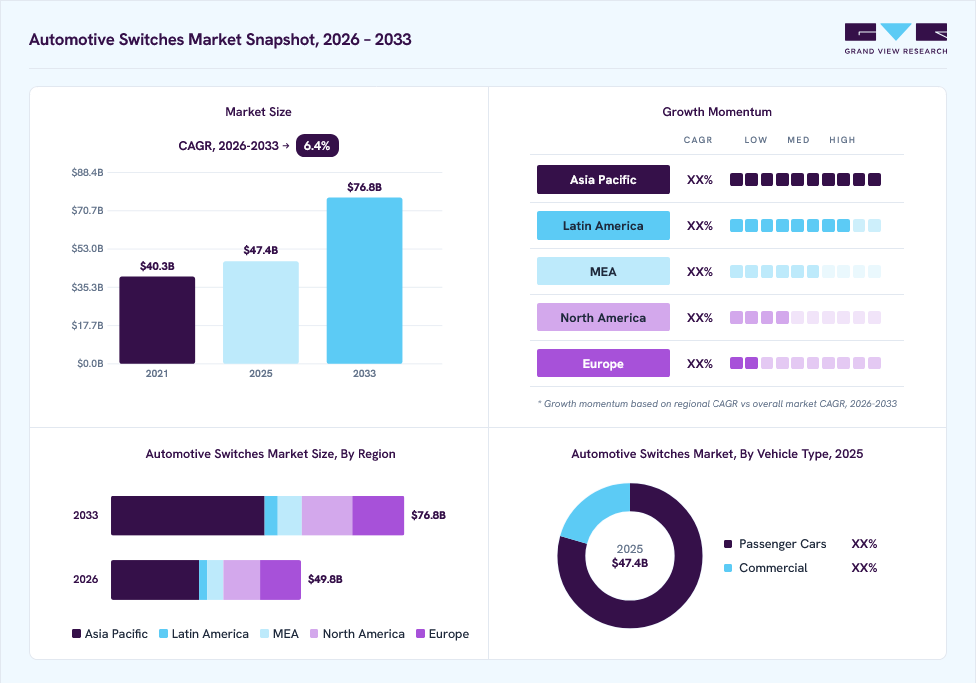
The global automotive switches market size was valued at USD 47.4 billion in 2025 and is projected to grow from USD 49.8 billion in 2026 to USD 76.8 billion by 2033, at a CAGR of 6.4% from 2026 to 2033. Asia Pacific dominated the market, accounting for the largest revenue share of 45.5% in 2025. Rising adoption of connected and electronically controlled vehicle functions is driving demand for the advanced automotive switches industry.
 Source: Grand View Research, IR Documents, Primary Interviews, Paid DatabasesTo learn more about this report,
 Download Free Sample Report
Key Market Trends & Insights
- By vehicle type: The passenger cars segment held the largest market share of 79.3% in 2025
- By sales channel: The OEM segment held the largest market share of 78.0% in 2025.
- By application: The infotainment &multimedia controls segment held the largest market share of 24.1% in 2025.
Regional Highlights
- Largest regional market: Asia Pacific (45.5% revenue share, 2025)
- Fastest-growing regional market: Asia Pacific (highest CAGR, 2026-2033)
- By country: The China dominated the Asia Pacific with the largest revenue share in 2025
Market Size & Forecast
- Market size in 2025: USD 47.4 Billion
- Estimated market size in 2026: USD 49.8 Billion
- Projected market size by 2033: USD 76.8 Billion
- CAGR (2026-2033): 6.4%
Prism AI by Grand View Research Free to tryAsk a question about the automotive switches marketTry asking✓Every figure cited from GVR research Prefer the report? Download free sample →
Increasing vehicle production is driving demand for automotive switches, as switches are required across multiple vehicle functions. As OEMs produce more vehicles, the volume of switches required for vehicle assembly also increases. The growth in global vehicle manufacturing supports this demand. For instance, in April 2026, according to the OICA, global motor vehicle production reached 96.4 million units in 2025, up 3.9% from 2024. Higher vehicle output is driving greater demand for automotive switches among OEMs and Tier-1 suppliers, contributing to market growth.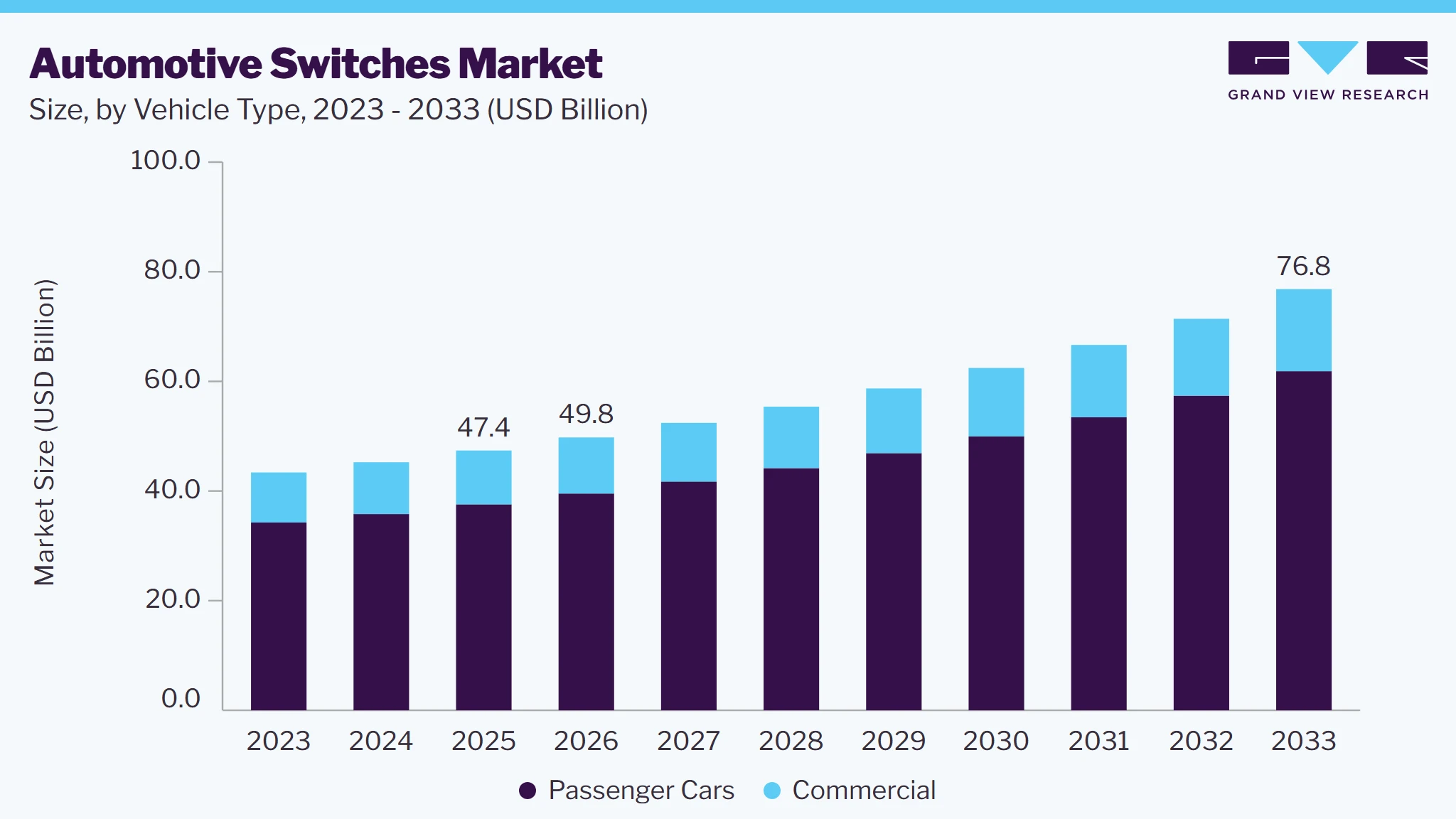 To learn more about this report, Download Free Sample Report
The growing adoption of multifunctional switches is a technology trend in the automotive switches industry. Modern vehicles are increasingly using a single switch or control interface to manage multiple functions, including infotainment, climate control, lighting, seat adjustment, and driving modes. Furthermore, advances in electronic, capacitive, and haptic technologies are enabling these switches to provide multiple controls within a compact interface. This helps automakers reduce the number of individual buttons and create cleaner, more integrated vehicle interiors. As automotive cockpit designs become more advanced, multifunctional switches are expected to gain wider adoption in passenger and premium vehicles.
Stringent lighting and signaling requirements are supporting demand for compliant automotive switches. The regulations governing the installation, positioning, visibility, and operation of vehicle lighting and signaling devices are increasing the need for compliant control systems. According to UN Regulation No. 48, to clarify requirements related to lighting and signaling equipment, including the visibility of rear direction indicators and stop lamps. These requirements influence the design and operation of controls used for vehicle lighting and signaling functions. Compliance with updated lighting and signaling requirements is encouraging the development of automotive switches that meet vehicle safety and functional requirements.
Increasing component and raw material costs pose a restraint in the automotive switches industry. Rising prices of plastics, metals, electronic components, and other inputs increase the manufacturing costs of automotive switches. Higher production costs can put pressure on manufacturers and narrow profit margins, thereby restraining market growth.
Market Dynamics
The automotive switches industry is being influenced by the increasing electronic content of vehicles, growing vehicle electrification, and rising demand for convenient and intuitive vehicle controls. Traditional mechanical switches are increasingly being complemented by electronic, capacitive, touch, and haptic interfaces. Vehicle manufacturers are also integrating switching functions with steering, infotainment, climate, seating, door, and other electronic systems. These developments are increasing demand for compact, reliable, multifunctional, and electronically integrated switching solutions.
The increasing adoption of electronic vehicle controls is driving demand for automotive switches across different vehicle functions. Modern vehicles are incorporating more electronic systems to improve convenience, safety, personalization, and operational efficiency. The expansion of electric and software-defined vehicles is further increasing the need for electronic interfaces capable of controlling multiple vehicle functions. This development is increasing the importance of reliable and responsive switching solutions within vehicle electronic architectures.
Automotive switches provide an interface through which drivers and passengers operate various electronic vehicle functions. Steering-wheel switches, door controls, climate controls, infotainment controls, gear-selection interfaces, and seat controls allow multiple vehicle systems to be operated through dedicated or multifunctional interfaces. The increasing number of electronically controlled functions is therefore raising the number and complexity of switching interfaces required in vehicles. This expansion in electronic functionality is expected to support demand for automotive switches across passenger and commercial vehicles.
The rising complexity of automotive switch systems poses a restraint on the market. The integration of electronic, capacitive, haptic, and multifunctional controls requires more advanced design, testing, and validation, as well as more advanced electronic components. Increasing vehicle functionality also requires switches to interact reliably with different electronic systems while meeting stringent performance and safety requirements. These requirements can increase the technical complexity involved in developing and manufacturing automotive switching solutions.
This complexity can increase development time and production costs for automotive switch manufacturers. It can also make advanced switching solutions more difficult to adopt in cost-sensitive vehicle segments, where manufacturers focus on keeping prices affordable. Smaller suppliers may face greater challenges in developing advanced electronic and multifunctional switching technologies due to higher technical and investment requirements. As a result, rising system complexity can slow the adoption of advanced switches and place additional pressure on suppliers to improve product design and manufacturing efficiency.
The growing adoption of haptic and multifunctional HMI switches is creating new opportunities in the automotive switches industry. Vehicle interiors are increasingly incorporating touch-sensitive, capacitive, haptic, and multifunctional controls to provide more intuitive interaction with vehicle functions. These technologies can combine several functions within compact interfaces while providing tactile or visual feedback to users. The transition toward more digital vehicle interiors is therefore creating demand for advanced switching solutions.
The opportunity is particularly strong in electric, premium, and software-defined vehicles, where interior technology and user interaction are becoming important areas of vehicle differentiation. Suppliers with capabilities in electronic controls, sensing, haptic feedback, and multifunctional interfaces are positioned to benefit from this shift. Increasing integration of multiple vehicle functions into fewer control interfaces can also increase the value of individual switching systems. This transition is expected to create opportunities for higher-value automotive switch products beyond conventional mechanical switches.
Market Concentration & Characteristics
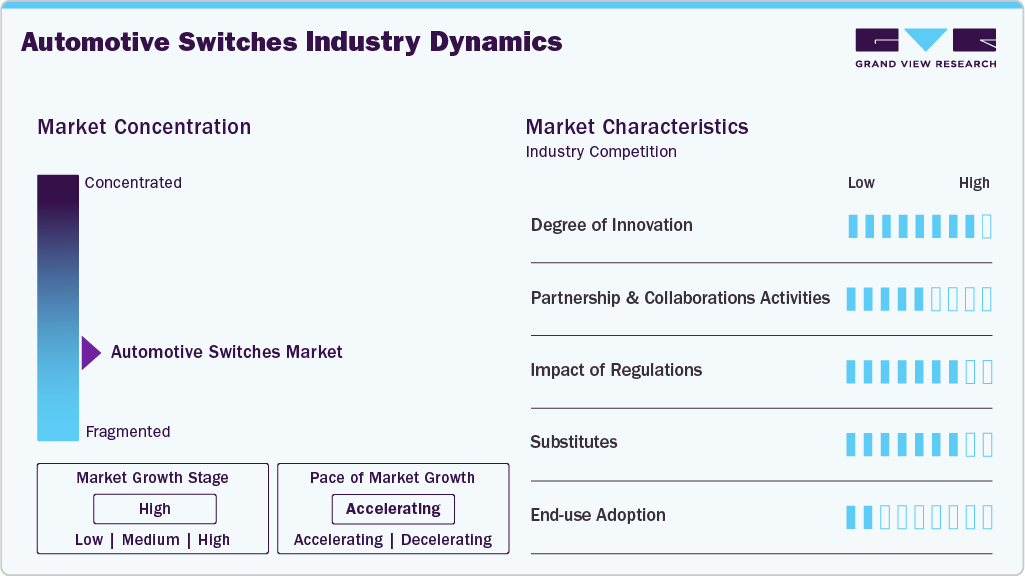
The automotive switches industry is moderately consolidated, as the market includes a group of established global suppliers with strong automotive relationships, broad product portfolios, and established manufacturing capabilities, while several specialized and regional suppliers also participate. The competitive structure is supported by high OEM qualification requirements, long product-development cycles, stringent quality expectations, and the need for reliable integration with vehicle electronic systems. This creates barriers to entry for new participants and allows established suppliers to maintain strong positions. At the same time, the market is not highly concentrated because automotive switches cover multiple applications and technologies, including steering-wheel controls, door switches, climate controls, infotainment controls, gear-selection interfaces, roof modules, and seat controls, creating room for specialized suppliers across individual applications.
 To learn more about this report, Download Free Sample Report
The market characteristics indicate high innovation, medium-high partnership activity, medium regulatory impact, medium-high substitution pressure, and medium-high end-user adoption, as reflected in the chart. Innovation is particularly important as the market shifts toward electronic, capacitive, haptic, illuminated, and multifunctional switching solutions, and as partnerships between automotive manufacturers and component suppliers enable customization and integration into vehicle platforms. Substitution pressure is increasing because touchscreens, voice controls, and other digital interfaces can replace some conventional switches; however, physical and tactile controls remain relevant for frequently used and safety-related functions. Moreover, the market combines established supplier strength with continued technology-driven competition, making moderate consolidation an appropriate characterization.
Analyst Perspective
The automotive switches market is transitioning from conventional mechanical controls toward electronically integrated, multifunctional, capacitive, and haptic interfaces. Growth is being supported by increasing vehicle electrification, higher electronic content, software-defined vehicle architectures, and growing demand for advanced human-machine interfaces. Technology development is increasingly focused on compact switching systems, haptic feedback, multifunctional controls, and integration with vehicle electronic architectures. Future investment is expected to focus on advanced HMIs, electronic switching systems, sensing technologies, and greater functional integration. Competition is also expected to shift toward suppliers capable of providing reliable, compact, and technologically advanced switching solutions.
Vehicle Type Insights
The passenger cars segment led the market with the largest revenue share of 79.3% in 2025 and is projected to grow at the fastest CAGR over the forecast period. The segment bifurcated into Hatchback/Sedan, and SUV, which require switches across multiple interior and vehicle functions. Increasing adoption of electronic features, comfort systems, infotainment, and advanced driver controls is driving demand for switches in passenger vehicles. The growing integration of multifunctional controls and electronically operated features is further increasing the requirement for automotive switches in passenger cars.
The commercial segment is projected to grow at a significant CAGR over the forecast period. The segment bifurcated into light commercial vehicles and heavy commercial vehicles (HCV) in the vehicle type segment. Commercial vehicles are increasingly equipped with electronic controls for lighting, climate control, infotainment, safety, and driver-assistance functions. Rising vehicle production and the increasing adoption of electronic systems are creating additional demand for automotive switches in commercial applications. The expansion of logistics, transportation, and commercial mobility is further supporting demand for switches across the segment.
Sales Channel Insights
The OEM segment led the market with the largest revenue share of 78.0% in 2025 and is projected to grow at the fastest CAGR over the forecast period. Automotive switches are installed during vehicle manufacturing and are supplied directly to vehicle manufacturers or Tier-1 suppliers. Increasing vehicle production and the growing integration of electronic and multifunctional features are driving up the demand for switches during vehicle assembly. The increasing electronic content of new vehicles is supporting demand through the OEM sales channel.
The aftermarket segment is projected to grow at a significant CAGR over the forecast period, supported by replacement demand from vehicles in operation. Automotive switches may require replacement due to prolonged usage, electrical failures, physical damage, or component wear. The expanding vehicle parc is increasing the number of vehicles requiring repairs and replacement components throughout their operating lives. Growing maintenance and repair activities are supporting demand for automotive switches through the aftermarket channel.
Application Insights
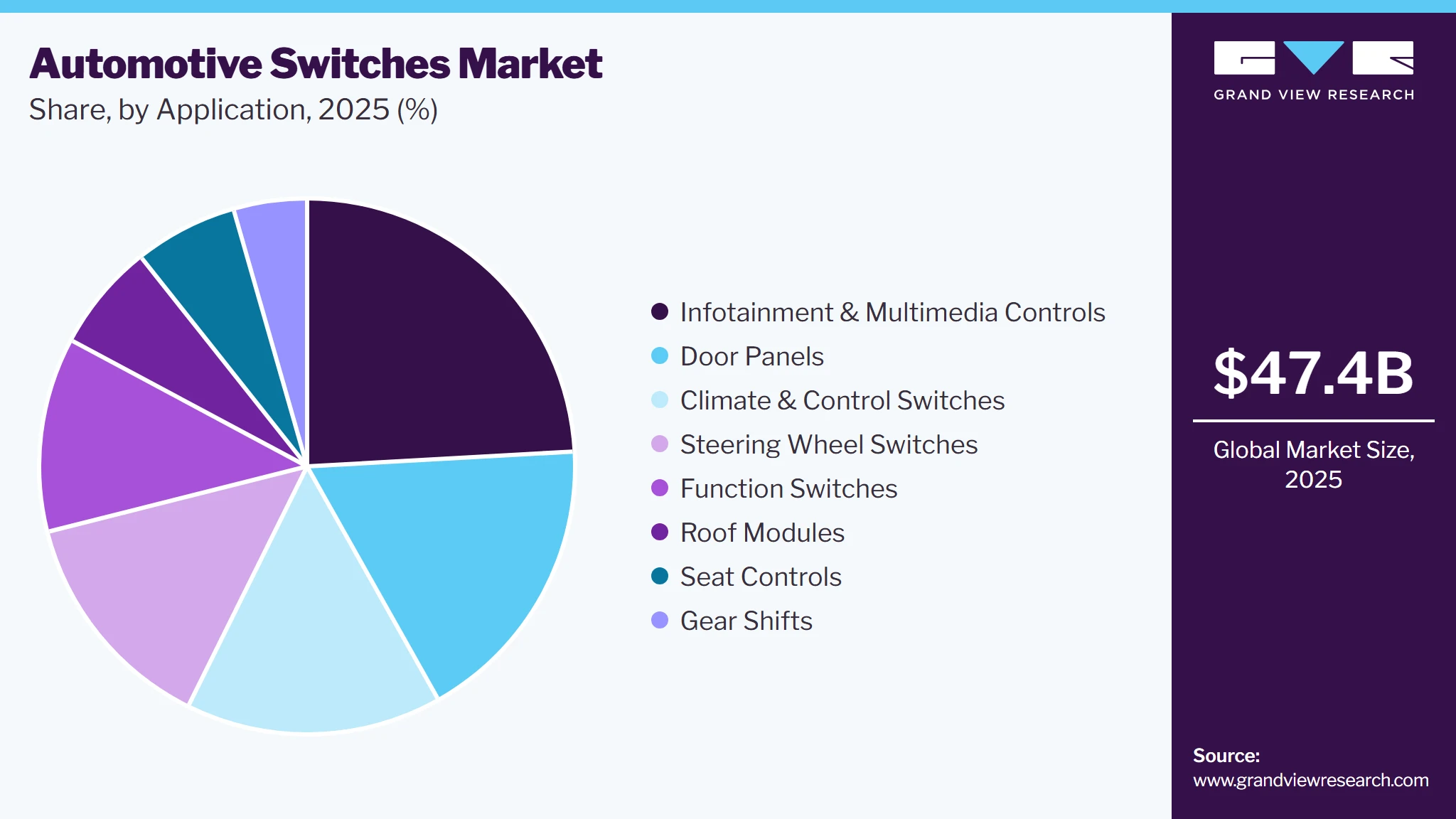
The infotainment & multimedia controls segment led the market with the largest revenue share of 24.1% in 2025, supported by the integration of electronic entertainment and connectivity functions in vehicles. Switches and control interfaces are used to operate audio, media, navigation, communication, and other infotainment functions. The growing adoption of connected and digitally enabled vehicle interiors is increasing the requirement for multifunctional control interfaces. Rising electronic content in passenger vehicles is further supporting demand for switches used in infotainment and multimedia systems.
 To learn more about this report, Download Free Sample Report
The steering wheel switches segment is projected to grow at the fastest CAGR over the forecast period. Steering wheel switches allow drivers to access multiple vehicle functions without taking their hands off the steering wheel. Increasing adoption of multifunctional steering controls for infotainment, communication, cruise control, and driver assistance functions is supporting segment growth. The development of advanced electronic and touch-sensitive controls is further increasing the functionality and value of steering wheel switch systems.
Regional Insights
The automotive switches market in North America experienced significant growth in the global market, supported by established vehicle manufacturing and increasing adoption of electronically controlled vehicle functions. The growing integration of infotainment, comfort, safety, and driver-assistance features is increasing the requirement for advanced automotive switches. The presence of major automotive OEMs and component suppliers further supports regional market development.
U.S. Automotive Switches Market Trends
The automotive switches market in the U.S. is supported by strong demand for passenger vehicles and increasing electronic content in modern vehicles. The adoption of advanced infotainment, comfort, safety, and driver-assistance systems is increasing the use of multifunctional switches and electronic controls. Continued vehicle production and technological development are expected to support demand for automotive switches in the country.
Asia Pacific Automotive Switches Market Trends
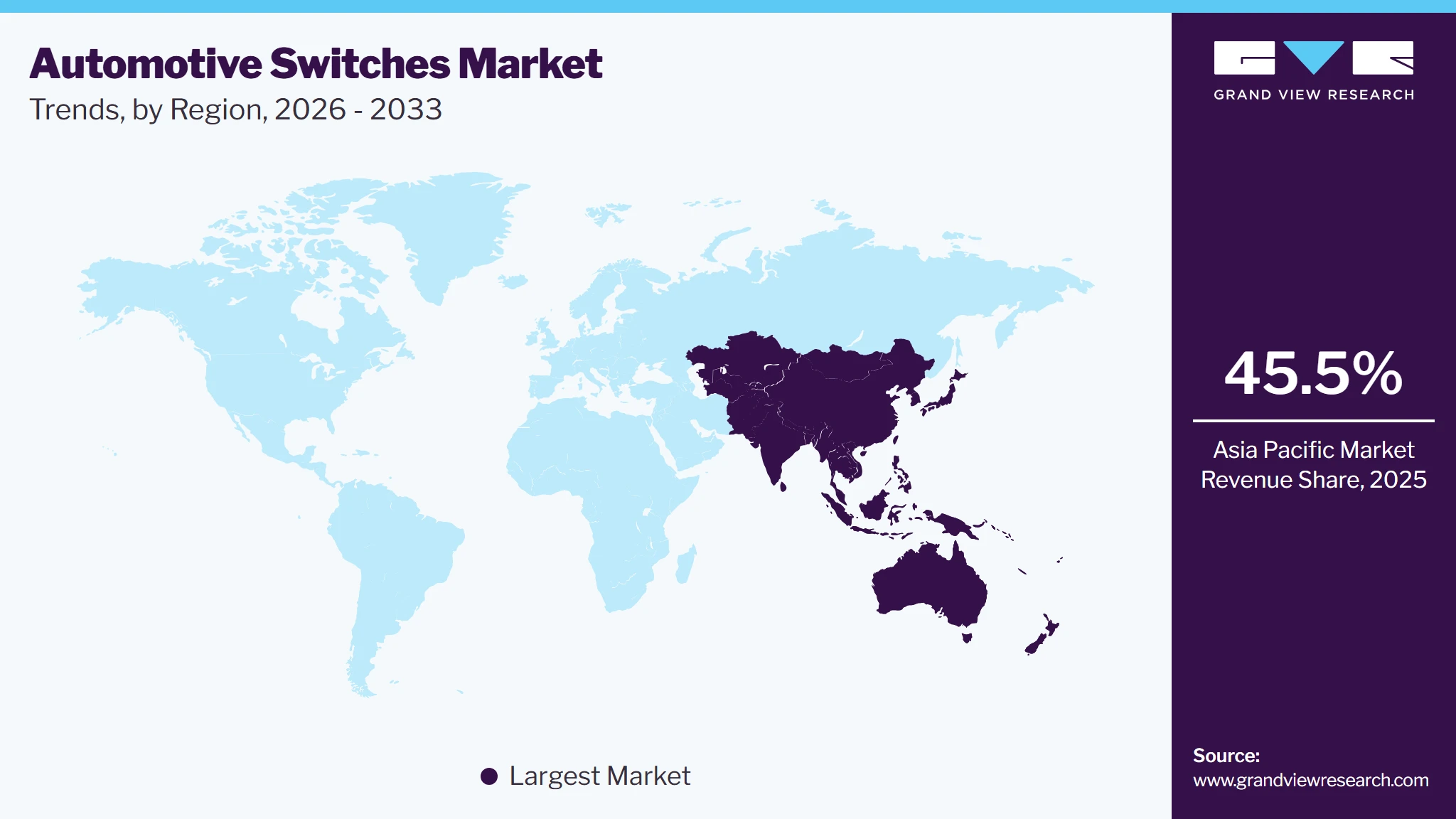
The Asia Pacific automotive switches market held the largest revenue share of 45.5% in 2025 and is expected to grow at the fastest CAGR from 2026 to 2033, driven by high vehicle production volumes and an expanding automotive electronics industry. Rapid electrification and increasing adoption of connected vehicle technologies are raising the electronic content of vehicles across the region. Growing passenger vehicle sales and investments in advanced vehicle technologies are creating further demand for automotive switches.
 To learn more about this report, Download Free Sample Report
The automotive switches market in China accounted for the largest market revenue share in the Asia Pacific in 2025. Rising adoption of electric and connected vehicles is increasing the integration of electronic controls across infotainment, comfort, lighting, and driver-assistance functions. The expansion of new energy vehicle production and advanced cockpit technologies is further increasing the demand for multifunctional, electronically integrated automotive switches.
The Japan automotive switches market is expected to grow at a significant CAGR over the forecast period. The increasing integration of electronic controls, multifunctional interfaces, and advanced cockpit technologies is expanding the use of automotive switches in new vehicle models. Ongoing development of electric, connected, and automated vehicles is further driving demand for advanced, electronically integrated switch solutions.
Europe Automotive Switches Market Trends
Theautomotive switches market in Europe is poised for significant growth from 2026 to 2033. Europe is characterized by a mature automotive industry and increasing adoption of electrified and electronically controlled vehicles. Vehicle manufacturers are incorporating more digital interfaces, multifunctional controls, and electronic systems into new vehicle models. Stringent vehicle safety and environmental requirements are also encouraging the development of advanced automotive control technologies.
The UK automotive switches market is experiencing growing demand as vehicle manufacturers expand the use of electronic and connected features. Electric vehicle adoption is encouraging greater integration of electronic control systems across vehicle interiors and powertrain-related functions. Growing demand for advanced infotainment, comfort, and safety features is creating additional opportunities for automotive switch suppliers.
The automotive switches market in Germany held a substantial share in the Europe in 2025. Germany remains a major automotive manufacturing hub, creating substantial demand for automotive switches across passenger and commercial vehicles. German automakers are increasingly incorporating sophisticated electronic controls, digital cockpit systems, and driver-assistance features into vehicles. Strong development of electric and software-defined vehicle technologies is further increasing the need for advanced switch and control solutions.
Key Automotive Switches Company Insights
Key players operating in the automotive switches industry include Continental AG, Valeo, ZF Friedrichshafen AG., DENSO CORPORATION, ALPS ALPINE CO., LTD., TOKAI RIKA CO., LTD., Leopold Kostal GmbH & Co. KG, Robert Bosch GmbH, Panasonic Automotive Systems Co., Ltd., and OMRON Corporation. Key players in the automotive switches industry are focusing on product development, technological advancements, strategic partnerships, and expansion of automotive electronic control portfolios to strengthen their market position. Companies are increasingly developing multifunctional, electronic, capacitive, and integrated switch solutions to address the growing electronic content of modern vehicles.
-
Valeo is a global automotive technology company. The company's divisions are segmented into POWER, BRAIN, and LIGHT. Valeo offers steering wheel switch solutions to control functions such as cruise control, ADAS, infotainment, audio, phone calls, and menu navigation without taking the driver's hands off the steering wheel. Its portfolio includes traditional buttons, hybrid switches, scroll wheels, joysticks, and capacitive touch switches with active haptics.
-
ZF Friedrichshafen AG is a global automotive technology company. The company offers automotive switches designed for vehicle control applications. Its portfolio includes compact subminiature and sub-subminiature switches. These switches are used in various automotive applications, including door locks, seat controls, pedals, steering systems, and other vehicle control functions.
Key Automotive Switches Companies
The following key companies have been profiled for this study on the automotive switches market.
-
Continental AG
-
Valeo
-
ZF Friedrichshafen AG
-
DENSO CORPORATION.
-
ALPS ALPINE CO., LTD.
-
TOKAI RIKA CO., LTD.
-
Leopold Kostal GmbH & Co. KG
-
Robert Bosch GmbH
-
Panasonic Automotive Systems Co., Ltd.
-
OMRON Corporation
Competitive Benchmarking
Operating Strategies
Competitive Edge
Weaknesses
Mature Players: Continental AG, ZF Friedrichshafen AG, DENSO CORPORATION, Robert Bosch GmbH, ALPS ALPINE CO., LTD.
Mature players in the automotive switches industry are focusing on broad automotive electronics portfolios, strong OEM relationships, global manufacturing capabilities, and continuous development of electronic HMI and vehicle-control technologies.
Mature players gain a competitive advantage through strong automotive expertise, broad product portfolios, established customer relationships, global production networks, and capabilities across switches, electronics, sensors, controls, and vehicle systems.
These companies often face challenges related to large-scale operations, which can increase organizational and development complexity. Continuous investment is also required to adapt existing switching technologies to rapidly changing electronic and software-based vehicle architectures.
Emerging Players: TOKAI RIKA CO., LTD., Leopold Kostal GmbH & Co. KG
Emerging players in the automotive switches industry are focusing on specialized automotive switching, HMI, control, steering-column, and electronic shift technologies. Their strategies emphasize application-specific product development and close integration with vehicle systems.
Emerging players gain market traction through strong specialization in automotive controls, switching technologies, HMI systems, and electronic control applications. Their focused product portfolios allow them to address specific vehicle-control requirements and develop customized solutions.
Emerging players face limitations due to their comparatively narrow product portfolios, which can constrain their ability to provide comprehensive vehicle-electronics solutions. Greater dependence on specific applications and vehicle programs can also increase exposure to changes in OEM sourcing decisions.
Recent Developments
-
In July 2025, Valeo launched new hardware, software, and AI technologies for safer and more sustainable mobility. At IAA MOBILITY, the company showcased next-generation steering-wheel technology, ADAS, electrification solutions, smart lighting, and software-defined vehicle technologies to support improved safety, comfort, personalization, and vehicle control.
-
In June 2025, Uno Minda. and Toyodenso Co., Ltd. formed a 60:40 joint venture to manufacture and market advanced automotive switches in India. The partnership would establish a new manufacturing facility in Noida, Uttar Pradesh, to serve the two-wheeler, passenger-vehicle, and other automotive segments, and to support the localization of advanced switching technologies.
Automotive Switches Market Report Scope
Report Attribute
Details
Market size in 2025
USD 47.4 billion
Estimated market size in 2026
USD 49.8 billion
Projected market size by 2033
USD 76.8 billion
Growth rate
CAGR of 6.4% from 2026 to 2033
Base year for estimation
2025
Historical data
2021 - 2024
Forecast period
2026 - 2033
Quantitative units
Revenue in USD billion and CAGR from 2026 to 2033
Report coverage
Revenue forecast, company ranking, competitive landscape, growth factors, and trends
Segments covered
Vehicle type, sales channel, application, region
Regional scope
North America; Europe; Asia Pacific; Latin America; MEA
Country scope
U.S.; Canada; Mexico; Germany; UK; France; China; Japan; India; South Korea; Australia; Brazil; KSA; UAE; South Africa
Key companies profiled
Continental AG; Valeo; ZF Friedrichshafen AG.; DENSO CORPORATION.; ALPS ALPINE CO., LTD.; TOKAI RIKA CO., LTD.; Leopold Kostal GmbH & Co. KG; Robert Bosch GmbH; Panasonic Automotive Systems Co., Ltd.; OMRON Corporation
Customization scope
Free report customization (equivalent up to 8 analysts working days) with purchase. Addition or alteration to country, regional & segment scope.
Pricing and purchase options
Avail customized purchase options to meet your exact research needs. Explore purchase options
Global Automotive Switches Market Report Segmentation
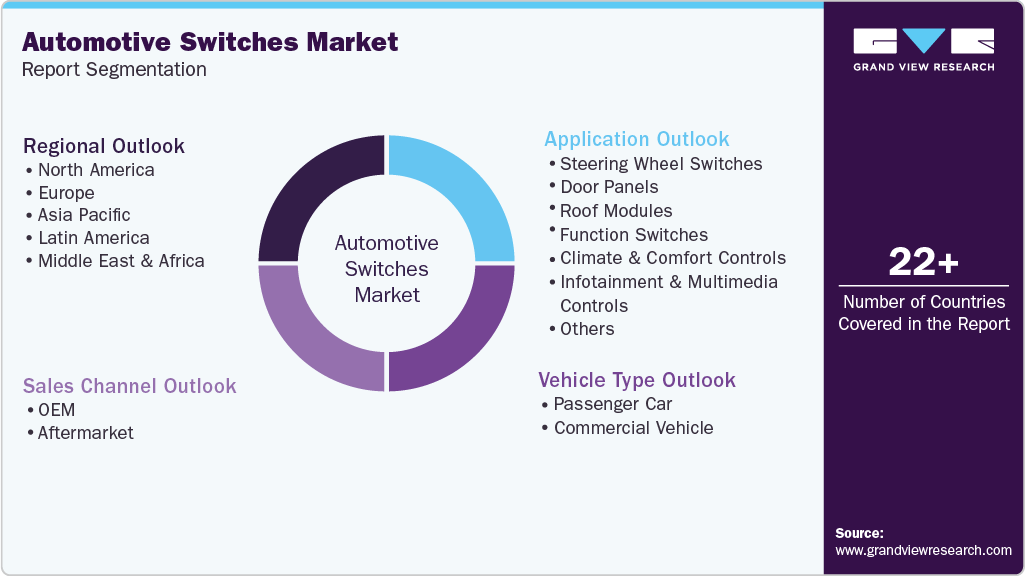
The report forecasts revenue growth at the global, regional, and country levels and provides an analysis of the latest industry trends across each sub-segment from 2021 to 2033. For this study, Grand View Research has segmented the global automotive switches market based on vehicle type, sales channel, application, and region:
 To learn more about this report, Download Free Sample Report
-
Vehicle Type Outlook (Revenue, USD Billion, 2021 - 2033)
-
Passenger Car
-
Hatchback/Sedan
-
SUV
-
-
Commercial Vehicle
-
Light Commercial Vehicle
-
Heavy Commercial Vehicle
-
-
-
Sales Channel Outlook (Revenue, USD Billion, 2021 - 2033)
-
OEM
-
Aftermarket
-
-
Application Outlook (Revenue, USD Billion, 2021 - 2033)
-
Steering Wheel Switches
-
Door Panels
-
Roof Modules
-
Function Switches
-
Climate & Comfort Controls
-
Infotainment & Multimedia Controls
-
Gear Shifts
-
Seat Controls
-
-
Regional Outlook (Revenue, USD Billion, 2021 - 2033)
-
North America
-
U.S.
-
Canada
-
Mexico
-
- Europe
-
Germany
-
UK
-
France
-
- Asia Pacific
-
China
-
India
-
Japan
-
South Korea
-
Australia
-
-
Latin America
-
Brazil
-
- Middle East & Africa (MEA)
-
UAE
-
Kingdom of Saudi Arabia (KSA)
-
South Africa
-
-
Research Methodology
The automotive switches market figures in this report are based on a proven research process that combines executive interviews with secondary research from proprietary databases, company filings, and recognized regulatory and institutional sources. Market size is built through value-chain sizing-reconciling supply-side and demand-side estimates-and triangulated with bottom-up and top-down approaches. Every estimate passes multiple levels of expert validation before publication, with each U.S. refractory segment quantified using the revenue-capture definitions in the table below.
Segment Definition
Segment - Vehicle Type
Revenue Capture Definition
Passenger Cars
The segment revenue is generated from automotive switches and switching assemblies supplied for passenger vehicles, including mechanical, electronic, capacitive, touch, and haptic switching solutions used across vehicle interiors. The segment includes passenger cars such as Hatchback/Sedan and SUV
- Hatchback/Sedan: The segment revenue is generated from switches supplied for hatchback and sedan vehicles, including steering-wheel switches, door controls, window controls, climate controls, infotainment controls, gear controls, roof controls, and seat controls.
- SUV: The segment revenue is generated from switches supplied for sport utility vehicles, including steering, door, window, roof, climate, infotainment, gear-selection, seat, and other vehicle-control applications.
Commercial
The segment revenue is generated from automotive switches and switching assemblies supplied for commercial vehicles, including controls used for vehicle operation, cabin functions, lighting, climate, doors, seats, windows, and other electronic vehicle functions. The segment includes commercial vehicles such as Light Commercial Vehicle and Heavy Commercial Vehicle
- Light Commercial Vehicle: The segment revenue is generated from switches supplied for light commercial vehicles, including steering, door, window, lighting, climate, infotainment, seat, and gear-control applications.
- Heavy Commercial Vehicle: The segment revenue is generated from switches supplied for heavy trucks, buses, coaches, and other heavy commercial vehicles, including steering, gear-selection, cabin, lighting, climate, door, seat, and operational control applications.
Segment - Sales Channel
Revenue capture definition
OEM
The segment revenue is generated from automotive switches supplied for installation in newly manufactured vehicles through vehicle manufacturers and their authorized procurement and production programs.
Aftermarket
The segment revenue is generated from replacement switches, switch assemblies, control interfaces, and related components sold after vehicle production through replacement-parts distribution, repair, service, retail, and other aftermarket channels.
Segment - Application
Revenue capture definition
Steering Wheel Switches
The segment revenue is generated from switches, buttons, rotary controls, and electronic interfaces integrated into steering wheels for operating vehicle functions such as audio, communication, cruise control, driver assistance, and other controls.
Door Panels
The segment revenue is generated from switches and control interfaces installed in vehicle doors for power windows, mirrors, door locking, child locks, lighting, and other door-related functions.
Roof Modules
The segment revenue is generated from switches and control interfaces installed in roof modules for sunroofs, sunshades, interior lighting, reading lights, and other roof-mounted functions.
Function Switches
The segment revenue is generated from dedicated switches and control interfaces used to activate, deactivate, or adjust specific vehicle functions, including lighting, access, safety, parking, and other vehicle operations.
Climate & Control Switches
The segment revenue is generated from switches, buttons, rotary controls, touch interfaces, and related control modules used for heating, ventilation, air conditioning, seat heating, seat ventilation, and other comfort functions.
Infotainment & Multimedia Controls
The segment revenue is generated from switches, rotary controllers, buttons, touch controls, and multifunctional interfaces used for audio, navigation, communication, media, display, and other infotainment functions.
Gear Shifts
The segment revenue is generated from switches, electronic shifters, selector interfaces, toggle controls, and shift-by-wire control elements used to select transmission positions and driving modes.
Seat Controls
The segment revenue is generated from switches and electronic control interfaces used for seat positioning, lumbar adjustment, memory functions, heating, ventilation, massage, and other powered-seat functions.
Estimation Model
Layer No.
Layer Name
Key Question
Description
01
Vehicle Production Base
How many vehicles require automotive switches?
This layer estimates the number of passenger cars and commercial vehicles produced in the target market. Vehicle production is divided by vehicle type and relevant categories. The assessment considers the overall vehicle base that can generate demand for automotive switches. This establishes the foundation for estimating potential market demand.
02
Switch Content per Vehicle
How many switches are installed in each vehicle?
This layer estimates the average number of automotive switches and switching interfaces per vehicle. The calculation considers steering-wheel switches, door controls, roof controls, climate controls, infotainment controls, gear controls, and seat controls. Vehicle electronic content and functionality are considered when determining the approximate switch content. This converts vehicle production into potential switch-unit demand.
03
Revenue per Switch / Module
What revenue can each switching solution generate?
This layer estimates the average revenue generated from automotive switches and switching modules. The value varies according to switch type, application, technology, functionality, integration level, and vehicle category. Advanced electronic, haptic, and multifunctional switches generally have higher value than conventional mechanical switching components. This layer converts estimated unit demand into potential market revenue.
04
Market Validation & Revenue Adjustment
Does the estimated value represent the addressable market?
This layer validates the estimated market value against vehicle applications, sales channels, product portfolios, and regional market conditions. Adjustments are made for OEM and aftermarket demand, technology penetration, vehicle-type differences, and regional adoption levels. Publicly available information on vehicle electronics and switching applications is used to validate the estimation assumptions. The final result represents the estimated automotive switches market revenue.
Delivered Customizations
This report has been delivered with the following In-depth customizations
Client Request
Customization Delivered
Value Adds
Regional Automotive Switches Market Opportunity Assessment
Country/region-wise market sizing and forecasts
Analysis of demand, adoption trends, and regulatory landscape
Identification of high-growth regions and investment hotspots
Identified region-specific growth opportunities
Supported expansion and go-to-market strategy
Enabled informed regional investment decisions
Cross-Segmentation Analysis for the Automotive Switches Market
Criss-cross market analysis by vehicle type, sales channel, and application
Demand and adoption assessment across key segments
Segment attractiveness and growth potential passenger benchmarking
Identified high-potential market segments
Supported targeted vehicle type positioning and marketing strategy
Improved customer and segment prioritization
Competitive Benchmarking and Strategic Positioning in the Automotive Switches Market
Benchmarking of key competitors across vehicle types, pricing, partnerships, and innovation
Comparative assessment of market share, capabilities, and strategies
Analysis of competitive strengths, gaps, and differentiation areas
Identified competitive white spaces and growth gaps
Supported strategic positioning and differentiation
Enabled data-driven competitive strategy development
Frequently Asked Questions About This Report
The global automotive switches market size was valued at USD 47.4 billion in 2025 and is expected to reach USD 49.8 billion in 2026.
The global automotive switches market is expected to grow at a compound annual growth rate of 6.4% from 2026 to 2033, reaching USD 76.8 billion by 2033.
Passenger cars vehicle type segment accounted for 79.3%, the largest share of global revenue in 2025, and is projected to grow at the fastest CAGR over the forecast period. The segment bifurcated into Hatchback/Sedan, and SUV, which require switches across multiple interior and vehicle functions. Increasing adoption of electronic features, comfort systems, infotainment, and advanced driver controls is supporting switch demand in passenger vehicles
The Asia Pacific automotive switches market led the global market and accounted for 45.5% of the global revenue in 2025 and is expected to register the highest growth from 2026 to 2033, due to its high vehicle production volumes and expanding automotive electronics industry
Rising adoption of connected and electronically controlled vehicle functions is driving demand for the advanced automotive switches market.
Some key players operating in the automotive switches market include Continental AG, Valeo, ZF Friedrichshafen AG., DENSO CORPORATION., ALPS ALPINE CO., LTD., TOKAI RIKA CO., LTD., Leopold Kostal GmbH & Co. KG, Robert Bosch GmbH, Panasonic Automotive Systems Co., Ltd., and OMRON Corporation
OEM segment accounted for 78.0%, the largest share of global revenue in 2025, and is projected to grow at the fastest CAGR over the forecast period.
Infotainment & multimedia controls segment accounted for the largest market revenue share in 2025, while steering wheel switches segment is projected to grow at the fastest CAGR over the forecast period
China held the largest market share in 2025.
About the Author(s)
Automotive & Transportation Research Team
Technology · Automotive & TransportationThis report was authored by the automotive & transportation research team at Grand View Research - comprising two research analysts, one senior research analyst, and one industry expert - with specialized expertise in the automotive & transportation segment of the technology industry. All findings are based on proprietary technology databases, executive interviews, and regulatory analysis, subject to internal peer review prior to publication.
Last Updated:
Speak to Analyst

Customize this report to your needs - add regions, segments, or data points, with 20% free customization.
Or view our licence options:


ISO 9001:2015 & 27001:2022 Certified
We are GDPR and CCPA compliant! Your transaction & personal information is safe and secure. For more details, please read our privacy policy.


