
- Home
- »
- Automotive & Transportation
- »
-
Automotive Tow Bar Market Size, Share Report, 2026-2035GVR Report cover

Automotive Tow Bar Market (2026 - 2035)
Size, Share & Trends Analysis Report By Product (Fixed Tow Bars, Detachable Tow Bars, Retractable Tow Bars, Swan Neck Tow Bars), By Vehicle Type, By Sales Channel, By Region, And Segment Forecasts
Market Size, 2025
$5.0BMarket Estimate, 2026
$5.3BMarket Forecast, 2035
$8.5BCAGR, 2026–2035
5.5%Automotive Tow Bar Market Summary
The global automotive tow bar market size was valued at USD 5.0 billion in 2025 and is projected to grow from USD 5.3 billion in 2026 to USD 8.5 billion in 2035, at a CAGR of 5.5% from 2026 to 2035. Europe dominated the market, accounting for the largest revenue share in 2025. The industry is supported by rising demand for recreational vehicles, commercial transportation solutions, and advanced towing systems. Increasing adoption of SUVs, light commercial vehicles, and vehicle-specific towing technologies is expected to drive market expansion during the forecast period.
Key Market Trends & Insights
- By product: The fixed tow bars segment held the largest market share in 2025.
- By vehicle type: The Sport Utility Vehicles (SUVs) segment accounted for the largest market share in 2025.
- By sales channel: The Original Equipment Manufacturers (OEMs) segment held the largest market share in 2025.
Regional Highlights
- Largest regional market: Europe (highest revenue share in 2025)
- Fastest-growing regional market: Asia Pacific (highest CAGR, 2026-2035)
Market Size & Forecast
- Market size in 2025: USD 5.0 Billion
- Estimated market size in 2026: USD 5.3 Billion
- Projected market size by 2035: USD 8.5 Billion
- CAGR (2026-2035): 5.5%
Prism AI by Grand View Research Free to tryAsk a question about the automotive tow bar marketTry asking✓Every figure cited from GVR research Prefer the report? Download free sample →The growing popularity of recreational vehicles, camping, cycling, and outdoor leisure activities continues to drive demand for automotive tow bars worldwide. Rising ownership of SUVs and crossover vehicles has encouraged consumers to install tow bars for towing caravans, trailers, boats, and bicycle carriers. In addition, expanding sales of light commercial vehicles are supporting demand for heavy-duty towing systems used in logistics, agriculture, and construction. Automotive manufacturers are also offering factory-installed towing packages to enhance vehicle versatility and customer convenience.
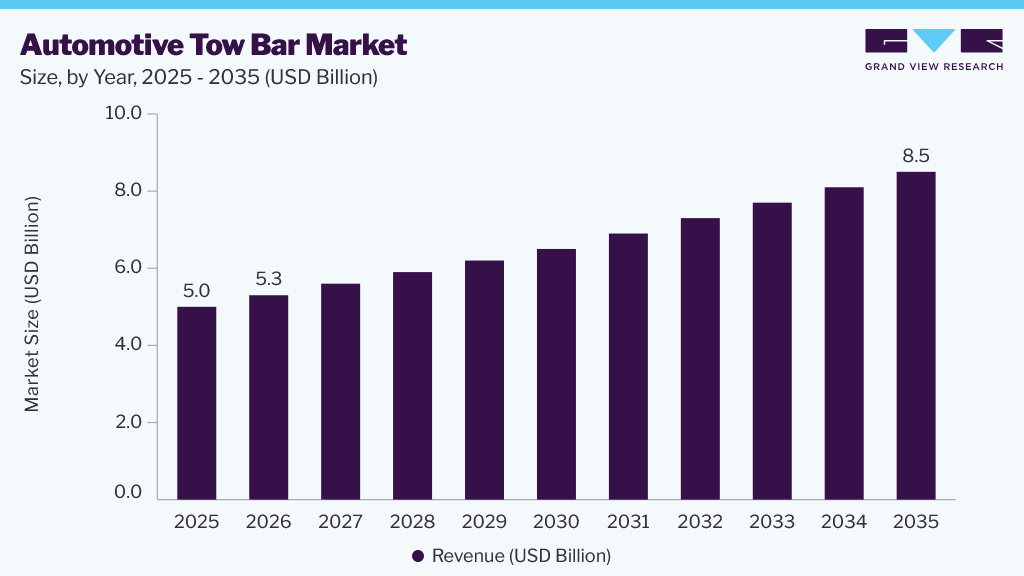 Source: Grand View Research, IR Documents, Primary Interviews, Paid DatabasesTo learn more about this report,
 Download Free Sample Report
Despite favorable demand, the market faces challenges from the increasing adoption of battery electric vehicles. Towing heavy loads can significantly reduce driving range, while packaging constraints and vehicle weight optimization complicate tow bar integration into electric vehicle platforms. Furthermore, increasingly stringent vehicle safety regulations and homologation requirements compel manufacturers to continuously invest in engineering, testing, and certification, increasing development costs.
The market presents significant opportunities through innovation in retractable and smart towing systems. In 2026, Westfalia-Automotive expanded its 2025 product catalog by introducing new vehicle-specific tow bar and wiring kit applications covering a broader range of passenger cars and light commercial vehicles, reinforcing its strategy of supporting the latest vehicle generations.
Analyst Perspective
The industry is driven by rising demand for recreational vehicles, caravans, trailers, and bicycle carriers. Growing consumer interest in outdoor leisure activities, camping, and adventure tourism has encouraged vehicle owners to equip passenger cars and SUVs with advanced towing systems. Increasing sales of light commercial vehicles are supporting demand for heavy-duty tow bars used in logistics, construction, and utility applications. Manufacturers are focusing on lightweight materials, electrically deployable tow bars, and vehicle-specific towing systems that integrate seamlessly with advanced driver assistance systems (ADAS). Although the growing adoption of battery electric vehicles presents design challenges related to towing capacity and driving range, continued innovation in lightweight engineering, smart towing technologies, and OEM-integrated towing solutions is expected to support sustained growth.
Product Insights
The fixed tow bars segment accounted for the largest share of the market in 2025 and is expected to maintain its dominant position throughout the forecast period. Fixed tow bars continue to be the preferred choice for both individual vehicle owners and commercial fleet operators because of their robust construction, high towing capacity, cost-effectiveness, and long service life. They are extensively installed on passenger cars, SUVs, light commercial vehicles, and pickup trucks used for towing trailers, caravans, utility equipment, and recreational vehicles. Their simple installation process and minimal maintenance requirements make them particularly attractive for customers who tow regularly.
The increasing popularity of outdoor recreational activities, caravan tourism, and utility trailers has further strengthened demand for fixed tow bars. Moreover, industries such as construction, agriculture, logistics, and landscaping continue to rely on vehicles equipped with fixed tow bars for transporting heavy equipment and cargo. To meet evolving customer and OEM requirements, manufacturers are introducing corrosion-resistant materials, lightweight steel alloys, advanced surface coatings, and vehicle-specific designs that improve durability, reduce vehicle weight, and support compatibility with conventional and electric vehicle platforms.
In July 2026, ACPS Automotive Group expanded its ORIS Aftermarket portfolio by introducing vehicle-specific tow bar solutions for the Renault 5 E-Tech and Alpine A290 electric vehicles. The launch includes a fixed tow bar, the vertically detachable ORIS AK41 FIX4BIKE, and ORIS DUO kits with vehicle-specific wiring harnesses, enabling workshops and aftermarket partners to offer tailored towing and bicycle transport solutions for the growing compact EV segment. In the same month, the company also introduced new ORIS tow bar solutions for the Ford Explorer and Ford Puma Gen-E, further strengthening its portfolio of vehicle-specific towing systems for next-generation electric vehicles.
The retractable tow bars segment is expected to record a significant CAGR over the forecast period. Retractable tow bars offer enhanced vehicle aesthetics, greater convenience, and improved safety by remaining concealed beneath the rear bumper when not in use. Premium passenger cars and SUVs are increasingly being equipped with electrically and manually retractable towing systems that eliminate the need for manual removal while preserving the vehicle's exterior design. Rising demand for luxury vehicles, increasing consumer preference for integrated OEM towing solutions, and continuous advancements in automatic deployment mechanisms and smart towing technologies are expected to accelerate adoption of retractable tow bars over the coming years. Furthermore, growing integration with advanced driver assistance systems (ADAS) and vehicle-specific electronic architectures is supporting the expansion of this segment across modern vehicle platforms.
Vehicle Type Insights
The Sport Utility Vehicles (SUVs) segment held the largest share in 2025. SUVs have become one of the most popular vehicle categories globally owing to their versatility, higher towing capacities, spacious interiors, and suitability for both urban commuting and outdoor recreational activities. Many SUV owners regularly tow caravans, camping trailers, boats, horse trailers, and bicycle carriers, creating strong demand for both factory-installed and aftermarket tow bar systems. Automotive manufacturers increasingly offer integrated towing packages as standard or optional equipment on midsize and full-size SUVs to enhance vehicle functionality and customer convenience. Furthermore, improvements in chassis strength, powertrain performance, trailer stability assist systems, and advanced driver assistance systems (ADAS) have significantly enhanced the towing capabilities of modern SUVs. Growing participation in adventure tourism, camping, and long-distance travel is expected to sustain demand for premium towing solutions throughout the forecast period.
The light commercial vehicles (LCVs) segment is expected to register the fastest CAGR during the forecast period. Rapid expansion of e-commerce, urban logistics, last-mile delivery services, and small business transportation is driving strong demand for LCVs equipped with reliable towing systems. Fleet operators increasingly utilize tow bars to transport utility trailers, construction equipment, generators, agricultural machinery, and mobile service units, supporting operational flexibility across multiple industries. In addition, growing investments in commercial transportation infrastructure, expanding fleet modernization initiatives, and increasing adoption of electric light commercial vehicles are expected to strengthen demand for advanced, vehicle-specific towing systems. Manufacturers are also introducing lightweight, corrosion-resistant tow bars with integrated electrical connectivity to improve durability, safety, and compatibility with modern commercial vehicle platforms.
Sales Channel Insights
The Original Equipment Manufacturers (OEMs) segment accounted for the largest share in 2025. Vehicle manufacturers increasingly integrate tow bars into factory-installed towing packages to ensure compatibility with electronic stability systems, trailer sway control, parking sensors, and advanced driver assistance systems (ADAS). OEM-installed tow bars are rigorously tested to meet vehicle-specific safety standards and towing capacity requirements, making them the preferred option for new vehicle buyers.
Automotive manufacturers continue collaborating with specialized tow bar suppliers to develop lightweight, corrosion-resistant, and aesthetically integrated towing systems that complement modern vehicle designs. The growing popularity of SUVs, pickup trucks, and commercial vehicles equipped with factory towing packages continues to support OEM demand.
The aftermarket segment is projected to register the fastest growth rate over the forecast period. Increasing vehicle ownership, rising average vehicle age, and growing consumer interest in vehicle customization are encouraging customers to install aftermarket tow bars. Recreational vehicle owners, caravan enthusiasts, and commercial fleet operators increasingly purchase aftermarket towing systems that provide higher towing capacities and compatibility with a broader range of trailers. The expanding automotive accessories industry and the growth of online retail channels are expected to further accelerate aftermarket sales globally.
Regional Insights
The Europe automotive tow bar market accounted for the largest global share in 2025 and is expected to maintain its leadership throughout the forecast period. The region has a well-established caravan and trailer culture, with countries such as Germany, the United Kingdom, France, the Netherlands, Sweden, and Norway representing major markets for towing equipment. High ownership of caravans, recreational trailers, horse trailers, and utility trailers continues to support strong demand for both OEM and aftermarket tow bars. In addition, Europe's strong automotive manufacturing base and widespread availability of factory-installed towing packages have further strengthened market growth.
European automotive manufacturers increasingly offer factory-approved towing systems integrated with advanced safety technologies, including trailer stability assist, trailer sway control, and advanced driver assistance systems (ADAS). Strict vehicle safety regulations, homologation requirements, and high consumer awareness regarding certified towing equipment continue to support demand for OEM-compliant towing solutions across the region.
Supporting regional innovation, ACPS Automotive, through its ORIS brand, continues to expand its portfolio of vehicle-specific towing solutions for European vehicle manufacturers. In 2026, the company introduced new tow bar applications for the Ford Explorer, Ford Puma Gen-E, Audi A6 e-tron, CUPRA Terramar, and Škoda Superb/VW Passat, while also expanding its range of fully electric retractable ORIS_E3 tow bars for the Mercedes-Benz C-Class and BMW iX3. These product launches highlight the region's continued focus on OEM-compatible, vehicle-specific, and electric vehicle-ready towing technologies.
Asia Pacific Automotive Tow Bar Market Trends
The automotive tow bar market in Asia Pacific is expected to register the fastest CAGR during the forecast period. Rising SUV ownership, increasing sales of light commercial vehicles, expanding construction and logistics industries, and growing interest in outdoor recreation are driving demand for automotive tow bars across China, India, Japan, Australia, and Southeast Asia. Government investments in transportation infrastructure, coupled with rising disposable incomes, urbanization, and increasing adoption of recreational vehicles, are creating favorable growth opportunities for towing equipment manufacturers.
The expansion of automotive manufacturing capabilities across the region, along with the development of aftermarket distribution networks and increasing availability of vehicle-specific towing solutions, is expected to further support market growth. In addition, the growing adoption of electric vehicles and the need for compatible towing systems are encouraging manufacturers to develop lightweight, electronically integrated, and EV-ready tow bar solutions. As vehicle ownership, commercial transportation activities, and recreational mobility trends continue to expand, Asia Pacific is projected to remain the fastest-growing regional market for automotive tow bars during the forecast period.
Key Automotive Tow Bar Companies Insights
The global automotive tow bar market is characterized by the presence of established OEM suppliers and aftermarket manufacturers that compete through product innovation, vehicle-specific designs, lightweight materials, and advanced towing technologies. Companies are increasingly focusing on detachable, retractable, and electrically deployable tow bars to address the growing demand for convenience, aesthetics, and compatibility with modern passenger vehicles, SUVs, and electric vehicles. Strategic partnerships with automotive OEMs, expansion of aftermarket product portfolios, and investments in advanced manufacturing technologies continue to strengthen their competitive positions.
Key Automotive Tow Bar Companies
The following key companies have been profiled for this study on the automotive tow bar market:
-
Brink Group
-
Westfalia-Automotive GmbH
-
Bosal International N.V.
-
CURT Manufacturing LLC
-
ACPS Automotive GmbH (ORIS)
-
Tow-Trust Towbars Ltd.
-
PCT Automotive Ltd.
-
Hayman Reese
-
GDW Group
-
AL-KO Vehicle Technology Group
Recent Developments
-
In January 2026, Westfalia-Automotive expanded its product portfolio by introducing a new tow bar application for the Ford Transit Custom, Ford Tourneo Custom, and Volkswagen T7 Transporter. The launch strengthens the company's aftermarket and OEM offerings by providing vehicle-specific towing solutions for the latest vehicle platforms.
-
In April 2026, Westfalia-Automotive introduced a vehicle-specific detachable tow bar along with a dedicated 13-pin electrical kit for the Nissan Qashqai (2021 onwards). The launch expands the company's portfolio of OEM-compatible towing solutions for newer passenger vehicle platforms and supports the growing demand for integrated towing systems.
Automotive Tow Bar Market Report Scope
Report Attribute
Details
Market size in 2025
USD 5.0 billion
Estimated market size in 2026
USD 5.3 billion
Projected market size by 2035
USD 8.5 billion
Growth rate
CAGR of 5.5% from 2026 to 2035
Base year for estimation
2025
Actual data
2021 – 2024
Forecast period
2026 – 2035
Quantitative units
Revenue in USD billion, and CAGR from 2026 to 2035
Report coverage
Revenue forecast, company ranking, competitive landscape, growth factors, and trends
Segments covered
Product, vehicle type, sales channel, region
Regional scope
North America; Europe; Asia Pacific; Central & South America; Middle East & Africa
Country scope
U.S.; Canada; Mexico; UK; Germany; France; China; Japan; India; Australia; South Korea; Brazil; Argentina; South Africa; Saudi Arabia; UAE.
Key companies profiled
Brink Group; Westfalia-Automotive GmbH; Bosal International N.V.; CURT Manufacturing LLC; ACPS Automotive GmbH (ORIS); Tow-Trust Towbars Ltd.; PCT Automotive Ltd.; Hayman Reese; GDW Group; AL-KO Vehicle Technology Group
Customization scope
Free report customization (equivalent to 8 analyst working days) with purchase. Addition or alteration to country, regional & segment scope.
Pricing and purchase options
Avail of customized purchase options to meet your exact research needs. Explore purchase options
Automotive Tow Bar Market Report Segmentation
This report forecasts revenue growth at the global, regional, and country levels and provides an analysis of the latest industry trends and opportunities across each sub-segment from 2021 to 2035. For this study, Grand View Research has segmented the global automotive tow bar market report based on product, vehicle type, sales channel, and region:
-
Product Outlook (Revenue, USD Billion, 2021–2035)
-
Fixed Tow Bars
-
Detachable Tow Bars
-
Retractable Tow Bars
-
Swan Neck Tow Bars
-
Flange Tow Bars
-
-
Vehicle Type Outlook (Revenue, USD Billion, 2021–2035)
-
Passenger Cars
-
Sport Utility Vehicles (SUVs)
-
Light Commercial Vehicles (LCVs)
-
Heavy Commercial Vehicles (HCVs)
-
-
Sales Channel Outlook (Revenue, USD Billion, 2021–2035)
-
Original Equipment Manufacturers (OEMs)
-
Aftermarket
-
-
Regional Outlook (Revenue, USD Billion, 2021 - 2035)
-
North America
-
U.S.
-
Canada
-
Mexico
-
-
Europe
-
UK
-
Germany
-
France
-
-
Asia Pacific
-
China
-
Japan
-
India
-
Australia
-
South Korea
-
-
Central & South America
-
Brazil
-
Argentina
-
-
Middle East and Africa (MEA)
-
South Africa
-
Saudi Arabia
-
UAE
-
-
Frequently Asked Questions About This Report
The global automotive tow bar market size was valued at USD 5.0 billion in 2025 and is estimated at USD 5.3 billion for 2026.
The global automotive tow bar market is expected to grow at a CAGR of 5.5% from 2026 to 2035, reaching USD 8.5 billion.
The fixed tow bars segment accounted for the largest revenue share in 2025.
Europe dominated with the largest revenue share in 2025.
Key players in the market include Brink Group, Westfalia-Automotive GmbH, Bosal International N.V., CURT Manufacturing LLC, ACPS Automotive GmbH (ORIS), Tow-Trust Towbars Ltd., PCT Automotive Ltd., Hayman Reese, GDW Group, and AL-KO Vehicle Technology Group.
About the Author(s)
Automotive & Transportation Research Team
Technology · Automotive & TransportationThis report was authored by the automotive & transportation research team at Grand View Research - comprising two research analysts, one senior research analyst, and one industry expert - with specialized expertise in the automotive & transportation segment of the technology industry. All findings are based on proprietary technology databases, executive interviews, and regulatory analysis, subject to internal peer review prior to publication.
Last Updated:
Speak to Analyst

Customize this report to your needs - add regions, segments, or data points, with 20% free customization.
Or view our licence options:


ISO 9001:2015 & 27001:2022 Certified
We are GDPR and CCPA compliant! Your transaction & personal information is safe and secure. For more details, please read our privacy policy.


