
- Home
- »
- Paints, Coatings & Printing Inks
- »
-
Automotive Wrap Films Market Size & Share Report, 2033GVR Report cover

Automotive Wrap Films Market (2026 - 2033)
Size, Share & Trends Analysis Report By Application (Trucks, Buses, Passenger Cars), By Region (North America, Europe, Asia Pacific, Latin America, MEA), Key Companies And Competitive Analysis And Segment Forecasts
Market Size, 2025
$4.1BMarket Estimate, 2026
$4.8BMarket Forecast, 2033
$15.3BCAGR, 2026–2033
17.9%Automotive Wrap Films Market Summary
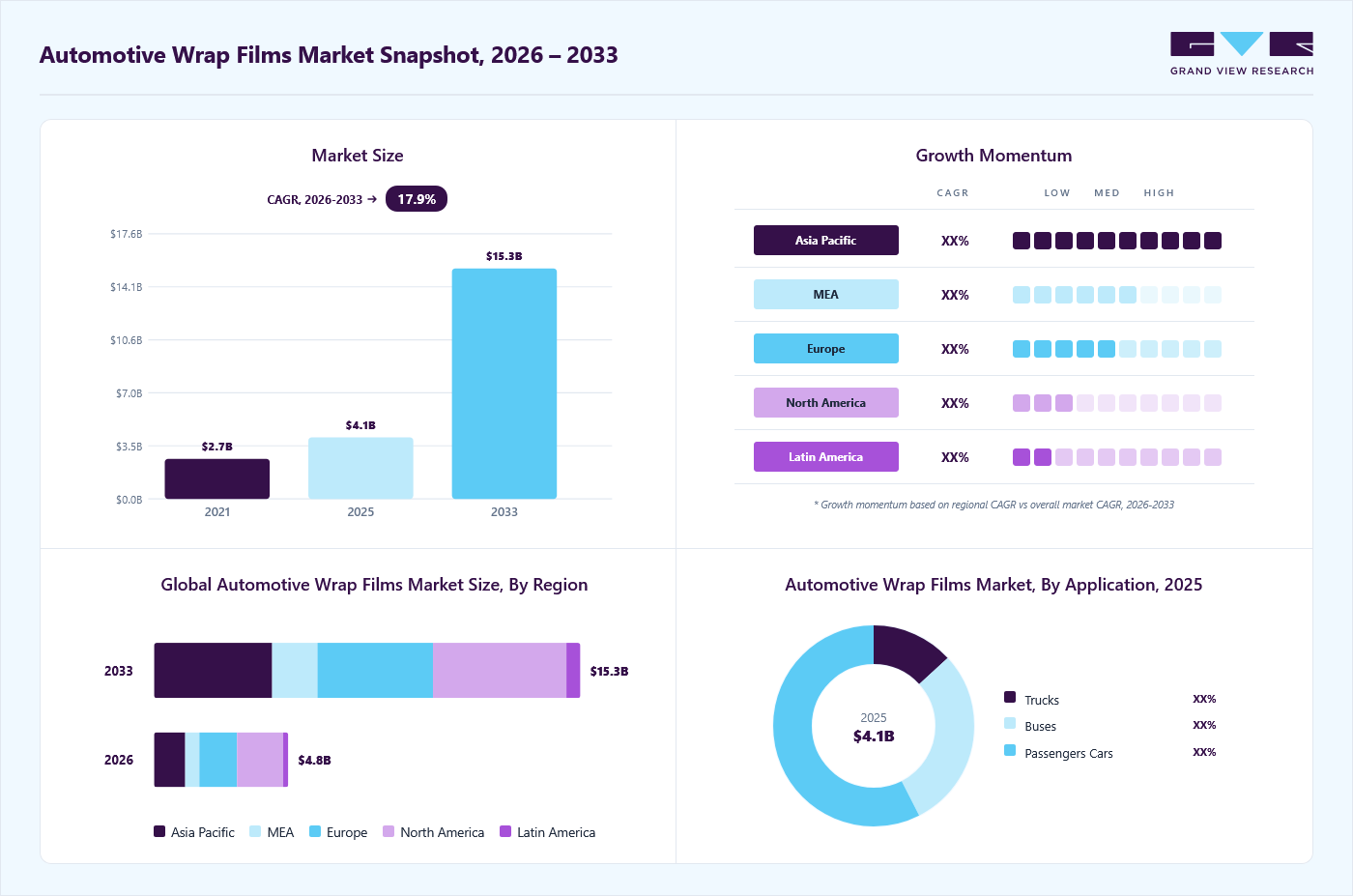
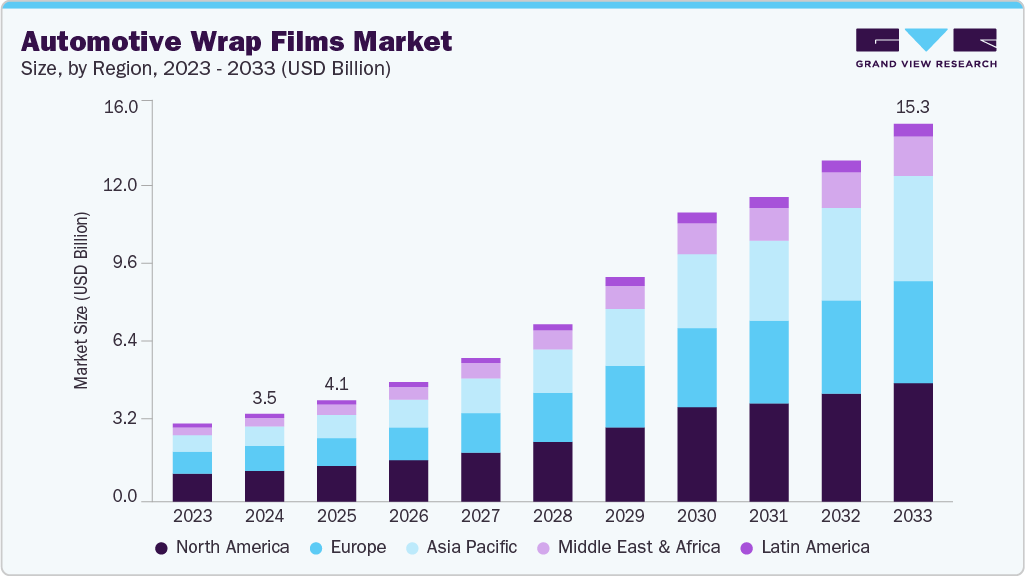
The global automotive wrap films market size was valued at USD 4.1 billion in 2025 and is projected to grow from USD 4.8 billion in 2026 to USD 15.3 billion by 2033, growing at a CAGR of 17.9% from 2026 to 2033. The North America automotive wrap films market held the largest share of 34.8% of the global market in 2025. The market growth is driven by the rising demand for vehicle customization and aesthetic personalization, along with increasing awareness of paint protection and durability.
 Source: Grand View Research, IR Documents, Primary Interviews, Paid DatabasesTo learn more about this report,
 Download Free Sample Report
Key Market Trends & Insights
- By: Passenger cars segment led the market with the largest revenue share of 57.5% in 2025.
- By: Passenger cars segment expected to grow at the fastest CAGR of 19.7% during the forecast period.
Regional Highlights
- Largest regional market: North America (34.8% revenue share, 2025)
- Fastest-growing regional market: Asia Pacific (highest CAGR, 2026-2033)
- By country: The U.S. held the largest market share in 2025.
Market Size & Forecast
- Market size in 2025: USD 4.1 Billion
- Estimated market size in 2026: USD 4.8 Billion
- Projected market size by 2033: USD 15.3 Billion
- CAGR (2026-2033): 17.9%
Three ways to get this report
Buy it, customize it, or ask a question.Ask an Analyst
Analyst response in 1 business day
- AccessReport author, directly
- Reply timeWithin 1 working day
- No sales callDirect answer only
- FormatEmail reply
- CostFree, no cost
Get the Full Report
What the study covers
- FormatsPDF · Excel · Dashboard
- Timeline2026–2033 annual, 2025 base
- Coverage20+ countries, 5 regions
- Companies10+ key players profiled
Customize the Report
20% free customization
- IncludeCountries, segments, points
- TailorTo your product definition
- ExtendDeeper competitor detail
- OrA fully bespoke study
- Turnaround5–10 working days
Additionally, growing automotive sales and trends in fleet branding and advertising boost market adoption. Consumers increasingly prefer unique vehicle aesthetics over standard paint finishes, seeking custom colors, textures, and designs. Automotive wraps provide a cost-effective and reversible alternative to traditional painting, enabling individuals and businesses to refresh or transform a vehicle’s appearance without permanent modifications. This trend is particularly strong among luxury vehicle owners, car enthusiasts, and commercial fleets looking for brand visibility through customized vehicle graphics.Another significant factor is the cost-effectiveness and protection offered by wrap films. Automotive wraps not only enhance appearance but also act as a protective layer against minor scratches, UV radiation, and environmental damage. This protection helps maintain the resale value of vehicles, which encourages more consumers and fleet operators to adopt wrap films. Compared to a full paint job, wraps are less expensive and require less downtime, making them an attractive solution for budget-conscious customers and businesses seeking fleet branding.
 To learn more about this report, Download Free Sample Report
The growing automotive aftermarket industry, especially in regions like North America and Europe, is also fueling the growth of the automotive wrap films industry. As car ownership increases and consumers invest more in vehicle aesthetics and maintenance, demand for aftermarket customization products such as wrap films continues to rise. Commercial applications, including branding for taxis, delivery vehicles, and company fleets, also contribute significantly to market expansion. Additionally, the proliferation of specialized wrap service providers and online platforms has made these products more accessible, further boosting adoption.
Moreover, technological advancements in wrap film materials and finishes are driving market adoption. Innovations such as air-release adhesives, high-durability polymers, textured finishes (like carbon fiber, matte, and metallic), and eco-friendly films enhance ease of installation, longevity, and visual appeal. These technological improvements reduce installation errors and maintenance issues, making wraps more appealing to both professional installers and DIY enthusiasts. As manufacturers continue to innovate, offering new colors, textures, and environmentally friendly solutions, the market for automotive wrap films is expected to sustain steady growth globally.
Market Dynamics
Automotive wrap films are increasingly used as a high-margin aftermarket upgrade for passenger cars, fleet vehicles, and transit assets, supported by demand for reversible customization, paint protection, and branding. The market is concentrated in North America and the Asia Pacific, where mature detailing networks, higher vehicle personalization spending, and stronger commercial fleet activity support adoption. Revenue is shaped by a mixed commercial structure that includes premium film sales, installer-led application services, and recurring replacement demand. Product choice is shifting toward durable, easy-apply, and eco-friendlier films, which is widening the value pool beyond basic aesthetic wraps.
A distinct driver for the market is the growing use of wrap films by commercial fleets and premium vehicle owners to protect asset value while creating a branded visual identity. Buses and trucks increasingly serve as mobile advertising platforms, which makes full-body wraps commercially attractive for operators that need frequent brand refreshes without permanent paint changes. Passenger car owners also adopt wraps to preserve original finishes against UV exposure, abrasions, and minor surface damage. This dual-use case sustains demand across both private and commercial channels and supports repeat replacement cycles.
The driver is reinforced by the economics of installation. Compared with repainting, wrap films offer shorter downtime, lower disruption, and easier reversibility, which improves adoption among fleet managers and customizers. The market also benefits from product innovation such as air-release adhesives, textured finishes, and stronger UV and scratch resistance, which reduce installation risk and raise perceived performance. This is especially visible in premium detailing studios and commercial graphics programs. As premiumization spreads through the aftermarket, buyers are increasingly willing to pay for higher-spec films rather than basic decorative grades.
The market remains constrained by its dependence on skilled installers and disciplined material handling. Wrap performance is highly sensitive to surface preparation, application quality, and adhesive consistency, which raises labor costs and limits scalability for smaller regional players. At the same time, manufacturers face compliance pressure from VOC rules, environmental requirements, and the shift away from PVC in some premium segments. These factors increase formulation cost, testing burden, and product development time. Price competition is also intense because low-cost alternatives and local service providers can compress margins, especially in commoditized color-change applications.
The clearest opportunity lies in premium PVC-free and low-VOC film systems that combine aesthetics with durability and easier removal. Demand is rising for matte, metallic, and specialty finishes that support both personalization and fleet branding. Suppliers that link wrap films with installer training, e-commerce reach, and regional distribution can improve pull-through. The strongest upside is in Asia Pacific, where vehicle modification culture and aftermarket expansion are accelerating adoption beyond core urban markets.
Market Concentration & Characteristics
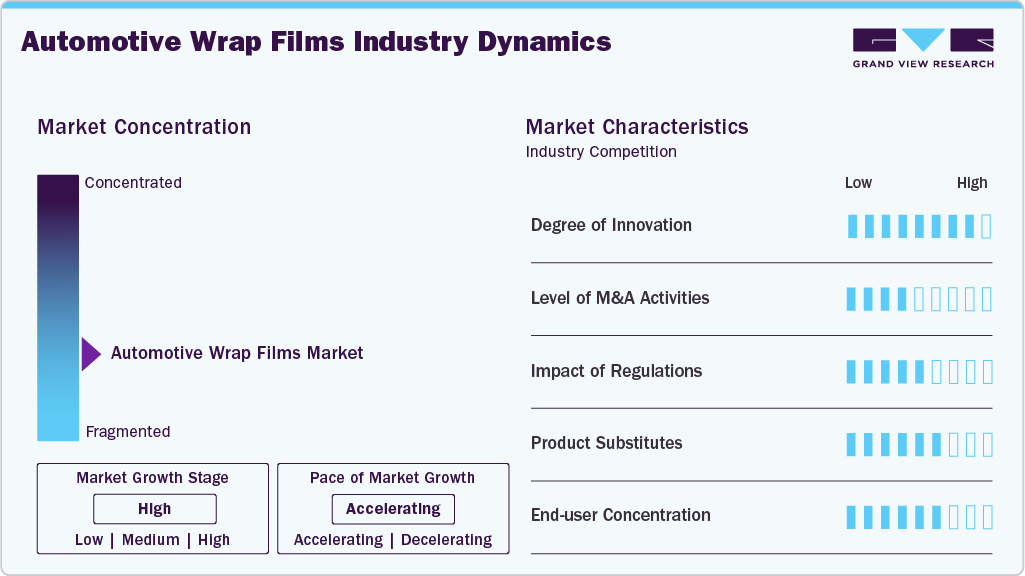
The automotive wrap films market is innovation-driven, with constant technological advancements in film materials, finishes, adhesives, and installation techniques. Companies invest in R&D to develop films that are more durable, scratch-resistant, UV-stable, and easier to install or remove. Innovations such as self-healing films, eco-friendly PVC-free wraps, and specialty textures (matte, satin, carbon fiber, and metallic) have expanded product offerings and increased consumer adoption. The rapid pace of innovation ensures that market participants must continuously adapt to evolving consumer preferences and regulatory requirements.
 To learn more about this report, Download Free Sample Report
The industry has a moderate-to-high entry barrier for new players due to the need for technical expertise, high-quality raw materials, and specialized installation skills. While raw film manufacturing requires significant capital investment and precision machinery, the installation and customization segment has lower barriers, attracting small local players. Regulatory compliance related to VOC emissions, environmental standards, and safety also plays a role in shaping market dynamics. Despite challenges, the industry offers growth opportunities through innovation, regional expansion, and increasing consumer preference for personalization and protective solutions.
Analyst Perspective
Over the forecast period, the automotive wrap films market is likely to move from a largely aesthetic, volume-led aftermarket into a more value-led platform built around protection, premium finishes, and sustainability. Demand will continue to be anchored by passenger cars, while buses and trucks will gain importance through fleet branding, transit media, and asset protection. Competitive advantage will depend less on basic film availability and more on product systems that combine easy installation, UV and scratch resistance, PVC-free formulations, and strong removal performance. Regions with mature customization culture will remain important, but the Asia Pacific will add incremental scale through vehicle modification activity and aftermarket expansion. Leaders will differentiate through installer networks, application training, partnerships with OEMs and graphics firms, and broader color and texture portfolios. Margin pressure will persist from raw material volatility, labor intensity, compliance requirements, and low-cost regional competition.
Application Insights
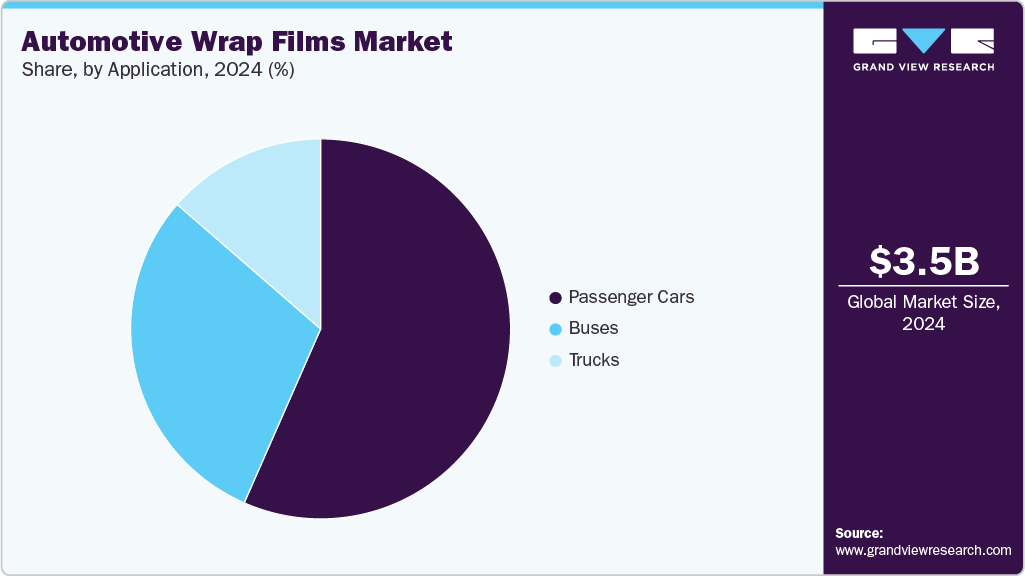
Based on application, the passenger cars segment led the market with the largest revenue share of 57.5% in 2025. It is expected to grow at the fastest CAGR of 19.7% during the forecast period. Vehicle owners increasingly prefer vinyl and polyurethane wrap films as a cost-effective and customizable alternative to traditional paint jobs. Wraps are used for full-body color changes, partial wraps, and aesthetic designs, including matte, gloss, metallic, and carbon fiber finishes. Additionally, luxury and premium car owners use wraps to protect original paint from UV rays, scratches, and minor abrasions. The growth of this segment is driven by rising consumer demand for vehicle personalization and aesthetic appeal, coupled with increasing awareness about paint protection solutions.
In buses, wrap films are primarily used for large-scale graphics, advertisements, and branding. Public and private transport operators use full-body wraps to display commercial ads or corporate identities, turning buses into moving billboards. Transit advertising has become a lucrative avenue for brands due to high visibility and extended exposure time. In addition, wrap films are used by school and intercity bus fleets to standardize vehicle appearance, improve surface protection, and simplify maintenance. The increasing investment in outdoor advertising and the growing popularity of transit media are major factors propelling wrap film adoption in buses.
Regional Insights
North America dominated the automotive wrap films market with the largest revenue share of 34.8% in 2025. North America dominates the premium segment of the automotive wrap films market, supported by a strong aftermarket customization culture and high consumer spending power. The U.S. and Canada are key centers for automotive restyling, where vehicle wrapping is considered both a fashion statement and a practical solution for paint protection. Car enthusiasts and professional detailing studios extensively use wrap films for color changes, texture customization, and branding. Major companies such as 3M and Arlon Graphics are headquartered in the region, ensuring continuous technological innovation, product availability, and customer education.
 To learn more about this report, Download Free Sample Report
Europe Automotive Wrap Films Market Trends
Europe represents a mature yet innovation-driven automotive wrap films industry, underpinned by advanced automotive manufacturing and strong consumer demand for vehicle aesthetics and protection. Countries such as Germany, the UK, and France are leading adopters of high-performance wrap films made from advanced materials such as polyurethane and fluoropolymer coatings. European consumers prioritize both functionality and sustainability, prompting wrap manufacturers to introduce low-VOC, eco-friendly, and recyclable products. Moreover, premium car owners in Germany and Italy increasingly use paint protection films (PPFs) to maintain vehicle resale value.
Asia Pacific Automotive Wrap Films Market Trends
Asia Pacific is expected to grow at the fastest CAGR of 21.0% over the forecast period. This positive outlook is due to rapid vehicle production, rising disposable incomes, and increasing consumer preference for vehicle customization. Countries such as China, Japan, and India are witnessing a surge in demand for aftermarket car modification services, including full-body wraps and protective films. Expanding automotive aftermarket networks and growing awareness about cost-effective alternatives to repainting are contributing to regional growth. The continuous growth of automotive e-commerce platforms and detailing studios across major cities such as Shanghai, Mumbai, and Bangkok also reinforces market penetration.
Key Automotive Wrap Films Company Insights
The competitive environment of the global automotive wrap films market is moderately fragmented, with a mix of large multinational players and regional manufacturers vying for market share. Key players differentiate themselves through product innovation, advanced printing technologies, customization options, and durability features such as UV resistance and scratch protection.
While established companies such as 3M, Avery Dennison, and ORAFOL dominate premium and commercial segments due to strong brand recognition and extensive distribution networks, smaller regional players compete on cost-effectiveness and localized solutions. Strategic partnerships with automotive OEMs, aftermarket installers, and e-commerce platforms are increasingly shaping competition, alongside mergers, acquisitions, and collaborations aimed at expanding geographic presence and technological capabilities.
-
In February 2025, Avery Dennison partnered with the UK-based car customizer Yianni Charalambous (Yiannimize) to launch new Supreme Wrapping Film colors in North America, previously exclusive to Europe. The Yiannimize Series features four standout shades, namely, Gloss Metallic Vibrant Violet, Gloss Pearl Tutu Pink, Gloss Pure Red, and Satin Metallic Spy Grey, designed for striking aesthetics and superior performance on vehicles like Lamborghinis and Bentleys, using Avery Dennison’s Easy Apply RS adhesive for hassle-free installation and professional results.
-
In March 2024, Arlon Graphics introduced VITAL, a groundbreaking new product line that is free from PVC. VITAL marks a major advancement in the graphics industry, establishing a new benchmark for those who seek top-notch quality, durability, and sustainability without any compromises.
Key Automotive Wrap Films Companies:
The following key companies have been profiled for this study on the automotive wrap films market.
-
Avery Dennison Corporation
-
Arlon Graphics LLC
-
3M
-
KPMF
-
Fedrigoni S.P.A
-
Vvivid Vinyl
-
ORAFOL Europe GmbH
-
Hexis S.A.S
-
CARBINS Film
-
LLumar (Eastman Performance Films, LLC)
Competitive Benchmarking
Category
Operating Strategies
Competitive Edge
Weakness
Established Players (Avery Dennison Corporation, 3M, ORAFOL Europe GmbH, LLumar (Eastman Performance Films, LLC), Arlon Graphics LLC, Fedrigoni S.P.A, KPMF, Hexis S.A.S.)
- Build premium wrap portfolios with high-durability, removable, and textured film systems.
- Expand through distributor networks, installer training, and aftermarket partnerships.
- Use product launches and region-specific color programs to defend premium pricing.
- Strong brand recognition and wider geographic reach.
- Better access to commercial fleets, premium installers, and higher-value accounts.
- Greater ability to fund R&D, certifications, and launch support.
- Higher compliance and formulation costs.
- Slower response to local niche trends and short-cycle design shifts.
- Greater margin exposure in commoditized color-change applications.
Emerging Players (Vvivid Vinyl, CARBINS Film)
- Focus on niche color-change products and price-sensitive aftermarket demand.
- Use digital channels, installer communities, and social-led promotion.
- Compete through faster product rotation and localized customization.
- Faster launch cycles and more flexible product positioning.
- Lower overhead structure and sharper entry pricing.
- Ability to target underserved regional and enthusiast segments.
- Limited global distribution and weaker brand trust.
- Narrower validation base for premium and fleet customers.
- Lower capacity for sustained R&D, compliance, and scale expansion.
Automotive Wrap Films Market Report Scope
Report Attribute
Details
Market size value in 2025
USD 4.1 billion
Market size value in 2026
USD 4.8 billion
Revenue forecast in 2033
USD 15.3 billion
Growth rate
CAGR of 17.9% from 2026 to 2033
Base year for estimation
2025
Historical data
2021 - 2024
Forecast period
2026 - 2033
Quantitative units
Revenue in USD million/billion and CAGR from 2026 to 2033
Report coverage
Revenue forecast, company ranking, competitive landscape, growth factors, and trends
Segments covered
Product, application, region
Regional scope
North America; Europe; Asia Pacific; Latin America; Middle East & Africa
Country scope
U.S.; Canada; Mexico; Germany; France; UK; Italy; Spain; Belgium; Netherlands; Poland; China; India; Japan; Australia; Indonesia; Malaysia; Thailand; Philippines; New Zealand; Brazil; Argentina; South Africa; Saudi Arabia; UAE
Key companies profiled
Avery Dennison Corporation; Arlon Graphics LLC; 3M; KPMF; Fedrigoni S.P.A; Vvivid Vinyl; ORAFOL Europe GmbH; Hexis S.A.S; CARBINS Film; LLumar
Customization scope
Free report customization (equivalent up to 8 analysts' working days) with purchase. Addition or alteration to country, regional & segment scope.
Pricing and purchase options
Avail customized purchase options to meet your exact research needs. Explore purchase options
Global Automotive Wrap Films Market Report Segmentation
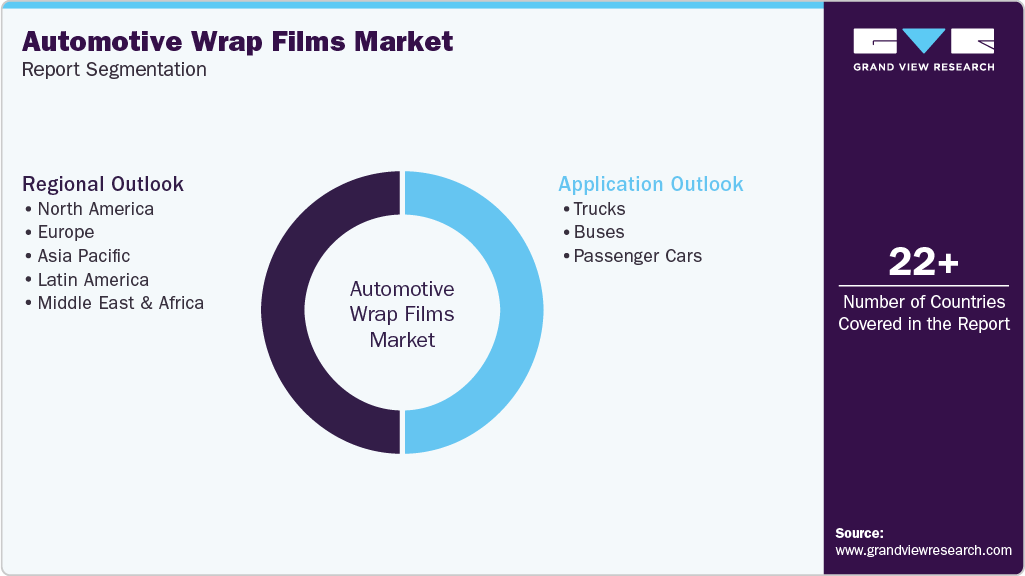
This report forecasts revenue growth at the global, regional & country levels and provides an analysis of the latest industry trends in each of the sub-segments from 2021 to 2033. For this study, Grand View Research has segmented the global automotive wrap films market report based on application and region:
 To learn more about this report, Download Free Sample Report
-
Application Outlook (Revenue, USD Million, 2021 - 2033)
-
Trucks
-
Buses
-
Passenger Cars
-
-
Regional Outlook (Revenue, USD Million, 2021 - 2033)
-
North America
-
U.S.
-
Canada
-
Mexico
-
-
Europe
-
Germany
-
France
-
UK
-
Italy
-
Spain
-
Belgium
-
Netherlands
-
Poland
-
-
Asia Pacific
-
China
-
India
-
Japan
-
Australia
-
Indonesia
-
Malaysia
-
Thailand
-
Philippines
-
New Zealand
-
-
Latin America
-
Brazil
-
Argentina
-
-
Middle East & Africa
-
South Africa
-
Saudi Arabia
-
UAE
-
-
Research Methodology
Segment Definition
Segment - Type
Revenue capture definition
Trucks
Revenue is captured through full-body and partial wraps purchased by logistics, construction, and specialty transport fleets for brand visibility, asset protection, and easier asset turnover. Orders are often routed through fleet management contracts and commercial graphics installers.
Buses
Revenue is driven by large-format wrap applications used for transit advertising, operator branding, and high-visibility route marketing. Commercial value is realized through contract-based installations, periodic campaign refreshes, and fleet standardization projects.
Passenger Cars
Revenue is mainly captured through owner-paid color-change and paint-protection wraps sold via detailers, specialty installers, and aftermarket retailers. Premium vehicle owners and enthusiasts drive repeat demand for aesthetic upgrades, finish changes, and original-paint protection.
Estimation Model
Layer Name
Question
Description
Demand Screen
Where demand originates?
The model starts with vehicle appearance and protection demand, because purchase intent is created at the end-user level.
Application Allocation
Which vehicles consume films?
Revenue is then allocated across trucks, buses, and passenger cars, reflecting distinct buying behavior and order sizes.
Channel Realization
How is revenue captured?
The split is checked against installer, distributor, and direct fleet channels, which determine realized monetization.
Regional Weighting
Where is demand concentrated?
Final values are adjusted for North America, Europe, Asia Pacific, Latin America, and MEA demand concentration.
Delivered Customizations
This report has been delivered with the following In-depth customizations
Client Request
Customization Delivered
Value Adds
Country-level demand split
Adds a country-wise split across major demand centers, showing how passenger car customization, commercial fleet branding, and aftermarket installation activity vary by market and how each country contributes to overall application revenue.
Improves regional prioritization and supports more precise go-to-market planning.
Premium film technology analysis
Expands the report with coverage of air-release adhesives, PVC-free films, matte and metallic finishes, and higher durability systems used for premium customization and paint protection across both consumer and fleet channels.
Strengthens technology positioning and clarifies premium value creation.
Company benchmarking matrix
Adds a side-by-side comparison of leading manufacturers on brand reach, installer support, product breadth, sustainability positioning, and market focus across passenger cars, buses, and trucks to clarify relative competitive strength.
Helps compare competitors on commercial depth and strategic fit.
Frequently Asked Questions About This Report
The global automotive wrap films market was estimated at around USD 4.1 billion in the year 2025 and is expected to reach around USD 4.8 billion in 2025.
The passenger cars segment dominates the automotive wrap films market due to the rising consumer preference for vehicle personalization and aesthetic enhancement, along with increasing demand for cost-effective paint protection solutions.
The key players in the automotive wrap films market include Avery Dennison Corporation; Arlon Graphics LLC; 3M; KPMF; Fedrigoni S.P.A; Vvivid Vinyl; ORAFOL Europe GmbH; Hexis S.A.S; CARBINS Film; and LLumar.
The automotive wrap films market is driven by the growing demand for vehicle customization and cost-effective paint protection solutions. Additionally, advancements in self-healing, eco-friendly films and expanding automotive aftermarket services further boost market growth.
North America dominated the automotive wrap films market with the largest revenue share of 34.8% in 2025.
The Asia Pacific automotive wrap films market is expected to grow at the fastest CAGR of 20.9% over the forecast period.
The passenger cars segment is expected to grow at the fastest CAGR of 19.7% over the forecast period in the automotive wrap films market.
Technological advancements in wrap film materials and finishes are driving market adoption. Innovations such as air-release adhesives, high-durability polymers, textured finishes (like carbon fiber, matte, and metallic), and eco-friendly films enhance ease of installation, longevity, and visual appeal.
The global automotive wrap films market is expected to grow at a compound annual growth rate of 17.9% from 2025 to 2030 to reach around USD 15.3 billion by 2033.
About the Author(s)
Paints, Coatings & Printing Inks Research Team
Bulk Chemicals · Paints, Coatings & Printing InksThis report was authored by the paints, coatings & printing inks research team at Grand View Research - comprising two research analysts, one senior research analyst, and one industry expert - with specialized expertise in the paints, coatings & printing inks segment of the bulk chemicals industry. All findings are based on proprietary bulk chemicals databases, executive interviews, and regulatory analysis, subject to internal peer review prior to publication.
Last Updated:
Speak to Analyst

Customize this report to your needs - add regions, segments, or data points, with 20% free customization.
Or view our licence options:


ISO 9001:2015 & 27001:2022 Certified
We are GDPR and CCPA compliant! Your transaction & personal information is safe and secure. For more details, please read our privacy policy.


