
- Home
- »
- Clothing, Footwear & Accessories
- »
-
Back To School Market Size, Share & Growth Report, 2033GVR Report cover

Back To School Market (2026 - 2033)
Size, Share & Trends Analysis Report By Product (Clothing & Accessories, Electronics, Stationery Supplies), By Distribution Channel (Offline, Online), By Region (North America, Europe), And Segment Forecasts
Market Size, 2025
$181.8BMarket Estimate, 2026
$191.4BMarket Forecast, 2033
$259.7BCAGR, 2026–2033
4.5%Back To School Market Summary
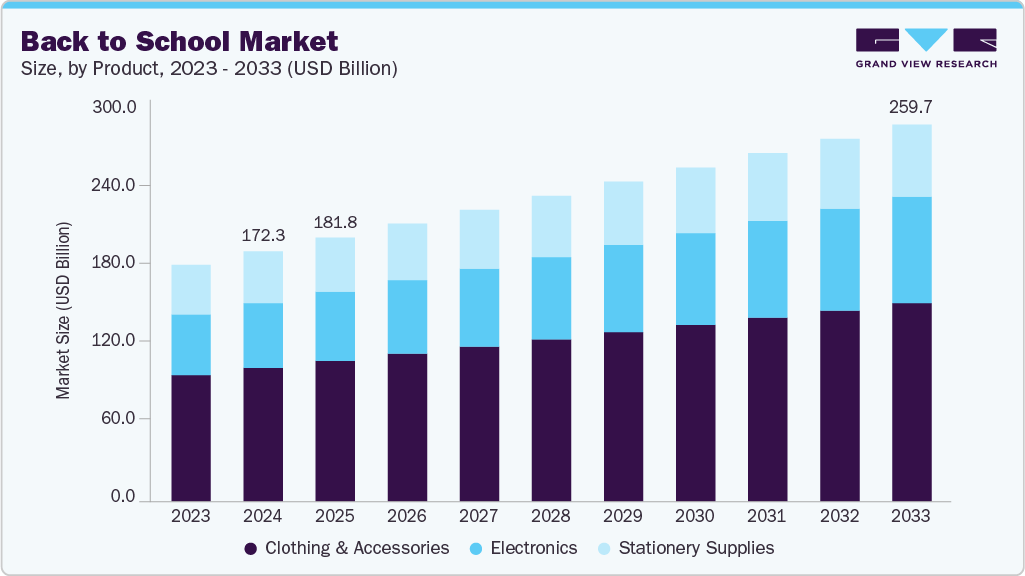
The global back to school market size was valued at USD 181.8 billion in 2025 and is projected to grow from USD 191.4 billion in 2026 to USD 259.7 billion in 2033, at a CAGR of 4.5% from 2026 to 2033.Asia Pacific dominated the market, accounting for a revenue share of 35.0% in 2025. Each year, as summer draws to a close, parents and students prepare for the new academic year, leading to a surge in demand for school supplies, apparel, electronics, and other essential items.
 Source: Grand View Research, IR Documents, Primary Interviews, Paid DatabasesTo learn more about this report,
 Download Free Sample Report
 Key Market Trends & Insights
- By product: The clothing & accessories segment accounted for a share of 50.0% in 2025.
- By distribution channel: The offline segment dominated the market, accounting for a share of over 60.0% in 2025.
Regional Highlights
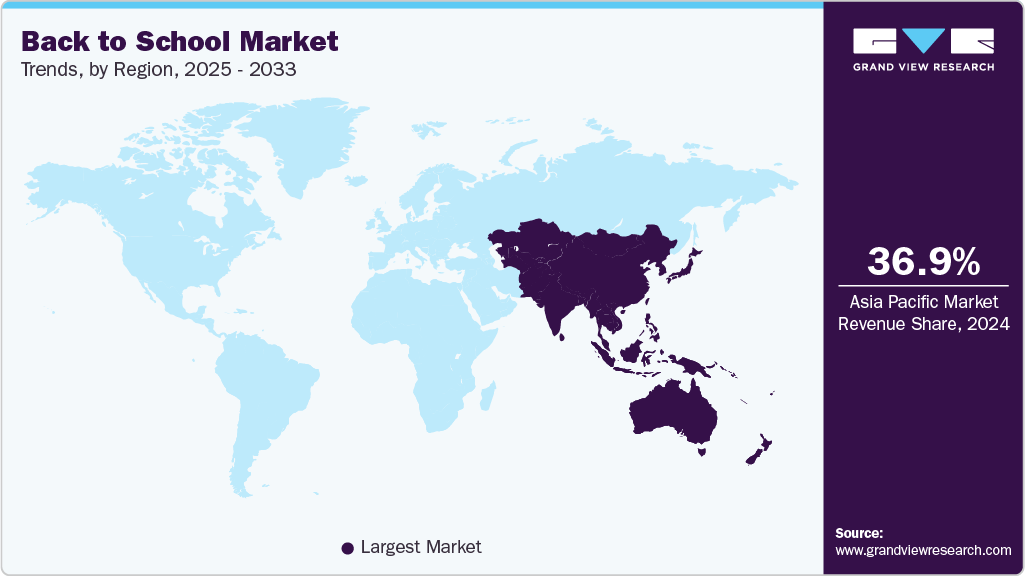
- Largest regional market: Asia Pacific (35.0% revenue share, 2025)
Market Size & Forecast
- Market size in 2025: USD 181.8 Billion
- Estimated market size in 2026: USD 191.4 Billion
- Projected market size by 2033: USD 259.7 Billion
- CAGR (2026-2033): 4.5%
Three ways to get this report
Buy it, customize it, or ask a question.Ask an Analyst
Analyst response in 1 business day
- AccessReport author, directly
- Reply timeWithin 1 working day
- No sales callDirect answer only
- FormatEmail reply
- CostFree, no cost
Get the Full Report
What the study covers
- FormatsPDF · Excel · Dashboard
- Timeline2026–2033 annual, 2025 base
- Coverage20+ countries, 5 regions
- Companies10+ key players profiled
Customize the Report
20% free customization
- IncludeCountries, segments, points
- TailorTo your product definition
- ExtendDeeper competitor detail
- OrA fully bespoke study
- Turnaround5–10 working days
Recent data indicate a growing inclination towards eco-friendly products, spurred by heightened environmental awareness among consumers. This trend is particularly prevalent among younger generations, who prioritize sustainability in their purchasing decisions. Moreover, retailers are responding to this demand by incorporating more environmentally friendly products into their campaigns, showcasing biodegradable materials, recycled notebooks, and sustainably sourced clothing.
The increasing need for digital tools in education has heightened the demand for laptops, tablets, and educational software, and accelerated the adoption of remote learning. As hybrid learning models become more commonplace, parents are investing in high-quality electronic devices that can facilitate both in-person and online learning environments. Moreover, the rise of e-learning has also prompted retailers to expand their product offerings to include educational apps and digital subscriptions, making technology a central pillar of back to school shopping lists for many families.
Analyst Perspective
The global back-to-school market is projected to grow as student enrollment, education spending, and demand for essential school products continue to increase. Demand for stationery, school bags, clothing, footwear, lunch products, and consumer electronics remains strong during the back-to-school season. Retailers are introducing early promotions, seasonal discounts, bundled offers, and omnichannel purchasing options to attract consumers and maximize sales during the peak shopping period. The growing use of e-commerce and mobile shopping platforms is allowing parents and students to complete purchases conveniently. Digital learning, online assignments, virtual classes, and technology-enabled classrooms are increasing the need for reliable and portable devices among students.
Consumer Insights
According to the NRF 2025 press release, the U.S. back to school shopping season is being defined by early purchase behavior driven by price sensitivity. Nearly 67% of families had already started buying school items by early July, compared to 55% a year earlier, a direct reflection of tariff-related price concerns influencing purchase timing. Yet, even with this early start, 84% of shoppers still had half or more of their lists left to buy, indicating deliberate pacing as parents wait for price drops, finalize school supply lists, or spread their spending across pay cycles.
For K-12 households, the average budget is set at USD 858, with the largest allocations going to electronics, USD 296; clothing, USD 249; footwear, USD 169; and supplies, USD 144. While this is slightly below last year’s per-family average, total spend is projected to rise to USD 39.4 billion, indicating growth in participation rather than inflation in individual spending.
Shopping behavior reflects a pragmatic balancing of convenience and cost. More than half of K-12 consumers anticipate making online purchases, while discount chains, department stores, and apparel retailers remain popular for price-driven purchases. College shoppers, meanwhile, are leaning more heavily into discount formats this year, with value stores seeing a five-point jump in preference, the strongest shift across all back-to-college retail channels.
Product Insights
The clothing & accessories segment accounted for over 50.0% share of the global revenue in 2025. As students return to school in late summer and early autumn, they need versatile clothing that can adapt to fluctuating temperatures. This need encourages the purchase of layered clothing, such as long-sleeve tops, jackets, and comfortable shoes. Furthermore, most schools have specific dress codes or uniform requirements, making it necessary for parents to shop for compliant attire. This combination of practicality and school regulations has a significant impact on purchasing behavior, prompting families to allocate budgets specifically for back to school clothing.
The electronics segment is expected to grow at the fastest CAGR from 2026 to 2033. As classrooms shift towards digital learning environments, students require various electronic devices, including laptops, tablets, and smartphones, to facilitate their studies. This trend is particularly pronounced in higher education and hybrid learning models, where students are expected to engage with online platforms for assignments and collaboration. According to the NRF's report published in July 2026, electronics represented the largest K-12 spending category, with consumers planning to spend an average of USD 293.11 per student and USD 14.7 billion in total. Consequently, brands offering innovative, high-performance electronics that cater to educational needs are well positioned to capitalize on this surge in demand.
Distribution Channel Insights
The sales of back to school products through offline channels accounted for a revenue share of over 60.0% in 2025. Parents and students favor physical stores for several reasons, including the ability to inspect products firsthand, which is particularly crucial for items such as clothing, backpacks, and school supplies. This hands-on interaction helps customers feel confident in their purchases, knowing they are selecting items that meet their specific needs and preferences. Moreover, seasonal promotions and discounts play a significant role in driving demand through offline channels. Retailers typically ramp up marketing efforts leading up to the back to school period, offering exclusive in-store sales, bundle deals, and loyalty rewards. These promotions can create an inviting atmosphere that encourages customers to shop early and often, fostering a sense of urgency.
The sales of back to school through online channels are expected to grow at a significant CAGR from 2026 to 2033. Online platforms offer an extensive range of products, from stationery to clothing and electronics, enabling parents to fulfill their shopping needs quickly and efficiently without the stress of crowded stores. Through e-commerce websites and mobile applications, consumers can easily compare prices, read product reviews, and access user-generated content that helps inform their decision-making. Moreover, online retailers often implement attractive promotional strategies, such as discounts, bundle offers, and special deals, specifically geared toward the back to school season, incentivizing buyers to complete their purchases before the school year begins.
Regional Insights
The back to school industry in North America captured a revenue share of over 20.0% of the global market in 2025. In the U.S. and Canada, the trend of sustainable schooling is emerging, as parents increasingly seek eco-friendly supplies, from recycled notebooks to ethically manufactured apparel. This shift reflects a growing awareness of environmental issues among consumers, influencing purchasing decisions to favor companies that uphold sustainable practices. Regions such as California and New York are at the forefront of promoting green products, as consumers in these areas tend to prioritize sustainability. Retailers are adapting their strategies by stocking innovative products that align with this focus, while also utilizing digital marketing campaigns on social media to effectively reach eco-conscious shoppers.
 To learn more about this report, Download Free Sample Report
 U.S. Back To School Market Trends
The U.S. back to school industry is expected to grow at a strong CAGR from 2026 to 2033. The market is experiencing robust growth, fueled by a shift towards increased online shopping as families seek convenience in their purchasing decisions. Major retailers are investing in their e-commerce capabilities and collaborating with third-party delivery platforms to meet the demand for same-day or next-day delivery. Furthermore, the integration of technology in shopping experiences, such as personalized recommendations based on past purchases, has also contributed to the growth of this trend.
Europe Back To School Market Trends
The back to school industry in Europe is expected to grow at a CAGR of 4.1% from 2026 to 2033. The market in the region demonstrates diversity driven by various cultural and economic factors within different countries. Western European nations, such as Germany and France, are showcasing a trend towards premium educational supplies and technology, which is anticipated to enhance learning experiences. Moreover, Eastern European markets are more price-sensitive, with consumers seeking affordable options that fit their increasingly tight budgets.
The Germany back to school industry is experiencing a transformation driven by a mix of traditional values and modern consumer habits. Parents typically visit local stores to purchase essential supplies such as stationery, backpacks, and lunchboxes for their children as school starts in late summer. However, there is a noticeable rise in the popularity of on-demand delivery services, powered by the increasing demand for convenience and faster purchasing options. Many German retailers are enhancing their e-commerce platforms, offering express delivery options and free shipping on larger orders to attract tech-savvy families who prefer online ordering.
The back to school industry in the UK is characterized by a blend of traditional shopping with a rising preference for online purchases. Parents are looking for convenience and efficiency when purchasing school supplies, clothing, and accessories for their children. As a result, retailers are responding by enhancing their online shopping platforms and leveraging on-demand delivery services. Moreover, consumers in the country are prioritizing eco-friendly products and brands that promote ethical manufacturing practices.
Asia Pacific Back To School Market Trends
The back to school industry in the Asia Pacific dominated the market with a share of over 35.0% in 2025 and is expected to witness a CAGR of 5.2% from 2026 to 2033. The market is driven by its large student population, rising education expenditure, and increasing integration of technology into education. Countries such as China, India, and Japan are witnessing growing demand for educational electronics, while South Korea and Singapore demonstrate a strong preference for quality educational products. In addition, the rapid expansion of digital commerce in major markets such as China and India is making school supplies, apparel, and electronics more accessible to consumers, supporting market growth across the region.
China’s back to school industry reflects a rapidly changing landscape heavily influenced by digitalization and consumer technology. Families are increasingly using e-commerce platforms for shopping, emphasizing speed and efficiency. On-demand delivery services have become a staple for many parents, enabling them to quickly purchase school supplies, clothing, and electronics. Moreover, major online platforms, such as Alibaba.com, Taobao, and JD.com, have reported significant increases in sales during the back to school period, responding with promotions and specially curated product categories designed to meet consumer needs.
The back to school industry in India is entering a new phase characterized by rapid shifts in consumer behavior and lifestyle changes, especially spurred by the pandemic's aftereffects. Traditionally, Indian families would stock up on school supplies during the peak back to school season, often visiting local stores and street markets. However, with the rise of the digital economy, there has been a significant increase in online shopping, with e-commerce giants such as Amazon and Flipkart quickly adapting to the demand for on-demand delivery services. As technology becomes increasingly integrated into daily life, parents are turning to online shopping not just for convenience but also for access to a broader range of products at competitive prices.
Latin America Back To School Market Trends
The back to school industry in Latin America is characterized by a blend of traditional purchasing behaviors and the adaptation of digital commerce. As the economy gradually stabilizes, families are prioritizing essential school supplies while remaining cost-conscious. Countries such as Brazil and Argentina have witnessed an uptick in demand for budget-friendly options as consumers navigate economic challenges. Local retailers are responding by offering bundled deals and promotions that emphasize value and accessibility, creating a competitive landscape as they vie for customers’ attention during the back to school season.
Middle East & Africa Back To School Market Trends
The back to school industry in the Middle East & Africa is poised for growth, driven by rising populations and a greater emphasis on education. Countries such as the UAE and Saudi Arabia are witnessing increasing investment in educational resources, alongside a culture that emphasizes high-quality education. Families are increasingly seeking premium products, including advanced learning materials and school supplies that meet global standards. The presence of international retailers in these markets provides parents with a wider selection of high-quality products, thereby enriching the local educational landscape.
Key Back To School Company Insights
The back to school industry has seen a dynamic shift as major players adapt to emerging consumer needs and changing educational landscapes. Manufacturers are focusing on innovative product launches to meet the changing needs of students and educators. With the rise of remote learning and hybrid classrooms, there is a growing demand for technology-infused supplies, such as smart notebooks, digital planners, and educational apps.
Manufacturers are ramping up their research and development (R&D) investments, enabling them to create cutting-edge products that enhance learning experiences. By leveraging expertise and resources, these partnerships allow for the development of integrated solutions that not only cater to the immediate demands of back to school shopping but also anticipate future educational trends. In addition to product innovation, the market has witnessed an increase in mergers and acquisitions as companies seek to consolidate their positions and expand their market reach.
Key Back To School Companies:
The following key companies have been profiled for this study on the back to school market:
-
The ODP Group
-
Amazon.com, Inc.
-
ACCO Brands
-
Staples Canada ULC
-
Apple Inc.
-
HP Development Company, L.P
-
Faber-Castell
-
Newell Brands
-
ITC
-
MITSUBISHI PENCIL CO., LTD
Recent Developments
- In August 2024, Apparel Group's R&B brand introduced its Back to school Collection in the UAE, aiming to offer trendy and budget-friendly styles that appeal to both students and parents. The company’s strategy centered on utilizing social media marketing and collaborating with influencers to enhance brand awareness and connect with the younger audience.
- In February 2024, Mitsubishi Pencil announced the acquisition of LAMY to expand its product lineup and strengthen its foothold in the premium stationery market, especially for back to school products. This acquisition will enhance Mitsubishi's competitive position, foster opportunities for collaboration between brands, and unlock new avenues for growth in both traditional and digital stationery markets.
Back To School Market Report Scope
Report Attribute
Details
Market size in 2025
USD 181.8 billion
Estimated market size in 2026
USD 191.4 billion
Projected market size by 2033
USD 259.7 billion
Growth rate
CAGR of 4.5% from 2026 to 2033
Base year for estimation
2025
Actual data
2021 – 2025
Forecast period
2026 – 2033
Quantitative units
Revenue in USD billion and CAGR from 2026 to 2033
Report coverage
Revenue forecast, company ranking, competitive landscape, growth factors, and trends
Segments covered
Product, distribution channel, region
Regional Scope
North America; Europe; Asia Pacific; Central & South America; Middle East & Africa
Country Scope
U.S.; Canada; Mexico; UK; Germany; France; Italy; Spain; China; Japan; India; South Korea; Australia & New Zealand; Brazil; South Africa
Key companies profiled
The ODP Group; Amazon.com, Inc.; ACCO Brands; Staples Canada ULC; Apple Inc.; HP Development Company, L.P; Faber-Castell; Newell Brands; ITC; MITSUBISHI PENCIL CO., LTD
Customization scope
Free report customization (equivalent up to 8 analysts working days) with purchase. Addition or alteration to country, regional & segment scope.
Pricing and purchase options
Avail of customized purchase options to meet your exact research needs. Explore purchase options
Global Back To School Market Report Segmentation
This report forecasts revenue growth at the global, regional, and country levels and provides an analysis of the latest industry trends and opportunities in each of the sub-segments from 2021 to 2033. For this study, Grand View Research has segmented the global back to school market report based on product, distribution channel, and region:
-
Product Outlook (Revenue, USD Billion, 2021 - 2033)
-
Clothing & Accessories
-
Electronics
-
Stationery Supplies
-
-
Distribution Channel Outlook (Revenue, USD Billion, 2021 - 2033)
-
Offline
-
Online
-
-
Regional Outlook (Revenue, USD Billion, 2021 - 2033)
-
North America
-
U.S.
-
Canada
-
Mexico
-
-
Europe
-
UK
-
France
-
Germany
-
Spain
-
Italy
-
-
Asia Pacific
-
China
-
Japan
-
India
-
Australia & New Zealand
-
South Korea
-
-
Central & South America
-
Brazil
-
-
Middle East & Africa
-
South Africa
-
-
Frequently Asked Questions About This Report
The global back to school market size was valued at USD 181.8 billion in 2025 and is estimated at USD 191.4 billion for 2026.
The global back to school market is expected to grow at a CAGR of 4.5% from 2026 to 2033, reaching USD 259.7 billion.
Asia Pacific dominated global industry and accounted for over 35.0% revenue share in 2025.
Key players in the market include The ODP Group, Amazon.com, Inc., ACCO Brands, Staples Canada ULC, Apple Inc., HP Development Company, L.P, Faber-Castell, Newell Brands, ITC, MITSUBISHI PENCIL CO., LTD, and others.
The clothing and accessories segment accounted for the largest revenue share of over 50.0% in 2025.
About the Author(s)
Clothing, Footwear & Accessories Research Team
Consumer Goods · Clothing, Footwear & AccessoriesThis report was authored by the clothing, footwear & accessories research team at Grand View Research - comprising two research analysts, one senior research analyst, and one industry expert - with specialized expertise in the clothing, footwear & accessories segment of the consumer goods industry. All findings are based on proprietary consumer goods databases, executive interviews, and regulatory analysis, subject to internal peer review prior to publication.
Last Updated:
Speak to Analyst

Customize this report to your needs - add regions, segments, or data points, with 20% free customization.
Or view our licence options:


ISO 9001:2015 & 27001:2022 Certified
We are GDPR and CCPA compliant! Your transaction & personal information is safe and secure. For more details, please read our privacy policy.


