
- Home
- »
- Homecare & Decor
- »
-
Bakeware Market Size, Share & Trends Report, 2026-2033GVR Report cover
![Bakeware Market (2026 - 2033)Report]()
Bakeware Market (2026 - 2033)
Size, Share & Trends Analysis Report By Product (Tin & Trays, Cups, Molds, Pans & Dishes, Rolling Pin), By Material (Stainless Steel, Aluminum, Stoneware, Carbon Steel), By End-use (Commercial, Residential), By Region, And Segment Forecasts
Market Size, 2025
$4.3BMarket Estimate, 2026
$4.5BMarket Forecast, 2033
$7.4BCAGR, 2026–2033
7.2%Bakeware Market Size & Trends
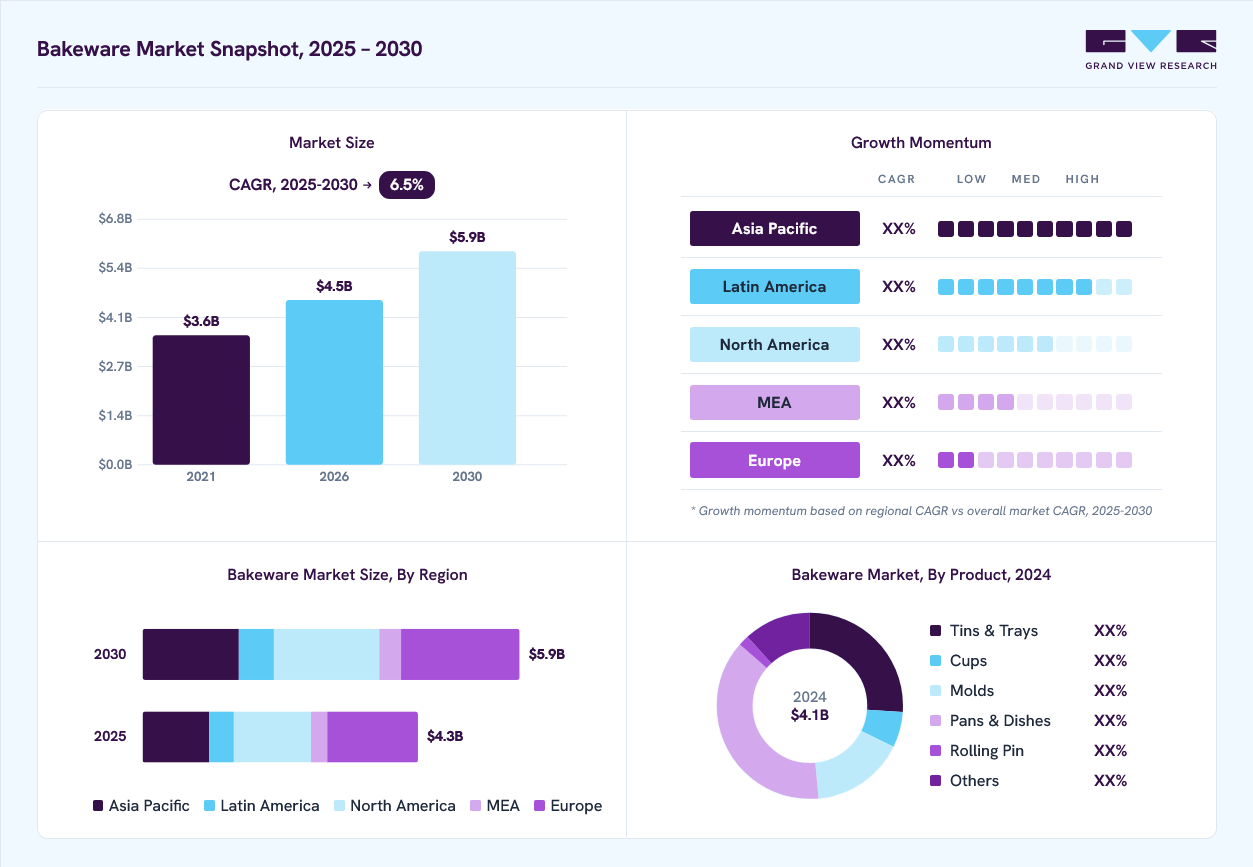
The global bakeware market size was valued at USD 4.3 billion in 2025 and is projected to grow from USD 4.5 billion in 2026 to USD 7.4 billion by 2033, at a CAGR of 7.2% from 2026 to 2033. Europe dominated the market, accounting for a revenue share of 32.9% in 2025. Shifts in lifestyle, heightened health consciousness, and the influence of social media on cooking culture fuel the demand for bakeware.
Key Market Trends & Insights
- By product: Pans and dishes segment led the market with the largest revenue share of 37.7% in 2025.
- By material: Aluminum segment led the market with the largest revenue share of 33.3% in 2025.
- By end user: Commercial segment led the market with the largest revenue share of 54.3% in 2025.
Regional Highlights
- Largest regional market: Europe (32.9% revenue share, 2025)
- By country: The U.S. held the largest share in the North America region in 2025.
Market Size & Forecast
- Market size in 2025: USD 4.3 Billion
- Estimated market size in 2026: USD 4.5 Billion
- Projected market size by 2033: USD 7.4 Billion
- CAGR (2026-2033): 7.2%
Three ways to get this report
Buy it, customize it, or ask a question.Ask an Analyst
A direct answer, usually in 1 working day
- AccessReport author, directly
- Reply timeWithin 1 working day
- No sales callDirect answer only
- FormatEmail reply
- CostFree, no cost
Get the Full Report
What the study covers
- FormatsPDF · Excel · Dashboard
- Timeline2026–2033 annual, 2025 base
- Coverage20+ countries, 5 regions
- Companies10+ key players profiled
Customize the Report
20% free customization
- IncludeCountries, segments, points
- TailorTo your product definition
- ExtendDeeper competitor detail
- OrA fully bespoke study
- Turnaround5–10 working days
More people are baking at home, a trend accelerated by the pandemic and sustained by an interest in healthier homemade alternatives. Home bakers enjoy having control over ingredients, avoiding preservatives, and creating unique treats, which has led to increased purchases of high-quality bakeware. Items like baking sheets, cake pans, and specialty molds are becoming common household essentials as baking evolves from a necessity into a form of self-care and creative expression. Social media and cooking TV shows play a significant role in this trend. Platforms like Instagram, TikTok, and YouTube have popularized baking as an accessible, enjoyable hobby, with influencers showcasing recipes, techniques, and specific bakeware tools. This visual inspiration encourages people to experiment with new designs and techniques, often requiring unique items like bundt pans, muffin tins, or silicon mats. The “bake and share” culture has grown, further driving demand for innovative and stylish bakeware that allows home bakers to achieve professional-level results.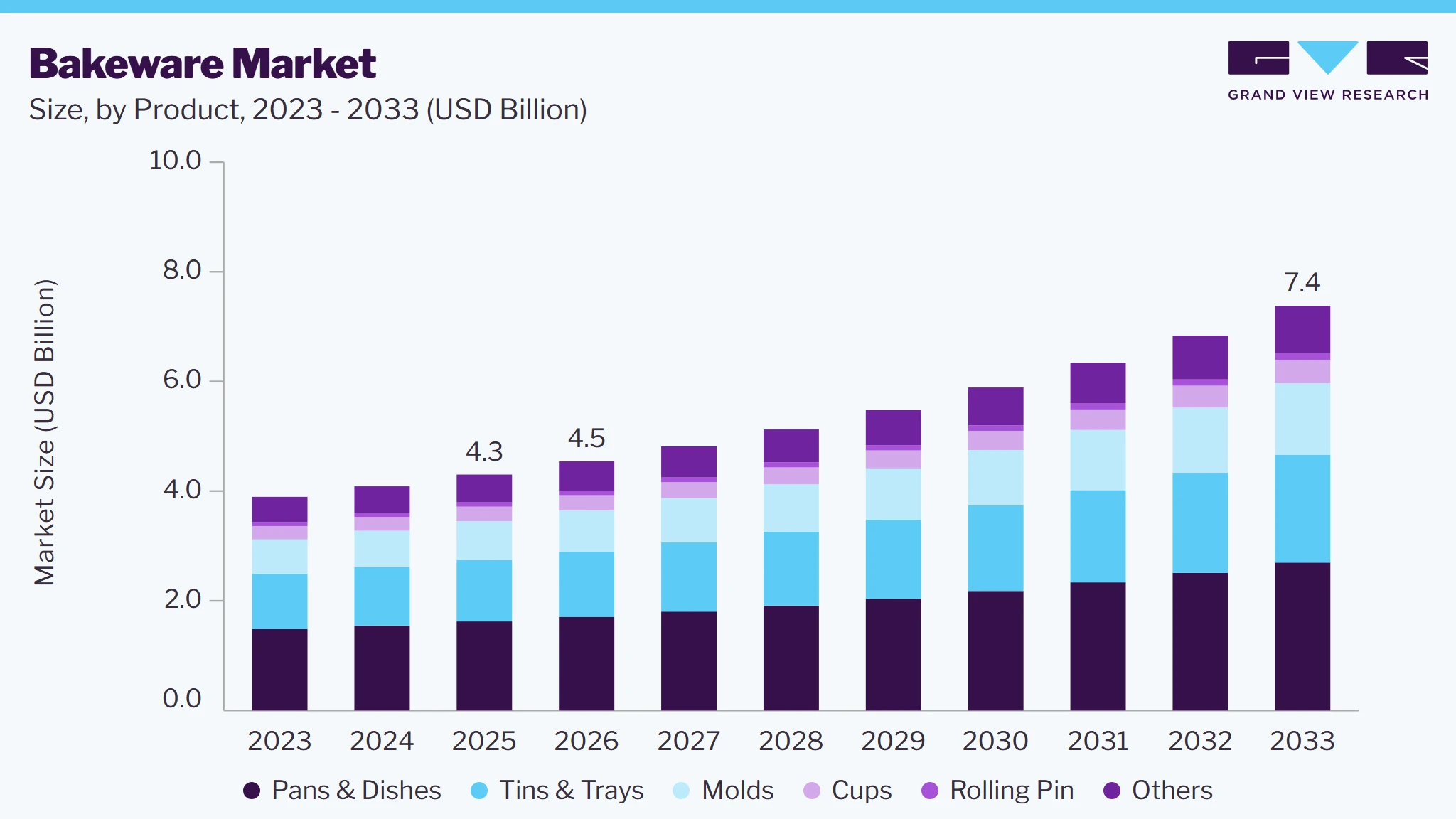
Sustainability and product quality are increasingly important to consumers. Eco-conscious individuals prefer bakeware made from durable, sustainable materials such as stainless steel, silicone, and ceramic. Non-stick and easy-to-clean products are particularly sought after for their convenience, and items that reduce waste, like reusable silicone mats, are gaining popularity. These shifts in consumer values, coupled with the joys of home baking, are collectively propelling the market forward on a global scale.
Furthermore, bakeware has become a popular gift choice, particularly during holidays like Thanksgiving and Christmas, as consumers are drawn to baking as a festive and family-centered activity. Seasonal demand sees a significant spike, with consumers purchasing bakeware for their holiday preparations or as gifts for friends and family interested in cooking and baking. This surge in demand is also supported by limited-edition holiday-themed bakeware sets and accessories that retailers often release, appealing to both novice and avid bakers. As a result, the gift-giving appeal and seasonal baking trends play a crucial role in driving growth within the market.
Market Dynamics
The bakeware market is witnessing strong growth, driven by rising consumer interest in home baking and demand for specialty baking products across residential and commercial kitchens. Growing adoption of premium and non-stick bakeware, expanding product portfolios featuring silicone, ceramic, and aluminized steel materials, and increasing demand for aesthetically appealing and multifunctional baking tools are supporting market expansion. Furthermore, the rising influence of social media-driven baking trends, increasing popularity of artisanal and celebration-based baked goods, and the introduction of innovative bakeware designs with enhanced heat distribution and easy-release coatings, coupled with the rapid growth of e-commerce channels and branded cookware retail networks, are expected to continue driving growth in the global bakeware market.
The rapid expansion of artisanal bakeries, café chains, cloud bakeries, and small-scale confectionery businesses is emerging as a major driver for the bakeware market. Increasing consumer demand for premium breads, pastries, cakes, and customized desserts has prompted commercial bakeries to invest in durable, high-performance bakeware that delivers consistency, faster production cycles, and superior product quality. Growing numbers of home-based baking entrepreneurs and online bakery businesses are also creating sustained demand for specialty pans, silicone molds, and heavy-duty baking sheets. This trend is accelerating the penetration of advanced bakeware products featuring enhanced heat distribution, non-toxic coatings, and professional-grade materials. Manufacturers are responding by expanding their product portfolios to cater to both professional and aspiring bakers.
For instance, in February 2024, Maison Demarle launched its Flexipan non-stick silicone mold collections for U.S. consumers, bringing professional bakery-grade molds traditionally used by pastry chefs into the residential market, thereby broadening the addressable customer base for premium bakeware products.
The bakeware market faces significant pressure from the proliferation of low-cost products from regional and unorganized manufacturers, particularly in Asia-Pacific and Latin America. These players supply inexpensive aluminum trays, carbon-steel pans, and silicone molds through supermarkets and online marketplaces, intensifying price competition with established brands. Consumers often prioritize affordability over material quality or durability, limiting the adoption of premium bakeware products with advanced coatings and specialized designs. In addition, the presence of counterfeit and unbranded products erodes brand differentiation and compresses margins, making it challenging for leading manufacturers to maintain premium pricing strategies and expand market share.
The increasing penetration of air fryers, countertop convection ovens, and multifunctional cooking appliances is creating a substantial opportunity for bakeware manufacturers. Consumers are seeking compact baking pans, perforated trays, loaf tins, and silicone accessories specifically designed to fit these appliances and maximize airflow. This shift is encouraging manufacturers to introduce purpose-built bakeware collections optimized for smaller cooking spaces and energy-efficient appliances. Demand is particularly strong among urban households and younger consumers adopting multifunctional kitchen equipment. Companies that develop appliance-specific, stackable, and space-saving bakeware products are well-positioned to capitalize on this emerging segment and strengthen their presence in the premium kitchenware market.
Analyst Perspective
The bakeware market benefits from sustained demand driven by home baking trends, premium kitchen upgrades, and expanding commercial bakery operations. Competitive advantage will increasingly rest with manufacturers offering comprehensive portfolios spanning specialty pans, non-stick coatings, and high-performance materials. Players that combine durability, multifunctionality, and design innovation across residential and foodservice applications are best positioned to capture replacement demand and command premium pricing, transforming bakeware from a commodity purchase into a value-added kitchen investment.
Product Insights
Based on product, the pans and dishes segment led the market with the largest revenue share of 37.7% in 2025. Pans and baking dishes are essential for a wide variety of recipes, from roasting and baking to casseroles and desserts, making them staples in most kitchens. The trend toward home-cooked meals and health-conscious eating has increased the use of bakeware products, especially pans, and dishes, which offer adaptability for various cooking styles. Moreover, the popularity of non-stick and durable materials like ceramic and cast iron enhances convenience and longevity, appealing to consumers looking for quality multi-functional products.
The demand for bakeware molds sales is projected to grow at a CAGR of 7.5% from 2025 to 2030. As consumers increasingly explore creative baking options, from shaped cakes to intricate desserts, it fuels the demand for molds. Molds enable bakers to achieve decorative, professional-looking results at home, catering to the growing interest in unique and visually appealing treats. Social media trends featuring elaborate baked goods have further fueled this demand, inspiring home bakers to experiment with various shapes and designs. In addition, molds in durable, non-stick materials enhance convenience, making them attractive for both novice and experienced bakers.
Material Insights
Based on material, the aluminum segment led the market with the largest revenue share of 33.3% in 2025. Aluminum bakeware heats evenly, ensuring that baked goods cook consistently, which appeals to both home and professional bakers. In addition, aluminum’s affordability makes it an accessible choice, offering good value for long-lasting use. Its versatility is also a key factor, as aluminum can be used for various bakeware types, from cookie sheets to cake pans. This combination of efficiency, cost-effectiveness, and performance is driving demand for aluminum bakeware.
The demand for carbon steel bakeware is projected to grow at a CAGR of 7.4% from 2025 to 2030 due to its durability, even heating, and non-stick potential, which appeal to both casual and professional bakers. Carbon steel is highly resistant to warping, ensuring it maintains its shape even under high temperatures, which makes it ideal for a range of baking needs. In addition, its ability to retain heat aids in consistent baking results, a quality value for items like bread and pastries. Carbon steel’s longevity and robust construction also support its growing popularity in the bakeware sector.
End-use Insights
Based on end user, the commercial segment led the market with the largest revenue share of 54.3% in 2025. The increasing demand for commercial bakeware is attributed to the expansion of the food service industry, with more bakeries, restaurants, cafes, and catering businesses needing durable, high-performance baking equipment. Commercial bakeware is designed to handle frequent, high-volume baking, making it essential for professional settings where consistency and durability are critical. In addition, as consumer demand for fresh and artisanal baked goods rises, commercial kitchens are investing in advanced bakeware that supports efficient production and high-quality results. This growing emphasis on consistent, large-scale baking capabilities drives the demand for commercial-grade bakeware.
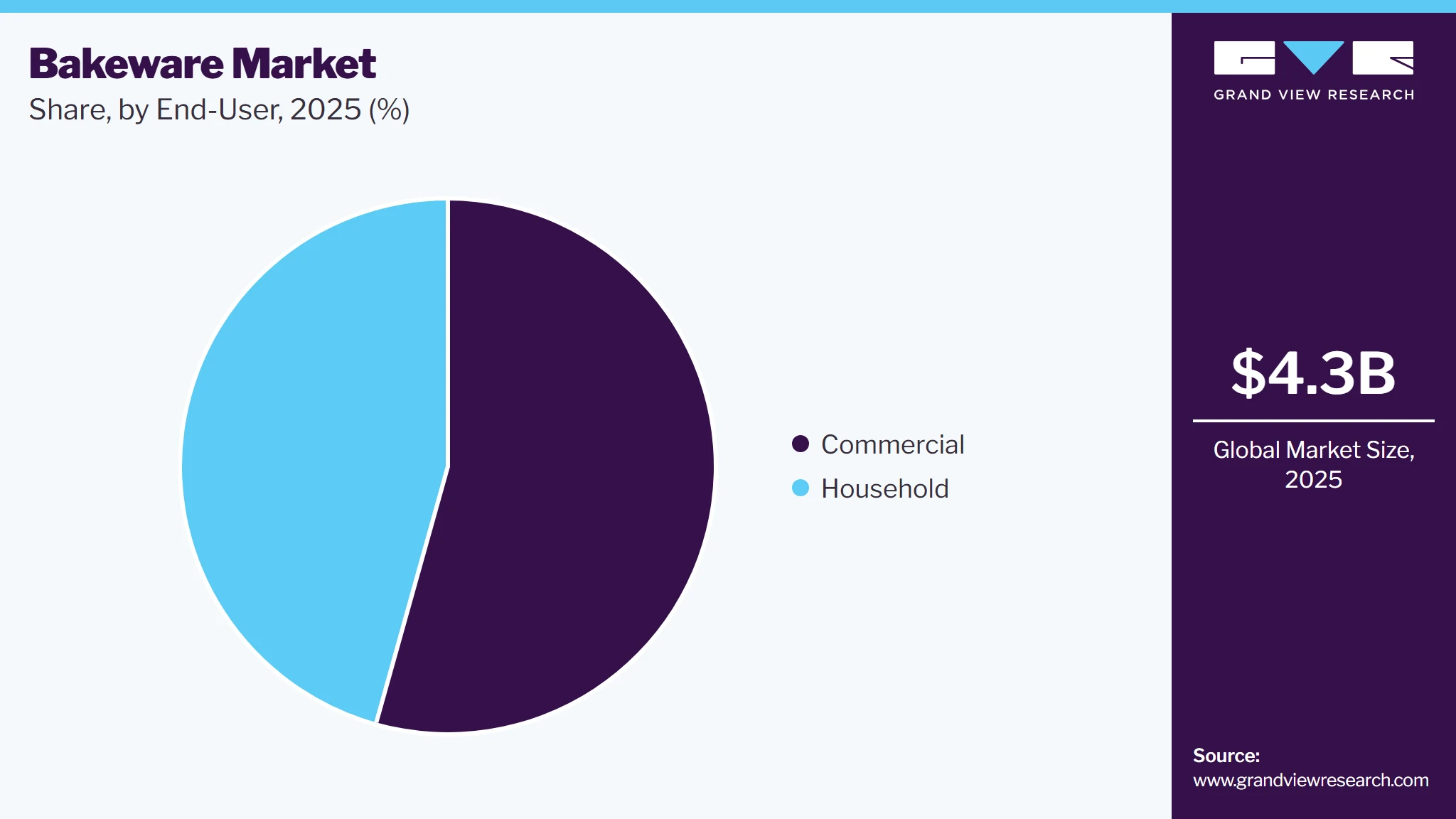
The demand for bakeware in household end use is projected to grow at a CAGR of 6.8% from 2025 to 2030 as more people turn to home baking, driven by health-consciousness and the joy of creating homemade foods. With an emphasis on controlling ingredients and reducing processed food intake, households are investing in quality bakeware to support frequent baking activities. In addition, social media and cooking shows continue to popularize baking, inspiring individuals to try new recipes at home. This rise in home-based cooking and baking is fueling steady growth in household bakeware demand.
Regional Insights
The North America bakeware market accounted for a share of 27.9% of the global market revenue in 2024, driven by health awareness, lifestyle trends, and the influence of social media. Many North Americans are opting for homemade baked goods to control ingredients, reduce additives, and explore creative baking as a hobby. The region’s strong culture of holiday baking and social gatherings further boosts demand, with households investing in quality bakeware to support frequent use. Additionally, North America’s preference for durable, high-performance kitchen products has led to greater interest in premium bakeware materials like carbon steel and silicone.
U.S. Bakeware Market Trends
The bakeware market in the U.S. held the largest share in the North America region in 2025, as home baking becomes more popular, fueled by health trends, convenience, and the desire for homemade goods, Americans are increasingly choosing to bake at home to control ingredients and avoid preservatives found in store-bought items. Additionally, social media has inspired many to try new baking projects, from artisan breads to intricate desserts, creating more interest in a variety of bakeware. Seasonal traditions, like holiday baking, further drive demand, making bakeware a staple in American kitchens.
Europe Bakeware Market Trends
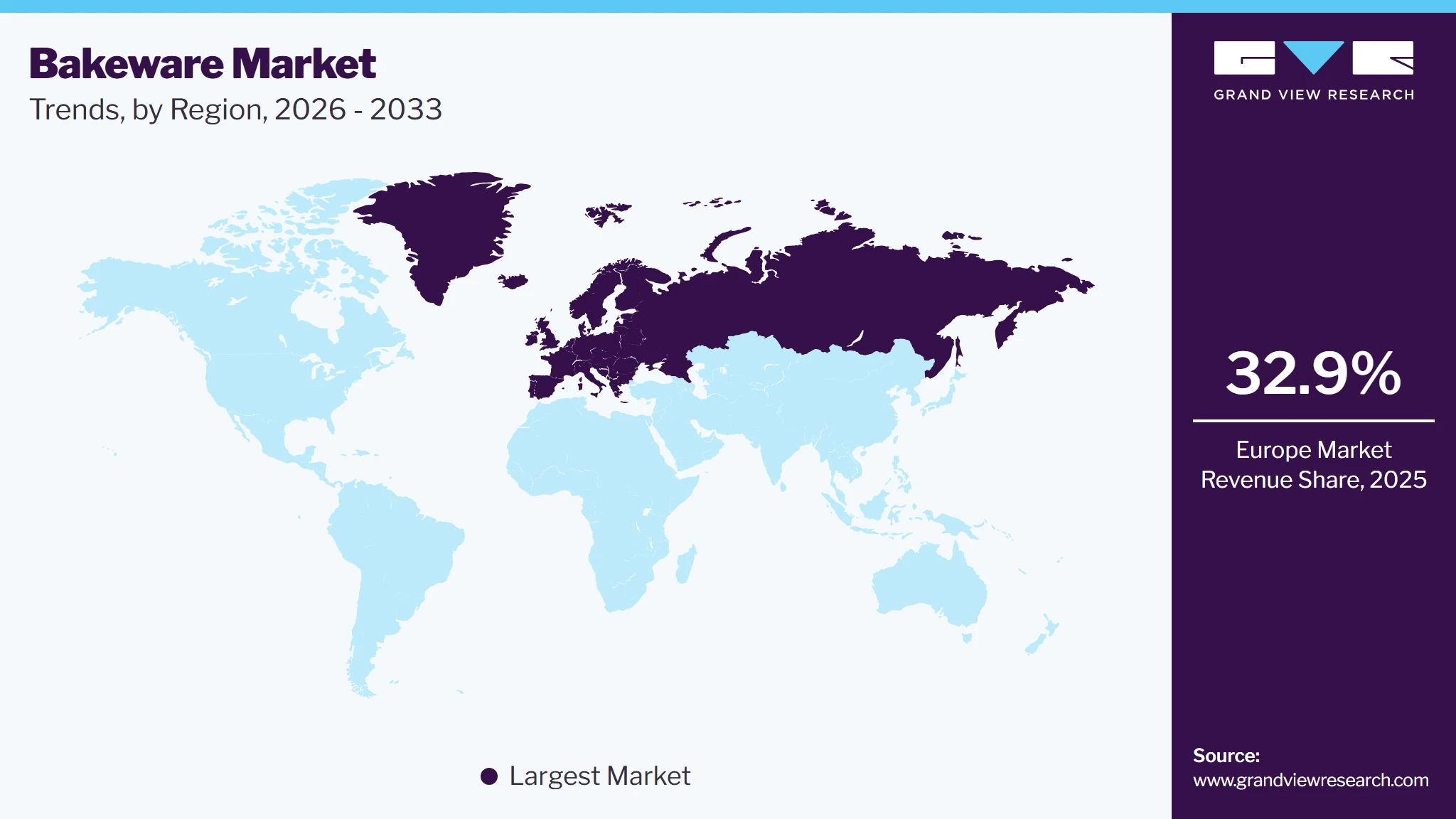
Europe dominated the bakeware market with the largest revenue share of 32.9% in 2025. Many Europeans are embracing homemade options over processed foods, seeking greater control over ingredients and opting for fresh, quality baked goods. Additionally, regional traditions such as holiday baking and artisanal bread-making encourage households to invest in quality bakeware that enhances their baking experiences. The focus on sustainable, long-lasting materials in Europe has also led consumers to favor durable, eco-friendly bakeware options.
Asia Pacific Bakeware Market Trends
The Asia Pacific bakeware market is expected to grow at a CAGR of 7.7% from 2025 to 2030 due to rising interest in home baking, spurred by lifestyle changes, urbanization, and exposure to global food trends. As more people in countries like Japan, South Korea, and Australia experiment with Western-style pastries, cakes, and breads, there is a growing need for diverse and high-quality bakeware. Social media has also contributed to this trend, inspiring home bakers to try new recipes. Additionally, the preference for health-focused, homemade foods has led consumers to invest in durable, reliable bakeware.
Key Bakeware Company Insights
The market is moderately fragmented and characterized by the presence of key established players. Key players, such as Newell Brands Inc., WMF GmbH, and Nordic Ware, focus on diversification and sustainability, driving market competitiveness. Despite challenges, with continuous innovations and a growing global passion for baking, the future of the market appears promising. The global movement toward reducing carbon emissions and adopting eco-friendly practices has led to companies taking a significant step toward environmentally conscious bakeware production.
Key Bakeware Companies
The following key companies have been profiled for this study on the bakeware market.
-
Groupe SEB
-
Wilton Brands LLC
-
Newell Brands Inc.
-
Fackelmann GmbH + Co. KG
-
Nordic War
-
USA Pan
-
Le Creuset
-
International Cookware
-
Emile Henry
-
Meyer Corporation U.S.
Competitive Benchmarking
Category
Operating Strategies
Competitive Edge
Weakness
Established Players (Groupe SEB; Wilton Brands LLC; Newell Brands Inc.; Fackelmann GmbH+Co. KG; Nordic Ware; Meyer Corporation U.S.)
- Expand through product innovation, premium and non-stick bakeware collections, omnichannel distribution strategies, partnerships with retailers and e-commerce platforms, and the introduction of sustainable and durable materials to cater to evolving consumer preferences.
- Strong brand recognition, extensive global distribution networks, diversified product portfolios, and well-established manufacturing and supply chain capabilities support customer loyalty and sustained market leadership.
- Dependence on fluctuations in raw material costs, changing consumer spending patterns, intense competition from private-label brands, and supply chain disruptions may constrain profitability and growth.
Emerging Players (USA Pan; Le Creuset; International Cookware; Emile Henry)
- Focus on premium and specialty bakeware products, innovative materials and designs, direct-to-consumer channels, and targeted marketing initiatives aimed at home bakers and culinary enthusiasts to strengthen market presence.
- Agility in product development, strong positioning in premium and niche segments, and the ability to respond quickly to changing cooking and baking trends enable differentiation and customer engagement.
- Limited scale compared with larger competitors, dependence on premium customer segments, and increasing competitive pressures from established multinational manufacturers may restrict expansion and market penetration.
Recent Developments
-
In February 2023, Guardini, a European bakeware brand, announced a partnership with ArcelorMittal, Cooper Coated Coil (CCC), and coating manufacturer ILAG to launch XBake, an eco-friendly bakeware line. Made from ArcelorMittal's XCarb green steel and featuring a PFAS-free non-stick coating, XBake was unveiled at the Ambiente fair in Frankfurt, Germany.
Bakeware Market Report Scope
Report Attribute
Details
Market size in 2025
USD 4.3 billion
Estimated market size in 2026
USD 4.5 billion
Projected market size by 2033
USD 7.4 billion
Growth rate
CAGR of 7.2% from 2026 to 2033
Base year for estimation
2025
Historical data
2021 - 2024
Forecast period
2026 - 2033
Quantitative units
Revenue in USD million/billion and CAGR from 2026 to 2033
Report coverage
Revenue forecast, company ranking, competitive landscape, growth factors, and trends
Segments covered
Product, material, end user, region
Regional scope
North America; Europe; Asia Pacific; Latin America; MEA
Country scope
U.S.; Canada; Mexico; Germany; UK; France; Italy; Spain; China; Japan; India; Australia & New Zealand; South Korea; Brazil; South Africa; UAE
Key companies profiled
Groupe SEB; Wilton Brands LLC; Newell Brands Inc.; Fackelmann GmbH+Co. KG; Nordic Ware; USA Pan; Le Creuset; International Cookware; Emile Henry; Meyer Corporation U.S.
Customization scope
Free report customization (equivalent to up to 8 analysts' working days) with purchase. Addition or alteration to country, regional & segment scope.
Pricing and purchase options
Avail customized purchase options to meet your exact research needs. Explore purchase options
Global Bakeware Market Report Segmentation
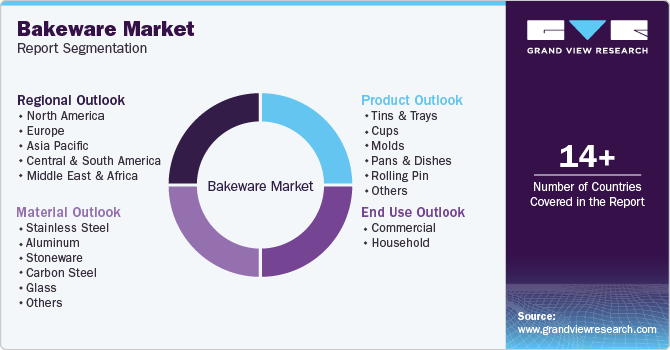
This report forecasts revenue growth at the global, regional, and country levels and provides an analysis of the latest industry trends and opportunities in each of the sub-segments from 2021 to 2033. For this study, Grand View Research has segmented the global bakeware market report based on product, material, end-use, and region.
-
Product Outlook (Revenue, USD Million, 2021 - 2033)
-
Tins & Trays
-
Cups
-
Molds
-
Pans & Dishes
-
Rolling Pin
-
Others
-
-
Material Outlook (Revenue, USD Million, 2021 - 2033)
-
Stainless Steel
-
Aluminum
-
Stoneware
-
Carbon Steel
-
Glass
-
Others
-
-
End Use Outlook (Revenue, USD Million, 2021 - 2033)
-
Commercial
-
Household
-
-
Regional Outlook (Revenue, USD Million, 2021 - 2033)
-
North America
-
U.S.
-
Canada
-
Mexico
-
-
Europe
-
UK
-
Germany
-
France
-
Italy
-
Spain
-
-
Asia Pacific
-
China
-
Japan
-
India
-
Australia & New Zealand
-
South Korea
-
-
Central & South America
-
Brazil
-
-
Middle East & Africa
-
South Africa
-
-
Research Methodology
The bakeware market figures in this report are based on a proven research process that combines executive interviews with secondary research from proprietary databases, company filings, and recognized regulatory and institutional sources. Market size is built through value-chain sizing - reconciling supply-side and demand-side estimates - and triangulated with bottom-up and top-down approaches. Every estimate passes multiple levels of expert validation before publication, with each bakeware segment quantified using the revenue-capture definitions in the table below.
Segment Definition
Segment - End-User
Revenue capture definition
Commercial
As the largest end user segment, revenue is generated from the sale and use of bakeware products by professional foodservice and bakery establishments, including commercial bakeries, cafés, restaurants, hotels, and catering businesses. The segment encompasses high-volume baking applications that require durable pans, trays, molds, and specialty bakeware, with spending on production efficiency, product consistency, and large-scale food preparation included.
Household
Revenue is generated from the purchase and use of bakeware products by residential consumers for home baking applications, including the preparation of bread, cakes, cookies, pastries, and other baked goods. The segment encompasses spending on baking sheets, cake pans, muffin tins, loaf pans, and specialty molds used for everyday baking, seasonal occasions, and hobby-driven baking activities.
Estimation Model
Home Baking & Foodservice User Base Layer
Access & Affordability Layer
Bakeware Purchase & Usage Layer
Revenue Generation Layer
Who has the potential to use bakeware products?
Who can access and afford bakeware products?
Who actively purchases and uses bakeware?
How much revenue is generated?
Identify home bakers, commercial bakeries, cafés, restaurants, hotels, pastry chefs, and foodservice operators requiring bakeware for baking and cooking applications.
Apply retail availability, e-commerce penetration, household income, and commercial kitchen investment to estimate consumers and businesses with access to bakeware products.
Estimate active buyers based on baking frequency, replacement cycles, product upgrades, specialty baking needs, and demand for non-stick, silicone, and premium bakeware.
Calculate market revenue by multiplying active buyers with average selling prices (ASP), replacement purchases, commercial demand, and sales across product categories.
Delivered Customizations
This report has been delivered with the following In-depth customizations
Client Request
Customization Delivered
Value Adds
Material Innovation, Coating Technologies & Product Performance Assessment for Bakeware
Conducted an assessment of advancements in bakeware materials including aluminum, stainless steel, carbon steel, silicone, ceramic, and glass. Evaluated the adoption of non-stick coatings, PFAS-free technologies, heat distribution capabilities, durability characteristics, and ease-of-cleaning features across product categories. Assessed emerging innovations aimed at improving baking efficiency and user convenience.
Helped identify product innovation and premiumization opportunities across material types. Supported product development strategies and enabled benchmarking of performance-enhancing technologies to strengthen market positioning.
Sustainability, Circular Economy & Regulatory Compliance Analysis for Bakeware
Conducted an evaluation of sustainability initiatives, recyclable materials, eco-friendly coatings, and manufacturing practices adopted within the bakeware industry. Assessed regulatory developments related to food-contact materials, chemical safety standards, and environmental compliance requirements across key markets. Evaluated opportunities associated with reusable and environmentally responsible bakeware products.
Helped identify sustainability-driven growth opportunities and regulatory risks across geographies. Supported ESG and product compliance strategies while enabling the development of eco-conscious product portfolios.
Commercial End-user & Foodservice Application Assessment for Bakeware
Conducted an assessment of the integration of bakeware products with emerging smart kitchen trends and connected cooking ecosystems. Evaluated innovations related to temperature-monitoring accessories, app-enabled cooking assistance, multifunctional designs, and compatibility with modern kitchen appliances. Assessed opportunities arising from increasing adoption of smart home technologies and convenience-oriented cooking solutions.
Helped identify future growth opportunities associated with smart kitchen adoption. Supported long-term innovation strategies and enabled the development of differentiated products aligned with evolving consumer lifestyles and connected home ecosystems.
Frequently Asked Questions About This Report
Some of the key players operating in the bakeware market include Wilton Brands LLC, Fackelmann GmbH + Co. KG, Nordic Ware, Groupe SEB, and Newell Brands Inc.
The global bakeware market size was valued at USD 4.3 billion in 2025 and is estimated to reach USD 4.5 billion in 2026.
Asia Pacific is the fastest-growing region over the forecast period.
The pans and dishes segment led with a 37.7% revenue share in 2025, while the molds segment is the fastest-growing product.
The aluminum segment held the largest revenue share in 2025, while the carbon steel segment is the fastest-growing material.
The commercial segment accounted for the largest market share of 54.3% in 2025, while the household segment is the fastest-growing.
The global bakeware market is expected to grow at a CAGR of 7.2% from 2026 to 2033, reaching USD 7.4 billion by 2033.
Europe dominated with a 32.9% revenue share in 2025.
Key factors include a surge in the number of home bakers, growing interest in home baking as a hobby, rapid urbanization, and rising disposable income, leading to increased expenditure on kitchen products, including bakeware.
About the Author(s)
Homecare & Decor Research Team
Consumer Goods · Homecare & DecorThis report was authored by the homecare & decor research team at Grand View Research - comprising two research analysts, one senior research analyst, and one industry expert - with specialized expertise in the homecare & decor segment of the consumer goods industry. All findings are based on proprietary consumer goods databases, executive interviews, and regulatory analysis, subject to internal peer review prior to publication.
Last Updated:
Speak to Analyst


Customize this report to your needs - add regions, segments, or data points, with 20% free customization.
Or view our licence options:


ISO 9001:2015 & 27001:2022 Certified
We are GDPR and CCPA compliant! Your transaction & personal information is safe and secure. For more details, please read our privacy policy.


