
- Home
- »
- Advanced Interior Materials
- »
-
Baling Wire Market Size And Share Report, 2026-2033GVR Report cover

Baling Wire Market (2026 - 2033)
Size, Share & Trends Analysis Report By End-use (Recycling, Waste Management, Agriculture, Construction), By Region (North America, Asia Pacific, Europe), And Segment Forecasts
Market Size, 2025
$2.1BMarket Estimate, 2026
$2.2BMarket Forecast, 2033
$4.7BCAGR, 2026–2033
11.3%Baling Wire Market Summary
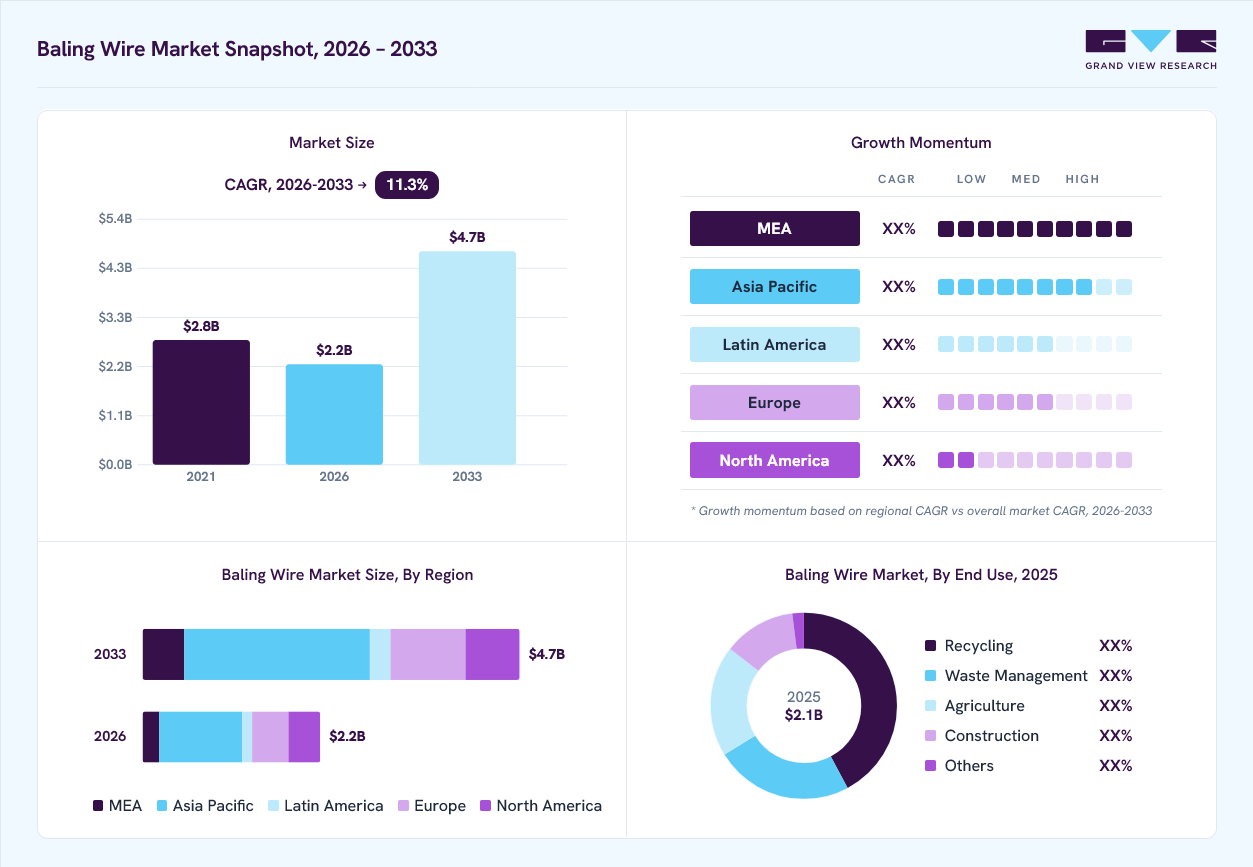
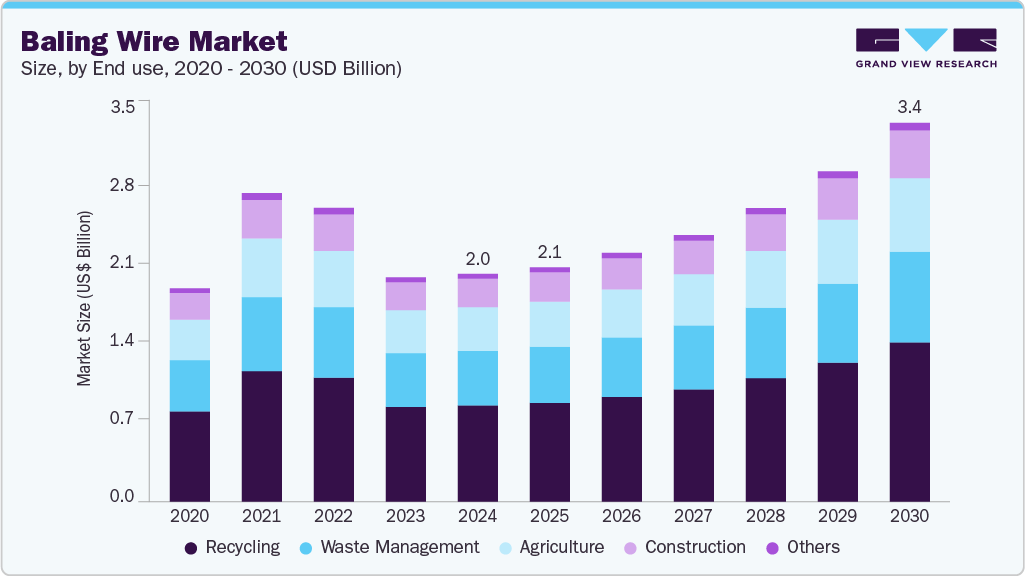
The global baling wire market size was valued at USD 2.1 billion in 2025 and is projected to grow from USD 2.2 billion in 2026 to USD 4.7 billion by 2033, at a CAGR of 11.3% from 2026 to 2033. Asia Pacific dominated the baling wire market with the largest revenue share of 46.4% in 2025. Governments and environmental agencies are implementing strict regulations to promote recycling and reduce landfill waste.
 Source: Grand View Research, IR Documents, Primary Interviews, Paid DatabasesTo learn more about this report,
 Download Free Sample Report
 Key Market Trends & Insights
- By end use: Recycling segment held the largest market share of 42.2% in 2025.
Regional Highlights
- Largest regional market: Asia Pacific (46.4% revenue share, 2025)
- By country: China held the largest market share in 2025.
Market Size & Forecast
- Market size in 2025: USD 2.1 Billion
- Estimated market size in 2026: USD 2.2 Billion
- Projected market size by 2033: USD 4.7 Billion
- CAGR (2026-2033): 11.3%
Three ways to get this report
Buy it, customize it, or ask a question.Ask an Analyst
A direct answer, usually in 1 working day
- AccessReport author, directly
- Reply timeWithin 1 working day
- No sales callDirect answer only
- FormatEmail reply
- CostFree, no cost
Get the Full Report
What the study covers
- FormatsPDF · Excel · Dashboard
- Timeline2026–2033 annual, 2025 base
- Coverage20+ countries, 5 regions
- Companies10+ key players profiled
Customize the Report
20% free customization
- IncludeCountries, segments, points
- TailorTo your product definition
- ExtendDeeper competitor detail
- OrA fully bespoke study
- Turnaround5–10 working days
As a result, industries such as paper, plastic, and metal recycling increasingly use baling wires to secure bales of recycled materials. This surge in recycling activities, especially in regions like Europe and North America, significantly boosts the demand for high-quality baling wire.The need for efficient baling solutions has surged due to the increasing use of paper-based packaging, driven by the e-commerce boom. Baling wires are essential for securely bundling large quantities of paper and pulp products, making them indispensable in packaging and logistics. The growth of the pulp and paper industry, particularly in developing countries, continues to fuel the market.
The adoption of advanced farming practices is also a significant growth driver in agriculture. Automated baling machines are becoming common in modern farming, particularly for handling hay, straw, and other agricultural products. These machines require robust and durable baling wires to bind large bales effectively. The use of galvanized and annealed steel wires ensures durability and resistance to corrosion, making them a popular choice among farmers, especially in regions with high agricultural output.
 To learn more about this report, Download Free Sample Report
 Technological advancements in baling wire production are another critical factor boosting market growth. Manufacturers are investing in research and development to introduce stronger, more flexible, and corrosion-resistant baling wires. These innovations cater to industries requiring high-performance baling solutions, such as recycling plants and agricultural operations. As new, improved products enter the market, their adoption increases, further supporting market expansion.
Lastly, regional expansions and strategic collaborations among key players shape the global baling wire industry. Companies are partnering with industries such as waste management and agriculture to provide customized solutions. Emerging economies in Asia-Pacific and Latin America are particularly lucrative due to their expanding recycling initiatives and agricultural modernization. In April 2024, Sigma Polymers and D R Baling collaborated to develop a ground-breaking baling wire made entirely from 100% recycled plastic, marking a significant step forward in sustainable innovation. These partnerships enhance product distribution and boost market presence, contributing to the overall market growth.
Market Dynamics
The growth of the baling wire market is being driven primarily by the rapid expansion of recycling and waste management activities worldwide. Governments, municipalities, and industries are increasingly implementing sustainable waste handling practices and stricter environmental regulations, leading to higher demand for baling wire in bundling recyclable materials such as paper, cardboard, plastics, and metals. The growing emphasis on reducing landfill waste and improving recycling efficiency has made baling wire an essential component in material recovery facilities and waste processing operations. In addition, rising urbanization and industrial waste generation are encouraging investments in advanced baling systems, further supporting market growth.
The expansion of recycling activities is a significant growth driver for the baling wire market, as recycling facilities rely heavily on baling equipment to compress and secure recyclable materials into compact bundles for storage and transportation. Materials such as paper, cardboard, plastics, aluminum cans, and metal scrap are routinely baled to improve handling efficiency and reduce logistics costs. Baling wire plays a critical role in maintaining the integrity of these compressed bales, ensuring that they remain securely bound throughout the supply chain. As recycling rates continue to rise across both developed and emerging economies, the demand for reliable and durable baling wire is increasing in parallel.
Government initiatives promoting circular economy practices, waste diversion programs, and stricter environmental regulations are further accelerating investments in recycling infrastructure. Municipal waste management agencies and private recycling operators are expanding their processing capacities to manage growing volumes of recyclable waste generated by urbanization, industrialization, and consumer packaging consumption. This expansion has led to greater deployment of balers and related consumables, including baling wire. In addition, the increasing focus on resource recovery and sustainable material management is encouraging long term growth in recycling operations, creating a stable demand base for baling wire manufacturers worldwide.
Volatility in raw material prices represents a major restraint for the baling wire market, as steel wire rod and other metal inputs account for a significant portion of production costs. Changes in global steel prices, driven by fluctuations in supply and demand, energy costs, trade policies, geopolitical tensions, and transportation expenses, can directly impact the cost structure of baling wire manufacturers. Frequent price variations make it difficult for producers to maintain stable profit margins and accurately forecast production expenses, particularly under long term supply contracts. These cost pressures are often passed on to end users, which can reduce purchasing volumes or encourage the adoption of alternative binding materials, thereby limiting overall market growth.
The growing demand from emerging economies presents a significant opportunity for the baling wire market, driven by rapid industrialization, urban development, and expanding agricultural and recycling sectors. Countries across regions such as Asia Pacific, Latin America, and parts of Africa are investing heavily in waste management infrastructure, manufacturing facilities, logistics networks, and modern farming practices, all of which require efficient material bundling and handling solutions. Rising volumes of industrial waste, recyclable materials, and agricultural output are increasing the adoption of baling equipment, thereby supporting demand for baling wire. Additionally, government initiatives focused on improving environmental sustainability, recycling rates, and agricultural productivity are creating favorable conditions for market expansion, enabling manufacturers to strengthen their presence and capture new revenue opportunities in these high growth regions.
Analyst Perspective
The baling wire market is witnessing strong growth as industries place greater emphasis on recycling, waste management, agricultural mechanization, and efficient material handling. The market is being driven by increasingly stringent environmental regulations that encourage recycling activities, creating sustained demand for baling wire to secure and transport paper, plastic, metal, and other recyclable materials. The rapid expansion of e commerce and paper based packaging industries is further supporting demand, while modern farming practices and the growing adoption of automated baling equipment are increasing wire consumption in the agricultural sector.
End Use Insights
Based on end use, recycling segment led the market with the largest revenue share of 42.2% in 2025. Governments across regions are enforcing stricter environmental regulations, encouraging industries and municipalities to recycle more and send less waste to landfills. Baling wire is essential in this process, as it binds and secures recyclable materials like paper, cardboard, plastic, and metal for easier handling, transport, and processing. As recycling becomes more widespread, the demand for baling wire rises significantly.
Agriculture are anticipated to register the fastest CAGR over the forecast period. Modern agricultural operations utilize baling machines to compress and bundle crops like hay, straw, and other forage materials efficiently. Baling wire is crucial in securing these bales, ensuring they remain intact during handling, storage, and transportation. The shift towards mechanization enhances productivity and necessitates reliable baling solutions, thereby boosting the demand for market in the agricultural sector.
Regional Insights
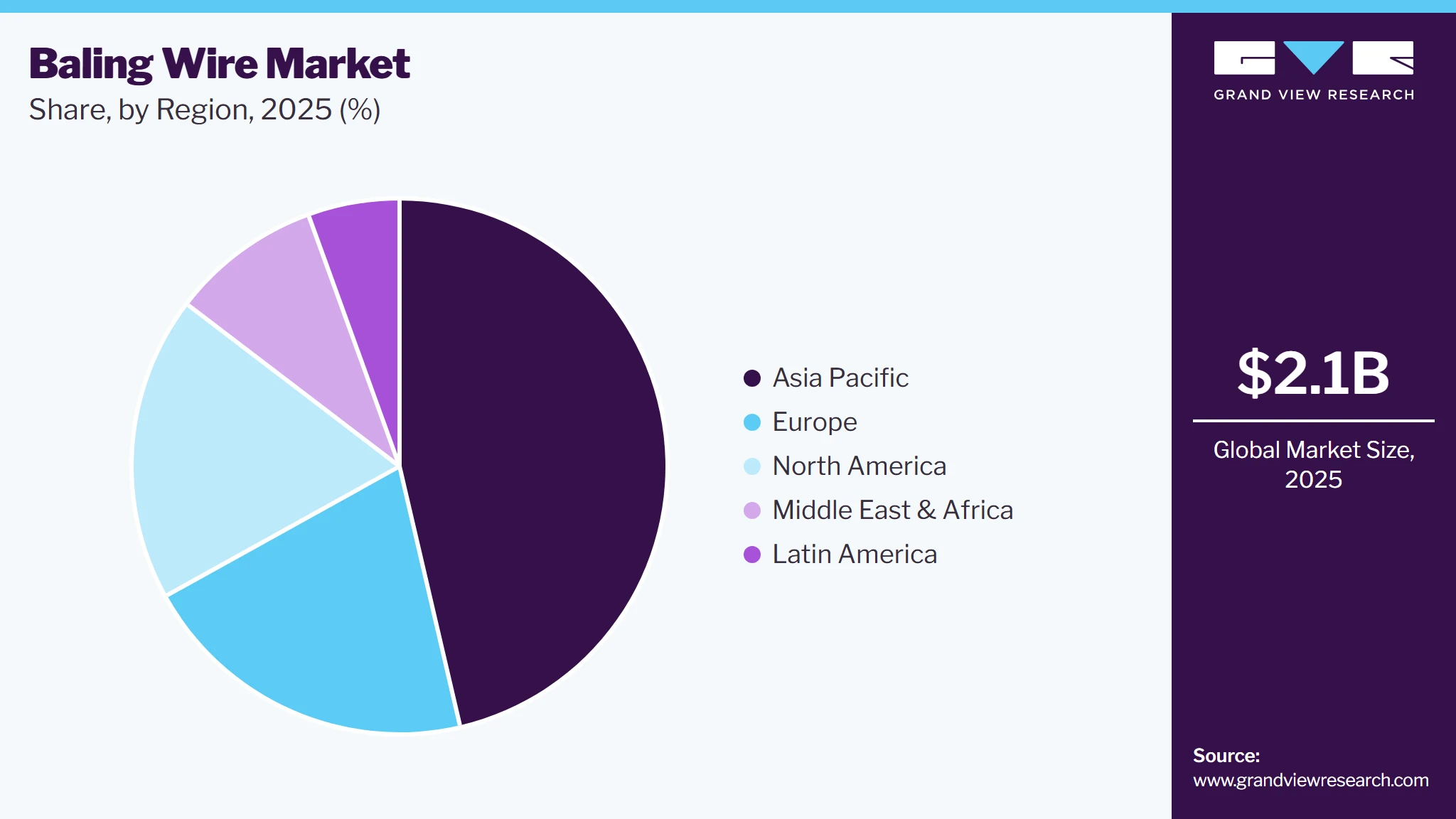
Asia Pacific dominated the baling wire market with the largest revenue share of 46.4% in 2025. The baling wire market in the China held the largest share in the Asia Pacific region in 2025. The Asia Pacific region is experiencing significant growth, primarily driven by the region's rapid industrialization and urbanization. Countries like China and India are expanding their recycling and waste management sectors to address the increasing volume of waste generated by urban populations. This expansion necessitates efficient baling solutions, boosting the baling wire demand. Additionally, the growth of the pulp and paper industry in the region contributes to the rising need for baling wire, as it is essential for bundling and transporting paper products.
 To learn more about this report, Download Free Sample Report
 North America Baling Wire Market Trends
The North American baling wire market is experiencing robust growth, driven by several key factors. One of the primary drivers is the increasing emphasis on recycling and waste management across the region. With growing environmental concerns and stringent regulations, industries are adopting efficient waste handling solutions, leading to a higher demand for baling wire to secure and transport recyclable materials. Additionally, the expansion of the pulp and paper industry, particularly in the U.S. and Canada, contributes to the rising need for baling wire, as it is essential for bundling and transporting paper products.
The U.S. baling wire market is experiencing significant growth, primarily driven by the expanding recycling and waste management sectors. With increasing environmental awareness and stringent regulations, industries are adopting efficient waste handling solutions, leading to a higher demand for baling wire to secure and transport recyclable materials. Additionally, the agricultural sector's shift towards mechanization has amplified the need for durable baling wire to bind hay and straw bales effectively. For instance, in December 2024, the acquisition of Olympic Wire and Equipment by Impact Environmental Group (IEG) was completed. This strategic move expanded IEG's presence on the West Coast, enhancing its service capabilities in the baling equipment and wire sector. Such collaborations underscore the industry's commitment to meeting the growing demand for efficient baling solutions across various applications.
Europe Baling Wire Market Trends
The European baling wire market is experiencing significant growth, primarily driven by the region's strong emphasis on recycling and waste management. The European Union's stringent regulations and sustainability targets have increased demand for efficient baling solutions in industries such as paper, plastic, and metal recycling. For instance, the EU's Circular Economy Action Plan enforces a 76% paper recycling target by 2030, compelling mills to upgrade baling systems for material recovery efficiency. This regulatory pressure and technological advancements in baling machinery are boosting the demand for high-quality baling wire across the region.
Latin America Baling Wire Market Trends
The Latin American baling wire market is experiencing notable growth, driven by the region's expanding recycling and agricultural sectors. Countries such as Brazil, Mexico, and Argentina are investing in advanced recycling technologies to manage increasing waste volumes, leading to a higher demand for efficient baling solutions. In agriculture, the shift towards mechanization and the need for efficient storage and transportation of crops like hay and sugarcane are boosting the use of baling wire.
Middle East & Africa Baling Wire Market Trends
The baling wire market in the MEA is witnessing growth, primarily driven by the region's expanding recycling and agricultural sectors. Countries like Saudi Arabia, the United Arab Emirates, and South Africa are investing in advanced recycling technologies to manage increasing waste volumes, leading to a higher demand for efficient baling solutions. In agriculture, the shift towards mechanization and the need for efficient storage and transportation of crops like hay and sugarcane are boosting the use of baling wire.
Key Baling Wire Company Insights
Some of the key players operating in the market include Accent Wire Tie, Advanced Wires Limited, and others
- Accent Wire Tie offers a comprehensive range of baling wire options, including box wire, stand wire, and bale ties, catering to various industries such as recycling, agriculture, and waste management. With a robust manufacturing and distribution network, Accent Wire Tie ensures timely delivery of high-quality products across the U.S., supporting efficient operations for its clients.
- Advanced Wires Limited specializes in the production of high-quality baling wire products tailored for the recycling and waste management industries. Leveraging over 46 years of combined experience in the recycling sector, the company offers a diverse range of baling wire solutions, including Quicklink bale ties, cut and looped wire, auto-galvanized wire, and re-wound coils. Their products are designed to meet the specific needs of various applications, ensuring durability and efficiency in securing recyclable materials.
Key Baling Wire Companies:
The following key companies have been profiled for this study on the baling wire market.
-
Accent Wire Tie
-
Advanced Wires Limited
-
AGST Draht-und Biegetechnik GmbH
-
Barnfather Wire
-
Gama Metal
-
Hörle Wire AB
-
MAZZOLENI TRAFILERIE BERGAMASCHE SPA
-
IBERMETAIS
-
Metalurgia S.A
Competitive Benchmarking
Category
Operating Strategies
Competitive Edge
Weakness
Established Players (e.g. Accent Wire Tie, Advanced Wires Limited)
- Mature participants in the baling wire market primarily focus on high volume manufacturing, broad distribution networks, and long term supply agreements with recycling facilities, waste management companies, agricultural operations, and packaging industries.
- These companies typically operate integrated wire production facilities that include wire rod processing, drawing, galvanizing, coating, and packaging operations.
- Established players possess significant competitive advantages through their large scale manufacturing capacities, integrated production capabilities, and extensive distribution infrastructure.
- Their ability to procure raw materials in bulk and optimize production processes enables lower manufacturing costs and greater pricing competitiveness.
- Despite their strong market presence, mature players face challenges associated with fluctuations in steel wire rod prices and raw material costs.
- Since baling wire is often a relatively low margin product, changes in steel prices, energy costs, and transportation expenses can significantly impact profitability.
Emerging & Regional Players (e.g., Gama Metal, Hörle Wire AB)
- Emerging participants in the baling wire market generally focus on regional markets, customized wire products, and customer specific service offerings.
- Rather than competing directly with large manufacturers on production scale, these companies often target localized demand and specialized applications requiring flexible production schedules and tailored product specifications.
- Emerging companies benefit from operational flexibility and the ability to quickly respond to changing customer requirements.
- Their smaller organizational structures often enable faster decision making, customized product development, and closer engagement with local customers.
- Emerging participants face significant challenges related to limited production capacity, lower economies of scale, and restricted purchasing power for raw materials.
- Competing with established manufacturers that benefit from large volume production and extensive distribution networks can be difficult, especially in price sensitive market segments.
Recent Developments
-
In April 2024, Stadler introduced a new automated bale wire remover, the Wirex, designed to address the challenges faced by recycling facilities in efficiently and safely removing wire from bales. Baling wire is essential for handling large volumes of waste, but removing it is often labor-intensive. The Wirex uses advanced sensor detection and measurement systems to automatically measure bales and remove wires from single- and cross-wired bales in a single pass, eliminating the risk of double feeding.
Baling Wire Market Report Scope
Report Attribute
Details
Market definition
The market represents the apparent consumption of baling wire-in various applications.
Market size in 2025
USD 2.1 billion
Estimated market size in 2026
USD 2.2 billion
Projected market size by 2033
USD 4.7 billion
Growth rate
CAGR of 11.3% from 2026 to 2033
Base year for estimation
2025
Historical data
2021 - 2024
Forecast period
2026 - 2033
Quantitative units
Revenue in USD million, volume in kilotons, and CAGR from 2026 to 2033
Report coverage
Revenue forecast, volume forecast, company ranking, competitive landscape, growth factors, and trends
Segments covered
End use, and region.
Regional scope
North America; Europe; Asia Pacific; Latin America; Middle East & Africa
Country scope
U.S., Canada, Mexico, Germany, UK, France, Italy, Spain, India, China, Japan, South Korea, Brazil, Saudi Arabia, UAE
Key companies profiled
Accent Wire Tie, Advanced Wires Limited, AGST Draht und Biegetechnik GmbH, Barnfather Wire, Gama Metal, Hörle Wire AB, Mazzoleni Trafilerie Bergamasche S.p.A., Ibermetais, Metalurgia S.A.
Customization scope
Free report customization (equivalent up to 8 analysts' working days) with purchase. Addition or alteration to country, regional & segment scope.
Pricing and purchase options
Avail customized purchase options to meet your exact research needs. Explore purchase options
Global Baling Wire Market Report Segmentation
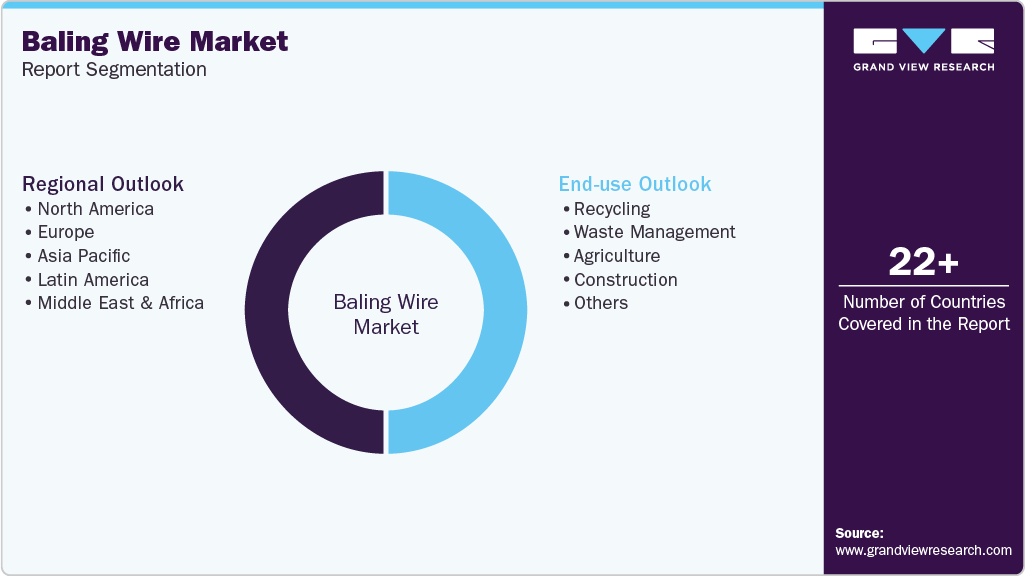
This report forecasts revenue and volume growth at the global, regional, and country levels and provides an analysis of the latest industry trends in each of the sub-segments from 2021 to 2033. For the purpose of this study, Grand View Research has segmented the global baling wire market report based on end use, and region:
 To learn more about this report, Download Free Sample Report
 -
End Use Outlook (Volume, Kilotons; Revenue, USD Million; 2021 - 2033)
-
Recycling
-
Waste Management
-
Agriculture
-
Construction
-
Others
-
-
Regional Outlook (Volume, Kilotons; Revenue, USD Million; 2021 - 2033)
-
North America
-
U.S.
-
Canada
-
Mexico
-
-
Europe
-
UK
-
Germany
-
France
-
Italy
-
Russia
-
Spain
-
Portugal
-
-
Asia Pacific
-
China
-
India
-
Japan
-
South Korea
-
-
Latin America
-
Brazil
-
-
Middle East & Africa
-
Saudi Arabia
-
UAE
-
-
Research Methodology
The baling wire market figures in this report are based on a proven research process that combines executive interviews with secondary research from proprietary databases, company filings, and recognized regulatory and institutional sources. Market size is built through value-chain sizing - reconciling supply-side and demand-side estimates - and triangulated with bottom-up and top-down approaches. Every estimate passes multiple levels of expert validation before publication, with each baling wire segment quantified using the revenue-capture definitions in the table below.
Segment Definition
End Use
Revenue Capture Definition
Recycling
The use of baling wire to compress and secure recyclable materials such as paper, cardboard, plastics, aluminum cans, and scrap metal into compact bales for storage, transportation, and processing.
Waste Management
The application of baling wire in waste collection and disposal operations to bind municipal solid waste, industrial waste, and other refuse into manageable bales that facilitate handling, transportation, and landfill management.
Agriculture
The use of baling wire to bind and secure agricultural products such as hay, straw, cotton, and forage into bales for efficient storage, transportation, and livestock feeding purposes.
Construction
The utilization of baling wire in construction activities for bundling and securing materials such as metal scrap, reinforcement bars, insulation materials, and construction debris during transportation, storage, and recycling processes.
Others
Includes applications across industries such as textiles, packaging, manufacturing, logistics, and warehousing where baling wire is used to compact, bundle, and secure materials for handling, storage, or shipment.
Estimation Model
Layer Name
Key Question
Description
Baled Material Demand Base Layer
What forms the demand base?
Identify global volumes of recyclable materials, agricultural products, and industrial waste that require baling for storage, handling, and transportation. Assess demand from recycling facilities, agriculture, waste management companies, paper mills, textile industries, and metal recycling operations. This layer establishes the total addressable demand for baling wire.
Baling Wire Application Penetration Layer
Where is baling wire utilized?
Estimate the penetration of baling wire across key applications including paper and cardboard recycling, plastic recycling, metal scrap baling, textile packaging, cotton baling, hay baling, and waste compaction. Analyze the adoption of single loop, double loop, galvanized, black annealed, and high tensile baling wire across end use sectors and regions.
Wire Consumption Intensity Layer
How much baling wire is consumed?
Analyze baling wire consumption intensity based on the volume of materials processed, bale size, baling frequency, compression requirements, and operational efficiency. Evaluate wire usage per ton of recycled material, agricultural produce, or industrial waste. Consumption intensity varies according to baler type, material density, and packaging standards.
Revenue Layer
How is market revenue generated?
Market revenue is quantified through the sale of baling wire products including black annealed wire, galvanized wire, high tensile wire, and specialty baling wire solutions. Revenue generation is driven by demand from recycling, agriculture, waste management, textile, and metal processing industries. Market value is influenced by steel wire prices, product specifications, coating requirements, wire strength, and regional demand dynamics.
Delivered Customizations
This report has been delivered with the following In-depth customizations
Client Request
Customization Delivered
Value Adds
Regional Segmentation
Detailed regional analysis of the baling wire market across North America, Europe, Asia Pacific, Latin America, and Middle East & Africa. Included evaluation of recycling industry growth, waste management infrastructure, agricultural production, packaging demand, metal recycling activities, logistics development, and industrial manufacturing trends influencing baling wire consumption.
Identified high growth demand centers across recycling, agriculture, and waste management sectors. Enabled regional expansion planning based on recycling rates, agricultural output, and industrial activity. Supported demand forecasting and market penetration strategies.
Trade Assessment
Evaluation of global baling wire trade flows, export import trends, country level trade balances, sourcing patterns, logistics routes, tariff impacts, and regional manufacturing competitiveness. Included assessment of international shipments of baling wire products serving recycling facilities, agricultural operations, and industrial packaging markets.
Highlighted export opportunities, sourcing risks, and import dependency trends. Supported strategic procurement decisions, logistics planning, and international market expansion initiatives.
Opportunity Assessment
Identification of high growth opportunities across recycling facilities, waste management operations, agricultural hay and straw baling, industrial packaging, paper recycling, textile recycling, and metal scrap processing industries. Assessed future demand potential driven by increasing recycling rates, sustainability initiatives, circular economy regulations, and agricultural mechanization trends.
Enabled prioritization of high return growth segments and emerging regional opportunities. Supported long term investment planning, capacity expansion decisions, and strategic business development initiatives aligned with sustainability and resource recovery trends.
Frequently Asked Questions About This Report
Middle East & Africa is anticipated to register the fastest CAGR over the forecast period.
Based on end use, recycling accounted for largest revenue share of 42.2% in 2025.
Based on end use, agriculture registered the fastest CAGR over the forecast period.
The key players operating in the baling wire market are Accent Wire Tie, Advanced Wires Limited, AGST Draht und Biegetechnik GmbH, Barnfather Wire, Gama Metal, Hörle Wire AB, Mazzoleni Trafilerie Bergamasche S.p.A., Ibermetais, Metalurgia S.A.
The baling wire market size was estimated at USD 2.1 billion in 2025 and is expected to reach USD 2.2 billion in 2026.
The baling wire market is expected to grow at a compound annual growth rate of 11.3% from 2026 to 2033 to reach USD 4.7 billion by 2033.
The key factor that is driving the growth of the global baling wire market is the increasing demand for efficient and secure packaging solutions across industries such as recycling, agriculture, and construction, where baling wire is essential for bundling, transporting, and storing materials safely and cost-effectively.
Asia Pacific dominated the market with revenue share of 46.4% in 2025.
China dominated the Asia Pacific market with revenue share of 38.4% in 2025.
About the Author(s)
Advanced Interior Materials Research Team
Advanced Materials · Advanced Interior MaterialsThis report was authored by the advanced interior materials research team at Grand View Research - comprising two research analysts, one senior research analyst, and one industry expert - with specialized expertise in the advanced interior materials segment of the advanced materials industry. All findings are based on proprietary advanced materials databases, executive interviews, and regulatory analysis, subject to internal peer review prior to publication.
Last Updated:
Speak to Analyst

Customize this report to your needs - add regions, segments, or data points, with 20% free customization.
Or view our licence options:


ISO 9001:2015 & 27001:2022 Certified
We are GDPR and CCPA compliant! Your transaction & personal information is safe and secure. For more details, please read our privacy policy.


