
- Home
- »
- Advanced Interior Materials
- »
-
Balsa Wood Market Size Share & Trends Report, 2026-2033GVR Report cover

Balsa Wood Market (2026 - 2033)
Size, Share & Trends Analysis Report By Product (Grade A, Grade B, Grade C), By End Use (Aerospace & Defense, Marine, Wind Energy), By Region (North America, Asia Pacific), And Segment Forecasts
Market Size, 2025
$180.7MMarket Estimate, 2026
$192.1MMarket Forecast, 2033
$294.6MCAGR, 2026–2033
6.3%Balsa Wood Market Summary
The global balsa wood market size was valued at USD 180.7 million in 2025 and is projected to grow from USD 192.1 million in 2026 to USD 294.6 million by 2033, at a CAGR of 6.3% from 2026 to 2033. Asia Pacific dominated the balsa wood market with the largest revenue share of 40.1% in 2025. The market is driven by the widespread adoption of balsa wood across various industries such as marine, construction, and wind energy.
 Source: Grand View Research, IR Documents, Primary Interviews, Paid DatabasesTo learn more about this report,
 Download Free Sample Report
 Key Market Trends & Insights
- By product: Grade A segment held the largest market share of 53.4% in 2025.
- By end use: Wind energy segment held the largest market share of 45.2% in 2025.
Regional Highlights
- Largest regional market: Asia Pacific (40.1% revenue share, 2025)
- By country: China held the largest market share in 2025.
Market Size & Forecast
- Market size in 2025: USD 180.7 million
- Estimated market size in 2026: USD 192.1 million
- Projected market size by 2033: USD 294.6 million
- CAGR (2026-2033): 6.3%
Three ways to get this report
Buy it, customize it, or ask a question.Ask an Analyst
A direct answer, usually in 1 working day
- AccessReport author, directly
- Reply timeWithin 1 working day
- No sales callDirect answer only
- FormatEmail reply
- CostFree, no cost
Get the Full Report
What the study covers
- FormatsPDF · Excel · Dashboard
- Timeline2026–2033 annual, 2025 base
- Coverage20+ countries, 5 regions
- Companies10+ key players profiled
Customize the Report
20% free customization
- IncludeCountries, segments, points
- TailorTo your product definition
- ExtendDeeper competitor detail
- OrA fully bespoke study
- Turnaround5–10 working days
Balsa wood’s unique properties-being lightweight, strong, and having excellent insulation capabilities- make it an ideal material for applications where the strength-to-weight ratio is critical. Another major driver is the expanding wind energy sector, where balsa wood is used extensively in the core material of wind turbine blades. As countries across the globe increase their investments in renewable energy sources to meet sustainability targets, the demand for efficient and durable materials like balsa wood continues to rise. Additionally, the construction industry's growing focus on sustainable building practices has spurred the use of balsa wood in insulation and structural panels due to its renewable nature and favorable environmental profile. To learn more about this report, Download Free Sample Report
 Moreover, technological advancements in wood processing and composite manufacturing have improved the quality, durability, and performance of balsa wood products. This has widened its application scope and attracted new end-users, thereby supporting market expansion. The availability of plantation-grown balsa wood, especially in regions such as Ecuador and Papua New Guinea, ensures a stable and sustainable supply chain, further encouraging the material's adoption across global markets.
Market Dynamics
The balsa wood market is experiencing steady growth driven by increasing demand for lightweight, high-strength, and sustainable core materials across industries such as wind energy, marine, aerospace, transportation, and construction. Balsa wood's excellent strength-to-weight ratio, low density, and insulation properties make it a preferred core material for composite structures, particularly in wind turbine blades and lightweight transportation components. Growing investments in renewable energy, rising adoption of composite materials, and increasing focus on sustainable manufacturing are further supporting market expansion.
The growing emphasis on lightweight and high-strength materials across industries such as wind energy, marine, aerospace, and transportation is a key driver of the global balsa wood market. Balsa wood is widely used as a core material in composite structures due to its excellent strength-to-weight ratio, vibration resistance, and thermal insulation properties. In the wind energy sector, the increasing installation of larger and more efficient wind turbine blades has significantly boosted the demand for balsa wood, as it helps reduce overall blade weight while maintaining structural integrity and durability. The transition toward renewable energy generation and rising investments in wind power projects across Europe, Asia Pacific, and North America are further accelerating market growth.
Additionally, manufacturers in marine and transportation industries are increasingly adopting balsa wood-based composites to improve fuel efficiency and reduce emissions through vehicle and vessel weight reduction. The material’s natural and renewable characteristics also align with the growing focus on sustainable manufacturing and eco-friendly materials. Rising demand for high-performance composite applications, coupled with advancements in composite manufacturing technologies, continues to strengthen the adoption of balsa wood across multiple end-use industries.
The global balsa wood market faces challenges associated with limited raw material availability and supply chain instability. Balsa wood is primarily sourced from specific regions in South America, particularly Ecuador, making the market highly dependent on regional climatic conditions, forestry practices, and export dynamics. Fluctuations in supply due to weather conditions, illegal harvesting, and increasing demand from the wind energy sector can result in raw material shortages and price volatility. Additionally, concerns related to deforestation and sustainable sourcing regulations may further restrict supply, creating challenges for manufacturers relying on consistent availability of high-quality balsa wood for composite applications.
The growing investment in onshore and offshore wind energy projects is creating significant opportunities for the balsa wood market, as larger turbine blades require lightweight and durable core materials. Increasing use of composite sandwich structures in marine, aerospace, transportation, and construction applications, along with advancements in composite manufacturing technologies and sustainable forestry practices, is further driving demand. Additionally, the global shift toward renewable and bio-based materials is expected to support long-term market growth.
Market Concentration & Characteristics
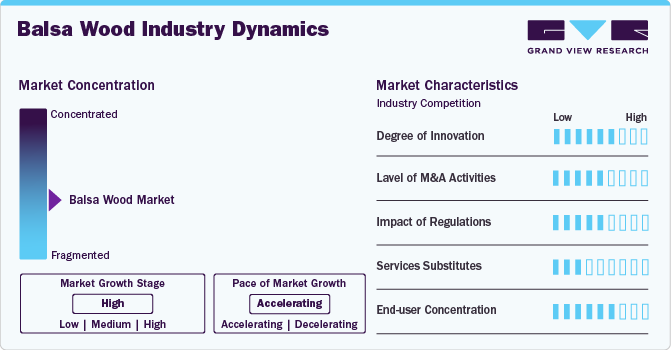
The industry is characterized by moderate to high concentration, with a few major players holding a significant share due to the limited availability of high-quality balsa resources, primarily sourced from regions like Ecuador.
The degree of innovation within the industry remains relatively low, as balsa wood is a naturally occurring material with limited scope for technological advancement; however, innovation is evident in processing techniques and composite product development for industries such as wind energy.
 To learn more about this report, Download Free Sample Report
 Mergers and acquisitions are moderately active, driven by companies seeking to secure raw material supply and expand their market reach amid fluctuating availability. Regulatory impacts are pronounced, particularly concerning sustainable forestry practices and trade regulations designed to preserve natural ecosystems, which influence production costs and operational strategies.
Substitutes for balsa wood, such as foams, synthetic composites, and other lightweight materials, have limited but growing impact, especially in industries requiring cost-efficient and high-performance alternatives. Nevertheless, balsa’s superior strength-to-weight ratio and natural properties sustain its niche in specialized applications.
End-use concentration is relatively high, with dominant demand coming from the marine, wind energy, and model-building sectors. The wind energy segment, in particular, has notably increased end-use concentration due to the rising adoption of balsa in manufacturing turbine blades, making fluctuations in this industry highly influential on overall market dynamics.
Analyst Perspective
The balsa wood market is undergoing steady transformation, supported by the growing adoption of lightweight core materials in high-performance composite applications and the global shift toward sustainable manufacturing practices. The wind energy industry will remain the primary demand generator, driven by increasing installations of larger wind turbines, while marine, aerospace, transportation, and industrial sectors are expected to provide sustained growth through greater use of advanced sandwich composites. As supply constraints and raw material availability continue to influence market dynamics, manufacturers are increasingly focusing on sustainable forestry, supply chain diversification, and value-added processing capabilities. Companies that can secure reliable sourcing, enhance product consistency, and align their portfolios with evolving performance and sustainability requirements are expected to strengthen their competitive position and capitalize on long-term market opportunities.
End Use Insights
Based on end use, the wind energy segment led the market with the largest revenue share of 45.2% in 2025 and is expected to grow at a CAGR of 6.6% over the forecast period. Balsa wood’s exceptional strength-to-weight ratio and natural stiffness make it an ideal core material for the production of wind turbine blades, where lightweight and durable structures are critical for optimizing performance and efficiency. As countries and energy companies intensify their investments in wind energy infrastructure to meet carbon neutrality and sustainability targets, the demand for reliable and high-performance materials like balsa wood has correspondingly surged.
The marine segment is expected to grow significantly at a CAGR of 6.2% over the forecast period, driven by the material’s exceptional strength-to-weight ratio, making it highly suitable for applications where both durability and lightweight characteristics are critical. Balsa wood is extensively used in the production of boat hulls, decks, and interiors, particularly within the construction of high-performance vessels, yachts, and recreational boats. Its natural resistance to compression and fatigue, combined with easy machinability, supports the growing demand for materials that enhance fuel efficiency and speed without compromising structural integrity.
Product Insights
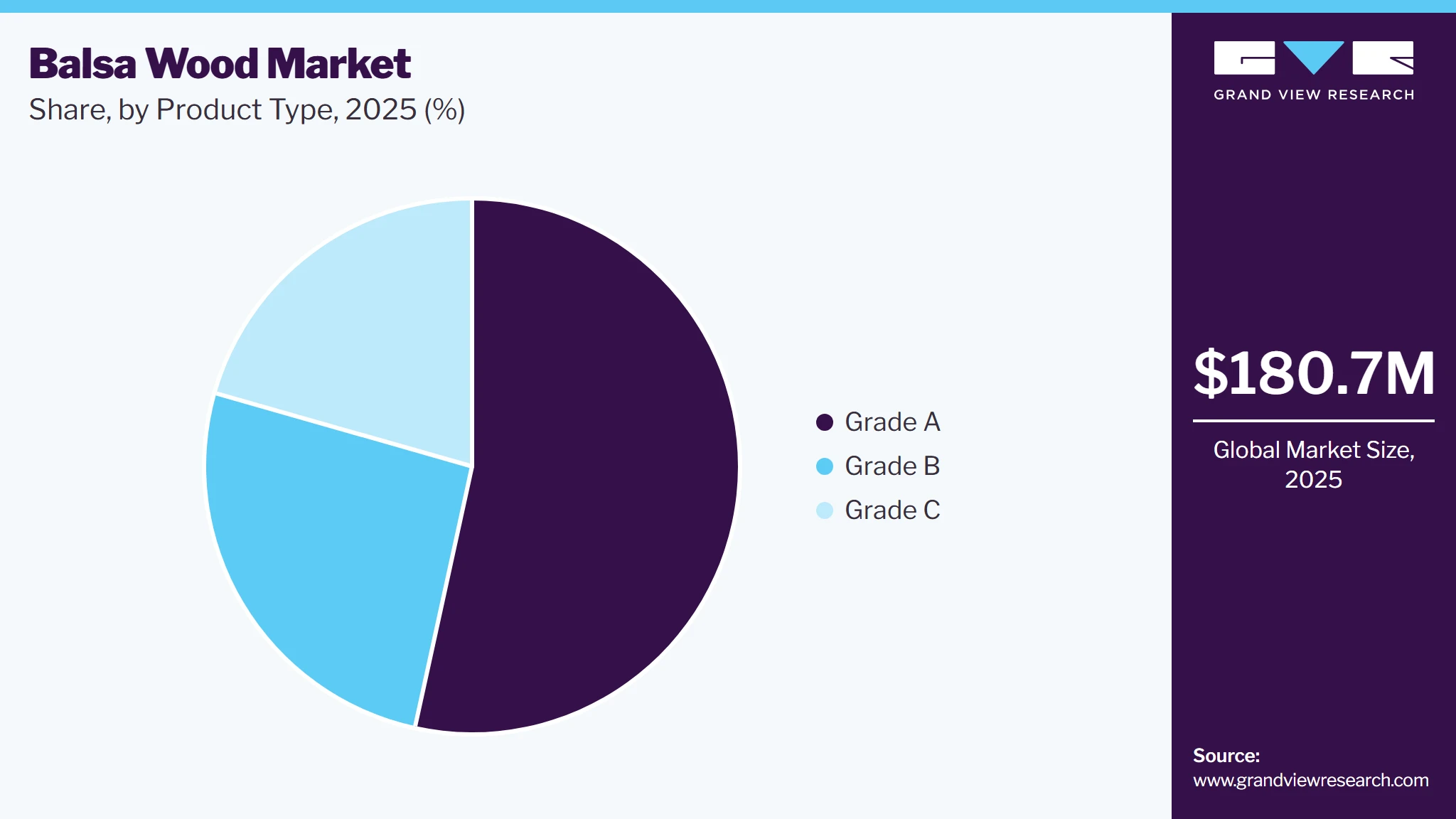
Based on product, the grade A segment led the market with the largest revenue share of 53.4% in 2025 and is expected to grow at a CAGR of 6.6% over the forecast period, driven by the increasing demand for high-quality, lightweight materials across critical industries such as marine and wind energy. Grade A balsa wood, known for its superior density uniformity, minimal defects, and excellent strength-to-weight ratio, is particularly sought after for applications requiring precision and reliability. Similarly, the growing investment in renewable energy infrastructure, especially in the production of wind turbine blades, is significantly boosting demand for premium-grade balsa wood, as it offers the necessary mechanical strength while maintaining weight efficiency.
 To learn more about this report, Download Free Sample Report
 The Grade B segment is expected to grow significantly at a CAGR of 6.0% over the forecast period. The increasing emphasis on sustainable materials in manufacturing and construction has positively influenced the Grade B segment. As environmental regulations and consumer preferences shift toward eco-friendly solutions, the use of natural, biodegradable materials like balsa wood becomes more appealing, even for mid-grade products. The versatility of Grade B balsa in being easily shaped, bonded, and integrated into composite materials also drives its demand, particularly in emerging economies where cost considerations are paramount.
Regional Insights
Asia Pacific dominated the balsa wood market with the largest revenue share of 40.1% in 2025. The material’s lightweight and high-strength properties make it an ideal choice for aircraft interiors, structural panels, and wind turbine blades. Federal initiatives promoting renewable energy projects, coupled with rising investment in lightweight Marine and defense applications, are enhancing market prospects. Moreover, North American consumers' increasing preference for sustainable and bio-based materials fuels the adoption of responsibly sourced balsa wood across multiple sectors.
U.S. Balsa Wood Market Trends
The balsa wood market in the U.S. benefits significantly from the country’s leadership in wind energy innovation and the growing emphasis on renewable energy installations, particularly wind energy projects in states such as Texas and Iowa. Balsa wood’s superior mechanical properties make it essential for reducing overall weight without sacrificing structural strength in wind energy and marine manufacturing. The focus on energy efficiency, coupled with government-backed sustainability initiatives, further accelerates balsa wood usage. Moreover, advancements in composite technology and the expanding recreational boating industry continue to serve as important growth catalysts for the U.S. market.
Asia Pacific Balsa Wood Market Trends
The balsa wood market in Asia Pacific dominated the global industry and accounted for the largest revenue share of about 39.9% in 2025, driven by the rapid expansion of the wind energy sector, especially in countries such as India, China, and Australia, where governments are heavily investing in renewable energy infrastructure. Balsa wood’s critical role as a core material in the production of lightweight, high-performance wind turbine blades has substantially elevated its demand. Additionally, the region's expanding marine, construction, and energy industries, which increasingly favor lightweight and sustainable materials, further boost market growth. Growing emphasis on sustainable forestry practices and regional manufacturing capabilities also supports the long-term development of the balsa wood sector in Asia Pacific.
 To learn more about this report, Download Free Sample Report
 The balsa wood market in China held the largest share in the Asia Pacific region in 2025. China balsa wood market is mainly driven by the country’s position as a global manufacturing hub for wind turbine production, a sector where balsa is a preferred material for core composites. China's aggressive renewable energy targets under its carbon neutrality commitments are directly influencing the increased consumption of balsa wood. Additionally, the country’s burgeoning marine and high-speed rail sectors, where lightweight materials are critical for efficiency and performance, further contribute to demand. The rise of domestic composite material industries, alongside government incentives for sustainable material adoption, reinforces China's growing reliance on balsa wood.
Europe Balsa Wood Market Trends
The balsa wood market in Europe is driven by the region’s stringent environmental regulations and its leadership in renewable energy adoption, particularly in offshore wind energy projects. European manufacturers are increasingly integrating balsa wood into composite structures to meet high-performance and sustainability standards. The region’s well-established marine and Marine industries also contribute significantly to demand, as lightweight materials are crucial for achieving emissions reduction targets. Furthermore, the growing focus on green building certifications and sustainable construction materials supports steady market expansion across Europe.
Germany balsa wood market is fueled by the country’s strong wind energy sector, particularly in offshore wind farms, where balsa is extensively used in turbine blade cores. Germany’s advanced marine and aerospace industries also create sustained demand for lightweight, durable materials like balsa wood. Regulatory initiatives promoting carbon neutrality and sustainable material adoption across the construction and transportation sectors further amplify growth. Additionally, Germany’s reputation for technological innovation drives ongoing research into composite materials incorporating balsa wood, supporting continuous market development.
Central & South America Balsa Wood Market Trends
The balsa wood market in Central & South America is significantly driven by Ecuador's position as the world's largest supplier of high-quality balsa wood, facilitating strong regional supply chains. Growth in renewable energy initiatives, particularly in Brazil and Chile, has also spurred demand for balsa in wind turbine manufacturing. Additionally, the region’s traditional and growing marine construction sectors utilize balsa wood for boat-building applications. Increasing awareness about sustainable forestry practices and international demand for certified sustainable products is encouraging producers in Latin America to enhance production capabilities and quality standards.
Middle East & Africa Balsa Wood Market Trends
The balsa wood market in the Middle East & Africa is driven by growing investment in lightweight construction and renewable energy projects, particularly in emerging economies seeking to diversify energy sources. The marine sector, crucial for tourism and offshore industries in the Middle East, also contributes to the demand for balsa wood as a core material for lightweight and high-strength structures. Additionally, the gradual shift toward sustainable building materials in new urban developments, especially in countries like the UAE and Saudi Arabia, is fostering the adoption of bio-based materials like balsa wood.
Key Balsa Wood Company Insights
Key players operating in the balsa wood market are undertaking various initiatives to strengthen their presence and increase the reach of their products and services. Strategies such as expansion activities and partnerships are key in propelling the market growth.
Key Balsa Wood Companies:
The following key companies have been profiled for this study on the balsa wood market.
-
3A Composites GmbH
-
Schweiter Technologies AG
-
DIAB International AB
-
CoreLite Inc.
-
Gurit Holding AG
-
Carbon-Core Corp.
-
Pacific Coast Marine
-
Pontus Wood Group
-
BALTEK Corporation
Competitive Benchmarking
Category
Operating Strategies
Competitive Edge
Weakness
Established Players (3A Composites GmbH, Schweiter Technologies AG, DIAB International AB)
- Expansion of sustainable balsa wood sourcing and processing capabilities
- Long-term supply agreements with wind energy and composite manufacturers
- Investments in engineered core material solutions and global distribution networks.
- Strong relationships with wind turbine blade and marine composite manufacturers
- Established sourcing networks and large-scale processing capabilities
- Broad product portfolio with consistent material quality and certification standards
- Dependence on limited geographic sourcing regions such as South America
- Exposure to fluctuations in raw material availability and pricing
- High logistics and transportation costs associated with global supply chains
Emerging & Regional Players (CoreLite Inc., Carbon-Core Corp., Pacific Coast Marine)
- Focus on niche composite applications and customized core material solutions
- Adoption of sustainable forestry and plantation management practices
- Expansion into regional markets with cost-effective processing capabilities
- Greater flexibility in meeting customized customer requirements
- Competitive pricing strategies in regional markets
- Increasing focus on eco-friendly and certified balsa wood products
- Limited production capacity and global market presence
- Lower bargaining power compared to established suppliers
- Challenges in securing long-term contracts with large end-use industries
Recent Developments
-
In April 2023, 3A Composites Core Materials introduced a new product line named Engicore Core Materials, targeting primarily the South and North American markets. With this launch, the company aims to expand its product portfolio by offering a range that enables customers to access customized solutions, allowing them to swiftly adapt to various manufacturing processes and standard requirements.
Balsa Wood Market Report Scope
Report Attribute
Details
Market size in 2025
USD 180.7 million
Estimated market size in 2026
USD 192.1 million
Projected market size by 2033
USD 294.6 million
Growth rate
CAGR of 6.3% from 2026 to 2033
Base year for estimation
2025
Historical data
2021 - 2024
Forecast period
2026 - 2033
Quantitative units
Revenue in USD million and CAGR from 2026 to 2033
Report coverage
Revenue forecast, company ranking, competitive landscape, growth factors, and trends
Segments covered
Product, end use, region
Regional scope
North America; Europe; Asia Pacific; Latin America; MEA
Country scope
U.S.; Canada; Mexico; U.K.; Germany; France; Italy; Spain; China; India; Japan; South Korea
Key companies profiled
3A Composites GmbH; Schweiter Technologies AG; DIAB International AB; CoreLite Inc.; Gurit Holding AG; Carbon-Core Corp.; Pacific Coast Marine; Pontus Wood Group; BALTEK Corporation
Customization scope
Free report customization (equivalent up to 8 analysts' working days) with purchase. Addition or alteration to country, regional & segment scope.
Pricing and purchase options
Avail customized purchase options to meet your exact research needs. Explore purchase options
Global Balsa Wood Market Report Segmentation
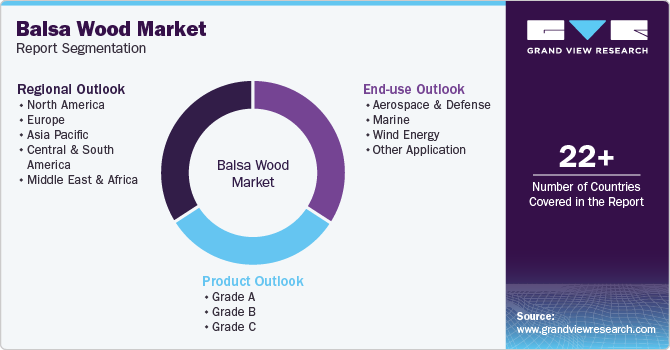
This report forecasts revenue growth at the global, regional, and country levels and provides an analysis of the latest industry trends in each of the sub-segments from 2021 to 2033. For this study, Grand View Research has segmented the global balsa wood market report based on product, end use, and region.
 To learn more about this report, Download Free Sample Report
 -
Product Outlook (Revenue, USD Million, 2021 - 2033)
-
Grade A
-
Grade B
-
Grade C
-
-
End Use Outlook (Revenue, USD Million, 2021 - 2033)
-
Aerospace & Defense
-
Marine
-
Wind Energy
-
Other Application
-
-
Regional Outlook (Revenue, USD Million, 2021 - 2033)
-
North America
-
U.S.
-
Canada
-
Mexico
-
-
Europe
-
Germany
-
UK
-
France
-
Italy
-
Spain
-
-
Asia Pacific
-
China
-
Japan
-
India
-
South Korea
-
-
Central & South America
-
Middle East & Africa
-
Research Methodology
The balsa wood market figures in this report are based on a proven research process that combines executive interviews with secondary research from proprietary databases, company filings, and recognized regulatory and institutional sources. Market size is built through value-chain sizing - reconciling supply-side and demand-side estimates - and triangulated with bottom-up and top-down approaches. Every estimate passes multiple levels of expert validation before publication, with each balsa wood segment quantified using the revenue-capture definitions in the table below.
Segment Definition
Segment - Product
Revenue Capture Definition
Grade A
Revenue generated from the sale of premium-grade balsa wood characterized by superior density uniformity, high mechanical strength, and minimal defects. This segment captures revenues from manufacturers supplying high-performance balsa wood for demanding composite applications, including wind turbine blades, aerospace & defense, and advanced marine structures where superior structural integrity is required.
Grade B
Revenue generated from the sale of medium-grade balsa wood offering a balanced combination of strength, weight, and cost. This segment captures revenues from manufacturers supplying balsa wood for general composite applications across marine, transportation, construction, and industrial sectors where moderate structural performance and cost efficiency are key considerations.
Grade C
Revenue generated from the sale of economy-grade balsa wood with relatively lower density consistency and mechanical properties. This segment captures revenues from manufacturers supplying balsa wood for non-critical structural applications, insulation, model making, packaging, and other industrial uses where lightweight characteristics are prioritized over high structural performance.
Segment- End Use
Revenue Capture Definition
Aerospace & Defense
Revenue generated from the sale of balsa wood used as a lightweight core material in aerospace and defense composite structures. This segment captures revenues from manufacturers supplying balsa wood for aircraft interiors, radomes, unmanned aerial vehicles (UAVs), military equipment, and other high-performance applications requiring lightweight construction and structural stability.
Marine
Revenue generated from the sale of balsa wood used in the production of composite marine structures, including boat hulls, decks, yachts, ferries, and other watercraft. This segment captures revenues from manufacturers supplying lightweight core materials that improve vessel strength, durability, buoyancy, and fuel efficiency.
Wind Energy
Revenue generated from the sale of balsa wood used as a core material in wind turbine blades. This segment captures revenues from manufacturers supplying high-strength, lightweight balsa wood for onshore and offshore wind energy projects, enabling improved blade stiffness, durability, and operational efficiency.
Others
Revenue generated from the sale of balsa wood used in applications outside aerospace & defense, marine, and wind energy. This segment captures revenues from manufacturers supplying balsa wood for transportation, construction, sporting goods, furniture, industrial products, model making, insulation, and other niche composite and lightweight applications.
Estimation Model
Layer Name
Key Question
Description
Global Core Materials Market
What is the total market value of core materials used in composite applications across industries?
Establishes the overall addressable market by analyzing demand for core materials used in composite structures across wind energy, marine, aerospace, transportation, construction, and other industrial applications. The analysis includes both natural and synthetic core materials across major regions and countries.
Balsa Wood Penetration Analysis
What proportion of the core materials market is represented by balsa wood?
Filters the broader core materials market by evaluating the adoption of balsa wood relative to alternative core materials such as PVC foam, PET foam, SAN foam, honeycomb, and other lightweight core materials. Penetration is assessed based on application suitability, mechanical performance, sustainability, cost competitiveness, and end-use industry preferences.
Application-Level Demand Assessment
How much balsa wood demand is generated across individual end-use industries?
Quantifies balsa wood demand across wind energy, marine, aerospace, transportation, construction, and other industrial applications. Demand is evaluated based on composite production volumes, core material consumption per application, manufacturing trends, and industry-specific adoption rates across different regions.
Revenue Realization & Market Sizing
What revenue is generated from balsa wood sales across applications and regions?
Converts balsa wood consumption into market revenue using average selling prices, product grades, processing levels, and regional pricing variations. The final market size is calculated by aggregating revenues across end-use applications and geographic markets to derive the overall global balsa wood market value.
Delivered Customizations
This report has been delivered with the following In-depth customizations
Client Request
Customization Delivered
Value Adds
Opportunity Assessment
Mapping growth opportunities across wind energy, marine, aerospace, transportation, and industrial composite applications, along with analysis of trends such as lightweight material adoption, renewable energy expansion, and increasing use of sustainable core materials.
Help identify high-growth applications and emerging demand areas, supports investment prioritization, and enables strategic expansion planning in the balsa wood market.
Regulatory & Sustainability Compliance
Analysis of environmental regulations, sustainable forestry certifications, sourcing standards, and compliance frameworks related to balsa wood harvesting, processing, and composite manufacturing across major regions.
Supports sustainable sourcing strategies, helps address regulatory risks, and enables alignment with environmental and ESG objectives across the value chain.
Regional Segmentation
Detailed market sizing and forecast analysis by major regions and countries, including demand trends across wind energy, marine, transportation, and industrial applications in North America, Europe, Asia Pacific, Latin America, and Middle East & Africa.
Provides deeper understanding of regional demand dynamics, supports market entry and expansion decisions, and identifies high-potential geographic markets for growth.
Frequently Asked Questions About This Report
The wind energy end use segment led the market with a revenue share of 45.2% in 2025.
Asia Pacific region led the market with a revenue share of 40.1% in 2025.
The wind energy end use is expected to grow at the fastest CAGR of 6.6% over the forecast period.
Asia Pacific region is expected to grow at the fastest CAGR of 6.7% over the forecast period.
The global balsa wood market size was estimated at USD 180.7 million in 2025 and is expected to reach USD 192.1 million in 2026.
The global balsa wood market is expected to grow at a compound annual growth rate of 6.3% from 2026 to 2033 to reach USD 294.6 million by 2033.
Some of the prominent companies in the balsa wood market include 3A Composites GmbH, Schweiter Technologies AG, DIAB International AB, CoreLite Inc., Gurit Holding AG, Carbon-Core Corp., Pacific Coast Marine, Pontus Wood Group, BALTEK Corporation.
Key factors driving the balsa wood market include its exceptional strength-to-weight ratio, growing demand in renewable energy applications like wind turbine blades, and the increasing preference for sustainable, lightweight materials in industries such as marine, aerospace, and construction.
Grade A segment led the market and accounted for the largest revenue share of 53.4% in 2024, driven by the increasing demand for high-quality, lightweight materials across critical industries such as Wind Energy, marine, and wind energy.
About the Author(s)
Advanced Interior Materials Research Team
Advanced Materials · Advanced Interior MaterialsThis report was authored by the advanced interior materials research team at Grand View Research - comprising two research analysts, one senior research analyst, and one industry expert - with specialized expertise in the advanced interior materials segment of the advanced materials industry. All findings are based on proprietary advanced materials databases, executive interviews, and regulatory analysis, subject to internal peer review prior to publication.
Last Updated:
Speak to Analyst

Customize this report to your needs - add regions, segments, or data points, with 20% free customization.
Or view our licence options:


ISO 9001:2015 & 27001:2022 Certified
We are GDPR and CCPA compliant! Your transaction & personal information is safe and secure. For more details, please read our privacy policy.


