
- Home
- »
- Advanced Interior Materials
- »
-
Battery-operated Rebar Tying Machine Market Report, 2035GVR Report cover

Battery-operated Rebar Tying Machine Market (2026 - 2035)
Size, Share & Trends Analysis Report By Application (Building Construction, Civil Infrastructure, Industrial), By Region, And Segment Forecasts
Market Size, 2025
$230.8MMarket Estimate, 2026
$255.1MMarket Forecast, 2035
$472.4MCAGR, 2026–2035
7.1%Battery-operated Rebar Tying Machine Market Summary
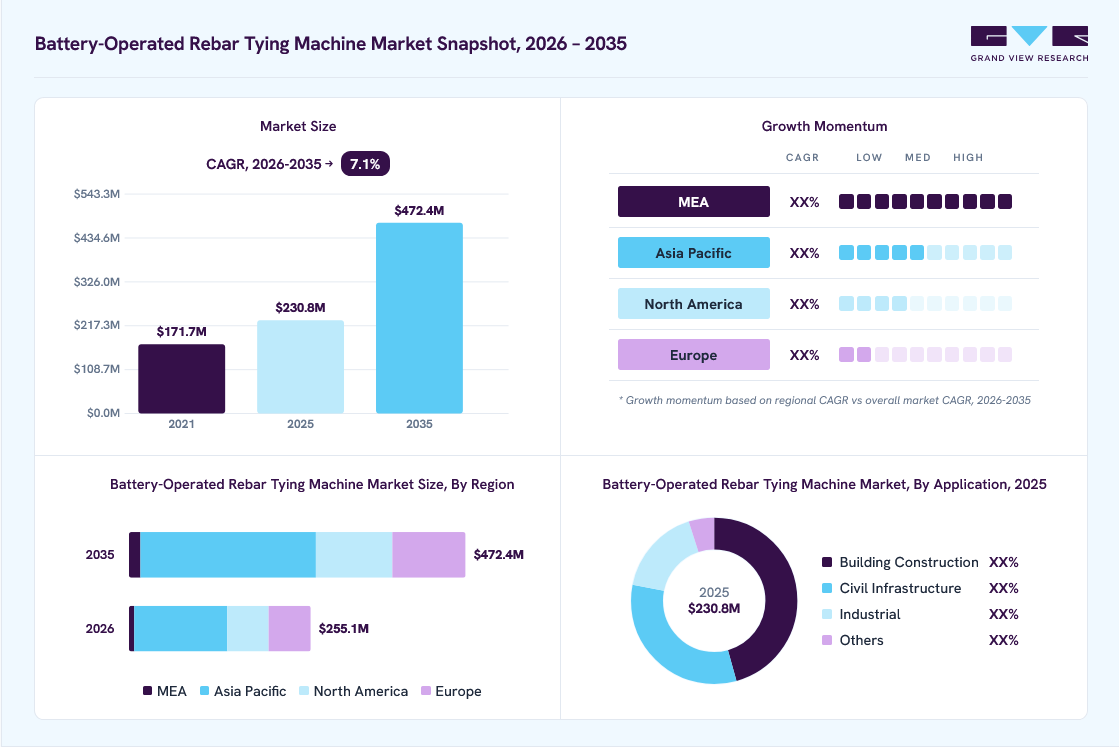
The global battery-operated rebar tying machine market size was valued at USD 230.8 million in 2025 and is projected to grow from USD 255.1 million in 2026 to USD 472.4 million by 2035, growing at a CAGR of 7.1% from 2026 to 2035. Asia Pacific dominated the market, accounting for the largest revenue share of 51.0% in 2025. The increasing emphasis on improving productivity and addressing labor shortages is driving the adoption of advanced construction equipment across the global construction industry.
 Source: Grand View Research, IR Documents, Primary Interviews, Paid DatabasesTo learn more about this report,
 Download Free Sample Report
Key Market Trends & Insights
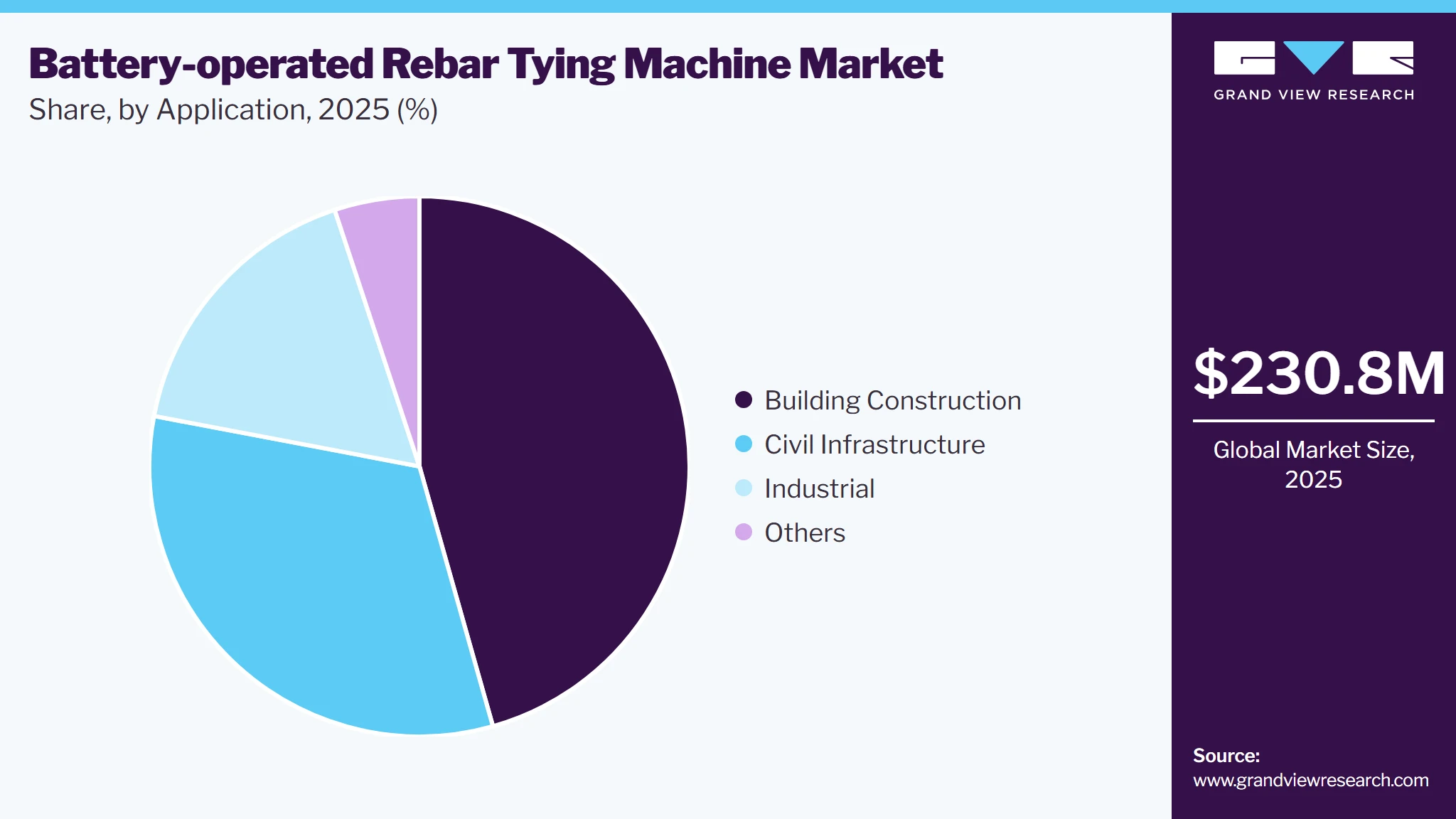
- By application: Building construction segment led the market with the largest revenue share of 45.6% in 2025.
Regional Highlights
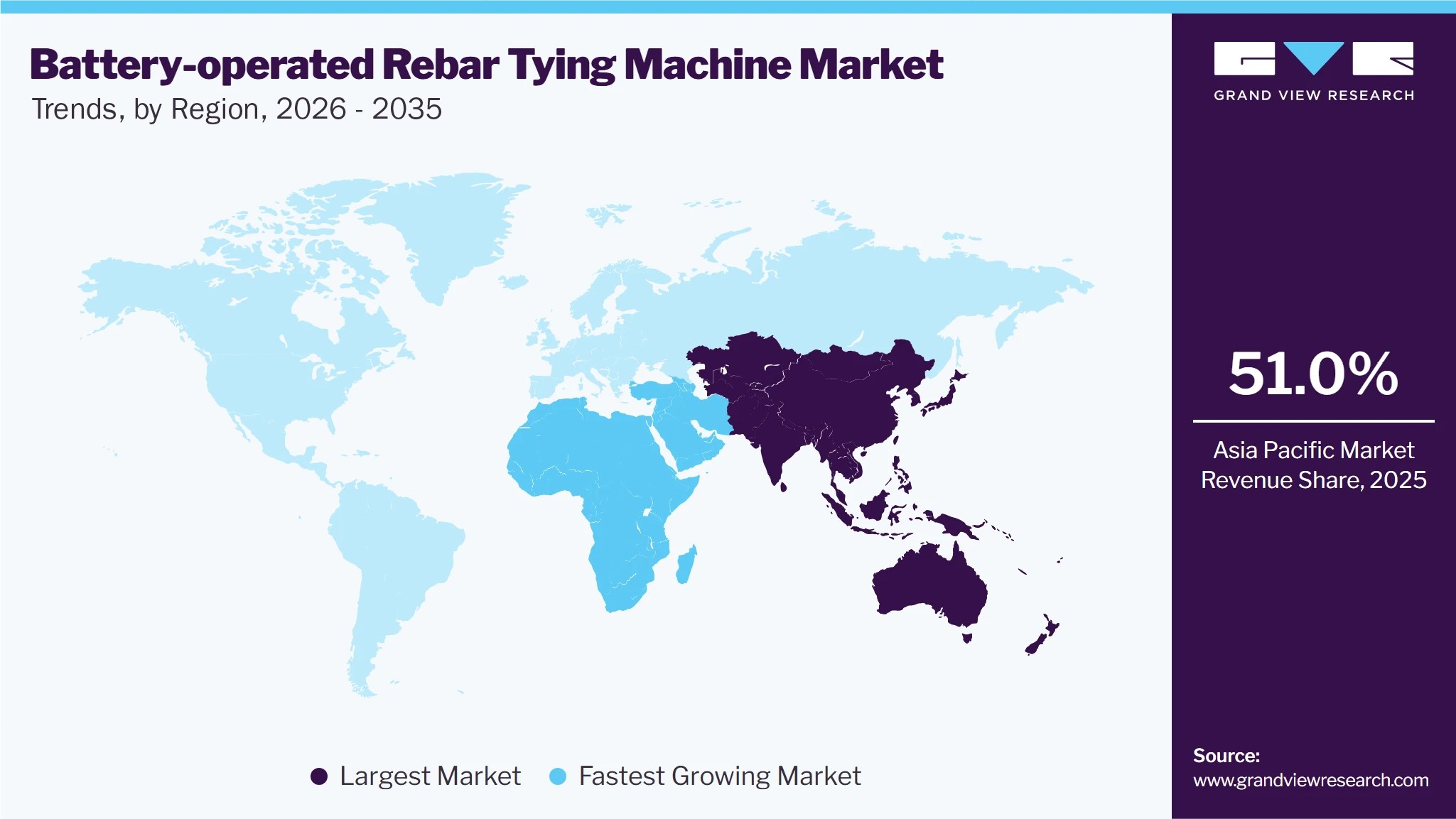
- Largest regional market: Asia Pacific (51.0% revenue share, 2025)
- Fastest growing regional market: Middle East & Africa (highest CAGR, 2026-2035)
- By Country: China held the largest market share in 2025.
Market Size & Forecast
- Market Size in 2025: USD 230.8 Million
- Estimated market size in 2026: USD 255.1 Million
- Projected Market Size by 2035: USD 472.4 Million
- CAGR (2026-2035): 7.1%
Prism AI by Grand View Research Free to tryAsk a question about the battery-operated rebar tying machine market✓Every figure cited from GVR research Prefer the report? Download free sample →
Contractors are increasingly replacing manual and conventional tools with battery-powered alternatives that offer greater mobility, ease of operation, and consistent performance. Battery-operated rebar tying machines help reduce the time required for reinforcement tying while minimizing worker fatigue and improving tying consistency.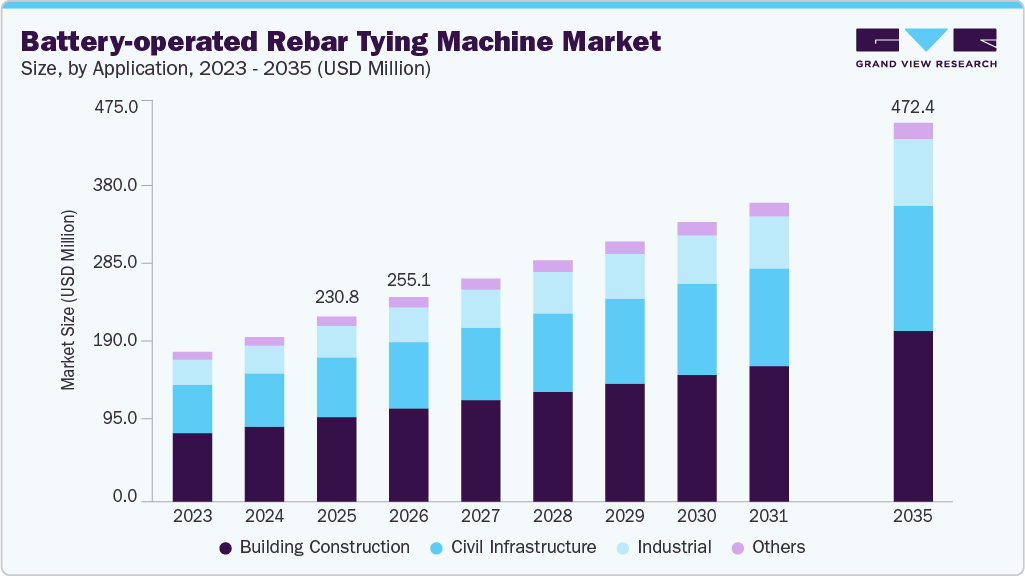 To learn more about this report, Download Free Sample Report
Continuous advancements in cordless power tool technologies are further supporting market growth. Modern battery-operated rebar tying machines are equipped with high-performance lithium-ion batteries, brushless motors, rapid charging capabilities, and intelligent battery management systems that enhance runtime, durability, and overall operational efficiency. Compared with older rechargeable battery technologies, lithium-ion batteries have become the preferred choice due to their higher energy density, lighter weight, longer operating time, and faster charging. These technological improvements enable contractors to complete reinforcement work more efficiently with reduced downtime, encouraging wider adoption of battery-operated rebar tying machines across diverse construction applications.
Market Dynamics
The battery-operated rebar tying machines industry is being driven by the increasing adoption of automation and cordless equipment in the construction industry to improve productivity, reduce labor dependency, and accelerate project execution. Growing investments in residential, commercial, and infrastructure development, coupled with continuous advancements in lithium-ion battery technology, are supporting market expansion. At the same time, the relatively high initial cost of battery-operated tools may limit adoption among small contractors. However, increasing investments in smart infrastructure, prefabricated construction, and large-scale civil engineering projects are expected to create significant growth opportunities for manufacturers over the forecast period.
The construction industry is increasingly adopting automated and battery-powered equipment to improve operational efficiency and address labor shortages. Battery-operated rebar tying machines significantly reduce the time and physical effort required for reinforcement tying while ensuring consistent tying quality. Their cordless design enhances mobility and enables contractors to perform reinforcement work more efficiently across residential, commercial, and infrastructure projects.
Continuous advancements in lithium-ion batteries, brushless motors, and intelligent battery management systems have further improved the performance, runtime, and reliability of battery-operated rebar tying machines. These technological improvements, combined with the growing focus on reducing project timelines and labor costs, are encouraging contractors to replace manual tying methods with automated solutions, supporting market growth.
Battery-operated rebar tying machines involve a higher upfront investment than conventional manual tying tools due to the inclusion of lithium-ion batteries, electronic control systems, chargers, and advanced motor technologies. In addition, replacement batteries and accessories increase the overall ownership cost, making adoption challenging for small and medium-sized contractors with limited capital budgets. This cost sensitivity may slow market penetration, particularly in price-sensitive developing regions.
The growing adoption of prefabricated and modular construction is creating significant opportunities for the battery-operated rebar tying machines industry. These construction methods require rapid, precise, and repetitive reinforcement tying to maintain production efficiency and consistent quality. As governments and private developers increasingly invest in modular housing, industrial facilities, and infrastructure projects, demand for automated rebar-tying equipment is expected to rise, enabling manufacturers to expand their presence in both developed and emerging construction markets.
Market Concentration & Characteristics
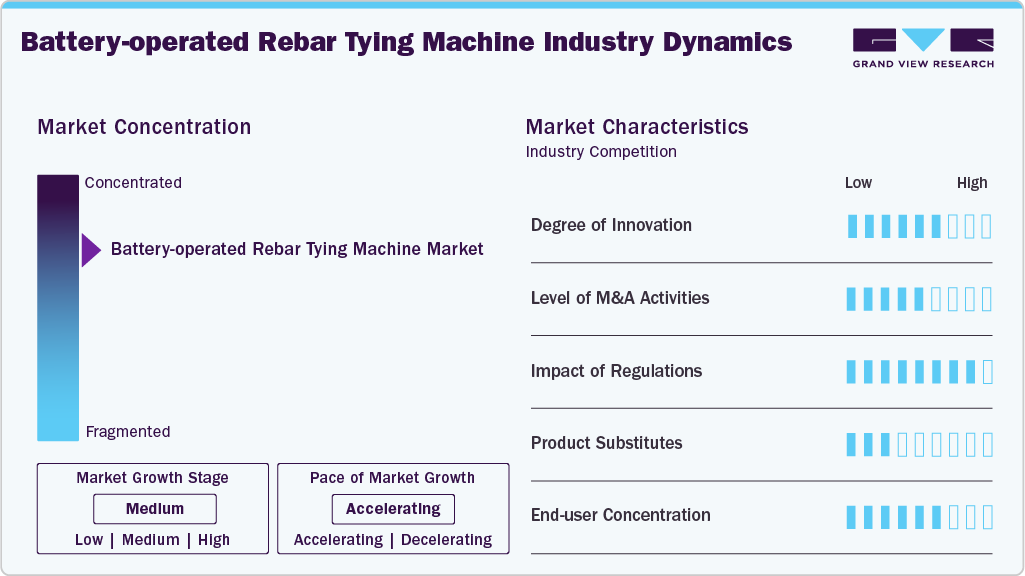
The battery-operated rebar tying machines industry is consolidated, with a limited number of established manufacturers accounting for a significant share of global revenue. Leading companies compete primarily through technological innovation, product quality, battery performance, durability, and extensive distribution networks. Their strong brand recognition, proprietary technologies, and long-standing relationships with construction equipment distributors create high barriers to entry for new participants.
The battery-operated rebar tying machines industry is characterized by a high degree of innovation, driven by continuous advancements in cordless power tool technologies and increasing demand for productivity-enhancing construction equipment. Manufacturers are focusing on integrating high-capacity lithium-ion batteries, brushless motors, intelligent battery management systems, and rapid charging technologies to improve runtime, durability, and operational efficiency. In addition, ergonomic designs, lightweight construction, and enhanced tying speed are helping contractors reduce labor intensity while improving overall job-site performance.
 To learn more about this report, Download Free Sample Report
The market is moderately influenced by regulations governing electrical safety, battery safety, and occupational health and safety. Compliance with standards such as IEC 62841, UL 62841, IEC 62133-2, and UN 38.3 ensures the safe operation, testing, and transportation of battery-powered construction tools and lithium-ion batteries. In addition, increasing emphasis on battery sustainability, recycling, and environmental compliance is encouraging manufacturers to develop safer, energy-efficient, and environmentally responsible products that meet evolving regulatory requirements across global markets.
The end-user base is moderately concentrated, with demand primarily generated by construction contractors, civil engineering firms, infrastructure developers, and precast concrete manufacturers. Large construction companies account for a significant share of equipment adoption, driven by frequent use in high-volume reinforcement work and ongoing investments in productivity-enhancing tools. At the same time, growing infrastructure development, commercial construction, and residential building activities are encouraging small and medium-sized contractors to increasingly adopt battery-operated rebar tying machines, broadening the market's customer base.
Analyst Perspective
The market for battery operated rebar tying machines is poised for steady growth, supported by increasing global construction activity, labor shortages, and the rising adoption of productivity-enhancing cordless tools. Investments in residential, commercial, industrial, and infrastructure projects, along with the expansion of EV plants, semiconductor facilities, logistics centers, and public infrastructure, are driving demand for efficient reinforcement installation equipment. Technological advancements such as brushless motors, high-capacity lithium-ion batteries, rapid charging, and ergonomic designs are improving performance leading to wider adoption among contractors. While high upfront costs may limit smaller contractors’ adoption, growing investments in infrastructure modernization, industrial construction, and prefabricated building methods are expected to create significant long-term growth opportunities, particularly across Asia Pacific and the Middle East.
Application Insights
Building construction dominated the market with the largest revenue share in 2025. The segment's leadership is driven by the high volume of reinforced concrete work in residential, commercial, and mixed-use building projects, where rebar tying is a repetitive and labor-intensive task. Battery-operated rebar tying machines help contractors improve installation speed, ensure consistent tie quality, and reduce worker fatigue, making them an increasingly preferred solution for large-scale building construction projects. The growing demand for high-rise residential buildings, commercial complexes, healthcare facilities, educational institutions, and urban redevelopment projects continues to support the segment's dominant position.
 To learn more about this report, Download Free Sample Report
The industrial segment is expected to register the fastest CAGR of 7.5% from 2026 to 2035. Rising investments in manufacturing facilities, warehouses, logistics centers, energy plants, semiconductor fabs, battery manufacturing plants, and data centers are increasing the demand for reinforced concrete structures. Industrial construction projects typically require faster execution, higher productivity, and consistent construction quality, encouraging contractors to adopt battery-powered rebar tying machines. The increasing focus on automation, labor efficiency, and the timely completion of large industrial projects is expected to further accelerate growth in this segment over the forecast period.
Regional Insights
North America accounted for a significant share of the global battery-operated rebar tying machine market, driven by strong investments in residential, commercial, and civil infrastructure construction. Increasing labor shortages, rising labor costs, and the growing adoption of cordless construction equipment are encouraging contractors to replace manual rebar tying methods with automated solutions. Ongoing investments in transportation infrastructure, industrial facilities, data centers, and energy projects across the U.S. and Canada are further supporting market growth.
U.S. Battery-operated Rebar Tying Machine Market Trends
The U.S. battery-operated rebar tying machine industry is expected to account for a significant share of the North American market, driven by continued investments in residential, commercial, industrial, and infrastructure construction. Rising development of housing, logistics facilities, data centers, manufacturing plants, healthcare facilities, and public infrastructure is increasing the demand for reinforced concrete structures, supporting the adoption of automated rebar tying equipment. For instance, in July 2026, BMW completed a USD 1.7 billion investment to expand electric vehicle production at its U.S. manufacturing facilities. Such large-scale industrial projects require extensive reinforcement work on production buildings and supporting infrastructure, creating demand for battery-powered rebar tying machines that improve installation speed, reduce labor dependence, and enhance construction productivity.
Europe Battery-operated Rebar Tying Machine Market Trends
The Europe battery-operated rebar tying machine industry represents a mature market, supported by increasing investments in sustainable buildings, infrastructure modernization, and industrial construction. The region's emphasis on workplace safety, labor productivity, and the adoption of advanced construction technologies is accelerating the use of battery-operated rebar tying machines. In addition, growing renovation activities and public infrastructure investments across countries such as Germany, France, and the UK continue to drive demand for efficient reinforcement installation equipment.
Germany's battery-powered rebar-tying machine industry is expected to account for a significant share of the European market, driven by continued investment in residential, commercial, infrastructure, and industrial construction. Industrial construction is a major growth driver, supported by investments in electric vehicle manufacturing, battery production, semiconductor facilities, logistics centers, and advanced manufacturing plants. For instance, in May 2026, Tesla announced a USD 250 million investment to expand EV battery cell production at its German Gigafactory. The expansion requires reinforced concrete construction for manufacturing facilities and supporting infrastructure, increasing demand for cordless lithium-ion battery-operated rebar tying machines that improve reinforcement productivity, reduce labor requirements, and accelerate project execution.
The France battery-operated rebar tying machine industry is expected to witness steady growth in the market, supported by ongoing investments in residential housing, commercial buildings, transportation infrastructure, and industrial facilities. Government-led infrastructure modernization, urban redevelopment, and renewable energy projects are increasing the use of reinforced concrete across the country. In addition, expanding investments in logistics hubs, manufacturing facilities, and battery production plants are encouraging contractors to adopt battery-operated rebar tying machines to improve construction efficiency, reduce manual labor, and ensure consistent reinforcement quality while meeting project deadlines.
Asia Pacific Battery Operated Rebar Tying Machine Market Trends
Asia Pacific battery-operated rebar tying machine industry dominated the market with a revenue share of 51.0% in 2025, owing to rapid urbanization, expanding construction activities, and large-scale infrastructure development across China, India, Japan, and Southeast Asia. Government investments in smart cities, transportation networks, residential housing, and industrial facilities are increasing the demand for reinforced concrete structures. The region's large construction workforce and increasing adoption of productivity-enhancing equipment are expected to further support market growth during the forecast period.
 To learn more about this report, Download Free Sample Report
China battery-operated rebar tying machine industry accounted for the largest share of the Asia Pacific market, supported by extensive investments in residential construction, transportation infrastructure, industrial facilities, and urban development. Ongoing expansion of high-speed rail networks, metro systems, airports, bridges, and manufacturing facilities continues to increase the demand for reinforced concrete structures. In addition, rapid growth in the electric vehicle, battery, semiconductor, and logistics sectors is accelerating the adoption of battery-operated rebar tying machines, as contractors seek to improve productivity, reduce labor dependency, and complete large-scale projects more efficiently.
The India battery-operated rebar tying machine market is projected to register the fastest CAGR over the forecast period, driven by rapid urbanization and rising investments in public infrastructure. Government capital expenditure remains a key demand driver, with the Union Budget FY2026-27 increasing public capital expenditure to INR 12.2 lakh crore (approximately USD 130.5 billion) while introducing measures to strengthen infrastructure development and encourage private-sector participation. Investments in roads, railways, freight corridors, waterways, urban transport, and industrial infrastructure are generating substantial rebar installation requirements across the country, supporting the adoption of battery-operated rebar tying machines to improve construction productivity, reduce labor requirements, and accelerate project execution.
Middle East & Africa Battery Operated Rebar Tying Machine Market Trends
The Middle East & Africa battery-operated rebar-tying machine industry is experiencing steady growth, driven by rising investments in mega infrastructure projects, commercial developments, and industrial expansion. Countries such as Saudi Arabia and the UAE are investing heavily in transportation, tourism, energy, and urban development projects as part of long-term economic diversification strategies, thereby creating sustained demand for advanced construction equipment. Meanwhile, infrastructure development across several African countries is also driving the adoption of battery-powered rebar tying machines as contractors seek to improve construction efficiency and reduce project completion times.
Saudi Arabia's battery-operated rebar tying machine industry is emerging as a key market, driven by large-scale investments in infrastructure, commercial, residential, and industrial construction under Vision 2030. Mega projects such as The Red Sea Project, Qiddiya, and extensive transportation and urban development initiatives are significantly increasing the demand for reinforced concrete structures. In addition, expanding investments in manufacturing, logistics, and energy infrastructure are encouraging contractors to adopt battery-powered rebar tying machines to improve construction productivity, reduce labor requirements, and accelerate project completion on large, complex projects.
Key Battery-operated Rebar Tying Machine Company Insights
Some of the key players operating in the market include Makita, MAX Co., Ltd., and Taizhou Xindalu Electronic Technology Co., Ltd.
-
Makita Corporation was founded in Japan as a specialized electric motor sales and repair company before incorporating in December 1938. The company offers a broad portfolio that includes cordless and corded drills, saws, grinders, fastening tools, concrete and masonry equipment, outdoor products, and construction tools such as battery-operated rebar tying machines. It has a global manufacturing and distribution network spanning Asia, Europe, North America, and Latin America, serving professionals in the construction, woodworking, metalworking, landscaping, and industrial sectors.
-
MAX Co., Ltd. is a global manufacturer engaged in producing high-end industrial tools, office equipment, and specialized machinery. The company operates internationally across North America, Europe, Asia Pacific, and other regions. Its North American division, MAX USA CORP., is based in Plainview, New York, and manages operations for North, Central, and South America.
Key Battery-operated Rebar Tying Machine Companies
The following key companies have been profiled for this study on the battery-operated rebar tying machine market.
-
Makita Corporation
-
MAX Co., Ltd.
-
Taizhou Xindalu Electronic Technology Co., Ltd
-
Guangdong Shunde Huayan Electronic Technology Co., Ltd.
-
Ninghai Sanyuan Power Tools Co., Ltd
-
BN Products-USA
-
KYOCERA CORPORATION
-
Wuyi YuLi Power Tools Manufacturing Co., Ltd.
Competitive Benchmarking
Category
Operating Strategies
Competitive Edge
Weakness
Established Players (e.g., Makita Corporation; MAX Co., Ltd.; KYOCERA CORPORATION; BN Products-USA)
- Focus on continuous product innovation, including brushless motors and lithium-ion battery technologies.
- Strengthen global distribution networks through dealers, distributors, and strategic partnerships.
- Target large-scale infrastructure, commercial, and industrial construction projects with premium product offerings.
- Strong brand recognition and established customer relationships in professional construction tools.
- Advanced product quality, durability, and reliable battery performance.
- Extensive global sales network and comprehensive after-sales support.
- Premium pricing limits adoption in cost-sensitive markets.
- Higher manufacturing and operating costs than regional competitors.
- Longer product development and commercialization cycles.
Emerging & Regional Players (e.g., Taizhou Xindalu Electronic Technology Co., Ltd.; Guangdong Shunde Huayan Electronic Technology Co., Ltd.; Ninghai Sanyuan Power Tools Co., Ltd.; Wuyi YuLi Power Tools Manufacturing Co., Ltd.)
- Compete through cost-effective products and OEM/ODM manufacturing capabilities.
- Expand regional and export sales through distributors and e-commerce channels.
- Develop application-specific and customized products for local construction markets.
- Competitive pricing supported by low-cost manufacturing.
- Flexible production with faster customization and shorter lead times.
- Strong presence in regional and emerging construction markets.
- Limited global brand recognition and international distribution.
- Smaller R&D capabilities and narrower product portfolios.
- Lower participation in large international infrastructure and industrial projects.
Recent Developments
-
In March 2026, Makita Corporation announced an agreement to acquire Panasonic Corporation's power tool business, including its factory fastening equipment and industrial IoT solutions. The transaction, subject to regulatory approvals, is expected to be completed during fiscal year 2026.
-
In March 2026, MAX USA Corp., a part of Max Co. Ltd., launched the RB613T, a battery-powered rebar tying tool designed for rebar combinations up to #9 × #10. The tool features a larger jaw capacity, a tying speed of approximately 0.5 seconds per tie, an automated wire loading mechanism, reduced trigger effort for improved ergonomics, and a wire pull-back system that minimizes wire consumption. Intended for commercial buildings, foundations, bridges, and precast construction, the RB613T is designed to improve productivity, durability, and tying consistency in heavy-duty reinforcement applications.
Battery-operated Rebar Tying Machine Market Report Scope
Report Attribute
Details
Market size value in 2025
USD 230.8 million
Market size value in 2026
USD 255.1 million
Revenue forecast in 2035
USD 472.4 million
Growth rate
CAGR of 7.1% from 2026 to 2035
Historical data
2021 - 2025
Forecast period
2026 - 2035
Quantitative units
Revenue in USD million, volume in Thousand Units, and CAGR from 2026 to 2035
Report coverage
Revenue forecast, company ranking, competitive landscape, growth factors, and trends
Segments covered
Application, region
Regional scope
North America; Europe; Asia Pacific; Middle East & Africa
Country scope
U.S.; UK; Germany; France; China; Japan; India; Australia; South Korea; Taiwan; Singapore; New Zealand; Saudi Arabia; UAE
Key companies profiled
Makita Corporation; MAX Co., Ltd.; Taizhou Xindalu Electronic Technology Co., Ltd.; Guangdong Shunde Huayan Electronic Technology Co., Ltd.; Ninghai Sanyuan Power Tools Co., Ltd.; BN Products-USA; KYOCERA CORPORATION; and Wuyi YuLi Power Tools Manufacturing Co., Ltd.
Customization scope
Free report customization (equivalent to up to 8 analyst working days) with purchase. Addition or alteration to country, regional & segment scope.
Pricing and purchase options
Avail customized purchase options to meet your exact research needs. Explore purchase options
Global Battery-operated Rebar Tying Machine Market Report Segmentation
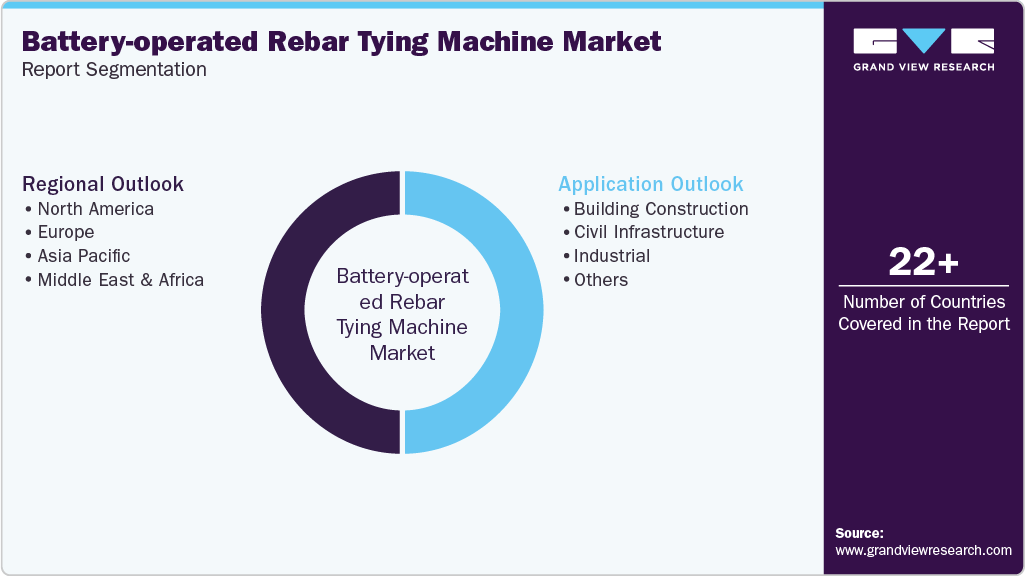
This report forecasts revenue & volume growth at the global, regional, and country levels and provides an analysis of the latest industry trends across each sub-segment from 2021 to 2035. For this study, Grand View Research has segmented the global battery-operated rebar tying machine market report based on application and region.
 To learn more about this report, Download Free Sample Report
-
Application Outlook (Volume, Thousand Units; Revenue, USD Million, 2021 - 2035)
-
Building Construction
-
Civil Infrastructure
-
Industrial
-
Others
-
-
Regional Outlook (Volume, Thousand Units; Revenue, USD Million, 2021 - 2035)
-
North America
-
U.S.
-
-
Europe
-
Germany
-
France
-
UK
-
-
Asia Pacific
-
China
-
India
-
Japan
-
South Korea
-
Australia
-
Taiwan
-
Singapore
-
New Zealand
-
-
Middle East & Africa
-
Saudi Arabia
-
UAE
-
-
Research Methodology
The battery-operated rebar tying machine market figures in this report are based on a proven research process that combines executive interviews with secondary research from proprietary databases, company filings, and recognized regulatory and institutional sources. Market size is built through value-chain sizing—reconciling supply-side and demand-side estimates—and triangulated with bottom-up and top-down approaches. Every estimate passes multiple levels of expert validation before publication, with each battery-operated rebar tying machine segment quantified using the revenue-capture definitions in the table below.
Segment Definition
Application
Revenue Capture Definition
Building Construction
Revenue generated from the sale of battery-operated rebar tying machines used in residential, commercial, institutional, and mixed-use building construction projects.
Civil Infrastructure
Revenue generated from the sale of battery-operated rebar tying machines used in bridges, highways, tunnels, railways, metros, airports, ports, dams, and other public infrastructure projects.
Industrial
Revenue generated from the sale of battery-operated rebar tying machines used in the construction of manufacturing plants, warehouses, logistics centers, power facilities, battery plants, semiconductor fabs, and other industrial structures.
Others
Revenue generated from the sale of battery-operated rebar tying machines used in agricultural buildings, sports facilities, swimming pools, precast concrete facilities, and other specialized construction applications.
Estimation Model
Layer Name
Key Question
Description
Construction Activity Assessment
Assess the volume of reinforced concrete construction requiring rebar tying.
Estimates demand by analyzing reinforced concrete usage across residential, commercial, industrial, and civil infrastructure construction projects.
Equipment Adoption Assessment
What is the adoption level of battery-operated rebar tying machines?
Evaluates the shift from manual tying methods to battery-operated rebar tying machines based on labor availability, productivity requirements, and project execution needs.
Unit Sales Estimation
How many battery-operated rebar tying machines are sold annually?
Estimates annual sales by considering new equipment demand, replacement demand, fleet expansion, and regional construction activity.
Revenue Estimation
What is the total market revenue generated?
Estimates the overall market value by consolidating revenue generated from the sale of battery-operated rebar tying machines across all regions, applications, and distribution channels.
Delivered Customizations
This report has been delivered with the following In-depth customizations
CLIENT REQUEST
CUSTOMIZATION DELIVERED
VALUE ADDS
Regional Segmentation
Delivered comprehensive regional analysis covering North America, Europe, Asia Pacific, and the Middle East & Africa, along with country-level insights for the U.S., Germany, France, China, India, and Saudi Arabia. The report highlights regional demand drivers, construction activity, infrastructure investments, and country-specific developments influencing the adoption of battery-operated rebar tying machines.
Enables clients to identify high-growth regional markets, prioritize country-level expansion strategies, and align sales and investment decisions with regional construction and infrastructure trends.
Competitive Benchmarking
Delivered an in-depth competitive assessment of leading manufacturers, including company profiling, market participant categorization, mature vs. emerging player analysis, operating strategies, competitive strengths, weaknesses, product benchmarking, and competitive positioning across the battery-operated rebar tying machines market.
Provides a clear understanding of the competitive landscape, helping clients benchmark their product portfolio, identify competitive gaps, evaluate market positioning, and formulate effective growth strategies.
Opportunity Assessment
Delivered a detailed opportunity assessment covering infrastructure expansion, industrial construction growth, prefabricated construction, advancements in cordless power tool technologies, and increasing adoption of automation in reinforcement work. The report also highlights key growth opportunities across major end-use applications and high-potential geographic markets.
Supports strategic planning by identifying emerging demand areas, investment opportunities, and future growth pockets, enabling clients to optimize product development, market entry, and long-term business expansion strategies.
Frequently Asked Questions About This Report
The global battery operated rebar tying machine market size was estimated at USD 230.8 million in 2025 and is expected to be USD 255.1 million in 2026.
The global battery operated rebar tying machine market, in terms of revenue, is expected to grow at a compound annual growth rate of 7.1% from 2026 to 2035 to reach USD 472.4 million by 2035.
Asia Pacific dominated the battery operated rebar tying machines market, accounting for the largest revenue share of 51.0% in 2025, driven by rapid urbanization, large-scale infrastructure development, and increasing construction activities across major economies.
China held the largest market share in the Asia Pacific region in 2025, supported by extensive investments in residential, industrial, transportation, and public infrastructure construction.
The building construction segment accounted for the largest revenue share of 45.6% in 2025, owing to the widespread use of reinforced concrete in residential, commercial, and institutional building projects.
The industrial segment is expected to register the fastest growth during the forecast period at CAGR of 7.5% from 2026-2035. Rising investments in manufacturing facilities, warehouses, logistics centers, energy plants, semiconductor fabs, battery manufacturing plants, and data centers are increasing the demand for reinforced concrete structures.
The Middle East & Africa is projected to be the fastest-growing regional market during the forecast period, driven by large-scale infrastructure investments, mega construction projects, industrial diversification, and smart city developments across countries such as Saudi Arabia and the UAE.
Some of the key players operating in the global battery operated rebar tying machine market include Makita Corporation; MAX Co., Ltd.; Taizhou Xindalu Electronic Technology Co., Ltd.; Guangdong Shunde Huayan Electronic Technology Co., Ltd.; Ninghai Sanyuan Power Tools Co., Ltd.; BN Products-USA; KYOCERA CORPORATION; and Wuyi YuLi Power Tools Manufacturing Co., Ltd.
The global battery operated rebar tying machines market is primarily driven by increasing investments in residential, commercial, industrial, and infrastructure construction projects, along with the growing demand for faster and more efficient reinforcement installation. Rising labor shortages and increasing labor costs are encouraging contractors to adopt automated cordless tools that improve productivity and reduce manual effort.
About the Author(s)
Advanced Interior Materials Research Team
Advanced Materials · Advanced Interior MaterialsThis report was authored by the advanced interior materials research team at Grand View Research - comprising two research analysts, one senior research analyst, and one industry expert - with specialized expertise in the advanced interior materials segment of the advanced materials industry. All findings are based on proprietary advanced materials databases, executive interviews, and regulatory analysis, subject to internal peer review prior to publication.
Last Updated:
Speak to Analyst

Customize this report to your needs - add regions, segments, or data points, with 20% free customization.
Or view our licence options:


ISO 9001:2015 & 27001:2022 Certified
We are GDPR and CCPA compliant! Your transaction & personal information is safe and secure. For more details, please read our privacy policy.


