- Home
- »
- Organic Chemicals
- »
-
Benzaldehyde Market Size, Share, Trends Report 2026-2033GVR Report cover
Benzaldehyde Market (2026 - 2033)
Size, Share & Trends Analysis Report By Derivative (Benzoic Acid, Sodium Benzoate, Benzyl Alcohol, Cinnamic Acid), By Application (Food & Beverage, Pharmaceuticals, Agrochemicals), By Process, By Region, And Segment Forecasts
Market Size, 2025
$394.0MMarket Estimate, 2026
$415.3MMarket Forecast, 2033
$620.7MCAGR, 2026–2033
5.9%Benzaldehyde Market Summary
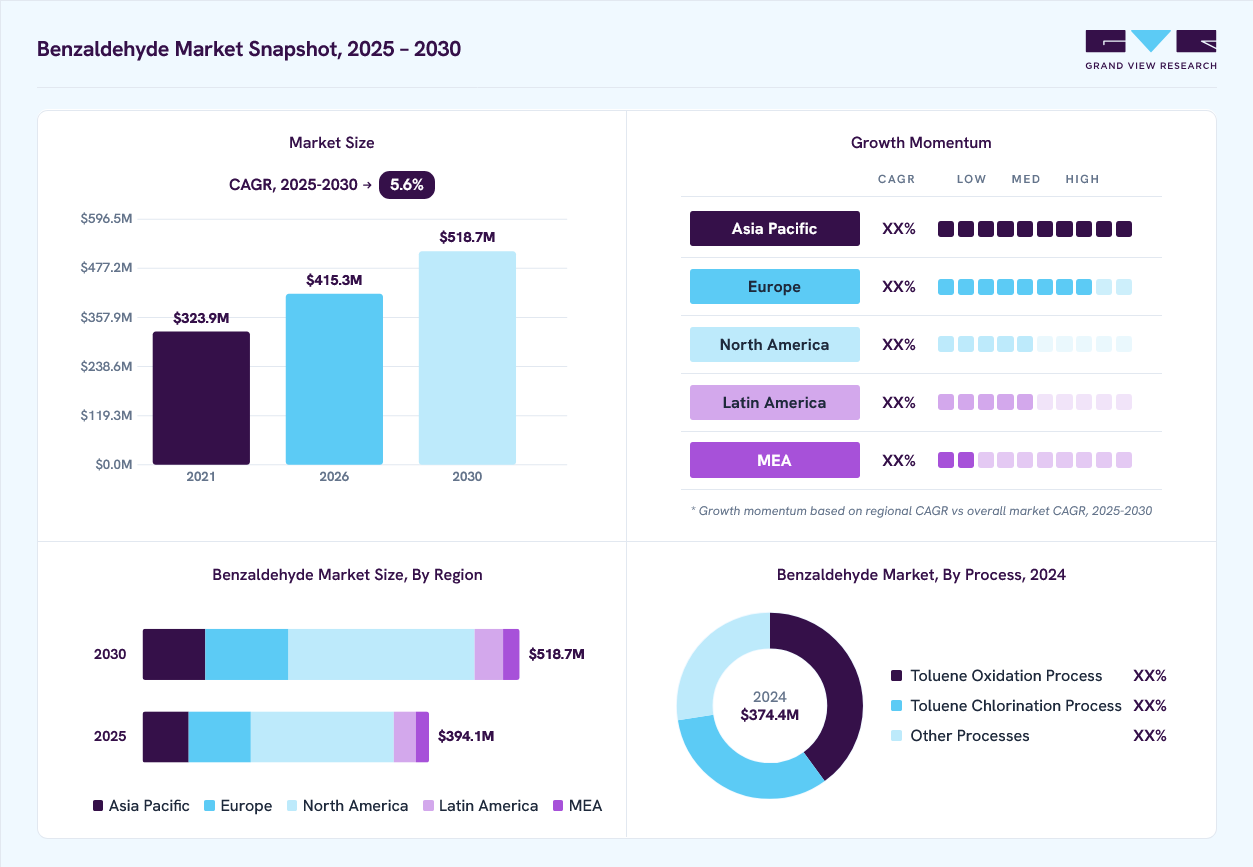
The global benzaldehyde market size was valued at USD 394.0 million in 2025 and is projected to grow from USD 415.3 million in 2026 to USD 620.7 million by 2033, at a CAGR of 5.9% from 2026 to 2033. North America dominated the market, accounting for a revenue share of 49.9% in 2025. Benzaldehyde is an organic compound synthesizing various products, including coatings, dyes, fragrances, flavors, pharmaceutical intermediates, and agrochemicals. It is essential in the fragrance, agricultural, and pharmaceutical industries, all of which are experiencing growing demand.
Key Market Trends & Insights
- By derivative: Benzoic acid segment dominated the market, with a revenue share of 30.6% in 2025.
- By application: Cosmetics & personal care segment held the largest market share of 25.4% in 2025.
- By process: Toluene oxidation process segment held the largest revenue share of 39.8% in 2025.
Regional Highlights
- Largest regional market: North America (44.2% revenue share, 2025)
- Fastest-growing regional market: Asia Pacific (highest CAGR, 2026-2033)
- By country: The U.S. held the largest market share in 2025.
Market Size & Forecast
- Market size in 2025: USD 394.0 Million
- Estimated market size in 2026: USD 415.3 Million
- Projected market size by 2033: USD 620.7 Million
- CAGR (2026-2033): 5.9%
The increasing demand for aroma chemical manufacturers, the greater utilization of derivatives in organic chemistry, and the rising necessity for benzaldehyde as an active pharmaceutical ingredient are the key market drivers fueling growth.
Benzaldehyde is commonly found in various cosmetic and personal care products, such as baby items, bath products, soaps, cleansers, eye makeup, and hair and skincare products. It acts as a preservative, helping to prevent microbial growth and ensuring the safety and longevity of these products. In addition, benzaldehyde is used as an aversive additive in household products like window cleaners and laundry detergents to discourage accidental ingestion, further broadening its applications.
Market Dynamics
The benzaldehyde market is experiencing steady growth driven by expanding demand from the flavor and fragrance industry, where the compound is widely used to impart almond-like notes in food products, beverages, perfumes, and personal care formulations. Rising pharmaceutical production is further supporting market expansion, as benzaldehyde serves as a key intermediate in the synthesis of active ingredients and specialty chemicals. The increasing adoption of benzoic acid and benzyl alcohol across preservatives, coatings, and industrial applications is strengthening downstream consumption. In addition, growing agrochemical manufacturing and investments in specialty chemical production, particularly in emerging economies, are creating new opportunities for producers. However, market participants face challenges related to volatile feedstock prices, stringent environmental regulations governing aromatic compounds, and the need to comply with evolving safety standards. To address these factors, manufacturers are emphasizing process optimization, sustainable production technologies, and high-purity product development while expanding capacity and strengthening supply chains to meet the requirements of diverse end-use industries.
The expanding global flavor and fragrance industry is a primary driver of the benzaldehyde market, supported by increasing consumer demand for premium food products, beverages, cosmetics, and personal care formulations. Benzaldehyde is valued for its characteristic almond-like aroma and is widely incorporated into flavoring agents, perfumes, soaps, and household products. As manufacturers focus on differentiated sensory experiences and product innovation, the consumption of high-quality aromatic ingredients continues to rise, strengthening the demand for benzaldehyde across multiple value chains.
Changing consumer preferences toward processed foods, premium confectionery, and sophisticated personal care products have encouraged manufacturers to invest in advanced fragrance and flavor formulations. This trend is particularly evident in rapidly urbanizing economies, where rising disposable incomes and expanding retail networks are accelerating product penetration. Consequently, benzaldehyde producers are benefiting from sustained procurement by downstream formulators seeking reliable supplies and consistent product quality.
A major restraint affecting the benzaldehyde market is the fluctuation in raw material costs, particularly those associated with petrochemical feedstocks such as toluene, combined with increasingly stringent environmental and safety regulations governing aromatic chemical production. Price instability can compress manufacturer margins, disrupt procurement strategies, and create uncertainty in long-term supply agreements. At the same time, compliance with evolving emission standards, waste management requirements, and occupational safety regulations often necessitates substantial investments in process upgrades, pollution control systems, and regulatory certifications. These additional costs can be especially burdensome for small and mid-sized producers, limiting operational flexibility and slowing capacity expansion, while also increasing the overall cost of production in highly regulated markets.
The growing pharmaceutical sector presents a significant opportunity for the benzaldehyde market, as the compound is widely used as an intermediate in the synthesis of active pharmaceutical ingredients and specialty chemical compounds. Increasing investments in drug development, contract manufacturing, and healthcare infrastructure are driving demand for high-purity intermediates, creating favorable conditions for benzaldehyde manufacturers to expand their product portfolios and strengthen relationships with pharmaceutical customers.
The shift toward advanced chemical synthesis and specialty therapeutics is increasing the need for dependable aromatic intermediates that enable efficient production processes. Emerging economies are witnessing capacity expansions in pharmaceutical manufacturing, supported by government initiatives and private investments, which is expected to generate long-term demand for benzaldehyde. Companies that focus on quality assurance, regulatory compliance, and customized formulations are well positioned to capitalize on these evolving market requirements.
Analyst Perspective
The benzaldehyde market is poised for stable growth, supported by expanding demand from the flavor and fragrance, pharmaceutical, and specialty chemical industries. Increasing utilization as a precursor for derivatives such as benzoic acid and benzyl alcohol is reinforcing its strategic importance across downstream value chains. Asia Pacific continues to strengthen its position as a key production and consumption hub, driven by industrial expansion and cost-competitive manufacturing. Sustainability initiatives and advancements in cleaner production technologies are encouraging investment in alternative synthesis routes and higher-purity grades. While feedstock price volatility and regulatory compliance remain challenges, ongoing innovation and diversification of end-use applications are expected to sustain long-term market competitiveness.
Process Insights
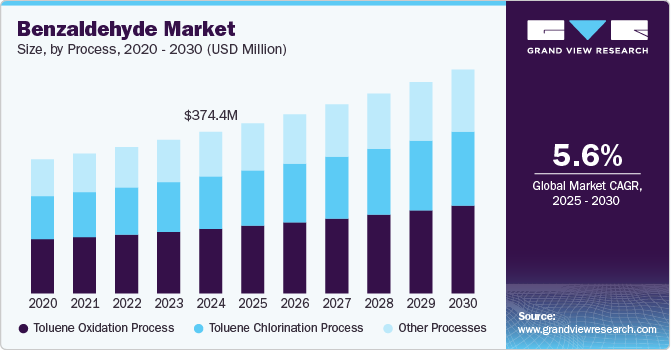
Based on process, the toluene oxidation process segment accounted for the highest market share, representing 39.8% of total revenue in 2025. This growth is attributed to well-established and well-understood technology that supports the production of benzaldehyde, ensuring reliability and operational efficiency. This process boasts high production efficiency, allowing for large-scale production that effectively meets the demands. Moreover, benzaldehyde production is cost-effective due to optimized processes and the availability of raw materials, enabling competitive pricing in the market.
The toluene chlorination process involves reacting toluene with chlorine in the presence of a catalyst, producing benzaldehyde as a primary product. This process is favored for its efficiency and ability to convert toluene directly, which is readily available and cost-effective. A key market driver is the growing demand for fragrances, flavoring agents, and pharmaceuticals, which propels the need for reliable and high-quality benzaldehyde production.
Derivative Insights
By derivative, benzoic acid held a dominant position, contributing 30.6% of total revenue in 2025, and is expected to continue to dominate the industry over the forecast period. This growth is attributed to the increasing demand for food preservatives worldwide. Increasing food production will positively impact the demand for food preservatives, increasing the demand for benzoic acid. Moreover, benzoic acid is also used in perfumes and flavoring industries.
Benzyl alcohol serves both as an effective anti-parasitic treatment and a widely used preservative in injectable medications. The increasing prevalence of parasitic infections in these regions has increased reliance on benzyl alcohol for medicinal purposes, thereby propelling its demand. The pharmaceutical industry's expansion and the heightened focus on product safety and longevity in injectable formulations further contribute to the need for reliable preservatives such as benzyl alcohol.
Application Insights
By application, cosmetics & personal care held a dominant position, contributing 25.4% of total revenue in 2025. The rising demand for personal care and cosmetics is increasing globally, leading to increased demand for benzaldehyde, which is used in personal care & cosmetics manufacturing, leading to rising demand for the product market during the forecast period.
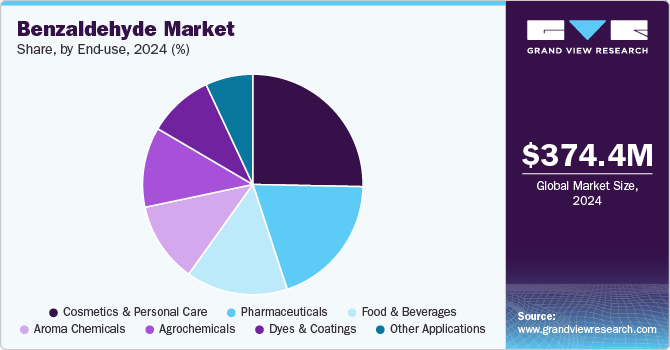
Aroma chemicals, like benzaldehyde, are widely used in the fragrance industry due to their pleasant almond-like scent, which enhances the appeal of various personal care products, perfumes, and household goods. The market is driven primarily by the growing demand for natural and synthetic fragrances and the increasing use of these aroma chemicals in food flavoring and beverages. Furthermore, the rise in consumer awareness about product quality and the trend toward unique fragrance combinations further boost the growth.
Regional Insights
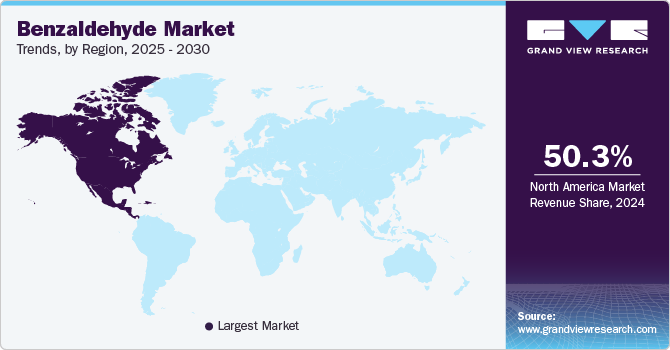
North America dominated the benzaldehyde market with the highest revenue share of 49.9% in 2025. North America benzaldehyde market dominant the industry, this growth is attributed to increasing demand for the product in various applications such as food & beverage, personal care & cosmetics, pharmaceuticals, and agrochemicals.
U.S. Benzaldehyde Market Trends
The U.S. dominated the North America with a market share of 86.1% in the benzaldehyde market in 2025. The benzaldehyde market in U.S. is expected to grow fastest in the North American region. The U.S. food industry is well-developed, leading toincreasing demand for product markets. Its almond-like fragrance and flavor make it a highly sought-after ingredient in various food products. The U.S. boasts advanced research and development facilities focused on creating new foods and beverages. Companies incorporate benzaldehyde into their formulations to develop unique flavor profiles that provide a distinctive and enjoyable taste experience.
Asia Pacific Benzaldehyde Market Trends
The benzaldehyde industry in the Asia Pacific is anticipated to grow at the fastest CAGR from 2026 to 2033. The region is expected to grow due to the rise in the pharmaceutical industry, which is well known for its pharmaceutical production capacity. This results in increased demand for product markets in the region.
Europe Benzaldehyde Market Trends
The benzaldehyde market in Europe is expected to grow significantly over the forecast period. In response to the rising demand, manufacturers continually work to increase their production capacities for benzaldehyde and other benzyl derivatives. This trend is expected to drive the region's market growth during the forecast period.
Latin America Benzaldehyde Market Trends
The benzaldehyde market in Latin America is expected to grow steadily over the forecast period. Rising product demand from the personal care and cosmetics, agrochemicals, pharmaceuticals, and fragrance industries is anticipated to positively influence market growth in the region. In addition, the presence of production plants in Brazil, Colombia, and Venezuela is expected to increase the demand for benzaldehyde during the forecast period.
Middle East & Africa Benzaldehyde Market Trends
The benzaldehyde market in the Middle East and Africa is expected to witness steady growth over the forecast period due to increasing regional food and beverage production, which is expected to create a high demand for benzaldehyde in the region.
Key Benzaldehyde Company Insights
Some key players operating in the market include LANXESS AG and Shimmer Chemicals Pvt. Ltd.
-
LANXESS AG is a German specialty chemicals company that was spun off of the chemicals division and parts of the polymers business from Bayer AG. The company has a presence in 32 countries and operates through three segments: Advanced Industrial Intermediates, Specialty Additives, and Consumer Protection.
-
The company is one of the significant players and independent Liquid Storage Tank (LST) providers, specializing in the storage and handling of all liquid chemicals and oil products and has storage terminals at Jawaharlal Nehru Port Trust - JNPT (Navi Mumbai), Kochi Port Trust - Kochi, and Mormugao Port Trust - Goa. The company also manufactures specialty chemicals, food preservatives, and oil additives through two factories at MIDC Tarapur (Maharashtra).
Key Benzaldehyde Companies
The following key companies have been profiled for this study on the benzaldehyde market.
-
LANXESS AG
-
Kadillac Chemicals Pvt. Ltd.
-
Gujarat Alkalies and Chemicals Limited
-
Emerald Kalama Chemical
-
Taile Chemical Industry Co. Ltd.
-
Shimmer Chemicals Pvt. Ltd.
-
Emerald Performance Materials, LLC
-
Valtris Specialty Chemicals
-
Axxence Aromatic GmbH
-
Ganesh Benzoplast Ltd.
-
Wuhan Dico Chemical Co., Ltd.
Competitive Benchmarking
Category
Operating Strategies
Competitive Edge
Weakness
Established Players (Lanxess AG, Gujarat Alkalies and Chemicals Limited, Emerald Kalama Chemical, Emerald Performance Materials, LLC, Valtris Specialty Chemicals, Ganesh Benzoplast Ltd.)
- Maintain integrated manufacturing and diversified product portfolios to optimize production efficiency.
- Invest in process modernization and sustainability initiatives to improve operational performance.
- Strengthen long-term supply agreements with pharmaceutical, fragrance, and specialty chemical customers.
- Expand global distribution networks while enhancing regulatory compliance and quality assurance systems.
- Strong brand recognition and established relationships with multinational customers.
- Economies of scale that enable cost-efficient manufacturing and procurement.
- Advanced research capabilities supporting high-purity and specialty product development.
- Extensive global supply chains and technical support infrastructure that enhance customer retention.
- Higher fixed operating costs are associated with large-scale manufacturing assets.
- Slower implementation of strategic changes due to complex organizational structures.
- Exposure to stringent environmental and regulatory obligations across multiple jurisdictions.
- Dependence on global supply chains may be affected by geopolitical or trade disruptions.
Emerging Players (Axxence Aromatic GmbH, Taile Chemical Industry Co., Ltd., Shimmer Chemicals Pvt. Ltd., Kadillac Chemicals Pvt. Ltd., Wuhan Dico Chemical Co., Ltd.)
- Focus on niche product offerings and customized benzaldehyde grades for specific customer requirements.
- Increase production capacity through targeted investments in regional manufacturing facilities.
- Build strategic partnerships with local distributors and downstream chemical processors.
- Compete through agile operations and flexible production scheduling to meet evolving demand.
- Faster response to changing market requirements and customer specifications.
- Ability to serve regional markets with shorter lead times and localized solutions.
- Competitive pricing strategies are supported by lean organizational structures.
- Greater flexibility in addressing specialized applications and lower-volume orders.
- Limited production capacity compared with multinational competitors may restrict scalability.
- Smaller research budgets can constrain the pace of technological innovation.
- Lower brand recognition in international markets may affect customer acquisition and expansion efforts.
- Greater dependence on regional demand and external raw material suppliers can increase business risk and earnings volatility.
Recent Developments
-
In April 2024, LANXESS announced the launch of its portfolio of preservatives, multifunctional flavors, and fragrances for cosmetics and personal care products, as well as solutions for oral care, at the cosmetic global show in Paris in April 2024. This product uses highly sustainable sodium benzoate. Purox S Scopeblue is a climate-friendly alternative to the established product, Purox S, which is nature-identical and readily biodegradable sodium benzoate. LANXESS uses the Scopeblue brand label to identify its own products whose CO2 footprint is at least 50% lower than that of conventional products or which consist of at least 50% sustainable raw materials.
-
In May 2023, LANXESS AG announced the expansion of its benzyl alcohol production capacity at its U.S. site. The expansion aims to support the growth of its established customer base in the North American region.
Benzaldehyde Market Report Scope
Report Attribute
Details
Market size in 2025
USD 394.1 million
Estimated market size in 2026
USD 415.3 million
Projected market size by 2033
USD 620.7 million
Growth rate
CAGR of 5.9% from 2026 to 2033
Base year for estimation
2025
Historical data
2021 - 2024
Forecast period
2026 - 2033
Quantitative units
Revenue in USD million/million, Volume in Kilotons and CAGR from 2026 to 2033
Report coverage
Revenue forecast, company ranking, competitive landscape, growth factors, and trends
Segments covered
Process, derivative, application region
Regional scope
North America; Europe; Asia Pacific; Latin America; Middle East & Africa
Country scope
U.S.; Canada; Mexico; Germany; UK; France; Italy; Spain; China; India; Japan; South Korea; Brazil; Argentina; Saudi Arabia; South Africa
Key companies profiled
Lanxess AG; Axxence Aromatic GmbH; Gujarat Alkalies and Chemicals Limited; Emerald Kalama Chemical; Taile Chemical Industry, Co. Ltd.; Shimmer Chemicals Pvt. Ltd.; Emerald Performance Materials, LLC; Valtris Specialty Chemicals; Kadillac Chemicals Pvt. Ltd.; Wuhan Dico Chemical Co., Ltd.; Ganesh Benzoplast Ltd.
Customization scope
Free report customization (equivalent up to 8 analysts' working days) with purchase. Addition or alteration to country, regional & segment scope.
Pricing and purchase options
Avail customized purchase options to meet your exact research needs. Explore purchase options
Global Benzaldehyde Market Report Segmentation
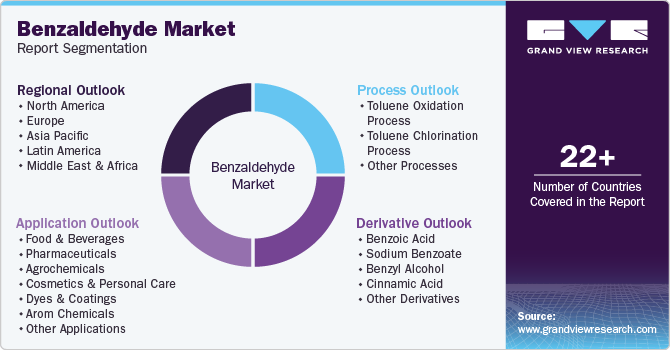
This report forecasts revenue and volume growth at global, regional, and country levels and provides an analysis of the latest industry trends in each of the sub-segments from 2021 to 2033. For this study, Grand View Research has segmented the global benzaldehyde market report based on process, derivative, application, and region:
-
Process Outlook (Volume, Kilotons; Revenue, USD Million, 2021 - 2033)
-
Toluene Oxidation Process
-
Toluene Chlorination Process
-
Other Processes
-
-
Derivative Outlook (Volume, Kilotons; Revenue, USD Million, 2021 - 2033)
-
Benzoic Acid
-
Sodium Benzoate
-
Benzyl Alcohol
-
Cinnamic Acid
-
Other Derivatives
-
-
Application Outlook (Volume, Kilotons; Revenue, USD Million, 2021 - 2033)
-
Food & Beverages
-
Pharmaceuticals
-
Agrochemicals
-
Cosmetics & Personal Care
-
Dyes & Coatings
-
Arom Chemicals
-
Other Applications
-
-
Regional Outlook (Volume, Kilotons; Revenue, USD Million, 2021 - 2033)
-
North America
-
U.S.
-
Canada
-
Mexico
-
-
Europe
-
Germany
-
UK
-
France
-
Italy
-
Spain
-
-
Asia Pacific
-
China
-
India
-
Japan
-
South Korea
-
-
Latin America
-
Brazil
-
Argentina
-
-
Middle East & Africa
-
Saudi Arabia
-
South Africa
-
-
Research Methodology
The benzaldehyde market figures in this report are based on a proven research process that combines executive interviews with secondary research from proprietary databases, company filings, and recognized regulatory and institutional sources. Market size is built through value-chain sizing - reconciling supply-side and demand-side estimates - and triangulated with bottom-up and top-down approaches. Every estimate passes multiple levels of expert validation before publication, with each benzaldehyde segment quantified using the revenue-capture definitions in the table below.
Segment Definition
Segment - Process
Revenue capture definition
Toluene Oxidation Process
Revenue is generated through the large-scale manufacture of benzaldehyde using efficient oxidation technology, supplying cost-competitive material to fragrance, pharmaceutical, food additive, and specialty chemical manufacturers worldwide.
Toluene Chlorination Process
Income is derived from the production of benzaldehyde grades manufactured via chlorination routes, catering to customers requiring specific purity profiles and serving niche industrial and chemical synthesis applications.
Other Processes
Commercial value is created through alternative production techniques, including catalytic and bio-based pathways, which address sustainability objectives and specialized end-user requirements for premium-grade benzaldehyde.
Segment - Derivative
Revenue capture definition
Benzoic Acid
Market earnings stem from the conversion of benzaldehyde into benzoic acid used in food preservation, industrial intermediates, plasticizers, and chemical manufacturing, supporting consistent downstream demand.
Sodium Benzoate
Financial returns are supported by the production of sodium benzoate for use as a preservative in processed foods, beverages, pharmaceuticals, and personal care formulations that require extended shelf life.
Benzyl Alcohol
Value creation is driven by the synthesis of benzyl alcohol utilized as a solvent, preservative, and formulation ingredient across pharmaceuticals, coatings, cosmetics, and specialty chemical applications.
Cinnamic Acid
Business revenue is realized through the manufacture of cinnamic acid employed in flavor compounds, fragrances, ultraviolet absorbers, and fine chemical intermediates serving multiple industrial sectors.
Other Derivatives
Sales opportunities arise from the transformation of benzaldehyde into specialty derivatives used in dyes, resins, performance chemicals, and customized formulations designed for diverse manufacturing applications.
Segment - Application
Revenue capture definition
Food & Beverages
Revenue is generated through the incorporation of benzaldehyde as a flavoring ingredient in confectionery, bakery products, beverages, and processed foods that require characteristic almond-like sensory profiles.
Pharmaceuticals
Commercial proceeds originate from the use of benzaldehyde as a chemical intermediate in the synthesis of active pharmaceutical ingredients, medicinal compounds, and specialty healthcare formulations.
Agrochemicals
Income is supported by the application of benzaldehyde in producing crop protection chemicals and agricultural intermediates that contribute to pesticide and plant health product manufacturing.
Cosmetics & Personal Care
Market value is captured through the inclusion of benzaldehyde in perfumes, skincare products, toiletries, and beauty formulations where fragrance performance and formulation compatibility are essential.
Dyes & Coatings
Earnings are driven by the utilization of benzaldehyde in dye intermediates, pigments, and coating additives that enhance color development and functional performance in industrial applications.
Aroma Chemicals
Revenue is fueled by strong demand for benzaldehyde in fragrance compositions, fine perfumes, air fresheners, and household care products requiring distinctive aromatic characteristics.
Other Applications
Business growth is supported by the deployment of benzaldehyde across laboratory reagents, specialty chemicals, research activities, and custom synthesis projects serving a broad range of industrial markets.
Estimation Model
Layer Name
Key Question
Description
Raw Material & Production Layer
What forms the supply base?
Assess global benzaldehyde production based on key feedstocks such as toluene and related aromatic hydrocarbons. Evaluate manufacturing routes including toluene oxidation, toluene chlorination, and emerging catalytic or bio-based processes, while examining production capacities, raw material availability, technological developments, and major manufacturing centers that shape global supply.
Application Adoption Layer
Where is benzaldehyde consumed?
Examine the utilization of benzaldehyde across major end-use industries including food & beverages, pharmaceuticals, agrochemicals, cosmetics & personal care, dyes & coatings, aroma chemicals, and other specialty applications. Demand is influenced by the need for flavoring agents, fragrance ingredients, chemical intermediates, and performance additives in industrial and consumer products.
Consumption Intensity Layer
How much benzaldehyde is utilized?
Analyze benzaldehyde consumption by measuring its incorporation into downstream derivatives and finished products such as benzoic acid, sodium benzoate, benzyl alcohol, cinnamic acid, and specialty chemicals. The evaluation considers manufacturing output, derivative conversion rates, sector-specific usage patterns, and regional demand dynamics to estimate annual consumption volumes.
Revenue Layer
How is market revenue generated?
Market revenue is generated through the production and sale of benzaldehyde and its derivatives supplied to flavor and fragrance manufacturers, pharmaceutical companies, agrochemical producers, and specialty chemical industries. Business growth is supported by increasing downstream demand, expansion of chemical processing capacity, innovation in high-purity grades, and rising investments in sustainable manufacturing technologies and value-added applications.
Delivered Customizations
This report has been delivered with the following In-depth customizations
Client Request
Customization Delivered
Value Adds
Regional Segmentation
The study delivers detailed country-level analysis across major benzaldehyde production and consumption markets and other key regions. The assessment covers feedstock availability, benzaldehyde manufacturing capacities, supply chain dynamics, trade flows, regulatory frameworks, sustainability initiatives, and demand trends across food & beverages, pharmaceuticals, agrochemicals, cosmetics & personal care, dyes & coatings, aroma chemicals, and other end-use industries.
Enables stakeholders to identify high-potential regional markets, evaluate supply-demand balances, understand regulatory developments, assess production capabilities, and prioritize investments in countries with expanding specialty chemical and downstream manufacturing sectors.
Competitive Benchmarking
The report provides a comprehensive competitive benchmarking analysis of leading benzaldehyde manufacturers operating across global and regional markets. The assessment covers company market presence, product portfolios, manufacturing technologies, production capacities, geographic reach, strategic initiatives, customer focus, innovation capabilities, and recent business developments.
Helps stakeholders compare competitive positioning, identify product and process differentiation, evaluate expansion strategies, understand operational strengths, and support informed decisions related to collaborations, capacity investments, portfolio optimization, and long-term growth planning.
Opportunity Assessment
The study delivers a detailed evaluation of growth opportunities across food & beverages, pharmaceuticals, agrochemicals, cosmetics & personal care, dyes & coatings, aroma chemicals, and other application areas. The analysis further examines prospects arising from bio-based production methods, rising demand for high-purity intermediates, expansion of pharmaceutical manufacturing, and increasing consumption of premium flavors and fragrances in global markets.
Assists companies in identifying attractive investment opportunities, aligning product development with evolving industry requirements, strengthening competitive advantage through sustainable manufacturing initiatives, and capturing emerging demand across high-value downstream applications.
Frequently Asked Questions About This Report
Based on process, the toluene oxidation process segment accounted for the highest market share, representing 39.8% of total revenue in 2025. The segment’s leading position is supported by its superior production efficiency, favorable economics, and widespread adoption for large-scale benzaldehyde manufacturing across pharmaceutical, flavor, fragrance, and specialty chemical applications.
By derivative, benzoic acid held a dominant position, contributing 30.6% of total revenue in 2025.
Asia Pacific is the fastest-growing region over the forecast period.
By application, cosmetics & personal care held a dominant position, contributing 25.4% of total revenue in 2025.
North America dominated the benzaldehyde market with the highest revenue share of 44.2% in 2025.
The benzaldehyde market is primarily driven by rising demand from the flavor and fragrance industry, where it is extensively used in food products, beverages, perfumes, and personal care formulations. Growth in pharmaceutical and agrochemical manufacturing, coupled with increasing consumption of downstream derivatives such as benzoic acid and benzyl alcohol, is further supporting market expansion.
The global benzaldehyde market size was valued at USD 394.0 million in 2025 and is estimated at USD 415.3 million in 2026.
The global benzaldehyde market is expected to grow at a CAGR of 5.9% from 2026 to 2033, reaching USD 620.7 million by 2033.
Some key players operating in the polyurethane market include Lanxess AG; Axxence Aromatic GmbH; Gujarat Alkalies and Chemicals Limited; Emerald Kalama Chemical; Taile Chemical Industry, Co. Ltd.; Shimmer Chemicals Pvt. Ltd.; Emerald Performance Materials, LLC; Valtris Specialty Chemicals; Kadillac Chemicals Pvt. Ltd.; Wuhan Dico Chemical Co., Ltd.; Ganesh Benzoplast Ltd.
About the Author(s)
Organic Chemicals Research Team
Bulk Chemicals · Organic ChemicalsThis report was authored by the organic chemicals research team at Grand View Research - comprising two research analysts, one senior research analyst, and one industry expert - with specialized expertise in the organic chemicals segment of the bulk chemicals industry. All findings are based on proprietary bulk chemicals databases, executive interviews, and regulatory analysis, subject to internal peer review prior to publication.
Last Updated:
Speak to Analyst
Customize this report to your needs — add regions, segments, or data points, with 20% free customization.
Or view our licence options:

ISO 9001:2015 & 27001:2022 Certified
We are GDPR and CCPA compliant! Your transaction & personal information is safe and secure. For more details, please read our privacy policy.