
- Home
- »
- Personal Care & Cosmetics
- »
-
Betulin Market Size, Share & Trends Report, 2026-2033GVR Report cover

Betulin Market (2026 - 2033)
Size, Share & Trends Analysis Report By Source (Birch Trees, Others), By Application (Personal Care & Cosmetics, Pharmaceuticals, Nutraceuticals), By Region, And Segment Forecasts
Market Size, 2025
$1.0BMarket Estimate, 2026
$1.1BMarket Forecast, 2033
$1.7BCAGR, 2026–2033
7.1%Betulin Market Summary
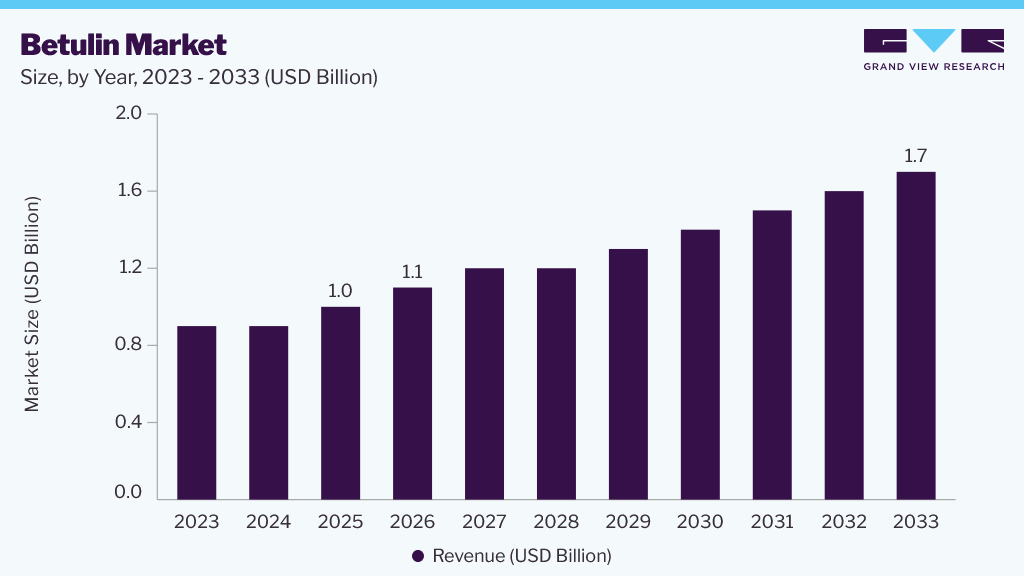
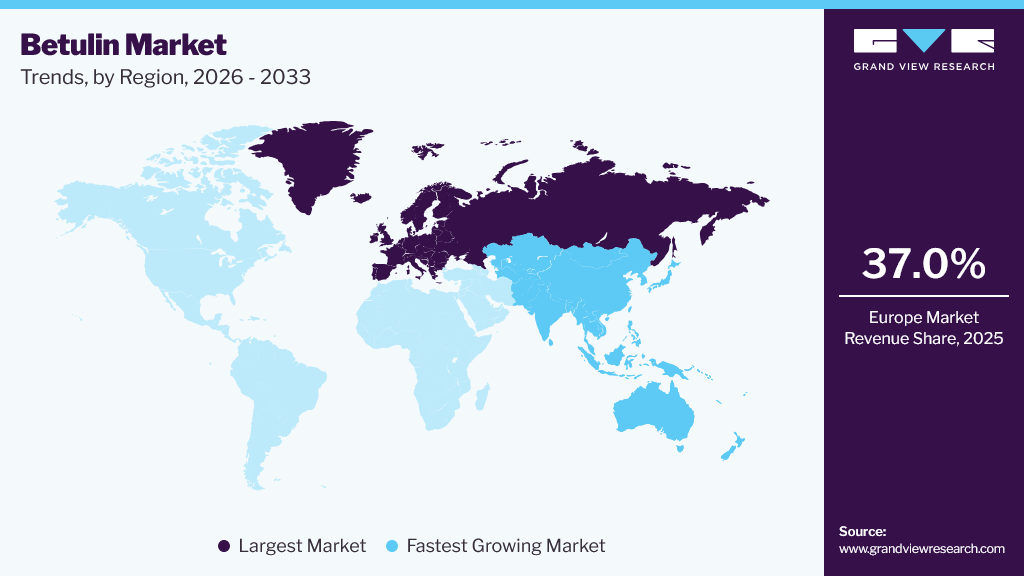
The global betulin market size was valued at USD 1.0 billion in 2025 and is projected to grow from USD 1.1 billion in 2026 to USD 1.7 billion by 2033, at a CAGR of 7.1% from 2026 to 2033. Europe dominated the market, accounting for a revenue share of 37.0% in 2025. The global betulin industry is growing steadily, driven by rising demand for natural, plant-based ingredients in pharmaceuticals and cosmetics.
 Source: Grand View Research, IR Documents, Primary Interviews, Paid DatabasesTo learn more about this report,
 Download Free Sample Report
Key Market Trends & Insights
- By source: The birch trees segment accounted for the largest market revenue share of around 85.0% in 2025.
- By application: The personal care and cosmetics segment led the market with the largest revenue share of 33.0% in 2025.
Regional Highlights
- Largest regional market: Europe (37.0% revenue share, 2025)
- Fastest-growing regional market: Asia Pacific (highest CAGR, 2026-2033)
Market Size & Forecast
- Market size in 2025: USD 1.0 Billion
- Estimated market size in 2026: USD 1.1 Billion
- Projected market size by 2033: USD 1.7 Billion
- CAGR (2026-2033): 7.1%
Prism AI by Grand View Research Free to tryAsk a question about the betulin marketTry asking✓Every figure cited from GVR research Prefer the report? Download free sample →
Betulin possesses strong anti-inflammatory, antioxidant, antiviral, and skin-protective properties, making it an attractive ingredient for pharmaceutical, cosmetic, and personal care applications. Growing consumer preference for plant-based and sustainable ingredients continues to support market expansion. Growing research activities in biotechnology and pharmaceutical sciences continue to expand the therapeutic potential of betulin and its derivatives. Ongoing studies investigating anticancer, antiviral, and anti-inflammatory properties are supporting the development of new formulations and future clinical applications. In addition, rising investments in natural compound-based drug discovery are enhancing betulin’s commercial potential across therapeutic and healthcare segments.The growing focus on green and sustainable extraction technologies offers a major opportunity for the betulin industry. Utilizing eco-friendly methods to extract betulin from birch bark can reduce costs and appeal to environmentally conscious brands. This approach also helps companies meet clean-label and sustainability standards. As industries shift toward natural sourcing, demand for eco-extracted betulin is expected to increase.
Market Concentration & Characteristics
The betulin industry is moderately concentrated, with a few key players in Europe and Asia dominating production and supply. These companies have access to abundant birch resources and advanced extraction technologies, giving them a strong competitive edge. Smaller firms and startups are entering the market through specialized, sustainable extraction solutions, adding innovation to the landscape.
The betulin industry is driven by innovation and sustainability, shaped by growing demand for natural bioactive compounds in cosmetics and pharmaceuticals. It features steady growth potential, supported by R&D activities and eco-friendly manufacturing trends. However, regulatory challenges and limited large-scale production still define the industry’s development stage.
Analyst Perspective
The betulin market is driven by rising demand for plant-derived bioactive ingredients in pharmaceutical, cosmetic, and personal care formulations, supported by growing research into betulin’s anti-inflammatory, antioxidant, and skin-protective properties. Market opportunities are emerging from the development of functional skincare products and pharmaceutical compounds derived from birch bark, as well as the greater utilization of renewable botanical raw materials. The birch trees accounted for the largest revenue share in 2025, supported by the high natural concentration of betulin in birch bark and the extraction practices across regions with abundant birch resources. Europe leads the market through its extensive birch forest resources, established botanical extraction industry, strong cosmetics sector, and active research into plant-derived ingredients.
Source Insights
By source, the birch trees segment led the market with the largest revenue share of around 85.0% in 2025, due to their exceptionally high betulin content compared to other plant sources. This natural abundance allows for cost-effective extraction and large-scale production. Their consistent availability across major regions further strengthens their role as the primary and most reliable source of raw materials. For instance, in June 2025, the Latvian State Institute of Wood Chemistry, together with Latvijas Finieris and cosmetics company Labrains, launched an ERDF-supported project to develop skincare products and cosmetic ingredients from birch outer bark extractives. The institute identified betulin, lupeol, and betulinic acid as valuable compounds in birch bark and noted their potential for cosmetic applications.
The others segment is anticipated to grow at the fastest CAGR during the forecast period, driven by increasing research on alternative botanical sources with comparable betulin yields. The rising focus on diversifying raw material sources and reducing dependence on birch trees is encouraging adoption. In addition, the growing interest in sourcing localized, sustainable ingredients support the segment’s accelerated expansion.
Application Insights
The personal care and cosmetics segment led the market with the largest revenue share of around 33.0% in 2025, primarily due to its extensive use in skincare, haircare, and anti-aging formulations. Betulin’s antioxidant and skin-repairing properties make it a preferred ingredient in premium natural cosmetic products. For instance, in May 2025, the Latvian State Institute of Wood Chemistry, Latvijas Finieris, and Labrains started an interdisciplinary project to develop sunscreen, moisturizing body creams, and moisturizing facial creams using microscale particles of birch bark extractives. The project specifically targeted the replacement of synthetic emulsifiers with multifunctional birch bark extractives, creating a direct application for betulin-rich material in skincare formulations.
The pharmaceutical segment is expected to grow at the fastest CAGR during the forecast period. This segment is expanding rapidly as ongoing research continues to reveal betulin’s therapeutic potential in treating inflammation, viral infections, and cancer. The growing number of clinical trials and formulation development efforts using betulin derivatives is accelerating the adoption of this compound. This growing scientific validation is positioning betulin as a promising bioactive compound in modern drug discovery.
Regional Insights
The betulin industry in North America is driven by the region’s growing investments in botanical drug research. Pharmaceutical companies are focusing on developing natural compounds with proven therapeutic efficacy, positioning betulin as a valuable bioactive ingredient. This science-driven demand supports long-term market stability and innovation.
 To learn more about this report, Download Free Sample Report
U.S. Betulin Market Trends
The betulin industry in the U.S. is propelled by growing clinical research of betulin’s potential in anti-cancer and anti-inflammatory therapies. Academic and commercial research collaborations are accelerating the development of products using betulin derivatives. This focus on evidence-based applications enhances its credibility and market acceptance in the healthcare sector.
Europe Betulin Market Trends
The betulin industry in Europe dominated the global market with a share of approximately 37.0% in 2025, driven by the region’s growing emphasis on sustainability and the replacement of synthetic ingredients with bio-based alternatives. Regulatory frameworks supporting natural formulations have encouraged manufacturers to incorporate betulin into pharmaceutical and cosmetic products. This alignment with the EU’s green chemistry goals continues to strengthen its market position across the region. Increasing research and development of betulin derivatives for therapeutic applications is driving market growth. For instance, in January 2025, researchers from the Medical University of Silesia and the Polish Academy of Sciences reported the development of new difunctional betulin derivatives and evaluated their antiproliferative activity against leukemia, lung, breast, prostate, colon, pancreatic, and melanoma cell lines.
Germany’s betulin industry is a key consumer in the European market, primarily driven by its robust pharmaceutical and biotechnology sectors. The country’s strong focus on research and clinical innovation encourages the adoption of betulin in advanced drug and skincare formulations, supporting steady market growth.
Asia Pacific Betulin Market Trends
The betulin industry in Asia Pacific is expected to grow at the fastest CAGR from 2026 to 2033, fueled by rapid industrial expansion in pharmaceuticals and nutraceuticals, alongside rising government focus on herbal product standardization. Countries in the region are investing heavily in plant-based research to develop safe and effective natural ingredients. This structured approach to innovation continues to accelerate the adoption of betulin in health and wellness applications.
The betulin industry in China accounted for the largest revenue share in Asia-Pacific in 2025, driven by the modernization of traditional Chinese medicine (TCM). The integration of betulin into modern formulations reflects the country’s strategic shift toward scientifically validated plant-derived therapeutics. This modernization trend is expanding the commercial scope of betulin in both healthcare and personal care sectors. For instance, in November 2025, researchers from Guangzhou Medical University and affiliated Chinese medical institutions published research showing that betulin, derived from Betula platyphylla, a Chinese medicinal birch species, suppressed tumor angiogenesis and tumor growth in non-small-cell lung cancer models. The research identified the PAX2/VEGF-A/VEGFR2 pathway as a mechanism underlying the activity and highlighted betulin's potential for NSCLC therapy.
Latin America Betulin Market Trends
The betulin industry in Latin America is expanding as the use of native plant resources in natural ingredient production grows. Local manufacturers are adding betulin to herbal cosmetics and supplements, boosting both domestic and export demand. This focus on regional biodiversity is enhancing Latin America’s global market presence.
Middle East & Africa Betulin Market Trends
The betulin industry in the Middle East and Africa is driven by the region’s expanding pharmaceutical and cosmetic manufacturing sectors. Growing industrial diversification and rising demand for locally produced plant-based ingredients are fostering betulin adoption. This manufacturing shift toward value-added natural products is creating new growth opportunities across the region.
Key Betulin Company Insights
Leading companies are expanding their market presence through investments in sustainable extraction technologies, product innovation, research collaborations, strategic partnerships, and expansion of botanical ingredient portfolios. Companies are also focusing on high-purity betulin production and value-added pharmaceutical and cosmetic applications to strengthen their competitive position.
Key Betulin Companies:
The following key companies have been profiled for this study on the betulin market:
-
Otto Chemie Pvt. Ltd.
-
SimSon Pharma Limited
-
ChemFaces
-
Aktin Chemicals, Inc.
-
Hovane Phytochemicals
-
Betulin Lab (Latvijas Finieris Group)
-
Tianjin NWS Biotechnology and Medicine Co. Ltd.
Recent Developments
-
In April 2024, Innomost launched Betuinno Betulin Top Quality Fine, an upcycled birch-bark-derived ingredient for beauty, skincare, surfaces, and coatings. The ingredient is positioned as a bio-based alternative to synthetic white pigments and can be used in cosmetics, toothpaste, sunscreens, and coatings. Innomost stated that the product is produced from certified forest-industry birch-bark side streams using its patented extraction and processing technology.
-
In July 2024, researchers from the University of British Columbia and the University of Pennsylvania developed cellulose-based insulating foams incorporating betulin extracted from tree bark. The material achieved water contact angles above 150°, self-extinguished within 10 seconds, and showed no degradation after 3 months in soil. The betulin-modified foam reduced greenhouse gas emissions by 96% and human toxicity by 92% compared with rigid polyurethane foam.
Betulin Market Report Scope
Report Attribute
Details
Market size in 2025
USD 1.0 billion
Estimated Market size in 2026
USD 1.1 billion
Projected Market size by 2033
USD 1.7 billion
Growth rate
CAGR of 7.1% from 2026 to 2033
Base year for estimation
2025
Actual data
2021 – 2025
Forecast period
2026 – 2033
Quantitative units
Revenue in USD Billion, volume in Kilotons, and CAGR from 2026 to 2033
Report coverage
Revenue forecast, company ranking, competitive landscape, growth factors, and trends
Segments covered
Source, application, region
Regional Scope
North America; Europe; Asia Pacific; Latin America; Middle East & Africa
Country scope
U.S.; Canada; Mexico; Germany; UK; France; Italy; Spain; China; India; Japan; South Korea; Brazil; Argentina; Saudi Arabia; South Africa.
Key companies profiled
Otto Chemie Pvt. Ltd.; SimSon Pharma Limited; ChemFaces; Aktin Chemicals, Inc.; Hovane Phytochemicals; Betulin Lab (Latvijas Finieris Group); Tianjin NWS Biotechnology and Medicine Co. Ltd.
Customization scope
Free report customization (equivalent up to 8 analysts working days) with purchase. Addition or alteration to country, regional & segment scope.
Pricing and purchase options
Avail of customized purchase options to meet your exact research needs. Explore purchase options
Global Betulin Market Report Segmentation
This report forecasts volume and revenue growth at the regional and country levels and provides an analysis of the latest industry trends and opportunities in each sub segment from 2021 to 2033. For this study, Grand View Research has segmented global betulin market report based on source, application, region.
- Source Outlook (Volume, Kilotons; Revenue, USD Billion, 2021 - 2033)
- Birch Trees
- Others (Hazel bark, calendula, alder cordial)
- Application Outlook (Volume, Kilotons; Revenue, USD Billion, 2021 - 2033)
- Personal Care & Cosmetics
- Pharmaceuticals
- Nutraceuticals
- Chemicals & Intermediates
- Food & Beverages
- Others
- Regional Outlook (Volume, Kilotons; Revenue, USD Billion, 2021 - 2033)
- North America
- U.S.
- Canada
- Mexico
- Europe
- Germany
- UK
- Italy
- Spain
- France
- Asia Pacific
- China
- Japan
- South Korea
- India
- Latin America
- Brazil
- Argentina
- Middle East & Africa
- Saudi Arabia
- South Africa
- North America
Frequently Asked Questions About This Report
The global betulin market is expected to grow at a CAGR of 7.1% from 2026 to 2033, reaching USD 1.7 billion.
Europe dominated with an approximately 37.0% revenue share in 2025.
The birch trees segment accounted for the largest revenue share of around 85.0% in 2025.
The global betulin market size was valued at USD 1.0 billion in 2025 and is estimated at USD 1.1 billion for 2026.
Key players in the market include Otto Chemie Pvt. Ltd.; SimSon Pharma Limited; ChemFaces; Aktin Chemicals, Inc.; Hovane Phytochemicals; Betulin Lab (Latvijas Finieris Group); Tianjin NWS Biotechnology and Medicine Co. Ltd. and others.
About the Author(s)
Personal Care & Cosmetics Research Team
Bulk Chemicals · Personal Care & CosmeticsThis report was authored by the personal care & cosmetics research team at Grand View Research - comprising two research analysts, one senior research analyst, and one industry expert - with specialized expertise in the personal care & cosmetics segment of the bulk chemicals industry. All findings are based on proprietary bulk chemicals databases, executive interviews, and regulatory analysis, subject to internal peer review prior to publication.
Last Updated:
Speak to Analyst

Customize this report to your needs - add regions, segments, or data points, with 20% free customization.
Or view our licence options:


ISO 9001:2015 & 27001:2022 Certified
We are GDPR and CCPA compliant! Your transaction & personal information is safe and secure. For more details, please read our privacy policy.


