
- Home
- »
- Next Generation Technologies
- »
-
Big Data Engineering Services Market Size Report, 2033GVR Report cover

Big Data Engineering Services Market (2026 - 2033)
Size, Share, & Trends Analysis Report By Service Type (Data Integration & ETL, Data Modeling & Architecture), By Deployment (Cloud, On-premises), By End Use (IT & Telecommunications, BFSI), By Region, and Segment Forecasts
Market Size, 2025
$101.0BMarket Estimate, 2026
$115.9BMarket Forecast, 2033
$321.3BCAGR, 2026–2033
15.7%Big Data Engineering Services Market Summary
The global big data engineering services market size was valued at USD 101.0 billion in 2025 and is projected to grow from USD 115.9 billion in 2026 to USD 321.3 billion by 2033, at a CAGR of 15.7% from 2026 to 2033. North America dominated the market, accounting for a revenue share of 41.4% in 2025. The global big data engineering services market is growing at a significant pace, driven by the increasing volume and complexity of data generated across industries.
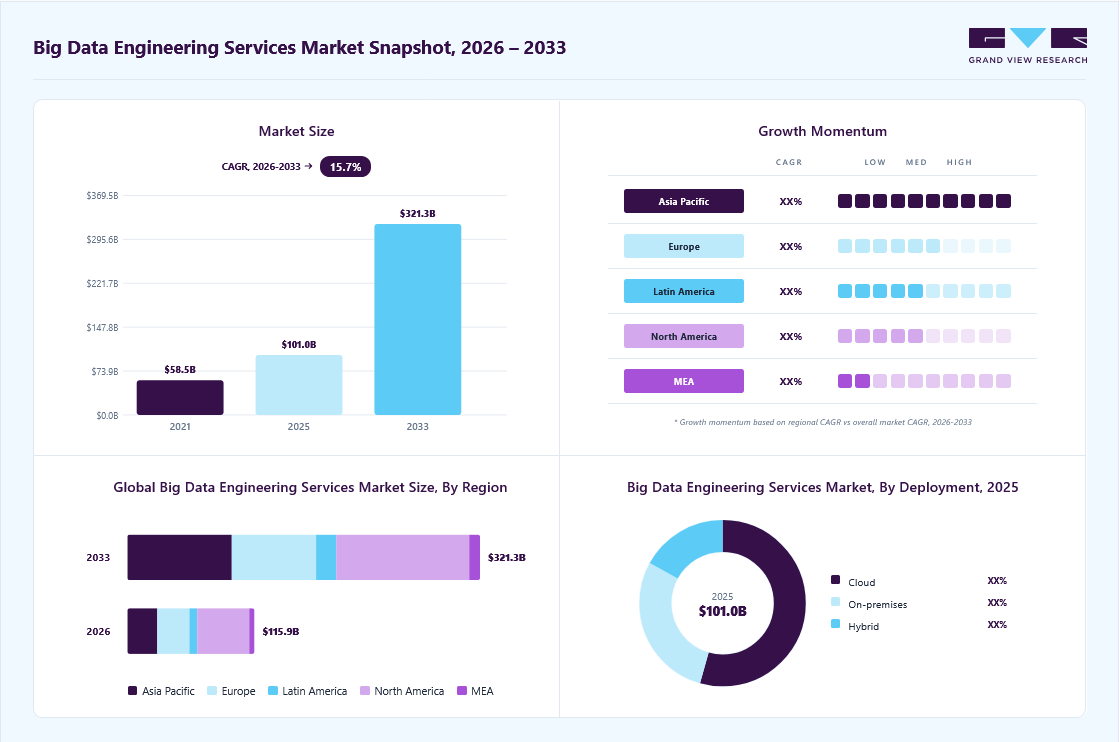 Source: Grand View Research, IR Documents, Primary Interviews, Paid DatabasesTo learn more about this report,
 Download Free Sample Report
Key Market Trends & Insights
- By service type: The data integration & ETL segment held the largest market share of around 31.5% in 2025.
- By deployment: Cloud segment held the largest market revenue share in 2025.
- By end use: IT & Telecommunications segment led the market with the largest revenue share in 2025.
Regional Highlights
- Largest regional market: North America (41.4% revenue share, 2025)
- Fastest-growing regional market: Asia Pacific (highest CAGR, 2026-2033)
- Leading country: The U.S. held the largest share in 2025
Market Size & Forecasts
- Market size in 2025: USD 101.0 Billion
- Estimated market size in 2026: USD 115.9 Billion
- Projected market size by 2033: USD 321.3 Billion
- CAGR (2026-2033): 15.7%
Prism AI by Grand View Research Free to tryAsk a question about the big data engineering services marketTry asking✓Every figure cited from GVR research Prefer the report? Download free sample →The adoption of cloud computing, artificial intelligence, and advanced analytics is increasing the demand for scalable data engineering solutions. Organizations are increasingly investing in data integration, data management, and analytics infrastructure to support data-driven decision-making.
The adoption of open and governed data lakehouse architecture is increasing as enterprises seek to improve data interoperability, accessibility, and governance. Organizations are increasingly managing data across hybrid and multicloud environments, creating demand for solutions that enable seamless data access and integration. Enterprises are adopting open data architectures to reduce data silos and improve data portability across different platforms. The increasing use of AI, advanced analytics, and real-time applications is further strengthening the need for flexible and scalable data infrastructure. This trend is expected to drive demand for big data engineering services focused on data integration, governance, architecture, and management. For instance, in June 2026, Cloudera, a U.S.-based enterprise data and AI platform company in California, adopted Apache Polaris as part of its open data lakehouse architecture powered by Apache Iceberg to improve interoperability and governed access to enterprise data. The integration supports secure data access across hybrid and multicloud environments while strengthening governance for AI and analytics.
 To learn more about this report, Download Free Sample Report
Enterprises are increasingly adopting real-time data integration to enable faster access to operational data for analytics and AI applications. The shift from traditional batch-based ETL toward continuous data movement and change data capture is increasing demand for scalable data engineering solutions. For instance, in March 2026, Snowflake, a U.S.-based cloud data platform company, announced the general availability of its Openflow Connector for Oracle, which enables near-real-time data replication from Oracle databases to Snowflake. This development reduces the need for complex third-party replication infrastructure and supports centralized access to enterprise data. The increasing adoption of real-time data integration is expected to drive demand for big data engineering services focused on data ingestion, pipeline development, data replication, and processing.
Enterprises are increasingly adopting unified data engineering platforms to manage complex data environments. These platforms integrate data ingestion, transformation, orchestration, governance, and analytics capabilities. Organizations are seeking to reduce the complexity associated with using multiple disconnected data tools. Cloud-native and lakehouse architectures are further supporting the adoption of unified platforms. These solutions enable enterprises to improve data quality, scalability, and operational efficiency. They also facilitate consistent data management across hybrid and multicloud environments. The growing adoption of AI and advanced analytics is increasing the need for integrated data infrastructure. As a result, organizations are investing in modern platforms to support increasingly complex data workflows. This is expected to drive demand for big data engineering services focused on integration, modernization, orchestration, and governance.
Market Dynamics
The global big data engineering services market is evolving with increasing focus on scalability, flexibility, and real-time data processing. Companies are investing in modern data engineering solutions to manage growing volumes of structured and unstructured data across cloud, hybrid, and multicloud environments. The rising adoption of AI, advanced analytics, and real-time applications is encouraging enterprises to modernize their data pipelines and infrastructure. Market players are enhancing their platforms and services to support data integration, governance, automation, and faster data processing. These developments are expected to drive sustained growth of the big data engineering services market.
The rapid growth of enterprise data is increasing demand for big data engineering services. Organizations generate large volumes of data through business applications, websites, connected devices, transactions, and digital platforms. This data is increasingly diverse, including structured, semi-structured, and unstructured formats. Managing and processing these growing datasets requires scalable data infrastructure and efficient data pipelines. As data environments become more complex, organizations are increasingly adopting data engineering services to support data integration, processing, and management.
Enterprises are also consolidating data from multiple sources and systems, creating challenges related to data accessibility and consistency. Traditional data infrastructure may not be sufficient to handle increasing data volumes and complex processing requirements. Organizations are therefore modernizing their data architectures to improve scalability and support faster data processing. The growing need to make enterprise data accessible for analytics, AI, and business intelligence is further increasing demand for data engineering capabilities. These developments are expected to support the growth of the big data engineering services market.
The implementation of big data engineering solutions can involve significant costs for enterprises. Organizations may need to invest in data infrastructure, cloud platforms, specialized tools, and skilled professionals to develop and manage complex data environments. Integrating data from multiple sources and modernizing legacy systems can further increase implementation expenses. Enterprises may also require additional resources for data security, governance, quality management, and system monitoring. These factors can make large-scale data engineering projects expensive, particularly for organizations with limited technology budgets.
Ongoing maintenance requirements can further increase the total cost of data engineering operations. Data pipelines, processing frameworks, storage environments, and integration systems require regular monitoring, optimization, and upgrades. Organizations may also need specialized professionals to manage increasingly complex data architectures and address technical issues. Changes in data sources and business requirements can require continuous modifications to existing pipelines and infrastructure. These cost and resource requirements may restrain the adoption of big data engineering services, particularly among small and medium-sized enterprises.
The increasing adoption of AI and advanced analytics is creating significant opportunities for big data engineering service providers. Organizations require scalable and reliable data infrastructure to collect, process, and prepare large datasets for AI and analytics applications. The growing use of generative AI and machine learning is further increasing the need for high-quality, well-governed, and accessible data. Enterprises are therefore modernizing data pipelines and architectures to support increasingly complex AI workloads. This creates opportunities for service providers offering data integration, pipeline development, data modernization, and governance capabilities.
The expansion of AI applications across industries is also increasing demand for specialized data engineering services. Organizations are integrating data from cloud platforms, enterprise applications, IoT devices, and other sources to develop AI-driven use cases. Service providers can address this demand by offering scalable cloud-based data platforms, real-time data processing, and automated data pipelines. The growing need to prepare enterprise data for AI models can further expand opportunities for data quality, governance, and data management services. These developments are expected to create new growth opportunities in the big data engineering services market.
Market Concentration & Characteristics
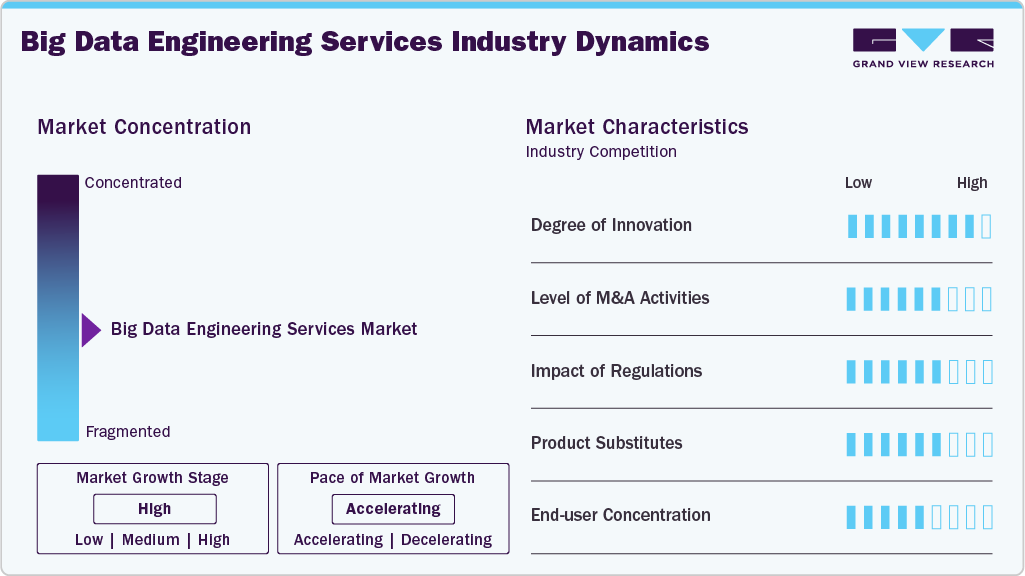
The big data engineering services market is moderately fragmented, with competition spread across global IT service providers and specialized data engineering firms. Large players offer broad capabilities across data integration, cloud, analytics, and modernization services. Specialized providers compete through domain expertise, technical capabilities, and customized solutions. The presence of established and emerging players limits the dominance of individual vendors. Market participants are expanding their service portfolios to address evolving enterprise data requirements. This competitive structure is expected to maintain a moderately fragmented market environment.
 To learn more about this report, Download Free Sample Report
The competitive landscape is shaped by technological capabilities, service breadth, scalability, and industry expertise. Companies are strengthening their offerings across cloud data platforms, AI, advanced analytics, and data modernization. Strategic partnerships and technology collaborations are being used to expand capabilities and customer reach. Providers are also investing in automation to improve data processing and engineering efficiency. Differentiation increasingly depends on the ability to manage complex data environments and support diverse workloads. These developments are contributing to an evolving and competitive market structure.
Analyst Perspective
The global big data engineering services market is shifting toward more integrated, scalable, and automated data ecosystems. Enterprises are prioritizing architectures that enable seamless data access across diverse platforms while improving data quality and governance. The growing complexity of enterprise data environments is also increasing demand for flexible engineering services that can support analytics, AI, and real-time workloads. These trends are reshaping service offerings and creating opportunities for market players to expand their capabilities.
Service Type Insights
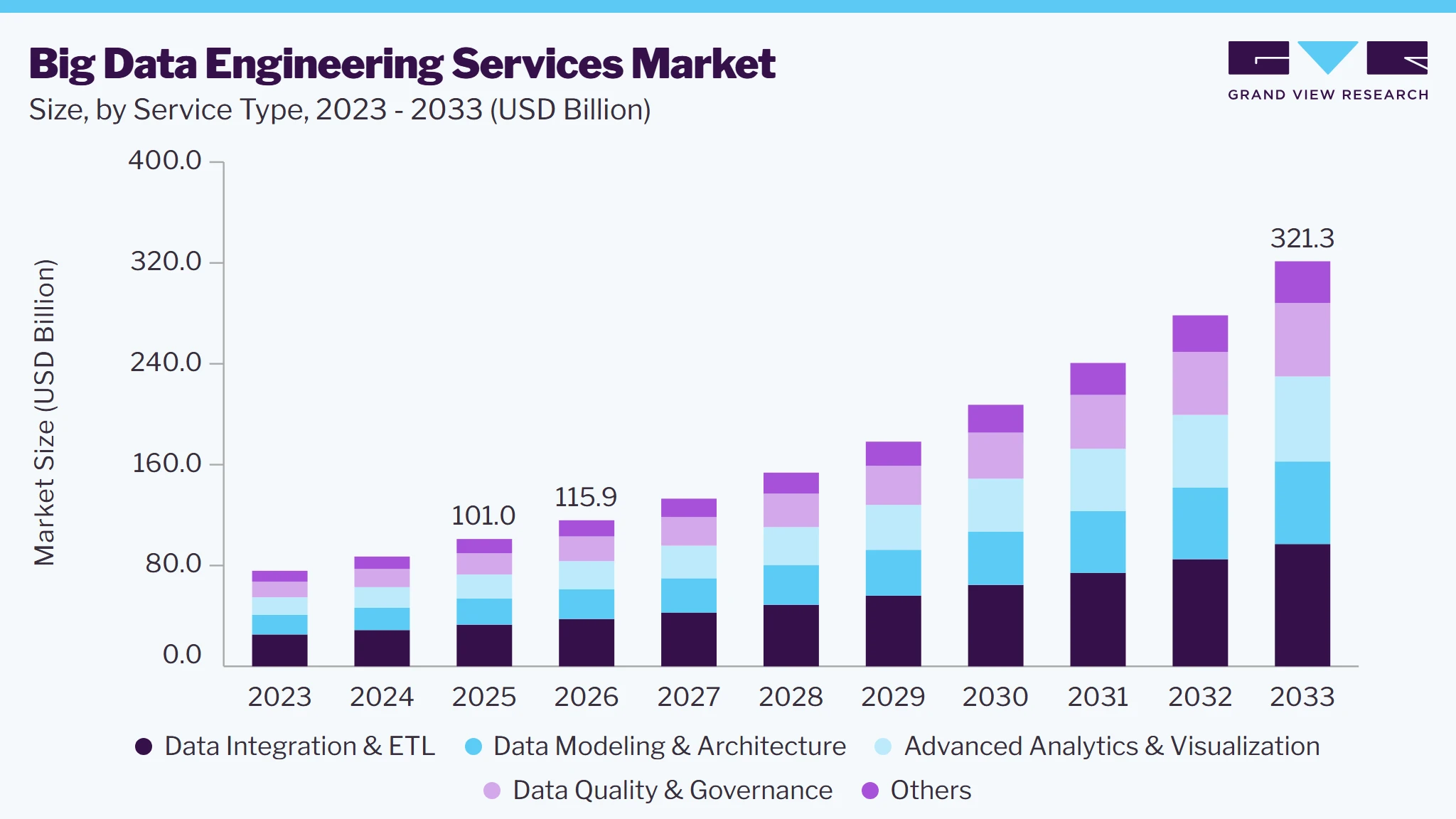
Data Integration & ETL dominated the big data engineering services market in 2025, accounting for a 32.7% revenue share. Enterprises rely on ETL solutions to extract, transform, and load data into centralized platforms for analytics and reporting. The increasing adoption of cloud and hybrid data environments is further driving demand for data integration services. Organizations are also modernizing legacy systems and integrating data from enterprise applications, databases, and cloud platforms. These factors are expected to support the continued dominance of the Data Integration & ETL segment.
Advanced Analytics & Visualization is experiencing growth as organizations increasingly use data to support business decision-making. Enterprises are adopting analytics tools to identify patterns, generate insights, and monitor business performance. The rising use of AI and machine learning is further increasing demand for advanced analytical capabilities. Growing volumes of complex data are also encouraging organizations to adopt visualization solutions that simplify data interpretation. These developments are expected to support the growth of the Advanced Analytics & Visualization segment.
Deployment Insights
Cloud deployment dominated the big data engineering services market due to the growing adoption of scalable and flexible data infrastructure. Enterprises are increasingly migrating data workloads and applications from on-premises environments to cloud platforms. Cloud environments enable organizations to manage large data volumes while supporting analytics, AI, and real-time processing requirements. The increasing use of cloud-native data platforms and hybrid architectures is further supporting segment demand. These factors are expected to maintain the dominance of the Cloud segment in the market.
The On-premises segment remains relevant as organizations continue to retain infrastructure for sensitive and business-critical data workloads. Enterprises in highly regulated industries often require greater control over data storage, security, and access. Existing investments in on-premises infrastructure are also encouraging organizations to maintain and modernize these environments. The integration of on-premises systems with cloud platforms is further supporting demand for related data engineering services. These factors are expected to sustain demand for on-premises data engineering solutions.
End Use Insights
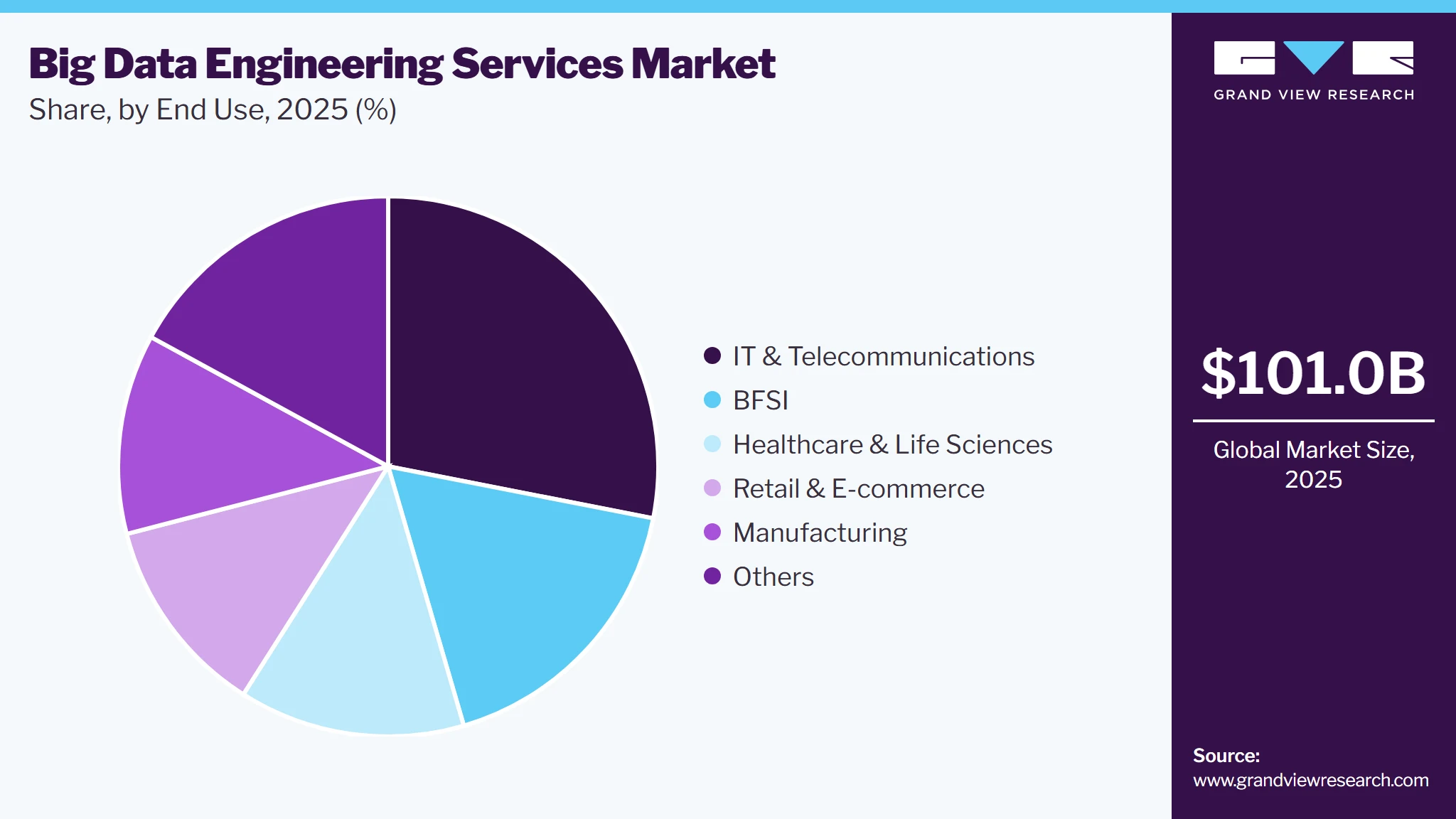
The IT & Telecommunications segment dominated the big data engineering services market due to the large volumes of data generated through digital platforms, networks, and enterprise applications. Companies in this sector require data engineering solutions to manage, integrate, and process data from diverse sources. The increasing adoption of cloud computing, AI, and advanced analytics is further increasing demand for scalable data infrastructure. Telecom operators also use data engineering capabilities to process network, customer, and operational data for analytics and optimization. These factors support the continued dominance of the IT & Telecommunications segment.
 To learn more about this report, Download Free Sample Report
The Manufacturing segment is increasingly adopting big data engineering services to manage data generated across production, supply chain, equipment, and quality management systems. The adoption of IoT, connected machinery, and smart manufacturing technologies is increasing the volume and complexity of industrial data. Manufacturers are using data engineering solutions to integrate operational data and support analytics across production and supply chain processes. The growing use of AI and predictive analytics is further increasing the need for reliable and accessible manufacturing data. These developments are expected to support the expansion of big data engineering services across the manufacturing sector.
Regional Insights
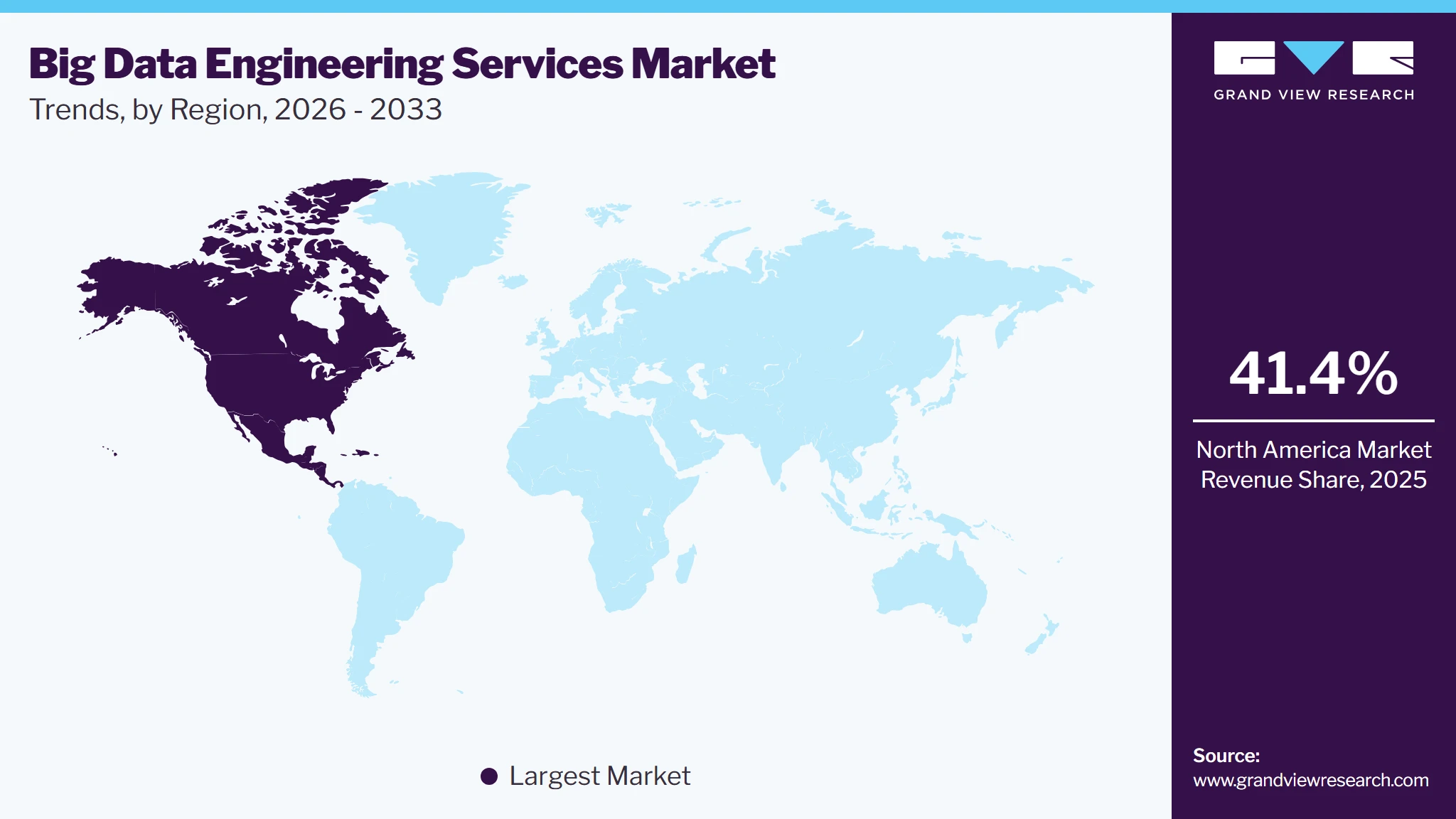
North America dominated the market by 41.4% revenue share in 2025. North America accounted for the largest share of the Big Data Engineering Services Market, supported by the widespread adoption of cloud computing, AI, and advanced analytics. Enterprises across industries are generating and processing large volumes of structured and unstructured data. The presence of established technology companies and data engineering service providers is also supporting regional demand. Organizations are increasingly modernizing data infrastructure to support real-time analytics and AI applications. These factors are contributing to North America's large share of the market.
 To learn more about this report, Download Free Sample Report
U.S. Big Data Engineering Services Market Trends
The U.S. accounted for a significant share of the big data engineering services market, supported by the widespread adoption of cloud computing and advanced data technologies. Enterprises across industries are generating large volumes of data through digital platforms, applications, and connected systems. The increasing adoption of AI, machine learning, and advanced analytics is creating demand for scalable data engineering solutions. Organizations are also modernizing legacy data infrastructure to support real-time processing and data-driven applications. These factors are supporting the strong demand for big data engineering services in the U.S.
Europe Big Data Engineering Services Market Trends
Europe represents a significant market for big data engineering services, supported by increasing digital transformation and data modernization initiatives. Enterprises are adopting cloud, hybrid, and multicloud environments to manage growing data volumes. The increasing use of AI and advanced analytics is further creating demand for scalable data engineering capabilities. Organizations are also focusing on data governance, security, and regulatory compliance. These developments are supporting the adoption of big data engineering services across Europe.
Asia Pacific Big Data Engineering Services Market Trends
Asia Pacific is expected to register the fastest growth in the Big Data Engineering Services Market. Rapid digitalization and increasing adoption of cloud computing are generating large volumes of enterprise and consumer data across the region. The growing use of AI, IoT, advanced analytics, and digital platforms is increasing demand for modern data infrastructure. The expansion of technology services and data-driven applications across countries such as China, India, and Japan is further supporting market development. These factors are expected to accelerate the adoption of Big Data Engineering Services across Asia Pacific.
Key Big Data Engineering Services Company Insights
Key players operating in the Big Data Engineering Services Market include Accenture; Capgemini; Cognizant; Genpact Limited; HCL Technologies Limited; IBM Corporation; Infosys Limited; NTT DATA Corporation; Tata Consultancy Services Limited (TCS); Wipro Limited.
-
Accenture is expanding its data engineering capabilities to help enterprises manage increasingly complex data environments. The company provides services covering data modernization, data integration, cloud data platforms, and advanced analytics. Its capabilities support organizations in building scalable data architectures across cloud and hybrid environments. Accenture is also incorporating AI into data engineering workflows to improve automation and data processing. These developments are strengthening its capabilities in the Big Data Engineering Services Market.
-
IBM Corporation is enhancing its data engineering capabilities through cloud-based data platforms, data integration, governance, and AI technologies. The company supports enterprises in managing and integrating data across hybrid cloud and multicloud environments. Its data solutions enable organizations to prepare and manage data for analytics, AI, and other data-driven applications. IBM is also focusing on automation and governed data access to improve enterprise data management. These developments are supporting its presence in the Big Data Engineering Services Market.
Key Big Data Engineering Services Market Companies
The following key companies have been profiled for this study on the big data engineering services market.
-
Accenture
-
Capgemini
-
Cognizant
-
EPAM Systems, Inc.
-
Globant S.A.
-
HCL Technologies Limited
-
IBM Corporation
-
Infosys Limited
-
Persistent Systems Limited
-
Tata Consultancy Services Limited (TCS)
-
Thoughtworks Holding, Inc.
-
Wipro Limited
Competitive Benchmarking
Operating Strategies
Competitive Edge
Weaknesses
Mature Players: Accenture; IBM Corporation; Cognizant
Focus on large-scale data modernization, cloud migration, data integration, AI-enabled data engineering, managed services, and long-term enterprise engagements.
Strong global delivery networks, established enterprise relationships, broad technology portfolios, industry expertise, and integrated cloud, AI, analytics, and data engineering capabilities.
Higher service costs, complex delivery structures, and dependence on large enterprise projects can create challenges for smaller organizations and clients with limited budgets.
Emerging Players: Capgemini; EPAM Systems, Inc.; Globant S.A.; HCL Technologies Limited
Focus on specialized data engineering, cloud-native solutions, AI-driven data platforms, agile delivery models, and customized services for specific business requirements.
Flexible delivery models, specialized technical expertise, faster implementation, and greater focus on niche technologies and modern data architectures.
Smaller global delivery networks, comparatively limited enterprise relationships, and lower scale across geographies and service offerings can constrain their ability to serve large multinational clients.
Recent Developments
-
In June 2026, Cognizant and Snowflake Inc., a U.S.-based cloud data platform company, expanded their collaboration to support AI-powered intelligent agents across data engineering, analytics, and business decision workflows. The collaboration combines Snowflake’s CoCo platform with Cognizant’s AI and engineering capabilities to help enterprises operationalize scalable and governed data and AI solutions.
-
In April 2026, Cognizant, a U.S.-based technology services company, established a dedicated Gemini Enterprise Practice in collaboration with Google Cloud, a U.S.-based cloud computing company, to accelerate enterprise adoption of AI solutions. The collaboration combines Cognizant’s engineering capabilities with Google Cloud’s Gemini Enterprise platform to support AI deployment, data and analytics, and workflow automation across enterprises.
-
On June 2025, IBM Corporation launched watsonx.data integration, a data integration solution that provides a single control plane for developing batch, real-time streaming, and data replication pipelines. It also introduced unstructured data integration capabilities for ingesting, transforming, and processing documents and other unstructured data, making it directly relevant to data engineering and integration services.
Big Data Engineering Services Market Report Scope
Report Attribute
Details
Market size in 2025
USD 101.0 Billion
Estimated market size in 2026
USD 115.9 Billion
Projected market size by 2033
USD 321.3 Billion
Growth rate
CAGR of 15.7% from 2026 to 2033
Actual data
2021 - 2025
Forecast period
2026 - 2033
Quantitative units
Revenue in USD million/billion and CAGR from 2026 to 2033
Report coverage
Revenue forecast, company share, competitive landscape, growth factors, and trends
Segments covered
Service type, deployment, end use, region
Regional scope
North America; Europe; Asia Pacific; Latin America; Middle East & Africa
Country scope
U.S.; Canada; Mexico; UK; Germany; France; China; Japan; India; South Korea; Australia; Brazil; UAE; KSA; South Africa
Key companies profiled
Accenture; Capgemini; Cognizant; EPAM Systems, Inc.; Globant S.A.; HCL Technologies Limited; IBM Corporation; Infosys Limited; Persistent Systems Limited; Tata Consultancy Services Limited (TCS); Thoughtworks Holding, Inc.; Wipro Limited
Customization scope
Free report customization (equivalent to up to 8 analyst working days) with purchase. Addition or alteration to country, regional & segment scope.
Pricing and purchase options
Avail customized purchase options to meet your exact research needs. Explore purchase options
Global Big Data Engineering Services Market Report Segmentation
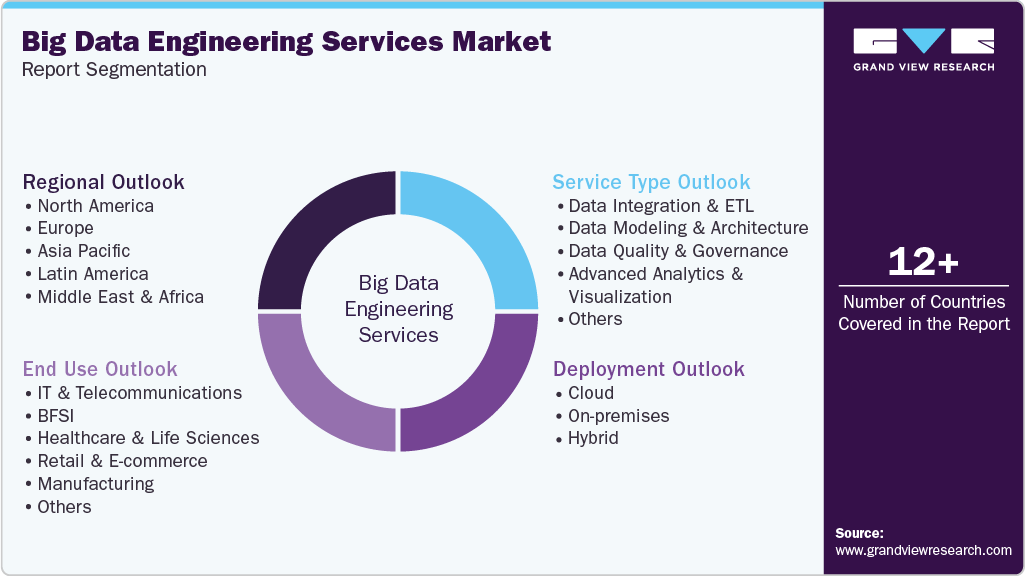
This report forecasts revenue growth at global, regional, and country levels and provides an analysis of the latest industry trends in each of the sub-segments from 2021 to 2033. For this study, Grand View Research has segmented the global big data engineering services market report based on service type, deployment, end use, and region.
 To learn more about this report, Download Free Sample Report
-
Service Type Outlook (Revenue, USD Million, 2021 - 2033)
-
Data Integration & ETL
-
Data Modeling & Architecture
-
Data Quality & Governance
-
Advanced Analytics & Visualization
-
Others
-
-
Deployment Outlook (Revenue, USD Million, 2021 - 2033)
-
Cloud
-
On-premises
-
Hybrid
-
-
End Use Outlook (Revenue, USD Million, 2021 - 2033)
-
IT & Telecommunications
-
BFSI
-
Healthcare & Life Sciences
-
Retail & E-commerce
-
Manufacturing
-
Others
-
-
Regional Outlook (Revenue, USD Million, 2021 - 2033)
-
North America
-
U.S.
-
Canada
-
Mexico
-
-
Europe
-
UK
-
Germany
-
France
-
-
Asia Pacific
-
China
-
Japan
-
India
-
South Korea
-
Australia
-
-
Latin America
-
Brazil
-
-
Middle East and Africa
-
UAE
-
KSA
-
South Africa
-
-
Research Methodology
The big data engineering services market figures in this report are based on a proven research process that combines executive interviews with secondary research from proprietary databases, company filings, and recognized regulatory and institutional sources. Market size is built through value-chain sizing-reconciling supply-side and demand-side estimates-and triangulated with bottom-up and top-down approaches. Every estimate passes multiple levels of expert validation before publication, with each big data engineering services segment quantified using the revenue-capture definitions in the table below.
Segment Definition
Service Type
Revenue Capture Definition
Data Integration & ETL
Revenue generated from services for extracting, transforming, migrating, and integrating data across databases, applications, platforms, and other data sources.
Data Modeling & Architecture
Revenue associated with designing data architectures, schemas, data models, data warehouses, data lakes, lakehouses, and related infrastructure.
Data Quality & Governance
Revenue earned from services that address data accuracy, consistency, lineage, metadata, security, compliance, and governance requirements.
Advanced Analytics & Visualization
Revenue derived from analytical solutions, dashboards, visualization tools, predictive models, and data-driven applications used to analyze enterprise data.
Others
Revenue from other data engineering services, including pipeline maintenance, performance optimization, data migration support, monitoring, and specialized engineering activities.
Deployment
Revenue Capture Definition
Cloud
Revenue from data engineering services delivered through public, private, or managed cloud environments, including cloud-based data platforms, storage, processing, and pipelines.
On-premises
Revenue attributable to data engineering services deployed within an organization's own data centers or privately operated infrastructure.
Hybrid
Revenue generated from services that integrate and manage data engineering workloads across cloud and on-premises environments, including synchronization, migration, and integration.
Segment
Revenue Capture Definition
IT & Telecommunications
Revenue from data engineering services provided to IT companies, software providers, telecommunications operators, and technology organizations for managing application, network, customer, and operational data.
BFSI
Revenue generated through data engineering engagements with banks, financial institutions, insurance companies, and other financial services organizations for processing and managing financial data.
Healthcare & Life Sciences
Revenue associated with data engineering services for healthcare providers, pharmaceutical companies, biotechnology firms, and life sciences organizations handling clinical, research, patient, and operational data.
Retail & E-commerce
Revenue earned from data engineering solutions used to integrate and process customer, transaction, inventory, product, and supply chain data.
Manufacturing
Revenue attributable to data engineering services supporting production, equipment, IoT, quality, supply chain, and operational data management.
Others
Revenue from data engineering services delivered to other industries, including energy, transportation, government, education, media, and hospitality.
Estimation Model
Layer Name
Key Question
Description
End-user Industry Layer
Who creates demand for Big Data Engineering Services?
Identifies the total base of organizations generating demand for big data engineering services across IT & telecommunications, BFSI, healthcare & life sciences, retail & e-commerce, manufacturing, and other industries that manage large and complex datasets.
Adoption / Usage Layer
Who actively adopts Big Data Engineering Services?
Filters the addressable market based on the adoption of cloud computing, data modernization, AI and advanced analytics, real-time data processing, data integration, and hybrid and multicloud environments.
Technology & Infrastructure Layer
Which technologies and infrastructure are deployed?
Estimates adoption across data integration and ETL, data modeling and architecture, data quality and governance, advanced analytics and visualization, cloud data platforms, data lakes, data warehouses, lakehouses, real-time processing, and related data engineering technologies.
Revenue Capture Layer
How is revenue generated in the Big Data Engineering Services ecosystem?
Calculates revenue generated from data integration and ETL, data architecture and modeling, data migration and modernization, data quality and governance, analytics and visualization, pipeline development, cloud data engineering, real-time data processing, implementation, customization, managed services, maintenance, and related data engineering services.
Delivered Customizations
This report has been delivered with the following in-depth customizations
Client Objective
Custom Research Modules Delivered
Strategic Value / Business Impact
Technology & Accessibility Capability Assessment
- Big data engineering technology and architecture trend analysis· Cloud, hybrid, and multicloud data infrastructure assessment
- Data integration, ETL, data pipeline, lakehouse, data warehouse, and real-time processing capability assessment
- Data engineering ecosystem and technology partner mapping
- Identified emerging data engineering technology opportunities
- Supported technology adoption plan
- Evaluated data infrastructure modernization requirements·
- Strengthened technology partnership and solution development decisions
Product Positioning & Competitive Intelligence
- Data engineering service portfolio benchmarking· Data integration, architecture, governance, analytics, and visualization capability comparison
- Pricing, service model, and value proposition analysis·
- Competitive strategy, delivery model, and service portfolio evaluation
- Improved service differentiation strategy
- Supported pricing and service model optimization· Identified customer requirements and capability gaps·
- Enhanced competitive positioning
Market Entry & Growth Assessment
- Regional market sizing and forecasting
- Service type, deployment, and end-use segmentation analysis
- Data modernization, cloud adoption, and AI-related demand assessment
- Competitive landscape and technology environment assessment
- ·Identified high-growth regional and service opportunities
- Supported go-to-market strategy development·
- Highlighted market opportunities and adoption barriers· Enabled data-driven expansion planning
Frequently Asked Questions About This Report
The Data Integration & ETL segment accounted for the largest market share of 31.5% in 2025, owing to the growing need to integrate data from diverse sources and enable efficient data processing across enterprise environments.
The global big data engineering services market size was estimated at USD 101.0 billion in 2025 and is expected to reach USD 115.9 billion in 2026.
The global big data engineering services market is expected to grow at a compound annual growth rate of 15.7% from 2026 to 2033 to reach USD 321.3 billion by 2033.
North America dominated the big data engineering services market with a share of 41.4% in 2025. This is attributable to the strong presence of technology companies, advanced cloud infrastructure, and growing enterprise adoption of data engineering and analytics solutions in the region.
Key factors that are driving the market growth include the growing volume of enterprise data, increasing adoption of cloud and hybrid data environments, rising demand for AI and advanced analytics, and the need for real-time data processing, integration, governance, and modernization.
Some key players operating in the big data engineering services market include Accenture; Capgemini; Cognizant; EPAM Systems, Inc.; Globant S.A.; HCL Technologies Limited; IBM Corporation; Infosys Limited; Persistent Systems Limited; Tata Consultancy Services Limited (TCS); Thoughtworks Holding, Inc.; and Wipro Limited.
Asia Pacific is the fastest-growing region over the forecast period.
Cloud segment held the largest market revenue share in 2025.
IT & Telecommunications segment led the market with the largest revenue share in 2025, owing to the growing volume of data generated by digital services and the increasing adoption of cloud, AI, and advanced analytics solutions.
About the Author(s)
Next Generation Technologies Research Team
Technology · Next Generation TechnologiesThis report was authored by the next generation technologies research team at Grand View Research - comprising two research analysts, one senior research analyst, and one industry expert - with specialized expertise in the next generation technologies segment of the technology industry. All findings are based on proprietary technology databases, executive interviews, and regulatory analysis, subject to internal peer review prior to publication.
Last Updated:
Speak to Analyst

Customize this report to your needs - add regions, segments, or data points, with 20% free customization.
Or view our licence options:


ISO 9001:2015 & 27001:2022 Certified
We are GDPR and CCPA compliant! Your transaction & personal information is safe and secure. For more details, please read our privacy policy.


