
- Home
- »
- Renewable Chemicals
- »
-
Bio-Based Naphtha Market Size Report, 2026-2033GVR Report cover

Bio-based Naphtha Market (2026 - 2033)
Size, Share & Trends Analysis Report By Feedstock (Vegetable Oils, Used Cooking Ol & Waste Oils), By Application (Gasoline, Bio-ethylene), By End Use (Packaging & Plastics, Chemicals & Petrochemicals), By Region, And Segment Forecasts
Market Size, 2025
$1.1BMarket Estimate, 2026
$1.3BMarket Forecast, 2033
$3.6BCAGR, 2026–2033
15.3%Bio-based Naphtha Market Summary
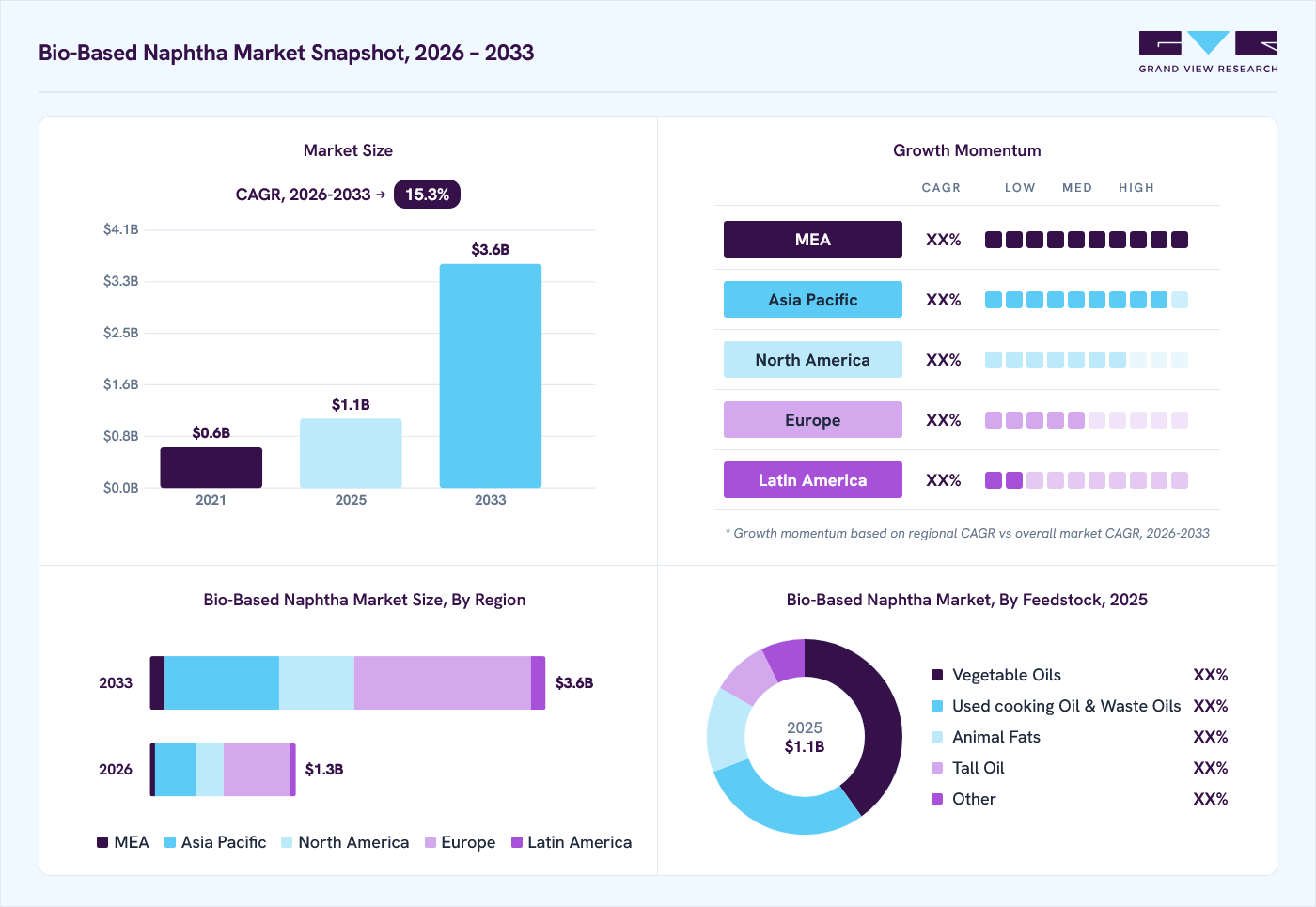
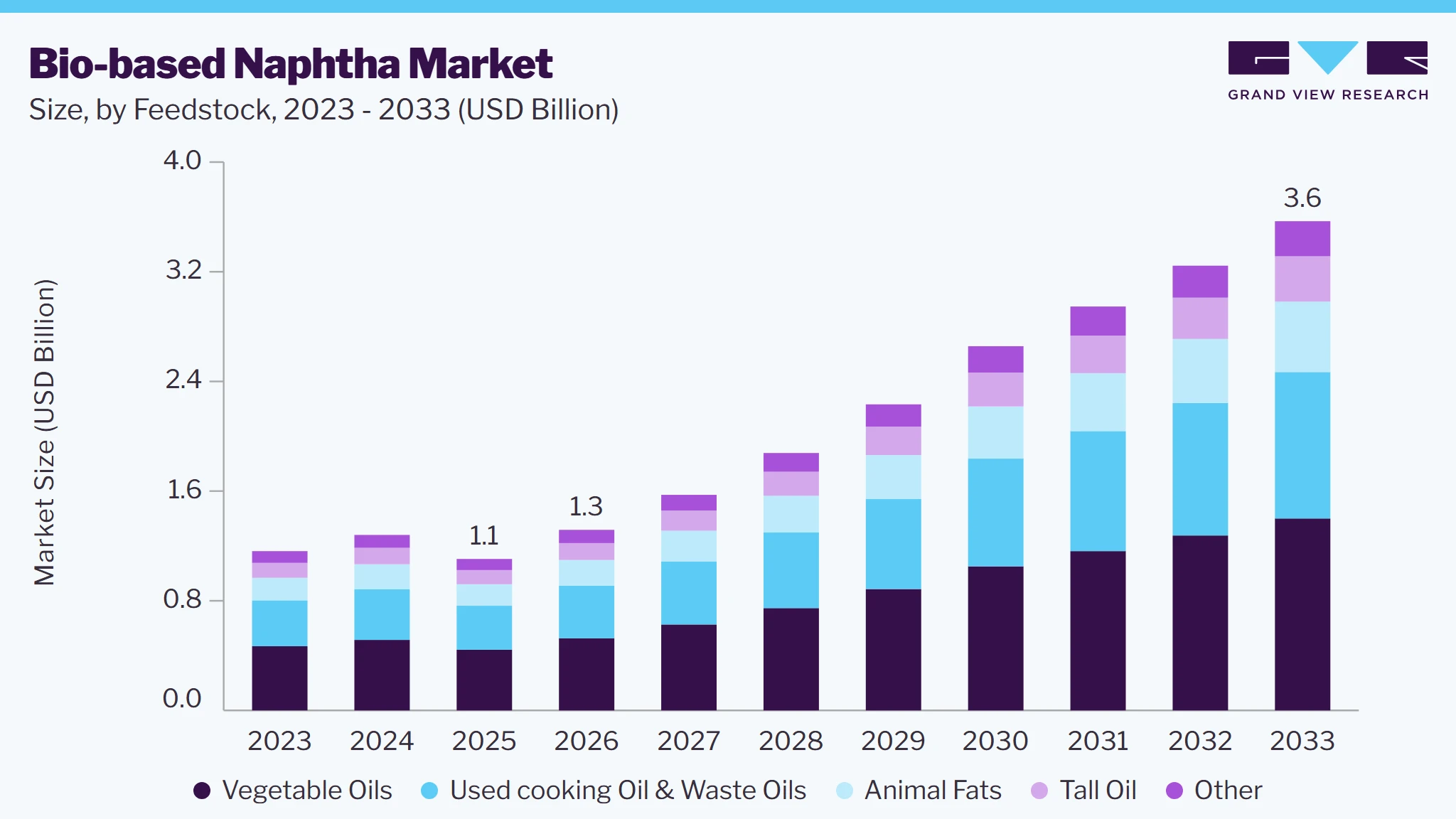
The global bio-based naphtha market size was valued at 1.1 billion in 2025 and is projected to grow from USD 1.3 billion in 2026 to USD 3.6 billion by 2033, at a CAGR of 15.3% from 2026 to 2033. Europe dominated the market, accounting for a revenue share of 45.7% in 2025. Growth is supported by increasing demand for renewable feedstocks in petrochemical production, sustainable plastics and polymers, low-carbon fuels, bio-based aromatics, and specialty chemicals across packaging, automotive, construction, and consumer goods applications.
 Source: Grand View Research, IR Documents, Primary Interviews, Paid DatabasesTo learn more about this report,
 Download Free Sample Report
 Key Market Trends & Insights
- By feedstock: Vegetable oils segment held the largest revenue share of 40.1% in 2025.a
- By application: Gasoline segment dominated the market with a revenue share of 34.8% in 2025.
- By end use: Packaging & plastics segment is expected to grow the fastest CAGR of 15.9% from 2026 to 2033.
Regional Highlights
- Largest Regional Market: Europe (45.7%, revenue share, 2025)
- Fastest-growing Regional Market: Asia Pacific (fastest CAGR, 2026-2033)
- By country: Germany held the largest share in 2025
Market Size & Forecast
- Market size in 2025: USD 1.1 Billion
- Estimated market size in 2026: USD 1.3 Billion
- Projected market size by 2033: USD 3.6 Billion
- CAGR (2026-2033): 15.3%
Three ways to get this report
Buy it, customize it, or ask a question.Ask an Analyst
A direct answer, usually in 1 working day
- AccessReport author, directly
- Reply timeWithin 1 working day
- No sales callDirect answer only
- FormatEmail reply
- CostFree, no cost
Get the Full Report
What the study covers
- FormatsPDF · Excel · Dashboard
- Timeline2026–2033 annual, 2025 base
- Coverage20+ countries, 5 regions
- Companies10+ key players profiled
Customize the Report
20% free customization
- IncludeCountries, segments, points
- TailorTo your product definition
- ExtendDeeper competitor detail
- OrA fully bespoke study
- Turnaround5–10 working days
 To learn more about this report, Download Free Sample Report
 Rising demand for low-carbon feedstocks and sustainable alternatives to conventional fossil-based naphtha is driving the adoption of bio-based naphtha. Bio-based naphtha is produced from renewable feedstocks such as vegetable oils, used cooking oil, animal fats, agricultural residues, and other biomass-derived resources. It can be used as a renewable feedstock for petrochemical manufacturing, plastics, resins, solvents, coatings, and other chemical products. Growing demand for sustainable plastics, increasing investments in circular and bio-based chemical production, expansion of renewable fuel facilities, and corporate efforts to reduce carbon emissions are supporting market growth.
Market Dynamics
The industry is supported by the increasing transition toward renewable feedstocks across the chemicals and petrochemicals industries. Bio-based naphtha provides manufacturers with a renewable alternative to fossil-derived naphtha while maintaining compatibility with several existing petrochemical production pathways. Increasing investments in renewable diesel and sustainable aviation fuel production are also supporting market development, as bio-based naphtha can be generated as a co-product of hydro processing-based renewable fuel production. Growing availability of waste-based feedstocks, refinery integration, technological improvements, and increasing demand for certified renewable raw materials are strengthening the market across major regions.
Chemical and polymer manufacturers are incorporating renewable feedstocks into their production chains to reduce reliance on crude oil and lower the carbon intensity of downstream products. The expansion of sustainable plastics and bio-based chemical production is strengthening this demand. Brand owners and chemical producers are seeking renewable raw materials that can be integrated into established manufacturing processes without significant changes to downstream infrastructure. Rising corporate decarbonization commitments, demand for lower-carbon materials, and the development of mass-balance and renewable-certified products are expected to support continued adoption of bio-based naphtha.
Limited availability and fluctuating prices of suitable renewable feedstocks can constrain the growth of the industry. Feedstocks such as used cooking oil, vegetable oils, animal fats, and biomass residues are also utilized by biodiesel, renewable diesel, sustainable aviation fuel, and other biofuel industries. Competition for these raw materials can increase procurement costs and create supply uncertainty for bio-based naphtha producers.
Production economics can also remain challenging compared with conventional fossil-based naphtha, particularly where renewable feedstocks, processing technologies, and certification requirements involve higher costs. Variations in feedstock quality, collection infrastructure, transportation costs, and regional availability can further influence production costs and product pricing. These factors may limit adoption in price-sensitive applications and create challenges for smaller producers.
Integration with renewable fuel and biorefinery operations presents significant opportunities for bio-based naphtha producers. Renewable diesel and sustainable aviation fuel facilities can generate renewable naphtha as a co-product, enabling producers to improve overall feedstock utilization and develop additional revenue streams. Increasing investments in integrated biorefineries and renewable fuel capacity are therefore expected to expand the supply of bio-based naphtha.
Manufacturers can use renewable naphtha as a feedstock for producing materials with reduced fossil-carbon content while leveraging existing chemical processing infrastructure. Development of advanced biomass conversion technologies, expansion of waste-based feedstock networks, and increasing adoption of renewable-content certification systems can further broaden market opportunities.
Market Concentration & Characteristics
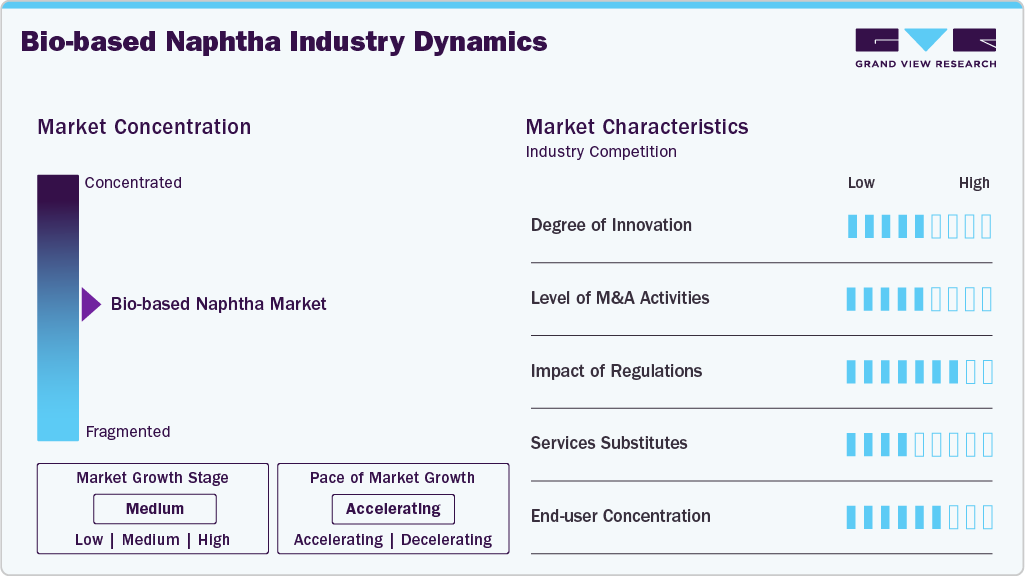
The industry is characterized by the presence of integrated energy companies, renewable fuel producers, biorefineries, and specialty renewable-feedstock manufacturers. Competitive positioning depends on production capacity, feedstock availability, processing technology, product quality, sustainability credentials, certification, supply reliability, and integration with downstream chemical and fuel operations. Companies are focusing on expanding renewable fuel and biorefinery capacity, securing sustainable feedstock supplies, improving conversion efficiency, and developing partnerships with chemical and polymer manufacturers. Integration across feedstock sourcing, refining, renewable fuel production, and downstream petrochemical applications provides companies with greater control over costs and supply.
 To learn more about this report, Download Free Sample Report
 Leading companies are focusing on capacity expansion, renewable feedstock sourcing, strategic collaborations, and partnerships across the chemical and petrochemical value chain. Companies are investing in advanced biomass conversion and refining technologies to improve production efficiency, increase feedstock flexibility, and enhance the availability of renewable naphtha. Partnerships with chemical manufacturers, polymer producers, and downstream customers are also supporting the development of sustainable applications and strengthening market access.
Analyst Perspective
The market is driven by growing demand for renewable feedstocks across the chemical, petrochemical, and polymer industries. Increasing adoption of sustainable plastics, bio-based polymers, resins, solvents, and other chemical products is supporting demand for renewable naphtha as an alternative to conventional fossil-based feedstocks. Rising investments in renewable diesel, sustainable aviation fuel, and integrated biorefineries are also increasing the availability of bio-based naphtha as a co-product. Growing emphasis on carbon reduction, circular production models, and sustainable manufacturing is encouraging chemical manufacturers to incorporate renewable feedstocks into existing production processes.
Feedstock Insights
The vegetable oils segment dominated the market, accounting for 40.1% of total revenue in 2025. Soybean, rapeseed, palm, and other plant-derived oils are being utilized as renewable carbon sources in integrated biorefining operations. Their established commercial supply chains, availability at an industrial scale, and compatibility with hydro processing technologies provide producers with a relatively mature feedstock pathway. The growing production of renewable diesel and sustainable aviation fuel also supports the availability of bio-based naphtha streams derived from vegetable oils, strengthening their contribution to overall market revenues.
The used cooking oil & waste oils segment is expected to expand at a CAGR of 15.7% during the forecast period, making it an important source for bio-based naphtha production. Growing efforts to collect, process, and commercialize waste oils are improving the availability of these feedstocks while reducing dependence on food-grade raw materials. Their utilization also supports waste valorization and lower-carbon production strategies, particularly among producers seeking feedstocks with favorable sustainability attributes.
Application Insights
The gasoline segment dominated the market, accounting for 34.8% of total revenue in 2025. Bio-based naphtha can be incorporated into renewable fuel pathways and used as a hydrocarbon feedstock for producing lower-carbon transportation fuels. Demand is being supported by stricter emissions-reduction objectives, renewable fuel policies, and increasing efforts by fuel producers to diversify their feedstock portfolios. The integration of bio-based naphtha into existing refining and fuel-production infrastructure also provides opportunities to increase renewable content without requiring a complete restructuring of established processing systems.
The bio-ethylene segment is expected to register the fastest growth, expanding at a CAGR of 16.2% during the forecast period. Bio-based naphtha can be processed through cracking operations to provide renewable carbon for ethylene production, creating a pathway toward lower-carbon polyethylene and other petrochemical products. Increasing demand for sustainable plastics, growing adoption of renewable and mass-balance feedstocks, and decarbonization commitments across the chemical industry are supporting this application. Expansion of downstream polymer capacity and stronger demand for certified renewable materials are expected to further increase the commercial importance of bio-ethylene.
End Use Insights
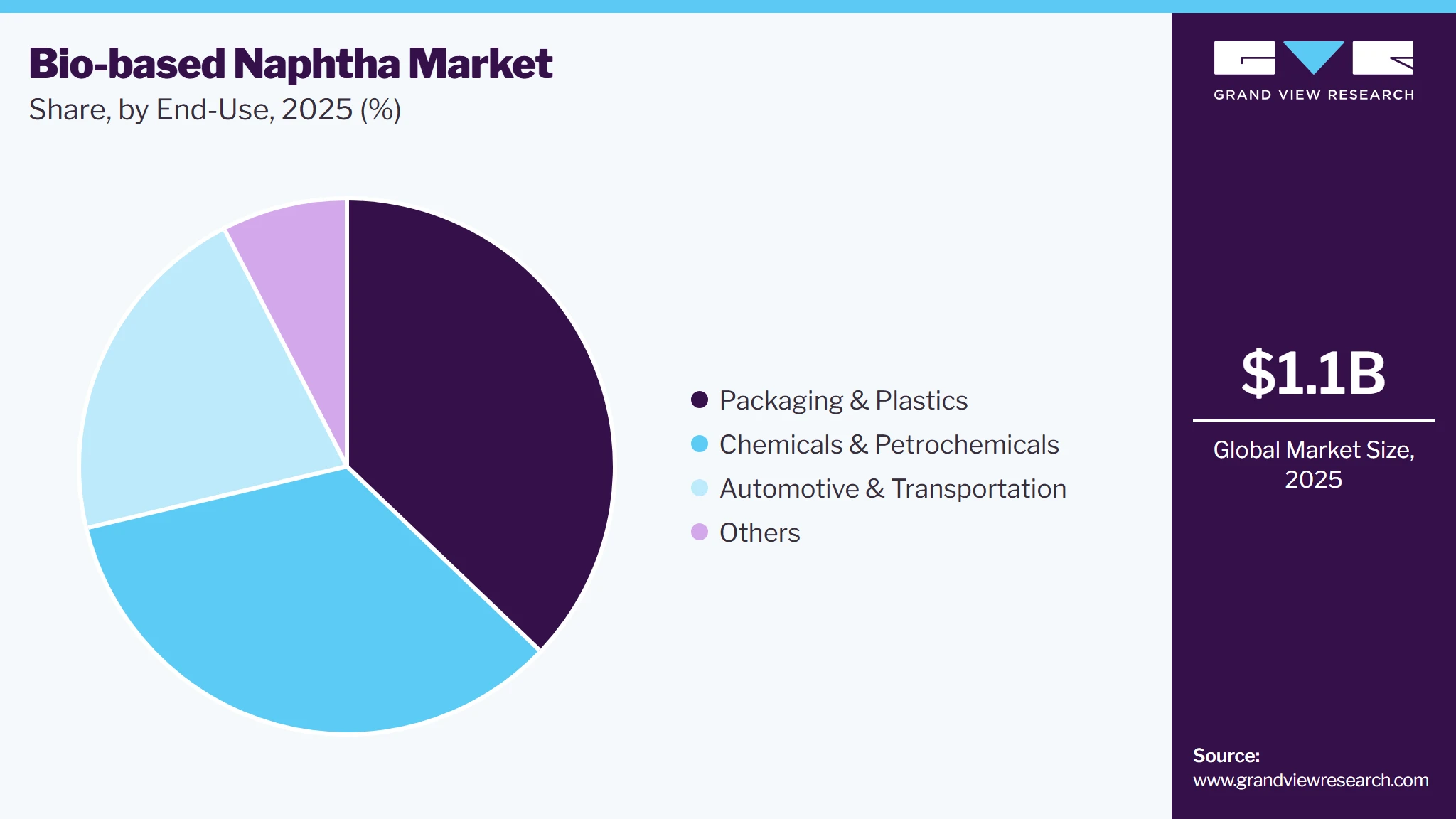
The packaging & plastics segment dominated the industry with a revenue share of 37.1% in 2025. Bio-based naphtha provides renewable carbon to produce polymers used across flexible packaging, rigid containers, films, consumer packaging, and other plastic products. Growing pressure to reduce fossil resource consumption and product-level carbon emissions is encouraging packaging manufacturers and brand owners to incorporate renewable feedstocks into their supply chains. Increasing availability of certified and mass-balance plastics is also improving the commercial potential of bio-based naphtha within this end-use segment.
 To learn more about this report, Download Free Sample Report
 The chemicals & petrochemicals segment is expected to grow at a CAGR of 15.5% during the forecast period. Increasing efforts to replace fossil-derived naphtha with renewable alternatives are creating opportunities for bio-based feedstocks across petrochemical processing and chemical manufacturing. Bio-based naphtha can provide renewable carbon for olefins, aromatics, polymers, resins, solvents, and other chemical intermediates, allowing producers to leverage existing infrastructure while lowering the fossil content of their products.
Regional Insights
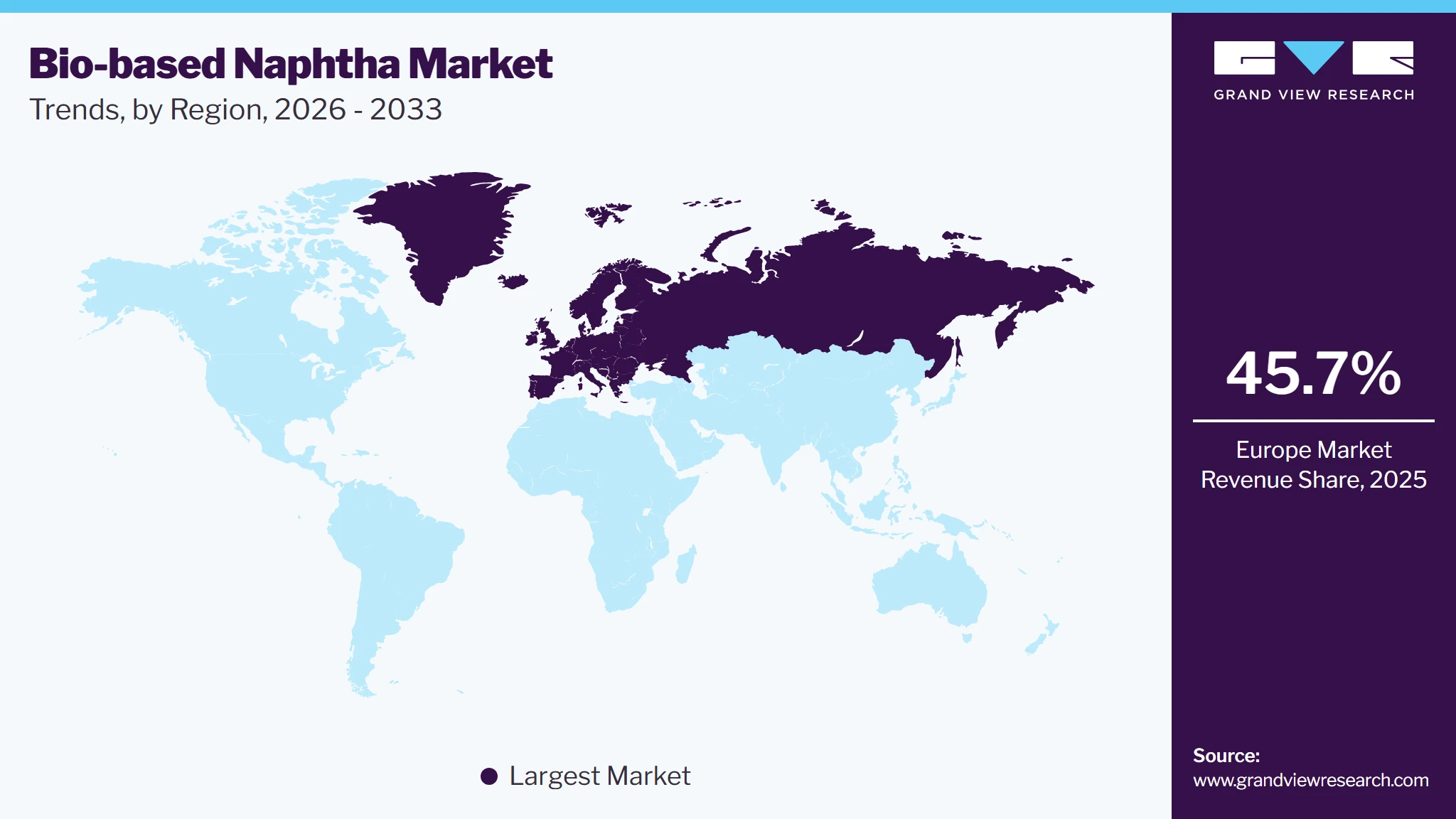
The Europe bio-based naphtha market dominated with a revenue share of 45.7% in 2025. The region’s strong position is supported by ambitious decarbonization targets, increasing demand for renewable feedstocks from the chemical and polymer industries, and the presence of established renewable fuel and biorefining infrastructure. Growing investments in sustainable aviation fuel, renewable diesel, and circular chemical production are also creating additional bio-based naphtha supply. European manufacturers are integrating renewable naphtha into petrochemical value chains to reduce fossil feedstock consumption and meet corporate and regulatory sustainability objectives.
 To learn more about this report, Download Free Sample Report
 The bio-based naphtha market in Germany represents a significant market within Europe due to its large chemical and automotive manufacturing base and growing emphasis on reducing industrial carbon emissions. The country’s established refining infrastructure, strong recycling and circular-economy initiatives, and focus on sustainable plastics are expected to create opportunities for bio-based naphtha adoption. Partnerships between renewable feedstock suppliers, refiners, and downstream chemical manufacturers are also supporting market development.
Asia Pacific Bio-based Naphtha Market Trends
The bio-based naphtha market in Asia Pacific is expected to register the fastest growth during the forecast period, with a projected CAGR of 15.8%. Rapid expansion of chemical and petrochemical manufacturing, increasing renewable fuel investments, and rising demand for sustainable plastics are creating favorable conditions for bio-based naphtha. Countries across the region are also expanding the utilization of waste oils, vegetable oils, and other renewable resources to diversify feedstock supplies. Investments in renewable diesel, SAF, biorefineries, and advanced biomass conversion are expected to improve regional production capabilities and accelerate adoption.
The China bio-based naphtha market is emerging as an important market as the country expands its renewable energy, sustainable chemical, and advanced materials industries. Growing environmental requirements and efforts to reduce the carbon intensity of petrochemical production are encouraging manufacturers to evaluate renewable alternatives to fossil-based feedstocks. The country’s large plastics and chemical manufacturing base provides significant downstream potential for bio-based naphtha, particularly in polymers and other petrochemical applications. Increasing investment in biomass utilization, waste-based feedstocks, and low-carbon production technologies is expected to support further market development.
North America Bio-based Naphtha Market Trends
The bio-based naphtha market in North America is witnessing growth as renewable fuel producers and chemical manufacturers pursue lower-carbon feedstock alternatives. The region benefits from established renewable diesel and SAF production capacity, which can generate renewable naphtha as a co-product. Abundant supplies of used cooking oil, agricultural resources, and other renewable feedstocks provide opportunities for expanding production. Growing demand for sustainable plastics and chemicals, combined with corporate emissions-reduction commitments, is expected to encourage greater integration of renewable naphtha into petrochemical value chains.
U.S. Bio-based Naphtha Market Trends
The bio-based naphtha market in the U.S. is supported by its large renewable fuels industry, extensive refining infrastructure, and substantial downstream chemical manufacturing base. Federal and state-level decarbonization initiatives, corporate sustainability targets, and growing interest in waste-based feedstocks are encouraging producers to develop integrated renewable feedstock and processing capabilities.
Latin America Bio-based Naphtha Market Trends
The bio-based naphtha market in Latin America offers considerable potential due to its strong agricultural sector and availability of vegetable oils, agricultural residues, and other biomass resources. Countries with established biofuel industries can leverage existing feedstock supply chains and processing infrastructure to expand renewable hydrocarbon production. Growing investments in sustainable aviation fuel, renewable diesel, and bio-based chemicals are expected to create new opportunities for bio-based naphtha. The region’s expanding agricultural and industrial base also provides scope for developing locally sourced feedstock-to-chemical value chains.
Middle East Bio-based Naphtha Market Trends
The bio-based naphtha market in the Middle East is gradually expanding as part of broader efforts to diversify energy portfolios and develop lower-carbon chemical production. Major refining and petrochemical companies can potentially integrate renewable feedstocks with existing processing infrastructure, creating opportunities for bio-based hydrocarbons alongside conventional products. The region’s strong petrochemical industry also provides a substantial downstream customer base for renewable feedstocks, particularly as producers seek to reduce the carbon intensity of plastics and chemical products.
Key Bio-based Naphtha Company Insights
Companies operating in the bio-based naphtha market are strengthening their competitive positions through product portfolio expansion, production capacity enhancement, feedstock integration, purification technology, and investments in high-quality DCPD products. Leading manufacturers are focusing on improving DCPD purity, product consistency, process efficiency, supply reliability, and application-specific grades while expanding their presence across unsaturated polyester resins, hydrocarbon resins, EPDM elastomers, cyclic olefin polymers, poly-DCPD, and other specialty applications.
-
Chevron Phillips Chemical Company is a major participant in the market, leveraging its integrated petrochemical operations and C5 hydrocarbon processing capabilities to produce and supply crude DCPD. The company focuses on reliable feedstock availability, efficient hydrocarbon separation, product quality, and consistent supply to downstream customers. Its DCPD production capabilities support applications including hydrocarbon resins, unsaturated polyester resins, elastomers, and other specialty chemical products, strengthening its position in the global DCPD value chain.
-
Shell Chemicals is a prominent participant in the market, leveraging its integrated petrochemical infrastructure and C5 hydrocarbon processing capabilities to manufacture and supply DCPD. The company emphasizes consistent product quality, reliable supply, production efficiency, and technical support for downstream applications. Its DCPD portfolio serves applications across resins, polymers, elastomers, and other specialty chemical formulations, while its broad manufacturing and distribution network supports its competitive position in global markets.
Key Bio-based Naphtha Companies
The following key companies have been profiled for the study on the bio-based naphtha market.
-
Neste
-
EcoCeres Limited
-
Enilive S.p.A
-
UPM Global
-
Chevron
-
TotalEnergies
-
Montana Renewables, LLC
-
OMV
-
Galp
-
Greenjoules Pvt Ltd.
Competitive Benchmarking
Operating Strategies
Competitive Edge
Weaknesses
Mature Players: Neste, EcoCeres Limited, Enilive S.p.A., UPM Global, Chevron, TotalEnergies
- Expand renewable refining and biorefinery capacity to increase the production and availability of bio-based naphtha.
- Secure diversified supplies of used cooking oil, animal fats, agricultural residues, and other renewable feedstocks to support long-term production.
- Integrate bio-based naphtha production with renewable diesel and sustainable aviation fuel operations to improve feedstock utilization and overall refinery economics.
- Develop bio-based naphtha applications for sustainable plastics, polymers, resins, chemicals, and other petrochemical products.
- Invest in hydroprocessing, feedstock pretreatment, and biomass conversion technologies to improve production efficiency, yield, and feedstock flexibility.
- Strengthen sustainability certification, traceability, and mass-balance capabilities to meet growing demand for certified renewable feedstocks.
- Large-scale renewable fuel and biorefinery infrastructure supports reliable production and supply of renewable hydrocarbon streams.
- Strong access to renewable feedstocks through established sourcing and procurement networks.
- Integrated renewable fuel operations enable the production of bio-based naphtha as a co-product, improving overall feedstock utilization.
- Established relationships with chemical, polymer, plastics, and fuel manufacturers provide strong access to downstream customers.
- Advanced processing technologies support the use of diverse renewable feedstocks while maintaining consistent product quality.
- Strong global presence, sustainability credentials, and established renewable product portfolios enhance customer confidence.
- High capital requirements for developing, converting, and expanding renewable refining and biorefinery facilities.
- Exposure to fluctuations in the availability and prices of waste oils, used cooking oil, animal fats, and other renewable feedstocks.
- Bio-based naphtha production can remain dependent on the operating rates and economics of associated renewable fuel facilities.
- Higher production costs compared with conventional fossil-based naphtha can limit adoption in price-sensitive applications.
- Sustainability certification, feedstock traceability, and regulatory compliance can increase operational complexity and costs.
- Dependence on specialized processing technologies and renewable feedstock logistics can create additional supply-chain challenges.
Emerging Players: Montana Renewables, LLC, OMV, Galp, Greenjoules Pvt. Ltd.
- Expand renewable fuel and biorefinery capacity to increase bio-based naphtha production and strengthen renewable product portfolios.
- Develop regional networks for sourcing waste oils, biomass residues, and other renewable feedstocks.
- Utilize renewable naphtha generated from renewable diesel and sustainable aviation fuel operations to improve overall plant economics.
- Establish partnerships with petrochemical, polymer, plastics, and chemical manufacturers to expand downstream applications.
- Invest in biomass conversion, feedstock pretreatment, and refining technologies to improve production efficiency and feedstock flexibility.
- Strengthen sustainability certification and traceability capabilities to support demand for low-carbon and renewable-content products.
- Growing renewable refining capabilities provide opportunities to increase bio-based naphtha production.
- Access to regional waste and biomass feedstocks can support localized production and supply advantages.
- Integrated biorefinery operations can generate multiple renewable products and improve overall feedstock utilization.
- Greater flexibility in developing customer-specific supply arrangements and downstream partnerships.
- Technology-focused production approaches can enable the use of alternative renewable feedstocks.
- Regional positioning can provide competitive access to emerging markets and growing demand for sustainable chemical feedstocks.
- Smaller production scale and geographic footprint compared with major global renewable fuel and chemical companies.
- Greater exposure to regional feedstock availability, collection infrastructure, and logistics costs.
- Bio-based naphtha output may depend on the production volumes and operating rates of associated renewable fuel facilities.
- Limited global distribution networks and downstream customer relationships compared with established multinational producers.
- Smaller financial resources may constrain rapid capacity expansion and international market development.
- Certification, technology upgrades, and regulatory compliance can increase production and operating costs.
Recent Developments
- In May 2023, Indian Oil Corporation (IOC) announced that it was exploring the use of bio-naphtha as a renewable feedstock for petrochemical crackers as part of its decarbonization efforts. The company was conducting R&D at its Faridabad facility and evaluating both used cooking oil and bio-ethanol pathways for bio-naphtha production.
Bio-based Naphtha Market Report Scope
Report Attribute
Details
Market size in 2025
USD 1.1 billion
Estimated market size in 2026
USD 1.3 billion
Projected market size in 2033
USD 3.6 billion
Growth rate
CAGR of 15.3% from 2026 to 2033
Base year for estimation
2025
Historical data
2021 - 2024
Forecast period
2026 - 2033
Quantitative units
Volume in kilotons; revenue in USD billion, and CAGR from 2026 to 2033
Report coverage
Volume & revenue forecast, company ranking, competitive landscape, growth factors, and trends
Segments covered
Feedstock, application, end use, region
Regional scope
North America; Asia Pacific; Europe; Latin America; Middle East & Africa
Country scope
U.S.; Canada; Mexico; Germany; UK; France; Italy; Spain; China; India; Japan; South Korea; Brazil; Argentina; Saudi Arabia; South Africa
Key companies profiled
Neste; EcoCeres Limited; Enilive S.p.A.; UPM Global; Chevron; TotalEnergies; Montana Renewables, LLC; OMV; Galp; Greenjoules Pvt. Ltd.
Customization scope
Free report customization (equivalent up to 8 analysts’ working days) with purchase. Addition or alteration to country, regional & segment scope.
Pricing and purchase options
Avail customized purchase options to meet your exact research needs. Explore purchase options
Global Bio-based Naphtha Market Report Segmentation
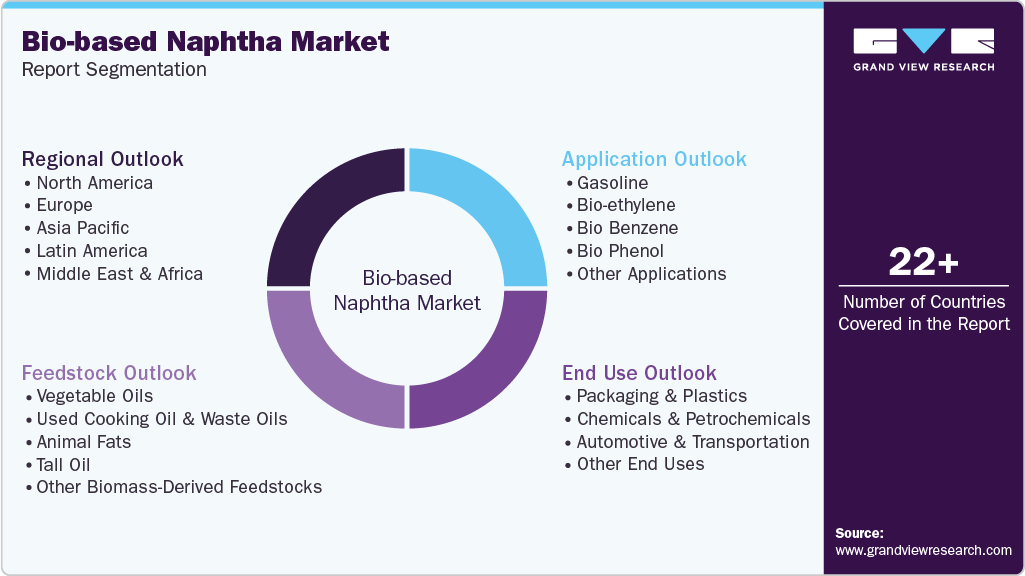
This report forecasts volume & revenue growth at the global, regional, and country levels and provides an analysis of the latest industry trends in each of the sub-segments from 2021 to 2033. For this study, Grand View Research has segmented the global bio-based naphtha market report based on feedstock, application, end use & region:
 To learn more about this report, Download Free Sample Report
 -
Feedstock Outlook (Volume, Kilotons; Revenue, USD Billion, 2021 - 2033)
-
Vegetable oils
-
Used cooking oil & waste oils
-
Animal fats
-
Tall oil
-
Other biomass-derived feedstocks
-
-
Application Outlook (Volume, Kilotons; Revenue, USD Billion, 2021 - 2033)
-
Gasoline
-
Bio-ethylene
-
Bio benzene
-
Bio phenol
-
Other Applications
-
-
End Use Outlook (Volume, Kilotons; Revenue, USD Billion, 2021 - 2033)
-
Packaging & plastics
-
Chemicals & petrochemicals
-
Automotive & transportation
-
Other End Uses
-
-
Regional Outlook (Volume, Kilotons; Revenue, USD Billion, 2021 - 2033)
-
North America
-
U.S.
-
Canada
-
Mexico
-
-
Europe
-
Germany
-
UK
-
France
-
Italy
-
Spain
-
-
Asia Pacific
-
China
-
India
-
Japan
-
South Korea
-
-
Latin America
-
Brazil
-
Argentina
-
-
Middle East & Africa
-
Saudi Arabia
-
South Africa
-
-
Research Methodology
The bio-based naphtha market figures in this report are based on a proven research process that combines executive interviews with secondary research from proprietary databases, company filings, and recognized regulatory and institutional sources. Market size is built through value-chain sizing-reconciling supply-side and demand-side estimates-and triangulated with bottom-up and top-down approaches. Every estimate passes multiple levels of expert validation before publication, with each bio-based naphtha segment quantified using the revenue-capture definitions in the table below.
Segment Definition
Segment - Feedstock
Revenue capture definition
Vegetable oils
Vegetable oils such as soybean, rapeseed, palm, and other plant-based oils serve as established renewable feedstocks for bio-based naphtha production. Their availability and integration with renewable diesel, SAF, and biorefining processes create a significant revenue base for this segment.
Used cooking oil & waste oils
The conversion of used cooking oil and other waste oils into bio-based naphtha creates value by transforming waste resources into renewable hydrocarbons. Rising collection infrastructure, waste utilization, and demand for lower-carbon feedstocks are supporting commercial opportunities in this segment.
Animal fats
Animal fats obtained from rendering and meat-processing activities provide another renewable feedstock route for bio-based naphtha. Their utilization in hydroprocessing and integrated renewable fuel facilities supports product diversification while improving the value of available waste-derived resources.
Tall oil
Tall oil, a by-product of the pulp and paper industry, offers a non-food renewable source for bio-based naphtha. Its use in bio-refining and renewable chemical production is creating opportunities for producers seeking alternative feedstocks with established industrial supply chains.
Other biomass-derived feedstocks
Agricultural residues, forestry residues, organic waste, and other biomass resources broaden the feedstock base for bio-based naphtha. Technological advances in biomass conversion are improving the feasibility of these resources and creating new production opportunities beyond conventional oil-based feedstocks.
Segment - Application
Revenue capture definition
Gasoline
Bio-based naphtha can be incorporated into renewable fuel pathways and gasoline production to lower the fossil-derived carbon content of transportation fuels. Adoption is influenced by renewable fuel mandates, decarbonization targets, and growing demand for lower-carbon mobility solutions.
Bio-ethylene
Through cracking and related conversion processes, bio-based naphtha can provide renewable carbon for ethylene production. The resulting bio-ethylene supports downstream manufacturing of polyethylene and other chemical products, creating opportunities across sustainable polymer value chains.
Bio benzene
Renewable naphtha serves as a feedstock for producing bio-based benzene and other aromatic intermediates. These materials extend into polymers, resins, solvents, coatings, and specialty chemicals, enabling manufacturers to replace a portion of fossil-based aromatic feedstocks.
Bio phenol
Bio-based naphtha contributes renewable carbon to emerging pathways for phenol and related aromatic chemical production. Demand is linked to the growing incorporation of renewable raw materials into plastics, resins, coatings, and specialty chemical formulations.
Other Applications
Beyond the major application areas, bio-based naphtha finds potential use across renewable chemicals, solvents, coatings, lubricants, polymers, and specialty materials. Expansion of bio-based product portfolios is opening additional demand avenues for renewable hydrocarbon feedstocks.
Segment - End Use
Revenue capture definition
Packaging & plastics
Sustainable packaging and plastic manufacturing represents an important downstream outlet for bio-based naphtha. Renewable naphtha can supply carbon for polymers such as polyethylene and polypropylene used in films, containers, flexible packaging, and consumer products.
Chemicals & petrochemicals
Petrochemical and chemical manufacturers utilize bio-based naphtha as a renewable alternative to conventional fossil naphtha. Its compatibility with established processing routes allows renewable carbon to enter the production of olefins, aromatics, polymers, resins, solvents, and chemical intermediates.
Automotive & transportation
The automotive and transportation industries create demand through the use of renewable or mass-balance polymers and chemical materials in vehicle components, interiors, coatings, and related products. Increasing focus on reducing product-level carbon footprints is encouraging greater adoption of renewable feedstocks.
Other End Uses
Construction materials, coatings, adhesives, lubricants, consumer goods, and specialty materials represent additional consumption areas. The expansion of sustainable product portfolios across these industries is increasing the potential for bio-based naphtha to replace fossil-derived inputs.
Estimation Model
Layer Name
Key Question
Description
Raw Material & Production Layer
What forms is the supply base?
Examine the availability and processing of renewable feedstocks used to produce bio-based naphtha, primarily vegetable oils and biomass-derived materials. The assessment covers feedstock sourcing, collection, pretreatment, conversion, hydroprocessing, biomass processing, naphtha recovery, purification, storage, production capacity, plant integration, quality control, and supply-chain management. It also evaluates feedstock availability, processing efficiency, technology maturity, energy requirements, production yields, sustainability certification, and capacity expansion that influence product quality, cost, availability, and scalability.
Form Adoption Layer
Where is bio-based naphtha utilized?
Evaluate the adoption of bio-based naphtha across major applications, including petrochemical feedstock, gasoline, bio-benzene, bio-phenol, and other chemical applications. The analysis considers its use as a renewable alternative to fossil-based naphtha in the production of polymers, plastics, resins, solvents, aromatics, and other chemical intermediates. Adoption is influenced by renewable content requirements, compatibility with existing processing infrastructure, product specifications, carbon reduction targets, sustainability certifications, and downstream demand.
Consumption Intensity Layer
How much bio-based naphtha is consumed?
Assess bio-based naphtha consumption across major downstream industries, including plastics and polymers, chemicals, automotive, packaging, construction, coatings and adhesives, and renewable fuels. The analysis considers downstream production volumes, renewable feedstock incorporation rates, bio-based content requirements, petrochemical processing capacity, substitution of fossil-based naphtha, capacity additions, and sustainability targets to estimate annual consumption across key markets.
Revenue Layer
How is market revenue generated?
Market revenue is generated through the production, processing, and sale of bio-based naphtha derived from renewable feedstocks. Revenue growth is supported by increasing demand for renewable petrochemical feedstocks, sustainable plastics and polymers, renewable chemicals, low-carbon fuels, and bio-based intermediates. Pricing and revenue realization are influenced by renewable feedstock costs, production yields, processing technology, plant capacity, certification requirements, product quality, downstream demand, government policies, and regional supply-demand conditions.
Delivered Customizations
This report has been delivered with the following In-depth customizations
Client Request
Customization Delivered
Value Adds
Cross-segmentation
The assessment provides detailed cross-segmentation of the bio-based naphtha market across feedstock, application, and end use. The analysis evaluates vegetable oils, used cooking oil & waste oils, animal fats, tall oil, and other biomass-derived feedstocks; applications including gasoline, bio-ethylene, bio-benzene, bio-phenol, and other applications; and end uses such as packaging & plastics, chemicals & petrochemicals, automotive & transportation, and other end uses.
Enables identification of high-growth opportunities across specific feedstock-application-end-use combinations. Supports feedstock sourcing, production planning, technology selection, capacity expansion, downstream integration, and market-entry strategies by highlighting feedstock availability, conversion requirements, application demand, sustainability requirements, and growth potential.
Opportunity Assessment
Detailed evaluation of growth opportunities arising from increasing demand for renewable petrochemical feedstocks, sustainable plastics and polymers, low-carbon chemicals, and renewable fuel components. The assessment covers growing adoption of bio-based naphtha in gasoline and petrochemical applications, development of bio-ethylene, bio-benzene, and bio-phenol pathways, integration with renewable fuel production, expansion of biorefinery capacity, advanced biomass conversion technologies, feedstock diversification, and geographic expansion.
Enables identification of attractive investment opportunities across the bio-based naphtha value chain, from renewable feedstock sourcing and conversion to downstream chemical, polymer, and fuel production. Supports decisions related to production capacity expansion, feedstock integration, processing technology, product development, regional market entry, downstream partnerships, and strategic investments by highlighting high-potential applications and evolving demand for renewable feedstocks.
Competitive Benchmarking
Comparative assessment of leading bio-based naphtha producers, renewable fuel companies, biorefinery operators, and integrated energy companies based on renewable naphtha production capacity, feedstock sources, processing technologies, product portfolio, plant footprint, geographic presence, sustainability certifications, downstream integration, customer relationships, and strategic initiatives. The benchmarking evaluates feedstock security, production efficiency, product quality, supply reliability, technology capabilities, renewable content, application coverage, and commercialization strategies.
Supports benchmarking against key bio-based naphtha producers while identifying opportunities to strengthen feedstock security, production efficiency, sustainability credentials, product quality, downstream integration, and geographic coverage. The analysis assists strategic decisions concerning capacity expansion, renewable feedstock sourcing, technology investments, product development, downstream partnerships, market entry, and long-term competitive positioning.
Frequently Asked Questions About This Report
The bio-based naphtha market is expected to grow at a compound annual growth rate of 15.3% from 2026 to 2033 to reach USD 3.6 billion by 2033.
The bio-based naphtha market size was estimated at USD 1.1 billion in 2025 and is expected to reach USD 1.3 billion in 2026.
By application, gasoline dominated the market with a 34.8% revenue share in 2025. Its leading position is associated with the growing incorporation of renewable hydrocarbon streams into low-carbon fuel pathways.
Key players include Neste, EcoCeres Limited, Enilive S.p.A., UPM Global, Chevron, TotalEnergies, Montana Renewables, LLC, OMV, Galp, Greenjoules Pvt. Ltd. Competition is shaped by renewable feedstock access, production capacity, processing technologies, sustainability certifications, downstream integration, product quality, and regional supply capabilities.
The market is primarily driven by the growing demand for sustainable petrochemical feedstocks, increasing production of renewable diesel and sustainable aviation fuel, and the need to reduce reliance on fossil-based naphtha. Rising adoption of lower-carbon plastics, polymers, chemicals, and renewable fuel components is creating additional demand.
Europe dominated the global bio-based naphtha market, accounting for 45.7% of revenue in 2025. The region benefits from strong decarbonization initiatives, established renewable fuel infrastructure, and increasing demand for renewable feedstocks from chemical, polymer, and petrochemical manufacturers.
The used cooking oil & waste oils is expected to register the fastest growth, expanding to a CAGR of 15.7% during the forecast period Increasing collection and utilization of waste-based feedstocks, together with their potential to reduce fossil resource consumption and support lower-carbon production, is strengthening their market potential.
The packaging & plastics segment dominated the bio-based naphtha market, capturing 37.1% of revenue in 2025. Growing demand for lower-carbon plastic materials and the increasing use of renewable feedstocks in polymer production are supporting adoption across packaging and other plastic applications.
Asia Pacific is expected to grow fastest at a CAGR of 15.8% during the forecast period. Rapid expansion of chemical and petrochemical manufacturing, rising renewable fuel investments, growing plastics production, and increasing efforts to introduce renewable feedstocks into industrial value chains are expected to drive regional growth.
About the Author(s)
Renewable Chemicals Research Team
Specialty & Chemicals · Renewable ChemicalsThis report was authored by the renewable chemicals research team at Grand View Research - comprising two research analysts, one senior research analyst, and one industry expert - with specialized expertise in the renewable chemicals segment of the specialty & chemicals industry. All findings are based on proprietary specialty & chemicals databases, executive interviews, and regulatory analysis, subject to internal peer review prior to publication.
Last Updated:
Speak to Analyst

Customize this report to your needs - add regions, segments, or data points, with 20% free customization.
Or view our licence options:


ISO 9001:2015 & 27001:2022 Certified
We are GDPR and CCPA compliant! Your transaction & personal information is safe and secure. For more details, please read our privacy policy.


