
- Home
- »
- Renewable Chemicals
- »
-
Bio-based Platform Chemicals Market Size Report 2026-2033GVR Report cover
![Bio-based Platform Chemicals Market (2026 - 2033)Report]()
Bio-based Platform Chemicals Market (2026 - 2033)
Size, Share & Trends Analysis Report By Product (1,3-Propanediol, Glycerol, Aspartic Acid, Lactic Acid, Succinic Acid, Fumaric Acid, Malic Acid, Glucaric Acid), By Region, And Segment Forecasts
Market Size, 2025
$15.4BMarket Estimate, 2026
$16.3BMarket Forecast, 2033
$24.8BCAGR, 2026–2033
6.2%Bio-based Platform Chemicals Market Summary
The global bio-based platform chemicals market size was valued at USD 15.4 billion in 2025 and is projected to grow from USD 16.3 billion in 2026 to USD 24.8 billion by 2033, at a CAGR of 6.2% from 2026 to 2033. The market in Asia Pacific dominated with a revenue share of 33.0% in 2025. The industry is primarily driven by stringent environmental regulations and increasing corporate commitments toward carbon neutrality, which are accelerating the shift from petrochemical-based to renewable alternatives.

Key Market Trends & Insights
- By product: Glycerol segment held the largest market share of 23.2% in 2025.
Regional Highlights
- Largest regional market: Asia Pacific (33.0% revenue share, 2025)
- By country: China held the largest market share in 2025
Market Size & Forecast
- Market size in 2025: USD 15.4 Billion
- Estimated market size in 2026: USD 16.3 Billion
- Projected market size by 2033: USD 24.8 Billion
- CAGR (2026-2033): 6.2%
In addition, continuous advancements in biotechnology, including fermentation and catalytic conversion processes, are enhancing production efficiency and scalability, thereby improving the commercial viability of bio-based chemicals across diverse end-use industries. The market presents significant opportunities through the growing adoption of bio-based polymers and sustainable materials, particularly in packaging, textiles, and automotive applications, where demand for low-carbon solutions is rising. The increasing investments in integrated biorefineries and the development of next-generation platform chemicals such as FDCA and bio-based diols are expected to unlock new revenue streams and enable deeper penetration into high-performance material markets.
Despite favorable growth dynamics, the market faces challenges related to high production costs and limited cost competitiveness compared to conventional petrochemicals, primarily due to feedstock price volatility and complex processing requirements. The infrastructure limitations, scalability constraints, and regulatory uncertainties in certain regions continue to impede large-scale commercialization and widespread adoption of bio-based platform chemicals.
Market Concentration & Characteristics
The global bio-based platform chemicals industry exhibits a moderately concentrated structure, led by a mix of multinational chemical companies and agro-based conglomerates that possess strong technological capabilities and established distribution networks. Leading participants such as BASF, Cargill, DuPont, and Evonik Industries AG benefit from advanced R&D infrastructure, integrated production models, and access to renewable feedstock sources. Their ability to scale up bio-based production, optimize process efficiencies, and offer a diversified product portfolio enables them to maintain a strong foothold across key application industries.
In parallel, the competitive landscape is evolving with the growing presence of specialized biotechnology firms and regional manufacturers such as GFBIOCHEMICALS, PTT Global Chemical Public Company Limited, and Novozymes A/S, which are focusing on niche product development and innovative fermentation technologies.
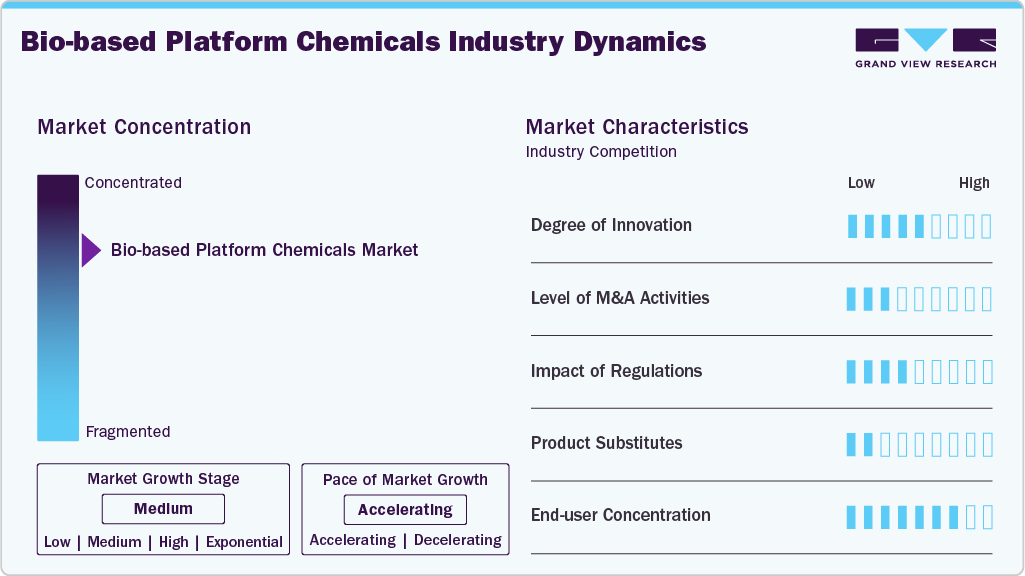
Industry participants are adopting strategies such as strategic collaborations, joint ventures, and capacity expansions to accelerate commercialization and expand their geographic reach. The emphasis on developing cost-competitive and high-performance bio-based alternatives is intensifying competition, particularly as companies aim to capitalize on rising demand for sustainable and low-carbon chemical solutions.
Product Insights
The glycerol segment dominated the global market, accounting for the largest revenue share of 23.2% in 2025, primarily due to its abundant availability as a by-product of biodiesel production and its broad applicability across pharmaceuticals, personal care, food, and industrial formulations. Its cost-effectiveness, biodegradability, and compatibility with multiple downstream processes have significantly strengthened its commercial adoption. The other high-volume organic acids, such as lactic acid, succinic acid, and itaconic acid, continue to witness strong demand, driven by their extensive use in biodegradable plastics, food additives, and specialty chemicals, supported by increasing regulatory focus on sustainable materials.
The specialty and emerging platform chemicals, including hydroxypropionic acid, furan dicarboxylic acid (FDCA), 1,5-pentanediamine, and farnesene, are gaining traction due to their potential to replace petrochemical-based intermediates in high-performance applications such as bio-based polymers, resins, and fuels. Bio-based diols such as 1,3-propanediol (PDO), 1,3-butanediol, and 1,4-butanediol are also experiencing steady growth owing to rising demand from textiles, coatings, and automotive sectors. In parallel, products such as malic acid, glucaric acid, aspartic acid, fumaric acid, and isobutanol are witnessing increasing adoption across food, pharmaceuticals, and chemical intermediates, collectively contributing to the market’s diversification and long-term growth potential.
Regional Insights
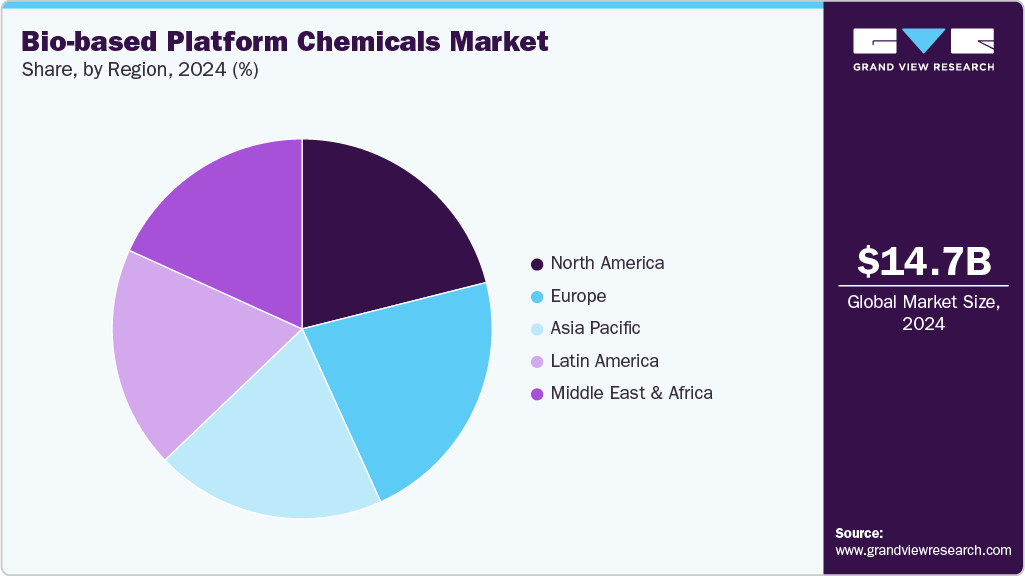
Asia Pacific dominated the global bio-based platform chemicals market with a 33.0% revenue share in 2025, driven by rapid industrialization, strong growth in end-use sectors such as packaging, textiles, and automotive, and increasing government support for bio-based and sustainable chemicals. The region benefits from abundant biomass availability, cost-competitive manufacturing, and expanding biorefinery capacities, particularly across emerging economies, positioning it as a key production and consumption hub.
The bio-based platform chemicals market in China represented the largest market within Asia Pacific, supported by its robust chemical manufacturing base, favorable government policies promoting green chemistry, and significant investments in bio-based industrial infrastructure. The country’s strong domestic demand, coupled with increasing focus on reducing carbon emissions and reliance on petrochemicals, is accelerating the adoption of bio-based platform chemicals across multiple industries.
Europe Bio-based Platform Chemicals Market Trends
The bio-based platform chemicals market in Europe accounted for a substantial 31.1% market share in 2025, underpinned by stringent environmental regulations, strong policy frameworks such as the circular economy action plan, and high consumer awareness regarding sustainable products. The region’s well-established chemical industry and increasing investments in advanced bio-refinery technologies are driving innovation and commercialization of bio-based platform chemicals.
Germany bio-based platform chemicals market stood as a key contributor within Europe, led by its advanced chemical manufacturing ecosystem, strong emphasis on research and development, and presence of leading market players. The country’s commitment to sustainability, coupled with supportive regulatory policies and industrial collaborations, is fostering the growth of bio-based chemicals, particularly in high-performance and specialty applications.
North America Bio-based Platform Chemicals Market Trends
The bio-based platform chemicals market in North America held a 27.7% share of the global market in 2025, driven by technological advancements, the strong presence of leading bio-based chemical producers, and increasing adoption of sustainable materials across industries. Favorable regulatory initiatives, along with rising investments in biotechnology and renewable feedstocks, are further supporting market expansion in the region.
The U.S. Bio-based Platform Chemicals Market Trends
The bio-based platform chemicals market in the U.S. dominated the North American market, supported by a well-established biotechnology sector, strong innovation capabilities, and increasing commercialization of bio-based chemicals. The country’s focus on reducing greenhouse gas emissions, along with active participation from major industry players, is accelerating the development and deployment of next-generation platform chemicals.
Middle East & Africa Bio-based Platform Chemicals Market Trends
The bio-based platform chemicals market in the Middle East & Africa is in a nascent but gradually evolving stage, supported by increasing diversification efforts away from oil-based economies and growing interest in sustainable chemical production. While the region faces challenges related to limited bio-based infrastructure, rising investments and government initiatives aimed at promoting green industries are expected to create long-term growth opportunities.
Latin America Bio-based Platform Chemicals Market Trends
The bio-based platform chemicals market in Latin America is emerging as a promising market, driven by the abundant availability of renewable feedstocks such as sugarcane and agricultural residues, particularly in countries like Brazil. The region’s strong bioethanol industry and increasing focus on sustainable industrial development are supporting the adoption of bio-based platform chemicals, although growth remains moderated by economic volatility and infrastructure constraints.
Key Bio-based Platform Chemicals Company Insights
Some of the key players operating in the market include Cargill and dsm-firmenich.
-
dsm-firmenich is a global science-based company with a strong presence in nutrition, health, and biosciences, actively leveraging its biotechnology expertise to advance bio-based chemical solutions. The company focuses on sustainable innovation through fermentation and enzymatic processes, enabling the development of high-performance, renewable ingredients and intermediates. Its strategic emphasis on decarbonization, circularity, and green chemistry, supported by robust R&D capabilities and global manufacturing infrastructure, positions it as a key player in the bio-based platform chemicals market.
GFBiochemicals and PTT Global Chemical Public Company Limited are emerging market participants.
-
GFBIOCHEMICALS is a prominent bio-based chemicals company specializing in the production of levulinic acid and its derivatives, which serve as versatile building blocks for a wide range of industrial and specialty applications. The company is focused on commercializing cost-effective and scalable alternatives to petrochemical-based intermediates through proprietary technologies and sustainable feedstocks. With a strong innovation-driven approach and strategic partnerships, GFBIOCHEMICALS is positioning itself as a key contributor to the transition toward renewable and environmentally friendly chemical production.
Key Bio-based Platform Chemicals Companies:
The following key companies have been profiled for this study on the bio-based platform chemicals market.
- Cargill
- dsm-firmenich
- GFBIOCHEMICALS
- BASF
- Mitsubishi Chemical Group Corporation.
- PTT Global Chemical Public Company Limited
- DuPont
- Tate & Lyle
- Braskem
- Evonik Industries AG
- Aktin Chemicals, Inc.
- Champlor
- LyondellBasell Industries Holdings B.V.
- NIPPON SHOKUBAI CO., LTD.
- Novozymes A/S, part of Novonesis Group
Recent Developments
-
In January 2025, Mitsubishi Chemical Group adopted plant-derived bioengineering plastic DURABIO by U.S.-based accessory brand PopSockets for its iPhone 16 cases, grips, and wallets. This highlights the rising demand for bio-based platform chemicals in consumer electronics and lifestyle products. These accessories reflect a growing preference for sustainable, high-performance materials that reduce reliance on fossil resources and lower carbon footprints.
-
In December 2024, Tate & Lyle and BioHarvest Sciences announced a strategic partnership to develop the next generation of plant-based ingredients for healthier food and beverages. The collaboration focuses on utilizing BioHarvest's proprietary Botanical Synthesis platform, which produces non-GMO, sustainable plant-derived molecules. This innovative process allows for producing plant-based ingredients without growing the entire plant, thus reducing land and water usage. This partnership highlights the accelerating demand for bio-based ingredients in the food industry, driven by consumer preferences for more natural, plant-derived options that address sustainability challenges.
-
In September 2024, Lygos’ partnership with CJ BIO highlights growing market demand for bio-based specialty chemicals, including bio-based aspartic acid. While the initial focus of the Fort Dodge biorefinery complex is on commercial production of Soltellus biodegradable polymers and Ecoteria malonates (up to 40,000 MT/year, expandable to 100,000 MT/year), the agreement includes plans to expand production to bio-based aspartic acid. This planned expansion indicates a strategic response to increasing market interest in sustainable alternatives to petroleum-derived chemicals.
Bio-based Platform Chemicals Market Report Scope
Report Attribute
Details
Market size in 2025
USD 15.4 billion
Market size value in 2026
USD 16.3 billion
Revenue forecast in 2033
USD 24.8 billion
Growth rate
CAGR of 6.2% from 2026 to 2033
Base year for estimation
2025
Historical data
2021 - 2024
Forecast period
2026 - 2033
Quantitative units
Volume in kilotons; revenue in USD million/billion, and CAGR from 2026 to 2033
Report coverage
Volume & revenue forecast, company ranking, competitive landscape, growth factors, and trends
Segments covered
Product, region
Regional scope
North America; Europe; Asia Pacific; Latin America; Middle East & Africa
Country scope
U.S.; Canada; Mexico; UK; Germany; Italy; France; Spain; China; India; Japan; South Korea; Brazil; Argentina; Saudi Arabia; South Africa
Key companies profiled
Cargill; dsm-firmenich; GFBIOCHEMICALS; BASF; Mitsubishi Chemical Group Corporation; PTT Global Chemical Public Company Limited; DuPont; Tate & Lyle; Braskem; Evonik Industries AG; Aktin Chemicals, Inc.; Champlor; LyondellBasell Industries Holdings B.V.; NIPPON SHOKUBAI CO., LTD.; Novozymes A/S, part of Novonesis Group
Customization scope
Free report customization (equivalent to up to 8 analysts’ working days) with purchase. Addition or alteration to country, regional & segment scope.
Pricing and purchase options
Avail customized purchase options to meet your exact research needs. Explore purchase options
Global Bio-based Platform Chemicals Market Report Segmentation
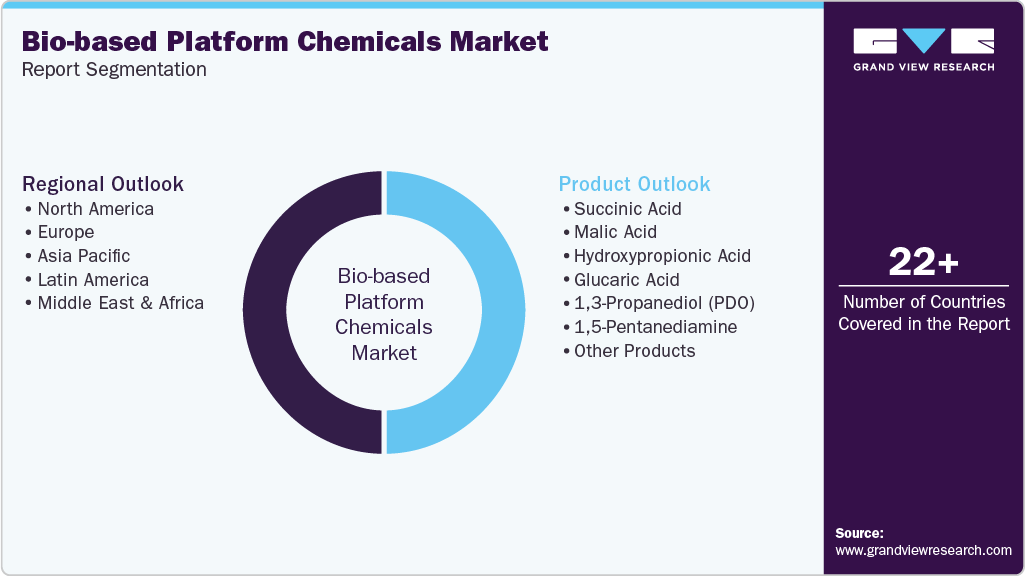
This report forecasts volume & revenue growth at the global, regional, and country levels and provides an analysis of the latest industry trends in each of the sub-segments from 2021 to 2033. For this study, Grand View Research has segmented the global bio-based platform chemicals market report based on product and region:
-
Product Outlook (Volume, Kilotons; Revenue, USD Billion, 2021 - 2033)
-
Succinic Acid
-
Malic Acid
-
Hydroxypropionic Acid
-
Glucaric Acid
-
1,3-Propanediol (PDO)
-
1,5-Pentanediamine
-
Furan Dicarboxylic acid
-
Glycerol
-
Aspartic Acid
-
Itaconic Acid
-
Lactic Acid
-
Fumaric Acid
-
1,3-Butanediol
-
1,4-Butanediol
-
Farnesene
-
Isobutanol
-
-
Regional Outlook (Volume, Kilotons; Revenue, USD Billion, 2021 - 2033)
-
North America
-
U.S.
-
Canada
-
Mexico
-
-
Europe
-
Germany
-
Italy
-
France
-
UK
-
Spain
-
-
Asia Pacific
-
China
-
India
-
Japan
-
South Korea
-
-
Latin America
-
Brazil
-
Argentina
-
-
Middle East & Africa
-
Saudi Arabia
-
South Africa
-
-
Frequently Asked Questions About This Report
The global bio-based platform chemicals Market size was estimated at USD 15.4 billion in 2025 and is expected to reach USD 16.3 billion in 2026.
The global bio-based platform chemicals Market is expected to grow at a compound annual growth rate of 6.2% from 2026 to 2033, reaching USD 24.8 billion by 2033.
Some of the key players operating in the Bio-based Platform Chemicals Market include Cargill, dsm-firmenich, GFBIOCHEMICALS, BASF, Mitsubishi Chemical Group Corporation, PTT Global Chemical Public Company Limited, DuPont, Tate & Lyle, Braskem, Evonik Industries AG, Aktin Chemicals, Inc., Champlor, LyondellBasell Industries Holdings B.V., NIPPON SHOKUBAI CO., LTD., and Novozymes A/S, part of Novonesis Group.
The market is driven by increasing regulatory pressure to reduce carbon emissions and transition toward sustainable, bio-based alternatives to petrochemicals. The advancements in biotechnology and fermentation processes are enhancing production efficiency and enabling the scalable commercialization of bio-based platform chemicals.
The glycerol segment dominated the market with a 23.2% revenue share in 2025, primarily due to its abundant and cost-effective availability as a by-product of biodiesel production, ensuring consistent supply at competitive pricing. Its versatile applicability across pharmaceuticals, personal care, food, and industrial sectors significantly enhances its demand and commercial viability.
Asia Pacific dominated with a 33.0% revenue share in 2025.
About the Author(s)
Renewable Chemicals Research Team
Specialty & Chemicals · Renewable ChemicalsThis report was authored by the renewable chemicals research team at Grand View Research - comprising two research analysts, one senior research analyst, and one industry expert - with specialized expertise in the renewable chemicals segment of the specialty & chemicals industry. All findings are based on proprietary specialty & chemicals databases, executive interviews, and regulatory analysis, subject to internal peer review prior to publication.
Last Updated:
Speak to Analyst


Customize this report to your needs — add regions, segments, or data points, with 20% free customization.
Or view our licence options:


ISO 9001:2015 & 27001:2022 Certified
We are GDPR and CCPA compliant! Your transaction & personal information is safe and secure. For more details, please read our privacy policy.


