
- Home
- »
- Biotechnology
- »
-
Biopreservation Market Size, Growth Report, 2026-2033GVR Report cover
![Biopreservation Market (2026 - 2033)Report]()
Biopreservation Market (2026 - 2033)
Size, Share & Trends Analysis Market Report By Product (Equipment, Media, LIMS), By Application (Regenerative Medicine, Biobanking, Drug Discovery), By Region, And Segment Forecasts
Market Size, 2025
$4.8BMarket Estimate, 2026
$6.1BMarket Forecast, 2033
$35.0BCAGR, 2026–2033
28.3%Biopreservation Market Summary
The global biopreservation market size was valued at USD 4.8 billion in 2025 and is projected to grow from USD 6.1 billion in 2026 to USD 35.0 billion in 2033, at a CAGR of 28.3% from 2026 to 2033. The North American market dominated, accounting for over 45.0% of revenue in 2025. Biopreservation is experiencing growth driven by extensive use in hospitals and labs, rising government and private partner funding in healthcare, an upsurge in research & development, and advancing product development.
Key Market Trends & Insights
- By product: The equipment segment held the largest market share of over 75.0% in 2025.
- By application: The biobanking segment held the largest market share of over 70.0% in 2025.
Regional Highlights
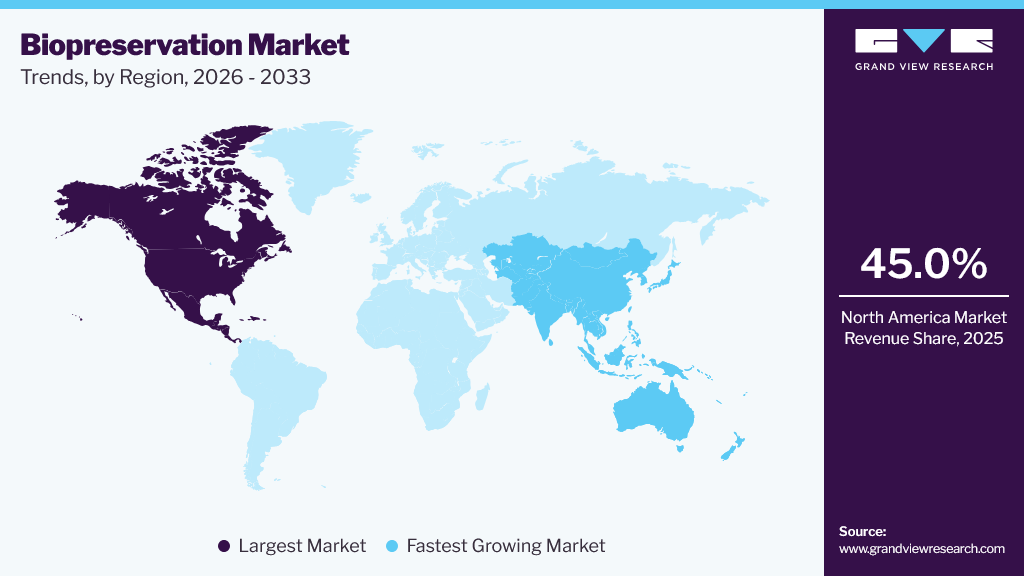
- Largest regional market: North America (Approximately 45.0% revenue share, 2025).
- Fastest-growing regional market: Asia Pacific (highest CAGR, 2026-2033)
Market Size & Forecast
- Market size in 2025: USD 4.8 Billion
- Estimated market size in 2026: USD 6.1 Billion
- Projected market size by 2033: USD 35.0 Billion
- CAGR (2026-2033): 28.3%
Due to these factors, opportunities for biologics manufacturing and preservation are anticipated to increase, thus generating further demand for biopreservation. Biopreservation is a process that helps maintain the integrity and functionality of biological products, such as stem cells, DNA, tissues, and organs, across a range of temperatures, thereby prolonging their lifespan outside their natural environments. Technology innovations include microarrays and the incorporation of a wide range of predictive models, such as hybrid models, as well as various API algorithms that help reduce the time, cost, and complexity of the overall process. Furthermore, the advent of multiplex cellular imaging platforms is anticipated to enhance biopreservation's ability to elucidate disease progression and inform appropriate diagnostic & treatment measures, particularly in cardiology, gynecology, and point-of-care applications.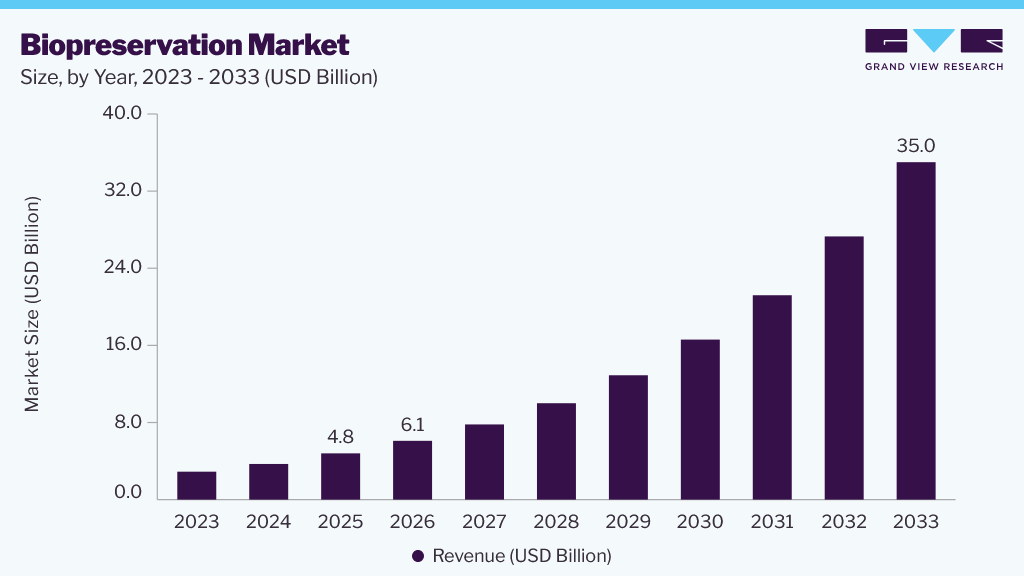
In recent years, demand for biopreservation has increased to support the development of biological products across sectors such as immunotherapies, vaccine production, antibody production, enzyme technology, and biologically produced chemicals. This impact is due to the rising incidence of chronic diseases globally. For instance, according to the Centers for Disease Control and Prevention, cardiovascular disorders and cancer are among the leading causes of disease-related mortality in adults in the U.S.
Furthermore, the government and private sectors have shown interest and supported funding for research & development, leading to significant market developments. In recent years, the growing demand to preserve stem cells and develop biological medicines and products has drawn investors' attention to this field. This considerable healthcare spending is expected to fuel market growth during the forecast period.
However, the growing biopreservation market faces challenges, including the shortage of skilled professionals and insufficient cybersecurity measures. The high cost of labor training and software standardization are some of the contributing factors. These challenges could potentially impact overall market growth.
Market Dynamics
The biopreservation market is driven by rising demand for cell and gene therapies and by expanding biobank infrastructure, both of which are increasing the adoption of advanced preservation technologies. In addition, high equipment costs and stringent regulatory requirements may pose barriers, particularly for smaller institutions. However, ongoing innovations in cryogenic systems, sustainable storage solutions, and global collaborations are strengthening the market.
The rising demand for advanced biopreservation in cell and gene therapy is a major driver of the biopreservation market. Cell and gene therapies rely on living cells, tissues, and genetic materials that must be stored and transported under carefully controlled conditions to maintain their quality, viability, and therapeutic effectiveness. Advanced biopreservation technologies, including cryopreservation media, controlled-rate freezers, and ultra-low-temperature storage systems, help protect these sensitive biological materials throughout development and treatment.
The growing number of cell and gene therapy clinical trials and product approvals is increasing the need for reliable preservation solutions. Pharmaceutical and biotechnology companies are investing in regenerative medicine, immunotherapies, and personalized treatments, all of which require efficient storage and handling of biological samples. In addition, the expansion of biobanks and research institutions is driving greater demand for technologies that preserve cells and tissues for extended periods without compromising their integrity.
As healthcare systems continue to adopt precision medicine approaches, maintaining the stability and functionality of biological materials becomes even more critical. Advanced biopreservation solutions support the safe storage, transportation, and distribution of these materials across the healthcare value chain. The increasing adoption of cell and gene therapies is expected to drive demand for biopreservation products and services, supporting overall market growth in the coming years.
High equipment costs and the need for specialized infrastructure pose significant challenges to the growth of the biopreservation market, particularly in small research laboratories, healthcare facilities, and institutions in developing regions. Effective biopreservation requires advanced equipment, including cryogenic freezers, liquid nitrogen storage systems, controlled-rate freezers, monitoring systems, and backup power solutions. The acquisition, installation, and maintenance of these systems entail substantial capital expenditures, making it difficult for organizations with limited budgets to adopt or expand their biopreservation capabilities.
Facilities must maintain strict temperature controls, continuous monitoring, and qualified personnel to ensure the integrity of stored biological samples. Any equipment malfunction, power interruption, or handling error can lead to sample degradation and significant financial losses. Furthermore, biopreservation processes must comply with stringent regulatory standards, including Good Manufacturing Practice (GMP) and International Organization for Standardization (ISO) guidelines. Meeting these requirements often requires additional investments in validation, documentation, quality control, and staff training.
Concerns regarding contamination, inconsistent cryostability, and variability in preservation outcomes further increase operational complexity. These factors can affect the long-term viability and reproducibility of biological materials, particularly in cell and gene therapy applications. As a result, the high cost of implementation and ongoing regulatory and operational demands continue to limit market accessibility and slow adoption across resource-constrained healthcare and research environments.
As regenerative medicine and cell therapies expand, demand for reliable preservation solutions is expected to accelerate. Emerging technologies such as AI enabled sample tracking, blockchain based data security, and ice free cryopreservation methods are opening new avenues for efficiency and safety. Moreover, the growing emphasis on sustainability is encouraging the development of energy efficient freezers and eco friendly preservation media, aligning with global climate goals.
Asia Pacific, in particular, is witnessing strong momentum, with governments investing heavily in biobank networks to support translational research and precision medicine. These initiatives not only enhance healthcare capacity but also create opportunities for international collaborations between pharmaceutical companies, hospitals, and research institutes.
As the market shifts toward personalized therapies, biopreservation will remain a critical enabler of innovation, ensuring the long-term integrity of biological materials essential to diagnostics and treatment.
Analyst Perspective
The biopreservation market is witnessing growth driven by the rapid expansion of regenerative medicine, cell and gene therapies, and biobanking infrastructure. The increasing demand for long-term storage of biological samples and advanced cryopreservation techniques is further strengthening market adoption among pharmaceutical companies and research institutions. However, high operational costs, stringent regulatory requirements, and the need for ultra-low temperature logistics continue to pose challenges to scalability. Overall, the market is expected to maintain strong momentum as advancements in biopreservation media, automation, and cold-chain technologies improve efficiency and reliability.
Product Insights
The equipment segment held the largest market share of over 75.0% in 2025 due to rising demand for biobanking to preserve stem cells, DNA, plasma, and tissue culture. The widespread acceptance and use of preservation have led to adequate storage capacity, and low maintenance is expected to boost the market.For instance, in January 2025, Stirling Ultracold launched the VAULT100 upright ultra-low-temperature freezer, which provides sustainable storage down to -100°C with high energy efficiency.
The media segment is expected to grow at a significant CAGR from 2026 to 2033. Media applications offer more features and details, allowing researchers to access and share research data and analyses, thereby improving their ability to research, diagnose, monitor, and treat health disorders. This trend is anticipated to drive market growth during the forecast period.
Application Insights
The biobanking segment dominated the global market, accounting for over 70.0% share in 2025. Rising awareness for stem cell preservation, increasing acceptance of sperm and egg banking, and utilizing assisted reproductive technology with animals. Pharmaceutical companies collaborate with reserve biobanks and hospitals to preserve tissues.For instance, in November 2025, Continental Hospitals in Hyderabad, India, launched a Next-Generation AI-Enabled Biobank in collaboration with Chronicle Bio, strengthening pharmaceutical partnerships and hospital-based tissue preservation through advanced biobanking and AI-driven analytics.
The regenerative medicine segment is expected to grow at the fastest CAGR over the forecast period, owing to increasing demand for technologically advanced bio-storage techniques. In addition, the launch of specific preservation techniques is expected to fuel the segment growth.
Regional Insights
The North America biopreservation industry was the largest revenue-generating region in 2025, accounting for over 45.0% of the market share, attributed to advances in biomedical research and the development of advanced therapies. Furthermore, the rising number of chronic conditions requiring treatment is driving demand for biopreservation in the region, strengthening its market presence. Such activities are expected to expand the biopreservation product market and drive growth.
U.S. Biopreservation Market Trends
The biopreservation industry in the U.S. is expected to grow significantly, driven by government organizations and various biobanking institutes that are advancing the adoption of biopreservation techniques. For instance, biospecimen collection in biorepositories and biobanks is supported by funding from the National Institutes of Health (NIH), whereas the National Cancer Institute (NCI) helps manage such biobanking programs. These biobanks support research and clinical trial programs in the country, thereby increasing the demand for biopreservation techniques.
Asia Pacific Biopreservation Market Trends
The biopreservation industry in the Asia Pacific is expected to witness the fastest growth, driven by rising funding for biobanking techniques and services and by increasing partnerships and collaborations in biopreservation.
Key Biopreservation Companies Insights
Key players in the market are pursuing strategic initiatives, including funding facilities for geographical expansion, as well as partnerships, mergers, and acquisitions in key regions.
Key Biopreservation Companies
The following key companies have been profiled for this study on the biopreservation market.
-
Azenta US, Inc.
-
LUMITOS AG
-
BioLife Solutions Inc.
-
MVE Biological Solutions
-
LabVantage Solutions, Inc.
-
Taylor-Wharton
-
Thermo Fisher Scientific, Inc.
-
Panasonic Corporation
-
X-Therma, Inc.
-
PrincetonCryo
-
Stirling Ultracold
Recent Developments
-
In February 2026, CaseBioscience launched two new biopreservation products, CaseCryo CTG DMSO and CaseStor HSS, at Advanced Therapies Week. These solutions are designed to improve cryopreservation and hypothermic storage for cell therapy, thereby expanding the company’s portfolio and supporting long-term cell health.
-
In February 2026, MVE Biological Solutions, a Cryoport subsidiary, introduced the Fusion 800 Series cryogenic freezer. This innovation eliminates the need for a continuous liquid nitrogen supply, offering self-sustaining cryogenic storage with improved safety, compact design, and high capacity.
Biopreservation Market Report Scope
Report Attribute
Details
Market size value in 2025
USD 4.8 billion
Market size value in 2026
USD 6.1 billion
Revenue forecast in 2033
USD 35.0 billion
Growth rate
CAGR of 28.3% from 2026 to 2033
Base year for estimation
2025
Historical data
2021 - 2024
Forecast period
2026 - 2033
Quantitative units
Revenue in USD billion and CAGR from 2026 to 2033
Report coverage
Revenue forecast, company ranking, competitive landscape, growth factors, and trends
Segments covered
Product, application, region
Regional Scope
North America, Europe, Asia Pacific, Latin America, Middle East & Africa
Country Scope
U.S.; Canada; Germany; UK; France; Spain; Italy; Denmark; Sweden; Norway; Japan; China; India; Australia; Thailand; South Korea; Brazil; Mexico; Argentina; South Africa; Saudi Arabia; UAE; Kuwait
Key companies profiled
Azenta US, Inc.; LUMITOS AG ; BioLife Solutions Inc.; MVE Biological Solutions; LabVantage Solutions, Inc.; Taylor-Wharton; Thermo Fisher Scientific, Inc.; Panasonic Corporation; X-Therma, Inc.; PrincetonCryo; Stirling Ultracold
Customization scope
Free report customization (equivalent up to 8 analysts working days) with purchase. Addition or alteration to country, regional & segment scope.
Pricing and purchase options
Avail of customized purchase options to meet your exact research needs. Explore purchase options
Global Biopreservation Market Report Segmentation
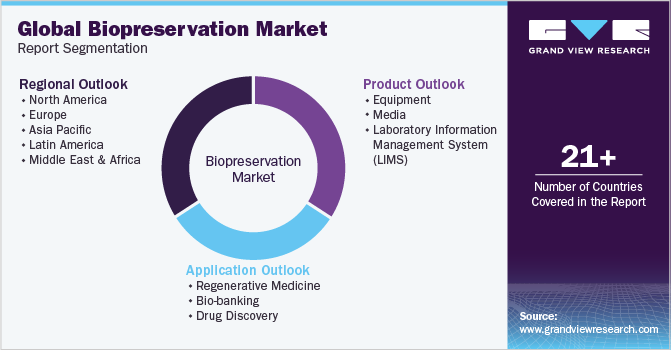
This report forecasts revenue growth and provides an analysis on the latest trends in each of the sub-segments from 2021 to 2033. For this report, Grand View Research has segmented the global biopreservation market report on the basis of product, application, and region:
-
Product Outlook (Revenue, USD Billion, 2021 - 2033)
-
Equipment
-
Freezers
-
Refrigerators
-
Consumables
-
Vials
-
Straws
-
Microtiter Plates
-
Bags
-
-
Liquid Nitrogen
-
-
Media
-
Pre-formulated
-
Home-brew
-
-
Laboratory Information Management System (LIMS)
-
-
Application Outlook (Revenue, USD Billion, 2021 - 2033)
-
Regenerative Medicine
-
Cell Therapy
-
Gene Therapy
-
Others
-
-
Bio-banking
-
Human Eggs
-
Human Sperms
-
Veterinary IVF
-
-
Drug Discovery
-
-
Regional Outlook (Revenue, USD Billion, 2021 - 2033)
-
North America
-
U.S.
-
Canada
-
-
Europe
-
Germany
-
U.K.
-
France
-
Italy
-
Spain
-
Denmark
-
Sweden
-
Norway
-
-
Asia Pacific
-
China
-
Japan
-
India
-
Australia
-
Thailand
-
South Korea
-
-
Latin America
-
Brazil
-
Mexico
-
Argentina
-
-
Middle East and Africa (MEA)
-
South Africa
-
Saudi Arabia
-
UAE
-
Kuwait
-
-
Frequently Asked Questions About This Report
North America dominated with a 45.0% revenue share in 2025.
The global biopreservation market size was valued at USD 4.8 billion in 2025 and is estimated at USD 6.1 billion for 2026.
Equipment dominated the E-commerce logistics market with a share of 75.0% in 2025, while biobanking is the fastest-growing segment.
The global biopreservation market is expected to grow at a CAGR of 28.3% from 2026 to 2033, reaching USD 35.0 billion.
Key players include Azenta US, Inc.; LUMITOS AG ; BioLife Solutions Inc.; MVE Biological Solutions; LabVantage Solutions, Inc.; Taylor-Wharton; Thermo Fisher Scientific, Inc.; Panasonic Corporation; X-Therma, Inc.; PrincetonCryo; Stirling Ultracold
About the Author(s)
Biotechnology Research Team
Healthcare · BiotechnologyThis report was authored by the biotechnology research team at Grand View Research - comprising two research analysts, one senior research analyst, and one industry expert - with specialized expertise in the biotechnology segment of the healthcare industry. All findings are based on proprietary healthcare databases, executive interviews, and regulatory analysis, subject to internal peer review prior to publication.
Last Updated:
Speak to Analyst


Customize this report to your needs — add regions, segments, or data points, with 20% free customization.
Or view our licence options:


ISO 9001:2015 & 27001:2022 Certified
We are GDPR and CCPA compliant! Your transaction & personal information is safe and secure. For more details, please read our privacy policy.


