
- Home
- »
- Disinfectants & Preservatives
- »
-
Biocides For Leather Market Size, Share Report, 2026-2033GVR Report cover
![Biocides For Leather Market (2026 - 2033)Report]()
Biocides For Leather Market (2026 - 2033)
Size, Share & Trends Analysis Report By Product (Bactericides, Fungicides), By Application (Curing, Tanning & Dyeing, Beamhouse, Finishing), By Region, And Segment Forecasts
Market Size, 2025
$612.5MMarket Estimate, 2026
$637.5MMarket Forecast, 2033
$859.1MCAGR, 2026–2033
4.4%Biocides For Leather Market Trends
The global biocides for leather market size was estimated at USD 612.5 million in 2025 and is projected to grow from USD 637.5 million in 2026 to USD 859.1 million by 2033, growing at a CAGR of 4.4% from 2026 to 2033. The Asia Pacific market held the largest share of 39.7% of the global market in 2025. This growth is attributed to the growing demand for leather products necessitates effective biocides to prevent microbial degradation, ensuring product longevity and quality.

Key Market Trends & Insights
- By product: The fungicides segment accounted for the largest share of the biocides for leather market, representing 86.9% of total revenue in 2025.
- By application: Tanning & dyeing dominated the application segment at a revenue share of 51.6% in 2025.
Regional Highlights
- Largest regional market: North America (31.3% revenue share in 2025)
- Fastest growing regional market: Asia Pacific (highest CAGR 30.0%, 2026-2033)
- By Country: The U.S. held the largest market share in 2025
Market Size & Forecast
- Market size in 2025: USD 612.5 Million
- Estimated market size in 2026: USD 637.5 Million
- Projected market size by 2033: USD 859.1 Million
- CAGR (2026-2033): 4.4%
In addition, technological developments have led to the development of more effective and environmentally friendly biocides, aligning with consumer preferences for sustainable solutions. Furthermore, stringent regulations regarding product safety and environmental impact are prompting manufacturers to adopt innovative biocide solutions, further fueling market expansion. Biocides are chemical agents that inhibit the growth of microorganisms such as bacteria and fungi on leather surfaces, ensuring the preservation and quality of leather products throughout various production stages. A primary factor driving the global biocides market is the escalating demand for leather goods, which are widely used in applications such as footwear, automotive interiors, and clothing. This demand is fueled by rising disposable incomes, evolving fashion trends, and an increasing appreciation for the durability of leather items. As consumers seek high-quality products, the necessity for effective biocides to combat microbial degradation becomes critical.
In addition, the leather industry faces heightened regulatory scrutiny regarding chemical usage. Regulatory bodies worldwide have implemented strict guidelines to mitigate the environmental impact of biocides used during leather production. These regulations aim to ensure that biocides are safe for both human health and the environment, prompting manufacturers to innovate safer alternatives that comply with these standards. This shift addresses regulatory demands and aligns with the growing consumer preference for sustainable and eco-friendly products.
Furthermore, rising consumer demand for leather products and stringent regulations on chemical use significantly drive the growth of the biocides market in the leather industry. The focus on sustainability and safety shapes product development, leading to innovations that enhance performance and environmental compatibility.
Market Dynamics
The biocides for leather market is experiencing steady growth due to increasing demand for leather preservation, microbial protection, and quality enhancement across footwear, automotive upholstery, furniture, fashion accessories, and industrial leather applications. Biocides are widely used during leather processing and storage to prevent the growth of bacteria, fungi, molds, and yeasts that can cause discoloration, odor formation, material degradation, and reduced product lifespan. Growing global leather production, rising demand for premium-quality leather goods, and increasing focus on maintaining product durability and hygiene standards are supporting market expansion.
The increasing demand for premium leather products across footwear, automotive interiors, furniture, and luxury goods is a major driver of the biocides for leather market. Biocides play a critical role in protecting hides, skins, and finished leather products from microbial contamination throughout the tanning, processing, transportation, and storage stages. Effective microbial control helps preserve leather quality, improve shelf life, and reduce economic losses associated with spoilage and product defects.
The impact of this trend extends across multiple end-use industries where product appearance, durability, and performance are essential. Automotive manufacturers, footwear producers, and luxury leather goods companies are increasingly adopting advanced biocide solutions to maintain consistent product quality and comply with stringent manufacturing standards. As global demand for high-value leather products continues to rise, the consumption of leather biocides is expected to grow significantly over the coming years.
Increasing regulatory scrutiny regarding the use of chemical preservatives and antimicrobial agents presents a significant challenge for the biocides for leather market. Many conventional biocides are subject to strict regulations concerning toxicity, environmental impact, worker safety, and disposal practices. Compliance with regulations established by authorities across North America, Europe, and Asia often requires extensive product testing, registration, and documentation.
Growing environmental awareness and concerns regarding hazardous chemical residues are encouraging manufacturers to reduce the use of certain traditional biocide formulations. The need to comply with evolving environmental standards and sustainability requirements can increase operational costs and product development expenses. These factors may create challenges for manufacturers, particularly smaller companies with limited resources for regulatory compliance and innovation.
The growing emphasis on sustainable leather processing and environmentally responsible manufacturing is creating substantial growth opportunities for the biocides for leather market. Leather producers are increasingly seeking eco-friendly antimicrobial solutions that provide effective microbial protection while minimizing environmental impact and regulatory concerns. This trend is driving investments in low-toxicity, biodegradable, and regulatory-compliant biocide technologies.
Opportunities are also emerging from the adoption of cleaner tanning processes, green chemistry initiatives, and sustainable leather production practices. Manufacturers are developing innovative biocide formulations that offer broad-spectrum antimicrobial protection with improved environmental profiles and reduced chemical footprints. As the leather industry continues to prioritize sustainability, product quality, and compliance, biocide suppliers can strengthen their market position through advanced product development and strategic partnerships across footwear, automotive, furniture, and luxury leather goods sectors.
Analyst Perspective
The biocides for leather market is expected to witness steady growth over the forecast period, driven by increasing demand for high-quality leather products, growing awareness regarding microbial contamination, and the need to extend the shelf life of hides, skins, and finished leather goods. As leather manufacturers continue to focus on product quality, durability, and compliance with international standards, the adoption of effective bactericides and fungicides through curing, beamhouse, tanning, dyeing, and finishing processes is increasing. The expansion of footwear, automotive upholstery, furniture, and luxury leather goods industries is further supporting market demand.
Product Insights
The fungicides segment accounted for the largest share of the biocides for leather market, representing 86.9% of total revenue in 2025. This growth is attributed to the increasing demand for high-quality leather products. Fungicides are essential in preventing mold and fungal growth during various stages of leather processing, such as soaking, tanning, and finishing. In addition, manufacturers must utilize effective fungicides to maintain product integrity and longevity as consumers seek durable and aesthetically appealing leather goods. Furthermore, the rise in consumer awareness regarding hygiene and microbial safety further propels the demand for fungicides, ensuring that leather products remain free from harmful microorganisms.
Bactericides are expected to grow at a CAGR of 2.8% over the forecast period, owing to the need for bactericides that prevent bacterial contamination during leather production, which can lead to significant quality degradation. As the leather industry expands due to rising consumer preferences for leather goods, the demand for effective bactericides increases correspondingly. Moreover, stringent product safety and quality regulations compel manufacturers to incorporate bactericides into their processes.
Application Insights
Tanning & dyeing dominated the application segment at a revenue share of 51.6% in 2025. This growth is attributed to the increasing demand for high-quality leather products. As leather is extensively used in various sectors such as fashion, automotive, and furniture, the need for effective biocides to prevent microbial contamination during tanning and dyeing processes becomes crucial. In addition, these biocides protect against bacteria and fungi, ensuring that the leather maintains its quality and durability. Furthermore, advancements in biocide formulations that are both effective and environmentally friendly are enhancing their adoption in these applications.

The finishing segment is expected to grow at a CAGR of 3.4% from 2026 to 2033, driven by the necessity of preserving leather products' aesthetic appeal and functional properties. In addition, finishing processes often involve treatments that can attract microbial growth; thus, incorporating biocides is essential to prevent spoilage and ensure product longevity. Furthermore, the rising consumer awareness regarding hygiene and product safety further drives the need for effective biocides in finishing applications. Moreover, regulatory pressures for safer chemical use push manufacturers to innovate and adopt advanced biocide solutions that meet environmental standards while maintaining leather quality.
Regional Insights
North America biocides for leather market is expected to grow at a CAGR of 3.7% over the forecast period, owing to the increasing demand for high-quality leather products across various industries, including automotive and fashion. In addition, the U.S. leads this growth, driven by rising consumer preferences for durable leather goods and the need for effective antimicrobial solutions to prevent microbial degradation. Furthermore, stringent regulations regarding product safety and environmental impact are prompting manufacturers to adopt advanced biocide formulations that comply with these standards, further fueling market expansion.
U.S. Biocides for Leather Market Trends
Biocides for leather market in the U.S. held the dominant position within the North American market and accounted for the largest revenue share in 2024, owing to the booming automotive sector, which requires high-quality leather upholstery. The presence of large meat processing companies ensures a steady supply of raw materials for leather production, enhancing market growth. Furthermore, increasing consumer awareness about hygiene and antimicrobial protection in leather products drives manufacturers to incorporate effective biocides into their processes.
Asia Pacific Biocides for Leather Market Trends
Asia Pacific accounted for 39.7% of the biocides for leather market revenue in 2025, making it the largest regional market. This growth is attributed to its extensive leather manufacturing capabilities and abundant raw materials. In addition, countries such as China and India are major contributors, driven by rising disposable incomes and increasing consumer demand for high-quality leather products. Furthermore, the region's modernization of production processes and government initiatives to enhance industrial growth further bolster the market. Moreover, the focus on sustainable practices and developing eco-friendly biocide formulations also play a crucial role in this growth trajectory.

Chinaheld the largest market share in Asia Pacific in 2025, driven by its status as one of the largest leather producers worldwide. The country's booming automotive and fashion industries drive substantial demand for leather goods, necessitating effective biocides to ensure product quality and longevity. In addition, china's competitive labor costs and significant investments in modernizing leather production facilities also contribute to increased biocide consumption. Furthermore, the government's support for sustainable practices in manufacturing further enhances the adoption of innovative biocide solutions.
Europe Biocides for Leather Market Trends
Europe biocides for leather market is expected to grow significantly over the forecast period, driven by its rich heritage in leather craftsmanship and a strong demand for luxury leather goods. In addition, the region's emphasis on sustainability and environmentally friendly production practices drives innovations in biocide formulations that meet stringent regulatory requirements. Furthermore, increasing consumer awareness about microbial contamination and the need for effective preservation methods are propelling market growth. Moreover, European manufacturers invest in research and development to create safer biocide solutions that align with evolving consumer preferences.
The growth of biocides for leather market in Italy is driven by its high-quality leather production and luxury fashion brands. The demand for biocides is driven by Italy's commitment to maintaining quality standards in leather goods while adhering to strict environmental regulations. In addition, as consumers increasingly seek sustainable products, Italian manufacturers focus on developing eco-friendly biocides that ensure product longevity without compromising safety. Furthermore, this trend toward sustainability, combined with Italy's strong position in the global leather market, is expected to drive continued growth in biocide usage.
Key Biocides for Leather Market Company Insights
Some of the key players in the market include Vink Chemicals GmbH & Co. KG, Troy Corporation, DuPont de Nemours, Inc., and others. These companies adopt various strategies to enhance their market presence and gain a competitive edge. These include investing in research and development to innovate and create advanced biocide formulations that meet evolving regulatory standards and consumer demands. In addition, companies establish strategic partnerships and collaborations with leather manufacturers to ensure a steady supply chain and enhance product distribution. Furthermore, they emphasize sustainability by developing eco-friendly biocides, aligning with the growing consumer preference for environmentally responsible products.
-
Lanxess AG manufactures a range of biocides, including fungicides and bactericides, which are essential during various stages of leather processing, such as tanning and finishing. Operating within the specialty chemicals segment, the company focuses on providing innovative and effective antimicrobial solutions that enhance the quality and durability of leather goods while ensuring compliance with environmental regulations.
-
Vink Chemicals GmbH & Co. KG manufactures biocides that prevent microbial growth during the tanning and finishing processes, ensuring that leather goods remain durable and aesthetically appealing. The company is positioned within the specialty chemicals sector, emphasizing sustainable practices and the development of eco-friendly solutions that meet the increasing demands for safety and environmental responsibility in the leather industry.
Key Biocides for Leather Companies:
The following key companies have been profiled for this study on the biocides for leather market.
-
Lanxess AG
-
Buckman Laboratories International, Inc.
-
Vink Chemicals GmbH & Co. KG
-
Troy Corporation
-
DuPont de Nemours, Inc.
-
ICL Performance Products LP
-
Akzo Nobel N.V.
-
Archroma Management LLC
-
Ashland Global Holdings Inc.
-
Huntsman International LLC
-
SUEZ SA
Competitive Benchmarking
Category
Operating Strategies
Competitive Edge
Weakness
Established Players (Lanxess AG, Buckman Laboratories International, Inc., Troy Corporation, DuPont de Nemours, Inc., Archroma Management LLC, Huntsman International LLC)
- Focus on expanding broad-spectrum biocide portfolios for leather preservation, microbial control, and process protection applications.
- Invest heavily in R&D, regulatory compliance, sustainable antimicrobial technologies, and global distribution networks.
- Strengthening market presence through product innovation, strategic acquisitions, and long-term partnerships with tanneries and leather manufacturers.
- Strong global manufacturing and supply-chain capabilities.
- Extensive expertise in antimicrobial technologies, leather chemicals, and regulatory compliance.
- Ability to serve diverse leather applications including footwear, automotive upholstery, furniture, fashion accessories, and industrial leather products.
- High operational and compliance costs associated with evolving environmental and biocide regulations.
- Large organizational structures may reduce flexibility in addressing niche customer requirements and rapidly changing regional market needs.
Category
Operating Strategies
Competitive Edge
Weakness
Emerging Players (Vink Chemicals GmbH & Co. KG, Thor, Stahl Holdings B.V., Tex Biosciences)
- Concentrate on specialized leather biocides, eco-friendly formulations, and customized antimicrobial solutions tailored to regional customer requirements.
- Expand through strategic partnerships with tanneries, distributors, and leather chemical suppliers.
- Focus on sustainable preservation technologies, cost-efficient manufacturing, and localized supply capabilities.
- Greater operational flexibility enables faster adaptation to customer-specific processing conditions and microbial protection requirements.
- Competitive pricing strategies and strong relationships within regional leather-processing markets.
- Ability to develop customized formulations for specialized leather applications and sustainability-focused customers.
- Limited global presence and smaller production capacities compared with multinational industry leaders.
- Lower R&D and regulatory resources may restrict the development and commercialization of next-generation sustainable biocide technologies.
- Greater exposure to regional demand fluctuations, raw material price volatility, and changing regulatory requirements.
Biocides for Leather Market Report Scope
Report Attribute
Details
Market size in 2025
USD 612.5 million
Estimated market size in 2026
USD 637.5 million
Projected market size by 2033
USD 859.1 million
Growth rate
CAGR of 4.4% from 2026 to 2033
Base year for estimation
2025
Historical data
2021 - 2024
Forecast period
2026 - 2033
Quantitative units
Volume, Kilotons; Revenue in USD million/billion and CAGR from 2026 to 2033
Report coverage
Revenue & Volume forecast, company ranking, competitive landscape, growth factors, and trends
Segments covered
Product, application, region
Regional scope
North America; Europe; Asia Pacific; Latin America; MEA
Country scope
U.S.; Canada; Mexico; Germany; UK; France; Italy; Spain; China; India; Japan; Brazil; Argentina; UAE; Saudi Arabia; South Africa.
Key companies profiled
Lanxess AG,Buckman Laboratories International, Inc., Vink Chemicals GmbH & Co. KG, Troy Corporation, DuPont de Nemours, Inc., Archroma Management LLC, Huntsman International LLC, Thor, Stahl Holdings B.V., Tex Biosciences
Customization scope
Free report customization (equivalent up to 8 analysts' working days) with purchase. Addition or alteration to country, regional & segment scope.
Pricing and purchase options
Avail customized purchase options to meet your exact research needs. Explore purchase options
Global Biocides for Leather Market Report Segmentation
This report forecasts revenue growth at global, regional, and country levels and analyzes the latest industry trends in each sub-segment from 2021 to 2033. For this study, Grand View Research has segmented the global biocides for leather market report based on product, application, and region:
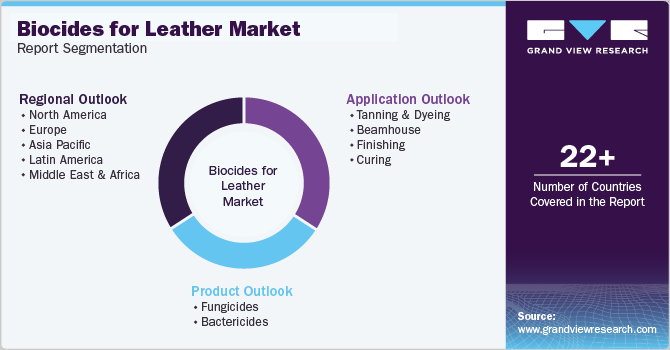
-
Product Outlook (Volume, Kilotons; Revenue, USD Million, 2021 - 2033)
-
Fungicides
-
Bactericides
-
-
Application Outlook (Volume, Kilotons; Revenue, USD Million, 2021 - 2033)
-
Tanning & Dyeing
-
Beamhouse
-
Finishing
-
Curing
-
-
Regional Outlook (Volume, Kilotons; Revenue, USD Million, 2021 - 2033)
-
North America
-
U.S.
-
Canada
-
Mexico
-
-
Europe
-
Germany
-
UK
-
France
-
Italy
-
Spain
-
-
Asia Pacific
-
China
-
India
-
Japan
-
-
Latin America
-
Brazil
-
Argentina
-
-
Middle East & Africa
-
UAE
-
South Africa
-
Saudi Arabia
-
-
Research Methodology
The biocides for leather market figures in this report are based on a proven research process that combines executive interviews with secondary research from proprietary databases, company filings, and recognized regulatory and institutional sources. Market size is built through value-chain sizing - reconciling supply-side and demand-side estimates - and triangulated with bottom-up and top-down approaches. Every estimate passes multiple levels of expert validation before publication, with each biocides for leather segment quantified using the revenue-capture definitions in the table below.
Segment Definition
Segment - Product
Revenue capture definition
Bactericides
Revenue generated from biocidal products specifically formulated to control and eliminate bacterial contamination during leather processing, storage, and transportation. These products help prevent bacterial degradation, unpleasant odors, discoloration, and quality deterioration in hides, skins, and finished leather products.
Fungicides
Revenue generated from fungicidal solutions used to inhibit the growth of molds, fungi, and yeasts throughout leather manufacturing and storage. These products protect leather from fungal staining, surface damage, and spoilage, thereby improving product durability, appearance, and shelf life.
Segment - Application
Revenue capture definition
Curing
Revenue generated from biocides used during the curing stage to preserve raw hides and skins immediately after slaughter. These products prevent microbial growth and decomposition during storage and transportation before leather processing begins.
Tanning & Dyeing
Revenue generated from biocides utilized during tanning and dyeing operations to control microbial contamination in tanning liquors, dye baths, and processing equipment. Their use helps maintain process efficiency, leather quality, and product consistency.
Beamhouse
Revenue generated from biocides applied during beamhouse operations, including soaking, liming, dehairing, and pickling processes. These products prevent bacterial and fungal growth in process water and raw materials, ensuring effective leather preparation and minimizing spoilage risks.
Finishing
Revenue generated from biocides incorporated into leather finishing formulations, coatings, and surface treatments. These products protect finished leather from microbial attack, mold growth, discoloration, and deterioration during storage, distribution, and end-use applications.
Estimation Model
Layer Name
Key Question
Description
Biocides for Leather Production Layer
What forms is the supply base?
Identify global production capacity of leather biocides supported by active ingredient availability, chemical manufacturing infrastructure, formulation technologies, antimicrobial product development capabilities, regulatory compliance standards, and regional production facilities. This establishes the foundational supply base available for microbial protection solutions used throughout leather processing and preservation worldwide.
Leather Processing Adoption Layer
Where are biocides for leather utilized?
Estimate the proportion of biocides consumed across curing, beamhouse operations, tanning & dyeing, finishing processes, and leather storage applications based on microbial control requirements, preservation needs, processing conditions, product quality standards, and industry adoption trends within the leather value chain.
Consumption Intensity Layer
How much biocide is used?
Analyze application-specific dosage rates, microbial risk levels, preservation requirements, leather processing methods, formulation standards, production volumes, and regional leather manufacturing trends to determine annual biocide consumption across major leather processing stages and end-use applications.
Revenue Layer
How is market revenue generated?
Market revenue is quantified through the sale of bactericides, fungicides, broad-spectrum antimicrobial formulations, preservation agents, and customized leather protection solutions supplied to tanneries, leather processors, footwear manufacturers, automotive upholstery producers, furniture manufacturers, and leather goods companies worldwide.
Delivered Customizations
This report has been delivered with the following In-depth customizations
Client Request
Customization Delivered
Value Adds
Cross-Segmentation Analysis
Detailed cross-segmentation assessment evaluating the relationship between biocide types, leather processing stages, and end-use leather applications. Analysis identifies consumption patterns, microbial protection requirements, preservation intensity, application-specific usage trends, and revenue contribution across intersecting segments such as bactericides in beamhouse operations, fungicides in finishing applications, and preservation solutions used during curing and tanning processes.
Supports product portfolio optimization and market prioritization by identifying the most attractive biocide-application-processing combinations, enabling improved resource allocation, sales targeting, product development strategies, and long-term growth planning across the leather value chain.
Competitive Benchmarking
Comparative evaluation of leading biocides for leather manufacturers based on product portfolio breadth, antimicrobial technology capabilities, regulatory compliance expertise, manufacturing capacity, geographic presence, sustainability initiatives, leather industry specialization, customer relationships, distribution networks, and strategic developments across key regional markets.
Assists competitive intelligence, partnership evaluation, and supplier assessment by providing deeper visibility into market positioning, technological strengths, differentiation strategies, innovation capabilities, regulatory preparedness, and areas of competitive advantage.
Opportunity Assessment
Comprehensive assessment of emerging opportunities associated with sustainable leather processing, eco-friendly biocide formulations, premium leather goods production, automotive leather applications, advanced preservation technologies, regulatory-compliant antimicrobial solutions, and increasing demand for high-quality leather products across global markets.
Helps identify high-growth investment areas, emerging application opportunities, technology development priorities, and market expansion strategies, supporting long-term revenue growth and competitive positioning across the biocides for leather value chain.
Frequently Asked Questions About This Report
Key players in the market include Lanxess, Buckmann, Vink Chemicals GmbH & Co. KG, Troy Corporation, Lamirsa, Schill+Seilacher GmbH, Thomas Swan, DuPont de Nemours, Inc.
The fungicides segment accounted for the largest market share of 86.9% in 2025, owing to their widespread use in preventing fungal growth, mold formation, and material degradation.
The tanning & dyeing segment led the market in 2025, accounting for 50.5% of total revenue.
Key trends include the increasing adoption of environmentally friendly and regulatory-compliant biocides, growing focus on sustainable leather processing, advancements in antimicrobial technologies, and rising investments in high-performance preservation solutions.
The fungicides segment is expected to witness the fastest growth during the forecast period, driven by the increasing need to prevent mold, mildew, and fungal deterioration in leather products.
The global biocides for leather market size was estimated at USD 612.6 million in 2025 and is estimated at USD 637.5 million for 2026.
The global biocides for leather market is expected to grow at a CAGR of 4.4% from 2026 to 2033, reaching USD 859.1 million by 2033.
Asia Pacific dominated the biocides for leather market with a share of 39.7% in 2025. The market in the region is anticipated to be driven by the increased demand for leather chemicals and growing demand for leather from end-use industries such as footwear, automotive upholstery, and textiles.
The growth of the biocides for leather market is driven by increasing demand for high-quality leather products, rising concerns regarding microbial contamination during leather processing and storage, and stringent regulations related to product durability and hygiene.
About the Author(s)
Disinfectants & Preservatives Research Team
Bulk Chemicals · Disinfectants & PreservativesThis report was authored by the disinfectants & preservatives research team at Grand View Research - comprising two research analysts, one senior research analyst, and one industry expert - with specialized expertise in the disinfectants & preservatives segment of the bulk chemicals industry. All findings are based on proprietary bulk chemicals databases, executive interviews, and regulatory analysis, subject to internal peer review prior to publication.
Last Updated:
Speak to Analyst


Customize this report to your needs — add regions, segments, or data points, with 20% free customization.
Or view our licence options:


ISO 9001:2015 & 27001:2022 Certified
We are GDPR and CCPA compliant! Your transaction & personal information is safe and secure. For more details, please read our privacy policy.


