
- Home
- »
- Advanced Interior Materials
- »
-
Biodiversity Conservation In Mining Market Size Report, 2033GVR Report cover

Biodiversity Conservation In Mining Market (2026 - 2033)
Size, Share & Trends Analysis Report By Component (Mitigation & Biodiversity Offsets, Rehabilitation & Ecological Restoration, Monitoring, Surveillance & Verification), By Region, And Segment Forecasts
Market Size, 2025
$3.2BMarket Estimate, 2026
$3.5BMarket Forecast, 2033
$6.4BCAGR, 2026–2033
9.1%Biodiversity Conservation In Mining Market Summary
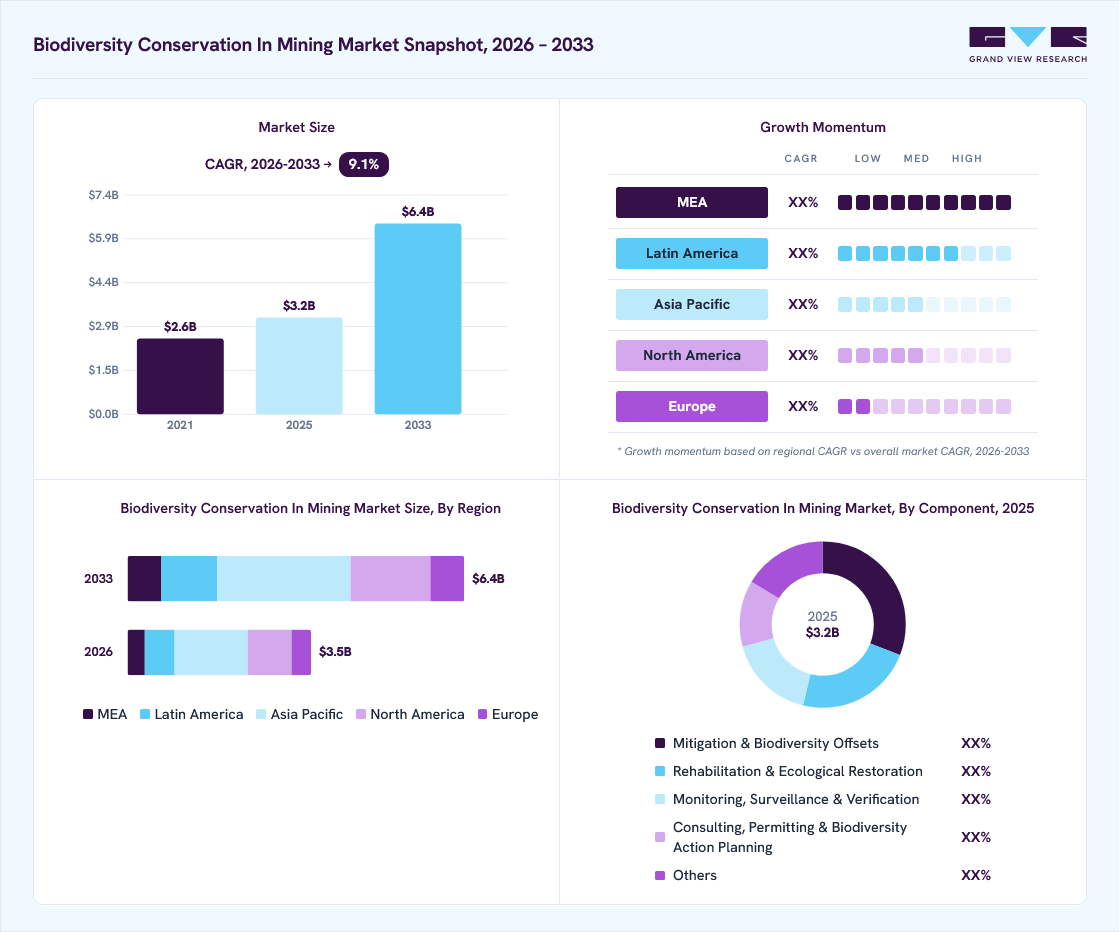
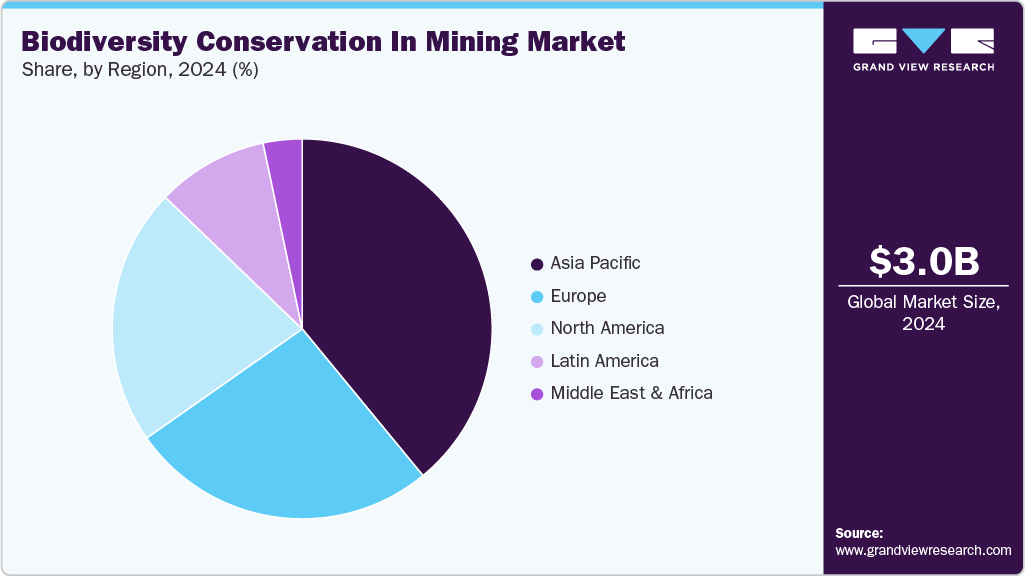
The biodiversity conservation in mining market size was valued at USD 3.2 billion in 2025 and is projected to grow from USD 3.5 billion in 2026 to USD 6.4 billion by 2033, at a CAGR of 9.1% from 2026 to 2033. Asia Pacific dominated the market, accounting for a revenue share of 39.9% in 2025. Biodiversity conservation in the mining industry involves strategies and practices aimed at minimizing the environmental impact of mining operations by protecting and restoring local ecosystems.
 Source: Grand View Research, IR Documents, Primary Interviews, Paid DatabasesTo learn more about this report,
 Download Free Sample Report
 Key Market Trends & Insights
- By component: Mitigation & biodiversity offsets segment led the market with the largest revenue share of 30.9% in 2025.
Regional Highlights
- Largest regional market: Asia Pacific (39.9% revenue share, 2025)
- By country: Australia held the largest market share in 2025.
Market Size & Forecast
- Market size in 2025: USD 3.2 Billion
- Estimated market size in 2026: USD 3.5 Billion
- Projected market size by 2033: USD 6.4 Billion
- CAGR (2026-2033): 9.1%
Three ways to get this report
Buy it, customize it, or ask a question.Ask an Analyst
A direct answer, usually in 1 working day
- AccessReport author, directly
- Reply timeWithin 1 working day
- No sales callDirect answer only
- FormatEmail reply
- CostFree, no cost
Get the Full Report
What the study covers
- FormatsPDF · Excel · Dashboard
- Timeline2026–2033 annual, 2025 base
- Coverage20+ countries, 5 regions
- Companies10+ key players profiled
Customize the Report
20% free customization
- IncludeCountries, segments, points
- TailorTo your product definition
- ExtendDeeper competitor detail
- OrA fully bespoke study
- Turnaround5–10 working days
It focuses on sustainable land use, habitat rehabilitation, and maintaining ecological balance throughout the mining lifecycle. The market is witnessing strong growth as governments around the world tighten environmental laws and mandate that companies integrate biodiversity management into their mine planning. Stricter compliance frameworks require mining operators to conduct environmental impact assessments and establish baseline biodiversity data before obtaining approvals. This legal enforcement ensures that companies invest in habitat restoration, rehabilitation, and long-term monitoring throughout the mine life cycle, creating a steady demand for biodiversity management solutions and services.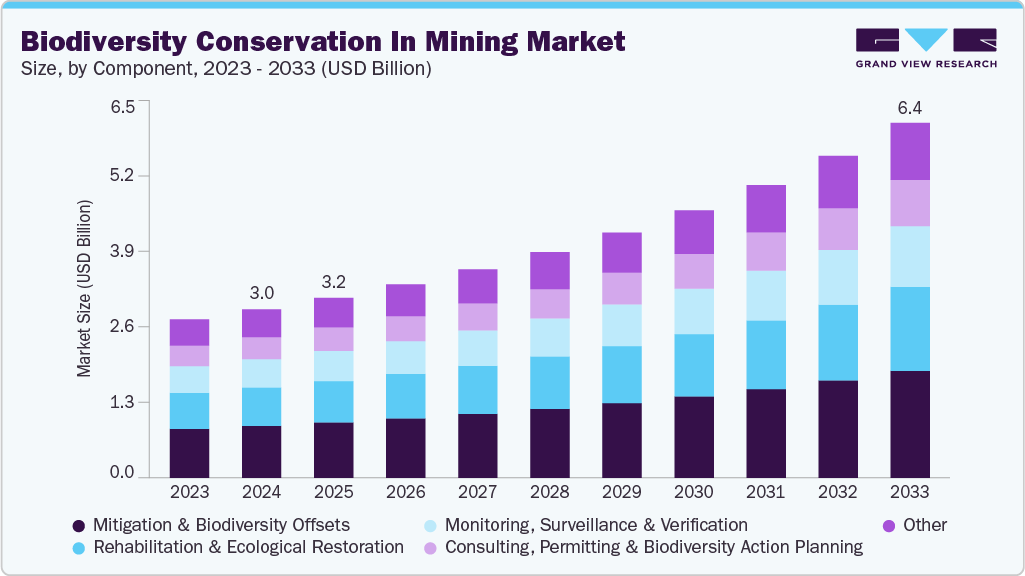 To learn more about this report, Download Free Sample Report
 Investor and market-driven factors are also propelling the growth of biodiversity conservation in mining. Financial institutions and shareholders increasingly evaluate mining companies based on their environmental and social performance. Maintaining biodiversity-positive operations has become crucial for securing funding, attracting investors, and protecting a corporate reputation.
The integration of advanced tools, including remote sensing, satellite imagery, drones, and AI-based environmental monitoring systems, enables real-time biodiversity assessment and data-driven decision-making. These technologies enable companies to identify sensitive ecosystems, monitor changes, and implement effective restoration strategies. The efficiency and accuracy provided by technology significantly enhance the scope of biodiversity management in mining regions, encouraging wider adoption across operations.
The rising importance of land reclamation and ecological restoration after mine closure is further strengthening market growth. Mining companies are shifting toward nature-positive targets that emphasize restoring habitats, re-establishing native species, and developing long-term ecosystem recovery projects. These initiatives not only reduce the environmental footprint of mining but also create new commercial opportunities for specialized biodiversity service providers focusing on mine rehabilitation and restoration planning.
Community involvement has emerged as a crucial factor in the growth of biodiversity conservation in the mining sector. Collaborative conservation projects that include indigenous participation and local knowledge enhance transparency, trust, and long-term sustainability. This community-centered approach motivates companies to increase their conservation investments and develop inclusive frameworks, thereby accelerating the overall growth of the biodiversity conservation market in the mining industry.
Market Dynamics
The biodiversity conservation in mining market is witnessing significant growth due to increasing environmental regulations, rising Environmental, Social, and Governance (ESG) commitments, and growing pressure on mining companies to minimize ecological impacts throughout the mine lifecycle. As mining activities expand to meet the rising demand for critical minerals, metals, and raw materials required for renewable energy technologies, electric vehicles, and infrastructure development, stakeholders are placing greater emphasis on protecting ecosystems, restoring degraded land, and achieving sustainable resource extraction. The adoption of biodiversity management plans, ecological restoration programs, habitat conservation initiatives, and advanced environmental monitoring technologies is supporting market growth globally.
The growing integration of biodiversity considerations into corporate sustainability strategies is a major driver for biodiversity conservation in the mining market. Governments, financial institutions, investors, and local communities are increasingly requiring mining companies to demonstrate responsible environmental stewardship and compliance with biodiversity protection standards. International frameworks such as the Global Biodiversity Framework, sustainability reporting requirements, and no-net-loss or net-positive-impact commitments are encouraging mining operators to invest in biodiversity assessments, habitat restoration, species conservation programs, and ecological monitoring systems.
Furthermore, mining companies are adopting advanced technologies, including remote sensing, GIS mapping, drones, satellite monitoring, and environmental data analytics, to evaluate and manage biodiversity risks more effectively. Increasing scrutiny from stakeholders and the need to secure social licenses are further accelerating investments in biodiversity conservation initiatives across mining projects worldwide.
The implementation of biodiversity conservation programs often involves substantial financial and operational commitments, creating challenges for mining companies. Activities such as environmental impact assessments, biodiversity baseline studies, habitat restoration, long-term ecological monitoring, and biodiversity offset programs require specialized expertise, advanced technologies, and continuous investment throughout the project lifecycle. These requirements can significantly increase project costs, particularly for small and mid-sized mining operators.
The growing emphasis on ecosystem restoration and sustainable land management presents substantial opportunities for biodiversity conservation in the mining market. Governments and mining companies are increasingly investing in mine closure, land rehabilitation, reforestation, wetland restoration, and habitat recovery projects to mitigate environmental impacts and enhance biodiversity outcomes. Nature-based solutions are gaining traction as effective approaches for restoring ecological functions while generating long-term environmental and social benefits.
Analyst Perspective
The biodiversity conservation in mining market is witnessing strong growth as mining companies increasingly prioritize environmental stewardship, ecosystem protection, and sustainable resource development. Growing regulatory requirements, heightened ESG expectations from investors, and increasing stakeholder scrutiny are driving the adoption of biodiversity management programs across the mining lifecycle. As global demand for critical minerals expands to support renewable energy, electrification, and infrastructure development, mining operators are investing more heavily in biodiversity impact assessments, habitat restoration, ecological monitoring, and conservation planning to minimize environmental impacts and maintain their social license to operate.
Drivers, Opportunities & Restraints
The key drivers of the biodiversity conservation in mining market include increasing environmental regulations, rising awareness of ecosystem protection, and the growing adoption of sustainable mining practices. Governments across major mining nations are implementing stringent environmental standards that require companies to assess and mitigate the impacts on biodiversity. The integration of advanced technologies, such as GIS mapping, drone monitoring, and AI-based data analytics, enables companies to manage biodiversity more effectively, thereby further enhancing market expansion.
The market offers several opportunities as sustainability becomes central to mining operations. Global initiatives promoting nature-positive development and biodiversity credit trading are creating new business avenues for conservation service providers and technology developers. There is an increasing demand for ecosystem restoration projects, the rehabilitation of degraded mine lands, and innovative partnerships among mining companies, local communities, and environmental organizations. Additionally, companies that align their biodiversity strategies with international frameworks can enhance their brand reputation, gain investor confidence, and secure long-term access to resources.
However, the biodiversity conservation in mining industry faces certain restraints that could limit its growth potential. High implementation costs of biodiversity monitoring and restoration programs continue to be a significant challenge for small and mid-sized mining companies. Limited technical expertise and a lack of standardized biodiversity assessment frameworks across regions also hinder uniform adoption.
Component Insights
By component, the mitigation & biodiversity offsets segment led the market with the largest revenue share of 30.9% in 2025. The segment’s growth is driven by the rising enforcement of environmental regulations and the global shift toward sustainable mining practices. Governments and financial institutions now require mining projects to demonstrate measurable biodiversity outcomes, leading to the widespread adoption of offset programs to balance ecological losses. Regulatory policies in regions such as Australia, Canada, and South Africa emphasize "no-net-loss" or "net-positive" biodiversity goals, prompting miners to restore degraded ecosystems or protect equivalent habitats elsewhere. This regulatory momentum, combined with pressure from investors and sustainability indices, has positioned mitigation and offsets as essential components of responsible resource extraction strategies.
 To learn more about this report, Download Free Sample Report
 The rehabilitation & ecological restoration segment is anticipated to register the fastest CAGR over the forecast period. This growth can be attributed to the increasing emphasis on post-mining land recovery and habitat renewal. Governments and environmental agencies are enforcing strict reclamation standards that require companies to integrate restoration plans into the early stages of project development. This proactive approach is supported by technological advances in soil rejuvenation, native vegetation replanting, and the restoration of hydrological balance, which are improving the success rates of rehabilitation projects.
Regional Insights
Asia Pacific dominated the biodiversity conservation in mining market with the largest revenue share of 39.9% in 2025. The Asia Pacific biodiversity conservation in mining market is experiencing strong growth, driven by tightening environmental regulations and an increasing emphasis on sustainable mining practices. Governments across countries such as Australia, India, China, and Indonesia are enforcing stricter guidelines on habitat protection and biodiversity management in mining leases. The inclusion of biodiversity impact assessments in project approvals and alignment with global sustainability frameworks, such as the IFC Performance Standards, is compelling companies to invest in conservation programs.
Australia Biodiversity Conservation In Mining Market Trends
Australia held the largest share of the Asia Pacific biodiversity conservation in mining market in 2025.
North America Biodiversity Conservation In Mining Market Trends
In North America, the growth of biodiversity conservation in the mining industry is driven by stringent environmental regulations and expanding sustainability mandates. Governments in the U.S. and Canada are implementing stricter laws to protect biodiversity, which require mining companies to adopt advanced ecological management and monitoring practices. Companies are required to incorporate biodiversity offset programs, habitat rehabilitation, and ecosystem restoration into their operational strategies to obtain permits and maintain compliance with relevant regulations.
U.S. Biodiversity Conservation In Mining Market Trends
In the U.S., biodiversity conservation in the mining sector is gaining momentum due to the tightening of federal and state-level environmental regulations. The U.S. Environmental Protection Agency (EPA) and the U.S. Fish and Wildlife Service are strengthening requirements related to habitat protection, endangered species management, and land reclamation.
Europe Biodiversity Conservation In Mining Market Trends
In Europe, biodiversity conservation in the mining industry is expanding due to the region’s stringent environmental regulations and the European Union’s commitment to achieving its 2030 Biodiversity Strategy. Governments across the region are enforcing policies that require mining operations to prevent ecosystem degradation, restore affected habitats, and maintain ecological connectivity. The implementation of the EU Habitats and Birds Directives has also made it mandatory for mining firms to assess the biodiversity impacts of their projects before approval. These regulations encourage companies to integrate advanced monitoring technologies, ecological restoration programs, and biodiversity offset frameworks into their mining operations, aligning with regional sustainability goals.
Middle East & Africa Biodiversity Conservation In Mining Market Trends
In the Middle East and Africa, the biodiversity conservation in mining industry’s growth is driven by the increasing recognition of environmental sustainability as a key factor in long-term resource development. Governments in South Africa, Saudi Arabia, and the UAE are integrating biodiversity management frameworks into their national mining policies to align with global sustainability commitments. These initiatives are pushing mining companies to implement habitat restoration, species protection, and ecosystem monitoring programs to maintain their social license to operate and ensure compliance with evolving environmental standards.
Latin America Biodiversity Conservation In Mining Market Trends
In Latin America, the biodiversity conservation in the mining industry is expanding due to the region’s rich ecological diversity and increasing environmental scrutiny on extractive industries. Countries such as Brazil, Chile, and Peru are enforcing stricter environmental licensing systems that require detailed biodiversity impact assessments and post-mining rehabilitation plans. Governments and regional agencies are emphasizing the need to protect sensitive ecosystems, including tropical forests and high-altitude wetlands that are often affected by mining operations.
Key Biodiversity Conservation In Mining Company Insights
Some of the key players operating in the market include Anglo American plc and BHP Group.
-
Anglo American plc is a leading global mining company headquartered in London, United Kingdom, with diversified operations across iron ore, copper, platinum group metals, diamonds, and coal. The company operates in over 15 countries, maintaining a strong focus on sustainable mining and environmental stewardship. In biodiversity conservation, Anglo American implements comprehensive ecosystem management and restoration programs at its mining sites. The company conducts detailed biodiversity assessments and partners with local and global organizations to develop offset and rehabilitation projects.
-
BHP Group is one of the world’s largest mining and resources companies, headquartered in Melbourne, Australia, with operations spanning the minerals, oil, and gas sectors. The company’s diversified portfolio includes copper, iron ore, nickel, and coal, serving key industrial and energy markets worldwide. BHP has embedded sustainability at the center of its corporate strategy, focusing on responsible resource development and ecosystem preservation. In biodiversity conservation, BHP Group is actively involved in large-scale environmental restoration and conservation initiatives across its global operations.
Key Biodiversity Conservation In Mining Companies:
The following key companies have been profiled for this study on the biodiversity conservation In mining market.
- Anglo American plc
- BHP Group
- Eramet Group
- Exxaro Resources Limited
- Freeport-McMoRan
- Glencore plc
- Hindustan Zinc Ltd.
- Imerys
- Rio Tinto Group
- Vale S.A.
Competitive Benchmarking
Category
Operating Strategies
Competitive Edge
Weakness
Established Players (Freeport-McMoRan, Anglo American plc, BHP Group, Rio Tinto Group, Vale S.A., Glencore plc)
- Integrate biodiversity management frameworks into mine planning, operation, closure, and post-closure activities.
- Collaborate with conservation organizations, research institutions, and local communities to implement landscape-level conservation programs.
- Deploy advanced environmental monitoring technologies, including satellite imagery, drones, GIS platforms, and biodiversity data analytics, to track ecological performance.
- Strong sustainability governance frameworks and extensive environmental management expertise.
- Ability to allocate substantial capital toward large-scale restoration, offset, and conservation initiatives.
- Well-established stakeholder relationships that facilitate regulatory approvals and long-term project development.
- Managing biodiversity commitments across diverse ecosystems and jurisdictions can be operationally complex.
- Long implementation timelines for restoration and conservation projects may delay measurable outcomes.
- Increasing expectations from investors and communities create ongoing pressure to demonstrate tangible biodiversity results.
Emerging & Regional Players (Hindustan Zinc Ltd., Exxaro Resources Limited, Eramet Group, Imerys)
- Prioritize site-specific biodiversity protection measures aligned with local regulatory requirements and environmental sensitivities.
- Engage specialized environmental consultants and third-party service providers for ecological assessments and rehabilitation programs.
- Focus on improving environmental performance through targeted habitat restoration and community-based conservation initiatives.
- Greater flexibility in adopting region-specific conservation approaches and innovative restoration techniques.
- Strong understanding of local ecological conditions and regulatory landscapes.
- Ability to implement focused conservation projects with faster decision-making processes.
- Limited financial resources compared with multinational mining companies for large-scale biodiversity investments.
- Dependence on external expertise for specialized ecological monitoring and biodiversity planning activities.
- Smaller operational footprints may limit economies of scale in environmental management programs.
Recent Development
- In November 2024, Zijin Mining introduced its first Biodiversity Conservation Guidelines, a major milestone in its environmental stewardship efforts. These Guidelines identify potential biodiversity impacts across all phases of mining activities and prescribe four tailored conservation measures, avoidance, mitigation, restoration, and compensation, applicable during exploration, construction, operations, and closure.
Biodiversity Conservation In Mining Market Report Scope
Report Attribute
Details
Market definition
The market size represents the aggregate annual spending by mining firms and supporting organizations on these biodiversity-related activities.
Market size in 2025
USD 3.2 billion
Estimated market size in 2026
USD 3.5 billion
Projected market size by 2033
USD 6.4 billion
Growth rate
CAGR of 9.1% from 2026 to 2033
Base year for estimation
2025
Historical data
2021 - 2024
Forecast period
2026 - 2033
Quantitative units
Revenue in USD million and CAGR from 2026 to 2033
Report coverage
Revenue forecast, company ranking, competitive landscape, growth factors, and trends
Segments covered
Component, region
Regional scope
North America; Europe; Asia Pacific; Latin America; Middle East & Africa
Country scope
U.S.; Canada; Mexico; Finland; Sweden; Poland; Russia; China; India; Australia; Brazil; South Africa; Iran
Key companies profiled
Anglo American plc; BHP Group; Eramet Group; Exxaro Resources Limited; Freeport-McMoRan; Glencore plc; Hindustan Zinc Ltd.; Imerys; Rio Tinto Group; Vale S.A.
Customization scope
Free report customization (equivalent up to 8 analysts' working days) with purchase addition or alteration to country, regional & segment scope.
Pricing and purchase options
Avail customized purchase options to meet your exact research needs. Explore purchase options
Global Biodiversity Conservation In Mining Market Report Segmentation
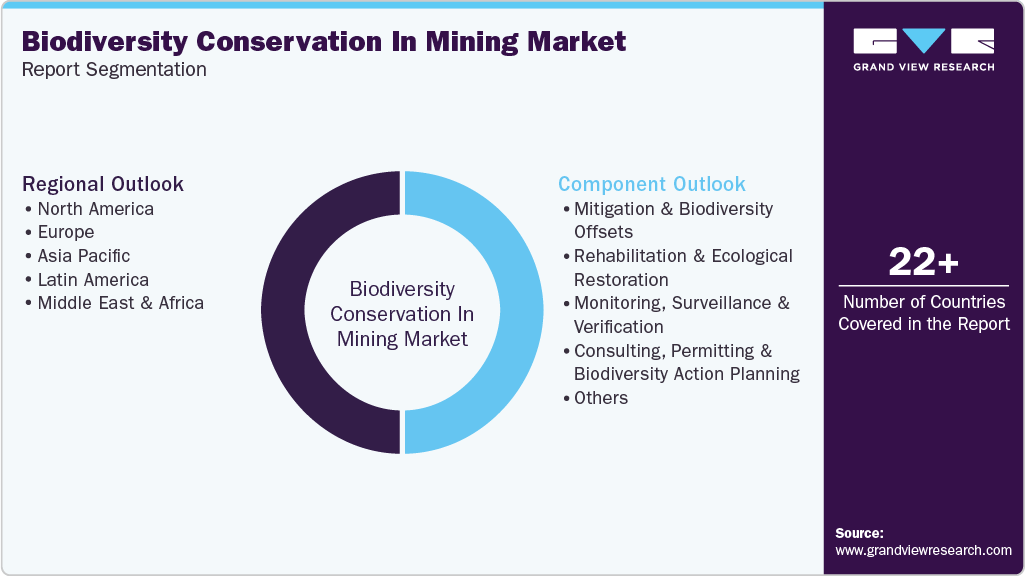
This report forecasts revenue growth at the global, regional, and country levels and provides an analysis of the latest industry trends in each of the sub-segments from 2021 to 2033. For this study, Grand View Research has segmented the global biodiversity conservation in mining market report based on component and region:
 To learn more about this report, Download Free Sample Report
 -
Component Outlook (Revenue, USD Million, 2021 - 2033)
-
Mitigation & Biodiversity Offsets
-
Rehabilitation & Ecological Restoration
-
Monitoring, Surveillance & Verification
-
Consulting, Permitting & Biodiversity Action Planning
-
Others
-
-
Regional Outlook (Revenue, USD Million, 2021 - 2033)
-
North America
-
U.S.
-
Canada
-
Mexico
-
-
Europe
-
Finland
-
Sweden
-
Poland
-
Russia
-
-
Asia Pacific
-
China
-
India
-
Australia
-
-
Latin America
-
Brazil
-
-
Middle East & Africa
-
South Africa
-
Iran
-
-
Research Methodology
The biodiversity conservation in mining market figures in this report are based on a proven research process that combines executive interviews with secondary research from proprietary databases, company filings, and recognized regulatory and institutional sources. Market size is built through value-chain sizing - reconciling supply-side and demand-side estimates - and triangulated with bottom-up and top-down approaches. Every estimate passes multiple levels of expert validation before publication, with each biodiversity conservation in mining segment quantified using the revenue-capture definitions in the table below.
Segment Definition
Component
Revenue Capture Definition
Mitigation & Biodiversity Offsets
This segment includes revenue generated from biodiversity impact mitigation measures and biodiversity offset programs implemented by mining companies to compensate for unavoidable ecological impacts. Services include habitat protection, species conservation initiatives, offset project development, and long-term biodiversity management activities.
Rehabilitation & Ecological Restoration
This segment comprises revenue generated from mine site rehabilitation, land reclamation, ecosystem restoration, reforestation, wetland restoration, soil recovery, and habitat reconstruction activities undertaken during mine closure and post-closure phases.
Monitoring, Surveillance & Verification
This segment includes revenue generated from biodiversity monitoring, ecological surveys, environmental data collection, remote sensing, GIS mapping, drone-based surveillance, species tracking, and verification services used to assess conservation performance and regulatory compliance.
Consulting, Permitting & Biodiversity Action Planning
This segment covers revenue generated from environmental consulting services, biodiversity impact assessments, permitting support, ecological risk analysis, stakeholder engagement, biodiversity action plan development, and regulatory compliance advisory services for mining projects.
Others
This segment includes revenue generated from biodiversity-related technologies, environmental training, conservation research, ecosystem valuation, biodiversity data management solutions, community-based conservation programs, and other specialized conservation services not covered under the above categories.
Estimation Model
Layer Name
Key Question
Description
Mining Activity & Biodiversity Risk Assessment Layer
What constitutes the demand base for biodiversity conservation services in mining?
Assess the scale of mining activities across surface and underground operations for metals, minerals, and critical raw materials. Evaluate the number of active mines, project pipelines, exploration activities, environmentally sensitive operating regions, biodiversity risk exposure, and regulatory obligations that drive demand for biodiversity conservation solutions.
Conservation Program & Service Adoption Layer
How is demand generated across conservation activities?
Analyze the adoption of biodiversity management programs across mining operations, including biodiversity impact assessments, mitigation measures, biodiversity offsets, ecological restoration, habitat conservation, environmental monitoring, and biodiversity action planning. Assess ESG commitments, sustainability targets, regulatory compliance requirements, and corporate biodiversity strategies influencing service uptake.
Service Deployment & Spending Analysis Layer
How are biodiversity conservation expenditures distributed?
Evaluate spending patterns across major service categories, including mitigation & biodiversity offsets, rehabilitation & ecological restoration, monitoring & verification, consulting & permitting, and other conservation-related activities. Assess project lifecycle stages, mine size, geographic distribution, and environmental risk profiles to understand expenditure allocation across applications and regions.
Pricing & Market Value Assessment Layer
What is the revenue potential of the market?
Assess pricing structures for biodiversity consulting, environmental assessments, restoration projects, biodiversity offset programs, monitoring technologies, and compliance services across major mining regions. Evaluate the impact of regulatory requirements, project complexity, mine scale, ecological sensitivity, and service intensity on revenue generation. This layer establishes the overall market value across components, mining types, and geographies while ensuring consistency with mining activity and conservation spending trends.
Delivered Customizations
This report has been delivered with the following In-depth customizations
Client Request
Customization Delivered
Value Adds
Biodiversity Investment & Cost Structure Analysis
Comprehensive evaluation of biodiversity conservation expenditures across mining operations, including environmental impact assessments, biodiversity offset programs, habitat restoration costs, ecological monitoring expenses, regulatory compliance costs, community engagement initiatives, and long-term rehabilitation investments. Assessed regional variations in conservation spending and project implementation costs.
Supported budgeting and resource allocation decisions, enabled cost optimization of conservation programs, improved ESG investment planning, and enhanced understanding of biodiversity-related expenditure trends across mining projects.
Conservation Capacity & Ecosystem Risk Assessment
Mapped mining activities across biodiversity-sensitive regions and evaluated ecological risk exposure, conservation requirements, restoration potential, protected area proximity, and regional regulatory frameworks. Assessed biodiversity management capabilities, rehabilitation project pipelines, and environmental monitoring infrastructure across key mining jurisdictions.
Supported environmental risk assessment, conservation planning, regulatory compliance strategies, and identification of regions requiring enhanced biodiversity management and restoration efforts.
Sustainability & Biodiversity Opportunity Assessment
Identified emerging opportunities in biodiversity offsets, mine rehabilitation, ecosystem restoration, nature-based solutions, biodiversity monitoring technologies, environmental consulting services, and ESG-driven conservation initiatives—assessed growth potential across major mining regions and evolving regulatory environments.
Enabled prioritization of high-growth conservation segments, supported sustainability strategy development, identified emerging revenue opportunities, and strengthened long-term environmental stewardship and ESG positioning.
Frequently Asked Questions About This Report
Asia Pacific dominated the biodiversity conservation in mining market with the largest revenue share of 39.9% in 2025.
The biodiversity conservation in mining market size was estimated at USD 3.2 billion in 2025 and is expected to reach USD 3.5 billion in 2026.
The biodiversity conservation in mining market is expected to grow at a compound annual growth rate of 9.1% from 2026 to 2033 to reach USD 6.4 billion by 2033.
By component, the mitigation & biodiversity offsets segment led the market with the largest revenue share of 30.9% in 2025.
The key factor driving the growth of the global biodiversity conservation in mining market is the increasing emphasis on ESG compliance, environmental regulations, and sustainable mining practices aimed at minimizing ecological impacts and protecting biodiversity.
The key players operating in the biodiversity conservation in mining market are Anglo American plc; BHP Group; Eramet Group; Exxaro Resources Limited; Freeport-McMoRan; Glencore plc; Hindustan Zinc Ltd.; Imerys; Rio Tinto Group; Vale S.A., among others.
Rehabilitation & ecological restoration is expected to be the fastest-growing segment in the biodiversity conservation in mining market during the forecast period.
About the Author(s)
Advanced Interior Materials Research Team
Advanced Materials · Advanced Interior MaterialsThis report was authored by the advanced interior materials research team at Grand View Research - comprising two research analysts, one senior research analyst, and one industry expert - with specialized expertise in the advanced interior materials segment of the advanced materials industry. All findings are based on proprietary advanced materials databases, executive interviews, and regulatory analysis, subject to internal peer review prior to publication.
Last Updated:
Speak to Analyst

Customize this report to your needs - add regions, segments, or data points, with 20% free customization.
Or view our licence options:


ISO 9001:2015 & 27001:2022 Certified
We are GDPR and CCPA compliant! Your transaction & personal information is safe and secure. For more details, please read our privacy policy.


