
- Home
- »
- Sustainable Energy
- »
-
Biodiversity Credit Market Size, Share & Trends Report, 2033GVR Report cover

Biodiversity Credit Market (2026 - 2033)
Size, Share & Trends Analysis Report By Credit Type (Voluntary Biodiversity Credits, Compliance Biodiversity Credits), By Application (Conservation Projects, Corporate Sustainability, Government Initiatives), By Region, And Segment Forecasts
Market Size, 2025
$1.3BMarket Estimate, 2026
$1.4BMarket Forecast, 2033
$3.2BCAGR, 2026–2033
12.1%Biodiversity Credit Market Summary
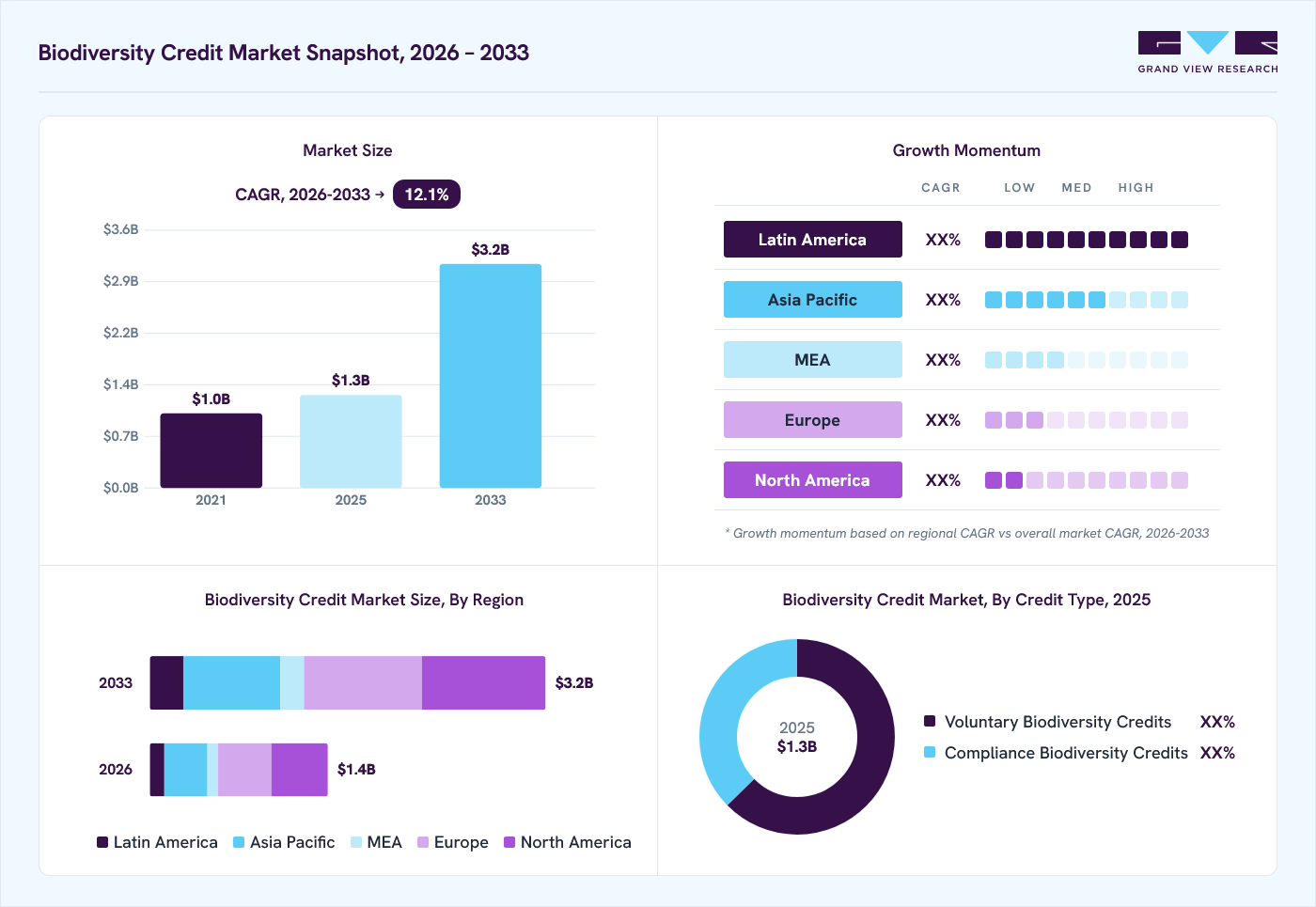
The global biodiversity credit market size was valued at USD 1.3 billion in 2025 and is projected to grow from USD 1.4 billion in 2026 to USD 3.2 billion by 2033, at a CAGR of 12.1% from 2026 to 2033. North America dominated the market, accounting for a revenue share of 31.8% in 2025. The market is witnessing strong momentum driven by the increasing global focus on biodiversity conservation, ecosystem restoration, and the integration of natural capital into financial systems. Biodiversity credits are emerging as a critical tool for enabling organizations to offset their ecological impact and contribute toward positive nature outcomes.
 Source: Grand View Research, IR Documents, Primary Interviews, Paid DatabasesTo learn more about this report,
 Download Free Sample Report
 Key Market Trends & Insights
- By credit type: Voluntary biodiversity credits segment led the market with the largest revenue share of 62.6% in 2025.
- By application: The conservation projects segment led the biodiversity credit industry, accounting for the largest revenue share of 46.9% in 2025.
Regional Highlights
- Largest regional market: North America (31.8% revenue share, 2025)
- Fastest-growing regional market: Latin America (highest CAGR, 2026-2033)
- By country: The U.S. held the largest market share in 2025.
Market Size & Forecast
- Market size in 2025: USD 1.3 Billion
- Estimated market size in 2026: USD 1.4 Billion
- Projected market size by 2033: USD 3.2 Billion
- CAGR (2026-2033): 12.1%
Three ways to get this report
Buy it, customize it, or ask a question.Ask an Analyst
Analyst response in 1 business day
- AccessReport author, directly
- Reply timeWithin 1 working day
- No sales callDirect answer only
- FormatEmail reply
- CostFree, no cost
Get the Full Report
What the study covers
- FormatsPDF · Excel · Dashboard
- Timeline2026–2033 annual, 2025 base
- Coverage20+ countries, 5 regions
- Companies10+ key players profiled
Customize the Report
20% free customization
- IncludeCountries, segments, points
- TailorTo your product definition
- ExtendDeeper competitor detail
- OrA fully bespoke study
- Turnaround5–10 working days
Biodiversity credits are emerging as a critical tool for enabling organizations to offset their ecological impact and contribute toward positive nature outcomes. Growing corporate commitments toward ESG goals and net-positive biodiversity targets are significantly accelerating market adoption across industries. Biodiversity credits are generated through activities such as habitat restoration, conservation of endangered species, and sustainable land management practices. These credits represent measurable, verifiable improvements in biodiversity and are increasingly traded in voluntary and compliance-based markets. The market remains largely voluntary; however, the development of regulatory frameworks and biodiversity offset policies across regions is expected to drive the expansion of compliance markets. Advancements in monitoring, reporting, and verification (MRV) systems, including the use of remote sensing, AI, and blockchain technologies, are enhancing transparency and credibility within the biodiversity credit industry.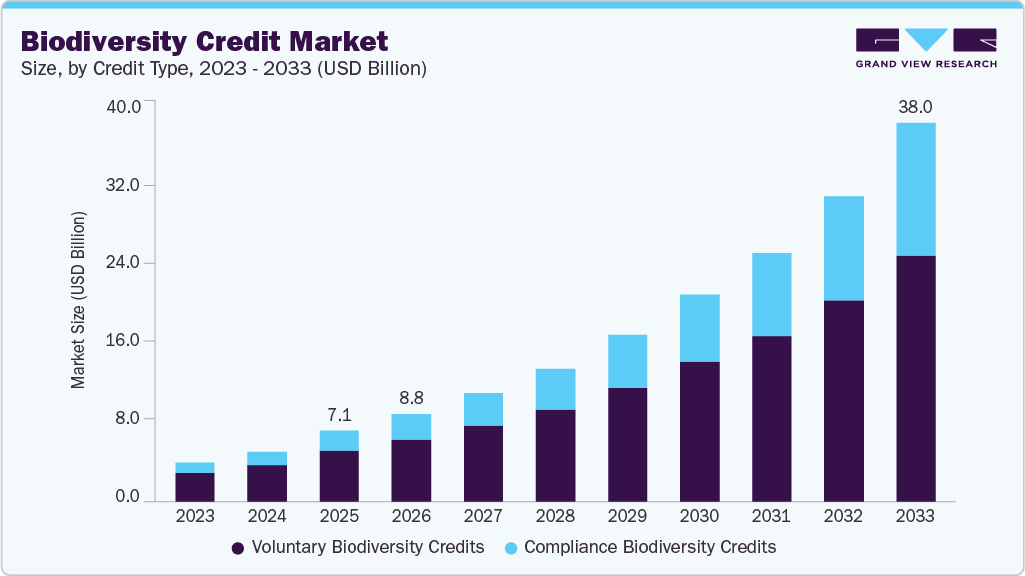 To learn more about this report, Download Free Sample Report
 The market is also benefiting from the growing alignment between biodiversity conservation and climate action initiatives. As governments and organizations intensify efforts to achieve net-zero emissions, there is a rising emphasis on nature-based solutions that deliver both carbon sequestration and biodiversity benefits. Increasing investments from financial institutions, conservation funds, and multinational corporations are supporting large-scale biodiversity projects globally. Furthermore, collaborations between governments, NGOs, and private stakeholders are fostering innovation and standardization in credit frameworks. As global awareness of biodiversity loss continues to rise, the biodiversity credit market is expected to play a pivotal role in advancing sustainable development and environmental resilience across both developed and emerging economies.
Market Dynamics
The biodiversity credit market is growing as businesses, investors, and governments increasingly invest in nature conservation and ecosystem restoration to meet sustainability commitments and manage biodiversity-related risks. Growing corporate focus on environmental responsibility, evolving disclosure frameworks, and rising demand for measurable conservation outcomes are supporting market growth. Improvements in biodiversity measurement, monitoring, and verification are increasing market credibility and encouraging broader participation. While the market is still developing with evolving standards and pricing mechanisms, continued policy support and private sector investment are expected to drive long-term growth.
Businesses across industries are increasingly recognizing biodiversity loss as a material business risk that can disrupt supply chains, reduce access to natural resources, and affect long-term operational resilience. Companies are expanding their sustainability strategies beyond carbon reduction to include biodiversity conservation and ecosystem restoration. Biodiversity credits provide a market-based mechanism for organizations to finance measurable conservation outcomes while supporting their environmental, social, and governance (ESG) objectives.
Growing investor expectations and evolving disclosure frameworks are further accelerating corporate demand for biodiversity credits. Initiatives such as the Taskforce on Nature-related Financial Disclosures (TNFD) and the Kunming-Montreal Global Biodiversity Framework encourage businesses to assess, disclose, and mitigate nature-related risks. This is driving companies in sectors such as mining, energy, agriculture, consumer goods, and financial services to invest in biodiversity projects as part of their broader nature-positive commitments and sustainability roadmaps.
Developing biodiversity credit projects requires significant upfront investment in ecological assessments, baseline studies, long-term monitoring, and independent verification. Unlike carbon projects, biodiversity outcomes often take several years to demonstrate, increasing project risk and delaying revenue generation. These high costs and extended development timelines discourage smaller project developers and limit the pace of market expansion. In July 2025, the European Commission released a thematic report highlighting that the lack of standardized methods for measuring biodiversity outcomes and the long-term monitoring required for high-integrity biodiversity credits remain major barriers to scaling the market.
The biodiversity credit market has a significant opportunity to grow through integration with carbon markets and broader nature-based solutions. As businesses increasingly pursue climate and biodiversity goals together, projects that generate both carbon and biodiversity credits are attracting greater corporate interest and investment. This integrated approach improves project economics, creates multiple revenue streams for conservation initiatives, and supports the long-term expansion of the biodiversity credit market. In February 2025, the International Institute for Sustainable Development highlighted that integrating biodiversity credits with carbon credits and other hybrid nature-finance models can attract greater private investment, improve project economics, and accelerate the scaling of conservation projects.
Analyst Perspective
The biodiversity credit market is still in its early stage but is gaining attention as companies look beyond carbon reduction and invest in nature conservation. Market growth depends on clear standards, reliable verification, and stronger participation from corporate buyers. As project quality and market transparency improve, buyer confidence is expected to increase and support long-term growth. Increasing support from governments, financial institutions, and conservation organizations is also helping the market develop. An emerging trend is the growing development of projects that combine carbon and biodiversity credits, allowing organizations to achieve both climate and nature goals through a single investment.
Credit Type Insights
Based on type, the voluntary biodiversity credits segment led the market with the largest revenue share of 62.6% in 2025, driven by increasing corporate participation in sustainability initiatives and the growing adoption of ESG frameworks across industries. Voluntary credits are widely utilized by organizations aiming to offset their ecological impact and achieve net-positive biodiversity goals beyond regulatory requirements. The flexibility, early-stage accessibility, and strong alignment with corporate social responsibility strategies have made voluntary biodiversity credits the dominant segment. Additionally, rising awareness regarding biodiversity loss and the need for nature-based solutions is encouraging companies across sectors such as energy, manufacturing, and finance to invest in voluntary conservation and restoration projects, particularly in regions such as North America and Europe.
Compliance biodiversity credits are expected to register the fastest CAGR of 26.7% over the forecast period, driven by the increasing implementation of regulatory frameworks and biodiversity offset policies across key regions. Governments are gradually introducing mandatory mechanisms requiring developers and industries to compensate for ecological damage, thereby accelerating the adoption of compliance-based credits. This segment is gaining traction as policymakers emphasize measurable biodiversity outcomes and enforce stricter environmental regulations. Furthermore, advancements in monitoring, reporting, and verification (MRV) systems are improving transparency and accountability, supporting the scalability of compliance markets. As global biodiversity commitments strengthen and regulatory clarity improves, compliance biodiversity credits are expected to emerge as a key growth driver in the market.
Application Insights
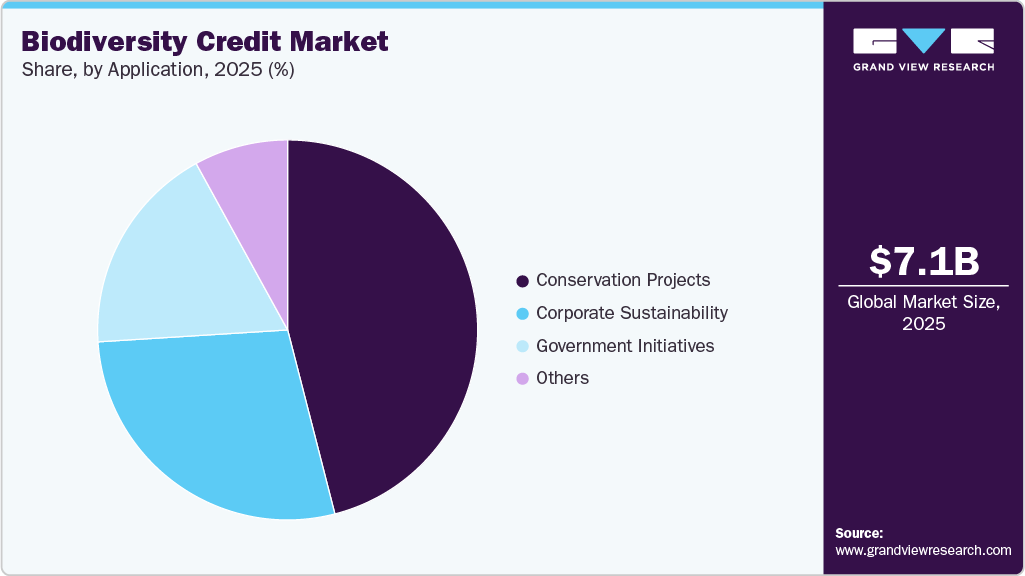
Based on application, the conservation projects segment led the market with the largest revenue share of 46.9% in 2025, as they serve as the primary source for generating biodiversity credits through activities such as habitat restoration, ecosystem preservation, and species protection. These projects form the foundation of the market by delivering measurable ecological outcomes that can be quantified and traded. Increasing global efforts to combat biodiversity loss, deforestation, and land degradation are driving investments into conservation initiatives. Governments, NGOs, and private stakeholders are actively funding large-scale restoration and conservation programs, particularly in biodiversity-rich regions such as Latin America, the Asia Pacific, and Africa, thereby supporting the dominance of this segment.
 To learn more about this report, Download Free Sample Report
 Corporate sustainability is expected to register the fastest CAGR of 26.3% over the forecast period, driven by the rising integration of biodiversity goals into corporate ESG strategies and sustainability reporting frameworks. Companies across industries are increasingly investing in biodiversity credits to offset their environmental impact and align with global sustainability commitments. The growing emphasis on nature-positive business models, along with stakeholder pressure from investors, regulators, and consumers, is accelerating corporate participation in biodiversity markets. Furthermore, the increasing adoption of voluntary disclosure frameworks and science-based targets related to nature is encouraging organizations to engage in biodiversity credit mechanisms actively, positioning corporate sustainability as a key growth driver in the market.
Regional Insights
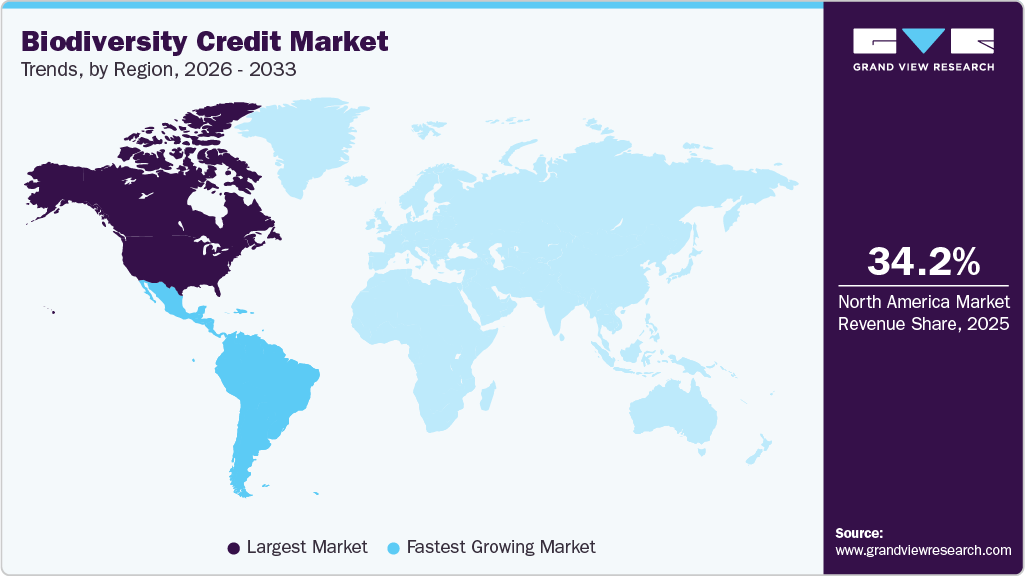
North America dominated the biodiversity credit market with the largest revenue share of 31.8% in 2025, driven by strong corporate ESG adoption, well-established voluntary carbon and biodiversity markets, and increasing integration of natural capital into financial decision-making. The region is witnessing growing participation from corporations, financial institutions, and conservation organizations in biodiversity credit initiatives to offset ecological impacts. Favorable regulatory frameworks, coupled with increasing awareness regarding biodiversity loss and sustainability reporting requirements, are accelerating market growth. Additionally, the presence of advanced monitoring, reporting, and verification (MRV) systems and a mature ecosystem of environmental markets is further strengthening the region’s leadership position.
 To learn more about this report, Download Free Sample Report
 U.S. Biodiversity Credit Market Trends
The biodiversity credit market in the U.S. held the largest share in the North America region in 2025, supported by strong corporate demand for voluntary biodiversity credits and increasing alignment with ESG and sustainability goals. Companies across sectors such as energy, technology, and finance are actively investing in biodiversity conservation projects to achieve a net-positive environmental impact. The country is also witnessing advancements in natural capital valuation, along with increased adoption of digital tools for tracking and verification of biodiversity outcomes. Furthermore, collaborations between private organizations, NGOs, and government bodies are fostering innovation and scaling biodiversity credit initiatives across the country.
Europe Biodiversity Credit Market Trends
Europe is experiencing significant growth in the biodiversity credit industry, supported by stringent environmental regulations and strong policy frameworks focused on biodiversity conservation and ecosystem restoration. The region is actively implementing biodiversity offset mechanisms and integrating nature-related risks into financial disclosures. Government initiatives aligned with the EU Biodiversity Strategy are encouraging investments in conservation projects and sustainable land-use practices. Additionally, increasing collaboration between public and private stakeholders is promoting the development of standardized biodiversity credit frameworks, positioning Europe as a key market in the global landscape.
Asia Pacific Biodiversity Credit Market Trends
Asia Pacific is emerging as a prominent market for biodiversity credits, driven by increasing environmental awareness, rapid economic development, and growing focus on sustainable practices. Countries such as China, India, and Australia are investing in biodiversity conservation programs and nature-based solutions to address ecological degradation. The region is witnessing rising corporate participation in voluntary biodiversity markets, supported by evolving regulatory landscapes and increasing ESG adoption. Additionally, the presence of biodiversity-rich ecosystems and expanding conservation initiatives is creating strong growth opportunities across the region.
Latin America Biodiversity Credit Market Trends
The Latin America biodiversity credit industry is expected to register the fastest CAGR of 26.4% over the forecast period, driven by its vast biodiversity resources and increasing global demand for nature-based solutions. Countries such as Brazil, Colombia, and Peru are leveraging their rich ecosystems to develop large-scale conservation and restoration projects that generate biodiversity credits. Growing international investments, along with partnerships between governments, NGOs, and private stakeholders, are accelerating market development. Furthermore, the region’s role as a key supplier of biodiversity credits is strengthening its position in global markets, creating significant growth opportunities.
Middle East & Africa Biodiversity Credit Market Trends
The Middle East & Africa biodiversity credit industry is witnessing steady growth, supported by increasing awareness of environmental sustainability and rising investments in conservation initiatives. The region is gradually adopting biodiversity credit mechanisms as part of broader sustainability and climate strategies. Countries in Africa offer significant potential due to their rich natural ecosystems and ongoing conservation efforts. Additionally, increasing support from international organizations, funding agencies, and governments is promoting biodiversity protection and restoration projects. Strategic collaborations and policy developments are expected to drive long-term market growth.
Key Biodiversity Credit Company Insights
Some of the key players operating in the global biodiversity credit market include South Pole, Verra, Terrasos, Biodiversity Credit Alliance, Plan Vivo Foundation, Climate Impact Partners, Wilderlands, RePlanet, NatureMetrics, and EcoRegistry. These companies operate across the biodiversity credit value chain, including project development, certification, monitoring, verification, and the establishment of trading platforms. Their capabilities span ecosystem restoration, biodiversity assessment, natural capital valuation, and digital monitoring solutions, supporting the development and scalability of biodiversity credit industry globally.
Their strategic initiatives are primarily focused on developing high-quality biodiversity projects, establishing standardized frameworks, and enhancing transparency through advanced monitoring, reporting, and verification (MRV) systems. Companies are increasingly investing in technologies such as remote sensing, environmental DNA (eDNA), and blockchain to improve the accuracy and credibility of biodiversity measurement. Additionally, collaborations with governments, NGOs, financial institutions, and conservation organizations are enabling the development of robust market infrastructure and facilitating the commercialization of biodiversity credits. These partnerships also support the creation of registries, marketplaces, and certification standards, which are critical for scaling market adoption.
As global awareness of biodiversity loss intensifies, these players are positioning biodiversity credits as a key instrument for achieving nature-positive outcomes and integrating environmental value into economic systems. Increasing corporate commitments toward ESG goals, along with regulatory developments around biodiversity offsets, are driving innovation and investment across the market. Furthermore, ongoing efforts toward standardization, improved project verification, and expansion of global trading mechanisms are expected to enhance market maturity. Continued investments in conservation initiatives and strategic alliances are likely to support long-term growth and strengthen the role of biodiversity credits in global sustainability frameworks.
Key Biodiversity Credit Companies:
The following key companies have been profiled for this study on the biodiversity credit market.
- Biodiversity Credit Alliance
- Climate Impact Partners
- EcoRegistry
- NatureMetrics
- Plan Vivo Foundation
- RePlanet
- South Pole
- Terrasos
- Verra
- Wilderlands
Competitive Benchmarking
Category
Operating Strategies
Competitive Edge
Weakness
Established Players (Climate Impact Partners, Environment Bank, NatureMetrics, South Pole, Terrasos, Verra)
- Expand biodiversity credit project portfolios across forests, wetlands, and ecosystem restoration initiatives.
- Strengthen partnerships with governments, corporates, NGOs, and certification bodies to scale biodiversity finance.
- Invest in robust MRV (Monitoring, Reporting, and Verification) technologies to improve credit transparency and credibility.
- Develop integrated carbon and biodiversity credit solutions to address broader corporate sustainability requirements.
- Strong global presence and well-established relationships with corporate buyers and conservation organizations.
- Proven expertise in project development, certification, and environmental market advisory services.
- High credibility supported by recognized methodologies, scientific capabilities, and large project pipelines.
- Greater access to investment capital and international conservation programs.
- Longer project development and certification timelines due to extensive verification requirements.
- Higher operating costs associated with scientific assessments and long-term ecosystem monitoring.
- Greater exposure to evolving biodiversity regulations and stakeholder scrutiny.
- Slower adoption of new business models because of established operational structures.
Emerging Players (CreditNature, RePlanet, Savimbo, Wilderlands)
- Focus on innovative biodiversity credit models and technology-enabled conservation solutions.
- Build partnerships with local communities, landowners, and regional conservation organizations.
- Leverage AI, remote sensing, blockchain, and digital MRV platforms to improve monitoring efficiency.
- Target niche ecosystems and pilot projects to demonstrate scalable biodiversity outcomes.
- Agile business models that enable faster innovation and project deployment.
- Strong focus on digital technologies and data-driven biodiversity measurement.
- Ability to address underserved regional markets and specialized conservation opportunities.
- Flexible partnerships that support customized biodiversity finance solutions.
- Limited project portfolios and lower global brand recognition.
- Dependence on external funding and strategic partnerships for business expansion.
- Limited experience in executing large-scale international biodiversity projects.
- Higher commercial risk due to evolving market standards and uncertain long-term demand.
Recent Developments
-
In July 2025, the European Commission released a thematic report on biodiversity credits, focusing on developing standardized methodologies for measuring biodiversity outcomes. The report aims to address one of the key challenges in the market, the lack of credible and consistent measurement frameworks. It outlines pathways to improve transparency, integrity, and comparability of biodiversity credits. This initiative is expected to accelerate private sector participation and support the scaling of biodiversity credit markets across Europe and globally.
Biodiversity Credit Market Report Scope
Report Attribute
Details
Market Definition
The biodiversity credit market size represents the total revenue generated from the issuance, trading, and purchase of biodiversity credits worldwide.
Market size in 2025
USD 1.3 billion
Estimated market size in 2026
USD 1.4 billion
Projected market size by 2033
USD 3.2 billion
Growth rate
CAGR of 12.1% from 2026 to 2033
Base year for estimation
2025
Historical data
2021 - 2024
Forecast period
2026 - 2033
Quantitative units
Revenue in USD Million and CAGR from 2026 to 2033
Report coverage
Revenue forecast, company ranking, competitive landscape, growth factors, and trends
Segments covered
Type, application, region
Regional scope
North America, Europe, Asia Pacific, Latin America, Middle East & Africa
Country scope
U.S.; Canada; Mexico; Germany; UK; France; Italy; Spain; China; India; Japan; South Korea; Brazil; Saudi Arabia; UAE; Australia; Argentina; South Africa
Key companies profiled
Climate Impact Partners, CreditNature, Environment Bank, NatureMetrics, RePlanet, Savimbo, South Pole, Terrasos, Verra, Wilderlands
Customization scope
Free report customization (equivalent up to 8 analysts' working days) with purchase. Addition or alteration to country, regional & segment scope.
Pricing and purchase options
Avail customized purchase options to meet your exact research needs. Explore purchase options
Global Biodiversity Credit Market Report Segmentation
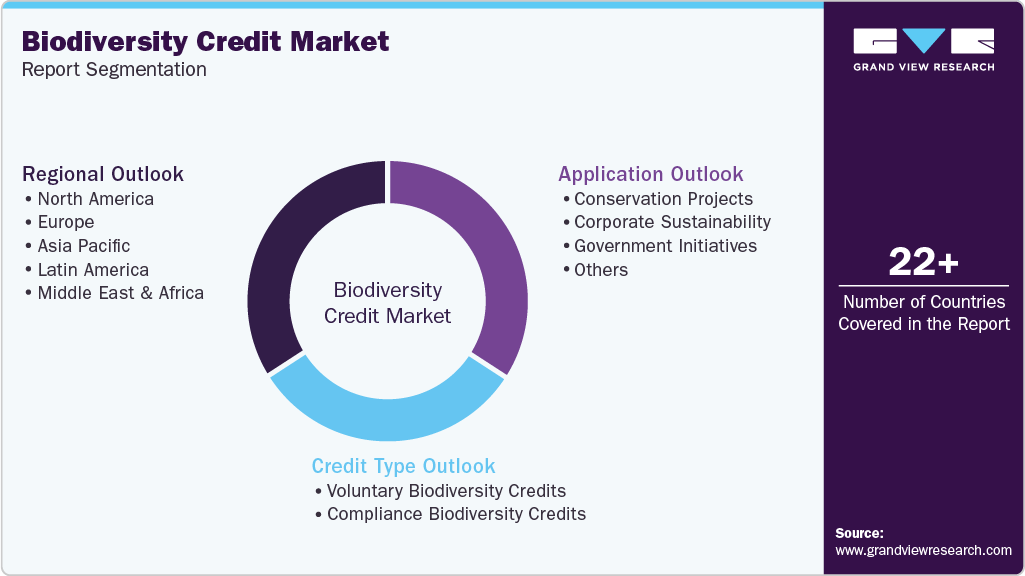
This report forecasts revenue growth at the global, regional, and country levels and provides an analysis of the latest industry trends in each of the sub-segments from 2021 to 2033. For this study, Grand View Research has segmented the global biodiversity credit market report based on credit type, application, and region:
 To learn more about this report, Download Free Sample Report
 -
Credit Type Outlook (Revenue, USD Billion, 2021 - 2033)
-
Voluntary Biodiversity Credits
-
Compliance Biodiversity Credits
-
-
Application Outlook (Revenue, USD Billion, 2021 - 2033)
-
Conservation Projects
-
Corporate Sustainability
-
Government Initiatives
-
Others
-
-
Regional Outlook (Revenue, USD Billion, 2021 - 2033)
-
North America
-
U.S.
-
Canada
-
Mexico
-
-
Europe
-
Germany
-
UK
-
France
-
Italy
-
Spain
-
-
Asia Pacific
-
China
-
India
-
Japan
-
South Korea
-
Australia
-
-
Latin America
-
Brazil
-
Argentina
-
-
Middle East & Africa
-
Saudi Arabia
-
UAE
-
South Africa
-
-
Research Methodology
The biodiversity credit market figures in this report are based on a proven research process that combines executive interviews with secondary research from proprietary databases, company filings, and recognized regulatory and institutional sources. Market size is built through value-chain sizing - reconciling supply-side and demand-side estimates - and triangulated with bottom-up and top-down approaches. Every estimate passes multiple levels of expert validation before publication, with each biodiversity credit segment quantified using the revenue-capture definitions in the table below.
Segment Definition
Segment - Type
Revenue capture definition
Voluntary Biodiversity Credits
Voluntary biodiversity credits are purchased by companies and organizations to support biodiversity conservation beyond regulatory requirements and strengthen sustainability commitments. Revenue is captured through the issuance and sale of voluntarily traded biodiversity credits.
Compliance Biodiversity Credits
Compliance biodiversity credits are used to meet mandatory biodiversity offset and environmental compensation requirements established by regulatory authorities. Revenue is generated from the sale of biodiversity credits used for regulatory compliance.
Segment - Application
Revenue capture definition
Conservation Projects
Conservation projects generate biodiversity credits through activities such as habitat restoration, ecosystem protection, and species conservation. Revenue is generated from the issuance and sale of verified biodiversity credits from these projects.
Corporate Sustainability
Organizations purchase biodiversity credits to support ESG targets, nature-positive strategies, and biodiversity commitments. Revenue is captured through the sale of biodiversity credits to corporate buyers.
Government Initiatives
Governments utilize biodiversity credits to support conservation programs, biodiversity offset schemes, and ecological restoration efforts. Revenue is captured through public funding and procurement of biodiversity credits.
Others
Biodiversity credits are also adopted by NGOs, financial institutions, conservation funds, and research organizations to support biodiversity protection initiatives. Revenue is captured through the sale of biodiversity credits across these end users.
Estimation Model
Layer Name
Key Question
Description
Biodiversity Conservation & Demand Layer
What forms the demand base for biodiversity credits?
Assess demand for biodiversity conservation driven by corporate sustainability commitments, biodiversity offset requirements, ESG initiatives, nature-positive strategies, and ecosystem restoration programs. Evaluate conservation funding, biodiversity loss, regulatory developments, and private sector participation to determine the underlying demand for biodiversity credits.
Credit Type & Framework Layer
Which biodiversity credit types are being adopted?
Analyze the adoption of voluntary and compliance biodiversity credits across different markets. Assess certification frameworks, verification methodologies, pricing mechanisms, regulatory requirements, and buyer preferences to determine segment-wise market demand.
Application Deployment Layer
Where are biodiversity credits being utilized?
Evaluate the use of biodiversity credits across conservation projects, corporate sustainability programs, government initiatives, and other environmental financing activities. Analyze credit purchases by businesses, governments, financial institutions, and conservation organizations to estimate application-wise market contribution.
Revenue Layer
How is market revenue generated?
Market revenue is quantified through the issuance and sale of biodiversity credits across voluntary and compliance markets. The overall market value is determined by the number of verified credits issued and traded, credit pricing, project scale, conservation outcomes, buyer demand, and regulatory support.
Delivered Customizations
This report has been delivered with the following In-depth customizations
Client Request
Customization Delivered
Value Adds
Regional Policy & Biodiversity Framework Assessment
Assessed biodiversity credit regulations, biodiversity offset policies, certification frameworks, and nature-positive initiatives across major countries and regions. Compared policy maturity and market readiness for biodiversity credit adoption.
Helped identify policy-driven growth opportunities, prioritize attractive markets, and understand regional regulatory differences.
Carbon Credit & Biodiversity Credit Integration Assessment
Compared the carbon credit and biodiversity credit markets across credit types, applications, end-use industries, market maturity, certification frameworks, and pricing trends. Assessed opportunities for integrating biodiversity credits with nature-based carbon credit projects and identified sectors with the highest dual-credit potential.
Helped identify integrated climate and nature investment opportunities, evaluate dual-credit project feasibility, understand demand across key end-use sectors, and support long-term market and investment strategies.
Competitive Landscape Assessment
Evaluated major biodiversity credit developers, certification bodies, and environmental service providers based on project portfolio, regional presence, partnerships, verification capabilities, and recent developments.
Helped benchmark competitors, identify market leaders, and understand competitive positioning across the biodiversity credit value chain.
Frequently Asked Questions About This Report
The biodiversity credit market is expected to grow at a CAGR of 12.1% from 2026 to 2033 to reach USD 3.2 billion by 2033.
Latin America is anticipated to register the fastest CAGR over the forecast period.
Based on credit type, the voluntary biodiversity credits segment accounted for largest revenue share of 62.6% in 2025.
Based on application, the conservation projects segment accounted for the largest revenue share of 46.9% in 2025.
The North America region dominated the biodiversity credit market with a revenue share of 31.8% in 2025.
The key players operating in the biodiversity credit market are CreditNature, RePlanet, Savimbo, Wilderlands, Climate Impact Partners, Environment Bank, NatureMetrics, South Pole, Terrasos, Verra, and others.
The biodiversity credit market is primarily driven by growing corporate sustainability commitments, increasing investments in nature conservation, and the rising adoption of nature-positive strategies and biodiversity offset initiatives.
The biodiversity credit market size was estimated at USD 1.3 billion in 2025 and is expected to reach USD 1.4 billion in 2026.
About the Author(s)
Sustainable Energy Research Team
Energy & Power · Sustainable EnergyThis report was authored by the sustainable energy research team at Grand View Research - comprising two research analysts, one senior research analyst, and one industry expert - with specialized expertise in the sustainable energy segment of the energy & power industry. All findings are based on proprietary energy & power databases, executive interviews, and regulatory analysis, subject to internal peer review prior to publication.
Last Updated:
Speak to Analyst

Customize this report to your needs - add regions, segments, or data points, with 20% free customization.
Or view our licence options:


ISO 9001:2015 & 27001:2022 Certified
We are GDPR and CCPA compliant! Your transaction & personal information is safe and secure. For more details, please read our privacy policy.


