
- Home
- »
- Catalysts & Enzymes
- »
-
Bioethanol Yeast Market Size And Share Report, 2026-2033GVR Report cover

Bioethanol Yeast Market (2026 - 2033)
Size, Share & Trends Analysis Report By Type (Baker's, Brewer's), By Application (Food, Animal Feed, Cleaning & Disinfection, Biofuel), By Region (North America, Europe), And Segment Forecasts
Market Size, 2025
$21.9BMarket Estimate, 2026
$24.6BMarket Forecast, 2033
$57.1BCAGR, 2026–2033
12.8%Bioethanol Yeast Market Size & Trends
The global bioethanol yeast market size was valued at USD 21.9 billion in 2025 and is projected to grow from USD 24.6 billion in 2026 to USD 57.1 billion by 2033, at a CAGR of 12.8% from 2026 to 2033. North America dominated the market, accounting for the largest revenue share of 52.3% in 2025. This growth is attributed to the increasing demand for renewable energy sources and biofuels, particularly in response to environmental concerns. In addition, growth in the food and beverage industry, fueled by rising disposable incomes and consumer preferences for bakery products and alcoholic beverages, also contributes significantly. Furthermore, advancements in fermentation technology, product innovations, and population growth are expected to drive market growth in the coming years.
 Source: Grand View Research, IR Documents, Primary Interviews, Paid DatabasesTo learn more about this report,
 Download Free Sample Report
 Key Market Trends & Insights
- By type : Baker’s segment led the market with the largest revenue share of 65.3% in 2025.
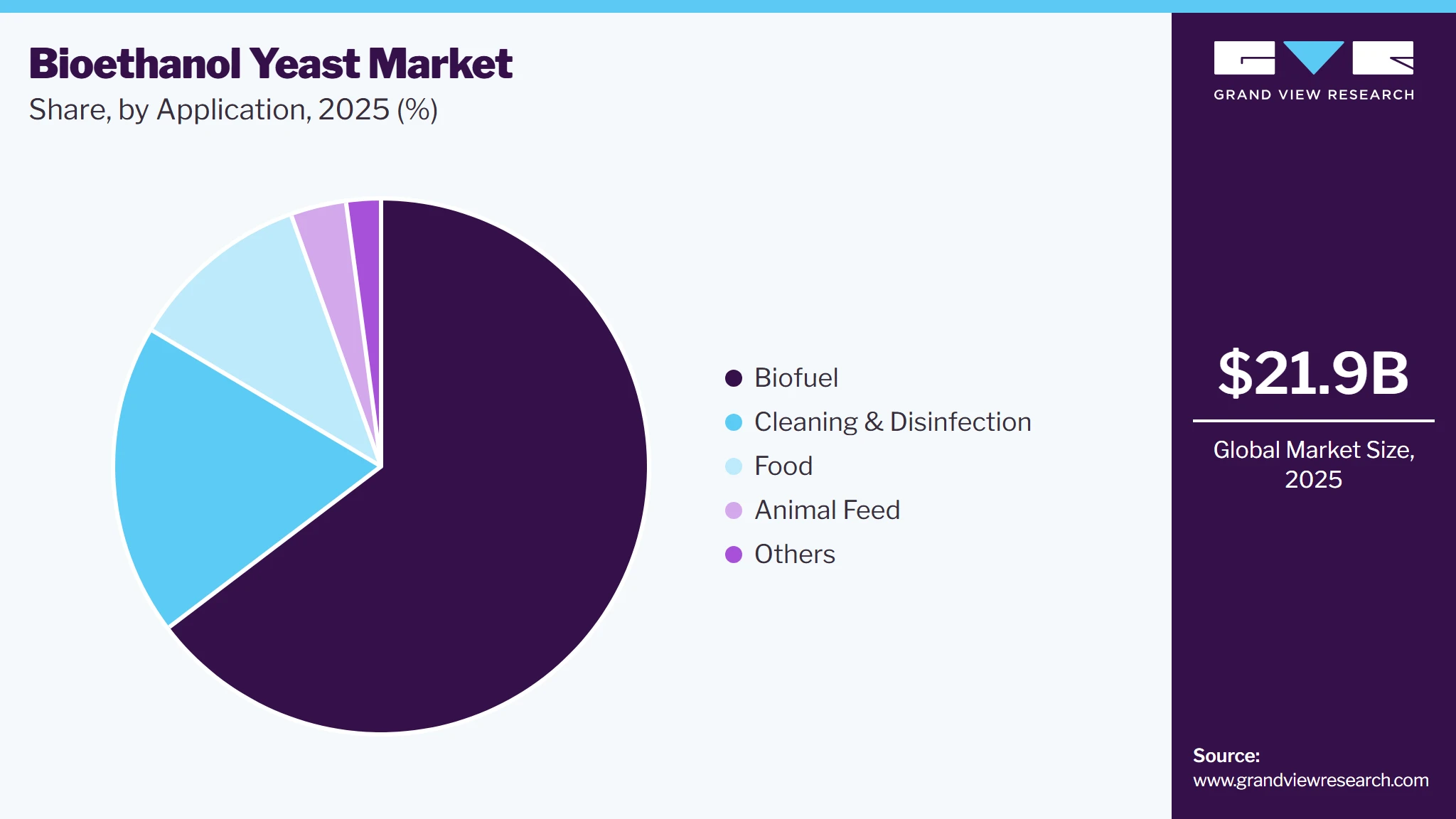
- By application: Biofuel segment led the market with the largest revenue share of 64.7% in 2025.
Regional Highlights
- Largest regional market: North America (52.3% revenue share, 2025)
- By country: The U.S. held the largest share of North America in 2025.
Market Size & Forecast
- Market Size in 2025: USD 21.9 Billion
- Estimated Market Size in 2026: USD 24.6 Billion
- Projected Market Size by 2033: USD 57.1 Billion
- CAGR (2026-2033): 12.8%
Three ways to get this report
Buy it, customize it, or ask a question.Ask an Analyst
A direct answer, usually in 1 working day
- AccessReport author, directly
- Reply timeWithin 1 working day
- No sales callDirect answer only
- FormatEmail reply
- CostFree, no cost
Get the Full Report
What the study covers
- FormatsPDF · Excel · Dashboard
- Timeline2026–2033 annual, 2025 base
- Coverage20+ countries, 5 regions
- Companies10+ key players profiled
Customize the Report
20% free customization
- IncludeCountries, segments, points
- TailorTo your product definition
- ExtendDeeper competitor detail
- OrA fully bespoke study
- Turnaround5–10 working days
Bioethanol yeast refers to specific strains of yeast, primarily Saccharomyces cerevisiae, utilized in the fermentation process to convert sugars into ethanol, which is a key component in bioethanol production. As the global demand for renewable energy sources rises, there is an increasing need for bioethanol, prompting the establishment of new production facilities and the expansion of existing ones. This growth is largely influenced by supportive government policies promoting renewable fuels and the economic benefits of scaling production capabilities. New plants are being constructed to satisfy the surging demand, while current facilities are enhancing their capacities to improve efficiency and output. This surge in bioethanol production directly correlates with an increased requirement for bioethanol yeast, as these facilities rely on a consistent supply of high-quality yeast to optimize fermentation processes and maintain stable ethanol yields. To learn more about this report, Download Free Sample Report
 In addition, advancements in agricultural practices have boosted the availability of essential feedstocks such as corn and sugarcane, which are crucial for bioethanol production. Improved farming techniques and higher crop yields contribute to greater agricultural output, enabling producers to source the necessary raw materials for their operations.
Furthermore, ongoing research is focused on developing advanced yeast strains that exhibit superior fermentation capabilities, such as increased ethanol tolerance and resilience to environmental challenges. These innovations can significantly enhance production efficiency and reduce costs. Moreover, advancements in fermentation technologies, such as improved reactors and nutrient management systems, contribute to higher yields and shorter production cycles. As these innovations progress, they will play a vital role in meeting the growing global demand for bioethanol, creating new opportunities within the market.
Market Dynamics
The bioethanol yeast market is driven by the increasing adoption of biofuels as a sustainable alternative to conventional fossil fuels, supported by government blending mandates, decarbonization initiatives, and rising investments in renewable energy infrastructure. Growing demand for higher ethanol yields and improved fermentation efficiency has encouraged the development of advanced yeast strains with enhanced stress tolerance and productivity.
The increasing implementation of biofuel blending mandates by governments across major economies has emerged as a significant growth driver for the Bioethanol Yeast Market. Regulatory frameworks aimed at reducing greenhouse gas emissions and enhancing energy security have accelerated bioethanol production, creating sustained demand for high-performance yeast strains. As ethanol producers strive to maximize fermentation efficiency and output, the adoption of advanced bioethanol yeast solutions has become a critical operational requirement.
Growing investments in renewable fuel infrastructure and the expansion of ethanol production facilities are supporting market growth. Industrial producers are focusing on improving conversion rates, reducing production costs, and optimizing fermentation processes, which has heightened the need for specialized yeast products capable of delivering higher ethanol yields under varying production conditions. These developments continue to strengthen the demand outlook for bioethanol yeasts across both established and emerging biofuel markets.
The bioethanol yeast market faces challenges due to fluctuations in the availability and pricing of key feedstocks such as corn, sugarcane, wheat, and other agricultural commodities. Changes in crop yields, weather conditions, trade policies, and competing demand from food and feed industries can significantly affect bioethanol production economics. These uncertainties often influence operating margins for ethanol producers and may impact investments in fermentation inputs, including yeast products.
Rising energy costs and operational expenditures also create pressure on bioethanol manufacturers, particularly in regions where government incentives are limited. Variability in raw material prices and production profitability may lead producers to focus on cost containment measures, potentially affecting the adoption rate of premium yeast solutions despite their performance advantages. Such conditions can slow technology upgrades and limit market expansion in cost-sensitive production environments.
The growing emphasis on improving ethanol production efficiency presents substantial opportunities for manufacturers to develop advanced bioethanol yeast strains. Innovations focused on enhanced stress tolerance, faster fermentation cycles, improved sugar utilization, and higher ethanol productivity are enabling producers to achieve better operational performance. Such advancements are particularly valuable in large-scale facilities seeking to increase output while maintaining cost competitiveness.
The expanding interest in second-generation and cellulosic bioethanol production is creating new avenues for specialized yeast technologies. As producers explore alternative feedstocks and more sustainable production pathways, demand is expected to rise for yeast strains capable of efficiently fermenting complex biomass-derived sugars. This shift is encouraging product innovation, strategic collaborations, and investment in research and development, supporting long-term growth prospects for the market.
Analyst Perspective
The bioethanol yeast market is expected to witness steady growth, supported by increasing demand from the biofuel industry, expanding applications in food and animal feed, and advancements in fermentation technologies. Market participants are focusing on improving yeast efficiency, production yields, and process optimization to enhance operational performance and meet evolving industry requirements. Growing emphasis on sustainable production practices and renewable energy initiatives is further expected to support long-term market development, creating opportunities for both established manufacturers and emerging suppliers.
Type Insights
Bakers dominated the type segment at a revenue share of 65.3% in 2025. This growth is attributed to the increasing demand for bakery products, fueled by changing consumer preferences for fresh and artisanal goods. In addition, the rise of home baking, urbanization, and higher disposable incomes have led to a surge in bakery consumption. Furthermore, innovations in yeast strains that enhance fermentation efficiency and product quality further stimulate market growth, as bakers seek to improve their offerings and meet evolving consumer tastes.
The brewer's yeast segment is expected to grow at a CAGR of 14.4% from 2026 to 2033, driven by the expanding craft beer industry and rising consumer interest in diverse alcoholic beverages. In addition, innovations in brewing techniques and the demand for unique flavors have increased the need for specialized yeast strains to enhance fermentation processes. Furthermore, the growing trend towards natural and organic products pushes brewers to adopt cleaner ingredients, including brewer's yeast.
Application Insights
The biofuel segment dominated the market and accounted for the largest revenue share of 64.7% in 2025. This growth is attributed to the increasing demand for renewable energy sources as countries strive to reduce their reliance on fossil fuels. Government policies and incentives promoting biofuel adoption further support this trend. Furthermore, advancements in fermentation technologies enhance the efficiency of converting biomass into bioethanol, making it a more viable alternative fuel. Moreover, as environmental concerns rise, the shift towards sustainable energy solutions bolsters the demand for bioethanol yeast in biofuel production.
 To learn more about this report, Download Free Sample Report
 The cleaning and disinfection applications are expected to grow at a CAGR of 17.1% over the forecast period, owing to rising awareness of hygiene and sanitation, particularly in the wake of global health crises. Bioethanol yeast produces eco-friendly cleaning agents that effectively eliminate pathogens while being less harmful to the environment. In addition, the shift towards sustainable and biodegradable cleaning products aligns with consumer preferences for natural ingredients, driving demand for bioethanol yeast. Furthermore, this trend is supported by regulatory frameworks encouraging the use of green chemicals in cleaning applications.
Regional Insights
North America accounted for 52.3% of the bioethanol yeast market revenue in 2025, making it the largest regional market. This growth is attributed to a strong emphasis on renewable energy sources and government policies that promote biofuels. In addition, the region benefits from advanced agricultural practices that ensure a steady supply of feedstocks such as corn and sugarcane, essential for bioethanol production. Furthermore, the growing consumer preference for sustainable products and expanding biofuel production facilities contribute significantly to market growth. The presence of major industry players further enhances innovation and competitiveness in this sector.
 To learn more about this report, Download Free Sample Report
 U.S. Bioethanol Yeast Market Trends
U.S. held the largest market share in North America in 2025, driven by its large-scale production capabilities and extensive infrastructure supporting biofuel initiatives. In addition, government mandates for renewable fuel standards have spurred investments in bioethanol plants, increasing demand for high-quality yeast. Furthermore, consumers' rising popularity of environmentally friendly fuels and the automotive industry’s shift towards cleaner energy sources are key factors driving growth.
Middle East & Africa Bioethanol Yeast Market Trends
The Middle East & Africa bioethanol yeast market is expected to grow at a CAGR of 6.9% over the forecast period, owing to the region’s emphasis on diversifying its energy sources amid fluctuating oil prices. In addition, government initiatives promoting renewable energy are beginning to take shape, leading to increased interest in biofuels. Furthermore, the agricultural sector is gradually evolving, providing essential feedstocks for bioethanol production. Moreover, as awareness of environmental issues grows, a rising demand for cleaner energy alternatives will likely drive future growth in this market.
Europe Bioethanol Yeast Market Trends
The bioethanol yeast market in Europe is expected to experience substantial growth over the forecast period, driven by stringent environmental regulations and a strong commitment to reducing carbon emissions. In addition, the European Union's policies favor renewable energy adoption, encouraging investments in bioethanol production facilities. Furthermore, consumer awareness regarding sustainability has led to increased demand for biofuels as an alternative to fossil fuels. Moreover, advancements in fermentation technology and the availability of diverse feedstocks support the growth of this market across various member states.
Germany bioethanol yeast market dominated the European market and accounted for the largest revenue share in 2024, due to its robust renewable energy sector and innovative agricultural practices. In addition, the country’s focus on energy transition policies has facilitated significant investments in biofuel technologies, driving demand for efficient yeast strains. Furthermore, Germany's strong automotive industry is increasingly adopting biofuels, further boosting the need for bioethanol production.
Asia Pacific Bioethanol Yeast Market Trends
The bioethanol yeast market in the Asia Pacific is expected to grow rapidly over the forecast period, owing to increasing urbanization and rising energy demands. In addition, countries such as India and Indonesia invest heavily in renewable energy projects, including biofuels, as part of their commitment to sustainable development. Furthermore, abundant agricultural resources support feedstock supply for bioethanol production. Moreover, technological advancements in fermentation processes enhance production efficiency, making bioethanol a more attractive option for energy generation across the region.
The growth of the China bioethanol yeast market is expected to be driven by its reliance on fossil fuels and enhancement of energy security. Government policies promoting renewable energy sources are driving investments in biofuel production facilities. Furthermore, the availability of diverse feedstocks, such as corn and sugarcane, supports this growth. Moreover, China's focus on environmental sustainability has led to increased consumer demand for cleaner fuels, positioning bioethanol as a viable alternative within its energy landscape.
Key Bioethanol Yeast Company Insights
Some of the key players in the global bioethanol yeast industry include Novozymes, Associated British Foods plc, DSM, and others. These companies adopt various strategies, such as investing in research and development to innovate yeast strains, forming strategic partnerships for enhanced collaboration, expanding production capacities to meet growing demand, and focusing on sustainability and alternative feedstocks.
-
AB Mauri produces various yeast strains and fermentation solutions tailored for biofuel applications. In addition, the company manufactures both bakery and non-bakery yeast products specifically designed for bioethanol production. The company operates within the broader segments of food and beverage, animal nutrition, and bioethanol, providing innovative fermentation technologies that enhance efficiency and sustainability in bioethanol production processes.
-
Cargill, Inc. produces a range of yeast products that serve the biofuel industry, facilitating the fermentation process essential for converting feedstocks into bioethanol. Operating within the agricultural sector, the company is involved in various segments, including food ingredients, animal nutrition, and biofuels, leveraging its extensive expertise to develop high-quality yeast solutions that meet the evolving demands of the bioethanol market.
Key Bioethanol Yeast Companies
The following key companies have been profiled for this study on the bioethanol yeast market.
-
Novozymes
-
Associated British Foods plc
-
DSM
-
AB Mauri
-
Cargill, Inc.
-
AngelYeast Co., Ltd.
-
LALLEMAND Inc.
-
Leiber GmbH
-
Lesaffre
-
Foodchem International Corporation
-
Omega Yeast Labs, LLC.
-
Pacific Ethanol, Inc.
-
Oriental Yeast Co., Ltd
Competitive Benchmarking
Operating Strategies
Competitive Edge
Weaknesses
Established Players (Novozymes, Associated British Foods plc, DSM, AB Mauri, Cargill, Inc., AngelYeast Co., Ltd., LALLEMAND Inc., Leiber GmbH, Lesaffre, Oriental Yeast Co., Ltd.)
- Focus on large-scale production and global distribution networks.
- Invest in research and development to improve yeast performance and fermentation efficiency.
- Expand product portfolios through innovation, partnerships, and acquisitions.
- Strengthen presence across food, feed, biofuel, and industrial applications.
- Maintain long-term relationships with major industrial and commercial customers.
- Strong brand recognition and established market presence.
- Extensive manufacturing capacities and supply chain infrastructure.
- Advanced fermentation technologies and technical expertise.
- Broad geographic reach and diversified customer base.
- Ability to meet stringent quality and regulatory requirements.
- Higher operational and compliance costs compared to smaller competitors.
- Greater exposure to fluctuations in raw material and energy prices.
- Longer product development and commercialization cycles.
- Complex organizational structures that may reduce operational flexibility.
Emerging & Specialized Players (Foodchem International Corporation, Omega Yeast Labs, LLC., Pacific Ethanol, Inc.)
- Target niche applications and specialized customer requirements.
- Focus on regional expansion and selective market penetration.
- Offer customized yeast solutions and technical support.
- Leverage strategic collaborations to enhance market visibility.
- Emphasize cost competitiveness and operational agility.
- Greater flexibility in responding to changing customer demands.
- Faster decision-making and product customization capabilities.
- Ability to address specialized or underserved market segments.
- Lower organizational complexity and quicker market adaptation.
- Limited production capacity and geographic presence.
- Lower brand recognition compared to established industry leaders.
- Restricted financial resources for large-scale expansion and R&D investments.
- Higher dependence on specific customers, regions, or application areas.
Bioethanol Yeast Market Report Scope
Report Attribute
Details
Market size in 2025
USD 21.9 Billion
Estimated Market size in 2026
USD 24.6 Billion
Projected Market size by 2033
USD 57.1 Billion
Growth rate
CAGR of 12.8% from 2026 to 2033
Base year for estimation
2025
Historical data
2021 - 2024
Forecast period
2026 - 2033
Quantitative units
Revenue in USD million/billion, volume in kilotons and CAGR from 2026 to 2033
Report coverage
Revenue forecast, company ranking, competitive landscape, growth factors, and trends
Segments covered
Type, application, region
Regional scope
North America; Europe; Asia Pacific; Latin America; MEA
Country scope
U.S.; Canada; Mexico; Germany; UK; Italy; France; Spain; China; India; Japan; South Korea; Brazil; Argentina; South Africa; Saudi Arabia
Key companies profiled
Novozymes; Associated British Foods plc; DSM; AB Mauri; Cargill, Inc.; AngelYeast Co., Ltd.; LALLEMAND Inc.; Leiber GmbH; Lesaffre; Foodchem International Corporation; Omega Yeast Labs, LLC.; Pacific Ethanol, Inc.; Oriental Yeast Co., Ltd.
Customization scope
Free report customization (equivalent up to 8 analysts' working days) with purchase. Addition or alteration to country, regional & segment scope.
Pricing and purchase options
Avail customized purchase options to meet your exact research needs. Explore purchase options
Global Bioethanol Yeast Market Report Segmentation
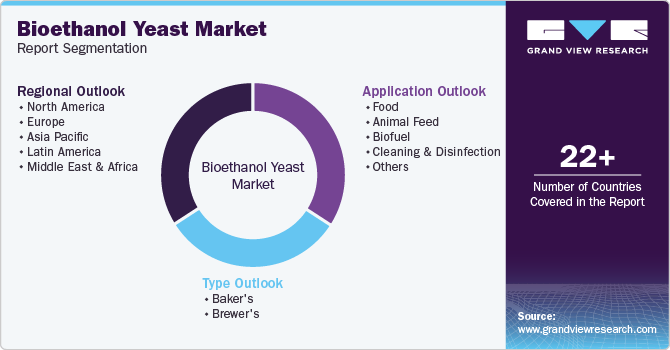
This report forecasts revenue growth at global, regional, and country levels and analyzes the latest industry trends in each sub-segment from 2021 to 2033. For this study, Grand View Research has segmented the global bioethanol yeast market report based on type, application, and region:
 To learn more about this report, Download Free Sample Report
 -
Type Outlook (Volume, Kilotons; Revenue, USD Million, 2021 - 2033)
-
Baker's
-
Brewer's
-
-
Application Outlook (Volume, Kilotons; Revenue, USD Million, 2021 - 2033)
-
Food
-
Animal Feed
-
Biofuel
-
Cleaning & Disinfection
-
Others
-
-
Regional Outlook (Revenue, USD Billion, 2021 - 2033)
-
North America
-
U.S.
-
Canada
-
Mexico
-
-
Europe
-
UK
-
Germany
-
France
-
Italy
-
-
Asia Pacific
-
China
-
Japan
-
India
-
-
Latin America
-
Brazil
-
-
Middle East and Africa
-
Saudi Arabia
-
-
Research Methodology
The bioethanol yeast market figures in this report are based on a proven research process that combines executive interviews with secondary research from proprietary databases, company filings, and recognized regulatory and institutional sources. Market size is built through value-chain sizing-reconciling supply-side and demand-side estimates-and triangulated with bottom-up and top-down approaches. Every estimate passes multiple levels of expert validation before publication, with each bioethanol yeast segment quantified using the revenue-capture definitions in the table below.
Segment Definition
Segment – Type
Revenue capture definition
Baker’s
Revenue generated from the Baker’s segment includes sales of yeast strains utilized in bioethanol production processes due to their efficient sugar fermentation capabilities, high ethanol yield potential, and adaptability to industrial-scale fermentation environments. The segment covers yeast products supplied to ethanol manufacturers for converting carbohydrate-rich feedstocks into bioethanol.
Brewer’s
Revenue generated from the Brewer’s segment comprises sales of brewer’s yeast strains employed in bioethanol production for their fermentation efficiency, robustness, and ability to perform under varying process conditions. This segment includes yeast products used across commercial bioethanol facilities to support ethanol output and process optimization.
Segment –Application
Revenue capture definition
Food
Revenue generated from the food segment includes sales of bioethanol yeast used in food processing applications, including baking, fermentation-based food production, and ingredient manufacturing. The segment covers yeast products supplied to food manufacturers requiring reliable fermentation performance and process consistency.
Animal Feed
Revenue derived from the animal feed segment comprises sales of bioethanol yeast utilized as a nutritional ingredient or feed additive in livestock, poultry, aquaculture, and pet nutrition applications. The segment includes yeast products valued for their protein content, digestibility benefits, and contribution to animal health and performance.
Biofuel
Revenue generated from the biofuel segment includes sales of bioethanol yeast used in the production of fuel ethanol from feedstocks such as corn, sugarcane, wheat, and other biomass sources. The segment covers yeast products designed to enhance fermentation efficiency, ethanol yield, and overall production productivity.
Cleaning & Disinfection
Revenue derived from the cleaning & disinfection segment is sales of bioethanol yeast used in the production of ethanol intended for cleaning agents, disinfectants, sanitizers, and related formulations. The segment includes yeast products supporting industrial fermentation processes for ethanol-based hygiene and sanitation applications.
Other Application
Revenue generated from the others segment includes sales of bioethanol yeast used across various industrial applications not covered under the primary categories, such as pharmaceuticals, chemicals, biotechnology, and research activities. The segment encompasses niche and emerging end-use areas utilizing yeast-driven fermentation processes.
Estimation Model
Layer Name
Key Question
Description
Bioethanol Yeast Production Layer
What forms is the supply base?
Identify the global production capacity of bioethanol yeast based on the availability of raw materials such as molasses, sugarcane, corn, wheat, and other fermentation feedstocks. The analysis includes yeast cultivation capabilities, fermentation infrastructure, manufacturing technologies, production efficiency, quality standards, and regional production facilities. This layer establishes the foundational supply base available to serve food, animal feed, biofuel, cleaning & disinfection, and other industrial applications worldwide.
Application Adoption Layer
Where is bioethanol yeast utilized?
Estimate the proportion of bioethanol yeast consumed across food processing, animal nutrition, biofuel production, cleaning & disinfection formulations, and other end-use industries. The assessment considers industry demand patterns, fermentation requirements, sustainability initiatives, industrial processing needs, regulatory compliance, and regional consumption trends to determine application-level adoption.
Consumption Intensity Layer
How much bioethanol yeast is used?
Analyze application-specific usage volumes, production output levels, fermentation intensity, feedstock processing requirements, blending practices, operational efficiencies, and end-user demand patterns to determine annual bioethanol yeast consumption across major application sectors. The evaluation also considers regional production activities, industrial utilization rates, and evolving consumption dynamics.
Revenue Layer
How is market revenue generated?
Market revenue is quantified through the sale of baker’s yeast and brewer’s yeast utilized across food, animal feed, biofuel, cleaning & disinfection, and other applications. Revenue generation is assessed based on product pricing, sales volumes, value-added yeast formulations, distribution networks, and demand from industrial processors, biofuel producers, food manufacturers, feed producers, and other commercial end users globally.
Delivered Customizations
This report has been delivered with the following In-depth customizations
Client Request
Customization Delivered
Value Adds
Cross-Segmentation Analysis
An integrated analysis was performed across yeast type and application segments to assess utilization patterns of baker's and brewer's yeast in biofuel production, feed formulations, food processing, and industrial cleaning applications. The study also examined shifts in end-use preferences and application-specific performance requirements influencing product adoption.
Facilitate identification of high-potential application areas and emerging demand pockets, enabling targeted product development and stronger alignment of offerings with end-user requirements.
Competitive Benchmarking
A comparative evaluation of leading bioethanol yeast manufacturers was conducted based on fermentation expertise, product portfolio diversity, production capabilities, geographic footprint, strain development capabilities, distribution networks, and strategic initiatives. The assessment also reviewed investments in yield enhancement, process optimization, and sustainable bioethanol production technologies.
Support benchmarking against industry leaders, identification of competitive differentiation opportunities, and evaluation of strategic positioning across key application markets.
Opportunity Assessment
Emerging growth avenues were evaluated across advanced bioethanol production, second-generation biofuels, sustainable aviation fuel value chains, animal nutrition applications, and industrial fermentation processes. The assessment also examined opportunities arising from renewable fuel mandates, decarbonization initiatives, and increasing adoption of sustainable fuel alternatives.
Highlight future growth opportunities and investment priorities, supporting long-term innovation planning, portfolio diversification, and strategic market expansion initiatives.
Frequently Asked Questions About This Report
Some key players operating in the bioethanol yeast market include Novozymes, Associated British Foods plc, DSM, AB Mauri, and Cargill, Incorporated
The increase in the consumption of bakery products and alcoholic beverages are the major driving factors for the market growth of bioethanol yeast.
The baker's segment dominated the market in 2025, accounting for 65.3% of the total market revenue, driven by its extensive use across bakery and food processing applications.
The brewer's segment is projected to witness the fastest growth during the forecast period, registering a CAGR of 14.4%,supported by rising demand from brewing, animal feed, and nutritional supplement applications.
The biofuel segment held the largest market share in 2025, capturing 64.7% of total revenue, owing to increasing adoption of renewable energy sources and bioethanol production.
The cleaning & disinfection segment is anticipated to be the fastest-growing application, expanding at a CAGR of 17.1%during the forecast period, driven by heightened hygiene awareness and growing industrial sanitation requirements.
The global bioethanol yeast market size was estimated at USD 21.9 billion in 2025 and is expected to reach USD 24.6 billion in 2026.
The global bioethanol yeast market is expected to grow at a compound annual growth rate of 12.8% from 2026 to 2033 to reach USD 57.1 billion by 2033.
North America dominated the bioethanol yeast market with a share of 52.3% in 2025. This is attributable to rising demand for end-use industries, growing consumer interest in healthy, gourmet, and organic products.
About the Author(s)
Catalysts & Enzymes Research Team
Specialty & Chemicals · Catalysts & EnzymesThis report was authored by the catalysts & enzymes research team at Grand View Research - comprising two research analysts, one senior research analyst, and one industry expert - with specialized expertise in the catalysts & enzymes segment of the specialty & chemicals industry. All findings are based on proprietary specialty & chemicals databases, executive interviews, and regulatory analysis, subject to internal peer review prior to publication.
Last Updated:
Speak to Analyst

Customize this report to your needs - add regions, segments, or data points, with 20% free customization.
Or view our licence options:


ISO 9001:2015 & 27001:2022 Certified
We are GDPR and CCPA compliant! Your transaction & personal information is safe and secure. For more details, please read our privacy policy.


