
- Home
- »
- Renewable Energy
- »
-
Biogas Upgrading Market Size And Share Report, 2033GVR Report cover

Biogas Upgrading Market (2026 - 2033)
Size, Share & Trends Analysis Report By Technology (Water Scrubbing, Organic Solvent Scrubbing, Chemical Scrubbing, PSA, Membrane Separation), By Feedstock, By Capacity, By End User, By Region, And Segment Forecasts
Market Size, 2025
$972.2MMarket Estimate, 2026
$1,040.2MMarket Forecast, 2033
$2,051.5MCAGR, 2026–2033
10.2%Biogas Upgrading Market Summary
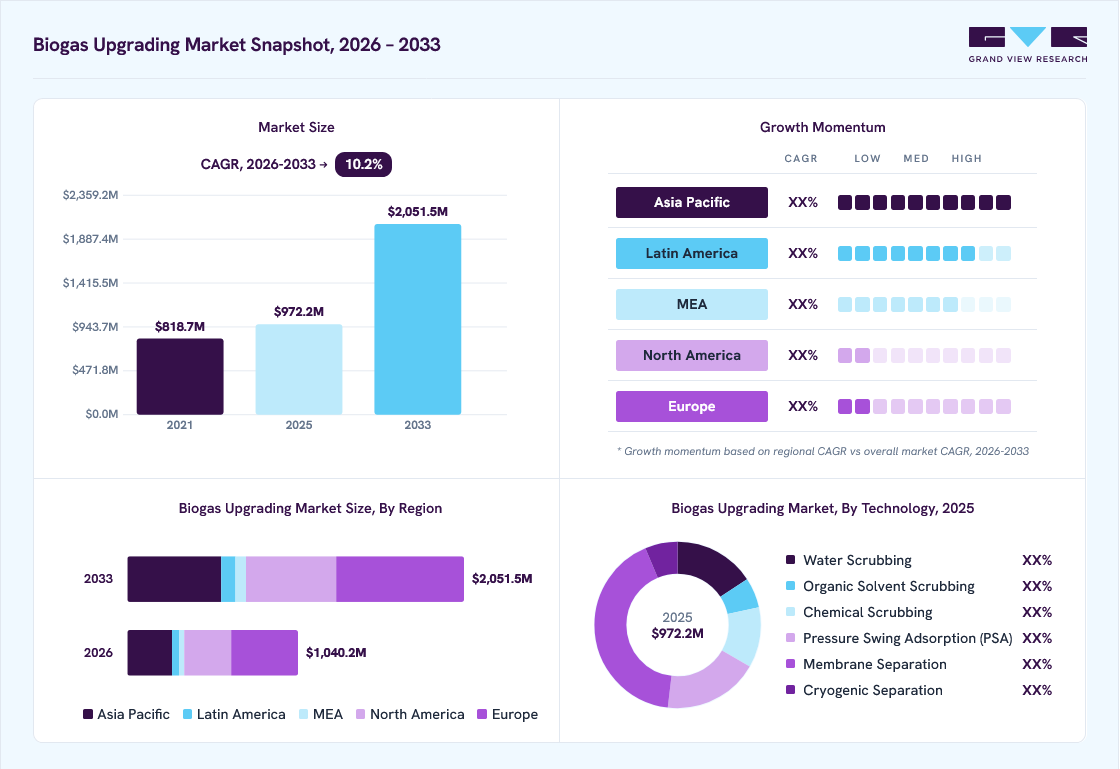
The biogas upgrading market size was valued at USD 972.2 million in 2025 and is projected to grow from USD 1,040.2 million in 2026 to USD 2,051.5 million by 2033, at a CAGR of 10.2% from 2026 to 2033. Europe dominated the market, accounting for a revenue share of 39.3% in 2025. The market is supported by increasing demand for renewable natural gas, favorable government policies, and growing investments in renewable energy infrastructure. Rising decarbonization efforts and the adoption of biomethane across transportation, industrial, and power generation applications further drive demand for biogas upgrading technologies.
 Source: Grand View Research, IR Documents, Primary Interviews, Paid DatabasesTo learn more about this report,
 Download Free Sample Report
Key Market Trends & Insights
- By technology: membrane separation held the largest revenue share of 41.7% in 2025.
- By feedstock: agricultural waste and crop residues held the largest revenue share of 21.6% in 2025.
- By capacity: 250-1,000 Nm³/h held the largest revenue share of 37.0% in 2025.
- By end user: Energy & biomethane producers held the largest revenue share of 27.5% in 2025.
Regional Highlights
- Largest regional market: Europe (39.3% revenue share, 2025)
- Fastest-growing regional market: Asia Pacific (highest CAGR, 2026-2033)
Market Size & Forecast
- Market size in 2025: USD 972.2 Million
- Estimated market size in 2026: USD 1,040.2 Million
- Projected market size by 2033: USD 2,051.5 Million
- CAGR (2026-2033): 10.2%
GVR research-powered AIAsk Prism AI about the biogas upgrading marketGet cited answers from GVR research on market growth, segments, regulations and forecasts.Start with✓ Source-linked answers ✓ Market-specific context ✓ Traceable figuresExplore Prism AI ↗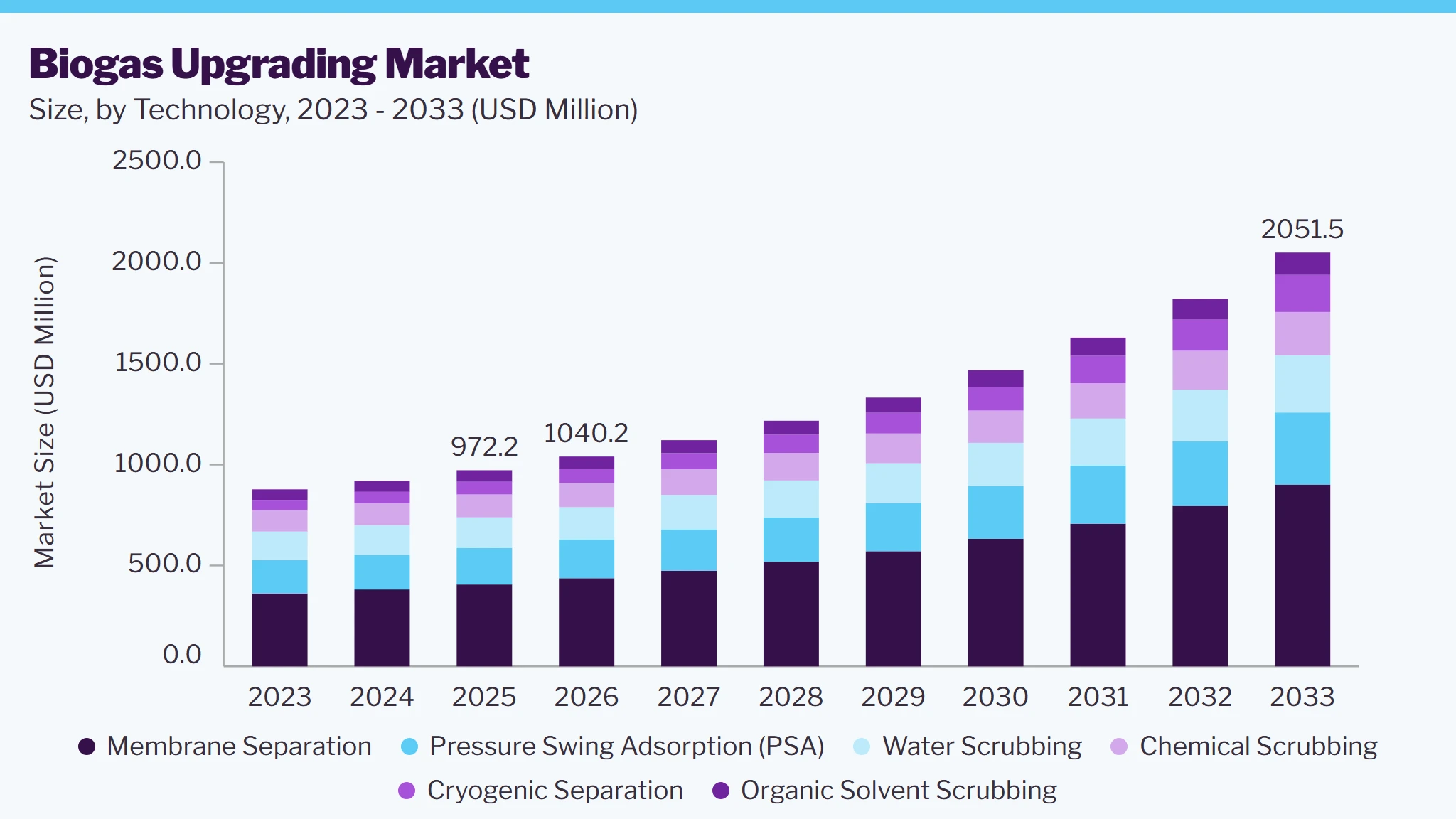 To learn more about this report, Download Free Sample Report
Market Dynamics
The biogas upgrading market is shaped by technological advancements, feedstock availability, and the economics of biomethane production. Membrane separation, pressure swing adsorption, and water scrubbing technologies compete on methane recovery rates, energy consumption, and operating costs. However, high installation costs, variable raw biogas composition, and limited gas-grid connectivity can affect project feasibility. Opportunities are emerging from landfill gas recovery, agricultural waste utilization, and the development of decentralized biomethane production facilities.
The biogas upgrading market is driven by the transition toward low-carbon energy systems, efforts to reduce greenhouse gas emissions, and the need to diversify energy supplies. Biogas upgrading technologies convert raw biogas into biomethane, enabling its use as a substitute for fossil-based natural gas in industrial, transportation, and energy applications. Supportive government policies and decarbonization targets are further encouraging investments in biomethane production and upgrading infrastructure.
In April 2026, Australia’s Delorean Corporation reached a final investment decision for its Horsley Park Bioenergy Project, supported by USD 21.1 million in government grants. The facility is designed to process 120,000 tonnes of organic waste annually and upgrade the resulting biogas into biomethane for Brickworks’ manufacturing operations, demonstrating growing investment in renewable gas solutions for industrial decarbonization.
The biogas upgrading market is restrained by the substantial initial investment required for upgrading equipment, gas pretreatment systems, compression units, and biomethane grid-connection infrastructure. Technologies such as pressure swing adsorption (PSA) and membrane separation involve significant equipment and installation expenses, particularly for small-scale projects. Additional costs associated with maintenance, electricity consumption, and gas-quality compliance can affect project economics and extend investment payback periods. These financial barriers may limit adoption among small biogas producers and operators with constrained funding.
The biogas upgrading market presents opportunities for modular membrane and pressure swing adsorption (PSA) systems installed near farms, agricultural clusters, and municipal waste facilities. These systems can convert locally generated biogas into biomethane for compressed renewable gas or liquefied biomethane applications, reducing reliance on centralized processing infrastructure. In October 2025, EnviTec Biogas secured a contract with Dutch energy provider Byont to build a biogas upgrading plant in Belgium, designed to inject 735 Nm³/h of biomethane into the gas grid and produce 24 tonnes of bio-LCO₂ daily, highlighting demand for scalable upgrading technologies.
Analyst Perspective
The biogas upgrading market is shifting from conventional gas purification toward integrated biomethane production systems that maximize methane recovery, improve energy efficiency, and enable the utilization of by-products such as biogenic CO₂. Membrane separation is gaining importance due to its modular design and suitability for decentralized installations, while growing interest in carbon capture and CO₂ liquefaction is creating additional revenue opportunities. The market is also moving toward larger-scale projects supported by long-term biomethane offtake agreements and integration with existing natural gas infrastructure. Going forward, competitive advantage will increasingly depend on lifecycle operating costs, methane recovery rates, system scalability, and the ability to meet stringent gas-quality requirements. Consequently, suppliers offering integrated, digitally monitored, and cost-efficient upgrading solutions are likely to be better positioned as the market matures.
Technology Insights
The membrane separation segment dominated the market with a revenue share of 41.7% in 2025. This growth is supported by the technology’s high energy efficiency, compact system design, and modular scalability, making it suitable for both small- and large-scale biogas upgrading facilities. Membrane systems offer continuous operation, relatively low maintenance requirements, and effective carbon dioxide removal to produce high-quality biomethane. Growing demand for cost-efficient upgrading solutions and the expansion of renewable natural gas projects are further supporting segment adoption.
The cryogenic separation segment is expected to grow at the fastest CAGR of 14.7% for the forecast period. This growth is driven by increasing demand for high-purity biomethane and the potential to recover valuable by-products, including liquefied biogenic carbon dioxide. Cryogenic separation uses low-temperature processing to separate gas components and can support the production of bio-LNG for transportation and industrial applications. Growing interest in renewable gas commercialization and integrated upgrading systems is expected to create further opportunities for this technology.
Feedstock Insights
Agricultural waste and crop residues held the largest revenue share of 21.6% in 2025, due to the abundant availability of agricultural by-products and their suitability for anaerobic digestion to generate biogas. Increasing efforts to convert crop residues into renewable energy are supporting the deployment of biogas production and upgrading facilities. Government initiatives promoting agricultural waste utilization and biomethane production are further encouraging investments in this segment. Additionally, growing interest in converting farm residues into pipeline-quality biomethane and compressed biogas is supporting demand for upgrading systems.
The municipal solid waste and organic food waste segment is anticipated to grow at the fastest CAGR of 11.6% from 2026 to 2033. This is due to increasing volumes of biodegradable waste generated by urban households, commercial establishments, and food processing facilities. Growing emphasis on landfill diversion, methane emission reduction, and sustainable waste management is encouraging investments in anaerobic digestion and biogas upgrading infrastructure. Additionally, government initiatives promoting waste-to-energy projects and biomethane production are creating opportunities for upgrading technology providers.
Capacity Insights
The 250-1,000 Nm³/h segment dominated the market with a revenue share of 37.0% in 2025. This dominance is attributed to the suitability of medium-capacity upgrading systems for agricultural digesters, municipal waste treatment facilities, and industrial biogas projects. These systems offer a balance between processing capacity, capital investment, and operational efficiency, making them commercially viable for a wide range of applications. Growing deployment of decentralized biomethane plants and medium-scale renewable gas projects is further supporting demand in this segment.
The above 1,000 Nm³/h segment is anticipated to register the fastest CAGR of 10.4% from 2026 to 2033. This growth is driven by increasing investments in large-scale biomethane production facilities, landfill gas recovery projects, and centralized organic waste processing plants. High-capacity upgrading systems offer economies of scale by processing larger volumes of raw biogas, helping reduce upgrading costs per unit of biomethane produced. Additionally, expanding demand for grid-injected renewable natural gas and industrial biomethane supply is encouraging the deployment of large-scale upgrading infrastructure.
End User Insights
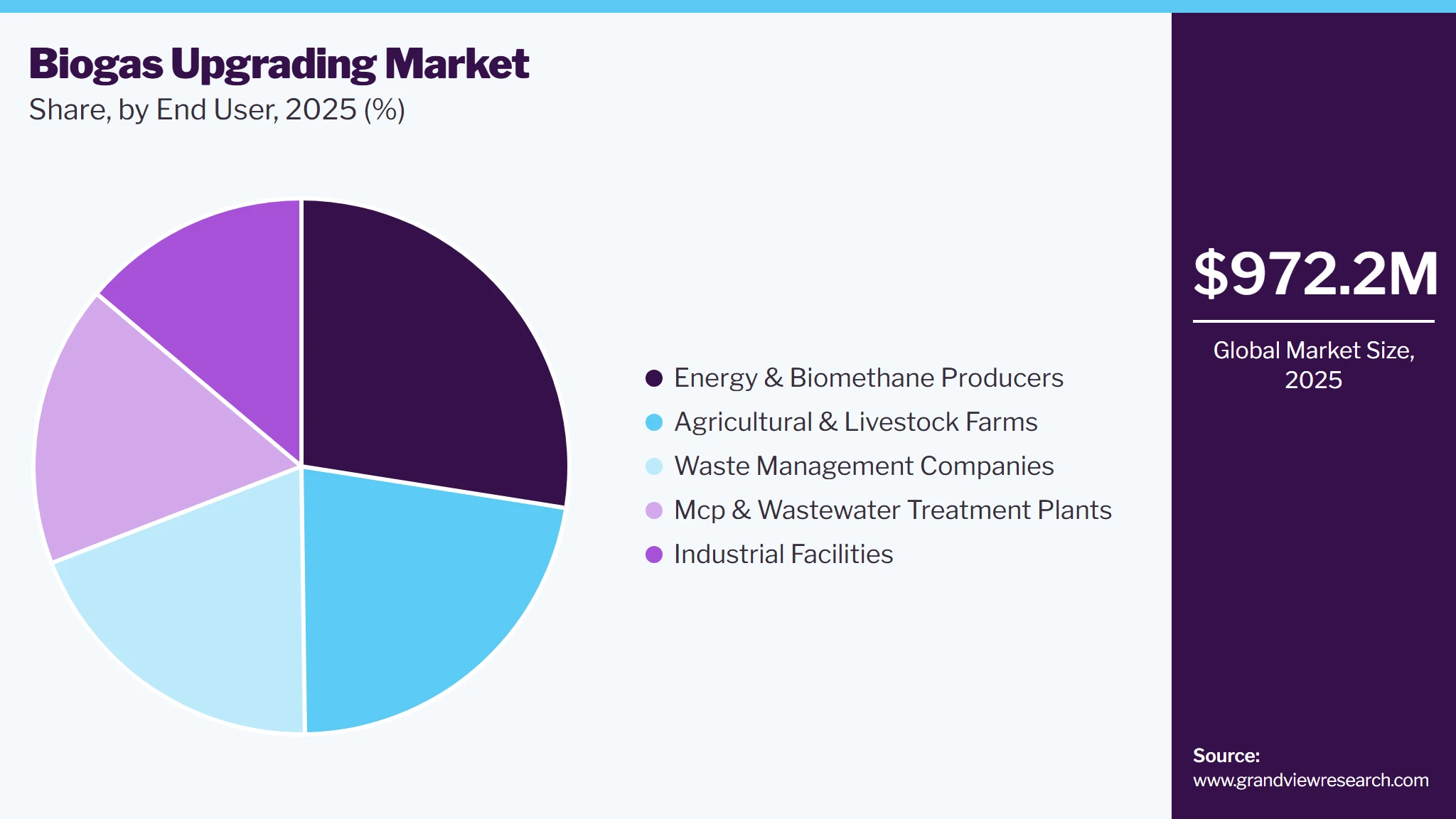
The energy & biomethane producers dominated the market with a revenue share of 27.5% in 2025. This is due to increasing investments in biomethane production facilities to supply renewable gas for grid injection, transportation, and industrial applications. These producers require efficient upgrading systems to meet gas quality standards and ensure reliable biomethane output. Growing demand for renewable natural gas, supportive decarbonization policies, and long-term gas offtake agreements are further encouraging investments in biogas upgrading technologies.
 To learn more about this report, Download Free Sample Report
The waste management companies segment is expected to register the fastest CAGR of 10.7% from 2026 to 2033. This is supported by increasing investments in landfill gas recovery, organic waste processing, and waste-to-energy projects. Growing regulatory pressure to reduce methane emissions and divert biodegradable waste from landfills is encouraging waste management operators to adopt biogas upgrading systems. Additionally, converting landfill gas and organic waste-derived biogas into biomethane creates opportunities to generate revenue from renewable gas sales and improve the economic viability of waste management operations.
Regional Insights
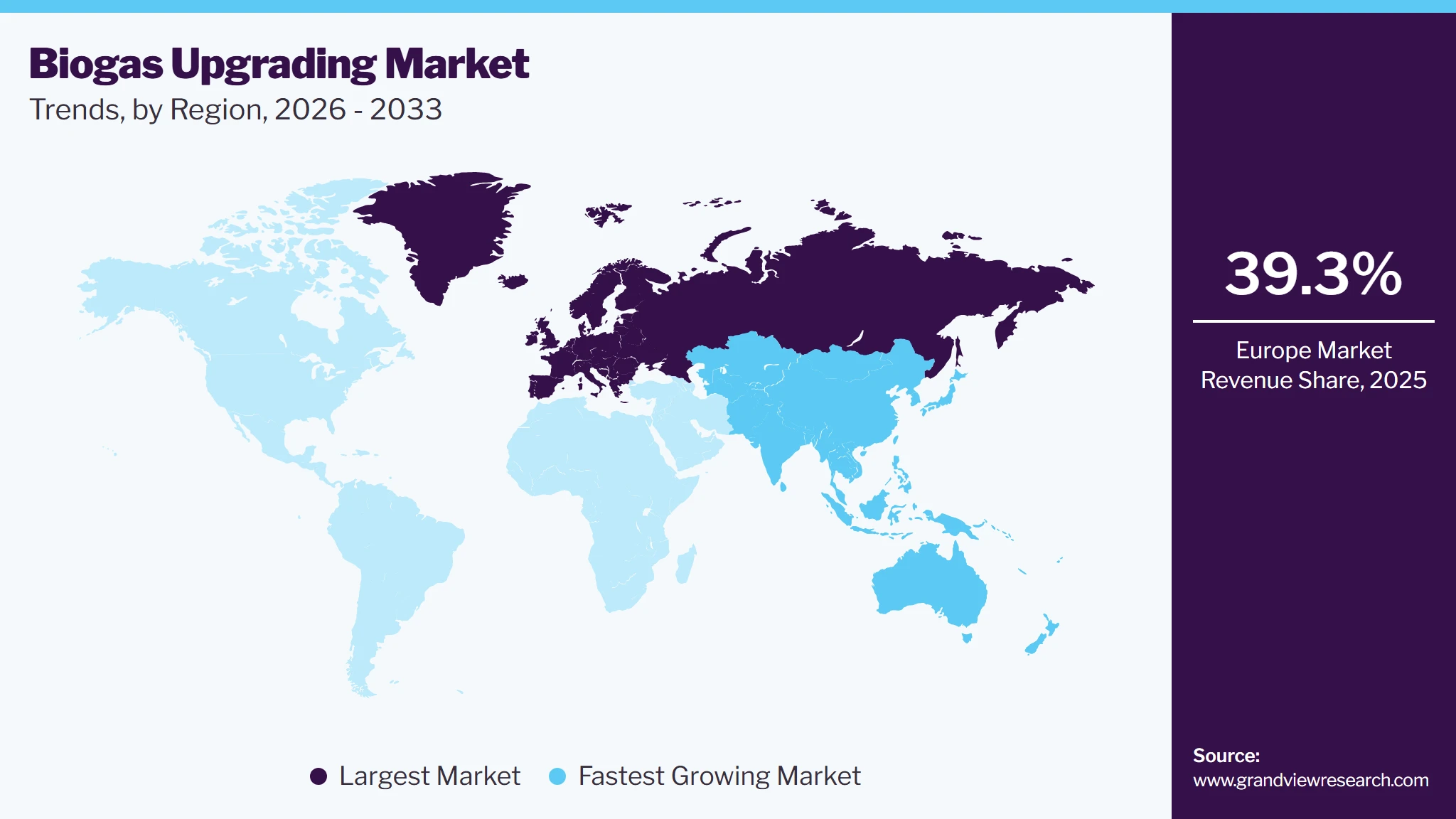
Europe held the largest revenue share of 39.3% in 2025. This is supported by decarbonization policies, energy security priorities, and established gas-grid infrastructure. According to the European Biogas Association, the region had 1,620 biomethane-producing facilities at the end of 2024, with at least 86% connected to the gas grid, while installed capacity reached approximately 7 billion cubic metres annually by early 2025. Germany, France, Italy, Denmark, and the Netherlands are important markets, while emerging producers such as Poland and Spain offer additional growth opportunities. Future demand is expected to benefit from the upgrading of existing biogas plants, new biomethane projects, and the recovery of biogenic CO₂, although regulatory uncertainty and grid-connection costs remain challenges.
 To learn more about this report, Download Free Sample Report
Asia Pacific Biogas Upgrading Market Trends
The Asia Pacific biogas upgrading market is anticipated to register the fastest CAGR of 11.2% for the forecast period. This is supported by abundant agricultural residues, livestock waste, municipal organic waste, and rising demand for alternative gaseous fuels. India and China present significant opportunities as governments promote waste-to-energy projects, compressed biogas production, and the utilization of agricultural waste. India’s SATAT initiative and Compressed Biogas (CBG) blending requirements are encouraging investment in upgrading systems, while Southeast Asian countries can benefit from agricultural residues and palm oil mill effluent. Market growth will depend on project financing, feedstock collection, gas distribution infrastructure, and the commercial viability of biomethane production.
China’s biogas upgrading demand is closely linked to agricultural waste utilization, rural energy development, and the expansion of organic waste treatment infrastructure. The country’s substantial volumes of crop residues, livestock manure, municipal organic waste, and industrial wastewater provide opportunities for biogas production and subsequent upgrading into biomethane. Government efforts to improve waste management, reduce methane emissions, and diversify renewable energy sources are supporting project development.
Middle East & Africa Biogas Upgrading Market Trends
The Middle East & Africa biogas upgrading market remains at an emerging stage, with opportunities linked to municipal solid waste management, wastewater treatment, agricultural residues, and landfill gas recovery. In the Middle East, countries such as Saudi Arabia and the UAE could explore biomethane production as part of broader waste-management and circular-economy initiatives, although natural gas availability and competing renewable energy investments may influence project economics. Across Africa, upgrading systems could support decentralized energy supply and convert organic waste into usable fuel for local industries and transport. Market development will depend on financing availability, project scale, technical expertise, and the establishment of reliable biomethane offtake arrangements.
North America Biogas Upgrading Market Trends
The North America region’s biogas upgrading market is driven primarily by RNG development in the U.S., supported by clean-fuel incentives, landfill gas recovery, agricultural waste utilization, and demand from transport fleets. The International Energy Agency reported that U.S. biomethane production reached approximately 136 petajoules, with transport-related RNG demand growing by an average of 28% annually over the preceding five years. The market is increasingly shifting toward pipeline-quality RNG rather than conventional biogas-to-electricity projects, creating opportunities for membrane separation, pressure swing adsorption, and integrated gas-cleaning systems. Canada also offers potential through agricultural digesters, municipal waste facilities, and renewable gas procurement by utilities.
The U.S. Biogas Upgrading Market is driven by growing investments in renewable natural gas (RNG) production, landfill gas recovery, and agricultural waste-to-energy projects. Federal and state-level incentives supporting low-carbon fuels and methane emission reduction are encouraging the deployment of upgrading systems. Membrane separation and pressure swing adsorption technologies are being adopted to convert raw biogas into pipeline-quality biomethane for transportation, industrial use, and natural gas networks.
Latin America Biogas Upgrading Market Trends
The Latin American biogas upgrading market offers growth opportunities through the utilization of agricultural residues, livestock waste, landfill gas, and organic waste from food-processing industries. Brazil is a key market due to its established bioenergy sector, substantial agricultural feedstock base, and policies encouraging biomethane production and natural gas decarbonization. In 2026, Brazil’s National Agency of Petroleum, Natural Gas and Biofuels (ANP) approved updated biomethane quality and monitoring regulations, strengthening the regulatory framework for commercial applications and gas-grid integration. However, limited pipeline connectivity in some regions creates opportunities for decentralized upgrading systems combined with compressed or liquefied biomethane distribution.
Key Biogas Upgrading Company Insights
Some of the key players operating in the global biogas upgrading market include Bright Renewables and Wärtsilä, among others.
-
Bright Renewables is a Netherlands-based provider of biogas upgrading technologies, specializing in three-stage membrane separation systems that convert raw biogas into pipeline-quality biomethane. Its PurePac product range supports different plant capacities, while complementary solutions for CO₂ liquefaction, Bio-CNG, and Bio-LNG enable customers to recover additional value from biogas processing. The company also offers engineering, installation, and maintenance services, along with a biogas-upgrading-as-a-service model. Its global project portfolio and integrated technology offering position it to benefit from growing demand for efficient biomethane production and resource recovery.
-
Wärtsilä participates in the biogas upgrading market through its Gas Solutions business and Puregas technology portfolio, which originated with its 2017 acquisition of Puregas Solutions. Its Puregas CA system uses amine-based absorption to separate CO₂ from raw biogas, producing high-purity biomethane suitable for gas-grid injection or further processing into bio-LNG. The company reports methane recovery above 99.9% for the upgrading process. In April 2025, Wärtsilä introduced Puregas BC, a CO₂ purification and liquefaction solution that enables plants to produce an additional commercial product instead of releasing the separated CO₂. This integrated approach strengthens its proposition for biomethane producers seeking higher resource utilization and additional revenue streams.
Key Biogas Upgrading Companies
The following key companies have been profiled for this study on the biogas upgrading market.
-
Air Liquide Engineering & Technologies
-
Bright Renewables
-
CarboTech
-
DMT International
-
EnviTec Biogas AG
-
Greenlane Renewables
-
Malmberg
-
PRODEVAL
-
Waga Energy
-
Wärtsilä
Competitive Benchmarking
Category
Operating Strategies
Competitive Edge
Weakness
Established Players (Air Liquide Engineering & Technologies, CarboTech, DMT International, EnviTec Biogas AG, Greenlane Renewables, Malmberg, PRODEVAL, Wärtsilä)
- Leverage established customer relationships, engineering expertise, and international sales and service networks.
- Offer integrated solutions combining pretreatment, upgrading, compression, liquefaction, and gas conditioning.
- Pursue large-scale projects, long-term service contracts, and partnerships with utilities, industrial customers, and biomethane producers.
- Improve existing technology platforms to enhance methane recovery and reduce lifecycle operating costs.
- Extensive industrial engineering experience and established commercial references.
- Ability to execute complex projects and serve multiple feedstock types and plant capacities.
- Broad technology portfolios and established service capabilities.
- Greater ability to support customers throughout project development, commissioning, and long-term operation.
- Potentially higher project costs due to complex engineering structures and extensive service networks.
- Large organizations may have slower decision-making and product customization cycles.
- Broad portfolios can create less specialization in niche applications compared with technology-focused competitors.
- Exposure to competition from lower-cost modular suppliers and specialized technology developers.
Emerging Players (Bright Renewables, Waga Energy)
- Focus on differentiated technologies, modular systems, and specialized applications such as landfill gas upgrading or CO₂ recovery.
- Expand through strategic partnerships, regional distribution networks, and project-specific collaborations.
- Introduce service-based or asset-owning business models to reduce upfront costs for customers.
- Target underserved markets and applications where established solutions may be expensive or insufficiently flexible.
- Greater specialization and ability to tailor solutions to specific feedstocks or project requirements.
- Potentially faster innovation and product development cycles.
- Flexible business models, including upgrading-as-a-service and integrated biomethane production.
- Opportunities to differentiate through methane recovery, energy efficiency, CO₂ valorization, and modular deployment.
- Comparatively smaller financial and operational resources than large industrial groups.
- Lower brand recognition or fewer references in certain international markets.
- Greater exposure to project delays, financing constraints, and fluctuations in biomethane investment.
- Dependence on continued technology development, strategic partnerships, and expansion of service capabilities.
Recent Developments
-
In May 2026, Bright Renewables signed a project with Bioo to develop a biogas upgrading and CO₂ liquefaction plant in Triunfo, Brazil, using membrane separation technology. The facility is designed to process 2,500 Nm³/h of biogas into biomethane and produce up to 2,000 kg/h of liquid biogenic CO₂, targeting daily biomethane production of 30,000 cubic meters. The project, supported by financing from Brazil’s BNDES through the Climate Fund, highlights growing demand for integrated upgrading systems that improve biomethane production, reduce emissions, and enable additional revenue from CO₂ recovery.
Biogas Upgrading Market Report Scope
Report Attribute
Details
Market Definition
The biogas upgrading market represents the revenue generated from the sales of technologies installed to purify raw biogas into renewable natural gas (Biomethane).
Market size in 2025
USD 972.2 million
Estimated market size in 2026
USD 1,040.2 million
Projected market size by 2033
USD 2,051.5 million
Growth Rate
CAGR of 10.2% from 2026 to 2033
Base year for estimation
2025
Historical data
2021 - 2024
Forecast period
2026 - 2033
Quantitative Units
Revenue in USD Million and CAGR from 2026 to 2033
Report coverage
Revenue forecast, competitive landscape, growth factors, and trends
Segments covered
Technology, feedstock, capacity, end user, region
Regional scope
North America, Europe, Asia Pacific, Latin America, Middle East & Africa
Country scope
U.S., Canada, Mexico, Germany, UK, France, Italy, China, India, Japan, South Korea, Brazil, Argentina, UAE, Saudi Arabia, South Africa
Key companies profiled
Air Liquide Engineering & Technologies, Bright Renewables, CarboTech, DMT International, EnviTec Biogas AG, Greenlane Renewables, Malmberg, PRODEVAL, Waga Energy, Wärtsilä
Customization scope
Free report customization (equivalent up to 8 analysts working days) with purchase. Addition or alteration to country, regional & segment scope.
Pricing and purchase options
Avail customized purchase options to meet your exact research needs. Explore purchase options
Global Biogas Upgrading Market Report Segmentation
This report forecasts revenue growth at global, regional, and country levels and provides an analysis of the latest industry trends in each of the sub-segments from 2021 to 2033. For the purpose of this study, Grand View Research has segmented the global biogas upgrading market report on the basis of technology, feedstock, capacity, end user, and region.
-
Technology Outlook (Revenue, USD Million; 2021 - 2033)
-
Water Scrubbing
-
Organic Solvent Scrubbing
-
Chemical Scrubbing
-
Pressure Swing Adsorption (PSA)
-
Membrane Separation
-
Cryogenic Separation
-
-
Feedstock Outlook (Revenue, USD Million; 2021 - 2033)
-
Agricultural waste and crop residues
-
Animal manure
-
Municipal solid waste and organic food waste
-
Industrial organic waste
-
Sewage sludge and wastewater
-
Landfill gas
-
-
Capacity Outlook (Revenue, USD Million; 2021 - 2033)
-
Less than 250 Nm³/h
-
250-1,000 Nm³/h
-
Above 1,000 Nm³/h
-
-
End User Outlook (Revenue, USD Million; 2021 - 2033)
-
Municipalities & Wastewater Treatment Plants
-
Agricultural & Livestock Farms
-
Waste Management Companies
-
Industrial Facilities
-
Energy & Biomethane Producers
-
-
Regional Outlook (Revenue, USD Million; 2021 - 2033)
-
North America
-
U.S.
-
Canada
-
Mexico
-
-
Europe
-
Germany
-
UK
-
France
-
Italy
-
-
Asia Pacific
-
China
-
India
-
Japan
-
South Korea
-
-
Latin America
-
Brazil
-
Argentina
-
-
Middle East & Africa
-
Saudi Arabia
-
UAE
-
South Africa
-
-
Research Methodology
The biogas upgrading market figures in this report are based on a proven research process that combines executive interviews with secondary research from proprietary databases, company filings, and recognized regulatory and institutional sources. Market size is built through value-chain sizing-reconciling supply-side and demand-side estimates-and triangulated with bottom-up and top-down approaches. Every estimate passes multiple levels of expert validation before publication, with each biogas upgrading segment quantified using the revenue-capture definitions in the table below.
Segment Definition
Segment - Technology
Revenue capture definition
Water Scrubbing
Covers upgrading technologies that use water to absorb carbon dioxide and selected impurities from raw biogas, increasing methane concentration.
Organic Solvent Scrubbing
Includes systems that use organic solvents to selectively absorb carbon dioxide and separate it from methane.
Chemical Scrubbing
Encompasses equipment that uses reactive chemical solutions, such as amines, to remove carbon dioxide and other acidic contaminants from biogas.
Pressure Swing Adsorption (PSA)
Comprises gas separation units that selectively adsorb carbon dioxide and other impurities under pressure to produce methane-rich gas.
Membrane Separation
Includes membrane-based technologies that separate carbon dioxide, water vapor, and other gas components from methane through selective permeation.
Cryogenic Separation
Covers low-temperature processing technologies that separate methane from other biogas components based on differences in their condensation and boiling characteristics.
Segment - Feedstock
Revenue capture definition
Agricultural waste and crop residues
Covers upgrading systems designed for biogas produced from crop residues, agricultural by-products, and other farm-generated organic materials.
Animal manure
Includes equipment used to process biogas generated through the anaerobic digestion of livestock manure from dairy farms, poultry operations, and other animal farming activities.
Municipal solid waste and organic food waste
Encompasses systems treating biogas derived from municipal organic waste, food scraps, and other biodegradable waste streams.
Industrial organic waste
Covers upgrading installations processing biogas generated from organic residues and wastewater from food processing, beverage manufacturing, pulp and paper, and other industries.
Sewage sludge and wastewater
Includes systems installed at sewage and wastewater treatment facilities to purify biogas recovered through anaerobic sludge digestion.
Landfill gas
Encompasses specialized technologies that remove carbon dioxide, moisture, nitrogen where applicable, and trace contaminants from landfill gas to produce biomethane.
Segment - Capacity
Revenue capture definition
Less than 250 Nm³/h
Includes small-scale upgrading systems processing less than 250 Nm³/h of raw biogas, typically suited to farm-based digesters and decentralized biomethane facilities.
250-1,000 Nm³/h
Covers medium-capacity installations processing 250-1,000 Nm³/h, generally used in agricultural, municipal, and industrial biomethane projects.
Above 1,000 Nm³/h
Comprises high-capacity systems processing more than 1,000 Nm³/h of raw biogas, primarily intended for large-scale waste processing, landfill gas recovery, and commercial biomethane production.
Segment - End User
Revenue capture definition
Municipalities & Wastewater Treatment Plants
Represents demand from municipal authorities and wastewater utilities seeking to purify biogas generated through sewage treatment and organic waste processing.
Agricultural & Livestock Farms
Covers demand from agricultural businesses, livestock operators, and farm-based digesters converting manure- and crop-derived biogas into biomethane.
Waste Management Companies
Encompasses requirements from landfill operators and waste processing companies recovering methane from landfills and organic waste treatment facilities.
Industrial Facilities
Includes industrial operators upgrading biogas derived from manufacturing residues, organic effluents, and wastewater for on-site fuel consumption or external supply.
Energy & Biomethane Producers
Represents demand from renewable gas developers, biomethane producers, and energy companies supplying purified gas for grid injection, compressed biomethane, liquefied biomethane, and other commercial energy applications.
Estimation Model
Layer Name
Key Question
Description
Demand Layer
Which factors generate demand for biogas upgrading systems?
Assess demand driven by increasing biomethane production, renewable natural gas adoption, decarbonization targets, renewable gas policies, organic waste utilization, and demand for alternatives to conventional natural gas. Evaluate the development of new anaerobic digestion facilities, landfill gas recovery projects, and the upgrading of existing biogas plants.
Cooling Technology Layer
Which upgrading technologies generate market revenue?
Evaluate revenue across water scrubbing, organic solvent scrubbing, chemical scrubbing, pressure swing adsorption (PSA), membrane separation, and cryogenic separation. Assess technology adoption based on methane recovery rates, gas purity, energy consumption, operating costs, feedstock composition, and plant capacity.
Application Layer
Which feedstocks, processing capacities, and end users generate market revenue?
Assess revenue across agricultural waste and crop residues, animal manure, municipal solid waste and organic food waste, industrial organic waste, sewage sludge and wastewater, and landfill gas. Further segment the market by system capacity: below 250 Nm³/h, 250-1,000 Nm³/h, and above 1,000 Nm³/h. Evaluate demand from municipalities, agricultural operators, waste management companies, industrial facilities, and energy and biomethane producers.
Revenue Layer
How is market revenue generated and quantified?
Market revenue is quantified through the sale of biogas upgrading systems and associated equipment used to purify raw biogas into biomethane. Revenue is estimated based on annual system installations, equipment selling prices, processing capacity, technology configuration, and project size. Include upgrading equipment supplied for new installations, plant expansions, and retrofits, while excluding biomethane sales, biogas production revenue, and unrelated plant equipment or services.
Delivered Customizations
We have successfully delivered the following deep-dive customizations
Client Request
Customization Delivered
Value Adds
Technology Analysis
Detailed assessment of biogas upgrading technologies, including membrane separation, PSA, water scrubbing, chemical scrubbing, organic solvent scrubbing, and cryogenic separation, comparing methane recovery rates, biomethane purity, CAPEX, OPEX, energy consumption, and capacity suitability.
Identifies suitable technologies across different project requirements and supports technology selection, product development, and competitive positioning.
Feedstock Specific Analysis
Detailed assessment of biogas upgrading demand across agricultural waste and crop residues, animal manure, municipal solid waste and food waste, industrial organic waste, sewage sludge and wastewater, and landfill gas, considering gas composition, pretreatment requirements, and upgrading needs.
Identifies high-potential feedstock segments and supports evaluation of technology requirements, target applications, and investment opportunities.
Competitive Benchmarking
Detailed assessment of key biogas upgrading system providers based on technology portfolios, processing capacity, methane recovery, biomethane purity, project references, geographic presence, pricing, strategic partnerships, and service capabilities.
Highlights competitive strengths, technology differentiation, and potential partnership opportunities, supporting market-entry planning and strategic decision-making.
Frequently Asked Questions About This Report
The biogas upgrading market is driven by increasing demand for renewable natural gas, stringent decarbonization policies, rising investments in biomethane production, and growing adoption of clean fuels across transportation, industrial, and power generation applications.
The Europe region dominated the biogas upgrading market with a revenue share of 39.3% in 2025.
Based on technology, the membrane separation segment accounted for the largest revenue share of 41.7% in 2025.
Based on end user, the energy & biomethane producers accounted for the largest revenue share of 27.5% in 2025.
The key players operating in the biogas upgrading market are Air Liquide Engineering & Technologies, Bright Renewables, CarboTech, DMT International, EnviTec Biogas AG, Greenlane Renewables, Malmberg, PRODEVAL, Waga Energy, Wärtsilä, and others.
The biogas upgrading market size was estimated at USD 972.2 million in 2025 and is expected to reach USD 1,040.2 million in 2026.
The biogas upgrading market is expected to grow at a CAGR of 10.2% from 2026 to 2033 to reach USD 2,051.5 million by 2033.
Agricultural waste and crop residues held the largest revenue share of 21.6% in 2025.
The Asia Pacific region is anticipated to register the fastest CAGR over the forecast period.
About the Author(s)
Renewable Energy Research Team
Energy & Power · Renewable EnergyThis report was authored by the renewable energy research team at Grand View Research - comprising two research analysts, one senior research analyst, and one industry expert - with specialized expertise in the renewable energy segment of the energy & power industry. All findings are based on proprietary energy & power databases, executive interviews, and regulatory analysis, subject to internal peer review prior to publication.
Last Updated:
Speak to Analyst

Customize this report to your needs - add regions, segments, or data points, with 20% free customization.
Or view our licence options:


ISO 9001:2015 & 27001:2022 Certified
We are GDPR and CCPA compliant! Your transaction & personal information is safe and secure. For more details, please read our privacy policy.


