
- Home
- »
- Medical Devices
- »
-
Biomedical Refrigerators And Freezers Market Report, 2030GVR Report cover

Biomedical Refrigerators And Freezers Market (2026 - 2033)
Size, Share & Trends Analysis Report By Product (Blood Bank Refrigerators, Shock Freezers, Plasma Freezers, Ultra Low Temperature Freezers), By End Use, By Region, And Segment Forecast
Market Size, 2025
$4.6BMarket Estimate, 2026
$4.6BMarket Forecast, 2033
$4.6BCAGR, 2026–2033
6.4%Biomedical Refrigerators and Freezers Market Summary
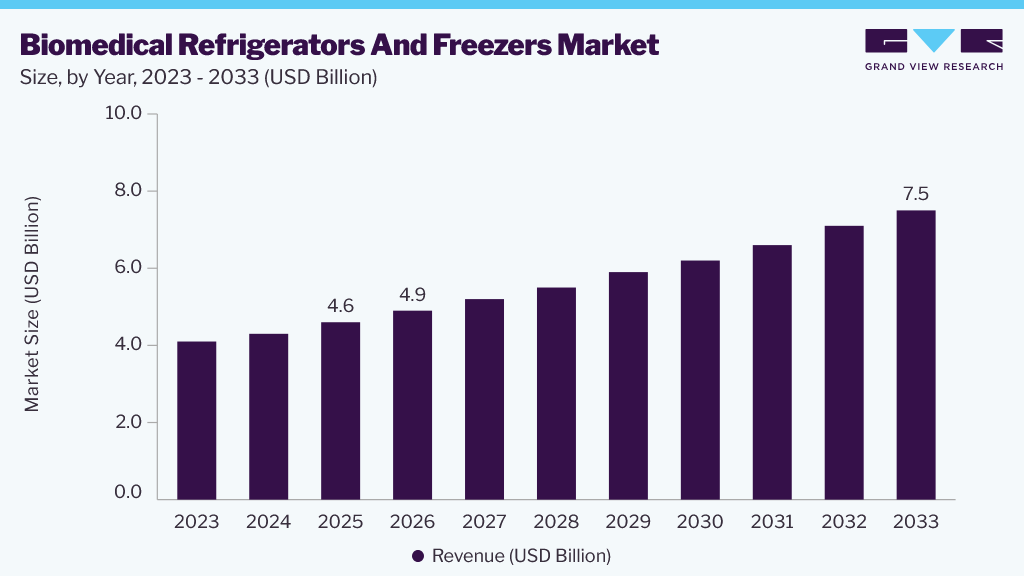
The global biomedical refrigerators and freezers market size was valued at USD 4.6 billion in 2025 and is projected to grow from USD 4.9 billion in 2026 to USD 7.5 billion in 2033, at a CAGR of 6.4% from 2026 to 2033. North America dominated the market, accounting for a revenue share of 37.5% in 2025. The rising geriatric population worldwide and the prevalence of chronic diseases such as cardiovascular disease, diabetes, and cancer are major drivers contributing to the market’s growth. These medical facilities are used to avoid product degradation, provide thermal insulation and store biological, which has increased their usage, leading to the market’s growth.
 Source: Grand View Research, IR Documents, Primary Interviews, Paid DatabasesTo learn more about this report,
 Download Free Sample Report
Key Market Trends & Insights
- By product: The plasma freezers segment held the largest market share of around 28.5% in 2025.
- By end-use: The blood bank refrigerators segment held the largest market share of over 35.0% in 2025.
Regional Highlights
- Largest regional market: North America (37.5% revenue share, 2025)
- Fastest-growing regional market: Asia Pacific (highest CAGR, 2026-2033)
Market Size & Forecast
- Market size in 2025: USD 4.6 Billion
- Estimated market size in 2026: USD 4.9 Billion
- Projected market size by 2033: USD 7.5 Billion
- CAGR (2026-2033): 6.4%
Three ways to get this report
Buy it, customize it, or ask a question.Ask an Analyst
Analyst response in 1 business day
- AccessReport author, directly
- Reply timeWithin 1 working day
- No sales callDirect answer only
- FormatEmail reply
- CostFree, no cost
Get the Full Report
What the study covers
- FormatsPDF · Excel · Dashboard
- Timeline2026–2033 annual, 2025 base
- Coverage20+ countries, 5 regions
- Companies10+ key players profiled
Customize the Report
20% free customization
- IncludeCountries, segments, points
- TailorTo your product definition
- ExtendDeeper competitor detail
- OrA fully bespoke study
- Turnaround5–10 working days
The advancement of pharmaceutical and biotechnology research continues to support demand for biomedical refrigerators and freezers used in the storage of biologics, vaccines, clinical samples, and temperature-sensitive therapeutics. Increasing investment in drug development, biologics manufacturing, and sterile production facilities is strengthening the need for reliable cold-chain infrastructure across healthcare and life science industries. For instance, in June 2025, Aenova expanded its sterile manufacturing facility in Latina with the addition of a new cold-chain warehouse to support biologics and temperature-sensitive pharmaceutical products. Such investments are expected to strengthen demand for advanced biomedical refrigeration and freezer systems.
The growing prevalence of chronic diseases is increasing demand for diagnostic testing, biologic therapies, blood products, and long-term treatment programs that rely on temperature-controlled storage. According to the World Health Organization (WHO), non-communicable diseases remain a leading cause of mortality globally, highlighting the continued need for healthcare infrastructure and advanced therapeutic products. Biomedical refrigerators and freezers play a critical role in preserving vaccines, blood components, laboratory samples, and specialty pharmaceuticals used across hospitals, blood banks, research institutions, and diagnostic laboratories.
The increasing commercialization of cell therapies, gene therapies, personalized medicines, and advanced biologics is creating demand for highly specialized storage systems capable of maintaining precise temperature conditions. Many next-generation therapies require ultra-low-temperature preservation to maintain product stability throughout development, transportation, and administration. For instance, In May 2025, SCHOTT Pharma launched SCHOTT TOPPAC, a freeze-prefillable polymer syringe designed for storage at temperatures as low as -180°C for sensitive biologics and cell and gene therapy applications. Such developments highlight the growing need for ultra-low-temperature storage infrastructure across the life sciences sector.
Analyst Perspective
The biomedical refrigerators and freezers market is increasingly evolving from conventional laboratory storage toward highly specialized cold-chain infrastructure that supports biologics, cell therapies, gene therapies, and precision medicine. While hospitals and blood banks remain important demand centers, future growth is expected to be driven by the rapid expansion of biopharmaceutical manufacturing and advanced therapy development.
The market is also benefiting from stricter regulatory requirements governing temperature-sensitive products, which are encouraging healthcare and life science organizations to invest in reliable storage technologies with enhanced monitoring and compliance capabilities. As advanced biologics move from clinical development into commercial production, demand for ultra-low-temperature preservation systems is expected to accelerate. Companies offering energy efficient, digitally connected, and high-performance storage solutions are likely to gain a competitive advantage.
Product Insights
By product, the plasma freezers segment held the largest market share of around 28.5% in 2025. The rising prevalence of chronic diseases has increased research activity and demand for storing biological samples, including blood and plasma products. This has driven the growth of the plasma freezers segment. Manufacturers of plasma freezers have introduced innovations that reduce energy usage, avoid crystallization, and ensure even temperature distribution. These advancements have made plasma freezers more efficient and reliable, further boosting their adoption.
The laboratory /pharmacy/medical refrigerators segment is expected to grow at the fastest CAGR during forecast period. Growth is driven by increasing storage requirements for vaccines, biologics, laboratory reagents, diagnostic samples, and temperature-sensitive pharmaceuticals. Rising implementation of Good Laboratory Practices (GLP), strengthening regulatory compliance requirements, and growing investments in healthcare and research infrastructure are supporting adoption. Furthermore, increasing emphasis on product integrity, quality assurance, and cold-chain management is encouraging laboratories, pharmacies, and healthcare providers to invest in advanced refrigeration systems equipped with temperature monitoring and data management capabilities.
End U se Insights
By end use, the blood bank refrigerators segment accounted for over 35.0% of the biomedical refrigerators and freezers market in 2025. The segment's dominance is attributed to the continuous requirement for temperature-controlled storage of whole blood, plasma, platelets, and other blood components used in transfusion medicine. Growing demand for blood transfusions, increasing blood donation programs, and expanding blood collection activities continue to support adoption of biomedical refrigeration systems. According to the American Red Cross, in 2025, the organization emphasized the need to collect approximately 12,500 blood donations daily to support more than 2,500 hospitals and transfusion centers across the U.S. Such demand highlights the critical role of reliable cold-storage infrastructure in maintaining blood safety and availability.
The pharmacies segment is expected to grow at a significant CAGR during the forecast period. Increasing utilization of biologics, specialty pharmaceuticals, vaccines, and temperature-sensitive medications is driving demand for advanced refrigeration systems across retail, hospital, and specialty pharmacy settings. Growing focus on medication safety, regulatory compliance, and cold-chain integrity is encouraging pharmacies to adopt reliable storage solutions that maintain product efficacy throughout the distribution process. In addition, expanding access to specialty therapies and increasing pharmaceutical dispensing volumes are expected to contribute to segment growth.
Regional Insights
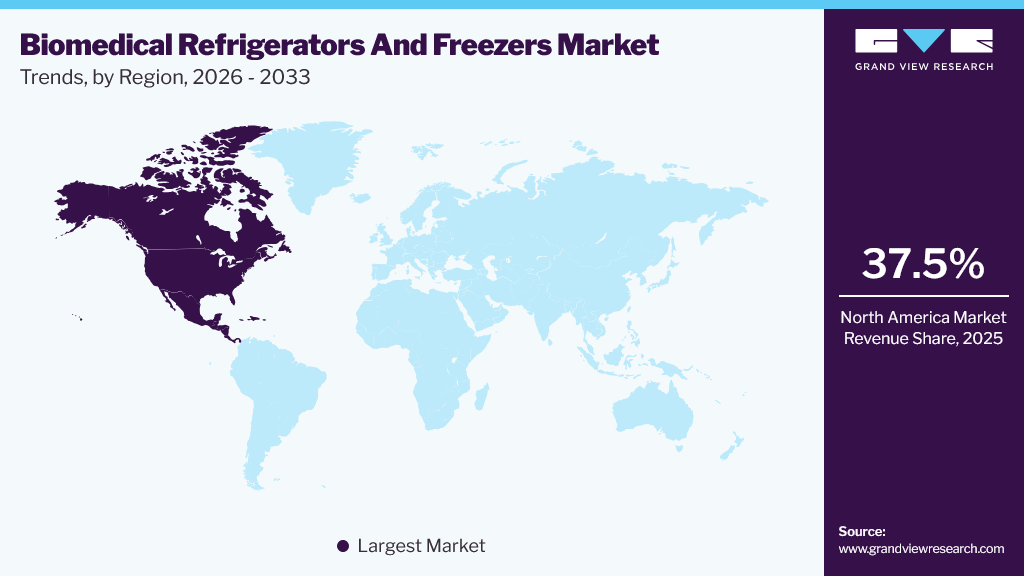
North America dominated the biomedical refrigerators and freezers market, accounting for approximately 37.5% in 2025. The region is driven by well-established healthcare system, extensive biopharmaceutical manufacturing activities, advanced research infrastructure, and a strong network of blood banks and diagnostic laboratories. Increasing demand for biologics, vaccines, blood products, and temperature-sensitive therapeutics continues to support adoption of biomedical refrigeration equipment. In addition, growing investments in life science research, cell and gene therapy development, and pharmaceutical cold-chain infrastructure are expected to sustain demand across healthcare and research institutions.
 To learn more about this report, Download Free Sample Report
The U.S. biomedical refrigerators and freezers market is supported by increasing storage requirements for biologics, specialty pharmaceuticals, vaccines, blood products, and clinical research samples. The country's extensive healthcare infrastructure, strong pharmaceutical manufacturing base, and growing investment in advanced therapies continue to generate demand for high-performance refrigeration and freezer systems. Rising blood collection and transfusion activities further contribute to equipment adoption across hospitals, blood banks, and healthcare facilities.
Europe Biomedical Refrigerators And Freezers Market Trends
The Europe marketis expected to grow at the fastest during the forecast period. Growth is supported by increasing investments in healthcare modernization, expanding biopharmaceutical activities, and growing demand for advanced cold-storage solutions across hospitals and research facilities. The region is also witnessing rising organ transplantation procedures that require strict temperature-controlled preservation and transportation systems. For instance, in January 2026, the Global Observatory on Donation and Transplantation (GODT), in collaboration with the World Health Organization (WHO), in 2024, performed 173 727 solid organ transplants. The increasing volume of transplant procedures is expected to strengthen demand for organ preservation and biomedical cold-storage infrastructure across the healthcare sector.
Asia Pacific Biomedical Refrigerators and Freezers Market Trends
The Asia Pacific biomedical refrigerators and freezers market is anticipated to witness significant growth during the forecast period. Rapid expansion of healthcare infrastructure, increasing pharmaceutical manufacturing activities, and rising investments in biotechnology research are supporting demand for temperature-controlled storage solutions across the region. Growing vaccination programs, expanding diagnostic laboratory networks, and increasing adoption of biologics and specialty therapies are further contributing to market growth. In addition, governments across several countries are strengthening healthcare capacity and cold-chain infrastructure, creating favorable conditions for the adoption of biomedical refrigeration equipment.
MEA Biomedical Refrigerators And Freezers Market Trends
MEA biomedical refrigerators and freezers market is anticipated to witness significant growth over the forecast period Increasing investments in healthcare infrastructure, expanding immunization programs, and improving access to diagnostic and laboratory services are supporting demand for biomedical cold-storage equipment. Growing establishment of blood banks, pharmaceutical distribution networks, and healthcare facilities across the region is further strengthening market adoption. In addition, government-led healthcare modernization initiatives and rising awareness regarding temperature-sensitive product storage are expected to contribute to long-term market expansion.
Key Biomedical Refrigerators and Freezers Market Companies Insights
Companies are investing in advanced ultra-low-temperature storage systems, expanding manufacturing capabilities, and strengthening their distribution networks to support growing demand from healthcare, pharmaceutical, blood banking, and life science research applications.
Key Biomedical Refrigerators and Freezers Companies
The following key companies have been profiled for this study on the biomedical refrigerators and freezers market:
-
PHC Holdings Corporation
-
Haier Biomedical
-
Eppendorf AG
-
Power Scientific, Inc.
-
Aegis Scientific, Inc.
-
Follett LLC
-
Helmer Scientific
-
Thermo Fisher Scientific
-
Azbil Corporation
Recent Developments
- In July 2025, PHCbi launched the TwinGuard ECO -85°C Ultra-Low Temperature Freezer for long-term storage of biological samples, cell and gene therapies, and vaccines. The product reflects ongoing innovation in ultra-low-temperature preservation technologies for healthcare and life science applications.
- In September 2025, Krish Biomedicals expanded its manufacturing facility within India's Medical Device Park to increase production of ultra-low-temperature freezers, blood bank refrigerators, vaccine carriers, and cold-chain equipment. The expansion strengthens regional manufacturing capacity and supports growing demand from healthcare, blood banking, and research institutions.
Biomedical Refrigerators and Freezers Market Report Scope
Report Attribute
Details
Market size in 2025
USD 4.6 b illion
Estimated market size in 2026
USD 4.9 b illion
Projected market size by 2033
USD 7.5 b illion
Growth r ate
CAGR of 6.4% from 2026 to 2033
Base year for estimation
2025
Actual data
2021 – 2024
Forecast period
2026 – 2033
Quantitative units
Revenue in USD billion, and CAGR from 2026 to 2033
Report coverage
Revenue forecast, company ranking, competitive landscape, growth factors, and trends
Segments covered
Product, end use, region
Regional s cope
North America ; Europe ; Asia Pacific ; Latin America ; MEA
Country s cope
U.S. ; Canada ; Mexico ; UK ; Germany ; France ; Italy ; Spain ; Denmark ; Sweden ; Norway ; Japan ; China ; India ; Australia ; South Korea ; Thailand ; Brazil ; Argentina ; KSA ; UAE ; South Africa; Saudi Arabia; Kuwait
Key companies profiled
PHC Holdings Corporation; Haier Biomedical; Eppendorf AG; Power Scientific, Inc.; Aegis Scientific, Inc.; Haier Biomedical; Follett LLC; Helmer Scientific; Thermo Fisher Scientific; Azbil Corporation
Customization scope
Free report customization (equivalent up to 8 analysts working days) with purchase. Addition or alteration to country, regional & segment scope.
Pricing and purchase options
Avail of customized purchase options to meet your exact research needs. Explore purchase options
Global Biomedical Refrigerators And Freezers Market Report Segmentation
This report forecasts revenue growth at global, regional, and country levels and provides an analysis of the latest industry trends in each of the sub-segments from 2021 to 2033. For this study, Grand View Research has segmented the global biomedical refrigerators and freezers market report based on products, end use, and region.
-
Product Outlook (Revenue, USD Billion, 2021 - 2033)
-
Blood Bank Refrigerators
-
Shock Freezers
-
Plasma Freezers
-
Ultra Low Temperature Freezers
-
Laboratory /Pharmacy/Medical Refrigerators
-
Laboratory /Pharmacy/Medical Freezers
-
- End Use (Revenue, USD Billion, 2021 - 2033)
-
Hospitals
-
Research Laboratories
-
Pharmacies
-
Diagnostic Centers
-
Blood Banks
-
Others
-
-
Regional Outlook (Revenue, USD Billion, 2021 - 2033)
-
North America
-
U.S.
-
Canada
-
Mexico
-
-
Europe
-
UK
-
Germany
-
France
-
Italy
-
Spain
-
Denmark
-
Sweden
-
Norway
-
-
Asia Pacific
-
Japan
-
China
-
India
-
Australia
-
South Korea
-
Thailand
-
-
Latin America
-
Brazil
-
Argentina
-
-
MEA
-
South Africa
-
Saudi Arabia
-
UAE
-
Kuwait
-
-
Frequently Asked Questions About This Report
The global Biomedical Refrigerators And Freezers market size was estimated at USD 4.6 billion in 2025 and is expected to reach USD 4.9 billion in 2026.
Some key players operating in the Biomedical Refrigerators And Freezers market include Philipp Kirsch GmbH, Haier Biomedical, Panasonic Healthcare Co., Thermo Fisher Scientific Inc., Helmer Scientific and Eppendorf AG.
The global Biomedical Refrigerators And Freezers market is expected to grow at a compound annual growth rate of 6.4% from 2026 to 2033 to reach USD 7.5 billion by 2023.
Blood banks dominated the biomedical refrigerators and freezers market with a share of 35.0% in 2025.
North America dominated with a 37.5% revenue share in 2025.
About the Author(s)
Medical Devices Research Team
Healthcare · Medical DevicesThis report was authored by the medical devices research team at Grand View Research - comprising two research analysts, one senior research analyst, and one industry expert - with specialized expertise in the medical devices segment of the healthcare industry. All findings are based on proprietary healthcare databases, executive interviews, and regulatory analysis, subject to internal peer review prior to publication.
Last Updated:
Speak to Analyst

Customize this report to your needs - add regions, segments, or data points, with 20% free customization.
Or view our licence options:


ISO 9001:2015 & 27001:2022 Certified
We are GDPR and CCPA compliant! Your transaction & personal information is safe and secure. For more details, please read our privacy policy.


