
- Home
- »
- Plastics, Polymers & Resins
- »
-
Biomimetic Packaging Materials Market Size Report, 2033GVR Report cover
![Biomimetic Packaging Materials Market (2026 - 2033)Report]()
Biomimetic Packaging Materials Market (2026 - 2033)
Size, Share & Trends Analysis Report By Material Platform (Biopolymer-based, Bio-based Synthetic Polymer-based, Natural Fiber & Cellulosic-based), By Functional Property, By Packaging Format, By End-use, By Region, And Segment Forecasts
Market Size, 2025
$1.8BMarket Estimate, 2026
$1.9BMarket Forecast, 2033
$3.7BCAGR, 2026–2033
9.8%Biomimetic Packaging Materials Market Summary
The global biomimetic packaging materials market size was valued at USD 1.8 billion in 2025 and is expected to grow from USD 1.9 billion in 2026 to USD 3.7 billion in 2033, at a CAGR of 9.8% from 2026 to 2033. Asia Pacific dominated the market, accounting for the largest revenue share of 36.5% in 2025. The market is primarily driven by increasing demand for sustainable, high-performance packaging solutions that replicate naturally occurring structures and functions, as well as the growing adoption of bio-inspired materials for improved barrier properties, strength, lightweighting, and resource efficiency.

Key Market Trends & Insights
- By packaging format: Films & flexible sheets segment held the largest revenue share of 38.8% in 2025.
- By material platform: Biopolymer-based segment held the largest revenue share of 31.1% in 2025.
- By end use: Food & beverage segment held the largest revenue share of 60.8% in 2025.
- By functional property: Gas & aroma barrier segment held the largest share of 24.6% in 2025.
Regional Highlights
- Largest regional market: Asia Pacific (36.5% revenue share, 2025
- By country: China held the largest revenue share of Asia Pacific in 2025
Market Size & Forecast
- Market Size in 2025: USD 1.8 Billion
- Estimated Market Size in 2026: USD 1.9 Billion
- Projected Market Size by 2033: USD 3.7 Billion
- CAGR (2026-2033): 9.8%
Asia Pacific is expected to remain the leading regional market through 2033, supported by rapid industrialization, expanding packaging and food & beverage sectors, and increasing emphasis on sustainable material development. The growth of the biomimetic packaging materials industry is driven by the growing demand for sustainable, high-performance, and resource-efficient packaging solutions that replicate functional structures and properties found in nature. As food & beverage, pharmaceuticals, personal care, and other consumer-facing industries increasingly seek alternatives to conventional packaging materials, there is a rising adoption of biopolymer-based, natural fiber, bio-nanocomposite, and other bio-inspired material platforms. Biopolymer-based materials represented the largest material platform, valued at USD 547.4 million in 2025, supported by their biodegradability, renewable feedstock potential, lightweight characteristics, and compatibility with flexible and rigid packaging formats. The increasing emphasis on reducing plastic waste and improving packaging sustainability is further accelerating the integration of nature-inspired material technologies into commercial packaging applications.An increasing focus on renewable feedstocks, biodegradability, and functional performance across packaging supply chains is expected to boost market growth in the coming years. Natural fiber & cellulosic-based materials are gaining traction due to their renewable origin, favorable strength-to-weight characteristics, and potential for recyclable or compostable packaging solutions. The segment is projected to increase from USD 370.9 million in 2025 to USD 782.2 million by 2033, reflecting growing demand for fiber-based packaging alternatives. At the same time, bio-based synthetic polymers and bio-nanocomposites are being increasingly developed to improve barrier properties, mechanical strength, moisture resistance, and shelf-life performance, particularly for food, healthcare, and personal care applications.

Material innovation and the transition toward advanced bio-inspired packaging systems are also significantly contributing to market growth. A defining trend in the biomimetic packaging materials industry is the growing development of bio-nanocomposites and hybrid & multimaterial-based solutions that combine distinct material characteristics to replicate specialized functions observed in natural systems. Bio-nanocomposite-based materials are projected to grow at a CAGR of 10.1%, while hybrid & multimaterial-based materials are expected to register the fastest CAGR of 10.7% from 2026 to 2033. These technologies can enable improved barrier performance, structural integrity, antimicrobial functionality, and intelligent or responsive packaging characteristics, creating opportunities for premium and application-specific packaging solutions.
The growing adoption of biomimetic materials across food & beverage, pharmaceuticals & healthcare, personal care & cosmetics, and electronics & electrical applications is expected to further expand the addressable market. Food & beverage remained the largest end-use segment, accounting for 60.8% of market revenue in 2025, while pharmaceuticals & healthcare is projected to grow at a 10.4% CAGR through 2033. This expansion reflects increasing requirements for packaging that combines sustainability with moisture and gas barriers, mechanical protection, antimicrobial properties, and other functional characteristics, strengthening the role of biomimetic materials in next-generation packaging development.
Market Dynamics
The biomimetic packaging materials market is witnessing strong growth, driven by increasing demand for sustainable packaging, advances in bio-inspired material science, and the need for packaging solutions that combine environmental benefits with enhanced functional performance. Manufacturers are increasingly developing materials that mimic natural structures to deliver improved barrier properties, mechanical strength, moisture management, antimicrobial protection, and intelligent functionality. Growing adoption across food & beverage, pharmaceuticals & healthcare, personal care, and electronics is supporting market expansion, while higher production costs, material scalability challenges, and limited commercial availability remain key constraints.
The growing demand for sustainable and high-performance packaging solutions is a key driver of the biomimetic packaging materials market. Packaging manufacturers and end-use industries are increasingly seeking alternatives to conventional materials that can reduce environmental impact while maintaining essential properties such as strength, barrier performance, moisture resistance, and product protection. Biomimetic materials derived from biopolymers, natural fibers, bio-nanocomposites, and other renewable platforms can replicate functional characteristics observed in natural systems, making them attractive for next-generation packaging applications.
The increasing adoption of sustainable packaging across food & beverage, pharmaceuticals & healthcare, and personal care applications is further supporting market growth. Biopolymer-based materials accounted for the largest material Platformshare of 31.1% in 2025, reflecting strong demand for renewable and bio-derived packaging materials. In addition, growing investments in material engineering and bio-inspired surface technologies are enabling manufacturers to develop lightweight packaging with enhanced barrier, antimicrobial, and protective properties, creating opportunities for broader commercial adoption.
A significant restraint for the biomimetic packaging materials market growth is the relatively high cost and complexity associated with developing and manufacturing advanced bio-inspired materials at a commercial scale. Compared with conventional packaging materials, biomimetic solutions may require specialized feedstocks, processing technologies, surface treatments, nanomaterials, or multilayer structures, increasing production costs and limiting price competitiveness. In addition, challenges related to consistent raw material availability, large-scale manufacturing, performance standardization, and integration with existing packaging production infrastructure can slow adoption among cost-sensitive manufacturers.
A major opportunity for the biomimetic packaging materials market lies in the development of bio-nanocomposite and hybrid & multimaterial-based solutions that combine renewable materials with advanced functional properties. These materials can provide improved gas and moisture barriers, mechanical strength, antimicrobial protection, and intelligent packaging capabilities, making them suitable for food & beverage, pharmaceuticals, and personal care applications. The hybrid & multimaterial-based segment is projected to grow at a CAGR of 10.7% from 2026 to 2033, while bio-nanocomposite-based materials are expected to grow at 10.1%, creating opportunities for manufacturers to develop sustainable packaging solutions with performance comparable to conventional materials.
Market Concentration & Characteristics
The biomimetic packaging materials market is characterized by a focus on integrating nature-inspired design principles with sustainable, high-performance material technologies. The industry relies on innovations in biopolymers, natural fibers, bio-nanocomposites, and hybrid materials to replicate properties found in natural systems, such as moisture regulation, gas barriers, mechanical strength, antimicrobial protection, and responsive functionality. Manufacturers prioritize material performance, scalability, sustainability, and compatibility with existing packaging processes. The market is increasingly supported by demand from food & beverage, pharmaceuticals & healthcare, and personal care industries, where advanced packaging performance and environmental considerations are becoming important purchasing factors.
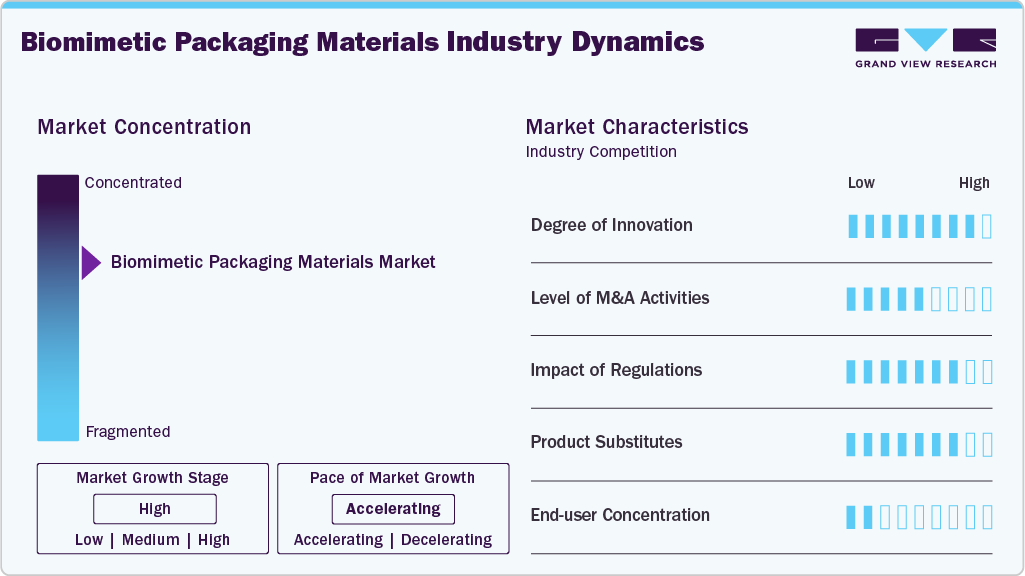
A defining feature of the biomimetic packaging materials industry is the increasing use of bio-based and renewable material platforms, particularly biopolymer-based and natural fiber & cellulosic-based materials. Biopolymer-based materials accounted for the largest share of 31.1% in 2025, while natural fiber & cellulosic-based materials represented 21.1%. At the same time, manufacturers are investing in bio-nanocomposites and hybrid & multimaterial structures to improve barrier performance, mechanical durability, and functional properties. The shift toward these advanced materials is supported by sustainability initiatives, growing demand for alternatives to conventional plastics, and technological advancements that are improving the commercial scalability of biomimetic packaging solutions.
Analyst Perspective
The biomimetic packaging materials market has evolved from a niche research-focused field into an emerging sustainable packaging segment, driven by demand for bio-based and high-performance alternatives to conventional materials. Advancements in biopolymers, natural fibers, bio-nanocomposites, and surface technologies are enabling improved barrier, mechanical, antimicrobial, and responsive properties. Looking ahead, the market is expected to grow strongly through 2033, supported by sustainability regulations, circular packaging initiatives, and increasing adoption across food & beverage, healthcare, personal care, electronics, and industrial applications.
Material Platform Insights
The biopolymer-based segment led the biomimetic packaging materials market, accounting for the largest revenue share of 31.1% in 2025. Biopolymer-based materials are widely adopted in biomimetic packaging due to their renewable origin, potential biodegradability, lightweight nature, and ability to provide functional properties inspired by natural materials. The segment was valued at USD 547.4 million in 2025 and is expected to reach USD 1,118.3 million by 2033, supported by increasing demand for sustainable packaging alternatives across food & beverage, pharmaceuticals, and personal care applications.
The hybrid & multimaterial-based segment is expected to grow at the fastest CAGR of 10.7% during the forecast period. These materials combine multiple material platforms to achieve enhanced mechanical strength, barrier performance, moisture resistance, and other functional properties that can replicate complex characteristics found in natural systems. The segment is projected to increase from USD 219.1 million in 2025 to USD 490.2 million by 2033, driven by increasing investment in advanced biomimetic material technologies and demand for high-performance sustainable packaging solutions.
Functional Property Insights
The gas & aroma barrier segment led the biomimetic packaging materials industry, accounting for the largest revenue share of 24.6% in 2025. Gas & aroma barrier properties are critical for biomimetic packaging, particularly in food & beverage and pharmaceutical applications, where maintaining product quality, freshness, and shelf life is essential. The segment was valued at USD 432.7 million in 2025 and is expected to reach USD 876.9 million by 2033, driven by rising demand for advanced packaging with enhanced barrier performance.
The responsive & intelligent functionality segment is expected to grow at the fastest CAGR of 10.5% during the forecast period. Biomimetic packaging incorporating responsive and intelligent functionalities can respond to changes in environmental conditions and provide enhanced product monitoring or protection. The segment is projected to increase from USD 171.8 million in 2025 to USD 380.2 million by 2033, driven by rising demand for smart, adaptive, and high-performance packaging solutions across food, healthcare, and other sensitive applications.
Packaging Format Insights
The films & flexible sheets segment led the biomimetic packaging materials market with the largest revenue share of 38.8% in 2025. Films and flexible sheets are widely used in biomimetic packaging due to their lightweight nature, material efficiency, flexibility, and ability to incorporate advanced barrier and functional properties. The segment was valued at USD 683.2 million in 2025 and is expected to reach USD 1,418.3 million by 2033, driven by rising demand for sustainable, high-performance flexible packaging solutions across food & beverage, healthcare, and personal care applications.
The other biomimetic materials segment is expected to grow at the fastest CAGR of 10.8% during the forecast period. This segment includes emerging and specialized biomimetic material formats designed to deliver specific natural-inspired functions and performance characteristics. The segment is projected to increase from USD 147.0 million in 2025 to USD 332.3 million by 2033, driven by continued material innovation, increasing research and development activities, and the adoption of specialized biomimetic solutions for advanced packaging applications.
End-use Insights
The food & beverage segment led the biomimetic packaging materials industry with the largest revenue share of 60.8% in 2025. Food & beverage is the largest end-use segment for biomimetic packaging materials due to increasing demand for sustainable packaging with enhanced barrier, moisture management, antimicrobial, and shelf-life extension properties. The segment was valued at USD 1,068.7 million in 2025 and is expected to reach USD 2,218.4 million by 2033, supported by the growing adoption of bio-based and nature-inspired packaging solutions.
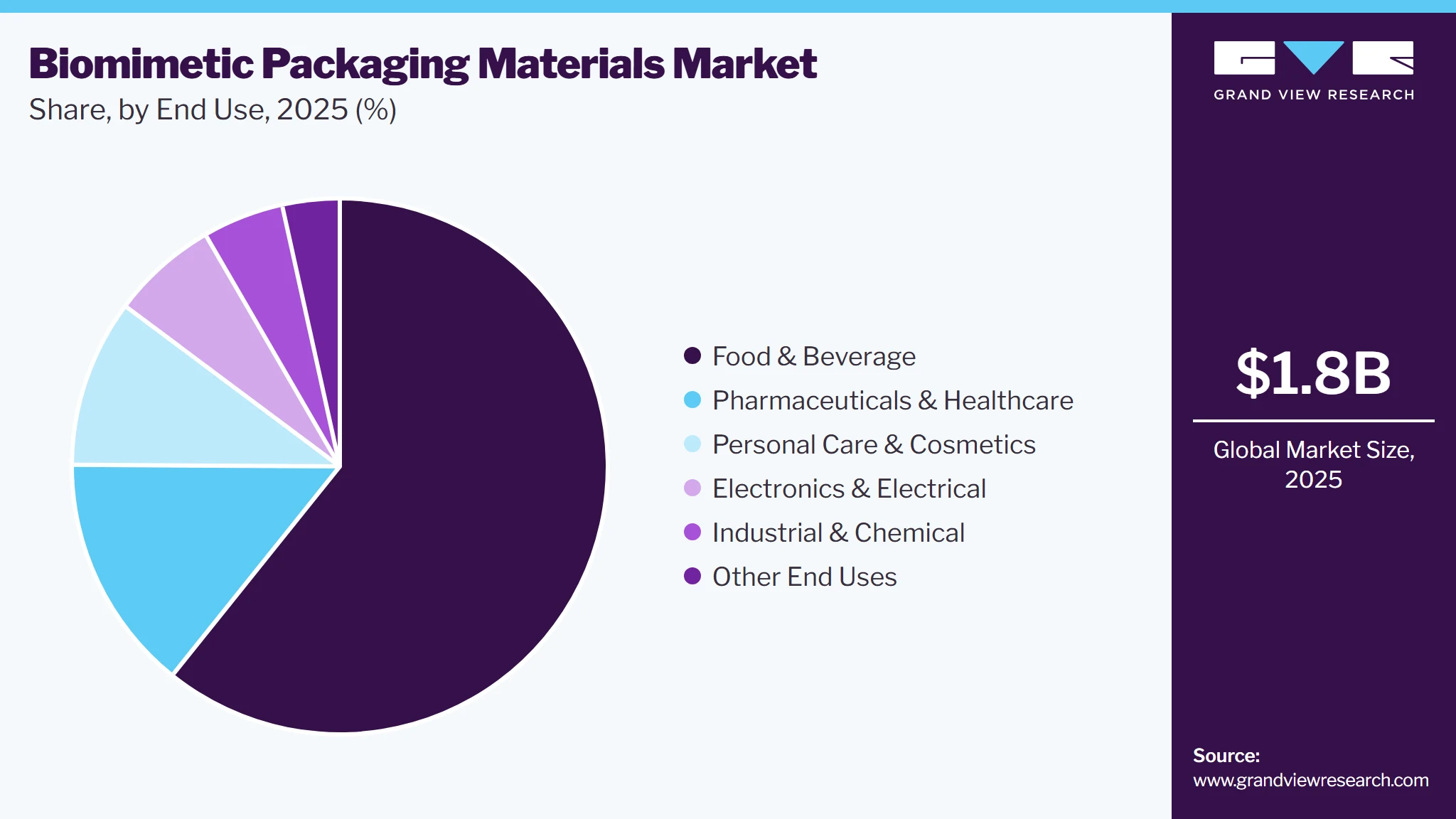
The pharmaceuticals & healthcare segment is expected to grow at the fastest CAGR of 10.4% during the forecast period. Biomimetic packaging materials are increasingly adopted in healthcare applications for their potential to provide enhanced protection against moisture, gases, light, and microbial contamination. The segment is projected to increase from USD 252.2 million in 2025 to USD 553.6 million by 2033, driven by rising demand for advanced, protective, and sustainable packaging solutions for pharmaceutical and healthcare products.
Regional Insights
Asia Pacific dominated the global biomimetic packaging materials market with a revenue share of 36.5% in 2025 and is projected to register the fastest CAGR of 10.4% during 2026-2033. The region's leadership is supported by therapid expansion of food & beverage and consumer goods manufacturing, increasing packaging consumption, and growing investments in sustainable material technologies. China, Japan, South Korea, and India are strengthening their capabilities in biopolymers, natural fiber materials, nanocomposites, and advanced packaging manufacturing, creating a strong foundation for regional market expansion.

The China biomimetic packaging materials marketis a major contributor to Asia Pacific, supported by its extensive packaging manufacturing base and large food & beverage, pharmaceutical, and consumer goods industries. Increasing investment in bio-based materials and advanced polymer technologies is encouraging the adoption of biomimetic packaging solutions. The country's expanding focus on sustainable manufacturing and material efficiency is expected to further strengthen demand for nature-inspired packaging technologies.
The biomimetic packaging materials market in India is expected to witness strong growth as expanding food processing, pharmaceutical manufacturing, personal care production, and organized retail increase the requirement for advanced packaging materials. Growing emphasis on sustainable packaging and the use of renewable feedstocks is creating opportunities for biopolymer- and natural fiber-based biomimetic solutions. Increasing domestic manufacturing capabilities and investments in innovative packaging materials are likely to support market development over the forecast period.
North America Biomimetic Packaging Materials Market Trends
The North America biomimetic packaging materials industry is expected to expand steadily during the forecast period, supported by increasing demand for sustainable packaging, advanced material technologies, and high-performance solutions across the food & beverage, pharmaceuticals, personal care, and other industries. Strong research and development capabilities and growing interest in bio-based polymers, nanocomposites, and intelligent packaging are encouraging commercial development. The region accounted for 23.8% of the global market in 2025 and is projected to reach USD 862.4 million by 2033.
U.S. Biomimetic Packaging Materials Market Trends
The U.S. biomimetic packaging materials industry is positioned as a major contributor to North American growth, benefiting from established packaging manufacturing capabilities and increasing corporate commitments toward sustainable materials. Demand for renewable, recyclable, and functional packaging is encouraging manufacturers to explore biomimetic structures and advanced bio-based materials. Growth in packaged food, healthcare products, and personal care goods is creating additional opportunities for biomimetic packaging solutions with improved barrier, antimicrobial, and protective properties.
Europe Biomimetic Packaging Materials Market Trends
The Europe biomimetic packaging materials industry is projected to experience steady growth, driven by strong sustainability objectives and rising demand for alternatives to conventional packaging materials. The region accounted for 26.6% of global revenue in 2025, with demand influenced by the adoption of bio-based polymers, natural fiber materials, and advanced functional packaging. European packaging manufacturers are increasingly focusing on material efficiency, recyclability, and circularity, supporting the integration of nature-inspired material technologies.
The Germany biomimetic packaging materials market is an important growth area in Europe, due to its advanced manufacturing ecosystem, strong materials research base, and established packaging and chemical industries. Demand for high-performance sustainable packaging is increasing across food, healthcare, automotive-related packaging, and industrial applications. Continued investment in material innovation and advanced processing technologies is expected to support the development and commercialization of biomimetic packaging materials.
The biomimetic packaging materials market in the UK is expected to grow steadily as brands and packaging producers focus more on sustainable material solutions and resource efficiency. Demand for innovative packaging formats across food, beverages, healthcare, and personal care is encouraging the development of bio-based and functional materials. Growing interest in recyclable and low-impact packaging designs is expected to create opportunities for biomimetic technologies during the forecast period.
Latin America Biomimetic Packaging Materials Market Trends
The Latin America biomimetic packaging materials industry is anticipated to grow at a healthy pace, supported by increasing packaged food consumption, expanding consumer goods production, and rising awareness of sustainable packaging. Brazil, Mexico, and other developing markets are gradually increasing the adoption of bio-based and recyclable packaging materials. Growth in food & beverage and personal care applications is expected to provide additional opportunities for biomimetic packaging manufacturers.
The Brazil biomimetic packaging materials market accounts for a significant share of Latin America, due to its large agricultural and food processing industries and an expanding consumer goods sector. The availability of renewable raw materials provides opportunities for the development of natural fiber- and biopolymer-based packaging. Increasing demand for sustainable packaging and improvements in domestic manufacturing capabilities are expected to contribute to future market growth.
Middle East & Africa Biomimetic Packaging Materials Market Trends
The Middle East & Africa biomimetic packaging materials industry is expected to experience gradual growth during the forecast period. Expansion of food processing, pharmaceuticals, personal care, and modern retail is increasing demand for innovative packaging solutions. Growing sustainability initiatives and efforts to improve resource efficiency are also encouraging interest in bio-based and recyclable materials, although relatively limited local production capabilities may constrain near-term adoption.
Key Biomimetic Packaging Materials Company Insights
Some key companies in the biomimetic packaging materials market include Sharklet Technologies, Inc.; Lotus Leaf Coatings, Inc.; Graham Packaging; Braskem / Cazoolo; and Amazu Biomimicry. The market is characterized by material innovation, bio-inspired surface engineering, sustainable material development, and collaboration between packaging manufacturers and biomimicry technology providers. Key participants are focusing on developing high-performance, recyclable, bio-based, and multifunctional packaging materials to meet evolving sustainability and performance requirements.
-
Sharklet Technologies, Inc. is a biomimicry-focused materials technology company known for developing micro-patterned surface technologies inspired by natural sharkskin structures. Its biomimetic surface solutions can support packaging applications requiring improved surface functionality and contamination management, offering opportunities for advanced packaging designs with enhanced functional performance.
-
Lotus Leaf Coatings, Inc. develops bio-inspired surface technologies based on the water-repellent properties of lotus leaves. Its coatings are designed to provide hydrophobic and self-cleaning characteristics, creating potential applications in packaging where moisture resistance, surface protection, and improved material performance are important.
Key Biomimetic Packaging Materials Companies
The following key companies have been profiled for this study of the biomimetic packaging materials market.
-
Sharklet Technologies, Inc.
-
Lotus Leaf Coatings, Inc.
-
Graham Packaging
-
Braskem / Cazoolo
-
Amazu Biomimicry
Competitive Benchmarking
Category
Operating Strategies
Competitive Edge
Weakness
Established Players (Graham Packaging; Braskem / Cazoolo)
- Focus on developing sustainable packaging solutions through material innovation, lightweighting, circular design, bio-based materials, and advanced packaging technologies. Invest in R&D, sustainable material platforms, strategic collaborations, and scalable manufacturing capabilities to address demand for high-performance and environmentally responsible packaging.
- Strong packaging expertise, established manufacturing capabilities, broad customer relationships, global market presence, and access to advanced polymer and packaging technologies provide a strong competitive foundation. Their ability to integrate sustainability with commercial-scale packaging production supports wider market adoption.
- High investment requirements for new material technologies, dependence on feedstock availability and recycling infrastructure, and challenges in achieving cost competitiveness with conventional packaging materials can constrain adoption.
Emerging & Specialized Players (Sharklet Technologies, Inc.; Lotus Leaf Coatings, Inc.; Amazu Biomimicry)
- Focus on developing specialized biomimetic technologies inspired by natural structures and biological functions, including surface engineering, water repellency, self-cleaning properties, and nature-inspired material design. Emphasize technology development, licensing, partnerships, and customized solutions for packaging and other advanced material applications.
- Strong expertise in biomimicry, differentiated technology platforms, specialized intellectual property, and the ability to address specific packaging performance requirements provide opportunities for technological differentiation. Their innovation-led approach enables the development of multifunctional and high-value packaging solutions.
- Limited commercial-scale manufacturing compared with established packaging producers, relatively narrow application portfolios, higher technology development costs, and dependence on partnerships with packaging manufacturers can limit large-scale market penetration.
Recent Developments
-
In 2026, biomimicry innovation continued to expand through startup development and commercialization initiatives. The Biomimicry Institute selected 10 nature-inspired startups for its 2026 Ray of Hope Accelerator, providing funding, technical resources, and expert mentorship to support the development of scalable nature-inspired technologies. One selected company, BioWraptor, is developing tardigrade-inspired technology for protecting perishable biomolecules, demonstrating the expanding application of biomimetic principles to packaging and preservation challenges.
-
In July 2025, Braskem’s Cazoolo, Graham Packaging, Amazu Biomimicry, and Danone collaborated to develop a biomimetic packaging solution for Danone’s 100g Activia, Danoninho, and Actimel product lines. The nature-inspired design reduced plastic usage and made the packaging 8% lighter while maintaining structural integrity and functionality. The project combined biomimicry, Design for Environment (DfE), and life-cycle assessment to improve packaging sustainability and logistics efficiency.
Biomimetic Packaging Materials Market Report Scope
Report Attribute
Details
Market size in 2025
USD 1.8 billion
Estimated market size in 2026
USD 1.9 billion
Projected market size by 2033
USD 3.7 billion
Growth Rate
CAGR of 9.8%from 2026 to 2033
Base year for estimation
2025
Historical data
2021 - 2024
Forecast period
2026 - 2033
Quantitative units
Revenue in USD million/billion, and CAGR from 2026 to 2033
Report coverage
Revenue forecast, company ranking, competitive landscape, growth factors, and trends
Segments covered
Material platform, functional property, packaging format, end-use, region
Regional Scope
North America; Europe; Asia Pacific; Latin America; Middle East & Africa
Key companies profiled
Sharklet Technologies, Inc.; Lotus Leaf Coatings, Inc.; Graham Packaging; Braskem / Cazoolo; Amazu Biomimicry
Customization scope
Free report customization (equivalent up to 8 analysts working days) with purchase. Addition or alteration to country, regional & segment scope.
Pricing and purchase options
Avail of customized purchase options to meet your exact research needs. Explore purchase options
Global Biomimetic Packaging Materials Market Report Segmentation
This report forecasts revenue growth at the global, regional & country levels and provides an analysis of the latest industry trends and opportunities in each of the sub-segments from 2021 to 2033. For this study, Grand View Research has segmented the biomimetic packaging materials market report based on material platform, functional property, packaging format, end-use, and region:
-
Material Platform Outlook (Revenue, USD Million/Billion, 2021 - 2033)
-
Biopolymer-Based
-
Bio-Based Synthetic Polymer-Based
-
Natural Fiber & Cellulosic-Based
-
Bio-Nanocomposite-Based
-
Hybrid & Multimaterial-Based
-
-
Functional Property Outlook (Revenue, USD Million/Billion, 2021 - 2033)
-
Moisture & Water Management
-
Gas & Aroma Barrier
-
Mechanical Protection
-
Antimicrobial & Antifouling
-
UV & Light Management
-
Responsive & Intelligent Functionality
-
Other Functionalities
-
-
Packaging Format Outlook (Revenue, USD Million/Billion, 2021 - 2033)
-
Films & Flexible Sheets
-
Coatings & Surface Treatments
-
Rigid Packaging Materials
-
Foams & Cellular Structures
-
Other Biomimetic Materials
-
-
End Use Outlook (Revenue, USD Million/Billion, 2021 - 2033)
-
Food & Beverage
-
Personal Care & Cosmetics
-
Electronics & Electrical
-
Pharmaceuticals & Healthcare
-
Industrial & Chemical
-
Other End Uses
-
-
Regional Outlook (Revenue, USD Million/Billion, 2021 - 2033)
-
North America
-
U.S.
-
Canada
-
Mexico
-
-
Europe
-
Germany
-
France
-
UK
-
Italy
-
Spain
-
-
Asia Pacific
-
China
-
India
-
Japan
-
South Korea
-
Australia
-
-
Latin America
-
Brazil
-
Argentina
-
-
Middle East & Africa
-
Saudi Arabia
-
UAE
-
South Africa
-
-
Research Methodology
The biomimetic packaging materials market figures in this report are based on a proven research process that combines executive interviews with secondary research from proprietary databases, company filings, and recognized regulatory and institutional sources. Market size is built through value-chain sizing-reconciling supply-side and demand-side estimates-and triangulated with bottom-up and top-down approaches. Every estimate passes multiple levels of expert validation before publication, with each biomimetic packaging materials segment quantified using the revenue-capture definitions in the table below.
Segment Definition
Segment - Material Platform Type
Revenue capture definition
Biopolymer-Based
Revenue generated from the sale of packaging materials derived from naturally occurring or biodegradable polymers, including mycelium-derived polymers, seaweed-based polymers, starch-based materials, PHA, PLA, and other bio-derived polymer systems. Includes biomimetic packaging materials designed to replicate natural structures or functions while providing biodegradability, compostability, barrier performance, and mechanical protection.
Bio-Based Synthetic Polymer-Based
Revenue generated from the sale of packaging materials manufactured using synthetic polymers derived partly or wholly from renewable biological feedstocks. Includes bio-based polyethylene, bio-based polypropylene, bio-based polyesters, and other renewable-feedstock polymer formulations used in films, coatings, rigid packaging, and flexible packaging applications.
Natural Fiber & Cellulosic-Based
Revenue generated from the sale of packaging materials manufactured from natural fibers and cellulose-based resources, including molded fiber, wood pulp, agricultural residues, bamboo, cellulose fibers, and related bio-based substrates. Includes packaging solutions designed to replicate natural structures and provide lightweight, protective, recyclable, biodegradable, or compostable properties.
Bio-Nanocomposite-Based
Revenue generated from the sale of packaging materials incorporating bio-based nanomaterials or nanoscale natural structures to enhance barrier, mechanical, thermal, antimicrobial, and functional performance. Includes nanocellulose, cellulose nanocrystals, chitin/chitosan-based materials, bio-derived nanoparticles, and other bio-nanocomposite formulations used in films, coatings, and advanced packaging structures.
Hybrid & Multimaterial-Based
Revenue generated from the sale of packaging materials combining two or more biomimetic, bio-based, natural, or conventional material platforms to achieve enhanced mechanical strength, barrier performance, flexibility, durability, or functionality. Includes multilayer structures, fiber-polymer composites, bio-based polymer composites, and other hybrid packaging materials developed for specialized performance requirements.
Segment - Functional Property
Revenue capture definition
Moisture & Water Management
Revenue generated from the sale of biomimetic packaging materials designed to control moisture absorption, water penetration, humidity, or condensation. Includes bio-based films, coatings, and structures that replicate natural moisture-regulating mechanisms to protect packaged products and maintain product quality.
Gas & Aroma Barrier
Revenue generated from the sale of biomimetic packaging materials providing resistance to oxygen, carbon dioxide, water vapor, and aroma transfer. Includes bio-based films, coatings, and nanocomposite structures engineered to replicate natural barrier functions and extend product shelf life.
Mechanical Protection
Revenue generated from the sale of biomimetic packaging materials designed to provide impact resistance, cushioning, structural strength, and protection against compression or physical damage. Includes mycelium-based, molded fiber, bio-composite, and other nature-inspired protective packaging solutions.
Antimicrobial & Antifouling
Revenue generated from the sale of biomimetic packaging materials incorporating antimicrobial, antifungal, or antifouling properties to reduce microbial growth, contamination, and surface attachment. Includes packaging materials using bio-derived compounds, functional coatings, and naturally inspired surface structures.
UV & Light Management
Revenue generated from the sale of biomimetic packaging materials designed to control UV, visible light, or other radiation exposure. Includes bio-based films, coatings, and composite structures that replicate natural light-filtering or light-reflective mechanisms to protect light-sensitive products.
Responsive & Intelligent Functionality
Revenue generated from the sale of biomimetic packaging materials capable of responding to environmental stimuli such as temperature, humidity, pH, light, pressure, or gases. Includes smart and adaptive materials inspired by natural sensing and response mechanisms, as well as packaging solutions incorporating active indicators or responsive structures.
Other Functionalities
Revenue generated from the sale of biomimetic packaging materials providing additional specialized functions, including thermal regulation, self-healing, odor control, adhesion, biodegradability enhancement, structural adaptability, and other nature-inspired performance characteristics not classified under the primary functional properties.
Segment - Packaging Format
Revenue capture definition
Films & Flexible Sheets
Revenue generated from the sale of flexible biomimetic packaging materials manufactured as films, sheets, wraps, and flexible structures. Includes bio-based and nature-inspired films designed to provide barrier protection, flexibility, moisture management, and other functional properties for packaging applications.
Coatings & Surface Treatments
Revenue generated from the sale of biomimetic coatings and surface treatment materials applied to paper, fiber, polymers, or other packaging substrates. Includes nature-inspired coatings providing water resistance, gas and aroma barriers, antimicrobial protection, UV management, and enhanced surface functionality.
Rigid Packaging Materials
Revenue generated from the sale of rigid biomimetic packaging products and materials, including molded containers, trays, boxes, shells, and structural packaging components. Includes mycelium-based, molded fiber, bio-composite, and other nature-inspired rigid materials providing structural strength and product protection.
Foams & Cellular Structures
Revenue generated from the sale of biomimetic foams and cellular packaging structures designed to replicate naturally occurring lightweight structures for cushioning, insulation, impact absorption, and mechanical protection. Includes mycelium-based foams, bio-based cellular materials, and other lightweight protective structures.
Other Biomimetic Materials
Revenue generated from the sale of other nature-inspired packaging materials and structures that do not fall within films, coatings, rigid formats, or foams. Includes specialized bio-composites, responsive materials, bio-nanostructures, edible materials, and other emerging biomimetic packaging formats.
Segment - End Use
Revenue capture definition
Food & Beverage
Revenue generated from the sale of biomimetic packaging materials used for food and beverage packaging applications, including fresh produce, meat, dairy, bakery, snacks, beverages, and ready-to-eat products. Includes nature-inspired materials providing moisture management, barrier protection, antimicrobial properties, cushioning, and shelf-life enhancement.
Pharmaceuticals & Healthcare
Revenue generated from the sale of biomimetic packaging materials used for pharmaceutical, medical, diagnostic, and healthcare products. Includes packaging designed to provide antimicrobial protection, moisture and gas barriers, light protection, mechanical protection, and controlled environmental conditions for sensitive products.
Personal Care & Cosmetics
Revenue generated from the sale of biomimetic packaging materials used for cosmetics, skincare, haircare, fragrances, and personal care products. Includes bio-based films, coatings, rigid containers, and functional materials developed to provide product protection while supporting sustainable and visually differentiated packaging designs.
Electronics & Electrical
Revenue generated from the sale of biomimetic packaging materials used to protect electronic components, electrical equipment, semiconductors, and consumer electronics during storage and transportation. Includes lightweight cushioning, impact-resistant, moisture-control, antistatic, and protective bio-based packaging materials.
Industrial & Chemical
Revenue generated from the sale of biomimetic packaging materials used for industrial goods, chemicals, specialty materials, machinery components, and other manufacturing applications. Includes protective packaging solutions offering mechanical strength, moisture resistance, chemical protection, cushioning, and environmental performance.
Other End Uses
Revenue generated from the sale of biomimetic packaging materials used across other applications, including agriculture, automotive, logistics, household products, retail, and specialty packaging. Includes nature-inspired packaging solutions developed for specialized protection, sustainability, and functional performance requirements.
Estimation Model
Layer Name
Key Question
Description
End-use Industry Layer
What drives demand?
Estimate demand from key industries, including food & beverage, pharmaceuticals & healthcare, personal care & cosmetics, electronics & electrical, and industrial & chemical sectors that adopt biomimetic packaging materials.
Functional Property Adoption Layer
What packaging functions are required?
Assess the adoption of biomimetic materials based on functional requirements, including moisture management, gas and aroma barriers, mechanical protection, antimicrobial performance, UV protection, and responsiveness.
Material & Format Consumption Layer
Which materials and formats generate demand?
Evaluate consumption of biopolymer-based, bio-based, synthetic polymer-based, natural fiber & cellulosic-based, bio-nanocomposite-based, and hybrid materials across films, coatings, rigid packaging, foams, and other biomimetic formats.
Revenue Layer
How is revenue generated?
Revenue is generated through the sale of biomimetic packaging materials and solutions used across food & beverage, healthcare, personal care, electronics, industrial, and other end-use applications.
Delivered Customizations
We have successfully delivered the following deep-dive customizations:
Client Request
Customization Delivered
Value Adds
Competitive Benchmarking
Comparative benchmarking of leading biomimetic packaging materials companies based on material platforms, packaging formats, functional properties, R&D capabilities, sustainability initiatives, production capabilities, geographic presence, and strategic developments.
Enables clients to assess competitor positioning, identify technology gaps, benchmark innovation capabilities, and develop effective product differentiation and market expansion strategies.
Pricing Analysis
Detailed assessment of pricing trends across biopolymer-based, natural fiber & cellulosic-based, bio-based synthetic polymer-based, bio-nanocomposite-based, and hybrid & multimaterial-based packaging materials, considering raw material costs, processing technologies, performance characteristics, production scale, and regional variations.
Supports pricing strategy development, procurement planning, margin optimization, cost benchmarking, and evaluation of commercially viable biomimetic material solutions.
Trade Assessment
Analysis of international trade flows for key biomimetic packaging material inputs and finished materials, covering major exporting and importing countries, trade trends, supply-demand patterns, tariff considerations, and regional supply dependencies.
Helps identify attractive sourcing markets, assess supply-chain risks, evaluate import/export opportunities, and develop resilient international procurement and distribution strategies
Frequently Asked Questions About This Report
The global biomimetic packaging materials market is expected to grow at a CAGR of 9.8% from 2026 to 2033, reaching USD 3.7 billion by 2033.
The global biomimetic packaging materials market size was valued at USD 1.8 billion in 2025 and is estimated to reach USD 1.9 billion in 2026.
The biomimetic packaging materials market is primarily driven by increasing demand for sustainable packaging, growing restrictions on conventional plastics, rising adoption of bio-based materials, advancements in biomimetic material engineering, and demand for packaging with enhanced barrier, antimicrobial, moisture management, and mechanical protection properties.
Asia Pacific dominated the biomimetic packaging materials market with a 36.5% revenue share in 2025.
Asia Pacific is the fastest-growing region in the biomimetic packaging materials market, with a CAGR of 10.4% over the forecast period.
The Hybrid & Multimaterial-Based segment is the fastest-growing material platform in the biomimetic packaging materials market, with a CAGR of 10.7% over the forecast period.
The Biopolymer-based segment led the biomimetic packaging materials market with a 31.1% revenue share in 2025.
The gas & aroma barrier segment led the biomimetic packaging materials market with a 24.6% revenue share in 2025.
Some of the key players in the biomimetic packaging materials market include Sharklet Technologies, Inc.; Lotus Leaf Coatings, Inc.; Graham Packaging; Braskem / Cazoolo; and Amazu Biomimicry.
About the Author(s)
Plastics, Polymers & Resins Research Team
Bulk Chemicals · Plastics, Polymers & ResinsThis report was authored by the plastics, polymers & resins research team at Grand View Research - comprising two research analysts, one senior research analyst, and one industry expert - with specialized expertise in the plastics, polymers & resins segment of the bulk chemicals industry. All findings are based on proprietary bulk chemicals databases, executive interviews, and regulatory analysis, subject to internal peer review prior to publication.
Last Updated:
Speak to Analyst


Customize this report to your needs — add regions, segments, or data points, with 20% free customization.
Or view our licence options:


ISO 9001:2015 & 27001:2022 Certified
We are GDPR and CCPA compliant! Your transaction & personal information is safe and secure. For more details, please read our privacy policy.


