
- Home
- »
- Plastics, Polymers & Resins
- »
-
Bioplastic Construction Materials Market Size Report, 2033GVR Report cover
![Bioplastic Construction Materials Market (2026 - 2033)Report]()
Bioplastic Construction Materials Market (2026 - 2033)
Size, Share & Trends Analysis Report By Material Type (Bio-based Polyethylene, Bio-based Polypropylene, Bio-based Polyethylene Terephthalate), By Application (Residential Construction, Commercial Construction), By Region, And Segment Forecasts
Market Size, 2025
$1.1BMarket Estimate, 2026
$1.2BMarket Forecast, 2033
$2.6BCAGR, 2026–2033
12.2%Bioplastic Construction Materials Market Summary
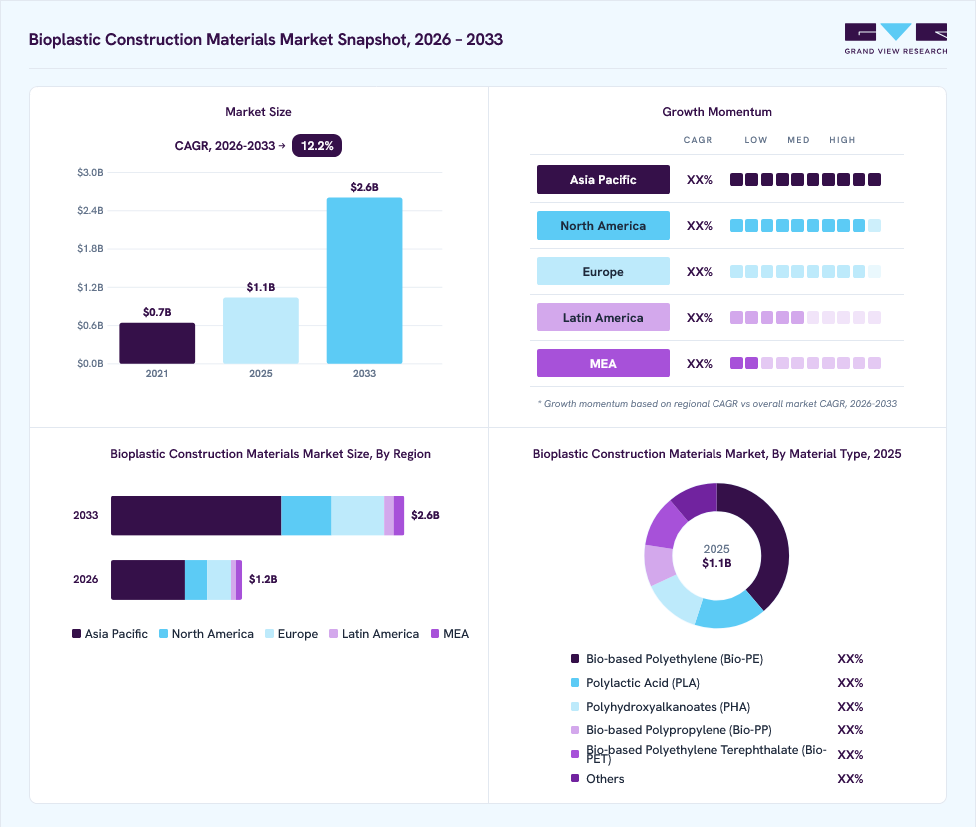
The global bioplastic construction materials market size was valued at USD 1.1 billion in 2025 and is projected to grow from USD 1.2 billion in 2026 to USD 2.6 billion by 2033, at a CAGR of 12.2% from 2026 to 2033. Asia Pacific dominated the market, accounting for the largest revenue share of 56.1% in 2025. The industry is driven by growing emphasis on sustainability within the construction sector and rising adoption of bioplastic construction materials.
Key Market Trends & Insights
- By material type: The polylactic acid (PLA) segment is anticipated to grow at a CAGR of 13.5%
- By application: The commercial construction segment is expected to grow at a 13.3% CAGR from 2026 to 2033.
Regional Highlights
- Largest regional market: Asia Pacific (56.1% revenue share, 2025)
- By country: China held the largest market share in 2025.
Market Size & Forecast
- Market size in 2025: USD 1.1 Billion
- Estimated market size in 2026: USD 1.2 Billion
- Projected market size by 2033: USD 2.6 Billion
- CAGR (2026 - 2033): 12.2%
These materials offer lower carbon footprints, improved environmental performance, and reduced VOC emissions compared with conventional alternatives. Advancements in bio-based resins, engineered materials, and energy-efficient processing are enhancing durability, cost-efficiency, and scalability, while green building standards and consumer preferences accelerate commercial adoption.
Technological advancements in material science and sustainable manufacturing are emerging as a key trend in the industry. Manufacturers are increasingly developing bio-based resins, engineered wood products, and mycelium-based composites that enhance strength, durability, and cost-efficiency. Advanced foam forming, processing automation, and energy-efficient production technologies are further improving scalability, enabling bioplastic materials to compete more effectively with conventional construction materials across diverse applications.
Growing demand for lightweight, durable, and environmentally responsible building materials is a major driver for the industry. These materials provide desirable performance characteristics, including impact resistance, flexibility, thermal stability, and moisture resistance, supporting applications across insulation, glazing, protective surfaces, flooring, and interior components. Rising construction activity, green building initiatives, and sustainable infrastructure development are further accelerating adoption as developers prioritize materials combining functional performance with reduced environmental impact.
Expanding preference for healthier and more sustainable indoor environments presents a significant opportunity for the industry. Bio-based materials can offer lower volatile organic compound emissions than conventional fossil-based alternatives, supporting improved indoor air quality and occupant comfort. As architects, developers, and building owners increasingly prioritize non-toxic, renewable, and low-carbon solutions, demand is rising for bioplastic materials that support green building certifications, sustainable design objectives, and healthier construction practices.
Market Dynamics
Non-residential and commercial builders are emerging as a key segment, capturing over 57% share through office complexes, factories, hospitals, and public infrastructure projects. Growing emphasis on sustainable construction, reduced carbon footprints, and environmentally responsible building materials is encouraging commercial developers to integrate bioplastic-based materials into diverse construction applications, supporting broader market adoption.
Increasing investments in commercial infrastructure and public development projects are further accelerating demand for bioplastic construction materials. Builders are increasingly seeking lightweight, durable, and lower-impact alternatives that support green building objectives while maintaining required structural and functional performance. Expansion of office, healthcare, industrial, and public infrastructure projects, supported by sustainability targets and evolving construction standards, is creating favorable conditions for the wider adoption of bioplastic materials.
Raw material price volatility is emerging as a key restraint, driven by fluctuations in petrochemical feedstock prices that can destabilize manufacturing profit margins. Bioplastic producers often face uncertainty in procurement costs, particularly when feedstock prices change rapidly across global markets. The resulting cost variability can complicate pricing strategies, reduce margin predictability, and limit investments in production capacity, particularly among cost-sensitive manufacturers.
Modular and prefabricated elements present a significant opportunity, driven by growing demand for faster, lightweight, and cost-efficient construction methods. Manufacturers are increasingly developing ultra-lightweight, snap-fit plastic components and composite formworks that simplify installation while reducing assembly duration and transport overhead. These materials can improve construction efficiency and support streamlined project execution, creating favorable conditions for broader adoption across modular buildings, infrastructure projects, and commercial construction applications
Market Concentration & Characteristics
The market growth stage is high, and the pace is accelerating. The market exhibits slight consolidated, with key players dominating the industry landscape. Major companies such as BASF SE, NatureWorks LLC, Kaneka Corporation, BEWI ASA, Mitsubishi Gas Chemical Company, Inc., Green Dot Bioplastics, Toyobo Co., Ltd., SK Chemicals, Solvay and others play a significant role in shaping the market dynamics. These leading players often drive innovation in the market by introducing new products, technologies, and materials to meet the industry's evolving demands.
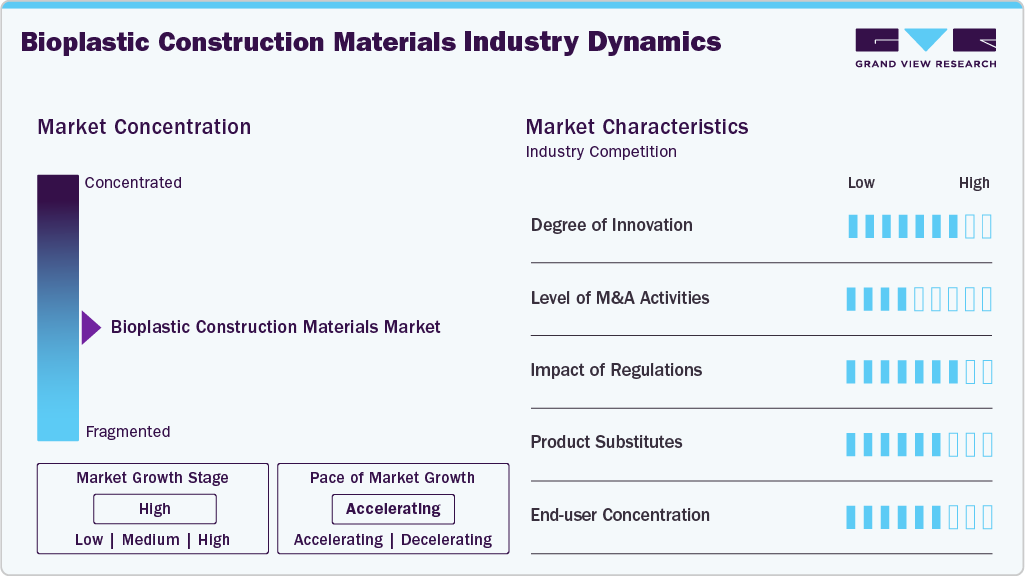
Innovations are driven by advances in high-performance bio-based formulations, interface adhesion, and scalable manufacturing technologies. Recyclable blends, flexible-rigid combinations, and improved thermal and UV stability are expanding use across modular construction, insulation systems, panels, and decorative components. These developments enhance durability, design flexibility, and processing efficiency while supporting lighter-weight, lower-impact material solutions for modern construction applications.
Product substitutes are also shaping market development, as builders and manufacturers can continue to rely on conventional plastics, wood composites, metal-based components, and traditional insulation materials for cost-sensitive projects. These alternatives may offer advantages in availability, established processing infrastructure, and proven performance, creating competitive pressure on bioplastic construction materials. However, ongoing improvements in lightweight construction, moisture resistance, structural versatility, and sustainability can strengthen their competitiveness in high-value applications.
Analyst Perspective
The market is expected to transition over the next 5-10 years from an early adoption and sustainability-led phase toward a more performance-driven and value-oriented growth stage, as construction companies seek materials that combine renewable content, durability, thermal efficiency, and lifecycle benefits. Market leaders will be differentiated by integrated feedstock and production capabilities, scalable manufacturing, application-specific material engineering, geographic reach, strategic partnerships, and credible sustainability credentials. However, high production costs, feedstock availability, price competition with conventional polymers, inconsistent end-of-life infrastructure, regulatory complexity, and supply chain volatility will remain key constraints. Long-term value creation will increasingly depend on material performance, lifecycle economics, and circularity rather than bio-based content alone.
Material Type Insights
The bio-based polyethylene (Bio-PE) bioplastic construction materials segment dominated the market, accounting for 38.7% market share in 2025, and is forecast to grow at a 12.7% CAGR from 2026 to 2033. The segment is being driven by continuous advances in bio-based polyethylene (Bio-PE) formulations, polymerization technologies, and processing methods, which enable improved control over mechanical strength, flexibility, chemical resistance, and durability. These developments allow manufacturers to develop Bio-PE materials with tailored performance characteristics for specific construction requirements. Customized formulations enhance lightweight performance, processability, and environmental benefits, supporting product differentiation and strengthening the role of Bio-PE across construction films, piping, insulation, and building components.
The polylactic acid (PLA) bioplastic construction materials segment is expected to expand at a 13.5% CAGR over the forecast period. Polylactic acid (PLA) represents a significant product segment within the bioplastic construction materials market, driven by its bio-based origin, biodegradability, lightweight properties, and ease of processing. Demand is increasing as construction industries seek sustainable materials capable of meeting performance and environmental requirements across insulation, panels, interior components, and prefabricated elements. PLA enables manufacturers to combine reduced environmental impact with functional performance, supporting sustainable material design and broader adoption across construction applications.
Application Insights
The residential construction segment led the market, accounting for 39.3% of revenue in 2025, and is projected to grow at a 12.7% CAGR from 2026 to 2033. The residential construction segment is gaining traction in the bioplastic construction materials market due to increasing demand for lightweight, durable, and environmentally responsible building materials. Bioplastic materials enable manufacturers to develop insulation, panels, flooring components, and interior elements that provide adequate strength, moisture resistance, and design flexibility. Their ability to support sustainable construction practices and reduce material weight enhances building efficiency, improves environmental performance, and accelerates adoption across residential projects.
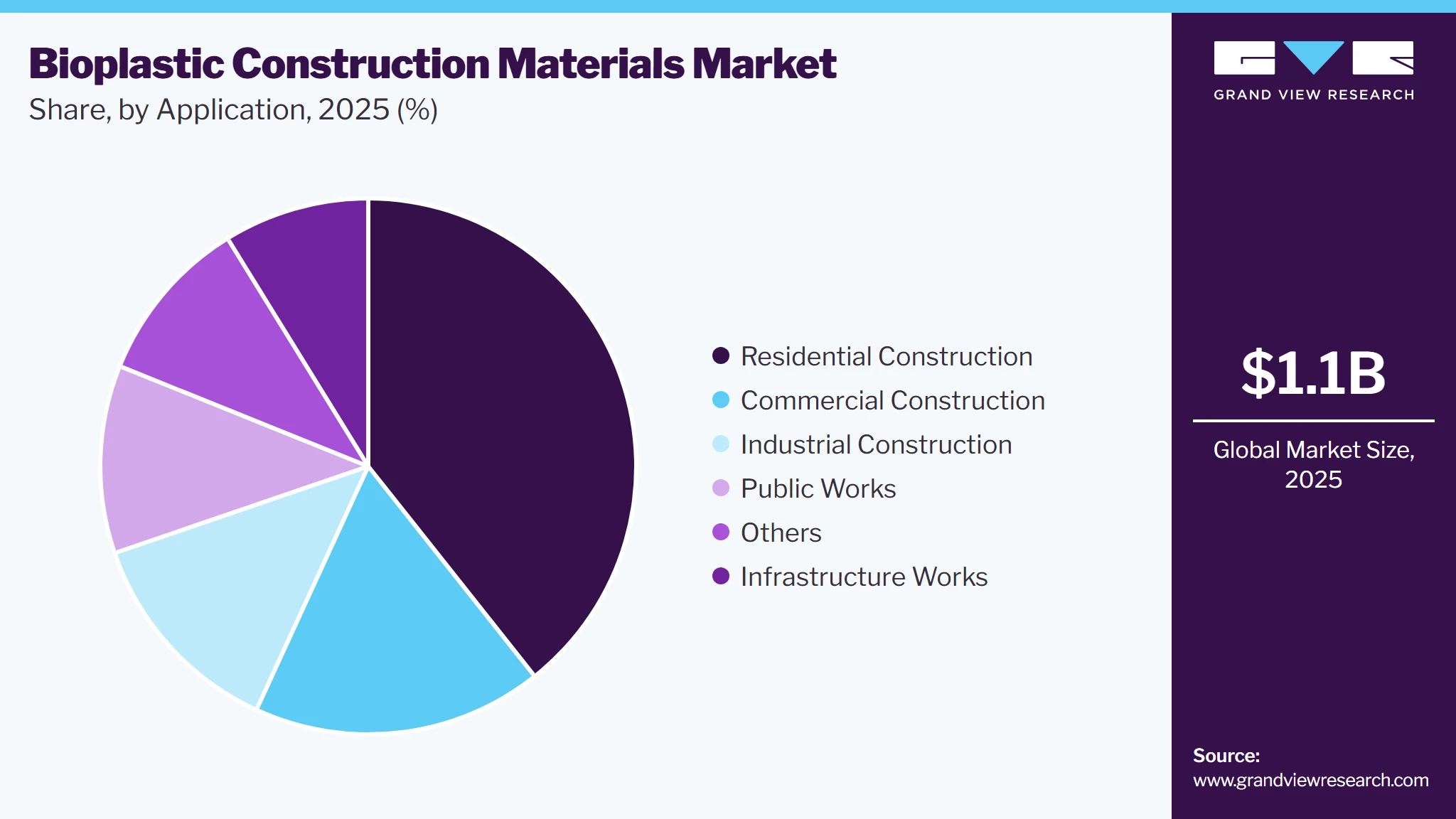
The commercial construction segment is expected to grow at the fastest CAGR of 13.3% over the forecast period. The commercial construction segment represents a high-value application area for bioplastic construction materials, supported by increasing demand for lightweight, durable, and environmentally responsible building solutions. These materials provide strength, moisture resistance, thermal stability, and design flexibility, enabling their use in panels, insulation systems, flooring, and interior components. Growing development of office complexes, hospitals, factories, and public infrastructure, alongside sustainability initiatives and green building requirements, is further accelerating demand for bioplastic construction materials across commercial applications.
Regional Insights
The Asia Pacific bioplastic construction materials industry held the largest revenue share of 56.1% in 2025. The region is expected to grow at a CAGR of 12.7% over the forecast period. Rapid industrialization and expanding construction activities are supporting the strong growth of the bioplastic construction materials market across Asia Pacific. Increasing demand from residential, commercial, infrastructure, and modular construction applications is driving the adoption of lightweight, durable, and sustainable materials. Rising investments in green buildings, urban infrastructure, and prefabricated construction are further accelerating regional market development. Continued innovation in bio-based polymers, composite materials, and scalable processing technologies is also strengthening adoption across the region.

India Bioplastic Construction Materials Market Trends
The India bioplastic construction materials market is expanding steadily, supported by rising demand from residential, commercial, and infrastructure construction applications. Growing investments in green buildings, urban development, modular construction, and sustainable infrastructure are strengthening the adoption of lightweight, durable, and environmentally responsible materials. Increasing focus on reducing construction waste, improving energy efficiency, and adopting bio-based materials, alongside expanding domestic manufacturing capabilities, is further encouraging market growth across the country.
North America Bioplastic Construction Materials Market Trends
The bioplastic construction materials market in North America is supported by strong demand from residential, commercial, industrial, and infrastructure construction applications. The region’s focus on sustainable building practices and advanced material technologies is driving the adoption of lightweight, durable, and environmentally responsible bioplastic solutions. Growing investments in green buildings, modular construction, renovation projects, and sustainable infrastructure are further strengthening regional market development.
The U.S. bioplastic construction materials market represents a major contributor to regional growth, supported by its established construction industry, technological capabilities, and increasing adoption of sustainable building materials. Rising utilization of bioplastic materials across insulation, panels, flooring, roofing, and prefabricated components is accelerating demand. Strong emphasis on energy efficiency, waste reduction, and environmentally responsible construction is further encouraging builders and manufacturers to develop high-performance bioplastic solutions for modern construction applications.
Europe Bioplastic Construction Materials Market Trends
The bioplastic construction materials market in Europe is expanding due to increasing adoption of sustainable materials across residential, commercial, industrial, and infrastructure applications. Demand is rising for lightweight, durable, and environmentally responsible materials that support energy-efficient buildings, modular construction, and sustainable infrastructure development. Additionally, stringent environmental regulations, sustainability-focused construction practices, and growing investments in green buildings and renovation projects are encouraging broader adoption of bioplastic construction materials across the region.
Central & South America Bioplastic Construction Materials Market Trends
The bioplastic construction materials market in Central & South America is driven by growing construction activity, expanding urban infrastructure, and rising adoption of sustainable building practices. These materials are increasingly used in insulation, panels, flooring, roofing, and prefabricated components due to their lightweight, durability, and environmental benefits. Increasing investments in residential development, commercial infrastructure, and modular construction are further supporting market growth, while growing emphasis on resource efficiency continues to encourage regional adoption.
Middle East and Africa Bioplastic Construction Materials Market Trends
The bioplastic construction materials market in the Middle East & Africa is expanding due to increasing adoption of sustainable materials across residential, commercial, industrial, and infrastructure applications. Growing demand for lightweight, durable, and environmentally responsible building materials is supporting their use in insulation, panels, flooring, roofing, and prefabricated components. Additionally, investments in urban development, sustainable infrastructure, green buildings, and construction modernization are encouraging broader adoption of bioplastic construction materials across the region.
Key Bioplastic Construction Materials Company Insights
Some of the key players operating in the market include BASF SE and NatureWorks LLC.
-
BASF SE participates in the bioplastic construction materials market through its bio-based polymers, sustainable resin technologies, and specialty material solutions designed for construction, automotive, packaging, and industrial applications. Supported by material innovation and polymer engineering capabilities, the company provides durable, lightweight, and resource-efficient solutions offering mechanical strength, thermal stability, processability, and enhanced sustainability, supporting growing demand for high-performance, customizable, and environmentally responsible bioplastic materials across construction and related application sectors.
-
NatureWorks LLC participates in the bioplastic construction materials market through its portfolio of Ingeo PLA biopolymer solutions designed for packaging, consumer goods, building materials, and industrial applications. Supported by strong biopolymer innovation capabilities and an established production footprint, the company provides bio-based materials offering lightweight properties, processability, durability, and reduced reliance on fossil-based feedstocks, strengthening its position in sustainable and high-performance bioplastic construction material applications.
Mitsubishi Gas Chemical Company Inc. and Green Dot Bioplastics are some of the emerging participants in the bioplastic construction materials market.
-
Mitsubishi Gas Chemical Company, Inc. is a specialty materials company focused on bio-based and engineering polymer solutions for construction, automotive, packaging, electronics, and industrial applications. Leveraging advanced polymer technology and material development capabilities, the company develops high-performance materials that provide durability, lightweight properties, thermal stability, chemical resistance, and processability. Its focus on sustainable and application-specific polymer development supports growing adoption of advanced bioplastic materials across demanding construction and industrial applications.
-
Green Dot Bioplastics participates in the bioplastic construction materials market through its portfolio of compostable and bio-based thermoplastic materials designed for consumer goods, packaging, industrial, and specialty applications. Leveraging advanced biopolymer technology, the company develops high-performance materials that provide durability, processability, renewable content, and end-of-life advantages. Its focus on application-specific and sustainable material development supports growing adoption of bioplastic solutions across construction and other environmentally responsible material applications.
Key Bioplastic Construction Materials Companies
The following key companies have been profiled for this study on the bioplastic construction materials market.
-
BASF SE
-
NatureWorks LLC
-
Kaneka Corporation
-
BEWI ASA
-
SK Chemicals
-
Solvay
-
Mitsubishi Gas Chemical Company, Inc.
-
Green Dot Bioplastics
-
Toyobo Co., Ltd.
Company Categorization
Operating Strategies
Competitive Edge
Weakness
Mature Players: BASF SE, NatureWorks LLC, Kaneka Corporation, BEWI ASA, SK Chemicals, Solvay
- Extensive focus on bio-based polymers, biodegradable materials, sustainable insulation, specialty resins, foams, and high-performance bioplastic solutions across construction, packaging, automotive, consumer goods, and industrial applications.
- Continuous investment in biopolymer innovation, renewable feedstocks, biodegradability, lightweighting, durability, thermal performance, and sustainable processing technologies.
- Expansion through global customer relationships, technical partnerships, application development, customized solutions, and established manufacturing and distribution networks.
- Strong expertise in bio-based polymers, biodegradable materials, specialty compounds, foams, resins, and sustainable material technologies.
- Established brands, customer relationships, technical capabilities, and global commercial networks provide strong market access.
- Broad product portfolios and application expertise enable customized, lightweight, durable, and environmentally responsible bioplastic solutions across construction and related application sectors.
- Bio-based and biodegradable materials can involve higher material, manufacturing, and processing costs compared with conventional petroleum-based construction materials.
- Dependence on construction, packaging, automotive, consumer goods, and industrial markets exposes companies to cyclical demand and changing sustainability requirements.
- Increasing competition, feedstock availability, performance requirements, regulatory standards, and development of alternative sustainable materials can raise R&D, testing, qualification, and commercialization costs.
Emerging Players: Mitsubishi Gas Chemical Company, Inc., Green Dot Bioplastics, Toyobo Co., Ltd.
- Focus on bio-based polymers, biodegradable materials, specialty resins, functional materials, and sustainable polymer solutions for construction, packaging, consumer goods, industrial, and specialty applications.
- Continuous investment in renewable feedstocks, biodegradability, mechanical performance, durability, light weighting, and advanced polymer processing technologies.
- Expansion across specialized applications through material innovation, application development, technical partnerships, and customized sustainable material solutions.
- Strong expertise in specialty polymers, bio-based materials, biodegradable formulations, functional resins, and advanced material development.
- Differentiated solutions combining sustainability, durability, processability, lightweight properties, and application-specific performance provide access to emerging bioplastic construction applications.
- Specialized capabilities across sustainable materials, specialty chemicals, and advanced polymer applications support market diversification and customer reach.
- Specialized product portfolios and application-focused solutions may limit exposure to broader construction material applications.
- Bio-based and biodegradable formulations can involve higher development, testing, qualification, and production costs compared with conventional materials.
- Competition from established polymer manufacturers and alternative bio-based material suppliers may increase pricing and differentiation pressures, particularly in cost-sensitive construction applications.
Recent Developments
-
In April 2026, NatureWorks LLC opened its fully integrated Ingeo PLA manufacturing facility in Thailand, integrating lactic acid, lactide, and polymer production and establishing the company’s second manufacturing site. The facility expands the global availability of PLA biopolymers for construction-related applications, including flooring, wall coverings, window shades, floor pads, protective moldings, and honeycomb cores, supporting broader adoption of bio-based materials across sustainable building and construction applications.
-
In February 2026, Kaneka Corporation and Mizuno advanced the commercialization of biodegradable materials by adopting Kaneka’s Green Planet biodegradable polymer in artificial turf at Vantelin Dome Nagoya, following their joint development efforts. Described as the world’s first application of Green Planet biodegradable artificial turf, the initiative demonstrates the use of biomass-derived biodegradable polymers in durable built-environment and sports infrastructure applications, supporting the broader adoption of sustainable material solutions in construction and infrastructure.
Bioplastic Construction Materials Market Report Scope
Report Attribute
Details
Market size value in 2025
USD 1.1 billion
Estimated market size in 2026
USD 1.2 billion
Projected market size by 2033
USD 2.6 billion
Growth rate
CAGR of 12.2% from 2026 to 2033
Historical data
2021 - 2025
Forecast period
2026 - 2033
Quantitative units
Volume in tons; revenue in USD billion, and CAGR from 2026 to 2033
Report coverage
Revenue & volume forecast, competitive landscape, growth factors, and trends
Segments covered
Material type, application, region
Regional scope
North America; Europe; Asia Pacific; Central & South America; Middle East & Africa
Country scope
U.S.; Canada; Mexico; Europe; Germany; UK; France; Italy; Spain; China; India; Japan; South Korea; Australia; Brazil; Argentina; Saudi Arabia; UAE; South Africa
Key companies profiled
BASF SE; NatureWorks LLC; Kaneka Corporation; BEWI ASA; SK Chemicals; Solvay; Mitsubishi Gas Chemical Company, Inc.; Green Dot Bioplastics; Toyobo Co., Ltd.
Customization scope
Free report customization (equivalent to up to 8 analyst working days) with purchase. Addition or alteration to country, regional & segment scope
Pricing and purchase options
Avail customized purchase options to meet your exact research needs. Explore purchase options
Global Bioplastic Construction Materials Market Report Segmentation
This report forecasts volume & revenue growth at the global, regional, and country levels and provides an analysis of the latest industry trends across sub-segments from 2021 to 2033. For this study, Grand View Research has segmented the global bioplastic construction materials market report based on material type, application, and region:

-
Material Type Outlook (Volume, Kilotons; Revenue, USD Billion, 2021 - 2033)
-
Bio-based Polyethylene (Bio-PE)
-
Polylactic Acid (PLA)
-
Polyhydroxyalkanoates (PHA)
-
Bio-based Polypropylene (Bio-PP)
-
Bio-based Polyethylene Terephthalate (Bio-PET)
-
Others
-
-
Application Outlook (Volume, Kilotons; Revenue, USD Billion, 2021 - 2033)
-
Residential Construction
-
Commercial Construction
-
Industrial Construction
-
Infrastructure Works
-
Public Works
-
Others
-
-
Regional Outlook (Volume, Kilotons; Revenue, USD Billion, 2021 - 2033)
-
North America
-
U.S.
-
Canada
-
Mexico
-
-
Europe
-
Germany
-
UK
-
France
-
Italy
-
Spain
-
-
Asia Pacific
-
China
-
India
-
Japan
-
South Korea
-
Australia
-
-
Central & South America
-
Brazil
-
Argentina
-
-
Middle East & Africa
-
Saudi Arabia
-
UAE
-
South Africa
-
-
Research Methodology
The bioplastic construction materials market figures in this report are based on a proven research process that combines executive interviews with secondary research from proprietary databases, company filings, and recognized regulatory and institutional sources. Market size is built through value-chain sizing-reconciling supply-side and demand-side estimates-and triangulated with bottom-up and top-down approaches. Every estimate passes multiple levels of expert validation before publication, with each bioplastic construction material segment quantified using the revenue-capture definitions in the table below.
Segment Definition
Segment - Material Type
Revenue capture definition
Bio-based Polyethylene (Bio-PE)
Revenue is captured through the sale of bio-based polyethylene materials used in construction films, vapor barriers, insulation components, piping, geomembranes, protective layers, and other building products. Value is driven by durability, moisture resistance, lightweight properties, chemical stability, and compatibility with established polyethylene processing technologies. Demand is supported by increasing adoption of renewable-content materials, green building practices, and low-carbon construction solutions requiring durable polymer materials with reduced fossil-feedstock dependence.
Polylactic Acid (PLA)
Revenue is generated through PLA materials used in construction panels, interior components, insulation applications, 3D-printed building elements, coatings, and other lightweight construction products. Value is influenced by bio-based content, biodegradability under suitable conditions, lightweight properties, processability, and design flexibility. Growth is supported by increasing demand for renewable construction materials, sustainable interior solutions, additive manufacturing, and building products seeking lower reliance on conventional fossil-based polymers.
Polyhydroxyalkanoates (PHA)
Revenue is captured through PHA materials used in specialty construction products, coatings, films, composites, insulation-related components, and other applications requiring biodegradable or bio-based polymer solutions. Value is driven by renewable feedstock potential, biodegradability, material versatility, and application-specific performance. Demand is supported by growing emphasis on circular construction practices, reduced environmental impact, and development of next-generation bioplastic materials for applications where end-of-life performance and sustainability are important considerations.
Bio-based Polypropylene (Bio-PP)
Revenue is generated through bio-based polypropylene materials used in construction components, insulation systems, pipes, fittings, flooring elements, protective products, and polymer-based building systems. Value is driven by lightweight properties, mechanical strength, chemical resistance, thermal performance, and compatibility with conventional polypropylene processing technologies. Demand is supported by increasing use of renewable-content polymers and the transition toward lower-carbon construction materials requiring durable materials without significant changes to existing processing and manufacturing infrastructure.
Bio-based Polyethylene Terephthalate (Bio-PET)
Revenue is captured through bio-based PET materials used in construction films, insulation components, fibers, reinforcement materials, protective layers, panels, and other building applications. Value is driven by mechanical strength, dimensional stability, chemical resistance, thermal performance, recyclability, and bio-based content. Demand is supported by increasing adoption of recycled and renewable-content materials, sustainable insulation and reinforcement solutions, and construction products requiring durable polymer materials with improved environmental performance.
Others
Revenue comes from other bio-based and biodegradable construction materials, including bio-based polyamides, bio-based polyurethanes, starch-based polymers, cellulose-based materials, bio-composites, and specialty biopolymer formulations used across insulation, coatings, panels, flooring, adhesives, and structural or interior applications. Value is supported by application-specific mechanical, thermal, chemical, and sustainability characteristics. Emerging applications create opportunities for premium formulations, multifunctional materials, customized performance, and diversified revenue streams across sustainable building and construction applications.
Segment - Application
Revenue capture definition
Residential Construction
Revenue is captured through bioplastic construction materials used in residential insulation, flooring, roofing components, wall panels, piping, interior products, protective films, and other building applications. Value is driven by lightweight properties, durability, moisture resistance, thermal performance, renewable content, and improved environmental characteristics. Demand is supported by increasing residential construction activity, green building standards, consumer preference for sustainable homes, and growing adoption of low-carbon and resource-efficient building materials.
Commercial Construction
Revenue is generated through bioplastic construction materials used in commercial buildings, including insulation systems, flooring, wall and ceiling panels, roofing components, interior finishes, piping, protective layers, and other building products. Value is driven by durability, design flexibility, lightweight performance, thermal properties, and sustainability credentials. Growth is supported by increasing green building investments, energy-efficient commercial construction, corporate sustainability initiatives, and demand for construction materials with lower environmental impact and reliable long-term performance.
Industrial Construction
Revenue is captured through bioplastic construction materials used in industrial facilities, warehouses, manufacturing plants, insulation systems, protective coatings, piping, flooring, panels, and specialized structural or interior components. Value is driven by mechanical strength, chemical resistance, thermal stability, durability, and processability. Demand is supported by industrial expansion, modernization of manufacturing facilities, sustainable infrastructure investments, and increasing requirements for durable construction materials that support resource efficiency and lower environmental impact.
Infrastructure Works
Revenue is generated through bioplastic construction materials used in roads, bridges, utilities, water management systems, drainage, geotechnical applications, protective layers, piping, insulation, and other infrastructure projects. Value is driven by durability, moisture resistance, lightweight properties, chemical stability, and potential reductions in lifecycle environmental impact. Demand is supported by infrastructure modernization, renewable and low-carbon construction initiatives, urban development, and increasing investment in sustainable materials for long-life infrastructure applications.
Public Works
Revenue is captured through bioplastic construction materials used in schools, hospitals, government buildings, public facilities, transportation infrastructure, recreational facilities, and municipal projects. Value is driven by sustainability, durability, lightweight performance, thermal efficiency, design flexibility, and resource-efficient material characteristics. Demand is supported by government-led green construction programs, sustainable procurement policies, public infrastructure development, and increasing emphasis on reducing the environmental footprint of publicly funded construction projects.
Others
Revenue comes from specialized construction applications, including temporary structures, modular construction, prefabricated buildings, landscaping products, agricultural construction, disaster-relief structures, and emerging sustainable building systems. Value is supported by lightweight properties, portability, durability, renewable content, design flexibility, and application-specific functional performance. These emerging applications create opportunities for multifunctional bioplastic materials, customized formulations, innovative construction systems, and diversified revenue streams across specialized and next-generation building applications.
Estimation Model
Layer No.
Layer Name
Key Question
Description
1
Top-Down Bioplastic Construction Materials Demand Assessment Layer
What defines market boundaries?
This layer establishes global demand for bioplastic construction materials across residential construction, commercial construction, industrial construction, infrastructure works, public works, and other construction applications. Demand is filtered through macro drivers such as green building initiatives, construction activity, sustainability regulations, decarbonization targets, circular economy practices, and increasing preference for renewable and low-carbon building materials. This defines the total addressable market based on consumption and revenue generated from bioplastic construction materials.
2
End-Use Demand Validation Layer
Where is demand generated?
This layer maps demand across residential, commercial, industrial, infrastructure, public works, and other construction applications, including insulation, flooring, roofing components, panels, piping, coatings, films, composites, and other building products. Market sizing is aligned with performance requirements such as mechanical strength, durability, thermal insulation, moisture resistance, chemical resistance, lightweight properties, processability, renewable content, recyclability, and biodegradability across different construction applications.
3
Consumption-to-Revenue Conversion Layer
Who captures market revenue?
This layer translates bioplastic material consumption and construction application volumes into revenue potential using material utilization rates, formulation requirements, processing methods, material specifications, component requirements, and application-specific consumption patterns. Pricing differentials across Bio-PE, PLA, PHA, Bio-PP, Bio-PET, and other bio-based or biodegradable materials are incorporated to estimate value realization across polymer manufacturers, compounders, material suppliers, distributors, construction product manufacturers, contractors, and downstream end users.
4
Regional Demand Verification Layer
How are assumptions validated?
This layer validates demand distribution across North America, Europe, Asia Pacific, Central & South America, and the Middle East & Africa by assessing construction activity, green building investments, infrastructure development, sustainability regulations, bio-based material adoption, and investments in low-carbon construction technologies. Regional construction trends, technology maturity, raw material availability, supply chain dynamics, production capacity, application penetration, regulatory frameworks, and investment in sustainable building materials are used to verify market penetration assumptions and strengthen forecast reliability.
Delivered Customizations
This report has been delivered with the following In-depth customizations
Client Request
Customization Delivered
Value Adds
Regional segmentation
Detailed analysis of the Bioplastic Construction Materials Market across North America, Europe, Asia Pacific, Latin America, and the Middle East & Africa, including country-level assessment of key markets, adoption trends, regulatory developments, and construction activity.
Enables identification of high-growth regions, country-level opportunities, and regional demand patterns for bioplastic construction materials.
Competitive benchmarking
Benchmarking of key participants based on product portfolio, bioplastic technologies, application coverage, geographic presence, sustainability initiatives, manufacturing capabilities, strategic developments, and market positioning.
Supports assessment of competitive strengths, differentiation strategies, capability gaps, and positioning opportunities across mature and emerging players.
Opportunity assessment
Identification of emerging opportunities across sustainable construction, bio-based insulation, biodegradable composites, green building materials, lightweight components, circular construction solutions, and low-carbon building applications, supported by technology and regulatory trends.
Helps stakeholders prioritize high-potential applications, technologies, geographic markets, and investment areas with strong long-term growth potential.
Frequently Asked Questions About This Report
The bioplastic construction materials market was estimated at around USD 1.1 billion in the year 2025 and is expected to reach around USD 1.2 billion in 2026.
The bioplastic construction materials market is expected to grow at a compound annual growth rate of 12.2% from 2026 to 2033 to reach around USD 2.6 billion by 2033.
The bio-based polyethylene (Bio-PE) in the bioplastic construction materials industry led the plastics in the bioplastic construction materials material type market in 2025 with a 38.7% share. Growing demand for sustainable construction materials, coupled with advances in bio-based polyethylene production and processing technologies, is accelerating Bio-PE adoption across residential, commercial, industrial, and infrastructure applications.
The Asia Pacific Bioplastic Construction Materials market accounted for the largest share of 56.1% market size in 2025.
India was the leading player in the bioplastic construction materials market and is expected to grow at a compound annual growth rate of 15.1%.
The key players in the bioplastic construction materials market are BASF SE, NatureWorks LLC, Kaneka Corporation, BEWI ASA, Mitsubishi Gas Chemical Company, Inc., Green Dot Bioplastics, Toyobo Co., Ltd., SK Chemicals, Solvay.
The market is driven by increasing sustainability priorities in construction and rising adoption of bioplastic materials. Bio-based solutions reduce carbon footprints and VOC emissions, while advances in resins, material engineering, and energy-efficient processing improve durability, cost-effectiveness, scalability, and alignment with green building standards.
Based on application, the residential construction segment accounted for the largest share of 39.3% market size in 2025. Growing residential construction activity, rising demand for sustainable building materials, and increasing focus on energy-efficient homes are accelerating bioplastic construction materials adoption across roofing, insulation, flooring, and structural applications.
The polylactic acid (PLA) segment, based on material type, is expected to grow at a CAGR of 13.5% for the forecast period.
About the Author(s)
Plastics, Polymers & Resins Research Team
Bulk Chemicals · Plastics, Polymers & ResinsThis report was authored by the plastics, polymers & resins research team at Grand View Research - comprising two research analysts, one senior research analyst, and one industry expert - with specialized expertise in the plastics, polymers & resins segment of the bulk chemicals industry. All findings are based on proprietary bulk chemicals databases, executive interviews, and regulatory analysis, subject to internal peer review prior to publication.
Last Updated:
Speak to Analyst


Customize this report to your needs — add regions, segments, or data points, with 20% free customization.
Or view our licence options:


ISO 9001:2015 & 27001:2022 Certified
We are GDPR and CCPA compliant! Your transaction & personal information is safe and secure. For more details, please read our privacy policy.












