
- Home
- »
- Renewable Chemicals
- »
-
Biosurfactants Market Size And Share Report, 2026-2033GVR Report cover
![Biosurfactants Market (2026 - 2033)Report]()
Biosurfactants Market (2026 - 2033)
Size, Share & Trends Analysis Report By Product (Rhamnolipids, Sophorolipids, MES, APG, Sorbitan Esters, Sucrose Esters), By Application (Household Detergents, Personal Care, Industrial Cleaners), By Region And Segment Forecasts
Market Size, 2025
$6.1BMarket Estimate, 2026
$6.4BMarket Forecast, 2033
$9.5BCAGR, 2026–2033
5.8%Biosurfactants Market Summary
The global biosurfactants market size was valued at USD 6.1 billion in 2025 and is projected to grow from USD 6.4 billion in 2026 to USD 9.5 billion by 2033, growing at a CAGR of 5.8% from 2026 to 2033. The Europe market held the largest share of 52.6% of the global market in 2025. Growing consumer awareness, preference for sustainable and natural products, and increasing demand for cleaning and hygiene products are factors driving the biosurfactants market.

Key Market Trends & Insights
- By product: The methyl ester sulfonate (MES) segment accounted for the largest share of the biosurfactants market, representing 33.3% of total revenue in 2025
- By application: The household detergents segment accounted for the largest share of the biosurfactants market, representing 45.0% of total revenue in 2025.
Regional Highlights
- Largest regional market: Europe (52.6% revenue share, 2025)
- By country: The Germany held the largest market share in 2025.li>
Market Size & Forecast
- Market size in 2025: USD 6.1 Billion
- Estimated market size in 2026: USD 6.4 Billion
- Projected market size by 2033: USD 9.5 Billion
- CAGR (2026-2033): 5.8%
The biosurfactants industry is experiencing a surge in demand due to the increasing awareness of the environmental benefits of biodegradable and renewable raw materials. Biosurfactants, produced by yeast, fungi, and bacteria, offer a more sustainable alternative to synthetic surfactants, with advantages such as low toxicity and easy biodegradability. As a result, the market for biosurfactants is expanding across various industries, including food processing, personal care products, medicines, and agriculture.
The growth of the biosurfactants market is attributed to its eco-friendly properties, which set it apart from synthetic surfactants. The production of biosurfactants is gaining popularity among manufacturers, who are shifting towards environmentally friendly products to meet consumer demands. Furthermore, government support and consumer awareness about the benefits of biosurfactants are expected to continue to drive the market growth.
The applications of biosurfactants are diverse, encompassing fields such as food and beverages, pharmaceuticals, agriculture, cosmetics, and oil recovery. The increasing adoption of biosurfactants as substitutes for chemical surfactants is also contributing to the market growth. Factors such as heightened awareness about environmental impact and cost advantages of biosurfactants is likely to further propel the market growth. As consumers become more aware of the benefits of eco-friendly products, the demand for biosurfactants is expected to increase, leading to a substantial growth in the global biosurfactants market in the coming years.
Market Dynamics
The biosurfactants market is witnessing significant growth driven by increasing demand for sustainable, biodegradable, and environmentally friendly alternatives to conventional petrochemical-based surfactants. Growing regulatory pressure on synthetic chemicals, rising consumer preference for green products, and expanding applications across personal care, household detergents, agriculture, food processing, and oilfield chemicals are supporting market expansion. In addition, advancements in biotechnology and fermentation technologies are improving production efficiency and enabling wider commercialization of biosurfactants. As industries increasingly focus on sustainability and carbon footprint reduction, biosurfactants are gaining traction as a viable solution across multiple end-use sectors
The growing global emphasis on sustainability and environmental protection is a major factor driving the biosurfactants market. Conventional surfactants are primarily derived from petrochemical feedstocks and may exhibit limited biodegradability, resulting in environmental concerns related to aquatic toxicity and ecosystem contamination. In contrast, biosurfactants are produced from renewable raw materials such as vegetable oils, sugars, and agricultural feedstocks, offering superior biodegradability and lower environmental impact. As governments worldwide implement stricter environmental regulations, industries are increasingly shifting toward bio-based alternatives to meet sustainability goals and regulatory requirements.
Rising consumer awareness regarding eco-friendly products is accelerating the adoption of biosurfactants in personal care, cosmetics, household cleaning products, and food applications. Consumers are actively seeking products formulated with natural and renewable ingredients, prompting manufacturers to incorporate biosurfactants into their product portfolios. The growing popularity of green labels, clean-label formulations, and sustainable consumer goods is expected to further strengthen demand for biosurfactants across both developed and emerging economies.
Despite their environmental advantages, high production costs remain a key challenge for the biosurfactants market. The manufacturing of biosurfactants typically involves complex fermentation processes, specialized microbial strains, downstream purification requirements, and stringent quality control measures. Compared to conventional synthetic surfactants, biosurfactant production remains relatively expensive, limiting their widespread adoption in price-sensitive applications such as bulk detergents and industrial cleaning products. Raw material costs, fermentation yields, and purification expenses continue to impact overall production economics.
Commercial-scale production remains limited compared to the well-established infrastructure available for petrochemical-based surfactants. Many biosurfactant manufacturers face challenges related to process optimization, production consistency, and scaling operations to meet growing global demand. Supply chain limitations and relatively lower production capacities can create availability constraints, particularly for large-volume industrial applications. These factors may slow market penetration and hinder broader adoption until technological advancements and economies of scale improve the cost competitiveness of biosurfactants.
Opportunity - Expansion of Biosurfactants in Personal Care, Agriculture, and Industrial Applications
The growing adoption of bio-based and sustainable ingredients across personal care, cosmetics, agriculture, and industrial sectors presents a significant opportunity for the biosurfactants market. Consumers are increasingly favoring natural and environmentally friendly products, prompting manufacturers to replace synthetic surfactants with biodegradable alternatives. Biosurfactants offer advantages such as low toxicity, high biodegradability, and compatibility with sensitive formulations, making them particularly attractive for skincare products, shampoos, household cleaners, and premium personal care applications. The rising demand for clean-label and sustainable consumer products is expected to create substantial growth opportunities for biosurfactant manufacturers.
Emerging applications in agriculture, oilfield chemicals, environmental remediation, and industrial cleaning are expanding the commercial potential of biosurfactants. In agriculture, biosurfactants are increasingly being incorporated into biopesticides, biosurfactantss, and soil conditioning products to support sustainable farming practices. Growing investments in biotechnology, coupled with advancements in fermentation technologies and renewable feedstock utilization, are expected to improve production economics and facilitate broader market adoption. As industries continue to pursue decarbonization and sustainability objectives, biosurfactants are well-positioned to capture a larger share of the global surfactants market in the coming years
Analyst Perspective
The biosurfactants market is undergoing a gradual transition from niche specialty applications toward broader commercial adoption as sustainability objectives, regulatory pressures, and consumer preferences increasingly favor bio-based alternatives to conventional surfactants. While personal care and household cleaning products currently represent key demand centers, emerging opportunities in agriculture, environmental remediation, oilfield chemicals, and industrial cleaning are expected to accelerate market growth over the forecast period. Advancements in fermentation technologies, microbial strain optimization, and renewable feedstock utilization are steadily improving production economics, enhancing the competitiveness of biosurfactants against synthetic counterparts. Going forward, manufacturers capable of achieving commercial-scale production, ensuring consistent product quality, and developing application-specific formulations are expected to be best positioned to capitalize on the growing demand for sustainable surfactant solutions
Product Insights
The methyl ester sulfonate (MES) segment accounted for the largest share of the biosurfactants market, representing 33.3% of total revenue in 2025. MES, derived from renewable resources such as palm and coconut oil, is a cost-effective and eco-friendly alternative to synthetic surfactants. It’s biodegradable, non-toxic, and exhibits excellent detergency, foaming, and wetting abilities, making it suitable for various cleaning applications in laundry soaps, dishwashing soaps, and household products.
Rhamnolipids is expected to register the fastest CAGR of 10.9% during the forecast period.Rhamnolipid biosurfactants are gaining global attention due to their unique features and environmental benefits. These surfactants have been found to reduce surface tension, emulsify, wet, and foam, making them versatile for various applications. Synthesized by bacteria such as Pseudomonas aeruginosa, rhamnolipids are being increasingly adopted in industries as the world shifts towards more eco-friendly products.
Application Insights
The household detergents segment accounted for the largest share of the biosurfactants market, representing 45.0% of total revenue in 2025. Biosurfactants, produced by microorganisms, are gaining attention as eco-friendly ingredients in household products. They can be used in dishwashing liquids, laundry detergents, and cleaning agents, effectively removing dirt, grease, and stains. Compared to traditional chemicals, biosurfactants are less toxic and environment-friendly, making them a safer choice for homes with children and pets.

Personal care is projected to grow at the fastest CAGR of 6.3% over the forecast period. Biosurfactants are widely used in shampoo and body wash production due to high demand for natural and gentle cosmetics. Their inclusion allows products to be labeled as natural and environment-friendly, justifying higher prices. As consumer awareness increases, the demand for natural products grows, presenting a promising market opportunity for biosurfactants in the personal care segment.
Regional Insights
North America biosurfactants market was identified as a lucrative region in 2023. The changes in consumer choices are expected as a result of increasing worry over the harmful effects of toxins released by chemical surfactants during decomposition. The market is expected to expand due to increasing expenditure on health and cleanliness. In addition, increasing need for biosurfactants in the petroleum & oil sector for enhancing oil recovery is anticipated to drive expansion.
U.S. Biosurfactants Market Trends
The biosurfactants market in the U.S. is expected to grow rapidly in the coming years due to a growing demand for natural and organic products across all sectors. This includes personal care products, detergents, and even food items. Biosurfactants are considered perfect for this purpose, as they are derived from renewable resources.
Europe Biosurfactants Market Trends
Europe accounted for 52.6% of the biosurfactants market revenue in 2025. Germany maintained a leading position in the Europe biosurfactants market. Increasing knowledge among manufacturers concerning the utilization of EA to reduce CFPs should drive the market forward. Higher legislation regarding the consumption of certain chemicals that may yield dangerous by-products or toxins when afflicted with biological decomposition is also anticipated to drive better growth. In regard to the Europe legislation, based on the information provided by the European Commission, the Europe community introduced a policy to reduce surfactant content in detergents from 1970 to prevent the foaming in water systems that affects the marine environment.

The biosurfactants market in the UK dominated the Europe market in 2023. The personal care and cosmetics market in the UK to meet the demand for natural raw materials. The utilization of biosurfactants is a means towards creation of efficient, environment-friendly products. The law on obtaining or disposing of hazardous substances is very strict in the UK, which encourages the industries to use the biosurfactants to replace those synthetic surfactants, which may not be compatible with new environmental measures.
Asia Pacific Biosurfactants Market Trends
Asia Pacific biosurfactants market is anticipated to witness significant growth in the market. The growing concern of the public about the impact of the regular surfactants on the environment and people’s heath also favor the use of biosurfactants in the region. China, Japan, India, South Korea are the principal countries driving the Asia Pacific biosurfactants market. Hence, it can be concluded that the increasing usage of personal care and home care products along with the implementation of environmental friendly technologies used are some of the factors that may further fuel the growth of the market in the coming years.
The biosurfactants market in China is expected to grow rapidly over the forecast period due to China’s booming industries, particularly those in food processing, textiles, and oil and gas, are creating a strong demand for high-performance cleaning agents. Biosurfactants offer a viable solution due to their effectiveness and biodegradability.
Key Biosurfactants Company Insights
Some key companies in biosurfactants market include Evonik Industries AG; Allied Carbon Solutions Co., Ltd.; Saraya Co., Ltd.; and Jeneil Biotech, Inc. Fueled by the growing demand for eco-friendly products across industries, key players form strategic partnerships to gain a competitive edge and boost market share in the biosurfactants market.
-
Evonik Industries AG, a subsidiary of RAG-Stiftung, offers a wide range of products, including surfactants, polymers, resins, and additives. Its products are utilized in various industries such as agriculture, renewable energy, paints, coatings, paper, and others.
-
Jeneil Biotech is a producer of biosurfactants, with over 50 years of experience in flavor technologies. The company develops dairy and plant-based flavors, probiotic cultures, and flavor chemicals through fermentation and enzyme technology. Its rhamnolipid biosurfactants are manufactured using renewable resources and precision fermentation, offering environmentally friendly and sustainable solutions.
Key Biosurfactants Companies:
The following key companies have been profiled for this study on the biosurfactants market.
-
Evonik Industries AG
-
Allied Carbon Solutions Co., Ltd.
-
Saraya Co., Ltd.
-
Jeneil Biotech, Inc.
-
Solvay S.A.
-
Givaudan
-
Synthezyme LLC
-
Kaneka Corporation
-
GlycoSurf LLC
-
Stepan Company
Competitive Benchmarking
Category
Operating Strategies
Competitive Edge
Weakness
Established Players (Evonik Industries AG, Solvay S.A., Givaudan, Kaneka Corporation, Stepan Company)
- Focus on expanding biosurfactant production capacities and commercial-scale fermentation technologies.
- Invest heavily in R&D for glycolipids, rhamnolipids, sophorolipids, and specialty bio-based surfactants.
- Strengthen sustainability portfolios through bio-based ingredients and low-carbon manufacturing initiatives.
- Expand through strategic partnerships, acquisitions, and global distribution networks across personal care, home care, agriculture, and industrial applications
- Strong technological expertise and established biotechnology capabilities.
- Extensive global manufacturing footprint and distribution networks.
- Diversified customer base across personal care, household cleaning, agriculture, food processing, and industrial sectors.
- Significant financial resources supporting innovation, regulatory approvals, and commercial expansion
- High production and fermentation costs compared to conventional surfactants.
- Complex scale-up and commercialization challenges for specialty biosurfactants.
- Exposure to feedstock price fluctuations and regulatory compliance requirements.
- Longer decision-making processes due to large organizational structures
Emerging / Regional Players (Allied Carbon Solutions Co., Ltd., Saraya Co., Ltd., Jeneil Biotech, Inc., Synthezyme LLC, GlycoSurf LLC, ConnOils LLC)
- Focus on niche biosurfactant technologies, specialty formulations, and application-specific solutions.
- Emphasize customized products for personal care, industrial cleaning, agriculture, and environmental remediation applications.
- Expand through regional distributor partnerships, contract manufacturing, and technology licensing agreements.
- Develop innovative fermentation processes and renewable feedstock utilization strategies
- Greater operational flexibility and faster adaptation to emerging customer requirements.
- Strong specialization in specific biosurfactant categories and niche applications.
- Ability to provide customized and cost-effective solutions for targeted industries.
- Faster commercialization of innovative bio-based surfactant technologies
- Limited geographic presence and smaller production capacities compared to multinational competitors.
- Lower financial resources for large-scale production expansion and global market penetration.
- Dependence on selected application sectors and regional demand patterns.
- Limited brand recognition and distribution capabilities in international markets
Recent Developments
-
In May 2024, Evonik Industries AG inaugurated a new facility in Slovakia, marking the first industrial-scale production of rhamnolipid biosurfactants worldwide. The triple-digit million-euro facility utilizes a biotechnological process to produce high-quality, sustainable biosurfactants from renewable corn feedstocks.
-
In April 2024, AmphiStar, a Ghent-based biotech startup, secured USD 6.5 million in funding to launch eco-friendly, cost-effective biosurfactants from waste. The investment enabled commercial production and R&D efforts, refining its technology and regulatory dossiers.
Biosurfactants Market Report Scope
Report Attribute
Details
Market size value in 2025
USD 6.1 billion
Estimated market size in 2026
USD 6.4 billion
Projected market size by 2033
USD 9.5 billion
Growth rate
CAGR of 5.8% from 2026 to 2033
Base year for estimation
2025
Historical data
2021 - 2024
Forecast period
2026 - 2033
Quantitative units
Volume, Kilotons; Revenue in USD million/billion and CAGR from 2026 to 2033
Report coverage
Revenue forecast, company ranking, competitive landscape, growth factors, and trends
Segments covered
Product, application, region
Regional scope
North America; Europe; Asia Pacific; Latin America; MEA
Country scope
U.S.; Canada; Mexico; Germany; UK; France; Italy; Spain; China; India; Japan; South Korea; Brazil; Argentina; Saudi Arabia; South Africa.
Key companies profiled
Evonik Industries AG; Allied Carbon Solutions Co., Ltd.; Saraya Co., Ltd.; Jeneil Biotech, Inc.; Solvay S.A.; Givaudan; Synthezyme LLC; Kaneka Corporation; GlycoSurf LLC; Stepan Company
Customization scope
Free report customization (equivalent up to 8 analysts' working days) with purchase. Addition or alteration to country, regional & segment scope.
Pricing and purchase options
Avail customized purchase options to meet your exact research needs. Explore purchase options
Global Biosurfactants Market Report Segmentation
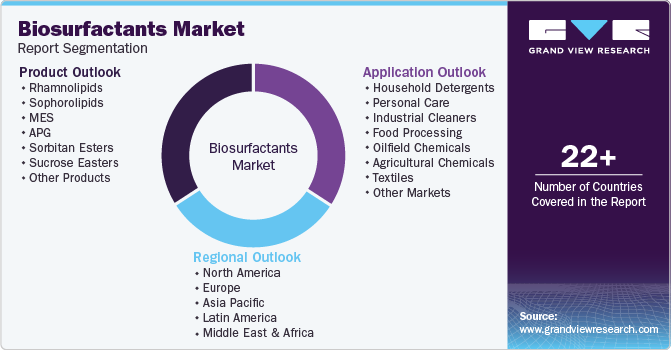
This report forecasts volume and revenue growth at global, regional, and country levels and provides an analysis of the latest industry trends in each of the sub-segments from 2021 to 2033. For this study, Grand View Research has segmented the global biosurfactants market report based on product, application, and region.
-
Product Outlook (Volume, Kilotons; Revenue, USD Million, 2021 - 2033)
-
Rhamnolipids
-
Sophorolipids
-
MES
-
APG
-
Sorbitan Esters
-
Sucrose Easters
-
Other Products
-
-
Application Outlook (Volume, Kilotons; Revenue, USD Million, 2021 - 2033)
-
Household Detergents
-
Personal Care
-
Industrial Cleaners
-
Food Processing
-
Oilfield Chemicals
-
Agricultural Chemicals
-
Textiles
-
Other Markets
-
-
Regional Outlook (Volume, Kilotons; Revenue, USD Million, 2021 - 2033)
-
North America
-
U.S.
-
Canada
-
Mexico
-
-
Europe
-
UK
-
Germany
-
France
-
Italy
-
Spain
-
-
Asia Pacific
-
China
-
Japan
-
India
-
South Korea
-
-
Latin America
-
Brazil
-
Argentina
-
-
Middle East and Africa (MEA)
-
South Africa
-
Saudi Arabia
-
-
Research Methodology
Segment Definition
Segment - Product
Revenue capture definition
Rhamnolipids
Revenue generated from the production and sale of rhamnolipid-based biosurfactants primarily used in household detergents, industrial cleaners, oilfield chemicals, agriculture, and environmental remediation applications. Revenue is driven by increasing demand for biodegradable surfactants with superior emulsification and wetting properties
Sophorolipids
Revenue generated from sophorolipid biosurfactants utilized across personal care, cosmetics, household cleaning products, food processing, and specialty industrial applications. Demand is supported by growing consumer preference for sustainable and bio-based ingredients in cleaning and personal care formulations
MES
Revenue generated from bio-based surfactant formulations derived from renewable vegetable oil feedstocks. MES products are widely utilized in detergents, cleaning products, and industrial applications due to their favorable biodegradability profile and cost competitiveness relative to conventional surfactants
APG
Revenue generated from APG-based biosurfactants used in personal care, household detergents, industrial cleaners, and agricultural formulations. Revenue growth is supported by increasing adoption of mild, non-toxic, and environmentally friendly surfactants across consumer and industrial markets.
Sorbitan Esters
Revenue generated from sorbitan ester biosurfactants utilized as emulsifiers, dispersing agents, and stabilizers across food processing, cosmetics, pharmaceuticals, and industrial formulations. Demand is driven by growing requirements for bio-based emulsification technologies
Sucrose Esters
Revenue generated from sucrose ester biosurfactants primarily used in food & beverage processing, pharmaceuticals, personal care, and specialty formulations. Revenue growth is supported by increasing demand for clean-label ingredients and sustainable emulsifier systems
Other Products
Revenue generated from other biosurfactant categories including lipopeptides, mannosylerythritol lipids (MELs), cellobiose lipids, polymeric biosurfactants, and specialty microbial surfactants designed for niche industrial, environmental, and agricultural applications
Segment - Application
Revenue capture definition
Household Detergents
Revenue generated from the incorporation of biosurfactants into laundry detergents, dishwashing liquids, surface cleaners, and other household cleaning products. Demand is driven by increasing consumer preference for biodegradable and environmentally friendly cleaning formulations
Personal Care
Revenue generated from biosurfactant utilization in skincare products, shampoos, body washes, facial cleansers, cosmetics, and other personal care formulations. Revenue growth is supported by rising demand for natural, mild, and sustainable ingredients
Industrial Cleaners
Revenue generated from biosurfactants functioning as emulsifiers, dispersants, stabilizers, and processing aids within food and beverage manufacturing. Growing clean-label and natural ingredient trends support demand within this application segment
Food Processing
Revenue generated from biosurfactants applications in oilseed and pulse crops including soybean, groundnut, sunflower, rapeseed, chickpea, lentil, pea, and other leguminous crops.
Oilfield Chemicals
Revenue generated from biosurfactant applications in enhanced oil recovery (EOR), drilling fluids, oil spill remediation, reservoir stimulation, and produced water treatment. Demand is supported by increasing focus on environmentally responsible oilfield operations
Agricultural Chemicals
Revenue generated from biosurfactants used as wetting agents, dispersants, emulsifiers, and adjuvants within crop protection products, biosurfactantss, biopesticides, and sustainable agricultural formulations
Textiles
Revenue generated from biosurfactant utilization in textile processing operations including dyeing, wetting, scouring, softening, and finishing applications. Adoption is increasing due to sustainability initiatives within the textile industry
Others Applications
Revenue generated from biosurfactant use across environmental remediation, mining, water treatment, pharmaceuticals, construction chemicals, and other specialty industrial applications requiring biodegradable surfactant solutions
Estimation Model
Layer Name
Key Question
Description
End-Use Industry Demand Layer
What forms the demand base?
Identify global demand across major end-use sectors including personal care & cosmetics, household detergents, agriculture, food processing, oilfield chemicals, industrial cleaning, and environmental remediation. This layer establishes the addressable demand base by evaluating surfactant consumption trends and the shift toward sustainable alternatives
Biosurfactant Adoption Layer
Where are biosurfactants used?
Estimate the penetration of biosurfactants within conventional surfactant-consuming industries. Assess adoption levels of rhamnolipids, sophorolipids, glycolipids, lipopeptides, and other biosurfactants across applications, regions, and sustainability-driven product categories
Consumption Intensity Layer
How much biosurfactants is used?
Analyze average biosurfactant usage rates within formulations across personal care products, detergents, agrochemicals, industrial cleaners, and specialty applications. Consumption intensity is influenced by product performance requirements, formulation complexity, regulatory standards, and application-specific dosage levels
Revenue Layer
How is market revenue generated?
Market revenue is generated through the sale of biosurfactants used as emulsifiers, wetting agents, dispersants, foaming agents, and cleaning agents across multiple industries. Revenue is captured from personal care manufacturers, detergent producers, agricultural formulators, industrial chemical companies, food processors, and environmental service providers seeking sustainable and biodegradable surfactant solutions
Delivered Customizations
This report has been delivered with the following In-depth customizations
Client Request
Customization Delivered
Value Adds
Regional Segmentation
Detailed regional assessment of biosurfactant demand across North America, Europe, Asia Pacific, Latin America, and Middle East & Africa, including country-level analysis of production capacity, feedstock availability, regulatory developments, sustainability initiatives, and end-use industry demand. Additional country-level coverage can be incorporated for key markets such as the U.S., Germany, France, China, Japan, South Korea, Brazil, and India
Enables identification of high-growth regional markets, production hubs, sourcing opportunities, and evolving regulatory landscapes. Supports geographic expansion planning, localization strategies, distributor identification, and investment decision-making through enhanced visibility into regional biosurfactant demand trends
Competitive Benchmarking
Comparative evaluation of leading biosurfactant manufacturers based on technology platforms, fermentation capabilities, product portfolio breadth, feedstock sourcing strategies, production capacity, geographic presence, distribution networks, sustainability initiatives, R&D investments, and strategic developments across key markets
Assists competitive intelligence, partnership evaluation, acquisition screening, and supplier assessment by providing deeper visibility into market positioning, technological capabilities, innovation strengths, and long-term growth potential
Opportunity Assessment
Comprehensive assessment of emerging opportunities associated with sustainable consumer products, bio-based detergents, natural personal care ingredients, environmental remediation, agricultural biologicals, industrial cleaning solutions, carbon reduction initiatives, and advancements in microbial fermentation technologies
Helps identify high-growth investment areas, emerging application opportunities, technology development priorities, and market expansion strategies, supporting long-term business growth and competitive differentiation within the biosurfactants value chain
Frequently Asked Questions About This Report
Key factors that are driving the market growth include escalating consumer preference towards the use of bio-based products, particularly in Europe and North America.
The global biosurfactant market size was estimated at USD 6.1 billion in 2025 and is expected to reach USD 6.4 billion in 2026.
The global biosurfactant market is expected to grow at a compound annual growth rate of 5.8% from 2026 to 2033 to reach USD 9.5 billion by 2033.
Europe dominated the biosurfactant market with a share of 52.6% in 2025. This is attributable to rising awareness among consumers regarding the health hazards associated with chemical surfactants.
Some key players operating in the biosurfactant market include BASF, Ecover, Urumqui Unite, MG Intobio and Saraya
MES segment dominated the biosurfactants market with a revenue share of 33.3%, in 2025.
Household segment dominated the biosurfactants market with a revenue share of 45.0%, in 2025.
Rhamnolipids segment is expected to grow the fastest with a CAGR of 10.9% during the forecast period.
Personal Care segment is expected to grow the fastest with a CAGR of 6.3% during the forecast period.
About the Author(s)
Renewable Chemicals Research Team
Specialty & Chemicals · Renewable ChemicalsThis report was authored by the renewable chemicals research team at Grand View Research - comprising two research analysts, one senior research analyst, and one industry expert - with specialized expertise in the renewable chemicals segment of the specialty & chemicals industry. All findings are based on proprietary specialty & chemicals databases, executive interviews, and regulatory analysis, subject to internal peer review prior to publication.
Last Updated:
Speak to Analyst


Need a Tailored Report?
Customize this report to your needs — add regions, segments, or data points, with 20% free customization.
Or view our licence options:


ISO 9001:2015 & 27001:2022 Certified
We are GDPR and CCPA compliant! Your transaction & personal information is safe and secure. For more details, please read our privacy policy.












