
- Home
- »
- Plastics, Polymers & Resins
- »
-
Blood Glucose Test Strip Packaging Market Report, 2033GVR Report cover

Blood Glucose Test Strip Packaging Market (2026 - 2033)
Size, Share & Trends Analysis Report By Packaging Type (Test Strip Vial/Tube, Single Foil Pouch), By Material (Aluminum & Aluminum Laminates), By End-use, By Packaging Configuration, By Region, And Segment Forecasts
Market Size, 2025
$2.5BMarket Estimate, 2026
$2.7BMarket Forecast, 2033
$4.2BCAGR, 2026–2033
6.6%Blood Glucose Test Strip Packaging Market Summary
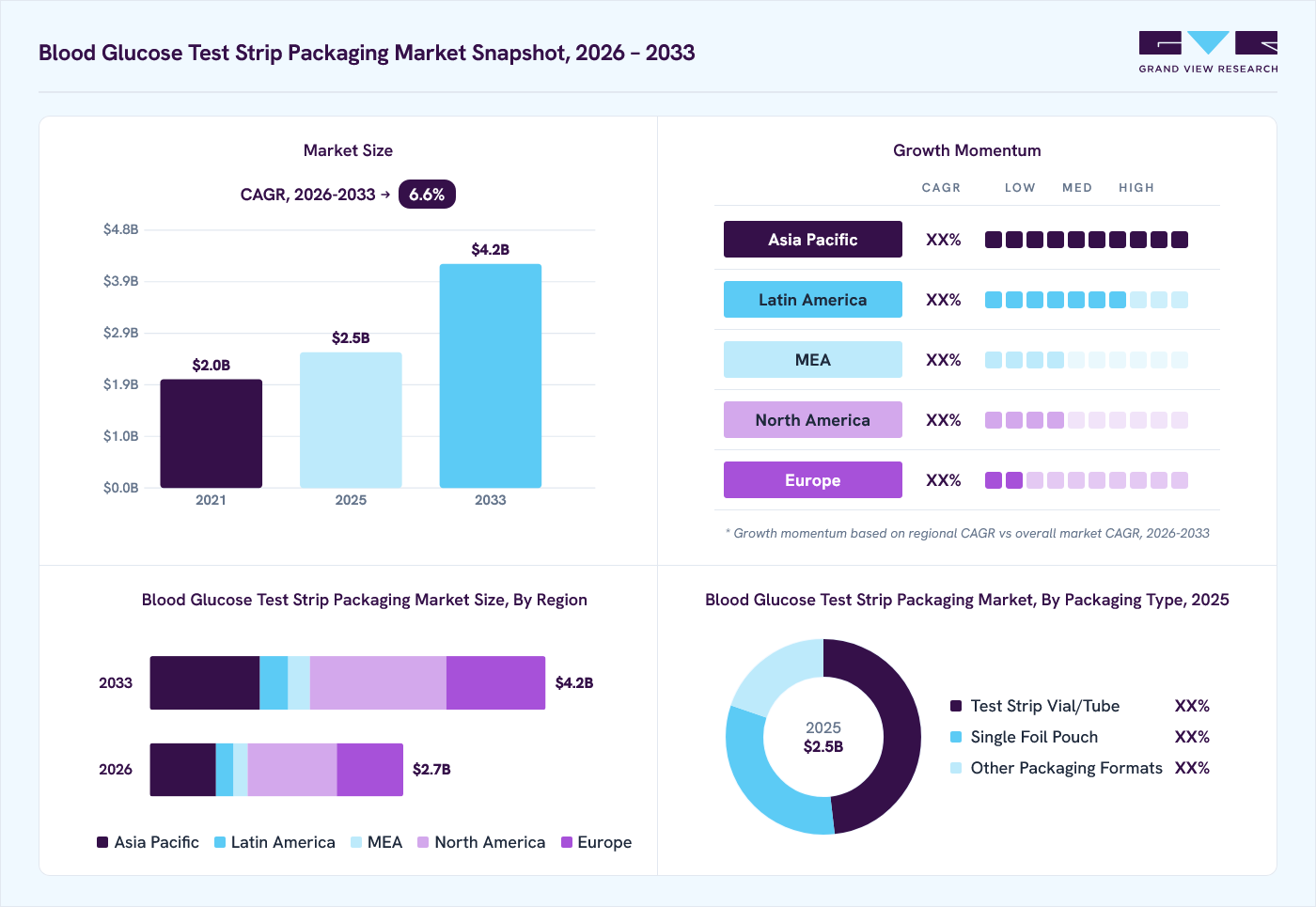
The global blood glucose test strip packaging market size was valued at USD 2.5 billion in 2025 and is projected to grow from USD 2.7 billion in 2026 to USD 4.2 billion by 2033, at a CAGR of 6.6% from 2026 to 2033. North America dominated the market, accounting for the largest revenue share of 35.3% in 2025. The industry is primarily driven by the rising prevalence of diabetes, increasing adoption of self-monitoring blood glucose systems, growing demand for convenient point-of-care diagnostics, and the need for moisture-resistant, protective, and contamination-free packaging that preserves the accuracy and shelf life of glucose test strips.
 Source: Grand View Research, IR Documents, Primary Interviews, Paid DatabasesTo learn more about this report,
 Download Free Sample Report
Key Market Trends & Insights
- By packaging type: the Test Strip Vial/Tube segment led the market with the largest share of 48.1% in 2025.
- Based on material: the Plastic segment led the market with the largest share of 51.1% in 2025.
- Based on end use: the Homecare/Self-Monitoring segment accounted for the largest revenue share of 62.7% in 2025.
- Based on packaging configuration: the Multi-Strip Packaging segment led the market with the largest revenue share of 64.5% in 2025.
Regional Insights
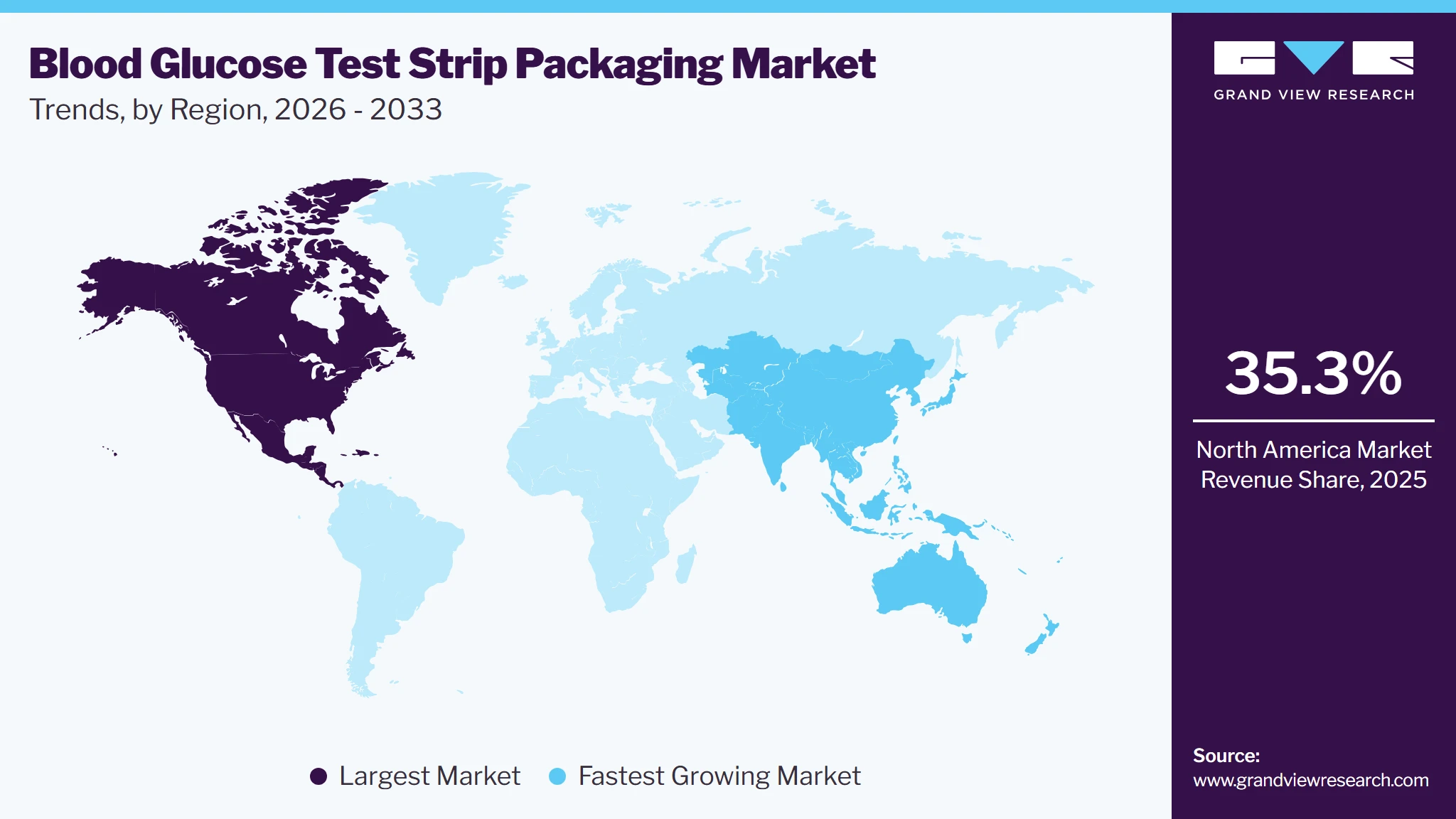
- Largest Market in 2025: North America (35.3% revenue share, 2025)
- Fastest Growing Market: Asia-Pacific (highest CAGR, 2026-2033)
- By country: The U.S. held the largest share of North America in 2025.
Market Size & Forecast
- Market Size in 2025: USD 2.5 Billion
- Estimated Market Size in 2026: USD 2.7 Billion
- Projected Market Size in 2033: USD 4.2 Billion
- CAGR (2026-2033): 6.6%
GVR research-powered AIAsk Prism AI about the blood glucose test strip packaging marketGet cited answers from GVR research on market growth, segments, regulations and forecasts.Start with✓ Source-linked answers ✓ Market-specific context ✓ Traceable figuresExplore Prism AI ↗
The industry is driven by the increasing prevalence of diabetes and the growing adoption of self-monitoring blood glucose systems. As patients increasingly manage glucose levels through home-based testing, there is a rising demand for reliable packaging formats that protect test strips from moisture, humidity, contamination, and environmental exposure. Test strip vials/tubes remain the dominant packaging type, supported by their ability to provide controlled storage conditions and convenient access to multiple strips. The growing use of portable glucose meters and frequent testing among diabetic patients is further supporting demand for durable and user-friendly vial and tube formats.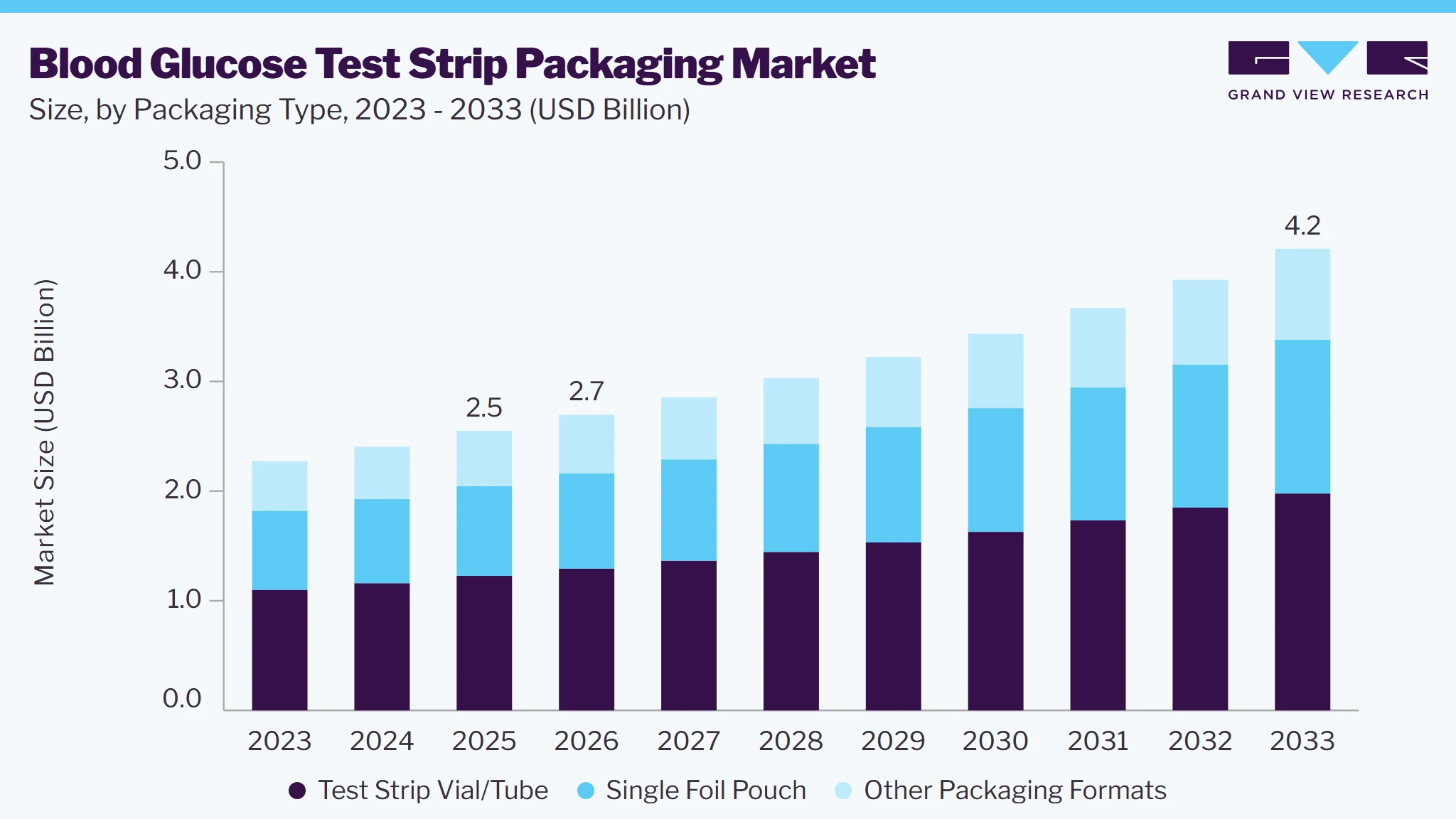 To learn more about this report, Download Free Sample Report
An increasing focus on test-strip accuracy, shelf-life preservation, and moisture protection is expected to boost market growth in the coming years. Blood glucose test strips contain chemically sensitive reagents that can deteriorate when exposed to humidity, temperature fluctuations, and contaminants, making effective barrier packaging essential for maintaining measurement reliability. Manufacturers are therefore increasingly adopting high-barrier plastics, aluminum laminates, and moisture-resistant closures for test-strip packaging. Single foil pouches, in particular, are gaining traction as they provide individual protection for each strip and reduce exposure to atmospheric moisture after opening. The segment is driven by growing demand for individually protected and convenient testing formats.
Technological advancements and the growing shift toward individualized, portable, and user-friendly diabetes monitoring solutions are also significantly contributing to market growth. A defining trend in the industry is the increasing adoption of packaging designs that combine high moisture-barrier performance with convenience, portability, and efficient strip dispensing. This shift reflects increasing demand for individually protected strips, particularly in homecare and self-monitoring.
Market Dynamics
The industry is driven by the rising prevalence of diabetes, increasing adoption of self-monitoring blood glucose systems, and growing demand for reliable packaging that protects chemically sensitive test strips from moisture, humidity, contamination, and environmental exposure. Manufacturers are focusing on high-barrier, moisture-resistant, and user-friendly packaging formats, including test strip vials/tubes and single foil pouches, to preserve strip stability and accuracy throughout the product shelf life. Additionally, advancements in active moisture-control technologies, increasing homecare testing, and growing demand for individually protected strips are supporting market expansion, while stringent product quality and packaging performance requirements remain key challenges.
The increasing adoption of home-based and self-monitoring blood glucose testing is a key driver of the industry. The growing diabetes patient population, increasing awareness regarding regular glucose monitoring, and wider availability of portable blood glucose meters are contributing to higher consumption of test strips. As patients increasingly perform glucose testing at home and on the go, demand is rising for packaging formats that provide convenient access while protecting strips from moisture, humidity, contamination, and physical damage.
The expansion of diabetes management programs and the increasing availability of glucose monitoring products through pharmacies, hospitals, specialty retailers, and e-commerce channels are further supporting packaging demand. Manufacturers are investing in moisture-resistant vials, integrated desiccant closures, high-barrier foil pouches, and convenient dispensing systems to maintain test-strip stability and measurement accuracy.
A significant restraint for the market is the stringent requirement to maintain test-strip stability, accuracy, and shelf life under varying environmental conditions. Blood glucose test strips contain sensitive chemical reagents that can deteriorate when exposed to moisture, humidity, temperature fluctuations, and contaminants, requiring specialized high-barrier materials, desiccants, and moisture-control technologies. These requirements increase packaging material, manufacturing, testing, and quality-control costs, while manufacturers must also balance protection with ease of opening, dispensing, portability, and user convenience, creating challenges in developing cost-effective packaging solutions.
A major opportunity for the industry lies in the growing adoption of individually protected strips and advanced moisture-control packaging solutions. Increasing home-based glucose monitoring is driving demand for packaging that protects test strips from moisture, humidity, and contamination while offering convenience and portability. The adoption of foil pouches, high-barrier polymers, and integrated desiccant closures is creating opportunities for manufacturers to develop packaging that improves strip stability and shelf life. In addition, lightweight and recyclable packaging solutions are gaining importance as manufacturers seek to combine product protection with sustainability.
Market Concentration & Characteristics
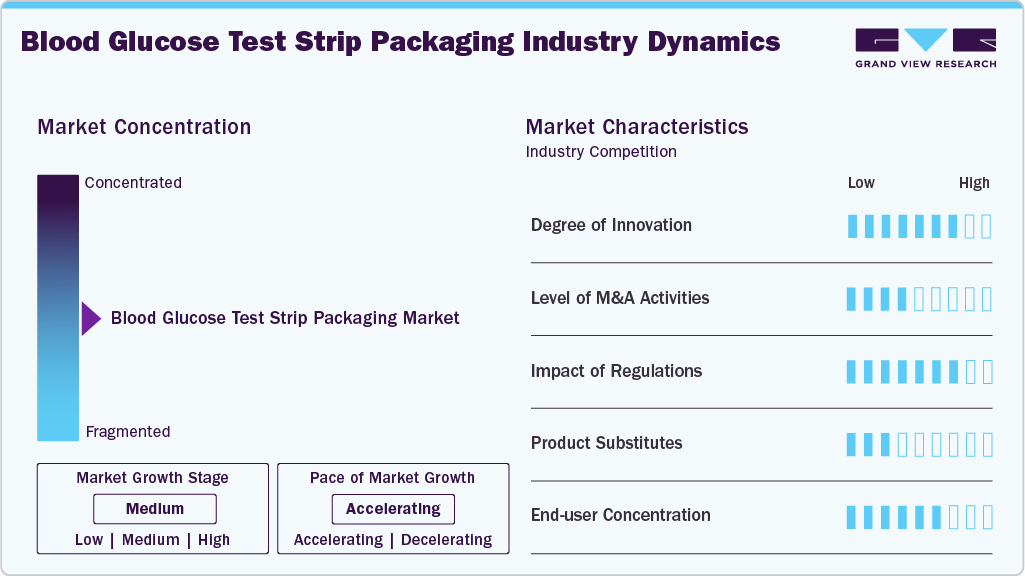
The industry is characterized by its strong emphasis on moisture protection, product stability, and packaging reliability, as test strips contain sensitive chemical reagents that require protection from humidity, contamination, and environmental exposure. The industry relies heavily on high-barrier materials, moisture-control technologies, and precision packaging processes to maintain strip accuracy and shelf life. Manufacturers prioritize packaging performance, product safety, ease of dispensing, and cost efficiency, particularly for high-volume homecare and self-monitoring applications. Leading players such as Aptar CSP Technologies, Sanner GmbH, Multisorb Technologies, Amcor plc, and IMPAK Corporation focus on advanced vial, tube, foil pouch, and moisture-control solutions designed for diagnostic applications.
A defining feature of the industry is its growing reliance on specialized barrier and moisture-resistant packaging materials, including plastics, aluminum laminates, and high-barrier foil structures. Test Strip Vial/Tube packaging remains an important format due to its ability to protect multiple strips and facilitate convenient dispensing, while individually packaged strips and single foil pouches are gaining adoption for enhanced moisture protection and portability.
 To learn more about this report, Download Free Sample Report
Manufacturers are also investing in integrated desiccant closures, active moisture-control systems, lightweight structures, and recyclable materials to improve product protection while addressing sustainability requirements. The increasing adoption of home-based glucose monitoring and portable testing is further influencing packaging development toward convenient, reliable, and user-friendly formats.
Analyst Perspective
The industry has evolved from conventional vial and tube formats toward advanced packaging solutions offering improved moisture, oxygen, light, and contamination protection. Historically, multi-strip vial/tube packaging dominated due to its convenience and cost efficiency, particularly for home-based glucose monitoring. Currently, rising diabetes prevalence, growing self-monitoring adoption, and increasing demand for reliable diagnostic products are driving the use of high-barrier plastics, aluminum laminates, foil pouches, and moisture-control solutions. Looking ahead, packaging innovation will focus on enhanced product stability, portability, sustainability, and user convenience.
Packaging Type Insights
Based on packaging type, the Test Strip Vial/Tube segment led the market with the largest revenue share of 48.1% in 2025. Test strip vials and tubes are widely used because they provide effective protection against moisture, humidity, and contamination while allowing multiple strips to be stored and dispensed conveniently. Their compatibility with integrated desiccant closures and moisture-control technologies further supports their adoption, particularly in homecare and self-monitoring applications. The continued demand for reliable packaging that preserves test-strip stability and shelf life is expected to sustain the segment's leading position.
The Single Foil Pouch segment is expected to grow at the fastest CAGR of 7.1% during the forecast period. Single foil pouches provide individual protection for test strips against moisture, humidity, oxygen, and other environmental factors, making them suitable for portable and on-the-go glucose testing. Their ability to maintain strip integrity until the point of use is particularly valuable for homecare and self-monitoring applications. Growing demand for individually packaged strips, enhanced product stability, and convenient single-use formats is expected to support the rapid adoption of foil pouch packaging.
Material Insights
Based on material, the Plastic segment led the market with the largest revenue share of 51.1% in 2025. Plastic is widely used in test strip packaging due to its lightweight nature, durability, flexibility, moisture resistance, and cost-effectiveness. Plastic is particularly suitable for test strip vials, tubes, closures, and other protective packaging components, offering reliable protection against environmental exposure while supporting convenient handling and dispensing. Its compatibility with moisture-control technologies and scalable manufacturing processes further supports its widespread adoption across homecare, hospitals, and diagnostic applications.
The Aluminum & Aluminum Laminates segment is expected to grow at the fastest CAGR of 7.2% during the forecast period. Aluminum and aluminum-based laminates provide strong barrier protection against moisture, oxygen, light, and contaminants, making them highly suitable for sensitive blood glucose test strips. These materials are particularly important in single foil pouch packaging, where maintaining strip stability and chemical integrity until use is critical. Increasing demand for individually protected strips, extended shelf life, and reliable packaging performance is expected to support the growing adoption of aluminum and aluminum laminate materials.
Packaging Configuration Insights
Based on packaging configuration, the Multi-Strip Packaging segment led the market with the largest revenue share of 64.5% in 2025. Multi-strip packaging is widely used for storing multiple glucose test strips in a single container, offering convenient dispensing, effective moisture protection, and cost-efficient packaging for frequent testing. Its compatibility with test strip vials and tubes equipped with moisture-control or desiccant systems makes it particularly suitable for homecare and self-monitoring applications. The continued demand for convenient and reliable storage of multiple strips is expected to support the segment's leading position.
The Individually Packaged Strips segment is expected to grow at the fastest CAGR of 7.0% during the forecast period. Individually packaged strips provide enhanced protection against moisture, humidity, contamination, and environmental exposure by isolating each strip until use. This configuration is particularly suitable for portable and on-the-go glucose testing, where maintaining strip integrity and convenience is essential. Growing adoption of home-based monitoring, increasing demand for single-use protection, and the expansion of foil pouch packaging are expected to support the rapid growth of individually packaged strip formats.
End-use Insights
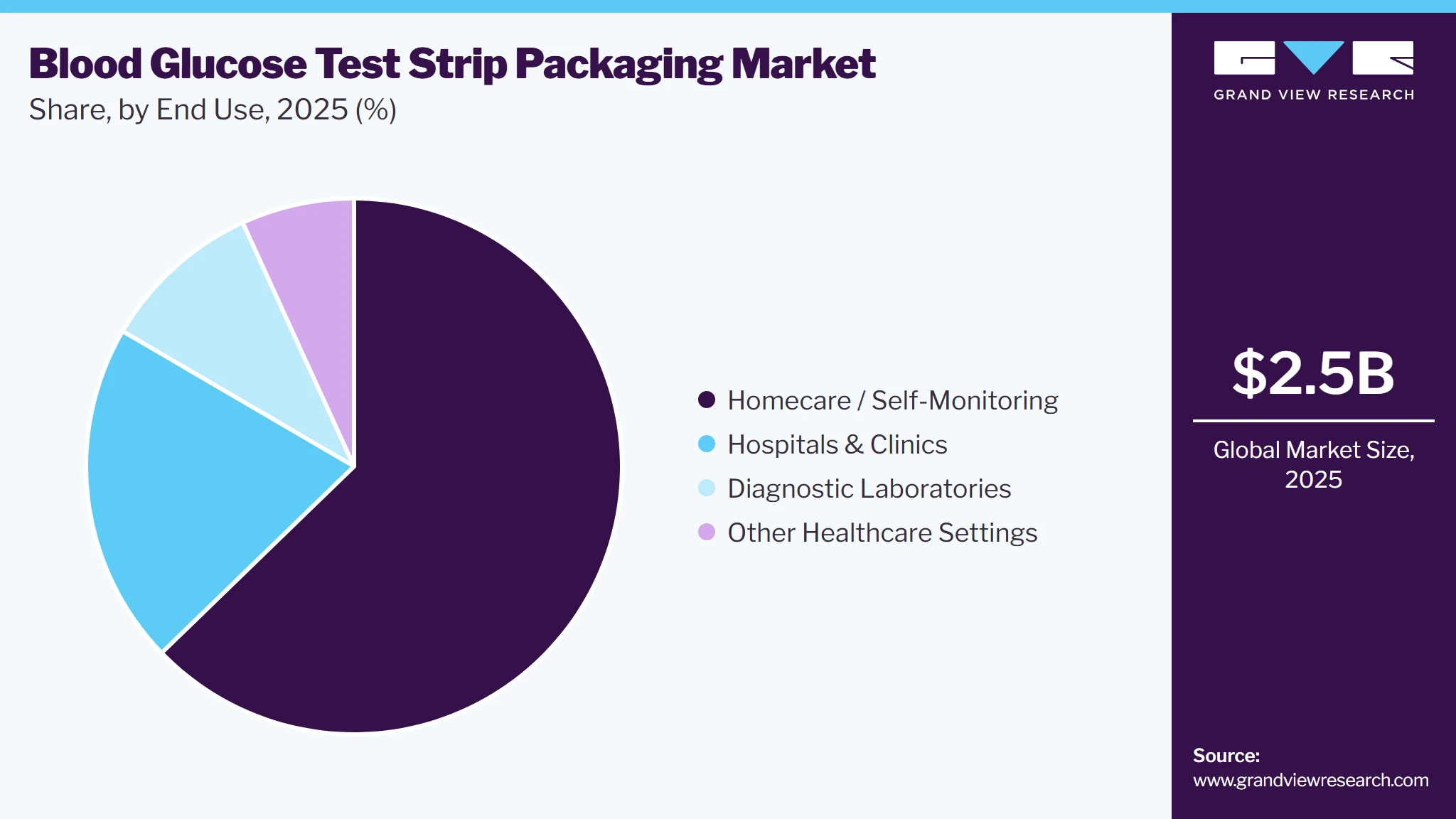
Based on end-use, the Homecare / Self-Monitoring segment led the market with the largest revenue share of 62.7% in 2025. The segment is supported by the growing adoption of home-based blood glucose monitoring, increasing diabetes awareness, and the rising use of portable glucose meters and test strips for regular testing. Homecare applications require packaging that is convenient, easy to handle, and capable of protecting test strips from moisture and contamination, supporting continued demand for vial/tube and individually packaged formats. The increasing preference for self-management of diabetes is expected to maintain the segment's leading position.
 To learn more about this report, Download Free Sample Report
The Homecare / Self-Monitoring segment is expected to grow at the fastest CAGR of 6.9% during the forecast period. Rising demand for convenient and frequent glucose testing outside clinical settings is encouraging greater consumption of test strips and associated packaging solutions. The expansion of home healthcare, increasing availability of portable monitoring devices, and growing preference for convenient single-use and moisture-protected packaging are expected to support segment growth. This trend is further encouraging packaging manufacturers to develop lightweight, portable, easy-to-open, and reliable formats tailored to everyday self-monitoring needs.
Regional Insights
The North America blood glucose test strip packaging market accounted for the largest regional revenue share of 35.3% in 2025. The region benefits from high adoption of self-monitoring blood glucose systems, established diabetes-care infrastructure, and strong demand for convenient home-based testing. The widespread availability of glucose meters and test strips through pharmacies, healthcare providers, and retail channels is supporting consistent demand for moisture-resistant vials, tubes, foil pouches, and other protective packaging formats.
 To learn more about this report, Download Free Sample Report
U.S. Blood Glucose Test Strip Packaging Market Trends
The blood glucose test strip packaging market in the U.S. represents the major share of North America, supported by the country's large diabetes patient population and high penetration of home glucose monitoring. Demand is further reinforced by established healthcare distribution networks and continued adoption of portable blood glucose monitoring devices. Increasing emphasis on test-strip stability, moisture protection, and convenient packaging is encouraging manufacturers to adopt high-barrier materials and advanced moisture-control technologies.
Europe Blood Glucose Test Strip Packaging Market Trends
The blood glucose test strip packaging market in Europe is projected to experience steady growth during the forecast period. Demand is supported by widespread diabetes monitoring, established healthcare systems, and increasing preference for home-based testing. The region's focus on product quality, medical-device safety, and sustainable packaging is encouraging manufacturers to develop efficient packaging structures that provide reliable moisture protection while reducing material consumption and environmental impact.
The Germany blood glucose test strip packaging market accounts for a significant share of the European market, supported by its advanced healthcare infrastructure and well-established medical technology industry. Growing use of blood glucose monitoring devices and increasing demand for reliable diagnostic products are sustaining packaging requirements. Manufacturers are also focusing on high-performance barrier materials and packaging designs that improve test-strip protection and support efficient healthcare distribution.
The blood glucose test strip packaging market in the UK is expected to grow steadily throughout the forecast period, supported by increasing adoption of self-monitoring solutions and continued demand for diabetes management products. The expanding role of home healthcare is creating demand for lightweight and easy-to-use packaging formats. Growing attention to sustainable healthcare packaging is also encouraging the development of material-efficient and recyclable packaging solutions.
Asia Pacific Blood Glucose Test Strip Packaging Market Trends
The blood glucose test strip packaging market in Asia Pacific is expected to register the fastest CAGR of 7.5% from 2026 to 2033. Rapid growth in diabetes prevalence, improving healthcare infrastructure, expanding access to diagnostic technologies, and increasing awareness of regular glucose monitoring are driving regional demand. The growing adoption of homecare testing and the increasing availability of affordable glucose monitoring devices are creating substantial opportunities for test-strip vial, tube, and foil pouch packaging manufacturers across the region.
The China blood glucose test strip packaging market is supported by a large diabetic population, expanding healthcare access, and increasing adoption of domestic and international glucose monitoring products. Growing investments in medical-device manufacturing and diagnostic technologies are strengthening demand for locally produced packaging components and high-barrier materials. Rising home-based testing is further increasing requirements for convenient and moisture-protective test-strip packaging.
The blood glucose test strip packaging market in India is expected to witness strong growth, supported by increasing diabetes prevalence, improving diagnostic accessibility, and rising awareness of self-monitoring blood glucose levels. The expansion of pharmacies, e-commerce healthcare channels, and homecare services is making glucose monitoring products more accessible to consumers. Growing demand for affordable yet reliable test strips is expected to encourage packaging manufacturers to develop cost-efficient vials, tubes, and individually packaged strip solutions.
Latin America Blood Glucose Test Strip Packaging Market Trends
The blood glucose test strip packaging market in Latin America is projected to grow steadily during the forecast period, supported by increasing diabetes awareness and the gradual expansion of healthcare and diagnostic services. Growing access to glucose monitoring devices and rising adoption of home-based testing are supporting demand for protective packaging formats. Increasing healthcare expenditure and improvements in pharmaceutical and medical-device distribution networks are expected to create further opportunities across the region.
The Brazil blood glucose test strip packaging market represents a significant portion of the Latin American market, supported by its large healthcare sector and growing demand for diabetes monitoring products. Increasing adoption of self-testing and greater availability of glucose meters and test strips through retail and healthcare channels are driving packaging requirements. The expansion of domestic healthcare manufacturing is also creating opportunities for suppliers of moisture-resistant and cost-efficient packaging solutions.
The blood glucose test strip packaging market in Argentina is expected to witness gradual growth throughout the forecast period. Increasing awareness of diabetes management and rising demand for home-based glucose monitoring are supporting the consumption of test strips and related packaging. Improvements in access to diagnostic products and growing preference for convenient packaging formats are expected to contribute to market development.
Middle East & Africa Blood Glucose Test Strip Packaging Market Trends
The blood glucose test strip packaging market in the Middle East & Africa is expected to expand steadily during the forecast period, supported by rising diabetes prevalence, improving healthcare infrastructure, and increasing availability of blood glucose monitoring products. Growing investments in healthcare facilities and diagnostic services, particularly in major Middle Eastern markets, are encouraging the adoption of self-monitoring technologies. Increasing demand for reliable and moisture-protective packaging is expected to support market opportunities across the region.
Key Blood Glucose Test Strip Packaging Company Insights
Some key companies in the blood glucose test strip packaging market include AptarGroup, Inc., Sanner GmbH, Multisorb Technologies, Amcor plc, Shijiazhuang Xinfuda Medical Packaging Co., Ltd., WISESORBENT TECHNOLOGY LLC, Abbott Laboratories, F. Hoffmann-La Roche Ltd, Ascensia Diabetes Care India Private Limited, HMD, ARKRAY, Inc., and AgaMatrix. The competitive landscape is shaped by moisture-control technologies, high-barrier packaging materials, specialized containers, desiccant integration, and packaging solutions designed to preserve the accuracy and stability of glucose test strips throughout storage and distribution.
-
Aptar provides advanced dispensing, closure, and healthcare packaging technologies that can support sensitive diagnostic and healthcare products. Its expertise in precision-engineered packaging components positions the company to address requirements related to product protection, usability, and controlled exposure to environmental conditions.
-
SANNER specializes in pharmaceutical and healthcare packaging, with particular expertise in packaging systems incorporating desiccant technologies. Its solutions are relevant to blood glucose test strips because controlling moisture inside containers is essential for maintaining strip performance and extending product shelf life.
Key Blood Glucose Test Strip Packaging Companies
The following key companies have been profiled for this study on the blood glucose test strip packaging market.
-
Aptar
-
SANNER
-
Multisorb
-
Amcor Plc
-
Shijiazhuang Xinfuda Medical Packaging Co., Ltd.
-
WISESORBENT® TECHNOLOGY LLC
-
Abbott Laboratories Limited
-
F. Hoffmann-La Roche Ltd
-
Ascensia Diabetes Care India Private Limited
-
HMD
-
Arkray
-
Aga Matrix
Competitive Benchmarking
Category
Operating Strategies
Competitive Edge
Weakness
Established Players (Aptar; SANNER; Multisorb; Amcor Plc; Abbott Laboratories Limited; F. Hoffmann-La Roche Ltd; Arkray)
- Focus on developing high-barrier packaging, moisture-control solutions, desiccant-integrated systems, and specialized packaging for blood glucose test strips and other sensitive diagnostic products. Companies invest in R&D, quality assurance, regulatory compliance, and strategic partnerships with healthcare and medical-device manufacturers to strengthen their market presence.
- Strong technical expertise, established healthcare and packaging capabilities, global distribution networks, recognized brands, advanced moisture-management technologies, and extensive experience with regulated medical products provide a strong competitive position.
- High R&D and manufacturing costs, stringent regulatory requirements, complex quality-control processes, and dependence on healthcare and diagnostic markets can increase operating costs and lengthen product development cycles.
Emerging Players (Shijiazhuang Xinfuda Medical Packaging Co., Ltd.; WISESORBENT® TECHNOLOGY LLC; Ascensia Diabetes Care India Private Limited; HMD; Aga Matrix)
- Focus on specialized medical packaging, moisture-control technologies, and glucose monitoring solutions tailored to specific applications. These companies emphasize cost-effective production, product customization, regional market expansion, and partnerships with diagnostic and healthcare providers to strengthen their presence in the blood glucose test strip packaging market.
- Greater flexibility, specialized product knowledge, customized solutions, competitive pricing, and the ability to respond quickly to regional or customer-specific requirements support their expansion in targeted markets.
- Smaller production capacities, comparatively limited global distribution, lower R&D resources, and weaker brand recognition than multinational competitors can restrict international expansion and large-scale customer acquisition.
Recent Development
-
In January 2026, Abbott was reported to have introduced a new blood glucose test strip incorporating advanced biosensor technology, aimed at improving measurement accuracy and reducing testing time. The development reflects the broader shift toward higher-performance glucose testing products, increasing the need for packaging that provides reliable protection and preserves test-strip integrity throughout storage and distribution.
-
In 2026, SANNER continued to highlight its specialized desiccated test-strip packaging portfolio, which integrates desiccants directly into packaging systems to protect glucose test strips from moisture and maintain their functionality. The company's focus on integrated moisture-management solutions supports the growing requirement for high-performance vial and tube packaging in diabetes diagnostics.
-
In 2026, Multisorb Technologies continued advancing active packaging solutions, combining moisture and oxygen control with automation-ready packaging systems. Its newer packaging technologies are designed to improve dispensing consistency and manufacturing efficiency while reducing plastic consumption, creating opportunities for more efficient packaging of moisture-sensitive diagnostic products.
Blood Glucose Test Strip Packaging Market Report Scope
Report Attribute
Details
Market size value in 2025
USD 2.5 billion
Estimated market size in 2026
USD 2.7 billion
Revenue forecast in 2033
USD 4.2 billion
Growth rate
CAGR of 6.6% from 2026 to 2033
Base year for estimation
2025
Historical data
2021 - 2024
Forecast period
2026 - 2033
Quantitative units
Revenue in USD billion, and CAGR from 2026 to 2033
Report coverage
Revenue forecast, company ranking, competitive landscape, growth factors, and trends
Segments covered
Packaging type, material, end-use, packaging configuration, region
Regional scope
North America; Europe; Asia Pacific; Latin America; Middle East & Africa
Country scope
U.S.; Canada; Mexico; Germany; France; UK; Italy; Spain; China; India; Japan; South Korea; Australia; Brazil; Argentina; Saudi Arabia; UAE; South Africa
Key companies profiled
Aptar; SANNER; Multisorb; Amcor Plc; Shijiazhuang Xinfuda Medical Packaging Co., Ltd.; WISESORBENT® TECHNOLOGY LLC; Abbott Laboratories Limited; F. Hoffmann-La Roche Ltd; Ascensia Diabetes Care India Private Limited; HMD; Arkray; Aga Matrix
Customization scope
Free report customization (equivalent up to 8 analysts working days) with purchase. Addition or alteration to country, regional & segment scope.
Pricing and purchase options
Avail of customized purchase options to meet your exact research needs. Explore purchase options
Global Blood Glucose Test Strip Packaging Market Report Segmentation
This report forecasts revenue growth at the global, regional, and country levels and provides an analysis of the latest industry trends and opportunities in each of the sub-segments from 2021 to 2033. For this study, Grand View Research has segmented the global blood glucose test strip packaging market report on the basis of packaging type, material, end-use, packaging configuration, and region:
-
Packaging Type Outlook (Revenue, USD Billion, 2021 - 2033)
-
Test Strip Vial/Tube
-
Single Foil Pouch
-
Other Packaging Formats
-
-
Material Outlook (Revenue, USD Billion, 2021 - 2033)
-
Aluminum & Aluminum Laminates
-
Paper & Paperboard
-
Plastic
-
Other Materials
-
-
End Use Outlook (Revenue, USD Billion, 2021 - 2033)
-
Homecare / Self-Monitoring
-
Hospitals & Clinics
-
Diagnostic Laboratories
-
Other Healthcare Settings
-
-
Packaging Configuration Outlook (Revenue, USD Billion, 2021 - 2033)
-
Multi-Strip Packaging
-
Individually Packaged Strips
-
-
Regional Outlook (Revenue, USD Billion, 2021 - 2033)
-
North America
-
U.S.
-
Canada
-
Mexico
-
-
Europe
-
Germany
-
France
-
UK
-
Italy
-
Spain
-
-
Asia Pacific
-
China
-
India
-
Japan
-
South Korea
-
Australia
-
-
Latin America
-
Brazil
-
Argentina
-
-
Middle East & Africa
-
Saudi Arabia
-
UAE
-
South Africa
-
-
Research Methodology
The blood glucose test strip packaging market figures in this report are based on a proven research process that combines executive interviews with secondary research from proprietary databases, company filings, and recognized regulatory and institutional sources. Market size is built through value-chain sizing-reconciling supply-side and demand-side estimates-and triangulated with bottom-up and top-down approaches. Every estimate passes multiple levels of expert validation before publication, with each blood glucose test strip packaging segment quantified using the revenue-capture definitions in the table below.
Segment Definition
Segment - Packaging Type
Revenue capture definition
Test Strip Vial/Tube
Revenue generated from the sale of vial and tube packaging systems designed to store and protect blood glucose test strips from moisture, humidity, dust, and other environmental factors that can affect strip performance. Includes plastic vials, tubes, closures, and integrated moisture-control or desiccant solutions supplied for homecare, clinical, and diagnostic applications.
Single Foil Pouch
Revenue generated from the sale of individually sealed foil pouch packaging used to protect blood glucose test strips from moisture, oxygen, light, and other external environmental conditions. Includes aluminum foil laminate pouches and other high-barrier flexible packaging formats supplied for individually packaged strips and single-use testing applications.
Other Packaging Formats
Revenue generated from the sale of alternative packaging formats used for blood glucose test strips, including blister packs, sachets, specialty containers, dispensers, and customized packaging systems. Includes packaging solutions incorporating barrier materials, moisture-control features, protective closures, or dispensing mechanisms for diagnostic and diabetes-care applications.
Segment - Material
Revenue capture definition
Plastic
Revenue generated from the sale of plastic materials used in blood glucose test strip packaging, including polyethylene, polypropylene, and other medical-grade plastics used for vials, tubes, closures, and protective packaging components. Includes plastic packaging designed to provide moisture resistance, durability, lightweight handling, and product protection during storage and distribution.
Aluminum & Aluminum Laminates
Revenue generated from the sale of aluminum and aluminum-based laminate materials used in blood glucose test strip packaging to provide high barriers against moisture, oxygen, light, and other environmental factors. Includes aluminum foil laminates used primarily in single foil pouches and other high-barrier flexible packaging formats.
Paper & Paperboard
Revenue generated from the sale of paper and paperboard materials used in secondary and protective packaging for blood glucose test strips, including cartons, sleeves, boxes, labels, and inserts. Includes paper-based packaging components used for product identification, instructions, handling, and transportation.
Other Materials
Revenue generated from the sale of other materials used in blood glucose test strip packaging, including specialized films, coatings, adhesives, desiccant materials, absorbent components, and other functional packaging materials that provide additional moisture control, barrier protection, or structural performance.
Segment - End-Use
Revenue capture definition
Homecare / Self-Monitoring
Revenue generated from blood glucose test strip packaging supplied for home-based and self-monitoring applications, where individuals regularly perform glucose testing using personal blood glucose meters. Includes packaging formats designed for convenient handling, repeated access, moisture protection, and portability.
Hospitals & Clinics
Revenue generated from blood glucose test strip packaging used in hospitals, clinics, outpatient facilities, and other institutional healthcare environments. Includes protective packaging solutions designed to maintain test-strip integrity during storage, dispensing, and routine patient testing.
Diagnostic Laboratories
Revenue generated from blood glucose test strip packaging supplied to diagnostic and clinical laboratories for glucose testing and related diagnostic procedures. Includes packaging formats that provide controlled storage, product identification, and protection against environmental exposure.
Other Healthcare Settings
Revenue generated from blood glucose test strip packaging used across other healthcare environments, including nursing homes, diabetes-care centers, pharmacies, home healthcare providers, and community healthcare facilities. Includes specialized and convenient packaging formats suited to decentralized and point-of-care glucose testing.
Segment - Packaging Configuration
Revenue capture definition
Multi-Strip Packaging
Revenue generated from the sale of packaging configurations designed to contain multiple blood glucose test strips within a single vial, tube, or other protective container. Includes multi-strip containers incorporating moisture-control features such as desiccants, closures, and high-barrier materials to maintain strip stability during repeated use and storage.
Individually Packaged Strips
Revenue generated from the sale of packaging configurations in which individual blood glucose test strips are separately sealed, primarily using foil pouches or other high-barrier formats. Includes single-use packaging designed to provide enhanced protection against moisture, oxygen, light, and contamination while supporting portability and convenient testing.
Estimation Model
Layer Name
Key Question
Description
End-use Healthcare Layer
What drives demand?
Estimate demand from key healthcare and diagnostic settings, including homecare/self-monitoring, hospitals & clinics, diagnostic laboratories, and other healthcare facilities that use blood glucose test strips.
Packaging Configuration Layer
How are test strips packaged?
Assess adoption of multi-strip packaging and individually packaged strips based on requirements for moisture protection, convenience, portability, repeated access, and product shelf-life.
Material & Packaging Type Layer
Which packaging solutions generate demand?
Evaluate consumption of plastic, aluminum and aluminum laminates, paper and paperboard, and other materials across test strip vial/tube, single foil pouch, and other packaging formats.
Revenue Layer
How is revenue generated?
Revenue is generated through the sale of packaging solutions used to protect blood glucose test strips from moisture, oxygen, light, contamination, and physical damage across homecare, clinical, laboratory, and other healthcare applications.
Delivered Customizations
We have successfully delivered the following deep-dive customizations
Client Request
Customization Delivered
Value Adds
Competitive Benchmarking
Comparative benchmarking of leading blood glucose test strip packaging companies based on packaging portfolio, material capabilities, moisture-control technologies, packaging configurations, healthcare application coverage, manufacturing capabilities, geographic presence, and recent strategic developments.
Helps identify competitive strengths, technology gaps, market positioning, potential partners, and differentiation opportunities across key packaging segments.
Pricing Analysis
Detailed assessment of blood glucose test strip packaging pricing based on packaging type, material composition, barrier performance, packaging configuration, production scale, customization requirements, and regional supply-demand conditions.
Supports pricing strategy, procurement planning, supplier negotiations, cost optimization, and evaluation of margin opportunities across different packaging formats.
Opportunity Assessment
Comprehensive assessment of growth opportunities across packaging types, materials, packaging configurations, end-use settings, and regional markets, with emphasis on individually packaged strips, high-barrier materials, moisture-control solutions, and expanding homecare glucose monitoring.
Enables identification of high-growth segments, emerging regional opportunities, technology priorities, and attractive areas for product development, capacity expansion, and market entry.
Frequently Asked Questions About This Report
The global blood glucose test strip packaging market size was valued at USD 2.5 billion in 2025 and is estimated at USD 2.7 billion in 2026.
The global blood glucose test strip packaging market is expected to grow at a CAGR of 6.6% from 2026 to 2033, reaching USD 4.2 billion by 2033.
The blood glucose test strip packaging market is primarily driven by increasing diabetes monitoring, growing adoption of home-based glucose testing, rising demand for self-monitoring devices, the need to protect test strips from moisture and environmental exposure, and increasing demand for convenient and reliable diagnostic packaging.
North America dominated the blood glucose test strip packaging market with a 35.3% revenue share in 2025.
Asia Pacific is the fastest-growing region in the blood glucose test strip packaging market, with a CAGR of 7.5% over the forecast period.
The aluminum & aluminum laminates segment is the fastest-growing material segment in the blood glucose test strip packaging market, with a CAGR of 7.2% over the forecast period.
The plastic segment led the blood glucose test strip packaging market with a 51.1% revenue share in 2025.
The test strip vial/tube segment led the blood glucose test strip packaging market with a 48.1% revenue share in 2025.
Key players in the blood glucose test strip packaging market include Aptar, SANNER, Multisorb, Amcor Plc, Shijiazhuang Xinfuda Medical Packaging Co., Ltd., WISESORBENT® TECHNOLOGY LLC, Abbott Laboratories Limited, F. Hoffmann-La Roche Ltd, Ascensia Diabetes Care India Private Limited, HMD, Arkray, and Aga Matrix.
About the Author(s)
Plastics, Polymers & Resins Research Team
Bulk Chemicals · Plastics, Polymers & ResinsThis report was authored by the plastics, polymers & resins research team at Grand View Research - comprising two research analysts, one senior research analyst, and one industry expert - with specialized expertise in the plastics, polymers & resins segment of the bulk chemicals industry. All findings are based on proprietary bulk chemicals databases, executive interviews, and regulatory analysis, subject to internal peer review prior to publication.
Last Updated:
Speak to Analyst

Customize this report to your needs - add regions, segments, or data points, with 20% free customization.
Or view our licence options:


ISO 9001:2015 & 27001:2022 Certified
We are GDPR and CCPA compliant! Your transaction & personal information is safe and secure. For more details, please read our privacy policy.


