
- Home
- »
- Conventional Energy
- »
-
Blowout Preventer Market Size And Share Report, 2026-2033GVR Report cover
![Blowout Preventer Market (2026 - 2033)Report]()
Blowout Preventer Market (2026 - 2033)
Size, Share & Trends Analysis Report By Type (Annular Blowout Preventers, Ram Blowout Preventers, Hybrid Blowout Preventers), By End-use (Oil & Gas, Geothermal, Mining), By Region, And Segment Forecasts
Market Size, 2025
$7.5BMarket Estimate, 2026
$7.7BMarket Forecast, 2033
$9.7BCAGR, 2026–2033
3.3%Blowout Preventer Market Summary
The global blowout preventer market size was estimated at USD 7.5 billion in 2025 and is projected to grow from USD 7.7 billion in 2026 to USD 9.7 billion by 2033, growing at a CAGR of 3.3% from 2026 to 2033. North America dominated the blowout preventer market with the largest revenue share of 44.4% in 2025. The industry is primarily driven by the increasing global demand for oil and gas, which necessitates advanced safety measures in drilling operations. As exploration activities expand into deeper and more challenging offshore and onshore environments, the risk of uncontrolled well-blowouts rises, leading to stricter safety regulations.

Key Market Trends & Insights
- By type: Ram blowout preventers segment held the largest market share of 55.6% in 2025.
- By end-use: Oil & gas segment held the largest market share of 93.8% in 2025.
Regional Highlights
- Largest regional market: North America (44.4% revenue share, 2025)
- By country: The U.S. held the largest market share in 2025
Market Size & Forecast
- Market size in 2025: USD 7.5 Billion
- Estimated market size in 2026: USD 7.7 Billion
- Projected market size by 2033: USD 9.7 Billion
- CAGR (2026-2033): 3.3%
The industry is primarily driven by the increasing global demand for oil and gas, which necessitates advanced safety measures in drilling operations. As exploration activities expand into deeper and more challenging offshore and onshore environments, the risk of uncontrolled well-blowouts rises, leading to stricter safety regulations. Regulatory bodies such as the Occupational Safety and Health Administration (OSHA) and the American Petroleum Institute (API) impose stringent standards for well control equipment, pushing operators to invest in high-performance BOP systems.
Growing investments in deepwater and ultra-deepwater projects, particularly in regions like the Gulf of Mexico, North Sea, and offshore Brazil, further drive the adoption of technologically advanced BOPs to ensure operational safety and compliance.
Another key driver is the rapid advancement in BOP technology, including automated control systems, real-time monitoring, and improved sealing mechanisms. Innovations such as smart BOPs with predictive maintenance capabilities help reduce downtime and enhance operational efficiency. Moreover, the industry is witnessing a shift toward renewable energy transition, which compels oil and gas companies to optimize existing resources by minimizing risks and improving equipment reliability. The increasing focus on cost-effective and environmentally friendly drilling solutions also propels the market, as manufacturers develop BOPs with enhanced durability and lower maintenance costs. Furthermore, the rising number of mature oilfields and well intervention activities creates additional demand for BOP systems to ensure safe and efficient well control operations.
Market Dynamics
A blowout preventer (BOP) is a critical well-control safety device used to seal, control, and monitor oil and gas wells during drilling. The blowout preventer market is growing due to increasing offshore and onshore oil & gas exploration, stricter well safety regulations, and rising investments in deepwater and high-pressure drilling projects. Energy companies are focusing on advanced blowout preventers with improved reliability, real-time monitoring, and automated control systems to reduce operational risks and downtime. Demand is also supported by aging drilling infrastructure that requires equipment replacement and upgrades. As global energy demand continues to drive new drilling activities, the need for reliable well control equipment is expected to support long-term market growth.
The increasing development of deepwater and ultra-deepwater oil and gas fields is a major driver for the BOP market. Wells drilled in deep offshore environments operate under extremely high pressures and challenging conditions, making advanced subsea BOP systems essential for maintaining well control and ensuring safe drilling operations. As oil companies invest in new offshore projects to expand production and improve energy security, demand for high-capacity, reliable, and technologically advanced BOP stacks continues to grow. This trend is particularly strong in offshore regions such as the Gulf of Mexico, Brazil, and West Africa, where exploration activity is increasing.
In March 2025, Shell approved the final investment decision for the Gato do Mato deepwater project in Brazil's Santos Basin. The project includes a floating production system with a production capacity of 120,000 barrels of oil per day, highlighting continued investment in deepwater offshore developments that require advanced subsea well control equipment, including blowout preventers.
The primary restraint for the blowout preventer market is the complex certification and regulatory compliance requirements for well control equipment. Blowout preventers must undergo rigorous design validation, pressure testing, inspection, and certification to comply with industry standards before deployment, increasing both costs and project timelines. Meeting evolving regulatory requirements across different countries also adds complexity for manufacturers and drilling contractors, slowing product approvals and equipment replacement cycles. For instance, in 2025, the Alberta Energy Regulator updated its Directive 036 with detailed inspection, testing, certification, and well control requirements for BOP systems, reinforcing stricter compliance standards for drilling operations.
The growing need to modernize aging blowout preventer systems is creating significant opportunities for IoT-enabled retrofitting and digital well-control solutions. Oil and gas operators are upgrading legacy BOPs with real-time monitoring, acoustic telemetry, predictive diagnostics, and remote condition monitoring to improve equipment reliability, reduce unplanned downtime, and ensure compliance with evolving safety regulations. These upgrades also extend equipment life while lowering maintenance costs, making aftermarket retrofit services an attractive growth area for manufacturers and service providers.
Analyst Perspective
The blowout preventer market is growing as offshore drilling projects increase and safety requirements become stricter. Oil and gas companies are investing in reliable well control equipment to reduce operational risks and avoid costly downtime. A key trend in the market is the adoption of digital BOP systems with real-time monitoring and predictive maintenance to improve performance. Demand for inspection, refurbishment, and retrofit services is also increasing as operators upgrade existing equipment instead of replacing it. Companies that offer safe, reliable, and cost-effective solutions are expected to gain a competitive advantage.
Type Insights
Based on type, the ram blowout preventers segment led the market with the largest revenue share of 56.6% in 2025 and is expected to grow at a significant CAGR of 2.95% during the forecast period. The Ram Blowout Preventers (BOP) market is primarily driven by the increasing global demand for oil and gas exploration and production, particularly in offshore and deepwater drilling operations. As energy consumption continues to rise, companies are expanding their drilling activities, necessitating advanced well control equipment to prevent blowouts and ensure operational safety. Stringent government regulations and industry standards, such as those set by the American Petroleum Institute (API) and the Bureau of Safety and Environmental Enforcement (BSEE), further drive the adoption of high-performance BOPs. Additionally, technological advancements in BOP systems, such as automated ram actuation and real-time monitoring, are enhancing their reliability and efficiency, making them essential for drilling contractors and operators.
The market for Annular Blowout Preventers (BOPs) is primarily driven by increasing offshore and onshore drilling activities, fueled by rising global energy demand and exploration of unconventional oil and gas reserves. As energy companies push deeper into high-pressure and high-temperature (HPHT) reservoirs, the need for advanced well control equipment, including annular BOPs, has grown. Additionally, stringent safety regulations from organizations such as API (American Petroleum Institute) and regulatory bodies worldwide have compelled drilling contractors and oilfield service companies to invest in high-performance BOP systems to mitigate the risks of well blowouts.
End Use Insights
Based on end-use, the oil & gas segment led the market with the largest revenue share of 93.8% in 2025. The segment is a primary driver in the blowout preventer (BOP) market due to the increasing global demand for energy and the rising exploration and production (E&P) activities in deepwater and ultra-deepwater regions. With stricter safety regulations and the need to prevent catastrophic well blowouts, oil & gas operators are investing heavily in advanced BOP systems. Technological advancements, such as smart BOPs with real-time monitoring and automated control systems, are further propelling the market. Additionally, the revival of offshore drilling projects, especially in regions like the Gulf of Mexico, the North Sea, and the Middle East, is boosting the demand for reliable and high-performance BOPs.

Another key factor driving the market is the increasing focus on unconventional oil & gas resources, including shale gas and tight oil, which require high-pressure drilling operations. The expansion of hydraulic fracturing (fracking) activities in North America and the development of new oilfields in Latin America and Africa are significantly contributing to BOP market growth. Furthermore, oil price stabilization and renewed investments by major oil companies in exploration projects are expected to sustain demand. As environmental and operational risks remain high in drilling operations, the need for robust and efficient blowout prevention systems will continue to drive the market in the oil & gas sector.
Regional Insights
North America dominated the blowout preventer market with the largest revenue share of 44.4% in 2025. The North American BOP industry is primarily driven by the region’s extensive offshore and onshore oil and gas exploration activities, particularly in the U.S. and Canada. The resurgence of shale gas and tight oil production, supported by advanced drilling technologies like hydraulic fracturing and horizontal drilling, has led to increased demand for BOP systems. Additionally, stringent safety and environmental regulations imposed by agencies like the Bureau of Safety and Environmental Enforcement (BSEE) in the U.S. have reinforced the need for reliable BOP equipment, driving market growth.

U.S. Blowout Preventer Market Trends
The blowout preventer market in the U.S. held the largest share in the North America region in 2025. The blowout preventer industry in the U.S. is driven by the nation's thriving oil and gas industry, especially with offshore drilling operations. As a critical component to ensure well control and prevent the uncontrolled release of hydrocarbons, BOPs are essential for operations in the Gulf of Mexico and other offshore fields. The increasing demand for energy and the focus on safety regulations post-incidents like the Deepwater Horizon spill have pushed for stringent regulations and the adoption of advanced BOP technologies. This has made the U.S. a key player in BOP market growth, particularly in terms of innovation and regulatory compliance.
Europe Blowout Preventer Market Trends
The blowout preventer market in Europe is experiencing significant growth, driven by several key factors. The region's increasing energy insecurity, exacerbated by geopolitical tensions and reduced natural gas production, has heightened the demand for reliable oil and gas exploration and production equipment. In response, countries like Norway and the United Kingdom are boosting their oil and gas production to enhance energy security, thereby increasing the need for advanced BOP systems.
Key Blowout Preventer Company Insights
The global blowout preventer market is characterized by intense competition. Key players such as Schlumberger, Halliburton, Parker Tube Fitting, FMC Technologies, Baker Hughes, and Tenaris dominate the market. The competitive environment is further intensified by the entry of new players, partnerships, and collaborations aimed at enhancing efficiency, reducing costs, and increasing oil & gas activity. Regional players are leveraging government incentives and local production capabilities to gain market share, while established companies focus on R&D, vertical integration, and scaling production to maintain their competitive edge.
-
In June 2024, INTLEF launched the QL-type blowout preventer, which enables quick and effortless bonnet opening or closing for ram seal or assembly replacement.
Key Blowout Preventer Companies:
The following key companies have been profiled for this study on the blowout preventer market.
-
Schlumberger
-
Halliburton
-
Parker Tube Fitting
-
FMC Technologies
-
Baker Hughes
-
Tenaris
-
Valve Solutions
-
National Oilwell Varco
-
Cameron International
-
GE
-
Weatherford
-
Parker Hannifin
-
DrilQuip
-
TechnipFMC
-
Aker Solutions
Competitive Benchmarking
Category
Operating Strategies
Competitive Edge
Weakness
Established Players (SLB, Parker Hannifin Ltd., Baker Hughes Company, NOV, Weatherford, TechnipFMC plc, Halliburton)
- Develop advanced blowout preventer systems with digital monitoring, automation, and predictive maintenance capabilities.
- Expand global service networks through long-term contracts, equipment refurbishment, and aftermarket well control services.
- Invest in next-generation subsea technologies and strengthen partnerships with offshore operators and drilling contractors.
- Strong global presence with extensive manufacturing capabilities and well-established service networks.
- Broad product portfolios backed by advanced engineering expertise and compliance with international safety standards.
- Long-standing relationships with major oil & gas operators and a proven track record in complex offshore projects.
- High manufacturing and operating costs compared to regional competitors.
- Significant dependence on cyclical offshore oil & gas capital expenditure.
- Longer product development and certification timelines due to stringent regulatory requirements.
Emerging Players (Shandong Kerui Petroleum Equipment Co., Ltd., Control Flow Inc., UZTEL S.A.)
- Focus on cost-effective and customized blowout preventer solutions for regional and niche drilling applications.
- Expand into high-growth markets through local partnerships and project-based supply contracts.
- Strengthen product portfolios by investing in API-certified technologies and enhanced well control capabilities.
- Competitive pricing with the ability to deliver customized solutions for regional customers.
- Faster response to customer requirements through flexible manufacturing and shorter lead times.
- Growing presence in emerging oil & gas markets supported by expanding production capabilities.
- Limited global brand recognition and smaller international service networks.
- Lower investment capacity for advanced R&D and digital well control technologies.
- Limited experience in large-scale offshore and ultra-deepwater drilling projects.
Blowout Preventer Market Report Scope
Report Attribute
Details
Market Definition
The blowout preventer market comprises revenue generated from the sale of annular, ram, and hybrid blowout preventers used across oil & gas, geothermal, and mining applications for well control and drilling safety.
Market size in 2025
USD 7.5 billion
Estimated market size in 2026
USD 7.7 billion
Projected market size by 2033
USD 9.7 billion
Growth rate
CAGR of 3.3% from 2026 to 2033
Base year for estimation
2025
Historical data
2021 - 2024
Forecast period
2026 - 2033
Quantitative units
Revenue in USD Million and CAGR from 2026 to 2033
Report coverage
Revenue forecast, company ranking, competitive landscape, growth factors, and trends
Segments covered
Type, end-use, region
Regional scope
North America, Europe, Asia Pacific, Latin America, Middle East & Africa
Country scope
U.S., Canada, Mexico, Germany, UK, France, Italy, Spain, Russia, China, India, Japan, Australia, Brazil, Argentina, Saudi Arabia, UAE, South Africa
Key companies profiled
SLB, Parker Hannifin Ltd., Baker Hughes Company, NOV, Weatherford, TechnipFMC plc, Shandong Kerui Petroleum Equipment Co., Ltd., Control Flow Inc., Halliburton, UZTEL S.A.
Customization scope
Free report customization (equivalent up to 8 analysts' working days) with purchase. Addition or alteration to country, regional & segment scope.
Pricing and purchase options
Avail customized purchase options to meet your exact research needs. Explore purchase options
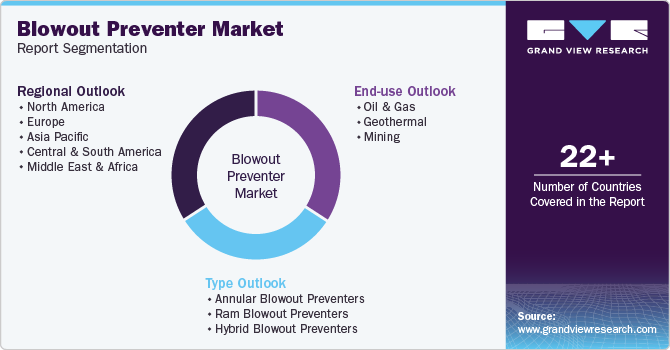
Global Blowout Preventer Market Report Segmentation
This report forecasts revenue growth at global, regional, and country levels and provides an analysis of the latest industry trends in each of the sub-segments from 2021 to 2033. For this study, Grand View Research has segmented the global blowout preventer market report on the basis of type, end-use, and region:
-
Type Outlook (Revenue, USD Million, 2021 - 2033)
-
Annular Blowout Preventers
-
Ram Blowout Preventers
-
Hybrid Blowout Preventers
-
-
End Use Outlook (Revenue, USD Million, 2021 - 2033)
-
Oil & Gas
-
Geothermal
-
Mining
-
-
Regional Outlook (Revenue, USD Million, 2021 - 2033)
-
North America
-
U.S.
-
Canada
-
Mexico
-
-
Europe
-
Germany
-
UK
-
France
-
Italy
-
Spain
-
Russia
-
-
Asia Pacific
-
China
-
India
-
Japan
-
Australia
-
-
Central & South America
-
Brazil
-
Argentina
-
-
Middle East & Africa
-
Saudi Arabia
-
UAE
-
South Africa
-
-
Research Methodology
The blowout preventer market figures in this report are based on a proven research process that combines executive interviews with secondary research from proprietary databases, company filings, and recognized regulatory and institutional sources. Market size is built through value-chain sizing - reconciling supply-side and demand-side estimates - and triangulated with bottom-up and top-down approaches. Every estimate passes multiple levels of expert validation before publication, with each blowout preventer segment quantified using the revenue-capture definitions in the table below.
Segment Definition
Segment - Type
Revenue capture definition
Annular Blowout Preventers
Annular blowout preventers are well control devices that use a flexible sealing element to seal around drill pipe, casing, or an open hole during drilling operations. Revenue is generated from the sale of annular blowout preventers.
Ram Blowout Preventers
Ram blowout preventers use hydraulically operated steel rams to seal the wellbore, close around drill pipe, or completely shut in the well during high-pressure drilling conditions. Revenue is generated from the sale of ram blowout preventers.
Hybrid Blowout Preventers
Hybrid blowout preventers combine annular and ram sealing mechanisms within an integrated system to provide enhanced well control, operational flexibility, and safety in complex drilling environments. Revenue is generated from the sale of hybrid blowout preventers.
Segment - End-Use
Revenue capture definition
Oil & Gas
Blowout preventers are used in onshore and offshore oil & gas drilling operations to maintain well control and prevent uncontrolled releases of formation fluids during drilling and well intervention. Revenue is generated from the sale of blowout preventers used in oil & gas applications.
Geothermal
Blowout preventers are used during geothermal well drilling to safely control high-pressure steam, hot water, and geothermal fluids encountered during well construction. Revenue is generated from the sale of blowout preventers used in geothermal applications.
Mining
Blowout preventers are used in specialized mining and mineral exploration drilling operations where high-pressure formations require reliable well control and pressure containment. Revenue is generated from the sale of blowout preventers used in mining applications.
Estimation Model
Layer Name
Key Question
Description
Drilling Activity & Well Control Demand Layer
What forms the demand base for blowout preventers?
Assess demand for blowout preventers driven by onshore and offshore oil & gas drilling, deepwater and ultra-deepwater exploration, geothermal well development, and high-pressure drilling activities. Evaluate exploration investments, rig count, well completions, offshore field developments, and well safety regulations to determine the underlying demand for blowout preventers.
Blowout Preventer Type Layer
Which types of blowout preventers are being adopted?
Analyze the adoption of annular, ram, and hybrid blowout preventers across different drilling environments. Assess well pressure conditions, drilling depth, operational requirements, safety performance, application suitability, and well control needs to determine type-wise market demand.
End-use Deployment Layer
Where are blowout preventers being deployed?
Evaluate the deployment of blowout preventers across oil & gas, geothermal, and mining applications. Analyze drilling activity, well depth, operating conditions, pressure control requirements, and end-user demand to estimate end-use-wise market contribution.
Revenue Layer
How is market revenue generated?
Market revenue is quantified through the sale of annular, ram, and hybrid blowout preventers across different end-use industries. The overall market value is determined by equipment sales, system configuration, pressure rating, application complexity, certification requirements, and aftermarket services including maintenance, inspection, and refurbishment.
Delivered Customizations
This report has been delivered with the following In-depth customizations
Client Request
Customization Delivered
Value Adds
Cross-Segmentation Analysis
Evaluated the adoption of annular, ram, and hybrid blowout preventers across upstream oil & gas drilling operations, comparing technology preference based on onshore vs. offshore deployment, well pressure, drilling depth, and well control requirements.
Helped identify the most suitable BOP type for different oil & gas drilling environments, understand technology adoption patterns, and support product positioning and investment decisions.
Type-wise Performance Benchmarking Assessment
Compared annular, ram, and hybrid blowout preventers based on pressure handling capability, operational flexibility, maintenance requirements, application suitability, and deployment across onshore and offshore drilling operations.
Helped identify the most suitable BOP type for different drilling conditions and supported equipment selection and investment decisions.
Competitive Landscape Assessment
Evaluated major blowout preventer manufacturers based on product portfolio, technology capabilities, manufacturing capacity, regional presence, aftermarket services, strategic partnerships, and recent business developments. Assessed competitive positioning across established and emerging market participants.
Helped benchmark key competitors, identify market leaders, understand competitive differentiation, and support strategic planning and partnership decisions.
Frequently Asked Questions About This Report
The blowout preventer market size was estimated at USD 7.5 billion in 2025 and is expected to reach USD 7.7 billion in 2026.
The blowout preventer market is expected to grow at a CAGR of 3.3% from 2026 to 2033 to reach USD 9.7 billion by 2033.
The blowout preventer market is primarily driven by increasing deepwater and ultra-deepwater drilling activities, along with stricter well safety and regulatory requirements across the oil & gas industry.
Asia Pacific is anticipated to register the fastest CAGR of 4.2% over the forecast period.
Based on type, the ram blowout preventers segment accounted for the largest revenue share of 56.5% in 2025.
Based on end-use, the oil & gas segment accounted for largest revenue share of 93.8% in 2025.
The key players operating in the blowout preventer market are SLB, Parker Hannifin Ltd., Baker Hughes Company, NOV, Weatherford, TechnipFMC plc, Shandong Kerui Petroleum Equipment Co., Ltd., Control Flow Inc., Halliburton, UZTEL S.A., and others.
The North America region dominated the blowout preventer market with a revenue share of 44.4% in 2025.
U.S. dominated the North America region market with a revenue share of 78.6% in 2025.
About the Author(s)
Conventional Energy Research Team
Energy & Power · Conventional EnergyThis report was authored by the conventional energy research team at Grand View Research - comprising two research analysts, one senior research analyst, and one industry expert - with specialized expertise in the conventional energy segment of the energy & power industry. All findings are based on proprietary energy & power databases, executive interviews, and regulatory analysis, subject to internal peer review prior to publication.
Last Updated:
Speak to Analyst


Customize this report to your needs — add regions, segments, or data points, with 20% free customization.
Or view our licence options:


ISO 9001:2015 & 27001:2022 Certified
We are GDPR and CCPA compliant! Your transaction & personal information is safe and secure. For more details, please read our privacy policy.


