
- Home
- »
- Beauty & Personal Care
- »
-
Brahmi Market Size, Share And Trends Report, 2026-2035GVR Report cover

Brahmi Market (2026 - 2035)
Size, Share & Trends Analysis Report By Form (Powder, Capsules & Tablets, Liquid, Oil), By End Use, By Distribution Channel (B2B, B2C), By Region, And Segment Forecasts
Market Size, 2025
$450.0MMarket Estimate, 2026
$473.4MMarket Forecast, 2035
$747.1MCAGR, 2026–2035
5.2%Brahmi Market Summary
The global brahmi market size was valued at USD 450.0 million in 2025 and is projected to grow from USD 473.4 million in 2026 to USD 747.1 million in 2035, at a CAGR of 5.2% from 2026 to 2035. Asia Pacific dominated the market, accounting for the largest revenue share in 2025. The market is witnessing steady growth, driven by increasing consumer preference for herbal and plant-based ingredients in pharmaceuticals, nutraceuticals, functional foods, and personal care products.
Key Market Trends & Insights
- By form: The powder segment held the largest market share in 2025.
- By end use: The pharmaceuticals segment held the largest market share in 2025.
- By distribution channel: The B2B segment held the largest market share in 2025.
Regional Highlights
- Largest regional market: Asia Pacific (2025)
- Fastest-growing regional market: North America (highest CAGR, 2026-2035)
Market Size & Forecast
- Market size in 2025: USD 450.0 Million
- Estimated market size in 2026: USD 473.4 Million
- Projected market size by 2035: USD 747.1 Million
- CAGR (2026-2035): 5.2%
Prism AI by Grand View Research Free to tryAsk a question about the brahmi marketTry asking✓Every figure cited from GVR research Prefer the report? Download free sample →Rising awareness of Brahmi's cognitive health, stress management, and wellness benefits, coupled with growing demand for natural Ayurvedic formulations and clean-label products, continues to support market expansion.
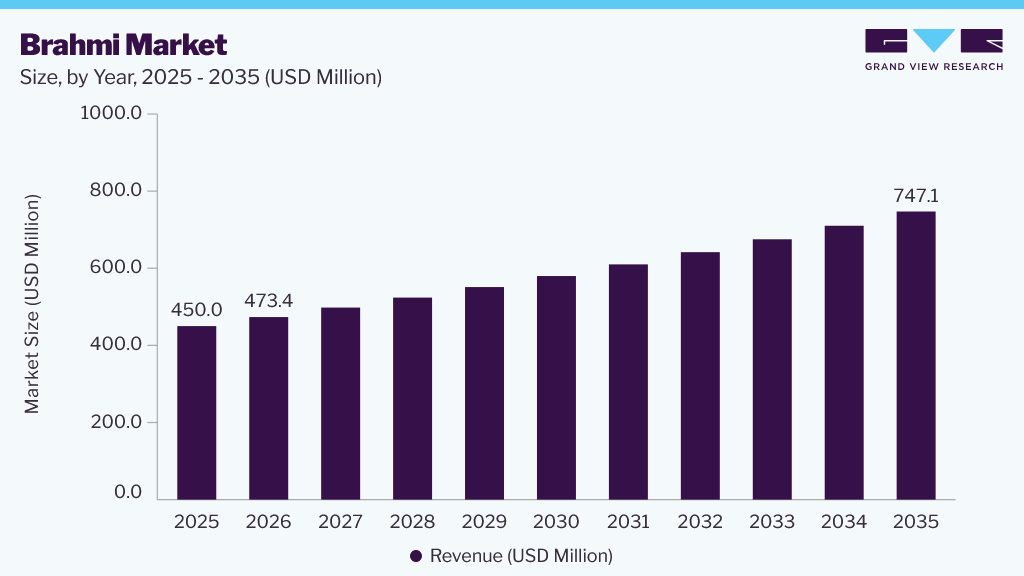 Source: Grand View Research, IR Documents, Primary Interviews, Paid DatabasesTo learn more about this report,
 Download Free Sample Report
The market is experiencing steady growth as consumers increasingly prefer herbal and plant-based ingredients for preventive healthcare and overall wellness. Growing awareness of Brahmi's traditional use in supporting cognitive health, memory enhancement, stress management, and mental well-being has significantly increased demand for it across pharmaceuticals, nutraceuticals, functional foods, and dietary supplements. In addition, the expanding popularity of Ayurveda and other natural healthcare systems, coupled with rising consumer preference for clean-label and botanical products, continues to drive market growth worldwide.
Despite favorable demand, the market faces challenges related to inconsistent raw material quality, seasonal availability of medicinal plants, and the lack of standardized cultivation and processing practices. Variations in the concentration of active compounds can affect product consistency, while stringent regulatory requirements for herbal formulations in several countries may delay product approvals and market entry. These factors can create supply chain complexities and increase production costs for manufacturers.
The market offers considerable growth opportunities as demand for natural wellness products continues to expand globally. Increasing investments in herbal research, standardized botanical extracts, and scientifically validated Ayurvedic formulations are creating new opportunities for product innovation. Rising consumer interest in functional beverages, herbal cosmetics, and plant-based dietary supplements is further broadening the scope of Brahmi's applications. As manufacturers focus on sustainable sourcing, organic cultivation, and premium herbal formulations, the Brahmi industry is expected to witness sustained growth over the forecast period.
Analyst Perspective
The brahmi market is transitioning from a traditional herbal ingredient segment to a broader wellness and nutraceutical category, driven by rising consumer interest in natural cognitive health and stress-management solutions. Increasing adoption of Ayurvedic-based products, clean-label supplements, and plant-derived ingredients is encouraging manufacturers to expand their Brahmi product portfolios across pharmaceuticals, functional foods, and personal care applications. Companies are focusing on standardized extracts, sustainable sourcing, and improved formulations to enhance product effectiveness and consumer acceptance. However, maintaining consistent quality, ensuring regulatory compliance, and developing scientifically supported applications remain key factors influencing future market growth. Overall, growing wellness trends and innovation in herbal formulations are expected to create significant opportunities for the expansion of the brahmi industry.
Form Insights
The powder segment accounted for the largest market revenue share in 2025. Brahmi powder remains the most widely used form due to its traditional acceptance, easy availability, longer shelf life, and versatility across various applications. It is commonly incorporated into Ayurvedic formulations, herbal supplements, functional foods, and beverages. The growing preference for natural ingredients and traditional wellness practices has supported the demand for Brahmi powder among consumers seeking plant-based health solutions. In addition, its cost-effectiveness and suitability for bulk manufacturing have made it a preferred choice among pharmaceutical companies, nutraceutical manufacturers, and herbal product suppliers.
The capsules & tablets segment is expected to grow at the fastest CAGR over the forecast period. Increasing consumer preference for convenient, standardized, and easy-to-consume dietary supplements is driving demand for Brahmi capsules and tablets. These formats offer accurate dosage, improved portability, and longer product stability compared with raw herbal forms, making them popular among urban consumers. Rising awareness of cognitive wellness supplements, growing demand for preventive healthcare products, and expansion of online health supplement platforms are further supporting the growth of this segment. Manufacturers are also focusing on advanced formulations combining Brahmi with other botanical ingredients to enhance product benefits and consumer acceptance.
End Use Insights
The pharmaceuticals segment accounted for the largest market revenue share in 2025. The segment's dominance is attributed to the long-standing use of Brahmi in Ayurvedic and herbal medicines for cognitive support, stress management, and neurological wellness. Pharmaceutical manufacturers are increasingly incorporating Brahmi extracts into formulations targeting memory enhancement, mental fatigue, and overall brain health. Growing acceptance of traditional medicine, increasing demand for plant-based therapeutic solutions, and rising investments in herbal research are further supporting the adoption of Brahmi in pharmaceutical applications. In addition, the development of standardized Brahmi extracts with improved bioavailability is strengthening its role in modern herbal medicine. In July 2025, Aayush Wellness Limited launched Brain Fuel Capsules, a nutraceutical formulation containing Brahmi (Bacopa monnieri), Ashwagandha, Ginkgo biloba, turmeric extract (curcumin), and Gotu Kola. The product is positioned to support cognitive function, memory retention, mental clarity, and the reduction of mental fatigue.
The food & beverages segment is expected to grow at the fastest CAGR over the forecast period. Rising consumer interest in functional foods, herbal beverages, and wellness-oriented nutrition products is driving the incorporation of Brahmi into food and beverage formulations. Consumers are increasingly seeking natural ingredients that provide additional health benefits beyond basic nutrition, creating opportunities for Brahmi-infused teas, health drinks, and dietary products. Furthermore, the growing popularity of clean-label, plant-based, and immunity-focused products is encouraging manufacturers to explore Brahmi as a functional ingredient. The expansion of premium wellness brands and the increasing availability through online distribution channels are expected to further accelerate segment growth. TATA Tea Gold Care herbal tea incorporates Brahmi along with tulsi, ginger, cardamom, and mulethi, as part of its portfolio of wellness-oriented beverages. Such products highlight the integration of Brahmi into mainstream tea and beverage formulations.
Distribution Channel Insights
The B2B segment accounted for the largest market revenue share in 2025. The segment's dominance is attributed to the widespread supply of Brahmi raw materials and extracts to pharmaceutical companies, nutraceutical manufacturers, herbal product producers, and food & beverage companies. Bulk purchasing through B2B channels enables manufacturers to maintain a consistent supply, reduce procurement costs, and develop large-scale herbal formulations. Increasing demand for standardized Brahmi extracts in dietary supplements, Ayurvedic medicines, and functional health products is further supporting the growth of B2B distribution networks. In addition, the expansion of herbal ingredient suppliers and contract manufacturers is strengthening the role of B2B channels in the global market.
The B2C segment is expected to grow at the fastest CAGR over the forecast period. Rising consumer awareness regarding herbal wellness products, increasing preference for self-care supplements, and rapid expansion of e-commerce platforms are driving direct-to-consumer sales of Brahmi products. Consumers are increasingly purchasing Brahmi capsules, powders, and liquid extracts through online marketplaces, brand-owned websites, pharmacies, and health stores due to convenience, product variety, and easy access to product information. Furthermore, growing digital marketing activities by herbal and nutraceutical brands are expected to accelerate B2C adoption throughout the forecast period.
Regional Insights
The brahmi market in North America is expected to grow at the fastest CAGR over the forecast period. Increasing awareness of cognitive health, stress management, and preventive wellness is driving demand for Brahmi-based dietary supplements among consumers in the region. The growing popularity of adaptogens, natural nootropics, and clean-label health products is encouraging nutraceutical companies to introduce Brahmi formulations in capsules, powders, and functional blends. Furthermore, the expansion of online supplement platforms and rising consumer interest in evidence-based herbal ingredients are expected to create significant growth opportunities for Brahmi suppliers across North America.
Asia Pacific Brahmi Market Trends
Asia Pacific dominated the global brahmi market with the largest revenue share in 2025. The region's dominance is driven by the deep-rooted acceptance of Ayurveda and traditional herbal medicine practices, as well as the availability of Brahmi, a native medicinal plant, in countries such as India. Increasing consumer preference for natural healthcare solutions, rising demand for herbal supplements, and growing adoption of plant-based ingredients across pharmaceuticals, nutraceuticals, and personal care products are supporting market growth in the region. In addition, the presence of established Ayurvedic manufacturers, expanding herbal product exports, and government initiatives promoting traditional medicine are further strengthening the Asia Pacific's position in the Brahmi industry.
Key Brahmi Company Insights
The brahmi industry is characterized by global, regional, and niche herbal product manufacturers competing through product innovation, strategic partnerships, acquisitions, sustainable sourcing, and the expansion of their natural wellness portfolios. Leading companies are increasingly investing in standardized herbal extracts, clinical research, organic cultivation practices, advanced formulation technologies, and nutraceutical product development to strengthen their competitive positions. The growing demand for natural cognitive health supplements, Ayurvedic formulations, functional foods, and plant-based wellness products is encouraging companies to expand their Brahmi-based offerings across pharmaceutical, food & beverage, and personal care applications.
Key Brahmi Companies
The following key companies have been profiled for this study on the global brahmi market:
-
Himalaya Wellness Company
-
Dabur
-
Patanjali Ayurved Limited
-
Organic India Private Limited
-
Banyan Botanicals.
-
Nature's Answer.
-
Natreon, Inc.
-
Gaia Herbs, Inc.
-
Swanson Health Products, Inc.
Recent Developments
-
In July 2025, Aayush Wellness Limited launched Brain Fuel Capsules, a herbal nutraceutical containing Brahmi (Bacopa monnieri), Ashwagandha, Ginkgo biloba, turmeric extract, and Gotu Kola, formulated to support cognitive function, memory retention, focus, and mental clarity. The launch highlights the increasing incorporation of Brahmi into multi-herb nutraceutical formulations targeting cognitive health and wellness.
-
In June 2025, Origindia launched its first herbal wellness product, Lion’s Mane & Brahmi Capsules, combining Brahmi with Lion’s Mane mushroom as a plant-based nootropic formulation aimed at supporting cognitive health. The launch reflects the growing trend toward combining traditional Ayurvedic ingredients with modern wellness formulations.
Brahmi Market Report Scope
Report Attribute
Details
Market size in 2025
USD 450.0 million
Estimated market size in 2026
USD 473.4 million
Projected market size by 2035
USD 747.1 million
Growth rate
CAGR of 5.2% from 2026 to 2035
Base year for estimation
2025
Historical data
2021 – 2024
Forecast period
2026 – 2035
Quantitative units
Revenue in USD million/billion, and CAGR from 2026 to 2035
Report coverage
Revenue forecast, company ranking, competitive landscape, growth factors, and trends
Segments covered
Form, end use, distribution channel, region
Regional scope
North America; Europe; Asia Pacific; Latin America; Middle East & Africa
Country scope
U.S.; Canada; Mexico; UK; Germany; France; Italy; Spain; China; Japan; India; Australia; South Korea; Brazil; Argentina; South Africa; Saudi Arabia; UAE.
Key companies profiled
Himalaya Wellness Company; Dabur India Limited; Patanjali Ayurved Limited; Organic India Private Limited; Banyan Botanicals; Nature's Answer; Natreon, Inc.; Gaia Herbs, Inc.; Swanson Health Products, Inc.
Customization scope
Free report customization (equivalent to 8 analyst working days) with purchase. Addition or alteration to country, regional & segment scope.
Pricing and purchase options
Avail of customized purchase options to meet your exact research needs. Explore purchase options
Global Brahmi Market Report Segmentation
This report forecasts revenue growth at the global, regional, and country levels and provides an analysis of the latest industry trends and opportunities across each sub-segment from 2021 to 2035. For this study, Grand View Research has segmented the global brahmi market report based on form, end use, distribution channel, and region:
-
Form Outlook (Revenue, USD Million, 2021 - 2035)
-
Powder
-
Capsules & Tablets
-
Liquid
-
Oil
-
Others
-
-
End Use Outlook (Revenue, USD Million, 2021 - 2035)
-
Pharmaceuticals
-
Food & Beverages
-
Personal Care
-
Others
-
-
Distribution Channel Outlook (Revenue, USD Million, 2021 - 2035)
-
B2B
-
B2C
-
-
Regional Outlook (Revenue, USD Million, 2021 - 2035)
-
North America
-
U.S.
-
Canada
-
Mexico
-
-
Europe
-
UK
-
Germany
-
France
-
Italy
-
Spain
-
-
Asia Pacific
-
China
-
Japan
-
India
-
Australia
-
South Korea
-
-
Latin America
-
Brazil
-
Argentina
-
-
Middle East and Africa
-
South Africa
-
Saudi Arabia
-
UAE
-
-
Frequently Asked Questions About This Report
The global Brahmi market size was valued at USD 450.0 million in 2025 and is estimated at USD 473.4 million for 2026.
The global Brahmi market is expected to grow at a CAGR of 5.2% from 2026 to 2035, reaching USD 747.1 million in 2035.
The powder segment accounted for the largest revenue share in 2025.
Asia Pacific dominated with the largest revenue share in 2025.
Key players in the market include Himalaya Wellness Company; Dabur India Limited; Patanjali Ayurved Limited; Organic India Private Limited; Banyan Botanicals; Nature's Answer; Natreon, Inc.; Gaia Herbs, Inc.; Swanson Health Products, Inc.
About the Author(s)
Beauty & Personal Care Research Team
Consumer Goods · Beauty & Personal CareThis report was authored by the beauty & personal care research team at Grand View Research - comprising two research analysts, one senior research analyst, and one industry expert - with specialized expertise in the beauty & personal care segment of the consumer goods industry. All findings are based on proprietary consumer goods databases, executive interviews, and regulatory analysis, subject to internal peer review prior to publication.
Last Updated:
Speak to Analyst

Customize this report to your needs - add regions, segments, or data points, with 20% free customization.
Or view our licence options:


ISO 9001:2015 & 27001:2022 Certified
We are GDPR and CCPA compliant! Your transaction & personal information is safe and secure. For more details, please read our privacy policy.


