
- Home
- »
- Alcohol & Tobacco
- »
-
Brandy Market Size, Share And Trends Report, 2026-2033GVR Report cover

Brandy Market (2026 - 2033)
Size, Share & Trends Analysis Report By Product (Flavored, Regular), By Price (Economy, Premium, Luxury), By Quality, By Distribution Channel, By Region, And Segment Forecasts
Market Size, 2025
$25.3BMarket Estimate, 2026
$27.0BMarket Forecast, 2033
$38.8BCAGR, 2026–2033
5.3%Brandy Market Summary
The global brandy market size was valued at USD 25.3 billion in 2025 and is projected to grow from USD 27.0 billion in 2026 to USD 38.8 billion by 2033, at a CAGR of 5.3% from 2026 to 2033. North America market dominated the market, accounting for a revenue share of 38.2% in 2025. The advancements in distillation techniques and the introduction of innovative ingredients have resulted in improvements in the resilience and excellence of crafted spirits, thus broadening their availability to a broader clientele.
 Source: Grand View Research, IR Documents, Primary Interviews, Paid DatabasesTo learn more about this report,
 Download Free Sample Report
Key Market Trends & Insights
- By product: Regular brandy segment led the market with the largest revenue share of 76.3% in 2025.
- By price: Economy segment led the market with the largest revenue share of 41.7% in 2025.
- By quality: Very special (VS) segment led the market with the largest revenue share of 42.9% in 2025.
- By distribution channel: Off-trade channel led the market with the largest revenue share of 73.6% in 2025.
Regional Highlights
- Largest regional market: North America (38.2% revenue share, 2025).
- Fastest-growing regional market: Asia Pacific (highest CAGR, 2026–2033).
- By country: The U.S. held the largest market share in 2025.
Market Size & Forecast
- Market size in 2025: USD 25.3 Billion
- Estimated market size in 2026: USD 27.0 Billion
- Projected market size by 2033: USD 38.8 Billion
- CAGR (2026-2033): 5.3%
Prism AI by Grand View Research Free to tryAsk a question about the brandy marketTry asking✓Every figure cited from GVR research Prefer the report? Download free sample →
Moreover, the capability to tailor and individualize stands as a pivotal benefit of these advancements, empowering the crafting of beverages tailored to suit the preferences of individual consumers, thereby enhancing both taste and overall drinking experience. The market is experiencing a surge in consumer demand for premium and aged spirits, reflecting a broader trend where consumers prioritize superior-quality beverages for their enriching experiences. This shift is prompting distilleries to respond with limited-edition releases, single-barrel selections, and aged variants, catering to discerning consumers who value exclusivity and sophistication. The aging process in oak barrels enhances brandy with complex flavors and a smooth finish, appealing particularly to connoisseurs.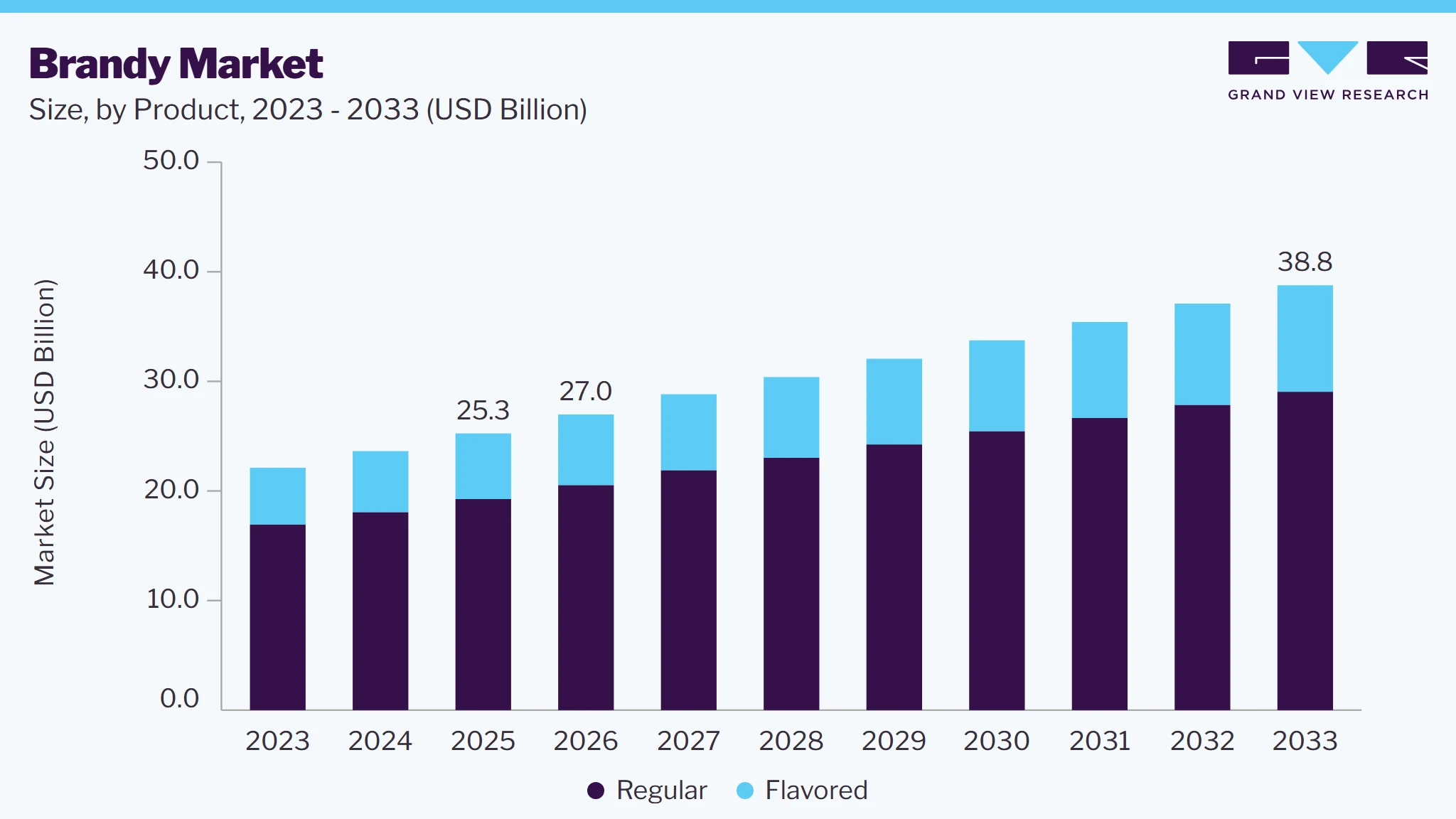 To learn more about this report, Download Free Sample Report
In addition, the expansion of e-commerce facilitates access to a diverse range of brandy products globally. At the same time, a focus on sustainable practices in production and packaging resonates with environmentally conscious consumers. Diversification of flavor profiles, including infusions and flavored brandies, attracts a new wave of experimental consumers, while perceived health benefits contribute to product demand. In addition, the rise of mixology culture and cocktail bars makes brandy more accessible to younger audiences, further driving market growth.
In February 2022, Bacardi India launched Good Man, marking its inaugural venture into the domestic spirits market. This premium blended brandy represents Bacardi India's debut in both the brandy sector and the Indian-made foreign liquor (IMFL) category. Crafted from a fusion of French and Indian grape brandies, Good Man undergoes a minimum two-year aging process in oak casks, embodying a blend of tradition and innovation.
Manufacturers are continually innovating in the realm of brandy flavors, leveraging various techniques and ingredients to create unique and enticing options for consumers. From traditional fruit infusions to more adventurous combinations such as spices, herbs, and botanicals, the landscape of brandy flavors is constantly evolving.
Moreover, the younger demographics are known for their adventurous palates and willingness to experiment with new flavors and experiences. They are attracted to brandy cocktails not only for their sophisticated and complex taste but also for the sense of exploration and creativity they offer. Social media platforms further amplify this trend, with influencers and enthusiasts sharing innovative cocktail recipes and experiences, driving curiosity and engagement among peers. As a result, brandy manufacturers are strategically positioning their products to appeal to these demographics by offering versatile and flavorful options that cater to their evolving tastes and preferences, thereby fueling the growth of the cocktail culture.
For instance, in September 2022, Stella Rosa, renowned as America's top imported wine, alongside its parent company Riboli Family Wines, ventures into the spirits sector with the introduction of their premium imported flavored brandy collection such as Stella Rosa Smooth Black, Tropical Passion, and Honey Peach Brandy.
Market Dynamics
The global brandy market is experiencing stable growth, supported by evolving consumer preferences for premium alcoholic beverages, expanding interest in heritage spirits, and continuous product innovation. Manufacturers are strengthening their portfolios through premiumization, flavored variants, and craft offerings to appeal to a wider consumer base. The growing presence of organized retail, hospitality establishments, and digital sales channels is further enhancing product accessibility. In addition, increasing focus on brand differentiation, packaging innovation, and premium experiences is expected to support the long-term growth of the brandy market.
Consumers are increasingly gravitating toward premium alcoholic beverages that deliver distinctive flavor profiles, heritage, and quality craftsmanship. The rising preference for aged and refined spirits has strengthened the demand for brandy among consumers seeking elevated drinking experiences. Additionally, growing interest in social gatherings, celebrations, and at-home premium beverage consumption continues to support product adoption. This evolving consumer preference for authenticity, quality, and premium experiences is driving sustained growth in the global brandy market.
The brandy market faces challenges due to varying alcohol regulations, advertising restrictions, and taxation policies across different countries. In addition, increasing consumer interest in moderation and alternative alcoholic beverages may influence purchasing patterns. Fluctuations in the availability of key raw materials and production costs can also impact manufacturing efficiency and product pricing, creating operational challenges for market participants.
The market presents significant growth opportunities through the introduction of premium, flavored, and craft brandy offerings that cater to evolving consumer tastes. Manufacturers are focusing on product differentiation through innovative aging techniques, unique flavor infusions, and premium packaging to enhance consumer appeal. The expansion of e-commerce platforms, travel retail, and modern retail channels, along with increasing consumer interest in premium spirits, is creating new opportunities for brand expansion, market penetration, and long-term revenue growth.
Market Concentration & Characteristics
Some product substitutes for brandy include whiskey, rum, cognac, and various liqueurs. Whiskey, whether Scotch, bourbon, or rye, offers a similar depth of flavor and complexity but with distinct characteristics based on the grains used and the production process. Rum provides a sweeter alternative, often with tropical fruit and spice notes. Cognac, while technically a type of brandy, offers a different flavor profile due to its specific grape varietals and aging process, with a smoother and more refined taste. Liqueurs such as Grand Marnier or Amaretto offer sweetness and flavor complexity, which can be used as a substitute in cocktails or enjoyed on their own. Each of these substitutes offers its own unique taste experience, catering to different preferences and occasions.
 To learn more about this report, Download Free Sample Report
The level of mergers and acquisitions (M&A) activities in the brandy industry is currently moderate. As the technology matures and market demand grows, companies are increasingly exploring strategic partnerships, acquisitions, and collaborations to enhance their capabilities, expand their product offerings, and gain a competitive edge.
Analyst Perspective
The global brandy market is expected to witness steady growth, supported by evolving consumer preferences for premium spirits, expanding cocktail culture, and increasing demand for aged and flavored alcoholic beverages. Product innovation, premiumization strategies, and wider retail and on-trade availability continue to strengthen market competitiveness. Manufacturers are also focusing on premium packaging, limited-edition offerings, and strategic brand positioning to attract a broader consumer base. Furthermore, rising consumer interest in authentic craftsmanship and diversified flavor profiles is anticipated to create new growth opportunities, supporting sustained market expansion throughout the forecast period.
Product Insights
Based on product, the regular brandy segment led the market with the largest revenue share of 76.3% in 2025. Regular flavored brandy can be enjoyed neat, on the rocks, or as a key ingredient in various cocktails. Its versatility makes it appealing to a wide range of consumers with different preferences.
The flavored segment is anticipated to grow at the fastest CAGR of 7.6% from 2024 to 2033. Flavored brandy can often be more approachable for individuals who may find the taste of traditional brandy too strong or intense. The added flavors can make the spirit more palatable to a broader audience.
Price Insights
Based on price, the economy segment led the market with the largest revenue share of 41.7% in 2025. Economy-priced brandy offers consumers a budget-friendly option without compromising too much on taste. This affordability makes it accessible to a broader audience, including students, young professionals, and budget-conscious individuals. Despite being priced lower than premium or luxury brandies, economy-priced brandy often delivers a reasonable level of quality and flavor. Consumers perceive it as offering good value for money, making it an attractive choice for everyday enjoyment.
The premium price segment is anticipated to grow at the fastest CAGR of 7.2% from 2024 to 2033. Many premium brandies are aged for extended periods in oak barrels, allowing them to develop complex flavours, depth, and character over time. The aging process imparts nuances such as vanilla, caramel, and spice, enhancing the overall drinking experience. Premium-priced brandies are often associated with luxury, sophistication, and prestige. Consumers may be willing to pay higher prices to indulge in a premium product that reflects their discerning taste and social status.
Distribution Channel Insights
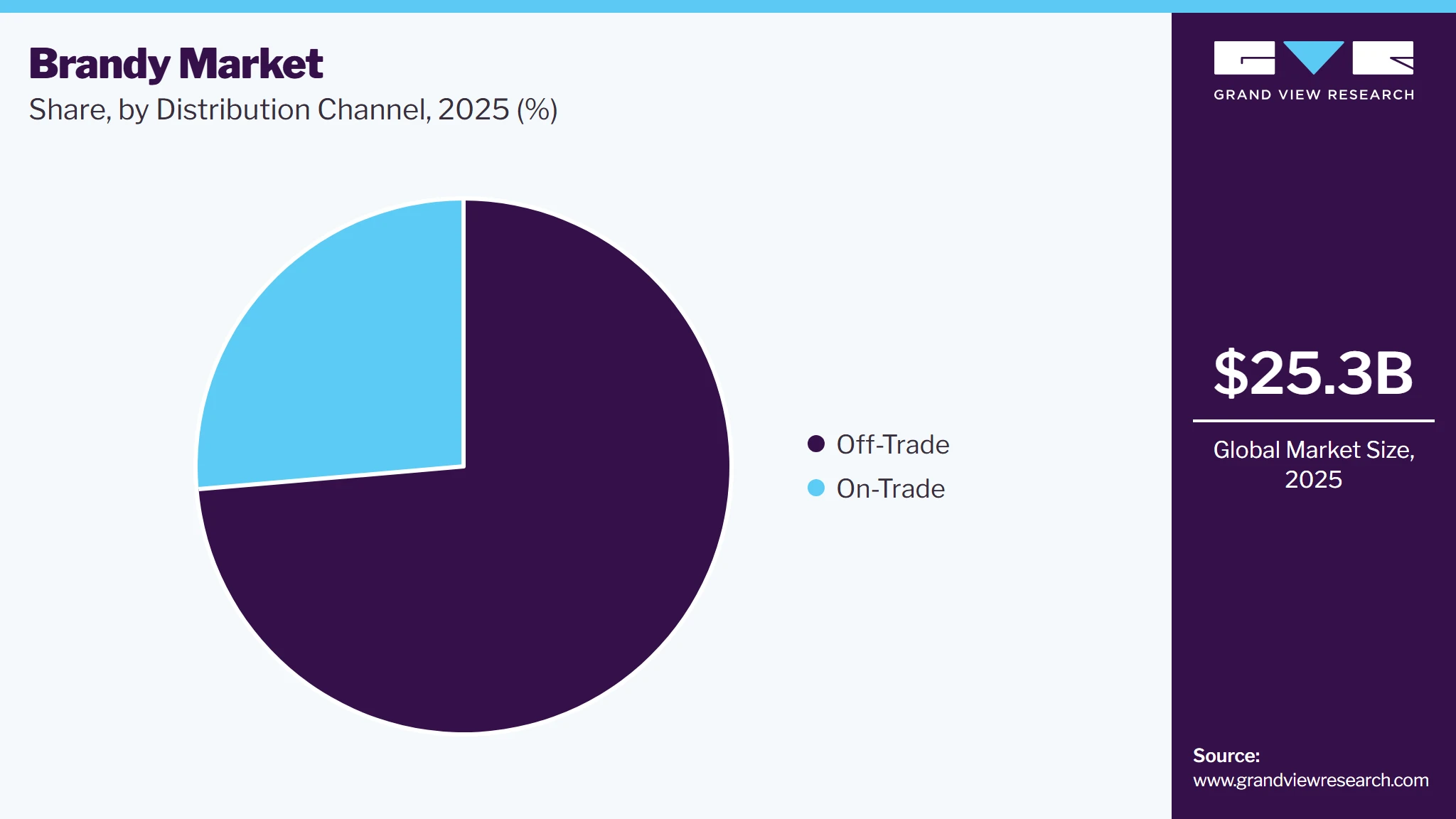
Based on distribution channel, the off-trade channel led the market with the largest revenue share of 73.6% in 2025. Off-trade channels often feature a diverse range of brandy products, including both domestic and international brands, as well as different grades and flavors. This variety allows consumers to explore different options and find brandies that suit their tastes and preferences.Off-trade outlets may provide educational materials, such as tasting notes and product descriptions, to inform consumers about different brandy varieties, production methods, and serving suggestions. This information empowers consumers to make informed purchasing decisions and explore new brandy experiences.
 To learn more about this report, Download Free Sample Report
The on-trade segment is anticipated to grow at the fastest CAGR of 6.6% from 2024 to 2033. Brandy is a key ingredient in many classic and contemporary cocktails served in bars and restaurants. Cocktails such as the Sidecar, Brandy Alexander, and Sazerac showcase the versatility and depth of flavour that brandy brings to mixed drinks, appealing to cocktail enthusiasts and casual drinkers alike. On-trade establishments often feature a selection of premium brandies, including VSOP and XO varieties, to cater to patrons seeking a more sophisticated and indulgent drinking experience. These premium offerings may be served neat or on the rocks, allowing customers to savour the nuances of aged brandy.
Quality Insights
Based on quality, the very special (VS)segment led the market with the largest revenue share of 42.9% in 2025. VS brandy is often more affordable compared to higher-grade options like VSOP or XO. This makes it accessible to a broader range of consumers who may be looking for a quality spirit without a premium price tag. VS brandy is versatile and can be enjoyed in various ways. It can be sipped neat, on the rocks, or used as a base for cocktails and mixed drinks. Its versatility appeals to both casual drinkers and cocktail enthusiasts.
The very superior old pale (VSOP) segment is projected to grow at the fastest CAGR of 7.1% from 2024 to 2033. VSOP brandy undergoes a longer aging process than VS brandy, resulting in enhanced depth, complexity, and smoothness. The extended time spent in oak barrels allows the brandy to develop richer flavours and aromas, making it more appealing to discerning drinkers. The designation of "Very Superior Old Pale" signifies a higher level of quality and craftsmanship. VSOP brandy is often crafted using premium ingredients and traditional production methods, resulting in a superior tasting experience.
Regional Insights
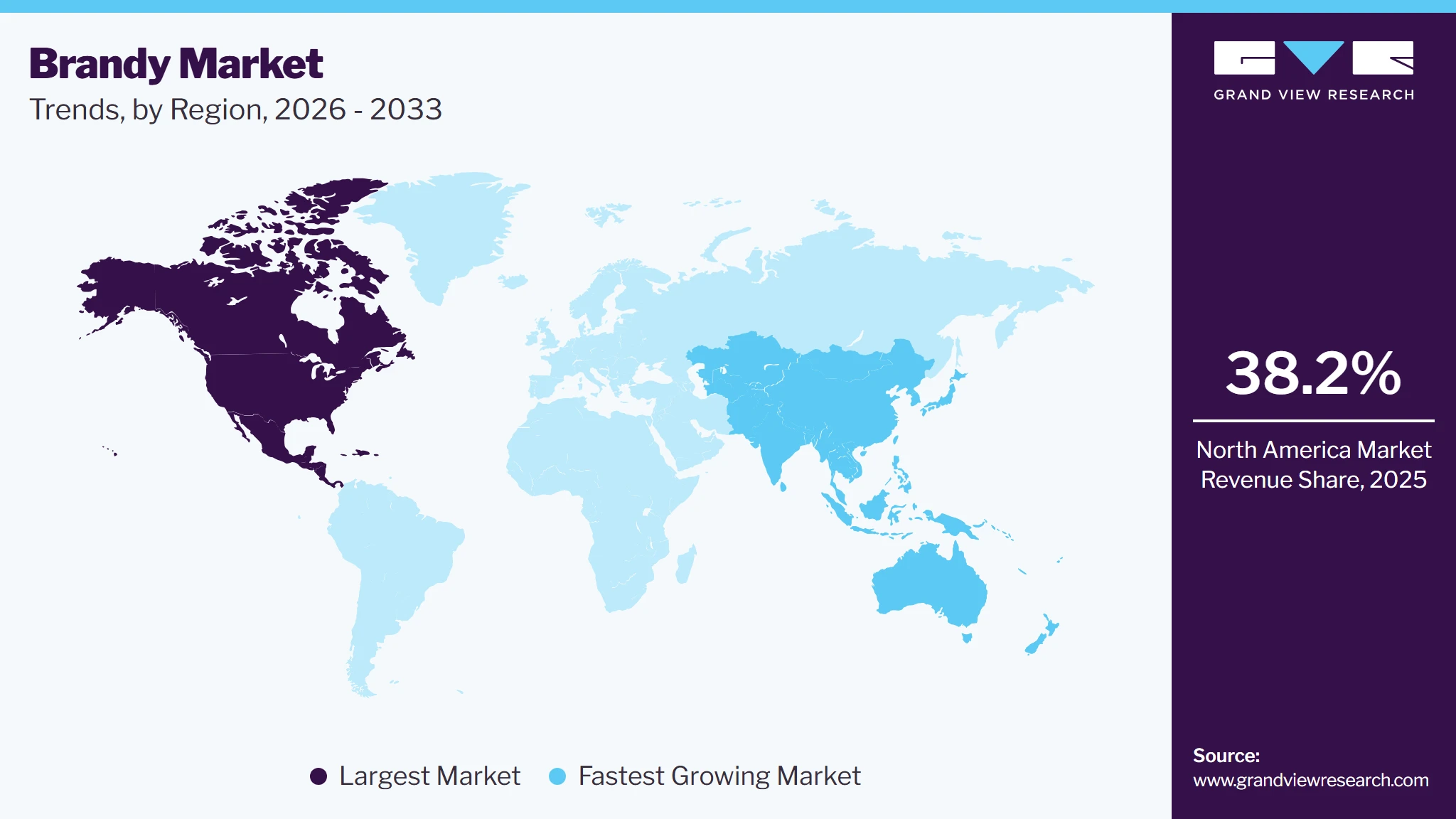
North America dominated the brandy market with the largest revenue share of 38.2% in 2025. North America is home to some of the world's leading technology companies and research institutions. The region has seen significant advancements in 3D printing technology, including improvements in printing speed, accuracy, and material capabilities. These advancements have made it easier and more cost-effective to produce high-quality brandy, driving adoption among manufacturers and consumers alike.
 To learn more about this report, Download Free Sample Report
U.S. Brandy Market Trends
The brandy market in the U.S. held the largest share in the North America region in 2025. The U.S. market is witnessing growth, propelled by a complex interplay of consumer preferences, market innovations, and cultural dynamics. This shift is complemented by an adventurous palate among consumers, eager to explore brandy's diverse flavor profiles. The market is further revitalized by innovations, with distillers introducing novel flavors, aging techniques, and limited editions, alongside the resurgence of cocktail culture that embraces brandy as a key ingredient in craft cocktails. Economic growth, resulting in increased disposable income, along with a demographic shift towards younger consumers seeking authenticity and quality, further fuel the market's expansion.
Asia Pacific Brandy Market Trends
The brandy market in Asia Pacific is expected to grow at the fastest CAGR of 7.3% from 2024 to 2033. Many countries in the Asia-Pacific region, such as China, Japan, and South Korea, are major manufacturing hubs with well-established supply chains and production capabilities. This infrastructure makes it conducive for the adoption of 3D printing technology in footwear manufacturing. Companies can leverage existing manufacturing infrastructure to integrate 3D printing into their production processes, reducing costs and lead times.
Key Brandy Company Insights
The market is highly competitive, with a range of companies offering various prices. Many big players are increasing their focus on new price launches, partnerships, and expansion into new markets to compete effectively.
Key Brandy Companies
The following key companies have been profiled for this study on the brandy market.
-
Hennessy
-
Rémy Martin
-
Courvoisier
-
Martell
-
Torres
-
E&J Gallo
-
Christian Brothers
-
St-Rémy
-
Germain-Robin
-
Vecchia Romagna
Recent Developments
-
In November 2023, Tilaknagar Industries Limited (TI), a prominent Indian-Made Foreign Liquor Manufacturer (IMFL), revealed its premiumization strategy with the introduction of Mansion House Chambers Brandy, an upscale iteration of its renowned brand, Mansion House. Tilaknagar Industries, recognized as one of India's leading producers of premium brandy, aims to capitalize on this launch to expand its presence and appeal to discerning consumers seeking elevated spirits experiences
-
In October 2023, Burnt Faith, a brandy distillery, revealed its new consumer-facing cocktail bar at the brandy house located in Walthamstow, East London, adding a vibrant dimension to the Blackhorse Road Beer Mile. The cocktail menu showcases classic cocktails with a local twist, such as the Aged Negroni featuring Burnt Faith British Brandy, VRSD London Vermouth, and Select Aperitivo, along with a Sazerac made with Burnt Faith British Brandy, Rittenhouse Rye, Devils Botany Absinthe, and Peychaud’s Bitters
-
In June 2022, Milestone Brands LLC, a distinguished premium spirits company, announced its acquisition of Victoria Distillers Inc ("VDI"), a venerable artisan distillery in Canada known for crafting Empress 1908 Gin, and Azzurre Spirits Corporation, the U.S. importer of Empress 1908 Gin. This strategic move underscores Milestone Brands' commitment to expanding its portfolio and strengthening its position in the global spirits market by integrating esteemed brands with rich heritage and exceptional quality
Competitive Benchmarking
Category
Operating Strategies
Competitive Edge
Weakness
Established Players (Hennessy, Rémy Martin, Courvoisier, Martell, E&J Gallo, Torres)
- Expand premium and super-premium brand portfolios through product innovation and limited-edition launches.
- Strengthen global market presence by expanding distribution networks and strategic retail partnerships.
- Strong brand recognition and established consumer trust across multiple regional and international markets.
- Large-scale manufacturing capabilities and well-developed distribution infrastructure enabling broad market reach.
- High operational and supply chain costs associated with large-scale production and distribution management.
- Slower adaptability to rapidly changing consumer preferences compared to smaller niche competitors.
Emerging Players (Christian Brothers, St-Rémy, Germain-Robin, Vecchia Romagna)
- Focus on niche premium offerings and regional heritage to differentiate product portfolios.
- Increase brand visibility through targeted marketing initiatives and expansion into selective international markets.
- Ability to quickly respond to evolving consumer preferences and emerging market trends.
- Greater flexibility in product innovation and customization compared to larger competitors.
- Limited financial resources and lower brand visibility relative to established market leaders.
- Restricted distribution networks and smaller production capacities, limiting market penetration.
Brandy Market Report Scope
Report Attribute
Details
Market size value in 2025
USD 25.3 billion
Estimated market size in 2026
USD 27.0 billion
Projected market size by 2033
USD 38.8 billion
Growth rate
CAGR of 5.3% from 2026 to 2033
Base year for estimation
2025
Historical data
2021 - 2024
Forecast period
2026 - 2033
Quantitative units
Revenue in USD million/billion and CAGR from 2026 to 2033
Report coverage
Revenue forecast, company ranking, competitive landscape, growth factors, and trends
Segments covered
Product, price, quality, distribution channel, region
Regional scope
North America; Europe; Asia Pacific; Central & South America and Middle East & Africa.
Country scope
U.S.; Canada; Mexico; Germany; France; UK; Italy; China; Japan; India; South Korea; Australia; Brazil; Argentina and South Africa
Key companies profiled
The Hershey's Company; Nestlé; The Kroger Co.; The J.M. Smucker Company; Torani; Bosco; Hollander Chocolate, Inc; Walder Farms; Amoretti; Gold's Pure Foods, LLC.
Customization scope
Free report customization (equivalent up to 8 analysts' working days) with purchase. Addition or alteration to country, regional & segment scope.
Pricing and purchase options
Avail customized purchase options to meet your exact research needs. Explore purchase options
Global Brandy Market Report Segmentation
This report forecasts revenue growth at the global, regional, and country levels and provides an analysis of the latest industry trends and opportunities in each of the sub-segments from 2021 to 2033. For this study, Grand View Research has segmented the global brandy market report based on product, price, quality, distribution channel, and region:
-
Product Outlook (Revenue, USD Million, 2021 - 2033)
-
Flavored
-
Regular
-
-
Price Outlook (Revenue, USD Million, 2021 - 2033)
-
Economy
-
Premium
-
Luxury
-
-
Quality Outlook (Revenue, USD Million, 2021 - 2033)
-
Very Special
-
Very Superior Ole Pale
-
Extra Old
-
-
Distribution Channel Outlook (Revenue, USD Million, 2021 - 2033)
-
On Trade
-
Bars & Restaurants
-
Pubs
-
-
Off Trade
-
Supermarkets/Hypermarkets
-
Liquor Stores
-
Online
-
Others
-
-
-
Regional Outlook (Revenue, USD Million, 2021 - 2033)
-
North America
-
U.S.
-
Canada
-
Mexico
-
-
Europe
-
Germany
-
UK
-
Spain
-
Italy
-
France
-
-
Asia Pacific
-
China
-
India
-
Japan
-
South Korea
-
Australia & New Zealand
-
-
Central & South America
-
Brazil
-
-
Middle East & Africa
-
South Africa
-
UAE
-
-
Research Methodology
The brandy market figures in this report are based on a proven research process that combines executive interviews with secondary research from proprietary databases, company filings, and recognized regulatory and institutional sources. Market size is built through value-chain sizing - reconciling supply-side and demand-side estimates - and triangulated with bottom-up and top-down approaches. Every estimate passes multiple levels of expert validation before publication, with each brandy segment quantified using the revenue-capture definitions in the table below.
Segment Definition
Segment - Product
Revenue capture definition
Flavored
This segment includes the sales of brandy infused with fruit, spice, herb, or other flavor profiles, catering to consumers seeking enhanced taste experiences and product variety.
Regular
This segment includes the sales of traditional brandy produced through conventional distillation and aging processes, offering classic flavor profiles preferred by mainstream consumers.
Estimation Model
No.
Layer
Key Question
Description
01
Consumption Layer
Who constitutes the potential brandy consumer base?
Identify the eligible consumer population based on legal drinking age, drinking habits, premium spirits preferences, and consumption occasions to establish the potential brandy consumer base.
02
Market Availability Layer
Who can access brandy products?
Assess retail penetration across liquor stores, supermarkets, duty-free outlets, bars, restaurants, and online alcohol platforms to determine the addressable consumer base.
03
Purchase Conversion Layer
Who actively purchases brandy?
Apply category-specific purchase rates by evaluating consumer preferences for regular and flavored brandy, premiumization trends, gifting occasions, and seasonal demand to estimate active buyers.
04
Revenue Estimation Layer
How is total brandy market revenue estimated?
Multiply active purchasers by average annual spending across product types and distribution channels, incorporating pricing tiers and purchase frequency to estimate total market revenue.
Delivered Customizations
This report has been delivered with the following In-depth customizations
Client Request
Customization Delivered
Value Adds
Cross-Segmentation Analysis for Brandy Types Across Distribution Channels
Detailed assessment of the brandy market across flavored and regular product categories, with analysis of sales performance through on-trade (bars & restaurants, pubs) and off-trade (supermarkets/hypermarkets, liquor stores, online, and other retail channels).
Identifies high-growth product-channel combinations, supports portfolio optimization, and highlights evolving consumer purchasing patterns and channel-specific growth opportunities
Value Chain Analysis
Comprehensive evaluation of the brandy value chain covering raw material sourcing, distillation, aging, blending, bottling, packaging, distribution, wholesale, retail operations, and end-consumer delivery. Analysis assesses operational efficiencies, cost structures, supply chain integration, and key value creation stages.
Supports supply chain optimization, improves operational efficiency, identifies cost-saving opportunities, strengthens distribution strategies, and enhances market competitiveness through effective value chain management.
Company Share Analysis
Detailed assessment of leading brandy manufacturers, including market share, product portfolio strength, distribution network, production capabilities, brand positioning, and competitive presence within the global brandy market.
Enables competitive benchmarking, identifies market leaders, supports strategic planning, and provides actionable insights for market positioning, investment decisions, and business expansion strategies.
Frequently Asked Questions About This Report
The global brandy market size was valued at USD 25.3 billion in 2025 and is estimated at USD 27.0 billion for 2026.
The global brandy market is expected to grow at a CAGR of 5.3% from 2026 to 2033, reaching USD 38.8 billion by 2033.
North America market dominated the market, accounting for a revenue share of 38.2% in 2025.
Key players include The Hershey's Company; Nestlé; The Kroger Co.; The J.M. Smucker Company; Torani; Bosco; Hollander Chocolate, Inc; Walder Farms; Amoretti; Gold's Pure Foods, LLC.
The advancements in distillation techniques and the introduction of innovative ingredients have resulted in improvements in the resilience and excellence of crafted spirits, thus broadening their availability to a broader clientele.
Off-trade channel led the market with the largest revenue share of 73.6% in 2025.
Asia Pacific is the fastest-growing region over the forecast period.
Regular brandy segment led the market with the largest revenue share of 76.3% in 2025.
Economy segment led the market with the largest revenue share of 41.7% in 2025.
About the Author(s)
Alcohol & Tobacco Research Team
Consumer Goods · Alcohol & TobaccoThis report was authored by the alcohol & tobacco research team at Grand View Research - comprising two research analysts, one senior research analyst, and one industry expert - with specialized expertise in the alcohol & tobacco segment of the consumer goods industry. All findings are based on proprietary consumer goods databases, executive interviews, and regulatory analysis, subject to internal peer review prior to publication.
Last Updated:
Speak to Analyst

Customize this report to your needs - add regions, segments, or data points, with 20% free customization.
Or view our licence options:


ISO 9001:2015 & 27001:2022 Certified
We are GDPR and CCPA compliant! Your transaction & personal information is safe and secure. For more details, please read our privacy policy.


