
- Home
- »
- Medical Devices
- »
-
Breast Coil Market Size, Share & Trends Report, 2026-2033GVR Report cover
![Breast Coil Market Size, Share & Trends Report]()
Breast Coil Market (2026 - 2033) Size, Share & Trends Analysis Report By Design Type (Closed/Prone Bilateral, Open/Interventional, Unilateral/Single-Breast), By Field Strength (1.5T Coils, 3.0T Coils, Ultra-high (7T)), By Application, By End Use, By Region, And Segment Forecasts
Market Size, 2025
$340.5MMarket Estimate, 2026
$383.2MMarket Forecast, 2033
$876.9MCAGR, 2026–2033
12.6%Breast Coil Market Summary
The global breast coil market size was valued at USD 340.5 million in 2025 and is projected to grow from USD 383.2 million in 2026 to USD 876.9 million by 2033, at a CAGR of 12.6% from 2026 to 2033. North America dominated the global market with the largest revenue share of 44.4% in 2025. This growth is due to the increasing demand for advanced breast imaging and the rising global burden of breast cancer.

Key Market Trends & Insights
- The breast coil industry in the U.S. accounted for the largest market revenue share in North America in 2025.
- By design type, the closed/prone bilateral segment accounted for the largest market revenue share in 2025.
- By field strength, the 3.0T coils segment accounted for the largest market revenue share in 2025.
- By application, the screening & diagnosis segment accounted for the largest market revenue share in 2025.
- By end use, the hospitals segment accounted for the largest market revenue share in 2025.
Market Size & Forecast
- 2025 Market Size: USD 340.5 Million
- 2026 Market Size: USD 383.2 Million
- 2033 Projected Market Size: USD 876.9 Million
- CAGR (2026-2033): 12.6%
- North America: Largest market in 2025
Healthcare providers are focusing more on early and accurate diagnosis, which has increased the use of magnetic resonance imaging (MRI) systems equipped with specialized breast coils. Breast coils help improve image quality and diagnostic precision, allowing radiologists to detect abnormalities more effectively. As awareness regarding preventive healthcare and routine breast screening continues to grow, the demand for breast MRI procedures is also increasing across hospitals and diagnostic centers.In addition, technological advancements in MRI systems are another major factor supporting market growth. Manufacturers are developing high-channel, patient-friendly breast coils that offer greater comfort, faster scanning, and enhanced imaging performance. These innovations improve workflow efficiency and support more reliable clinical outcomes, encouraging healthcare facilities to upgrade their imaging equipment. Furthermore, the integration of artificial intelligence (AI) and advanced imaging software is improving the interpretation of MRI scans, further supporting adoption.

For instance, Siemens Healthcare Private Limited offers the 16-Channel AI Breast Coil, which is designed to deliver high-quality, high-resolution 2D and 3D MR breast imaging with enhanced clarity and faster scan performance. Its 16-channel architecture with integrated preamplifiers supports advanced parallel imaging techniques, enabling iPAT acceleration factors up to 4. The coil allows simultaneous bilateral breast imaging in multiple directions and includes patient comfort features such as a positioning cushion and headrest. Its optimized design also enables accurate breast and axillary imaging, improving diagnostic efficiency.
Rising numbers of breast cancer cases have significantly increased the demand for advanced diagnostic imaging technologies, particularly magnetic resonance imaging (MRI), for early detection and accurate diagnosis. Breast coils play an important role in improving MRI image quality, enabling healthcare professionals to identify tumors and abnormalities with greater precision. Growing awareness regarding the importance of early breast cancer screening, along with government-led screening programs and improved healthcare infrastructure, is further supporting the adoption of advanced breast imaging systems.
Trends in Breast Cancer Prevalence and Incidence in the U.S., 2026
Breast Cancer Statistics
Data
New invasive breast cancer cases
321,910
New ductal carcinoma in situ (DCIS) cases
60,730
Expected breast cancer deaths
42,140
Share of all new female cancers
About 30% (1 in 3)
Median age at diagnosis
62 years
Lifetime risk of breast cancer
1 in 8 women (13%)
Annual increase in incidence rate
1% per year
Increase in women under 50
1.4% per year
Decline in death rate (1989-2022)
44%
Chance of dying from breast cancer
1 in 43 women
Breast cancer survivors in the U.S.
Over 4 million
Source: American Cancer Society, Inc.

Market Dynamics
Increasing public health campaigns, educational programs, and awareness initiatives by governments and healthcare organizations are encouraging women to undergo regular breast cancer screening and diagnostic examinations. Early detection of breast cancer improves treatment success rates, reduces mortality, and helps identify abnormalities before the disease progresses to advanced stages. As a result, demand for advanced imaging technologies, such as breast MRI, is increasing worldwide. Breast coils play a critical role in enhancing MRI image quality and diagnostic accuracy, enabling healthcare professionals to detect small lesions and tissue abnormalities more effectively.
Breast coils used in MRI systems require advanced technology, multi-channel configurations, integrated preamplifiers, and high-performance imaging capabilities, which significantly increase overall equipment costs. In addition to the initial purchase price, healthcare facilities must also invest in installation, maintenance, software upgrades, and skilled professionals to operate the systems effectively. These high expenses can limit the adoption of advanced breast MRI technologies, particularly in small hospitals, diagnostic centers, and healthcare facilities in developing regions with limited budgets.
Market Characteristics & Concentration
The breast coil industry is witnessing moderate to high innovation driven by advancements in AI-enabled MRI technologies, multi-channel coil designs, and high-resolution breast imaging systems. Companies are focusing on improving image quality, reducing scan times, and enhancing patient comfort during breast MRI procedures. Technological developments such as parallel imaging, lightweight coil structures, and advanced 3D imaging capabilities are improving diagnostic accuracy and workflow efficiency in healthcare facilities.
The breast coil industry is experiencing a moderate level of mergers, acquisitions, and strategic partnerships as medical imaging companies seek to strengthen their MRI technology portfolios and expand their global market presence. For instance, in April 2026, GE HealthCare expanded its partnership with DeepHealth, a RadNet subsidiary, to accelerate the global adoption of breast cancer screening solutions. The collaboration will enhance workflow efficiency, introduce second reader AI capabilities, and expand international access to advanced breast cancer detection technologies. Such strategies and expansion initiatives are expected to drive technological advancements, improve diagnostic accuracy, and support the long-term growth of the global market.
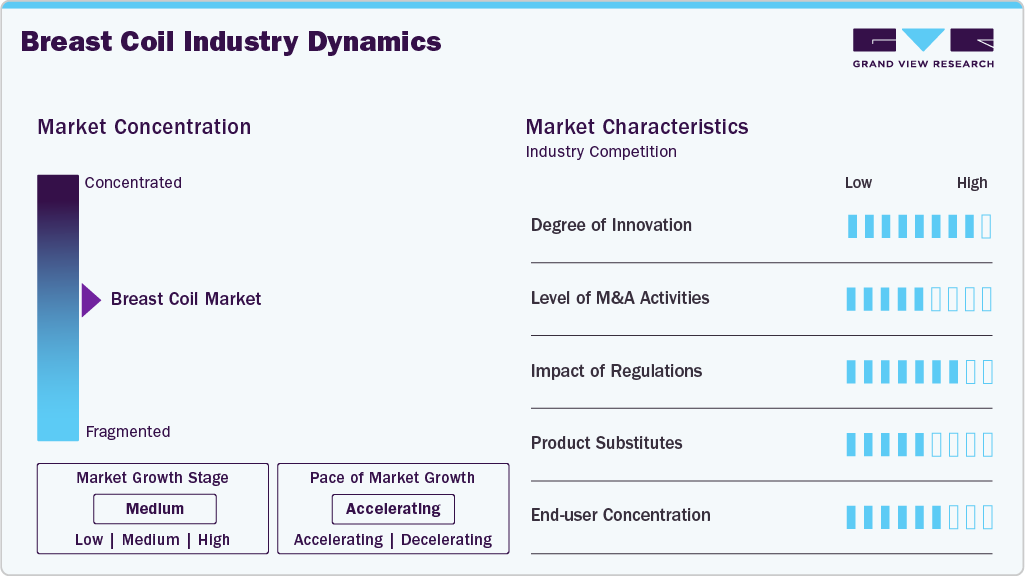
Regulations have a significant impact on the breast coil industry, shaping product development, commercialization, and competitive dynamics. Breast coils and MRI imaging systems are subject to strict safety, quality, and performance standards established by regulatory authorities such as the U.S. Food and Drug Administration and the European CE regulatory framework. Manufacturers are required to comply with rigorous approval procedures, clinical validation requirements, and medical device quality standards before launching products in the market.
The availability of product substitutes in the breast coil industry is relatively limited. Alternative pain management methods, including sedation dentistry, nitrous oxide, and non-invasive dental technologies, can reduce dependence on traditional local anesthesia products in certain procedures. However, the local breast coil remains essential for most surgical and restorative treatments due to its effectiveness and affordability.
End-use concentration in the breast coil industry is high, with hospitals, cancer care centers, and advanced diagnostic imaging facilities serving as the primary consumers of breast coil systems. The increasing number of breast cancer screening and diagnostic procedures performed in these healthcare settings continues to drive consistent demand for high-performance MRI breast imaging solutions. Large hospitals and specialized imaging centers account for a significant share of market demand due to their higher patient volumes, advanced MRI infrastructure, and greater investment capacity in technologically advanced imaging equipment.
Design Type Insights
The closed/prone bilateral segment led the market with the largest revenue share of 65.10% in 2025, driven by strong imaging performance, high patient throughput, and widespread adoption across hospitals and diagnostic imaging centers. These coils provide a superior signal-to-noise ratio and improved image quality, enabling more accurate breast cancer detection and diagnosis during MRI procedures. The prone positioning design also helps reduce motion artifacts and enhances patient comfort during longer imaging sessions. In addition, bilateral breast coils allow simultaneous imaging of both breasts, improving workflow efficiency and reducing scan time for radiologists and healthcare providers. The increasing prevalence of breast cancer, rising demand for early detection technologies, and growing use of advanced MRI systems further supported segment growth.
The open/interventional unilateral segment is expected to grow at the fastest CAGR over the forecast period, due to the increasing demand for targeted breast imaging, personalized diagnostic procedures, and minimally invasive interventions. These coils are highly preferred for focused examinations, post-surgical evaluations, and image-guided biopsy procedures because they provide enhanced visualization of a single breast with improved image resolution and signal sensitivity. Technological advancements in dedicated breast MRI systems and increasing adoption of precision imaging techniques are also supporting segment growth. For instance, in 2026, researchers at Mass General Brigham demonstrated the technical feasibility of ultra-low-field (ULF) MRI for breast imaging, highlighting its potential as a lower-cost, more accessible option for breast cancer screening. Published in Scientific Reports, the study suggests that with further refinement, ULF MRI could help reduce screening barriers and expand access to breast imaging services.
Field Strength Insights
The 3.0T coils segment accounted for the largest market revenue share in 2025, due to the rising adoption of high-field MRI systems for advanced breast imaging and cancer detection. Compared to 1.5T systems, 3.0T breast coils provide a higher signal-to-noise ratio (SNR), improved spatial resolution, and superior lesion visualization, enabling more accurate diagnosis and better assessment of dense breast tissue. In addition, ongoing technological advancements, such as deep learning-based image reconstruction, multi-channel coil configurations, and accelerated MRI protocols, are enhancing the efficiency and clinical performance of 3.0T breast MRI systems. Recent April 2025 studies published in the European Journal of Radiology reported that advanced 3.0T breast MRI techniques significantly improved image quality, lesion conspicuity, and diagnostic performance, supporting the increasing clinical preference for 3.0T breast imaging solutions.
The 1.5T coils segment is expected to grow at a significant CAGR over the forecast period, due to its wide adoption across hospitals and diagnostic imaging centers, supported by the extensive global installation base of 1.5T MRI systems. In addition, manufacturers continued to introduce technologically advanced 1.5T MRI systems to improve workflow and diagnostic accuracy. For instance, in January 2026, Siemens Healthineers received FDA clearance for its Magnetom Flow. 70 cm bore 1.5T MRI system, designed with a closed helium circuit and no quench pipe to reduce helium dependency and energy consumption significantly. The system uses AI-based image reconstruction for faster scan times and enhanced image quality. At the same time, DryCool technology requires only 0.7 liters of liquid helium compared to over 1,000 liters in conventional MRI scanners, helping lower operational and installation costs. These technological advancements, combined with lower operating costs and improved imaging efficiency, are expected to further strengthen the adoption of 1.5T coils in breast imaging applications worldwide.
Application Insights
The screening & diagnosis application segment accounted for the largest market revenue share in 2025, driven by the growing global focus on early breast cancer detection and the increasing use of MRI in high-risk screening programs. Breast MRI, supported by advanced breast coil technology, has become an important diagnostic tool because of its high sensitivity in detecting invasive breast cancers and lesions that may not be visible through conventional mammography, particularly in women with dense breast tissue. According to the Radiological Society of North America (RSNA), in May 2026, dense breast tissue can reduce mammography sensitivity from nearly 95% to around 60%, increasing the demand for supplemental MRI screening solutions. In addition, a 2026 systematic review published in The Breast journal reported that supplemental MRI screening detected approximately 19 additional cancers per 1,000 screenings among women with dense breasts, significantly higher than ultrasound and digital breast tomosynthesis. These advancements, along with the integration of AI-assisted imaging technologies, continued to strengthen the adoption of breast coils in screening and diagnostic applications worldwide.
The NAC therapy monitoring segment is expected to grow at the fastest CAGR over the forecast period. Breast MRI coils play a critical role in capturing high-resolution images during NAC therapy, helping clinicians monitor tumor shrinkage, evaluate treatment effectiveness, and support personalized treatment planning. Growing adoption of advanced imaging technologies, including AI-enabled MRI analysis and radiomics, is further supporting segment growth. In February 2026, studies show that MRI remains one of the most widely used imaging techniques for monitoring NAC response, with around 19% of over 1,300 reviewed studies focusing on MRI-based monitoring technologies.
End Use Insights
The hospitals segment accounted for the largest market revenue share in 2025, due to the rapid expansion of hospital infrastructure, increasing patient admissions for breast cancer screening, and growing investments in advanced MRI and diagnostic imaging systems. Hospitals remain the primary centers for breast MRI procedures because they offer comprehensive oncology, radiology, and surgical services under one roof. For instance, in June 2025, NIIMS Hospital expanded its capacity to 900 beds and installed the advanced MAGNETOM Sempra 1.5T MRI System by Siemens Healthineers to strengthen diagnostic imaging capabilities. The upgraded MRI system features TIM & DOT technology, a patient-friendly non-claustrophobic design, feet-first imaging support, and QUIET Suite technology that reduces scan noise by nearly 93%, while the hospital continues to provide affordable healthcare services under Ayushman Bharat and CGHS. This growing focus on expanding hospital-based imaging infrastructure and improving patient-centric diagnostic services is strengthening the adoption of advanced breast coils worldwide.
“We are thrilled to announce this new development at NIIMS, as we have increased bed capacity and cutting-edge radiology infrastructure. We are now better prepared to manage a higher patient load while delivering unparalleled diagnostic precision. The MAGNETOM Sempra puts us on par with international imaging standards.”
- Raj Vaardhan Dixit, OSD Chairman, NIIMS Hospital

The ambulatory surgery center (ASCs) segment is expected to grow at the fastest CAGR during the forecast period, due to the increasing awareness of breast cancer screening and early diagnosis. Growing public health campaigns, social media awareness, and government initiatives are encouraging more women to undergo regular breast imaging procedures. For instance, Breast Cancer Awareness Month, observed every October, is a global campaign focused on promoting early detection, screening, education, and support for people affected by breast cancer. Beyond the well-known pink ribbons, the campaign also highlights the emotional and personal experiences of millions of patients and survivors worldwide. The initiative encourages regular screenings, raises awareness about risk factors, and supports ongoing research and treatment efforts. As a result, the rising focus on specialized breast imaging services and early cancer detection initiatives is expected to significantly drive the market growthover the forecast period.
Regional Insights
North America dominated the global breast coil market with the largest revenue share of 44.4% in 2025 and is projected to grow at the fastest CAGR during the forecast period, due to the region’s advanced healthcare infrastructure, high adoption of MRI technologies, and increasing focus on early breast cancer detection. Countries such as the U.S., Canada, and Mexico are witnessing a growing number of breast imaging procedures, including breast MRI screenings, diagnostic imaging, and oncology-related examinations, all of which require advanced breast coil systems to improve imaging accuracy.

U.S. Breast Coil Market Trends
The breast coil market in the U.S. accounted for the largest market revenue share in North America in 2025, due to the increasing prevalence of breast disease, which continues to raise demand for advanced breast imaging and early diagnostic solutions. The growing focus on accurate detection and routine breast MRI screenings is encouraging healthcare providers to adopt high-performance breast coil systems that improve imaging quality and diagnostic precision. For instance, in April 2026, according to the National Breast Cancer Foundation, Inc., breast cancer is the second leading cause of cancer-related deaths among U.S. women after lung cancer, with approximately 42,140 women expected to die from the disease in 2026. This rising disease burden and the increasing emphasis on early diagnosis are expected to continue driving the adoption of advanced breast coil technologies across U.S. healthcare facilities.
Europe Breast Coil Market Trends
The breast coil market in Europe is witnessing strong growth over the forecast period due to the presence of well-established healthcare systems and increasing access to advanced diagnostic imaging services across countries such as the UK, Germany, France, Italy, Spain, Denmark, Sweden, and Norway. These countries have strong public and private healthcare infrastructures that support routine breast cancer screening, early diagnosis, and advanced MRI procedures.
The UK breast coil market is mainly driven by the stringent healthcare regulations and national breast cancer screening initiatives that promote the adoption of advanced diagnostic imaging technologies. Regulatory guidelines issued under the NHS Breast Screening Program encourage the use of high-quality MRI systems and standardized imaging practices for early breast cancer detection. For instance, in February 2026, according to the publication of NHS England’s Breast Screening Program 2024-25 report, around 2.15 million women were screened in England, while approximately 19,291 cancers were detected through screening programs, highlighting the increasing importance of advanced breast imaging solutions and breast coil technologies across the country.
The breast coil market in Italy is driven by the supportive government initiatives aimed at strengthening breast cancer screening and improving access to advanced diagnostic imaging services. National healthcare programs promoting early breast cancer detection, along with increasing investments in hospital modernization and MRI infrastructure, are encouraging the adoption of advanced breast coil systems across healthcare facilities in Italy.
Asia Pacific Breast Coil Market Trends
The breast coil market in the Asia Pacific is witnessing significant growth in the global market in 2025, driven by rising healthcare investments and improved access to advanced diagnostic imaging services. Countries such as China, India, Japan, Australia, Thailand, and South Korea are experiencing increasing demand for breast cancer screening, MRI-based diagnostic procedures, and early disease detection services as awareness regarding women’s health continues to rise. The growing middle-class population, expanding healthcare infrastructure, and higher healthcare spending are encouraging hospitals and diagnostic centers to adopt advanced breast imaging technologies, which are directly increasing the demand for breast coil systems. For instance, according to the India Brand Equity Foundation, India’s healthcare sector is witnessing strong growth driven by rising demand for healthcare professionals, which is expected to double both nationally and globally by 2030. At the same time, India has only around 1.3 hospital beds per 1,000 people, far below the global median, creating significant opportunities for healthcare infrastructure development and investment. Continuous advancements in MRI technology, supportive government healthcare initiatives, and increasing investments by private healthcare providers are expected to further accelerate the adoption of breast coil systems across the Asia Pacific region during the forecast period.
The China breast coil market is significantly driven by the expansion of diagnostic imaging and oncology healthcare services across multiple end-use segments. Hospitals and private diagnostic centers in China are rapidly expanding to meet increasing patient demand for advanced, high-quality breast cancer screening services. These healthcare facilities are increasingly adopting MRI-based breast imaging procedures for early cancer detection, tumor evaluation, and treatment monitoring, all of which require advanced breast coil systems to enhance imaging quality, improve patient positioning, and improve diagnostic accuracy.
Latin America Breast Coil Market Trends
The breast coil market in Latin America is expected to witness strong growth during the forecast period, due to the rising awareness regarding early disease detection and expanding access to diagnostic imaging services. Countries such as Brazil and Argentina are experiencing growing demand for breast MRI procedures, cancer screening programs, and advanced oncology diagnostics, which is driving the need for high-performance breast coil systems. In Brazil, the large patient population, improving healthcare infrastructure, and growing presence of private diagnostic centers are supporting market expansion.
MEA Breast Coil Market Trends
The breast coil market in the Middle East & Africa is growing significantly. Countries such as Saudi Arabia, the UAE, Kuwait, and South Africa are investing in advanced healthcare infrastructure and encouraging the adoption of modern diagnostic imaging technologies in hospitals and diagnostic centers. Governments across these countries are also focusing on expanding access to cancer screening services and improving the quality of healthcare through healthcare modernization programs and regulatory reforms. For instance, the UAE is strengthening its preventive healthcare framework by planning to make early cancer screening mandatory and integrating these tests into health insurance coverage requirements. This initiative, announced by the Ministry of Health and Ahmed Al Sayegh, was presented to the Federal National Council (FNC) in January 2026 and is expected to improve early diagnosis rates, increase access to advanced screening services, and drive demand for diagnostic imaging technologies across the country.
Key Breast Coil Company Insights
Some of the key companies in the breast coil industry include Siemens Healthcare Private Limited, Koninklijke Philips N.V., GE HealthCare, NeoCoil, NORAS MRI Products, Canon Medical Systems, USA, and AURORA HEALTHCARE US CORP. Organizations are focusing on increasing their customer base to gain a competitive edge in the industry. Therefore, key players are taking several strategic initiatives, such as mergers and acquisitions, and partnerships with other major companies.
Key Breast Coil Companies
The following key companies have been profiled for this study on the breast coil market.
-
Siemens Healthcare Private Limited
-
Koninklijke Philips N.V.
-
GE HealthCare
-
NeoCoil
-
NORAS MRI Products
-
Canon Medical Systems, USA
-
AURORA HEALTHCARE US CORP
-
FUJIFILM Corporation
-
Hologic, Inc.
-
ScanMed, LLC
Competitive Benchmarking
Operating Strategies
Competitive Edge
Weaknesses
Mature Players: Siemens Healthcare Private Limited; Koninklijke Philips N.V.; GE HealthCare; Canon Medical Systems, USA; FUJIFILM Corporation; Hologic, Inc.
- Strengthening collaborations with hospitals, diagnostic imaging centers, cancer research institutes, and healthcare providers to increase adoption of advanced breast imaging solutions.
- Expanding geographic presence in emerging healthcare markets through strategic distribution partnerships, and regional service networks.
- Broad product portfolios covering MRI systems, advanced breast coil technologies, AI-powered imaging solutions, and breast cancer screening platforms.
- Strong global brand recognition and established relationships with hospitals, diagnostic imaging centers, and healthcare institutions across multiple regions.
- High dependence on regulatory approvals, clinical validation requirements, and compliance standards, increasing operational complexity and extending product launch timelines.
- Premium pricing of advanced MRI systems and breast coil technologies limit adoption among small and mid-sized healthcare facilities.
Emerging Players: NeoCoil; NORAS MRI Products; AURORA HEALTHCARE US CORP; ScanMed, LLC.
- Investing in product innovation and lightweight, patient-friendly coil designs to enhance imaging performance and user comfort.
- Collaborating with regional hospitals, diagnostic centers, and research institutions to improve product visibility and accelerate clinical adoption.
- Greater operational flexibility and faster adaptation to evolving imaging technology trends and regional healthcare requirements.
- Competitive pricing advantages supported by lower manufacturing, operational, and distribution costs.
- Limited global brand recognition and smaller distribution and service networks compared to established market leaders.
- Lower investment capacity for advanced research and development, clinical validation studies, and large-scale technological innovation.
Recent Developments
-
In February 2026, Wipro GE Healthcare launched the SIGNA Prime Elite MR imaging system at IRIA 2026 in Hyderabad, expanding its ‘Made in India’ healthcare technology portfolio. The AI-powered MRI system integrates AIR Recon DL and AIR Coils to improve imaging efficiency, patient comfort, and diagnostic accuracy, while supporting sustainable operations by reducing helium consumption.
-
In October 2025, Waverly Health Center expanded its breast imaging capabilities by introducing the NeoCoil breast coil with the GE Voyager MRI system. The advanced technology is designed to improve breast cancer detection, particularly for women with dense breast tissue or higher cancer risk, supporting more accurate and early diagnosis.
-
In June 2025, Probo Medical announced a strategic partnership with MedServ Marketplace to expand access to diagnostic imaging equipment repair and on-demand service solutions. Through this collaboration, Probo’s MRI coil, ultrasound probe, and endoscope repair services will be integrated into the MedServ platform, helping healthcare providers improve equipment maintenance efficiency and minimize operational downtime.
-
In March 2024, Wipro GE Healthcare announced an investment of over INR 8,000 crore (~USD 950 million) over the next five years to expand manufacturing and local R&D in India’s MedTech sector. As part of this initiative, “Made in India” products, including MR breast coils, PET CT Discovery IQ, Revolution ACT, and Revolution Aspire CT, will be produced in India for global markets, strengthening export capabilities and supply chain resilience.
Breast Coil Market Report Scope
Report Attribute
Details
Market size value in 2025
USD 340.5 million
Market size value in 2026
USD 383.2 million
Revenue forecast in 2033
USD 876.9 million
Growth rate
CAGR of 12.6% from 2026 to 2033
Base year for estimation
2025
Historical data
2021 - 2024
Forecast period
2026 - 2033
Market representation
Revenue in USD million/billion, and CAGR from 2026 to 2033
Segments covered
Design type, field strength, application, End Use, region
Regional scope
North America; Europe; Asia Pacific; Latin America; Middle East & Africa
Country scope
U.S.; Canada; Mexico; UK; Germany; France; Italy; Spain; Denmark; Sweden; Norway; Japan; China; India; Thailand; Australia; South Korea; Brazil; Argentina; South Africa; Saudi Arabia; UAE; Kuwait
Key companies profiled
Siemens Healthcare Private Limited; Koninklijke Philips N.V.; GE HealthCare; NeoCoil; NORAS MRI Products; Canon Medical Systems, USA; AURORA HEALTHCARE US CORP; FUJIFILM Corporation; Hologic, Inc.; ScanMed, LLC.
Customization scope
Free report customization (equivalent up to 8 analyst’s working days) with purchase. Addition or alteration to country, regional & segment scope
Pricing and purchase options
Avail customized purchase options to meet your exact research needs. Explore purchase options
Global Breast Coil Market Report Segmentation
This report forecasts revenue growth at global, regional & country levels and provides an analysis of the latest industry trends in each of the sub-segments from 2021 to 2033. For this study, Grand View Research has segmented the global breast coil market report based on design type, field strength, application, end use, and region:
-
Design Type Outlook (Revenue, USD Million, 2021 - 2033)
-
Closed / Prone Bilateral
-
Open / Interventional Unilateral
-
Dedicated Breast System
-
-
Field Strength Outlook (Revenue, USD Million, 2021 - 2033)
-
1.5T Coils
-
3.0T Coils
-
Ultra-high (7T)
-
-
Application Outlook (Revenue, USD Million, 2021 - 2033)
-
Screening & Diagnosis
-
MRI-Guided Biopsy
-
NAC Therapy Monitoring
-
Research / Clinical Trials
-
-
End Use Outlook (Revenue, USD Million, 2021 - 2033)
-
Hospitals
-
Diagnostic Imaging Centers
-
Breast Care Centers
-
Academic / Research
-
Ambulatory Surgery Center (ASCs)
-
-
Regional Outlook (Revenue, USD Million, 2021 - 2033)
-
North America
-
U.S.
-
Canada
-
Mexico
-
-
Europe
-
UK
-
Germany
-
France
-
Italy
-
Spain
-
Denmark
-
Sweden
-
Norway
-
-
Asia Pacific
-
Japan
-
China
-
India
-
Thailand
-
Australia
-
South Korea
-
-
Latin America
-
Brazil
-
Argentina
-
-
Middle East & Africa
-
South Africa
-
Saudi Arabia
-
UAE
-
Kuwait
-
-
Frequently Asked Questions About This Report
The breast coil market is primarily driven by the increasing adoption of breast MRI for early breast cancer detection, diagnosis, and treatment planning, supported by growing breast cancer prevalence and advancements in high-resolution imaging technologies.
The global breast coil market size was estimated at USD 340.5 million in 2025 and is expected to reach USD 383.2 million in 2026.
The closed / prone bilateral design type segment dominated the breast coil market in 2025. Due to its strong imaging performance, high patient throughput, and widespread adoption across hospitals and diagnostic imaging centers.
Some key players operating in the global breast coil market include Siemens Healthcare Private Limited, Koninklijke Philips N.V., GE HealthCare, NeoCoil, NORAS MRI Products, Canon Medical Systems, USA, AURORA HEALTHCARE US CORP, FUJIFILM Corporation, Hologic, Inc., ScanMed, LLC
The global breast coil market is expected to grow at a compound annual growth rate of 12.6% from 2026 to 2033 to reach USD 876.9 million by 2033.
About the Author(s)
Medical Devices Research Team
Healthcare · Medical DevicesThis report was authored by the medical devices research team at Grand View Research - comprising two research analysts, one senior research analyst, and one industry expert - with specialized expertise in the medical devices segment of the healthcare industry. All findings are based on proprietary healthcare databases, executive interviews, and regulatory analysis, subject to internal peer review prior to publication.
Last Updated:
Speak to Analyst


Customize this report to your needs — add regions, segments, or data points, with 20% free customization.
Or view our licence options:


ISO 9001:2015 & 27001:2022 Certified
We are GDPR and CCPA compliant! Your transaction & personal information is safe and secure. For more details, please read our privacy policy.


