
- Home
- »
- Advanced Interior Materials
- »
-
Building Insulation Market Size & Share Report, 2026-2033GVR Report cover

Building Insulation Market (2026 - 2033)
Size, Share & Trends Analysis Report By Material (Glass Wool, Mineral Wool, EPS, XPS, Cellulose, PIR, Phenolic Foam, Polyurethane), By Product, By Region, And Segment Forecasts
Market Size, 2025
$37.7BMarket Estimate, 2026
$39.7BMarket Forecast, 2033
$58.9BCAGR, 2026–2033
5.8%Building Insulation Market Summary
The global building insulation market size was valued at USD 37.7 billion in 2025 and is projected to grow from USD 39.7 billion in 2026 to USD 58.9 billion by 2033, at a CAGR of 5.8% from 2026 to 2033. Asia Pacific dominated the market, accounting for a revenue share of 39.9% in 2025. The demand for building insulation is rising as global construction activity accelerates across residential, commercial, and industrial sectors.
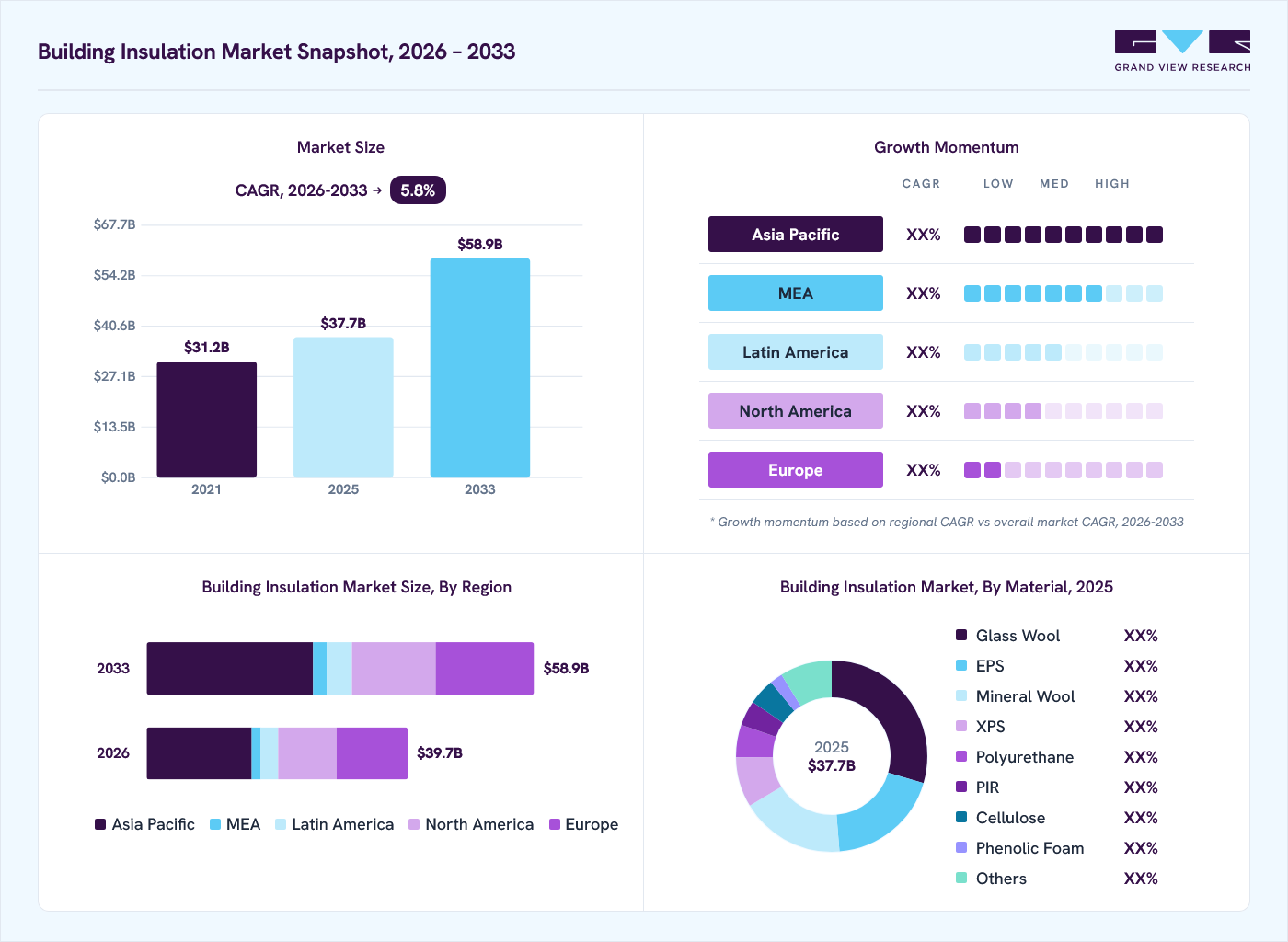 Source: Grand View Research, IR Documents, Primary Interviews, Paid DatabasesTo learn more about this report,
 Download Free Sample Report
 Key Market Trends & Insights
- By material: Glass wool segment led the market with the largest revenue share of 29.5% in 2025.
- By product: Batt & roll (blanket) insulation segment led the market with the largest revenue share of 39.6% in 2025
Regional Highlights
- Largest regional market: Asia Pacific (39.9% revenue share, 2025)
- By country: The China held the largest market share in 2025.
Market Size & Forecast
- Market size in 2025: USD 37.7 Billion
- Estimated market size in 2026: USD 39.7 Billion
- Projected market size by 2033: USD 58.9 Billion
- CAGR (2026-2033): 5.8%
Three ways to get this report
Buy it, customize it, or ask a question.Ask an Analyst
Analyst response in 1 business day
- AccessReport author, directly
- Reply timeWithin 1 working day
- No sales callDirect answer only
- FormatEmail reply
- CostFree, no cost
Get the Full Report
What the study covers
- FormatsPDF · Excel · Dashboard
- Timeline2026–2033 annual, 2025 base
- Coverage20+ countries, 5 regions
- Companies10+ key players profiled
Customize the Report
20% free customization
- IncludeCountries, segments, points
- TailorTo your product definition
- ExtendDeeper competitor detail
- OrA fully bespoke study
- Turnaround5–10 working days
The growing emphasis on energy-efficient buildings is prompting developers to upgrade thermal performance and reduce operational costs. Urban population growth and the rapid expansion of housing projects are further stimulating product consumption. Consumers and developers are now more aware of indoor comfort, air quality, and long-term utility savings, strengthening market adoption. Green building certifications and benchmarking systems are also promoting compliant insulation materials. Renovation and retrofitting of older building stock are expanding application opportunities.One of the major drivers is the global focus on energy conservation, enabling buildings to reduce heat transfer and improve temperature regulation. Stringent construction standards are pushing stakeholders toward high-performance insulating foams, boards, and mineral wool products. Climate change concerns are accelerating the implementation of low-carbon building technologies and eco-friendly insulants. Rising fuel and electricity prices are encouraging property owners to minimize energy consumption. Industrial growth and the expansion of logistics centers are generating demand for temperature-controlled structures. Technological upgrades in manufacturing methods are improving material durability and acoustic performance.
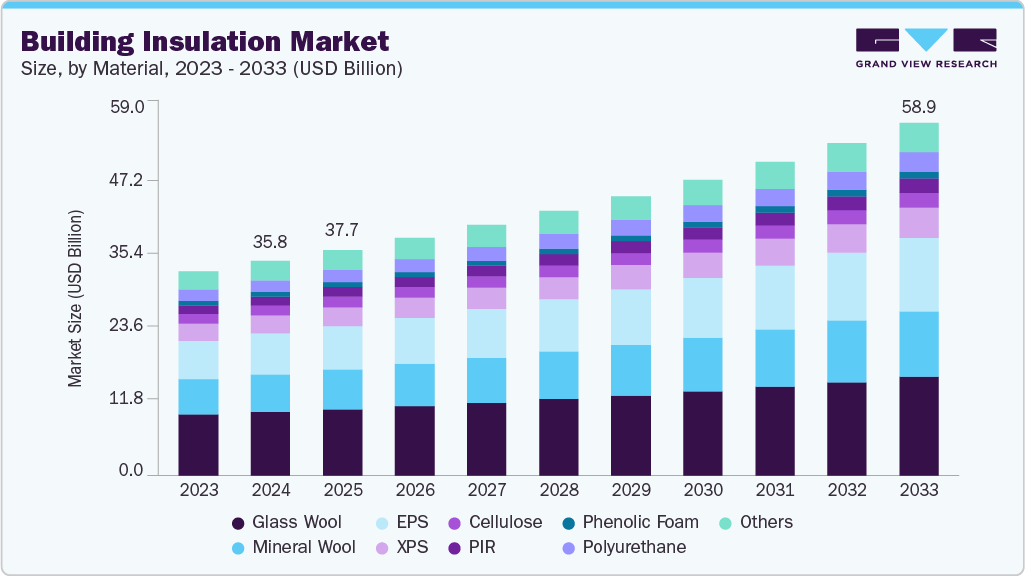 To learn more about this report, Download Free Sample Report
 Manufacturers are developing advanced products such as vacuum insulation panels, aerogel boards, and nanotechnology-based materials to improve performance while reducing thickness. There is a clear trend toward bio-based and recyclable insulation derived from cellulose, agricultural fibers, and natural minerals. Digital modeling and building performance simulation tools are optimizing insulation decisions during project planning. Smart insulation solutions capable of controlling temperature dynamically are also gaining attention. The market is witnessing strong interest in fire-resistant and moisture-resistant materials to support safety regulations. Continuous investment in automation and precision manufacturing is improving cost efficiency. Strategic R&D investments are enabling new product classes for both new construction and renovation segments.
Market Dynamics
The building insulation market is experiencing strong growth driven by increasing focus on energy efficiency, stringent building regulations, rising construction activities, and growing awareness of sustainable building practices. Insulation materials such as fiberglass, mineral wool, expanded polystyrene (EPS), extruded polystyrene (XPS), polyurethane foam, and cellulose are widely used in residential, commercial, and industrial buildings to reduce energy consumption, improve thermal comfort, and enhance overall building performance. Governments across various regions are implementing stricter energy-efficiency standards and promoting green building initiatives, further accelerating insulation adoption. Additionally, growing renovation and retrofitting activities aimed at improving the energy performance of existing buildings continue to support market expansion.
Increasing regulatory emphasis on reducing building energy consumption is a major driver for the building insulation market. Governments and regulatory bodies worldwide have introduced building energy codes, carbon reduction targets, and efficiency standards that require improved thermal performance in new and existing structures. Building insulation plays a critical role in minimizing heat loss and heat gain, thereby reducing heating and cooling requirements and lowering energy costs.
In addition, rising awareness regarding climate change and sustainability is encouraging developers, homeowners, and commercial building operators to invest in energy-efficient construction solutions. The growing adoption of green building certifications and net-zero energy building concepts is further increasing demand for high-performance insulation materials. Rapid urbanization, infrastructure development, and expanding residential and commercial construction activities are also contributing to market growth across both developed and emerging economies.
The building insulation market faces challenges from fluctuations in the prices of key raw materials such as petrochemical derivatives, glass, mineral fibers, and specialty chemicals, which can increase manufacturing costs and affect product pricing. Additionally, high upfront investment associated with premium insulation materials and installation expenses may discourage adoption, particularly in cost-sensitive residential projects and developing economies. Supply chain disruptions and labor shortages for proper installation can further impact project timelines and overall market growth.
The increasing focus on improving the energy performance of existing buildings presents a significant opportunity for the building insulation market. Governments and regulatory agencies worldwide are promoting energy renovation programs, retrofit projects, and building decarbonization initiatives to reduce energy consumption and carbon emissions. As aging building infrastructure undergoes modernization, demand for advanced insulation solutions is expected to rise, creating opportunities for manufacturers to offer high-performance, sustainable, and environmentally friendly insulation materials that support long-term energy savings and compliance with evolving efficiency standards.
Market Concentration & Characteristics
The market includes several large multinational manufacturers along with numerous regional suppliers that cater to local construction demand. Major players typically operate extensive distribution networks, advanced insulation technology platforms, and strategically located production facilities. Smaller companies compete on pricing, local availability, and relationships with contractors. High brand recall, certification requirements, and compliance standards give larger firms a competitive advantage. However, strong growth opportunities in emerging markets allow new entrants to gain traction. Product differentiation is often based on energy performance, installation convenience, durability, and eco-credentials. Overall, the industry exhibits moderate consolidation with growing competition.
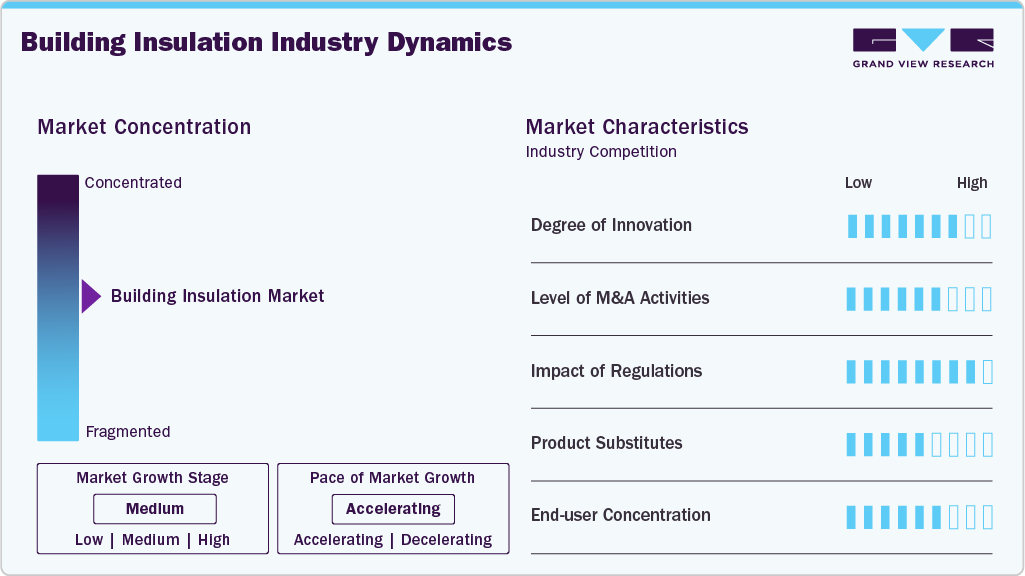 To learn more about this report, Download Free Sample Report
 While traditional insulation materials remain dominant, substitutes such as phase-change materials, smart coatings, reflective products, and advanced cementitious layers are emerging. These alternatives sometimes offer thinner profiles or enhanced thermal performance, but often at a higher price. In certain climates, superior architectural design can reduce the need for conventional insulation materials. Adoption of substitutes also depends on local building codes and return-on-investment expectations. New substitutes are still in early commercial development and are not widely available in all markets. Performance variability across climate zones also limits rapid displacement. Therefore, threat of substitutes remains moderate.
Analyst Perspective
The building insulation market is positioned for steady long-term growth, driven by the structural shift toward energy-efficient and low-carbon buildings. While demand from new construction remains a key growth contributor, the market is increasingly benefiting from large-scale renovation and retrofit activities aimed at improving the thermal performance of existing building stock. Regulatory mandates related to energy conservation, carbon emission reduction, and building performance standards are expected to remain the primary demand catalysts across major markets. Furthermore, insulation is evolving from conventional construction material to a strategic component of building sustainability, prompting manufacturers to focus on products that offer enhanced thermal efficiency, fire safety, durability, and environmental performance. As a result, companies with strong innovation capabilities, diversified product portfolios, and exposure to retrofit-driven demand are expected to be better positioned to capitalize on emerging growth opportunities in the market.
Material Insights
Based on material, the glass wool segment led the market with the largest revenue share of 29.5% in 2025 and is expected to grow at a CAGR of 5.1% over the forecast period, owing to its widespread use in residential, commercial, and industrial construction projects. Its superior thermal and acoustic performance, non-combustibility, and affordability make it one of the most preferred insulation materials across global markets. Moreover, glass wool is easy to install, compatible with various building structures, and widely available. Growing emphasis on energy efficiency and indoor comfort in both new builds and retrofit projects continues to support demand. Manufacturers are also expanding production capacities and introducing eco-friendly versions, further strengthening segment leadership.
The EPS segment is expected to grow at the fastest CAGR of 6.8% over the forecast period, due to increasing adoption in external wall insulation systems, roofing, and foundation applications. EPS offers excellent insulation efficiency, lightweight construction, and cost-effectiveness, making it suitable for large-scale residential and commercial development. Growing use in energy-efficient building envelopes and green construction initiatives is boosting demand. Furthermore, advancements in modified EPS formulations with enhanced fire resistance and moisture control are broadening end use potential. Rapid urbanization in emerging markets is also driving strong consumption growth in coming years.
Product Insights
Based on product, the batt & roll (blanket) insulation segment led the market with the largest revenue share of 39.6% in 2025 and is expected to grow at a CAGR of 5.4% over the forecast period, as it remains the most commonly used solution in residential construction, particularly for walls, attics, and floors. Its simple installation, affordability, and easy availability through retail and distribution networks make it popular among contractors and homeowners. The segment benefits from strong demand in new housing developments as well as renovation and retrofitting activity. Widespread use of fiberglass and mineral wool blanket products also supports steady sales. Growing consumer focus on improving indoor comfort and energy savings further reinforces segment leadership.
 To learn more about this report, Download Free Sample Report
 The rigid foam board insulation segment is expected to grow at the fastest CAGR of 6.4% over the forecast period, due to rising use in energy-efficient building envelopes, including roofs, walls, and foundations. These boards deliver high R-values, excellent moisture control, and structural stability, making them suitable for demanding thermal performance standards. Demand is particularly strong in commercial and industrial construction, where durability and long-term insulation performance are critical. Increasing adoption of external insulation finishing systems (EIFS) and advanced materials such as polyiso and extruded polystyrene is also supporting growth. Continued regulatory pressure for improved building efficiency is likely to accelerate market expansion.
Regional Insights
Asia Pacific dominated the building insulation market with the largest revenue share of 39.9% in 2025, due to vast construction activity in China, India, Southeast Asia, and Japan. Rapid urbanization and large-scale infrastructure development continue to enhance insulation demand. Governments are updating building codes to improve thermal performance and lower energy consumption in new structures. Rising middle-class income levels are increasing demand for well-insulated homes and commercial properties. Regional manufacturers are expanding production facilities and investing in technology upgrades. Retrofit programs are gaining momentum in developed economies such as Japan and South Korea. The region is expected to remain the major demand center over the coming years.
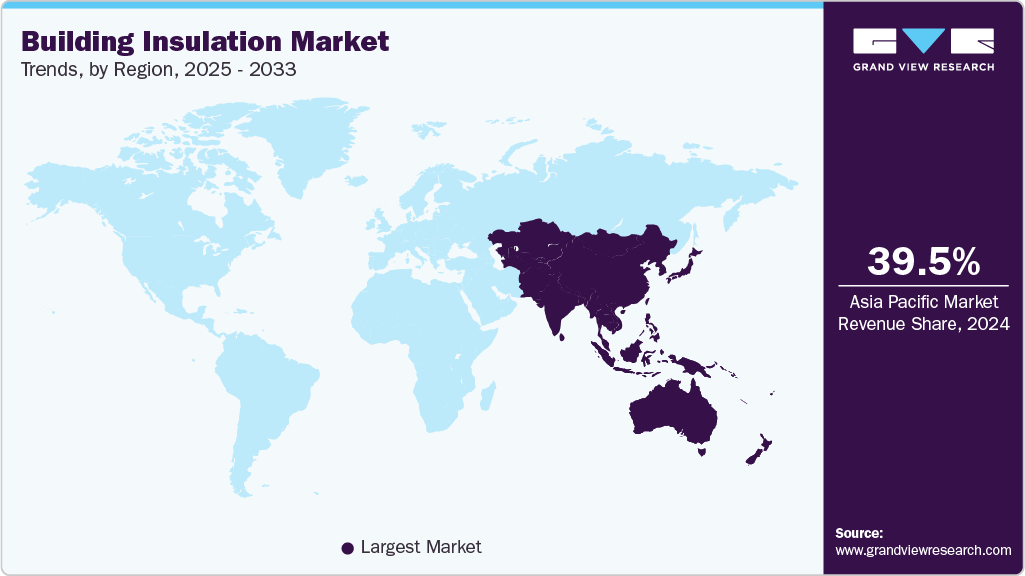 To learn more about this report, Download Free Sample Report
 China Building Insulation Market Trends
The building insulation market in China held the largest share in the Asia Pacific region in 2025. Building insulation market in China is witnessing significant growth due to massive urban development, high-rise construction, and industrial expansion. The government is pushing green building standards, improving compliance levels across public and private projects. Energy-efficient building mandates are driving increased insulation deployment in walls, floors, and roofing systems. Large and mature manufacturing clusters provide cost advantages and faster supply chain response. Retrofitting of older residential blocks is becoming an important demand driver. Rapid improvement in living standards is increasing consumer preference for thermally optimized homes. China is likely to remain one of the world’s largest insulation markets.
North America Building Insulation Market Trends
North America benefits from strong regulatory enforcement of energy codes across states and municipalities. Renovation of mature building stock accounts for a large share of insulation demand. Consumer expectations for indoor comfort, humidity control, and noise reduction are influencing material choices. Builders are focusing on high-efficiency building envelopes to improve long-term performance. Industrial and warehousing sector expansion is contributing to continuous product adoption. Corporate sustainability commitments are motivating large developers to use environmentally responsible materials. Ongoing technology development continues to enhance overall product competitiveness.
The U.S. remains one of the most strictly regulated insulation markets, with detailed building energy requirements at federal and state levels. Home retrofitting is accelerating due to incentivized upgrade programs and increasing energy prices. The construction sector is benefiting from strong investments in commercial, residential, and industrial projects. Consumer awareness about reduced monthly utility bills is supporting the adoption of premium insulation materials. Several manufacturers are focusing on recyclable, low-VOC, and fire-safe products. Stricter green certification frameworks also guide procurement decisions. The U.S. is expected to maintain steady, policy-driven growth.
Europe Building Insulation Market Trends
Europe is a mature market with long-established insulation standards and strong emphasis on sustainable buildings. Ongoing renovation of older housing and public structures is a major market catalyst. EU climate agendas are encouraging deep building retrofits for energy reduction. Manufacturing capabilities are well developed, with leading companies headquartered across multiple European countries. Consumer preference for quiet, comfortable, and energy-efficient living spaces is driving usage. Long-term logistics and infrastructure expansion support industrial demand. Innovation continues to be an important growth determinant in Europe.
Germany Building Insulation Market is witnessing growth due tocountry’s stringent energy efficiency standards that strongly influence insulation adoption in new and renovated buildings. Public awareness regarding sustainability, heat loss reduction, and noise control remains high. Government incentives support low-emission materials and building retrofits, especially in older residential districts. Manufacturers in Germany invest heavily in R&D and quality engineering. Industrial construction growth and logistics facility expansion are contributing to demand. Strict compliance criteria drive the adoption of technically advanced solutions. Germany continues to be one of Europe’s most regulated and high-performance insulation markets.
Central & South America Building Insulation Market Trends
The building insulation market in Central & South America shows gradual growth led by rising construction activity in countries such as Brazil, Mexico, and Chile. Increasing awareness of indoor comfort, particularly in heat-prone regions, is driving the adoption of insulation. Industrial and logistics sector development is also creating additional demand outlets. Government building standards are evolving, improving material standardization and adoption rates. Local manufacturing capabilities are improving, although reliance on imports remains in certain product categories. Market growth is also tied to economic cycles and urban development plans. Adoption is expanding as developers increasingly prioritize energy-efficient buildings.
Middle East & Africa Building Insulation Market Trends
The Middle East & Africa market is influenced by stringent climatic conditions that require improved indoor temperature control. Rapid development of residential communities, commercial complexes, and industrial zones supports continued insulation demand. Governments are introducing building codes aligned with global sustainability benchmarks. Increasing electricity tariffs are pushing property owners toward materials that reduce cooling loads. Urbanization and investment in tourism, transportation, and logistics hubs further boost market potential. Adoption of advanced and fire-resistant products is growing in high-rise buildings. The region is poised for sustained but uneven growth depending on local construction cycles.
Key Building Insulation Company Insights
Some of the key players operating in the market include Huntsman International LLC and Owens Corning
-
Huntsman International LLC is a global chemical manufacturer known for producing performance materials and specialty chemicals used in industries such as construction, automotive, aerospace, and consumer products. The company has a strong portfolio of polyurethane systems that are widely used in insulation applications due to their energy efficiency and durability. Huntsman operates manufacturing and R&D facilities worldwide and focuses heavily on innovation, sustainability, and customer-driven solutions.
-
Owens Corning is a leading U.S.-based manufacturer of insulation, roofing, and fiberglass composites. The company is recognized for its advanced thermal and acoustic insulation products used in residential, commercial, and industrial buildings. With a strong global presence and a reputation for innovation, Owens Corning invests significantly in sustainability initiatives and energy-efficient construction technologies, making it one of the most influential players in the insulation industry.
DuPont and BASF are some of the emerging market participants in the building insulation market.
-
DuPont is a global technology and materials company known for developing advanced products in electronics, construction, packaging, and automotive industries. In the insulation market, DuPont provides solutions such as weatherproofing membranes, spray foams, and thermal barriers that enhance building efficiency and durability. With a long heritage of R&D, DuPont continues to lead innovation through high-performance materials that support modern construction and sustainability goals.
-
BASF is one of the world’s largest chemical producers, offering a wide range of products for construction, automotive, agriculture, and industrial sectors. The company is a major supplier of polyurethane and polystyrene-based insulation materials used to reduce energy consumption and improve building performance.
Key Building Insulation Companies
The following key companies have been profiled for this study on the building insulation market.
-
GAF Materials Corporation
-
Huntsman International LLC
-
DuPont
-
Owens Corning
-
Saint-Gobain S.A.
-
Kingspan Group
-
BASF
-
Knauf Insulation
-
Carlisle Companies, Inc.
-
3M Company
Competitive Benchmarking
Operating Strategies
Competitive Edge
Weaknesses
Established Players (Saint-Gobain S.A., Owens Corning, Kingspan Group, Knauf Insulation, GAF Materials Corporation, DuPont, BASF)
- Focus on expanding manufacturing capacity, strengthening global distribution networks, and developing high-performance insulation solutions.
- Invest heavily in R&D, sustainable insulation materials, energy-efficient building technologies, and strategic acquisitions to enhance product portfolios and geographic reach.
- Strong global brand recognition, extensive manufacturing footprints, broad insulation product portfolios, and established relationships with contractors, architects, and building owners.
- Significant technical expertise and economies of scale support innovation, regulatory compliance, and market leadership.
- High operational and manufacturing costs, along with exposure to fluctuations in raw material and energy prices.
- Large organizational structures may reduce flexibility in addressing niche applications and rapidly evolving regional market requirements.
Specialized & Niche Players (Huntsman International LLC, Carlisle Companies, Inc., 3M Company)
- Focus on specialized insulation materials, advanced foam technologies, building envelope solutions, and high-performance applications.
- Compete through technological expertise, targeted product development, strategic partnerships, and customer-specific solutions for commercial, industrial, and specialty construction projects.
- Strong technical capabilities in specific material categories, differentiated product offerings, and greater flexibility in serving specialized applications.
- Ability to leverage expertise from adjacent industries to develop innovative insulation solutions.
- Comparatively narrower insulation product portfolios and lower market visibility in the insulation sector than dedicated industry leaders.
- Limited participation across all insulation segments may reduce competitiveness in large-scale, multi-product projects.
Recent Developments
-
In May 2024, GAF Materials Corporation began production at its new polyiso (polyisocyanurate) insulation plant in Peru, Illinois, producing its EnergyGuard line, including non-halogenated (NH) boards.
-
In May 2024, Huntsman Building Solutions launched a new Icynene Series of spray polyurethane foam (SPF) insulation (open- and closed-cell) at the SprayFoam 2024 Expo.
Building Insulation Market Report Scope
Report Attribute
Details
Market size in 2025
USD 37.7 billion
Estimated market size in 2026
USD 39.7 billion
Projected market size by 2033
USD 58.9 billion
Growth rate
CAGR of 5.8% from 2026 to 2033
Base year for estimation
2025
Historical data
2021 - 2024
Forecast period
2026 - 2033
Quantitative units
Volume in Kilotons, Revenue in USD million/billion and CAGR from 2026 to 2033
Report coverage
Revenue forecast, company ranking, competitive landscape, growth factors, and trends
Segments covered
Material, Product, region
Regional scope
North America; Europe; Asia Pacific; Central & South America; Middle East & Africa
Country scope
U.S.; Canada; Mexico; Germany; UK; France; Spain; China; Japan; India; South Korea; Saudi Arabia; UAE; Egypt; Kuwait; Qatar
Key companies profiled
GAF Materials Corporation; Huntsman International LLC; DuPont; Owens Corning; Saint-Gobain S.A.; Kingspan Group; BASF; Knauf Insulation; Carlisle Companies Inc.; 3M Company
Customization scope
Free report customization (equivalent up to 8 analysts' working days) with purchase. Addition or alteration to country, regional & segment scope.
Pricing and purchase options
Avail customized purchase options to meet your exact research needs. Explore purchase options
Global Building Insulation Market Report Segmentation
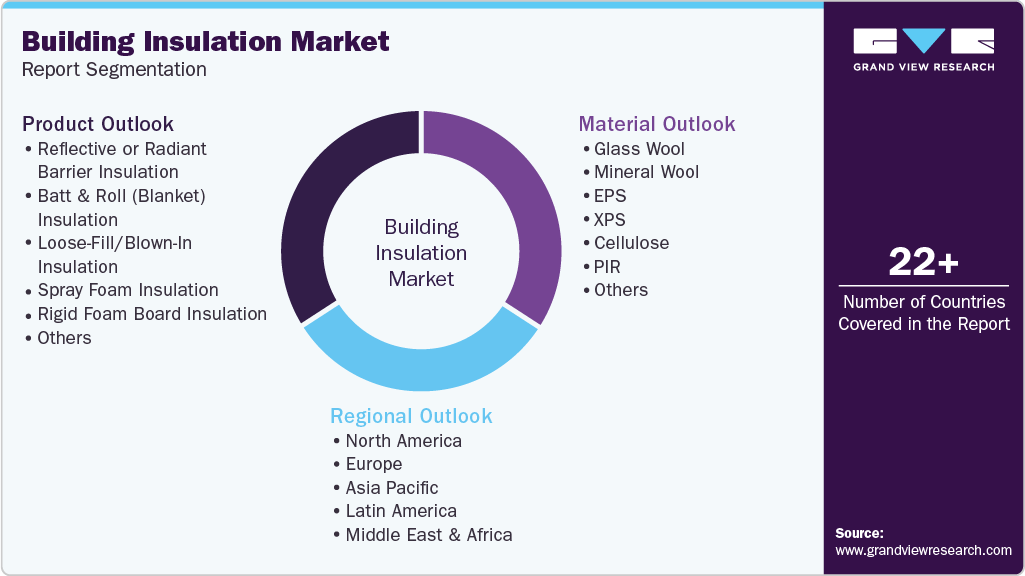
This report forecasts revenue growth at global, regional, and country levels and provides an analysis of the industry trends in each of the sub-segments from 2021 to 2033. For this study, Grand View Research has segmented the building insulation market based on material, product, and region:
 To learn more about this report, Download Free Sample Report
 -
Material Outlook (Volume, Kilotons; Revenue, USD Million, 2021 - 2033)
-
Glass Wool
-
Mineral Wool
-
EPS
-
XPS
-
Cellulose
-
PIR
-
Phenolic Foam
-
Polyurethane
-
Others
-
-
Product Outlook (Volume, Kilotons; Revenue, USD Million, 2021 - 2033)
-
Reflective or Radiant Barrier Insulation
-
Batt & Roll (Blanket) Insulation
-
Loose-Fill / Blown-In Insulation
-
Spray Foam Insulation
-
Rigid Foam Board Insulation
-
Others
-
-
Regional Outlook (Volume, Kilotons; Revenue, USD Million, 2021 - 2033)
-
North America
-
U.S.
-
Canada
-
Mexico
-
-
Europe
-
UK
-
Germany
-
France
-
Spain
-
-
Asia Pacific
-
China
-
Japan
-
India
-
South Korea
-
-
Central & South America
-
Middle East & Africa
-
Saudi Arabia
-
UAE
-
Egypt
-
Qatar
-
Kuwait
-
-
Research Methodology
The building insulation market figures in this report are based on a proven research process that combines executive interviews with secondary research from proprietary databases, company filings, and recognized regulatory and institutional sources. Market size is built through value-chain sizing-reconciling supply-side and demand-side estimates-and triangulated with bottom-up and top-down approaches. Every estimate passes multiple levels of expert validation before publication, with each building insulation segment quantified using the revenue-capture definitions in the table below.
Segment Definition
Segment- Material
Revenue Capture Definition
Glass Wool
Revenue generated from the sale of glass fiber-based insulation materials used in walls, roofs, ceilings, HVAC systems, and acoustic insulation applications in residential, commercial, and industrial buildings.
Mineral Wool
Revenue generated from stone wool and slag wool insulation products utilized for thermal insulation, fire protection, and soundproofing in building envelopes, façades, roofs, and industrial facilities.
EPS (Expanded Polystyrene)
Revenue generated from EPS insulation boards and panels used in wall insulation systems, roofing applications, insulated concrete forms, and energy-efficient building construction.
XPS (Extruded Polystyrene)
Revenue generated from XPS insulation products employed in foundations, below-grade construction, roofs, walls, and moisture-resistant insulation applications.
Cellulose
Revenue generated from cellulose-based insulation materials, primarily manufactured from recycled paper fibers, used in wall cavities, attics, and retrofit insulation projects.
PIR (Polyisocyanurate)
Revenue generated from PIR insulation boards and panels used in commercial roofing, wall systems, cold storage facilities, and high-performance building applications requiring superior thermal efficiency.
Phenolic Foam
Revenue generated from phenolic foam insulation products utilized in HVAC ducts, building façades, roofing systems, and applications requiring low thermal conductivity and enhanced fire performance.
Polyurethane
Revenue generated from polyurethane insulation materials, including rigid foam panels and spray foam products, used for thermal insulation in residential, commercial, and industrial buildings.
Others
Revenue generated from other insulation materials such as aerogel, natural fiber insulation, cork, hemp, sheep wool, vacuum insulation panels (VIPs), and emerging bio-based insulation products.
Segment- Product
Revenue Capture Definition
Reflective or Radiant Barrier Insulation
Revenue generated from reflective insulation systems and radiant barriers designed to reduce heat transfer by reflecting radiant heat in roofs, walls, attics, and building envelopes.
Batt & Roll (Blanket) Insulation
Revenue generated from pre-cut batt insulation and rolled blanket insulation products, typically made from fiberglass, mineral wool, or natural fibers, used in walls, floors, ceilings, and attics.
Loose-Fill / Blown-In Insulation
Revenue generated from loose-fill insulation materials such as cellulose, fiberglass, and mineral wool that are mechanically blown into wall cavities, attics, and hard-to-reach spaces.
Spray Foam Insulation
Revenue generated from spray-applied polyurethane and similar foam insulation systems used for air sealing, thermal insulation, moisture control, and energy-efficient building construction.
Rigid Foam Board Insulation
Revenue generated from rigid insulation boards manufactured from EPS, XPS, PIR, polyurethane, phenolic foam, and similar materials used in roofs, walls, foundations, and exterior insulation systems.
Others
Revenue generated from other insulation product formats including insulated panels, structural insulated panels (SIPs), pipe insulation, acoustic insulation systems, and specialty insulation solutions not classified under the above categories.
Estimation Model
Layer Name
Key Question
Description
Global Construction and Building Stock Assessment
What is the total addressable building base generating demand for insulation?
This layer evaluates residential, commercial, and industrial construction activities, along with existing building stock and renovation projects, to establish the potential demand for insulation materials.
Insulation Adoption Across Building Components
What proportion of buildings utilize insulation solutions?
This layer assesses insulation penetration across roofs, walls, floors, ceilings, and HVAC systems based on energy-efficiency requirements, climate conditions, and building regulations.
Material and Product Utilization Analysis
What share of demand is served by different insulation materials and products?
This layer analyzes the use of various insulation materials and product formats across building applications based on performance, cost, and end-use requirements.
Building Insulation Market Revenue
What revenue is generated from the sale of building insulation materials globally?
This final layer estimates market revenue by combining insulation demand volumes with average selling prices across materials, products, building sectors, and regions.
Delivered Customizations
This report has been delivered with the following In-depth customizations
Client Request
Customization Delivered
Value Adds
Opportunity Assessment
Detailed assessment of growth opportunities across insulation materials, product types, building components, and end-use sectors, including analysis of high-growth construction segments, retrofit and energy renovation activities, green building adoption, regulatory support, and evolving insulation performance requirements.
Enables identification of high-growth demand areas, emerging application opportunities, and strategic investment priorities across the insulation value chain.
Technology & Sustainability Assessment
Comprehensive evaluation of technological advancements and sustainability trends in the building insulation market, including high-performance insulation materials, bio-based and recyclable insulation products, low-carbon manufacturing processes, enhanced fire-resistant solutions, net-zero building initiatives, and energy-efficiency innovations.
Supports product innovation, sustainability strategy development, regulatory compliance, and competitive differentiation in the evolving building materials landscape.
Regional Segmentation Analysis
In-depth regional and country-level analysis covering market size, growth outlook, construction activity, building energy-efficiency regulations, retrofit investments, climate-driven insulation demand, competitive landscape, and adoption trends across key geographic markets.
Assists in identifying high-growth regions, optimizing expansion strategies, and understanding region-specific demand drivers, regulatory developments, and market opportunities.
Frequently Asked Questions About This Report
Some of the key players operating in the building insulation market include GAF Materials Corporation, Huntsman International LLC, DuPont, Owens Corning, Saint-Gobain S.A., Kingspan Group, BASF, Knauf Insulation, 3M Company, and Carlisle Companies, Inc.
Rising energy-efficiency regulations, growing construction activity, increasing electricity costs, and greater awareness of indoor comfort are key factors driving the building insulation market.
Asia Pacific held the highest revenue market share of 39.9% in 2025 of the global building insulation market.
Batt and roll (blanket) insulation held the highest revenue market share of 39.6% in 2025 of the global building insulation market.
Asia Pacific is the fastest-growing region in the building insulation market.
Rigid foam board insulation is the fastest-growing product in the building insulation market.
The global building insulation market is expected to grow at a compound annual growth rate of 5.8% from 2026 to 2033 to reach USD 58.9 billion by 2033.
The glass wool segment held the highest revenue market share of 29.5% in 2025, owing to its widespread use in residential, commercial, and industrial construction projects.
The global building insulation market size was valued at USD 37.7 billion in 2025 and is expected to reach USD 39.7 billion in 2026.
About the Author(s)
Advanced Interior Materials Research Team
Advanced Materials · Advanced Interior MaterialsThis report was authored by the advanced interior materials research team at Grand View Research - comprising two research analysts, one senior research analyst, and one industry expert - with specialized expertise in the advanced interior materials segment of the advanced materials industry. All findings are based on proprietary advanced materials databases, executive interviews, and regulatory analysis, subject to internal peer review prior to publication.
Last Updated:
Speak to Analyst

Customize this report to your needs - add regions, segments, or data points, with 20% free customization.
Or view our licence options:


ISO 9001:2015 & 27001:2022 Certified
We are GDPR and CCPA compliant! Your transaction & personal information is safe and secure. For more details, please read our privacy policy.


