
- Home
- »
- Advanced Interior Materials
- »
-
Building Thermal Insulation Market Size Report, 2026-2033GVR Report cover

Building Thermal Insulation Market (2026 - 2033)
Size, Share & Trends Analysis Report By Product (Glass Wool, Mineral Wool, EPS, XPS, Cellulose), By Application (Roof, Walls, Floor), End Use (Residential, Commercial), By Region, And Segment Forecasts
Market Size, 2025
$28.4BMarket Estimate, 2026
$30.0BMarket Forecast, 2033
$45.2BCAGR, 2026–2033
6.0%Building Thermal Insulation Market Summary
The global building thermal insulation market size was valued at USD 28.4 billion in 2025 and is projected to grow from USD 30.0 billion in 2026 to USD 45.2 billion by 2033, at a CAGR of 6.0% from 2026 to 2033. The market in Europe dominated with a revenue share of 37.3% in 2025. Increasing residential and commercial applications of the product to reduce overall energy costs, coupled with rising awareness about energy conservation, are expected to drive the growth.
 Source: Grand View Research, IR Documents, Primary Interviews, Paid DatabasesTo learn more about this report,
 Download Free Sample Report
 Key Market Trends & Insights
- By product: Glass wool insulation segment held the largest market share of 37.0% in 2025.
- By application: Wall application segment held the largest market share of 42.3% in 2025.
- By end use: Residential segment held the largest market share of 53.3% in 2025.
Regional Highlights
- Largest regional market: Europe (37.3% revenue share, 2025)
- Fastest-growing regional market: Asia Pacific (highest CAGR, 2026-2033)
Market Size & Forecast
- Market size in 2025: USD 28.4 Billion
- Estimated market size in 2026: USD 30.0 Billion
- Projected market size by 2033: USD 45.2 Billion
- CAGR (2026-2033): 6.0%
Three ways to get this report
Buy it, customize it, or ask a question.Ask an Analyst
Analyst response in 1 business day
- AccessReport author, directly
- Reply timeWithin 1 working day
- No sales callDirect answer only
- FormatEmail reply
- CostFree, no cost
Get the Full Report
What the study covers
- FormatsPDF · Excel · Dashboard
- Timeline2026–2033 annual, 2025 base
- Coverage20+ countries, 5 regions
- Companies10+ key players profiled
Customize the Report
20% free customization
- IncludeCountries, segments, points
- TailorTo your product definition
- ExtendDeeper competitor detail
- OrA fully bespoke study
- Turnaround5–10 working days
Favorable regulations that focus on reducing overall energy consumption are likely to be a major driver of the market for building thermal insulation. Thermal building insulation helps reduce the dependency on heat, ventilation, and air conditioning (HVAC), thereby lowering overall energy consumption, which is expected to benefit growth. Favorable building codes in the U.S. and Canada, coupled with the establishment of energy certification agencies such as the Leadership in Energy and Environmental Design (LEED) and the U.S. Green Building Council (USGBC), are expected to have a positive impact on the demand for building thermal insulation. However, stringent regulations imposed by the United States Environmental Protection Agency (EPA) on the use of foamed plastics, owing to their low biodegradability and carcinogenicity, may hurt the market growth. To learn more about this report, Download Free Sample Report
 The environmental impact of building insulation materials is likely to shift the industry’s focus to developing environmentally friendly products over the forecast period. Besides, rising prices of plastic foam are expected to harm the industry's growth, thereby driving the development of alternative products.
Recyclable insulation is gaining popularity due to the stringent regulations governing conventional products such as plastic foams. As environmental awareness grows, homeowners, architects, and businesses are expected to favor green, biodegradable, and recyclable products. This is expected to boost the threat of substitutes in the building thermal insulation market over the forecast period.
Market Dynamics
Rapid urbanization, industrialization, and population growth across emerging economies in the Asia Pacific, the Middle East, Africa, and Central & South America are significantly driving construction activities, thereby supporting demand for building thermal insulation. Governments in countries such as India, the UAE, China, and Indonesia are investing heavily in public infrastructure projects, including hospitals, offices, housing developments, and transportation facilities. Additionally, the expansion of private construction firms, rising disposable income, foreign investment, and favorable government regulations are contributing to sustained growth in residential and non-residential construction.
The increasing focus on energy-efficient buildings and infrastructure modernization is further accelerating the adoption of thermal insulation materials across commercial, residential, and industrial sectors. In regions such as the Middle East & Africa, easing credit conditions, diversification of non-oil economic activities, and rapid urban development are creating strong demand for insulation solutions. Similarly, growing tourism infrastructure, luxury high-rise developments, and public construction projects in Central & South America and the Asia-Pacific are expected to continue supporting market growth over the forecast period.
Environmental concerns and stringent government regulations regarding ozone-depleting and greenhouse gas-emitting blowing agents used in conventional insulation materials are posing challenges for the building thermal insulation industry. Regulatory authorities such as the U.S. EPA have imposed strict restrictions on substances including CFCs, HFCs, asbestos, and certain chemicals used in spray polyurethane foams due to their environmental and health impacts. As a result, demand is gradually shifting toward recyclable, biodegradable, and environmentally friendly insulation materials, encouraging manufacturers to adopt sustainable raw materials and limiting the growth of traditionally used insulation products.
Market Concentration & Characteristics
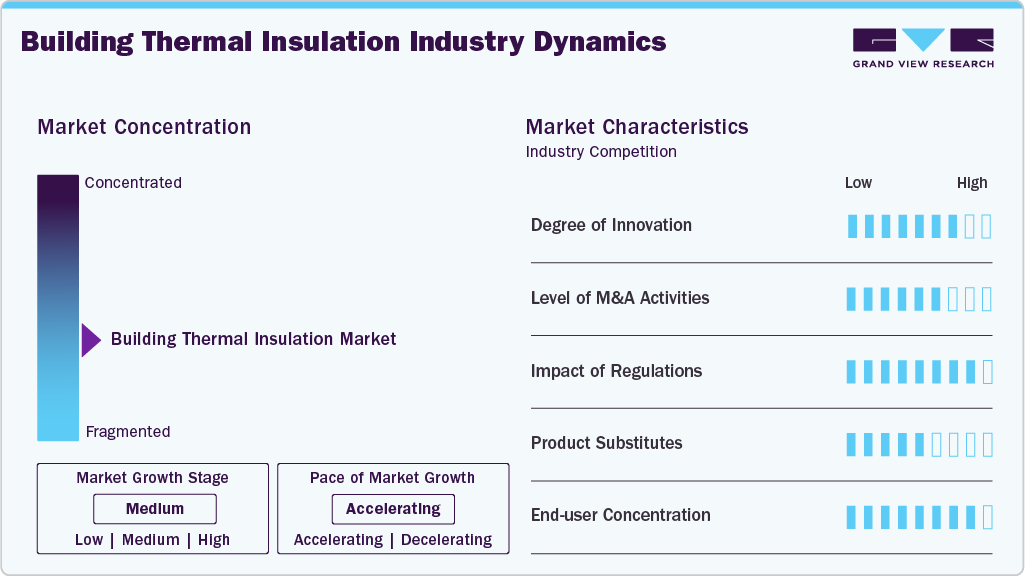
The market growth stage is moderate, and the pace of growth is accelerating. The market exhibits a moderate level of innovation, as players aim to achieve optimal growth by introducing enhanced insulation products and implementing the latest technologies.
Environmental regulations have a significant impact on the industry, as several bodies around the world govern and pass regulations regarding the production and installation of thermal insulation in buildings, such as The American Society for Testing and Materials (ASTM), Construction Products Regulation 2011 (CPR), and the British Standards Institution (BSI). Moreover, the manufacturing of insulation should meet the standard performance requirements. They have to pass various tests prior to their sales in the market.
 To learn more about this report, Download Free Sample Report
 Plastic foam and wool-derived insulation materials are the most preferred choice globally owing to their superior insulating properties, vast availability, and comparatively low cost. However, materials such as wool fiber are used for numerous applications despite their high costs. Hence, the threat of internal substitution is expected to remain accurate.
The building thermal insulation market's end user concentration is moderately high, with significant demand stemming from the residential and commercial construction sectors. Single-unit residential buildings account for a substantial portion of consumption. Moreover, commercial buildings, including educational institutions, retail shops, and hospitals, contribute to consistent product demand.
Product Insights
Glass wool insulation dominated the segment with a market share of 37.0% in 2025. Glass wool is manufactured by heating silica sand at 1200ºC to 1250ºC and converting it into fibers. It can be manufactured in the form of pipes, boards, and blankets of different sizes, with different technical properties, specific to its applications. The product also offers energy-efficient thermal and acoustic insulation, as well as fire safety, which will drive its growth over the forecast period.
Expanded Polystyrene (EPS) is expected to exhibit a CAGR of 7.0% over the forecast period, owing to its excellent thermal insulation properties and long life span. Also, increasing preference for the product owing to its non-toxic, rot-proof, and recyclable properties is expected to boost the growth.
Mineral/stone wool is one of the most environmentally robust insulation materials. It is widely used for thermal insulation in buildings, as it maintains energy efficiency, provides fire protection, and improves acoustics. Mineral wool is manufactured from volcanic rocks, such as dolomite, diabase, and basalt, which are easily available.
Application Insights
Wall application led the building thermal insulation market and accounted for a market share of 42.3% in 2025, due to the rising emphasis on energy-efficient building envelopes and stringent regulations related to indoor thermal performance. Wall insulation plays a critical role in reducing heat transfer, maintaining indoor temperature stability, and lowering overall energy consumption in residential and commercial buildings. Increasing urbanization and large-scale construction activities, particularly in emerging economies, have accelerated the adoption of insulated wall systems in both new constructions and renovation projects.
The roof application segment is expected to exhibit a CAGR of 6.0% over the forecast period, owing to the increasing need to minimize heat gain and improve building energy efficiency. Roofs are among the primary sources of thermal exchange in buildings, making insulation essential for reducing cooling and heating costs, particularly in regions experiencing extreme climatic conditions. The growing installation of cool roofs, green roofs, and energy-efficient roofing systems in commercial and industrial infrastructure is further driving segment growth.
End Use Insights
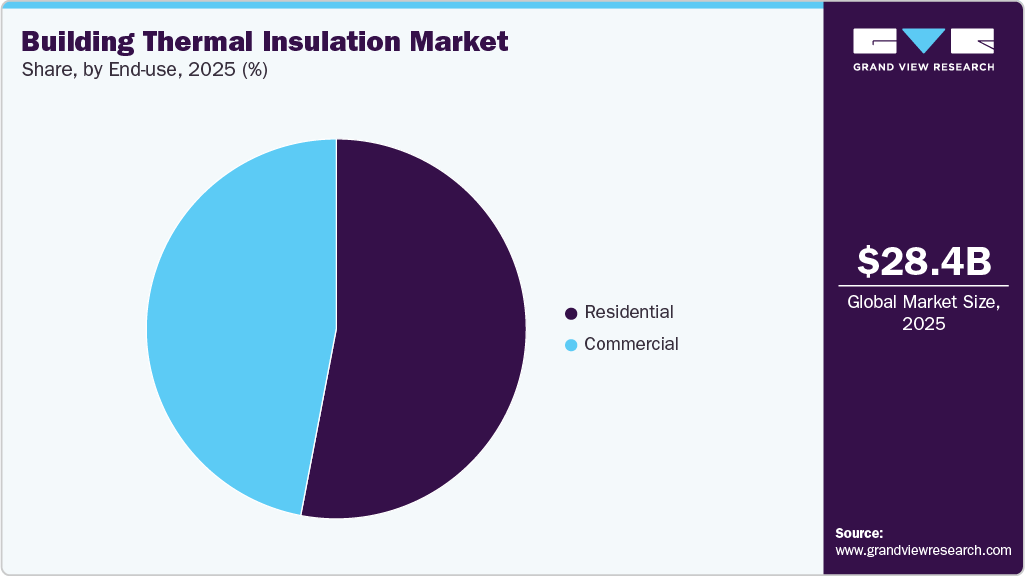
The residential end use segment dominated the market with the largest revenue share of 53.3% in 2025, due to increasing urbanization, rising housing construction activities, and growing consumer awareness regarding energy conservation and indoor comfort. The demand for thermal insulation in residential buildings is driven by the need to reduce electricity consumption from heating and cooling systems, particularly in regions with fluctuating climatic conditions. Government incentives promoting energy-efficient homes and green residential construction are further supporting market expansion.
 To learn more about this report, Download Free Sample Report
 The commercial segment is expected to grow at a CAGR of 6.0% over the forecast period, owing to the increasing construction of offices, hospitals, educational institutions, retail complexes, hotels, and industrial facilities that require efficient temperature management systems. Commercial buildings consume substantial amounts of energy for heating, ventilation, and air conditioning (HVAC), making thermal insulation a critical component for reducing operational costs and improving energy efficiency. Governments and regulatory authorities across developed economies have implemented stringent building energy codes and green certification standards for commercial infrastructure, further accelerating the adoption of insulation.
Regional Insights
The building thermal insulation industry in Europe accounted for the largest market share of 37.3% in 2025, due to strict environmental regulations and strong emphasis on sustainable construction practices. The European Union’s carbon-neutrality targets and energy-efficiency directives are driving the adoption of insulation across the residential and commercial sectors. Renovations of old buildings to improve thermal performance are further supporting market demand. Countries across the region are investing heavily in low-carbon infrastructure and energy-efficient housing projects.
 To learn more about this report, Download Free Sample Report
 Germany Building Thermal Insulation Market Trends
The Germany building thermal insulation industry is a leading contributor to the Europe market due to its strong focus on energy-efficient construction and environmental sustainability. Government initiatives supporting low-energy buildings and the renovation of existing structures are driving demand for insulation materials. The country’s advanced construction industry and adoption of green building standards are promoting the use of high-performance insulation systems. Increasing investments in residential modernization projects and smart building technologies are also contributing to market expansion.
North America Building Thermal Insulation Market Trends
The building thermal insulation industry in North America is witnessing steady growth, driven by increasing renovation activity and stringent energy-efficiency standards in the U.S. and Canada. The region has a high adoption rate of advanced insulation materials in both residential and commercial sectors. Government initiatives encouraging green building construction and retrofitting of old buildings are significantly supporting market expansion. Rising energy costs and growing consumer environmental awareness are further driving up insulation demand.
The building thermal insulation industry in the U.S. is driven by rising investments in energy-efficient residential and commercial construction projects. Federal and state-level building energy codes are encouraging the widespread use of insulation materials to reduce energy consumption and greenhouse gas emissions. The growing trend of green buildings and smart homes is increasing demand for high-performance insulation solutions.
Asia Pacific Building Thermal Insulation Market Trends
The building thermal insulation industry in the Asia Pacific is expected to exhibit the fastest growth over the forecast period, with a CAGR of 7.2%, driven by rapid urbanization, large-scale infrastructure development, and increasing residential construction activity in countries such as China, India, Japan, and South Korea. Rising energy demand and supportive government regulations promoting energy-efficient buildings are accelerating the adoption of insulation across the region. Growing investments in commercial infrastructure and smart city projects are also contributing to market expansion.
The China building thermal insulation industry is one of the largest markets for thermal insulation, owing to extensive urban infrastructure projects and strict building energy-efficiency regulations. The government’s focus on reducing carbon emissions and improving energy conservation in residential and commercial buildings is driving demand for advanced insulation materials. The increasing adoption of green construction practices and the rapid development of high-rise residential complexes are also supporting market growth.
Central & South America Building Thermal Insulation Market Trends
The building thermal insulation industry in Central & South America is growing steadily due to rising urbanization and expanding residential construction activities in countries such as Brazil and Mexico. Increasing awareness regarding energy conservation and indoor comfort is encouraging the use of insulation materials in modern construction projects. Governments are gradually implementing building energy efficiency standards, creating opportunities for market growth.
Middle East & Africa Building Thermal Insulation Market Trends
The building thermal insulation industry in the Middle East & Africa is witnessing growth due to increasing infrastructure development and the need for efficient cooling systems in extreme climatic conditions. Rapid urbanization and large-scale commercial construction projects in countries such as the UAE and Saudi Arabia are driving demand for insulation materials. Governments are introducing sustainable construction regulations and green building initiatives to reduce energy consumption in buildings. Rising investments in tourism, healthcare, and smart city projects are further supporting market expansion.
Key Building Thermal Insulation Company Insights
Some of the key players operating in the market are BASF SE, Saint-Gobain S.A., Dow, and Owens Corning:
-
Saint Gobain S.A. is engaged in the design, manufacturing, and distribution of high-performance materials and building materials. In addition, it provides solutions for energy efficiency, addressing growth challenges, and protecting the environment.
-
Dow operates in several sectors, including agriculture, feed & animal care, beauty & personal care, building, construction & infrastructure, chemical manufacturing & industrial, and consumer goods & appliances. It has over 103 manufacturing sites in about 31 countries worldwide.
Fletcher Building, American Rockwool Manufacturing LLC. GAF Materials Corporation and Byucksan are some of the emerging market participants in the building thermal insulation market:
-
Rockwool Manufacturing LLC manufactures mineral wool boards and cement for residential and industrial insulation applications. It offers its customers a broad product portfolio, including boards, metal mesh blankets, and pipes.
-
Byucksan produces various building products, including ceiling systems, insulation systems, exterior systems, interior systems, and floor systems.
Key Building Thermal Insulation Companies:
The following key companies have been profiled for this study on the building thermal insulation market.
- Rockwool International A/S
- GAF Materials Corporation
- Huntsman International LLC
- Johns Manville Corporation
- Cellofoam North America, Inc.
- Atlas Roofing Corporation
- Dow
- Owens Corning
- Saint-Gobain S.A.
- Byucksan
- Kingspan Group
- BASF SE
- Knauf Insulation
- American Rockwool Manufacturing, LLC
- Fletcher Building
Competitive Benchmarking
Operating Strategies
Competitive Edge
Weaknesses
Mature Players: BASF SE; Saint Gobain S.A.; Dow; Owens Corning
- Diverse operations and strong global presence.
- Diversified product portfolio.
- Integration across the value chain.
- Focus on mergers & acquisitions to expand technological capabilities.
- High investments in R&D.
- Large production capacity with multiple manufacturing facilities.
- Long-term contracts with suppliers and end-users.
- Offers customized solutions.
- Limited market share growth owing to intense competition.
Emerging Players: Fletcher Building; American Rockwool Manufacturing LLC; GAF Materials Corporation; Byucksan
- Focus on specific product segments.
- Strong product portfolio within targeted segments
- Potential to capture niche opportunities through specialized offerings.
- Limited production capacity and product portfolio.
- Vulnerable to substitute products and established competitors
Recent Developments
-
In September 2024, Saint-Gobain S.A. completed the acquisition of CSR Limited to expand its construction chemicals and insulation business presence in Australia and the Asia-Pacific. The acquisition strengthened Saint-Gobain’s sustainable building solutions portfolio and regional manufacturing capabilities.
-
In May 2024, Owens Corning acquired Masonite International Corporation to strengthen its position in residential and commercial building materials solutions. The acquisition expanded Owens Corning’s product portfolio across insulation, roofing, and doors while enhancing its integrated construction materials business strategy.
Building Thermal Insulation Market Report Scope
Report Attribute
Details
Market size in 2025
USD 28.4 billion
Estimated market size in 2026
USD 30.0 billion
Projected market size by 2033
USD 45.2 billion
Growth rate
CAGR of 6.0% from 2026 to 2033
Base year for estimation
2025
Historical data
2021 - 2024
Forecast period
2026 - 2033
Quantitative units
Volume in Kilotons, Revenue in USD Million, and CAGR from 2026 to 2033
Report coverage
Revenue forecast, competitive landscape, growth factors, and trends
Segments covered
Product, application, end use, region
Regional scope
North America; Europe; Asia Pacific; Central & South America; Middle East & Africa
Country scope
U.S.; Canada; Mexico; Germany; UK; France; Spain; Italy; Central Eastern Europe; Romania; Czech Republic; Poland; China; India; Japan; South Korea; Indonesia; Malaysia; Taiwan; Brazil; Argentina; Saudi Arabia; UAE; Qatar; South Africa
Key companies profiled
Rockwool International A/S; GAF Materials Corporation; Huntsman International LLC; Johns Manville Corporation; Cellofoam North America, Inc.; Atlas Roofing Corporation; Dow; Owens Corning; Saint-Gobain S.A.; Byucksan; Kingspan Group; BASF SE; Knauf Insulation; American Rockwool Manufacturing, LLC; Fletcher Building
Customization scope
Free report customization (equivalent up to 8 analysts working days) with purchase. Addition or alteration to country, regional & segment scope.
Pricing and purchase options
Avail customized purchase options to meet your exact research needs. Explore purchase options
Global Building Thermal Insulation Market Report Segmentation
This report forecasts revenue growth at global, regional, and country levels and provides an analysis of the latest industry trends in each of the sub-segments from 2021 to 2033. For this study, Grand View Research has segmented the global building thermal insulation market based on product, application, end use, and region:
 To learn more about this report, Download Free Sample Report
 -
Product Outlook (Volume, Kilotons; Revenue, USD Million, 2021 - 2033)
-
Glass Wool
-
Mineral Wool
-
EPS
-
XPS
-
Cellulose
-
PIR
-
PUR
-
Other Products
-
-
Application Outlook (Volume, Kilotons; Revenue, USD Million, 2021 - 2033)
-
Roof
-
Walls
-
Floor
-
-
End-use Outlook (Volume, Kilotons; Revenue, USD Million, 2021 - 2033)
-
Residential
-
Commercial
-
-
Regional Outlook (Volume, Kilotons; Revenue; USD Million, 2021 - 2033)
-
North America
-
U.S.
-
Canada
-
Mexico
-
-
Europe
-
Germany
-
UK
-
France
-
Spain
-
Italy
-
Central Eastern Europe
-
Romania
-
Czech Republic
-
Poland
-
-
Asia Pacific
-
China
-
India
-
Japan
-
South Korea
-
Indonesia
-
Malaysia
-
Taiwan
-
-
Central & South America
-
Brazil
-
Argentina
-
-
Middle East & Africa
-
Saudi Arabia
-
UAE
-
Qatar
-
South Africa
-
-
Delivered Customizations
This report has been delivered with the following In-depth customizations
Client Request
Customization Delivered
Value Adds
Regional Segmentation
Detailed assessment of the building thermal insulation market across key regions. Analysis includes regional demand trends, construction activity, regulatory landscape, insulation adoption patterns, material preferences, and country-level growth outlook.
Identify high-growth regional markets and demand hotspots. Support regional expansion and investment prioritization strategies. Enable understanding of region-specific regulations, construction trends, and competitive dynamics.
Competitive Benchmarking
Benchmarking of major building thermal insulation manufacturers based on product portfolio, production capacity, geographical presence, pricing positioning, sustainability initiatives, technology capabilities, distribution network, and strategic developments including mergers, acquisitions, and capacity expansions.
Enable comparison of competitive positioning and strategic strengths of key market participants. Identify market gaps, differentiation opportunities, and benchmarking against industry leaders. Support strategic planning, and competitive response development.
Opportunity Assessment
Evaluation of high-potential growth opportunities across insulation materials, end use industries, applications, and emerging construction markets. Analysis includes demand outlook for residential and non-residential buildings, energy-efficient construction trends, green building initiatives, retrofit opportunities, and adoption of sustainable insulation materials.
Identify attractive growth segments and emerging market opportunities. Support product development, market entry, and expansion strategies. Reveal long-term demand drivers and whitespace opportunities across sustainable and energy-efficient building applications.
Frequently Asked Questions About This Report
Key factors driving the building thermal insulation market growth include the increasing use of the product in residential and commercial applications to reduce overall energy costs, coupled with rising awareness of energy conservation.
The glass wool insulation segment led with a 37.0% revenue share in 2025, while the expanded polystyrene segment is the fastest-growing.
The wall application segment led with a 42.3% revenue share in 2025, while the roof application segment is the fastest-growing.
The residential segment led with a 53.3% revenue share in 2025, while the commercial segment is the fastest-growing.
The global building thermal insulation market size was valued at USD 28.4 billion in 2025 and is estimated at USD 30.0 billion for 2026.
The global building thermal insulation market is expected to grow at a CAGR of 6.0% from 2026 to 2033, reaching USD 45.2 billion by 2033.
Europe dominated with a 37.3% revenue share in 2025.
Asia Pacific is the fastest-growing region over the forecast period.
Key players include Rockwool International A/S; GAF Materials Corporation; Huntsman International LLC; Johns Manville Corporation; Cellofoam North America, Inc.; Atlas Roofing Corporation; Dow; Owens Corning; Saint-Gobain S.A.; Byucksan; Kingspan Group; BASF SE; Knauf Insulation; American Rockwool Manufacturing, LLC; Fletcher Building
About the Author(s)
Advanced Interior Materials Research Team
Advanced Materials · Advanced Interior MaterialsThis report was authored by the advanced interior materials research team at Grand View Research - comprising two research analysts, one senior research analyst, and one industry expert - with specialized expertise in the advanced interior materials segment of the advanced materials industry. All findings are based on proprietary advanced materials databases, executive interviews, and regulatory analysis, subject to internal peer review prior to publication.
Last Updated:
Speak to Analyst

Customize this report to your needs - add regions, segments, or data points, with 20% free customization.
Or view our licence options:


ISO 9001:2015 & 27001:2022 Certified
We are GDPR and CCPA compliant! Your transaction & personal information is safe and secure. For more details, please read our privacy policy.


