
- Home
- »
- Renewable Chemicals
- »
-
Caprylic Acid Market Size, Share & Trends Report 2026-2033GVR Report cover

Caprylic Acid Market (2026 - 2033)
Size, Share & Trends Analysis By Application (Personal Care, Pharmaceutical, Food & Beverages), By Region (North America, Europe, Asia Pacific, Latin America, MEA), And Segment Forecasts
Market Size, 2025
$5.7MMarket Estimate, 2026
$6.3MMarket Forecast, 2033
$10.7MCAGR, 2026–2033
8.4%Caprylic Acid Market Summary
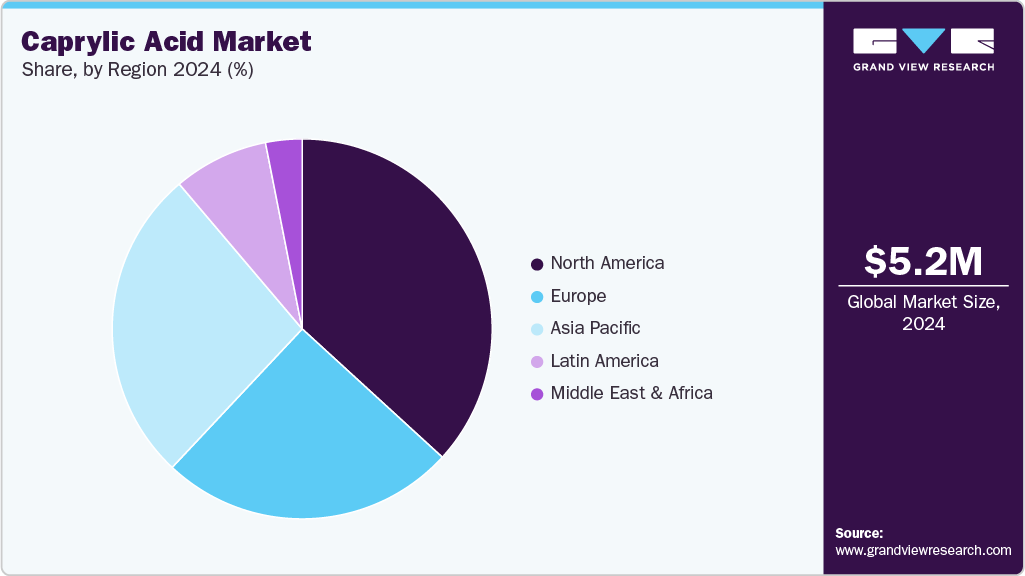
The global caprylic acid market size was valued at USD 5.7 million in 2025 and is projected to grow from USD 6.3 million in 2026 to USD 10.7 million by 2033, at a CAGR of 8.4% from 2026 to 2033. North America dominated the global market with the largest revenue share of 36.1% in 2025. Due to its antimicrobial properties, caprylic acid is increasingly used as an additive and preservative in the food and beverage industry.
 Source: Grand View Research, IR Documents, Primary Interviews, Paid DatabasesTo learn more about this report,
 Download Free Sample Report
 Key Market Trends & Insights
- By application: Personal care application segment led the market with the largest revenue share of 34.6% in 2025.
Regional Highlights
- Largest regional market: North America (36.1% revenue share, 2025)
- Fastest-growing regional market: Asia Pacific (highest CAGR, 2026-2033)
- By country: The U.S. held the largest market share in 2025.
Market Size & Forecast
- Market size in 2025: USD 5.7 Billion
- Estimated market size in 2026: USD 6.3 Billion
- Projected market size by 2033: USD 10.7 Billion
- CAGR (2026-2033): 8.4%
Three ways to get this report
Buy it, customize it, or ask a question.Ask an Analyst
Analyst response in 1 business day
- AccessReport author, directly
- Reply timeWithin 1 working day
- No sales callDirect answer only
- FormatEmail reply
- CostFree, no cost
Get the Full Report
What the study covers
- FormatsPDF · Excel · Dashboard
- Timeline2026–2033 annual, 2025 base
- Coverage20+ countries, 5 regions
- Companies10+ key players profiled
Customize the Report
20% free customization
- IncludeCountries, segments, points
- TailorTo your product definition
- ExtendDeeper competitor detail
- OrA fully bespoke study
- Turnaround5–10 working days
It aids in extending the shelf life of products by preventing the growth of bacteria and fungi, which is valuable in producing dairy products, processed foods, and beverages. The growing consumer preference for natural ingredients further drives the demand for caprylic acid in this sector, as it is derived from natural sources such as coconut and palm oil.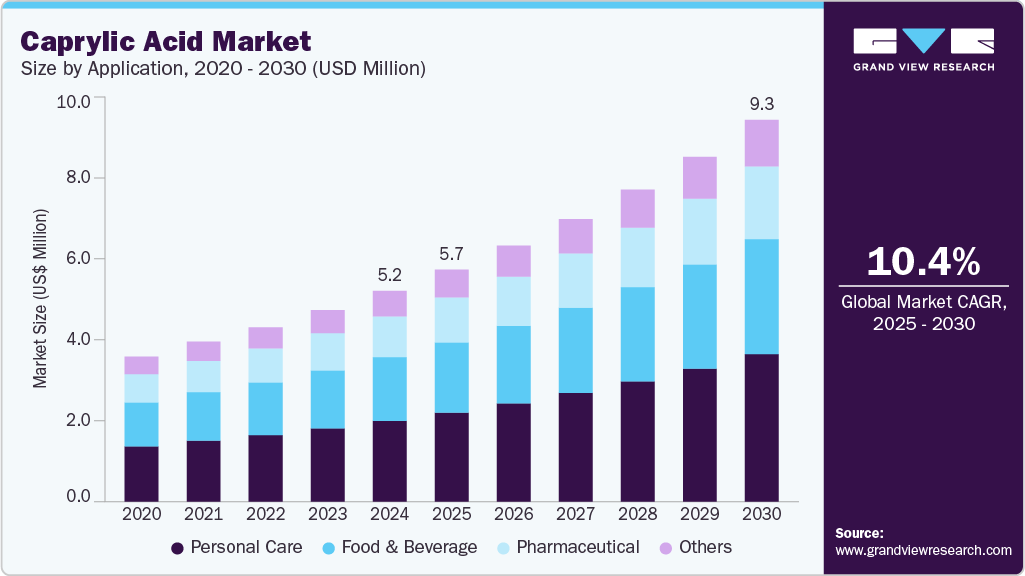 To learn more about this report, Download Free Sample Report
 Caprylic acid is known for its antifungal, antiviral, and anti-inflammatory properties, making it a key ingredient in various health supplements and medications. It is widely used to treat fungal infections, such as Candida. It is also used for its potential in managing other health conditions such as irritable bowel syndrome (IBS) and Crohn’s disease. The growing consumer awareness regarding health and wellness and the increasing prevalence of lifestyle-related diseases are increasing the demand for caprylic acid in these industries.
Caprylic acid is also gaining traction in personal care and cosmetics due to its emollient and skin-conditioning properties. It is often used in formulations of skincare products, hair care products, and cosmetics, providing benefits such as UVA protection, moisturizing, and skin softening. As consumers become more conscious of the ingredients in their personal care products, there is a growing preference for natural and organic ingredients, which is driving the demand for caprylic acid. Additionally, its compatibility with other ingredients and its ability to enhance the texture and stability of products make it a popular choice among manufacturers. For instance, in November 2023, Croda launched several sunscreen ingredients that offer high SPF and effective UVA protection. Solaveil CZ-300 includes zinc oxide, caprylic/capric triglyceride, polyhydroxystearic acid, and isostearic acid. Solaveil CT-300 Caprylic/Capric Triglyceride Titanium Dioxide Polyhydroxystearic Acid Aluminum Stearate Alumina.
Market Dynamics
Caprylic acid (octanoic acid) is a medium-chain fatty acid primarily derived from coconut oil and palm kernel oil and is widely utilized across personal care, pharmaceuticals, food & beverages, animal nutrition, and industrial applications. Its antimicrobial properties, emulsification capabilities, and favorable toxicological profile have supported increasing adoption in specialty formulations and functional ingredient applications. Growing demand for naturally derived ingredients, expanding utilization in personal care formulations, and increasing incorporation into nutraceutical and pharmaceutical products continue to support market growth globally.
The increasing consumer preference for naturally derived ingredients is a key factor driving demand for caprylic acid. Manufacturers across personal care, pharmaceutical, and food industries are increasingly incorporating medium-chain fatty acid derivatives into product formulations to address growing demand for clean-label, naturally sourced, and multifunctional ingredients.
In personal care applications, caprylic acid and its derivatives are widely used as emollients, emulsifiers, and antimicrobial agents in skincare, haircare, and cosmetic formulations. The expanding market for premium personal care products and naturally positioned formulations continues to support long-term demand growth.
The caprylic acid market remains highly dependent on coconut oil and palm kernel oil supply chains. Fluctuations in feedstock availability, agricultural output, weather conditions, and vegetable oil pricing can significantly influence production economics and profitability.
Additionally, sustainability concerns surrounding palm-based feedstocks and increasing regulatory scrutiny regarding sourcing practices may create challenges for manufacturers operating within global supply chains.
The growing utilization of medium-chain triglycerides (MCTs), functional nutrition products, and specialty pharmaceutical formulations presents significant opportunities for caprylic acid producers. Increasing consumer focus on digestive health, metabolic wellness, and functional ingredients is supporting demand for caprylic acid-based products across nutraceutical and healthcare applications.
Furthermore, ongoing product innovation in personal care, food preservation, and specialty chemical formulations is expected to create additional avenues for market expansion.
Market Concentration & Characteristics
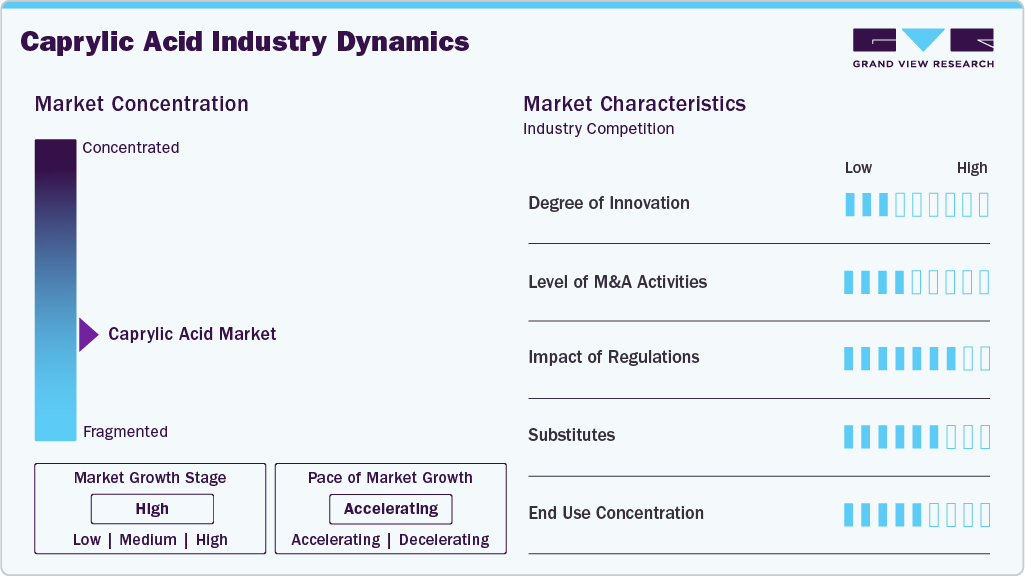
The market growth stage is high, and the market growth is accelerating. The caprylic acid market has moderate innovation, primarily focused on improving extraction processes, developing bio-based alternatives, and expanding applications in personal care, pharmaceuticals, and food industries. Substitutes are available for caprylic acid depending on the application, such as other medium-chain fatty acids (e.g., capric acid, lauric acid) or synthetic alternatives. However, caprylic acid’s natural antimicrobial properties and food-grade status still give it a strong foothold.
 To learn more about this report, Download Free Sample Report
 Environmental, health, and food safety regulations significantly influence industry, especially in the EU and North America. Compliance with Registration, Evaluation, Authorization, and Restriction of Chemicals (REACH), FDA, and other regulatory bodies affects production methods and product approval. The market serves multiple sectors, including personal care, food and beverages, pharmaceuticals, and industrial uses. While personal care and food dominate, no single end-use completely controls demand, indicating moderate concentration.
Analyst Perspective
The caprylic acid market occupies a strategically important position within the broader oleochemicals industry, where competitive advantage is increasingly determined by feedstock integration and access to high-growth specialty applications rather than commodity fatty acid production alone. While personal care remains the largest demand center, the market is witnessing increasing diversification into pharmaceutical, nutraceutical, and functional food applications, where caprylic acid benefits from its antimicrobial properties, favorable safety profile, and compatibility with naturally derived formulations. As consumer preference shifts toward clean-label, bio-based, and multifunctional ingredients, manufacturers are increasingly moving up the value chain from basic fatty acid production toward application-specific solutions. Consequently, companies with secure vegetable oil supply chains, sustainability credentials, and strong positions in specialty ingredient markets are expected to capture a disproportionate share of future value creation within the caprylic acid industry.
Application Insights
Based on application, the personal care application segment led the market with the largest revenue share of 34.6% in 2025. Caprylic acid has multifunctional properties, making it a versatile ingredient in personal care formulations. It is an emollient that helps moisturize and soften the skin by forming a barrier that prevents water loss. Additionally, it includes antimicrobial properties, which make it effective in preserving the stability of formulations and preventing the growth of bacteria and fungi. Its ability to improve product texture and its spreading ability enhance the consumer's sensory experience. These factors combined drive the demand for Caprylic acid in personal care.
The food & beverage segment is expected to witness significant growth over the forecast period. With growing consumers’ awareness about food safety and the potential health risks associated with synthetic additives, the demand for natural food preservatives is also growing consistently. Caprylic acid, derived from natural sources such as coconut oil and palm kernel oil, has antimicrobial properties, effectively inhibiting the growth of bacteria, yeast, and mold in food products. This extends the shelf life of various food and beverage items without synthetic chemicals, including dairy products, baked goods, and beverages. The growing consumer preference for these products free from artificial preservatives and additives drives the demand for caprylic acid in the food and beverage industry.
Regional Insights
North America dominated the Caprylic Acid market with the largest revenue share of 36.1% in 2025. Food processing in North America is a highly established industry, with a strong focus on innovation and quality control. Caprylic acid is used as a natural preservative across various food products due to its antimicrobial properties, which aid in extending product life and maintaining product quality. The growing demand for processed and convenience foods free from synthetic preservatives drives the adoption of natural alternatives such as caprylic acid.
 To learn more about this report, Download Free Sample Report
 U.S. Caprylic Acid Market Trends
The caprylic acid market in the U.S. held the largest share of 75.8% in the North America region in 2025. The U.S. is a significant personal care and cosmetics market, and consumers are increasingly demanding high-quality, safe, and effective products. Caprylic acid is widely used in this industry for its emollient, skin-conditioning, and antimicrobial properties. It is a common ingredient in skincare products, haircare formulations, and cosmetics, particularly in products designed for sensitive or problem-prone skin. The trend toward clean beauty, with growing consumers’ preference for products made with natural and non-toxic ingredients, further increases the demand for caprylic acid in the U.S. personal care market.
Europe Caprylic Acid Market Trends
Europe caprylic acid market is expected to witness significant growth over the forecast period. The functional food and nutraceutical markets in Europe are experiencing growth as consumers increasingly seek foods and supplements that offer additional health benefits. Owing to its health-promoting properties, caprylic acid is integrated into various functional foods, including fortified beverages, energy bars, and meal replacement products. Additionally, it is used in MCT (medium-chain triglycerides) oil, which is prevalent among athletes, fitness enthusiasts, and individuals. The increasing demand for functional foods and nutraceuticals, driven by a growing focus on preventive health and wellness, drives the demand for caprylic acid in Europe.
The UK caprylic acid market is expected to witness significant growth over the forecast period. Caprylic acid is increasingly used in the pharmaceutical sector due to its potential therapeutic benefits, especially its antimicrobial and antifungal properties. It is being explored as an ingredient in treating conditions such as infections and microbial imbalances. Additionally, its role in formulations for drug delivery systems, where medium-chain fatty acids enhance the bioavailability of active pharmaceutical ingredients, is driving its adoption.
Asia Pacific Caprylic Acid Market Trends
Asia Pacific caprylic acid market is expected to witness the fastest CAGR of 11.6% over the forecast period. The expansion of e-commerce in the Asia Pacific region significantly impacts the distribution and accessibility of caprylic acid-based products. Online platforms provide consumers with easy access to a wide range of dietary supplements, personal care products, and organic food items containing caprylic acid. The convenience of online shopping, combined with the ability to research and compare products, has increased the sales and visibility of the caprylic acid industry in the region. The growing e-commerce sector enables wider distribution and access to these products for a diverse consumer base.
India caprylic acid market is expected to witness significant growth over the forecast period. Caprylic acid is a natural preservative used in organic food products. It aids in maintaining product integrity and safety without compromising organic standards. The growth of the organic food sector, which prioritizes using natural ingredients and sustainable practices, drives the demand for the caprylic acid market in India. As the demand for organic food continues to rise, the use of caprylic acid in this segment is expected to increase.
Key Caprylic Acid Market Share Insights
Key players in the caprylic acid market include VVF L.L.C., Oleon NV, Wilmar International Ltd, Emery Oleochemicals, and others.
-
VVF L.L.C. is a global company specializing in manufacturing personal care products, oleochemicals, and specialty chemicals. VVF’s product offerings include a wide range of bar soaps, liquid soaps, hand sanitizers, skin care products under various brands, and bulk supplies of fatty acids, glycerin, and other oleochemical derivatives used in industries such as personal care, food, and pharmaceuticals.
-
Emery Oleochemicals is a global company that produces natural-based specialty chemicals. Their product lines are organized into several business units, including Green Polymer Additives, Eco-Friendly Polyols, and Bio-Lubricants, each focused on providing suitable solutions.
Key Caprylic Acid Companies:
The following key companies have been profiled for this study on the caprylic acid market.
-
VVF L.L.C.
-
Oleon NV
-
Wilmar International Ltd.
-
KLK OLEO
-
Emery Oleochemicals
-
P & G Chemicals
-
PT. Ecogreen Oleochemicals
-
Temix Oleo Srl
-
Pacific Oleochemicals, Sdn. Bhd.
-
Musim Mas Group
Competitive Benchmarking
Category
Operating Strategies
Competitive Edge
Weakness
Established Players (Wilmar International Ltd.; KLK OLEO; Oleon NV; Musim Mas Group; Emery Oleochemicals; P&G Chemicals)
- Strengthening backward integration into vegetable oil feedstocks, expanding specialty fatty acid portfolios, and investing in sustainable sourcing initiatives. Expanding downstream oleochemical offerings to support personal care, pharmaceutical, and food applications.
- Strong feedstock integration, large-scale oleochemical production capabilities, global distribution networks, and established customer relationships support competitive positioning.
- Exposure to palm kernel oil and coconut oil price volatility can impact profitability. Sustainability-related scrutiny and regulatory requirements may increase compliance costs.
Emerging Players (VVF L.L.C.; PT Ecogreen Oleochemicals; Temix Oleo Srl; Pacific Oleochemicals Sdn. Bhd.)
- Expanding regional production capabilities and targeting specialty fatty acid applications with customized product offerings. Strengthening partnerships with personal care and specialty ingredient manufacturers.
- Strong regional presence and operational flexibility enable responsiveness to customer-specific requirements and niche market opportunities.
- Comparatively smaller manufacturing scale and lower feedstock integration can reduce cost competitiveness relative to global leaders.
Recent Developments
-
In April 2024, Wild Biome launched a two-part supplement system, Detoxification and Repopulation, developed for leaky gut syndrome and its associated issues in dogs. For Detoxification, the MCT-3 Oil supplement is designed to detoxify the gut microbiome, targeting the overgrowth of yeast with its concentration of caprylic acid. In Repopulation, the DT-Synbiotic 1 formula includes a blend of prebiotics, enzymes, and probiotics, supporting microbial balance and gut function.
-
In April 2022, Symrise launched a biobased version of caprylyl glycol, 1,2-octanediol. It is an antimicrobial and moisturizing ingredient commonly utilized in lotions and other personal care products. Symrise's biobased caprylyl glycol is derived from plant sources, specifically caprylic acid in coconut and palm oil.
Caprylic Acid Market Report Scope
Report Attribute
Details
Market size in 2025
USD 5.7 million
Estimated market size in 2026
USD 6.3 million
Projected market size by 2033
USD 10.7 million
Growth rate
CAGR of 8.4% from 2026 to 2033
Base year for estimation
2025
Historical data
2021 - 2024
Forecast period
2026 - 2033
Quantitative units
Revenue in USD thousand/million, Volume in Tons/Kilotons and CAGR from 2026 to 2033
Report coverage
Revenue forecast, company ranking, competitive landscape, growth factors, and trends
Segments covered
Application, region
Regional scope
North America; Europe; Asia Pacific; Latin America; MEA
Country scope
U.S.; Canada; Mexico; Germany; UK; France; Italy; Spain; China; Japan; India; South Korea; Brazil; Argentina; Saudi Arabia; South Africa;
Key companies profiled
VVF L.L.C., Oleon NV, Wilmar International Ltd, KLK OLEO, Emery Oleochemicals, P & G Chemicals, PT. Ecogreen Oleochemicals, Temix Oleo Srl, Pacific Oleochemicals, Sdn. Bhd., Musim Mas Group
Customization scope
Free report customization (equivalent up to 8 analysts' working days) with purchase. Addition or alteration to country, regional & segment scope.
Pricing and purchase options
Avail customized purchase options to meet your exact research needs. Explore purchase options
Global Caprylic Acid Market Report Segmentation
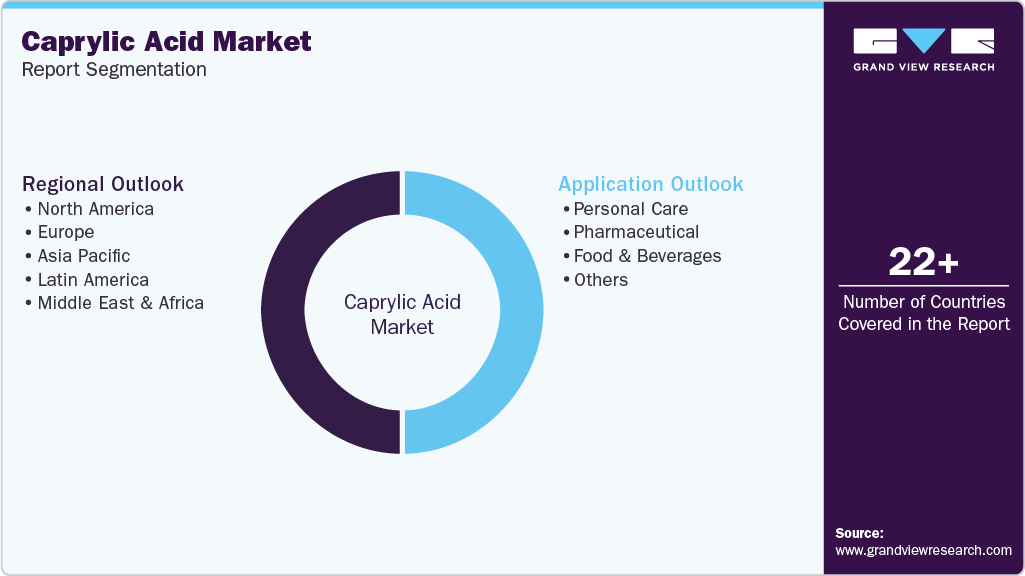
This report forecasts revenue growth at global levels and provides an analysis of the latest industry trends in each of the sub-segments from 2021 to 2033. For this study, Grand View Research has segmented the global caprylic acid market report based on application and region.
 To learn more about this report, Download Free Sample Report
 -
Application Outlook (Revenue, USD Million, 2021 - 2033)
-
Personal Care
-
Pharmaceutical
-
Food & Beverages
-
Others
-
-
Regional Outlook (Revenue, USD Million, 2021 - 2033)
-
North America
-
U.S.
-
Canada
-
Mexico
-
-
Europe
-
UK
-
Germany
-
France
-
Italy
-
Spain
-
-
Asia Pacific
-
China
-
Japan
-
India
-
South Korea
-
-
Latin America
-
Brazil
-
Argentina
-
-
Middle East and Africa (MEA)
-
Saudi Arabia
-
South Africa
-
-
Research Methodology
Segment Definition
Segment - Application
Revenue capture definition
Personal Care
As the leading application segment, revenue is generated through the incorporation of caprylic acid and its derivatives into skincare, haircare, cosmetic, and personal hygiene formulations. Demand is supported by increasing preference for naturally derived ingredients and multifunctional formulation components.
Pharmaceutical
Revenue is supported by utilization in drug formulations, excipient systems, antimicrobial applications, and specialty healthcare products. Growth is influenced by pharmaceutical production activity and increasing demand for functional ingredients in healthcare applications.
Food & Beverages
Market value is generated through applications in food preservation, flavor systems, functional nutrition products, and medium-chain triglyceride (MCT) formulations. Consumer preference for clean-label and functional food products supports segment demand.
Other
Revenue is derived from animal nutrition, industrial chemicals, lubricants, and specialty applications where caprylic acid provides functional performance benefits.
Estimation Model
Layer Name
Key Question
Description
Feedstock Availability Layer
What forms the supply base?
Identify global availability of coconut oil, palm kernel oil, and other vegetable oil feedstocks utilized in caprylic acid production. Evaluate regional feedstock production, processing infrastructure, and oleochemical manufacturing capacities.
Production Layer
How much caprylic acid can be commercially produced?
Apply oleochemical conversion yields, production capacities, and processing efficiencies to estimate commercially available caprylic acid volumes.
Application Adoption Layer
Where is caprylic acid consumed?
Estimate consumption across personal care, pharmaceutical, food & beverage, and industrial applications based on formulation inclusion rates and end-use demand patterns.
Revenue Layer
How is market revenue generated?
Market revenue is quantified through the sale of caprylic acid supplied to personal care manufacturers, pharmaceutical companies, food ingredient suppliers, and industrial formulators globally.
Delivered Customizations
This report has been delivered with the following In-depth customizations
Client Request
Customization Delivered
Value Adds
Feedstock Analysis
The study delivers detailed assessment of coconut oil and palm kernel oil supply chains, including production trends, regional availability, pricing dynamics, and sustainability considerations.
Supports procurement planning, feedstock risk assessment, and long-term sourcing strategy development.
Application Assessment
The report provides detailed analysis of caprylic acid consumption across personal care, pharmaceutical, food & beverage, animal nutrition, and specialty industrial applications.
Helps stakeholders identify high-growth demand centers and optimize market prioritization strategies.
Competitive Benchmarking
The study benchmarks major oleochemical producers based on feedstock integration, production capacities, sustainability initiatives, product portfolios, and regional market presence.
Enables evaluation of competitive positioning, supply chain advantages, and future growth opportunities across the caprylic acid value chain.
Frequently Asked Questions About This Report
Key factors that are driving the market growth include growing demand for naturally derived ingredients, expanding utilization in personal care formulations, and increasing incorporation into nutraceutical and pharmaceutical products continue to support market growth globally.
The global caprylic acid market is expected to grow at a compound annual growth rate of 8.4% from 2026 to 2033 to reach USD 10.7 million by 2033.
Personal care application segment dominated the caprylic acid market with a share of 34.6% in 2025. Caprylic acid has multifunctional properties, making it a versatile ingredient in personal care formulations. It is an emollient that helps moisturize and soften the skin by forming a barrier that prevents water loss.
Europe follows a close-second to North America in 2025. The functional food and nutraceutical markets in Europe are experiencing growth as consumers increasingly seek foods and supplements that offer additional health benefits.
The caprylic acid market remains highly dependent on coconut oil and palm kernel oil supply chains. Fluctuations in feedstock availability, agricultural output, weather conditions, and vegetable oil pricing can significantly influence production economics and profitability.
The global caprylic acid market size was estimated at USD 5.7 million in 2025 and is expected to reach USD 6.3 million in 2026.
North America dominated the caprylic acid market with a share of 36.1% in 2025. This is attributable to the growing demand for processed and convenience foods free from synthetic preservatives, which in turn, drives the adoption of natural alternatives such as caprylic acid.
Key players in the caprylic acid market include VVF L.L.C., Oleon NV, Wilmar International Ltd, KLK OLEO, Emery Oleochemicals, P & G Chemicals, PT. Ecogreen Oleochemicals, Temix Oleo Srl, Pacific Oleochemicals, Sdn. Bhd., Musim Mas Group.
About the Author(s)
Renewable Chemicals Research Team
Specialty & Chemicals · Renewable ChemicalsThis report was authored by the renewable chemicals research team at Grand View Research - comprising two research analysts, one senior research analyst, and one industry expert - with specialized expertise in the renewable chemicals segment of the specialty & chemicals industry. All findings are based on proprietary specialty & chemicals databases, executive interviews, and regulatory analysis, subject to internal peer review prior to publication.
Last Updated:
Speak to Analyst

Customize this report to your needs - add regions, segments, or data points, with 20% free customization.
Or view our licence options:


ISO 9001:2015 & 27001:2022 Certified
We are GDPR and CCPA compliant! Your transaction & personal information is safe and secure. For more details, please read our privacy policy.


