
- Home
- »
- Food Additives & Nutricosmetics
- »
-
Caprylyl Glycol Market Size And Share Report, 2026-2033GVR Report cover

Caprylyl Glycol Market (2026 - 2033)
Size, Share & Trends Analysis Report By End-use (Personal Care & Cosmetics, Chemical Intermediate), By Region (North America, Europe, Asia Pacific, Central & South America, MEA), And Segment Forecasts
Market Size, 2025
$1.8BMarket Estimate, 2026
$1.9BMarket Forecast, 2033
$3.0BCAGR, 2026–2033
7.1%Caprylyl Glycol Market Size & Trends
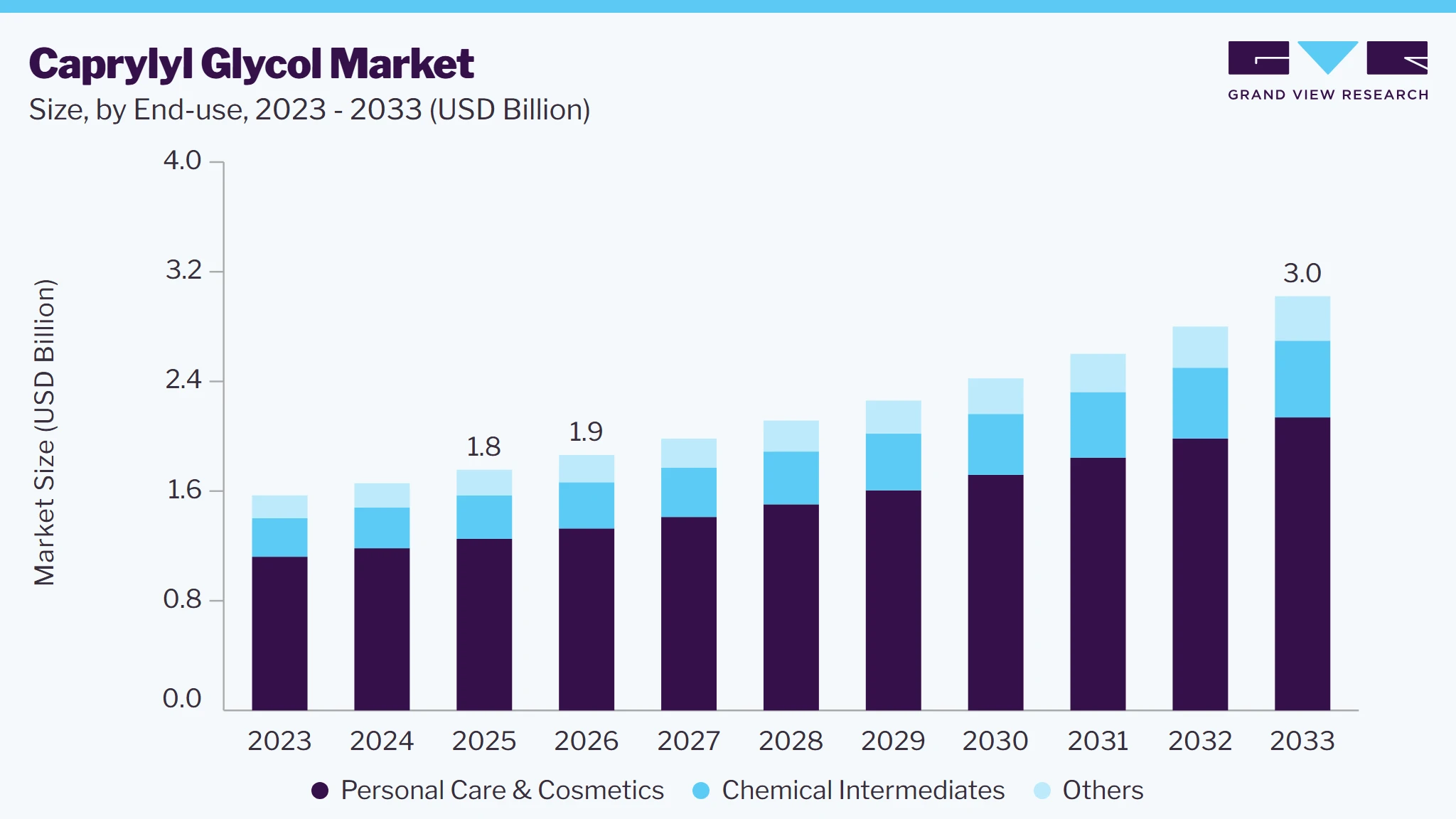
The global caprylyl glycol market size was valued at USD 1.8 billion in 2025 and is projected to grow from USD 1.9 billion in 2026 to USD 3.0 billion by 2033, at a CAGR of 7.1% from 2026 to 2033. North America dominated the caprylyl glycol market with the highest revenue share of 38.2% in 2025. This growth is attributed to its extensive usage in various industries such as cosmetics, personal care, and pharmaceuticals. It offers moisturizing, emollient, and antimicrobial properties, making it a popular choice in these sectors.
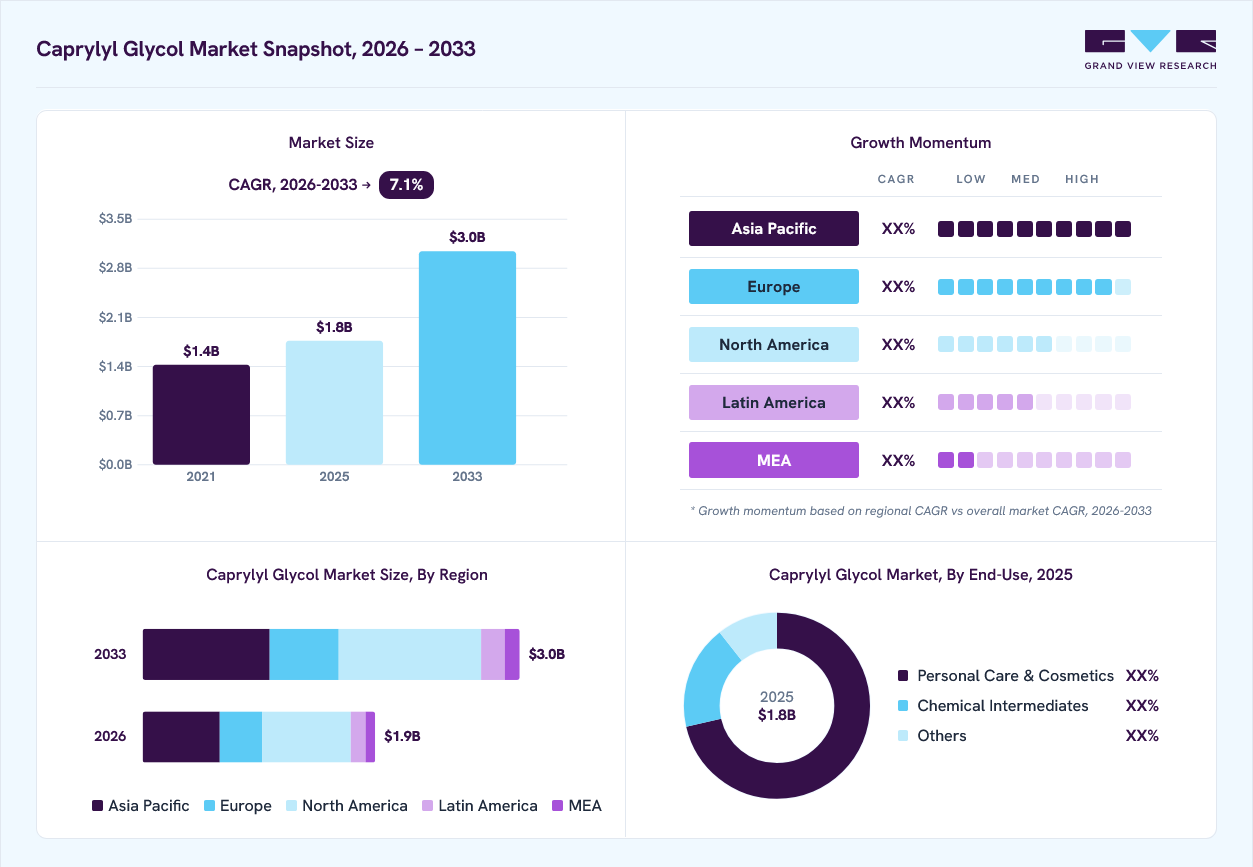 Source: Grand View Research, IR Documents, Primary Interviews, Paid DatabasesTo learn more about this report,
 Download Free Sample Report
Key Market Trends & Insights
- By end use: Personal care & cosmetics segment held the largest market share of 71.3% in 2025.
Regional Highlights
- Largest regional market: North America (38.2% revenue share, 2025)
- By country: The U.S. held the largest market share in 2025
Market Size & Forecast
- Market size in 2025: USD 1.8 Billion
- Estimated market size in 2026: USD 1.9 Billion
- Projected market size by 2033: USD 3.0 Billion
- CAGR (2026-2033): 7.1%
Prism AI by Grand View Research Free to tryAsk a question about the caprylyl glycol marketTry asking✓Every figure cited from GVR research Prefer the report? Download free sample →The rising awareness regarding personal hygiene and grooming is a significant driver for the market growth. The availability of various brands and products in the market, such as oral hygiene products, shower and bath products, and beard maintenance products, is contributing to the growth of the personal hygiene market. This, in turn, leads to increased consumption of ingredients in the hygiene products’ manufacturing processes.
 To learn more about this report, Download Free Sample Report
The trend of personal care and grooming has been growing in the United States. Consumers are becoming more conscious of their appearance and are seeking products that enhance their personal care routines. The clean beauty movement, which emphasizes the use of safe and non-toxic ingredients in personal care products, has gained momentum in the United States. Caprylyl glycol, with its antimicrobial properties, is used by the cosmetics firm to preserve clean beauty formulations to ensure product safety without compromising on performance.
Caprylyl glycol kills or inhibits the growth of microorganisms, including bacteria, viruses, protozoans, and fungi, making it a valuable ingredient in cosmetic and personal care products, as well as in pharmaceutical formulations. Caprylyl glycol is often used as a preservative in cosmetic and personal care products, extending the shelf life of these products and ensures their safety and efficacy.
Regulatory compliance and safety are crucial factors driving the caprylyl glycol industry. Compliance with regulations ensures that caprylyl glycol and products containing it meet safety standards and legal requirements. Regulatory bodies such as the Food and Drug Administration (FDA) in the United States and the European Union's REACH regulations set standards for the use of preservatives in cosmetics. Compliance with these regulations ensures that the ingredients meet safety requirements and are suitable for use in cosmetic formulations.
Market Dynamics
The caprylyl glycol market is witnessing steady growth, supported by rising demand for multifunctional cosmetic ingredients that enhance product preservation, moisturization, and formulation stability. Increasing consumer preference for mild, skin-friendly, and preservative-boosting ingredients is encouraging manufacturers to incorporate caprylyl glycol across skincare, haircare, personal care, and cosmetic formulations. Innovation in clean-label and sustainable formulations, coupled with expanding personal care production in emerging economies and evolving regulatory compliance requirements, is further strengthening market prospects. However, fluctuations in raw material prices and the availability of alternative multifunctional ingredients may moderately influence market growth.
The growing demand for multifunctional ingredients in personal care and cosmetic formulations is a key factor driving the caprylyl glycol market. As consumers increasingly prefer products with simplified ingredient lists, enhanced efficacy, and improved skin compatibility, manufacturers are incorporating caprylyl glycol as both a humectant and a preservative booster. Its ability to enhance moisturization, improve formulation stability, and support preservation systems makes it a preferred ingredient in skincare, haircare, and cosmetic products, helping brands develop high-performance formulations while reducing reliance on conventional preservatives.
The robust expansion of the global beauty and personal care industry is further strengthening demand for caprylyl glycol. According to Cosmetics Europe, the European cosmetics and personal care market generated approximately USD 118820 million in retail sales in 2024, highlighting sustained consumer spending on beauty and skincare products. Reinforcing this trend, L'Oréal reported USD 49680 million in sales for 2024, reflecting 5.6% like-for-like growth, supported by strong performance in dermatological beauty and premium skincare segments. As leading personal care companies continue to invest in innovative, high-performance formulations that meet evolving consumer and regulatory expectations, the demand for multifunctional ingredients such as caprylyl glycol is expected to witness sustained growth.
The availability of alternative multifunctional ingredients is a key restraint for the substitute of glycol market. Cosmetic and personal care manufacturers have access to a broad range of ingredients, including phenoxyethanol, ethylhexylglycerin, pentylene glycol, and other preservative-boosting agents that offer similar moisturizing and formulation-stabilizing properties. The presence of these substitutes increases competitive pressure and may limit the pricing power of caprylyl glycol suppliers, particularly in cost-sensitive product categories.
Fluctuations in raw material prices and the need for continuous formulation optimization can influence ingredient selection decisions among manufacturers. Personal care brands frequently evaluate ingredient performance, regulatory acceptance, consumer perception, and overall formulation cost before finalizing product compositions. As a result, the availability of comparable multifunctional ingredients may moderate the pace of caprylyl glycol adoption across certain skincare, haircare, and cosmetic applications.
The accelerating shift toward clean beauty and transparent ingredient formulations presents a significant growth opportunity for the caprylyl glycol market. Consumers are increasingly seeking personal care products formulated with gentle, skin-compatible ingredients that offer both performance and safety. As a multifunctional ingredient that provides moisturizing properties while enhancing preservative efficacy, caprylyl glycol enables manufacturers to develop formulations with optimized preservation systems and streamlined ingredient lists, aligning with evolving consumer preferences.
The opportunity is further supported by continued investment in premium skincare, dermo cosmetics, and natural-inspired personal care products across developed and emerging markets. Leading beauty brands are expanding their portfolios with innovative formulations designed to meet stricter regulatory requirements and growing demand for high-performance products. As manufacturers prioritize ingredient efficiency, product stability, and formulation flexibility, the adoption of caprylyl glycol is expected to increase across skincare, haircare, cosmetics, and other personal care applications.
Analyst Perspective
The caprylyl glycol market is expected to witness steady growth, driven by increasing demand for multifunctional ingredients that enhance moisturization, product stability, and preservative efficacy in personal care formulations. Growing investments in premium skincare, clean beauty products, and dermatologically tested cosmetics are encouraging manufacturers to adopt high-performance specialty ingredients. While the presence of alternative multifunctional compounds may intensify competition, continued innovation in formulation technologies, evolving regulatory standards, and expanding personal care manufacturing in emerging economies are expected to create sustained growth opportunities for market participants.
End-use Insights
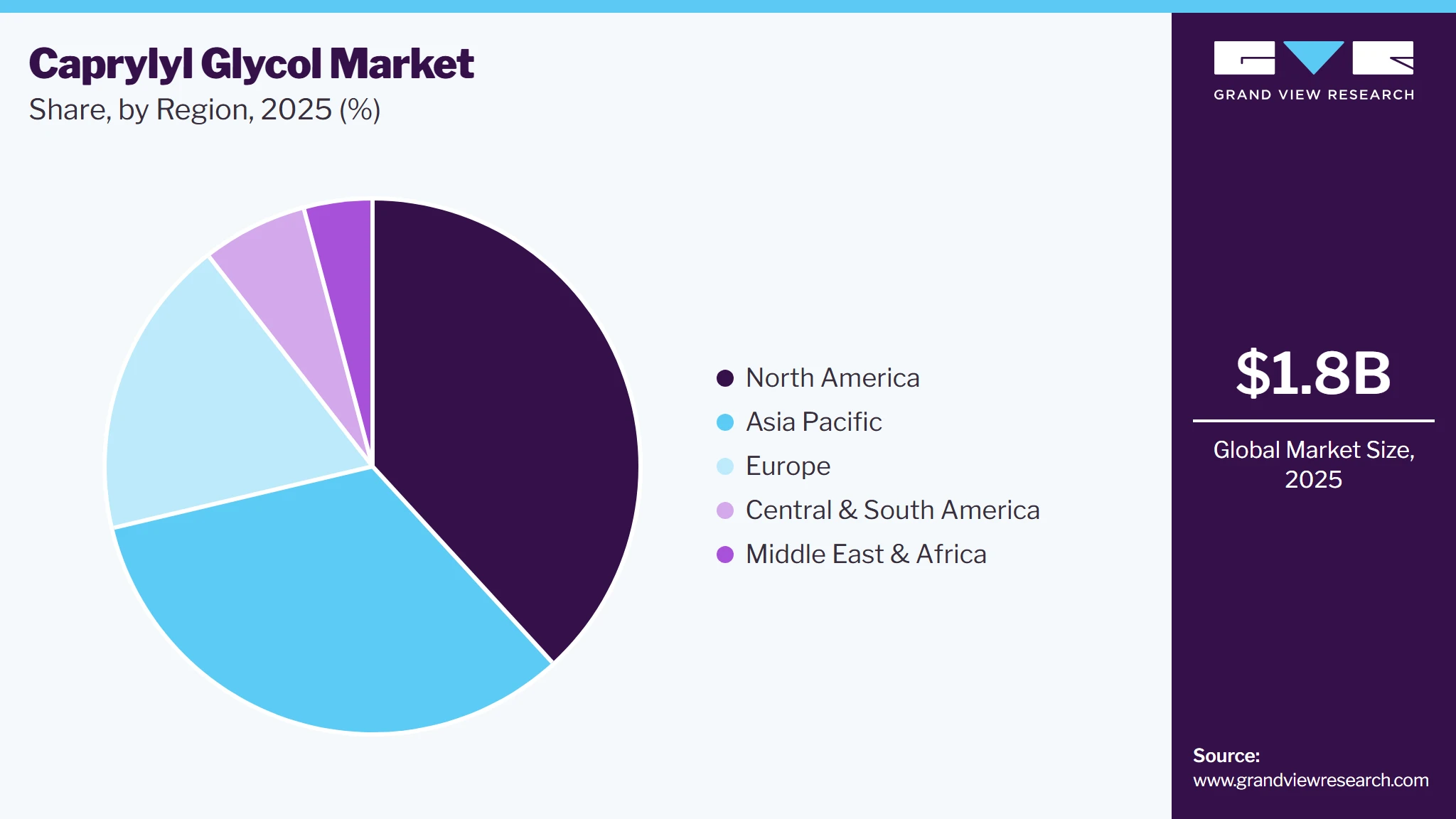
By end use, personal care & cosmetics held a dominant position, contributing 71.3% of total revenue in 2025, which is attributed to its extensive use of personal care & cosmetics products.Caprylyl glycol is a versatile ingredient and works as a humectant, emollient, and skin conditioning agent that offers multiple benefits for various skincare and haircare products. It is commonly used as a preservative booster, emollient, and moisturizing agent due to its excellent skin compatibility and antimicrobial properties.
 To learn more about this report, Download Free Sample Report
In the personal care industry, caprylyl glycol is often used as a multifunctional ingredient in formulations such as lotions, creams, serums, cleansers, shampoos, and conditioners. Its hydrating properties help attract and retain moisture in the skin and hair, providing a smoother and softer feel. It also acts as a stabilizer, enhancing the efficacy and shelf life of formulations by inhibiting the growth of microorganisms. Caprylyl glycol is often combined with other preservatives to create a synergistic effect, allowing for lower levels of traditional preservatives while maintaining product integrity.
Caprylyl glycol, also known as 1,2-Octanediol, is a versatile compound widely used in the chemical industry as a chemical intermediate for its various properties and applications. It is a colorless liquid with a faint odor and is soluble in water and most organic solvents. Caprylyl glycol has gained popularity in recent years due to its multifunctional nature and its ability to enhance the performance of many products.
Caprylyl glycol is used in the pharmaceutical industry as an ingredient in ointment bases, vehicles for drugs in suppositories, capsules, tablet binders, and liquid prescriptions. It is also used in veterinary drugs for various preparations. Industries such as leather, plastics, resins, paper, ceramics, glass, rubber, petroleum, and metal find applications for caprylyl glycol.
Regional Insights
North America dominated the caprylyl glycol market with the highest revenue share of 38.2% in 2025. This is attributed to the wide usage of personal care and cosmetic products in North America as humectants, emollients, and preservatives. It helps to retain moisture, improve texture, and extend the shelf life of these products. In addition, it finds applications in the large North America pharmaceutical industry as an ingredient in ointments, capsules, tablets, and liquid prescriptions. U.S. dominated the North America caprylyl glycol market in 2025.
In North America, the demand is driven by the growing consumer preference for natural and organic personal care products. Manufacturers are focusing on developing formulations that are free from harmful chemicals, and caprylyl glycol, being a safe and effective ingredient, is gaining popularity in this context. The region also witnesses a high demand for disinfectant sprays and wipes, especially in the wake of the COVID-19 pandemic, where antimicrobial properties are valued.
The Asia Pacific region is another significant market with diverse end-user industries and consumption trends. Consumption in the Asia Pacific region is influenced by several factors. The region has a large population, which drives the demand for personal care and cosmetic products. In addition, the rising disposable income and changing lifestyles of consumers contribute to the growth of the market.
Apart from personal care, caprylyl glycol finds applications in other industries in the Asia Pacific region. For instance, it is used in the production of textiles, plastics, resins, and paper. Caprylyl glycol's properties, such as compatibility with surfactants and the ability to form substantive films on surfaces, make it suitable for various industrial applications. Moreover, the presence of major manufacturing hubs and availability of raw materials in the region further support the production and consumption of glycol-based products.
Caprylyl glycol is extensively used in the personal care and cosmetic industry in Europe. The presence of major cosmetic manufacturers and suppliers in Europe contributes to the growth of the caprylyl glycol industry. These companies ensure the availability and distribution of ingredients to meet the demands of the industry. In addition, advancements in research and development activities in Europe drive innovation in the market.
Key Companies & Market Share Insights
The market is characterized by the presence of a limited number of market players vying for a majority share. The firms have been indulging in research and development to offer new products. In addition, caprylyl glycol is used as an ingredient in the production of various beauty products by key cosmetics manufacturers. For instance, in August 2023, Evonik Industries AG announced the launch of a new line of fermented actives, which addresses the issues of skin aging. The products enhance skin resurfacing and enable a healthy balance of the skin microbiota.
Key Caprylyl Glycol Companies
The following key companies have been profiled for this study on the caprylyl glycol market.
-
Ashland
-
BASF SE
-
Symrise
-
Inolex, Inc.
-
Lonza Group Ltd.
-
Evonik Industries AG
-
Dow
-
Clariant AG
-
Lotioncrafter
-
Thor Personal Care
Competitive Benchmarking
Category
Operating Strategies
Competitive Edge
Weakness
Established Players (Ashland, BASF SE, Symrise, Inolex, Inc., Lonza Group Ltd., Evonik Industries AG, Dow, Clariant AG)
- Focus on large-scale production, continuous R&D investment, strategic partnerships with personal care brands, expansion of specialty ingredient portfolios, global distribution networks, and compliance with international regulatory standards.
- Strong global brand recognition, extensive manufacturing capabilities, diversified product portfolios, established customer relationships, robust technical support, and broad geographic presence.
- High operational and regulatory compliance costs, exposure to raw material price fluctuations, and comparatively slower product commercialization due to complex organizational structures.
Emerging Players (Lotioncrafter, Thor Personal Care)
- Emphasize niche product offerings, customized ingredient solutions, agile product development, targeted customer engagement, and expansion within specialty and premium personal care ingredient markets.
- Flexibility in responding to customer requirements, specialization in cosmetic ingredients, faster innovation cycles, and stronger focus on niche applications.
- Limited manufacturing scale, narrower global distribution network, lower brand visibility compared to multinational suppliers, and relatively lower financial resources for large-scale expansion.
Caprylyl Glycol Market Report Scope
Report Attribute
Details
Market size value in 2025
USD 1.8 billion
Market size value in 2026
USD 1.9 billion
Revenue forecast in 2033
USD 3.0 billion
Growth rate
CAGR of 7.1% from 2026 to 2033
Base year for estimation
2025
Historical data
2021 - 2024
Forecast period
2026 - 2033
Quantitative units
Revenue in USD billion/million, Volume I kilotons and CAGR from 2026 to 2033
Report coverage
Revenue forecast, company ranking, competitive landscape, growth factors, and trends
Segments covered
End Use and Region
Regional scope
North America; Europe; Asia Pacific; Latin America; MEA
Country scope
U.S., Canada, Mexico, Germany, UK, France, Italy, Spain, China, Japan, India, South Korea, Brazil, Argentina, Saudi Arabia, South Africa
Key companies profiled
Ashland; BASF SE; Symrise; Inolex, Inc.; Lonza Group Ltd.; Evonik Industries AG; Dow; Clariant AG; Lotioncrafter; Thor Personal Care
Customization scope
Free report customization (equivalent up to 8 analysts' working days) with purchase. Addition or alteration to country, regional & segment scope.
Pricing and purchase options
Avail customized purchase options to meet your exact research needs. Explore purchase options
Global Caprylyl Glycol Market Report Segmentation
This report forecasts volume and revenue growth at global, regional, and country levels and provides an analysis of the latest industry trends in each of the sub-segments from 2021 to 2033. For this study, Grand View Research has segmented the global caprylyl glycol market report based on end-use, and region:
 To learn more about this report, Download Free Sample Report
-
End-use Outlook (Volume, Kilotons; Revenue, USD Million, 2021 - 2033)
-
Personal Care & Cosmetics
-
Chemical Intermediate
-
Others
-
-
Regional Outlook (Volume, Kilotons; Revenue, USD Million, 2021 - 2033)
-
North America
-
U.S.
-
Canada
-
Mexico
-
-
Europe
-
U.K.
-
Germany
-
France
-
Italy
-
Spain
-
-
Asia Pacific
-
China
-
Japan
-
India
-
South Korea
-
-
Central & South America
-
Argentina
-
Brazil
-
-
Middle East & Africa
-
South Africa
-
Saudi Arabia
-
-
Research Methodology
The caprylyl glycol market figures in this report are based on a proven research process that combines executive interviews with secondary research from proprietary databases, company filings, and recognized regulatory and institutional sources. Market size is built through value-chain sizing - reconciling supply-side and demand-side estimates - and triangulated with bottom-up and top-down approaches. Every estimate passes multiple levels of expert validation before publication, with each caprylyl glycol segment quantified using the revenue-capture definitions in the table below.
Segment Definition
Segment – End Use
Revenue capture definition
Personal Care & Cosmetics
Revenue generated from the sale of caprylyl glycol used in the formulation of skincare, haircare, color cosmetics, sun care, personal hygiene, and other cosmetic products, where it functions as a humectant, skin-conditioning agent, and preservative booster.
Chemical Intermediates
Revenue generated from the use of caprylyl glycol as an intermediate or functional ingredient in the production of specialty chemicals, industrial formulations, and other downstream chemical products requiring multifunctional glycols.
Others
Revenue generated from caprylyl glycol utilized in applications beyond personal care and chemical intermediates, including pharmaceutical, household, and niche industrial formulations where its moisturizing, stabilizing, or antimicrobial-supporting properties provide functional value.
Estimation Model
Layer No.
Layer Name
Key Question
Description
01
Global Caprylyl Glycol Production & Supply
What is the global production and supply potential of caprylyl glycol?
Assesses global production volumes, manufacturing capacity, supply chain dynamics, and availability of caprylyl glycol from key manufacturers and chemical suppliers.
02
End-Use Industry Demand
Which industries generate demand for caprylyl glycol?
Evaluates consumption across key end-use industries, including personal care & cosmetics, chemical intermediates, pharmaceuticals, and other industrial applications, to determine demand patterns.
03
Regional Demand Assessment
Which regions contribute the highest market revenue?
Estimates market demand across North America, Europe, Asia Pacific, Latin America, and the Middle East & Africa by considering manufacturing activity, consumer demand, regulatory landscape, and industry presence.
04
Market Size & Forecast Validation
What is the validated market size and future growth outlook?
Integrates supply-side analysis, end-use demand, pricing trends, trade analysis, and primary research inputs to estimate and validate the global caprylyl glycol market size and forecast.
Delivered Customizations
This report has been delivered with the following In-depth customizations
Client Request
Customization Delivered
Value Adds
Regional Segmentation
A comprehensive regional assessment of the caprylyl glycol market was conducted across North America, Europe, Asia Pacific, Latin America, and Middle East & Africa. The study evaluated country-level demand across personal care & cosmetics, chemical intermediate, and other end-use industries while examining manufacturing presence, regulatory landscape, formulation trends, and consumption patterns in key markets.
Provides greater visibility into regional demand dynamics and country-level growth opportunities. Supports market expansion planning, regional product positioning, and investment prioritization across high-consumption markets.
Competitive Benchmarking
Leading caprylyl glycol manufacturers were benchmarked based on product portfolio, manufacturing capabilities, formulation expertise, global distribution network, sustainability initiatives, regulatory compliance, and recent strategic developments. Competitive positioning across cosmetic and industrial applications was also evaluated.
Helps identify competitive strengths, product differentiation opportunities, and market positioning gaps. Facilitates partnership evaluation, competitive strategy development, and long-term business planning.
Opportunity Assessment
Growth opportunities were assessed across multifunctional cosmetic formulations, preservative-boosting ingredients, clean beauty products, premium skincare, and expanding personal care applications in emerging markets. The analysis also examined opportunities arising from increasing demand for mild, multifunctional ingredients in cosmetic formulations.
Enables identification of high-growth application areas and emerging investment opportunities. Supports innovation planning, portfolio expansion, and long-term market growth strategies.
Frequently Asked Questions About This Report
Some key players operating in the caprylyl glycol market include Ashland, BASF SE, Symrise, Inolex, Inc., Lonza Group Ltd., Evonik Industries AG, Dow, Clariant AG, Lotioncrafter, and Thor Personal Care, to name a few.
Key factors that are driving the market growth include extensive usage in various industries such as cosmetics, personal care, and pharmaceuticals. The rising awareness regarding personal hygiene and grooming is a significant driver of the caprylyl glycol market.
Personal care & cosmetics accounted largest revenue share of 71.3% in 2025.
Chemical intermediates is fastest growing segment with revenue CAGR of 7.5% during forecast period.
North America dominated the caprylyl glycol market with a share of 38.2% in 2025. This is attributable to its wide usage in personal care and cosmetic products in North America as a humectant, emollient, and preservative.
The caprylyl glycol market faces restraints from fluctuating raw material costs, competition from alternative preservatives and multifunctional ingredients, and regulatory requirements across different regions. Additionally, formulation compatibility challenges and pricing pressures may limit its adoption among cost-sensitive personal care and cosmetic manufacturers.
The caprylyl glycol market presents growth opportunities through increasing demand for multifunctional cosmetic ingredients that provide moisturizing, skin-conditioning, and antimicrobial benefits. The growing adoption of premium skincare, haircare, and personal care products, alongside rising demand for mild and effective preservative systems, is expected to create opportunities for manufacturers to develop innovative formulations and expand their presence across emerging markets.
The global caprylyl glycol market size was estimated at USD 1.8 billion in 2025 and is expected to reach USD 1.9 billion in 2026.
The global caprylyl glycol market is expected to grow at a compound annual growth rate of 7.1% from 2026 to 2033 to reach USD 3.0 billion by 2033.
About the Author(s)
Food Additives & Nutricosmetics Research Team
Specialty & Chemicals · Food Additives & NutricosmeticsThis report was authored by the food additives & nutricosmetics research team at Grand View Research - comprising two research analysts, one senior research analyst, and one industry expert - with specialized expertise in the food additives & nutricosmetics segment of the specialty & chemicals industry. All findings are based on proprietary specialty & chemicals databases, executive interviews, and regulatory analysis, subject to internal peer review prior to publication.
Last Updated:
Speak to Analyst

Customize this report to your needs - add regions, segments, or data points, with 20% free customization.
Or view our licence options:


ISO 9001:2015 & 27001:2022 Certified
We are GDPR and CCPA compliant! Your transaction & personal information is safe and secure. For more details, please read our privacy policy.


