
- Home
- »
- Electronic & Electrical
- »
-
Capsule Coffee Machine Market Size Report, 2026-2033GVR Report cover

Capsule Coffee Machine Market (2026 - 2033)
Size, Share & Trends Analysis Report By Application (Commercial, Household), By Region (North America, Europe, Asia Pacific, Latin America, MEA), Consumer Behavior And Competitive Analysis, And Segment Forecasts
Market Size, 2025
$1.8BMarket Estimate, 2026
$1.9BMarket Forecast, 2033
$2.6BCAGR, 2026–2033
4.7%Capsule Coffee Machine Market Summary
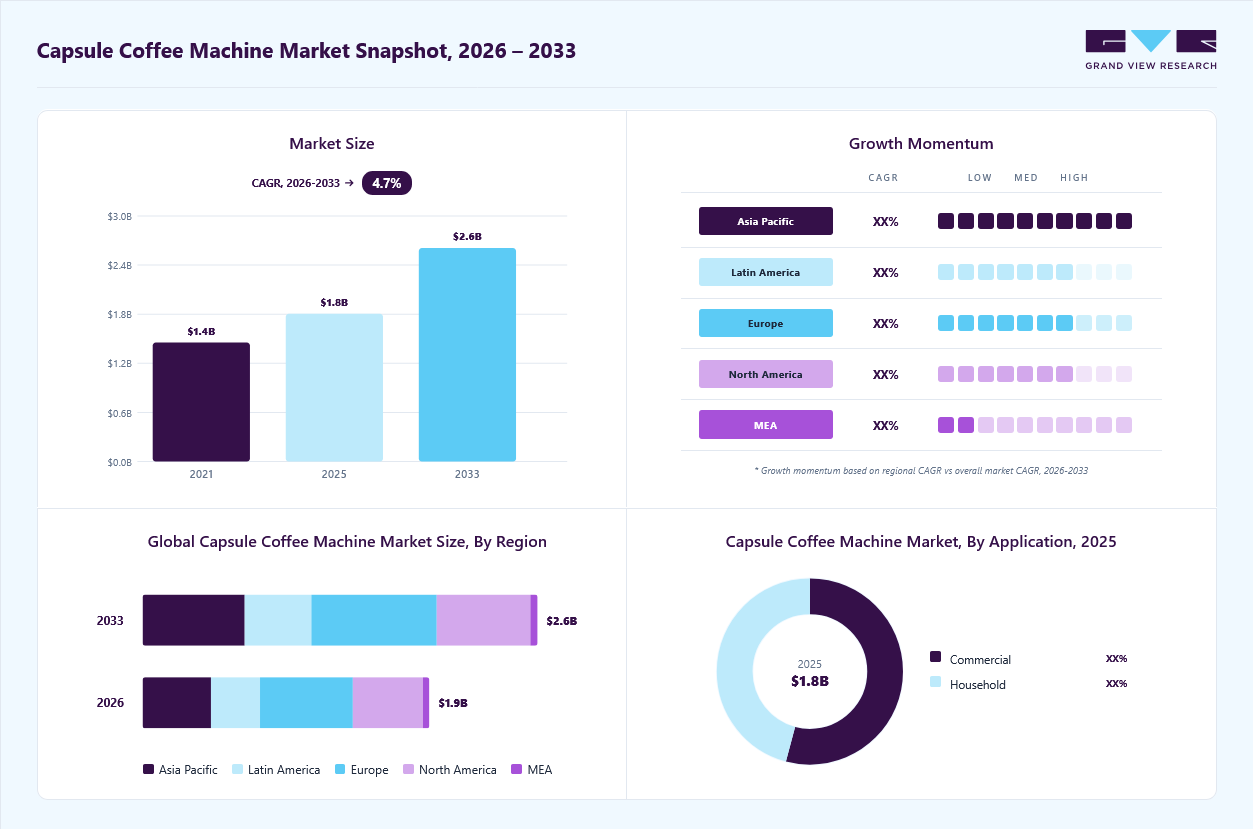
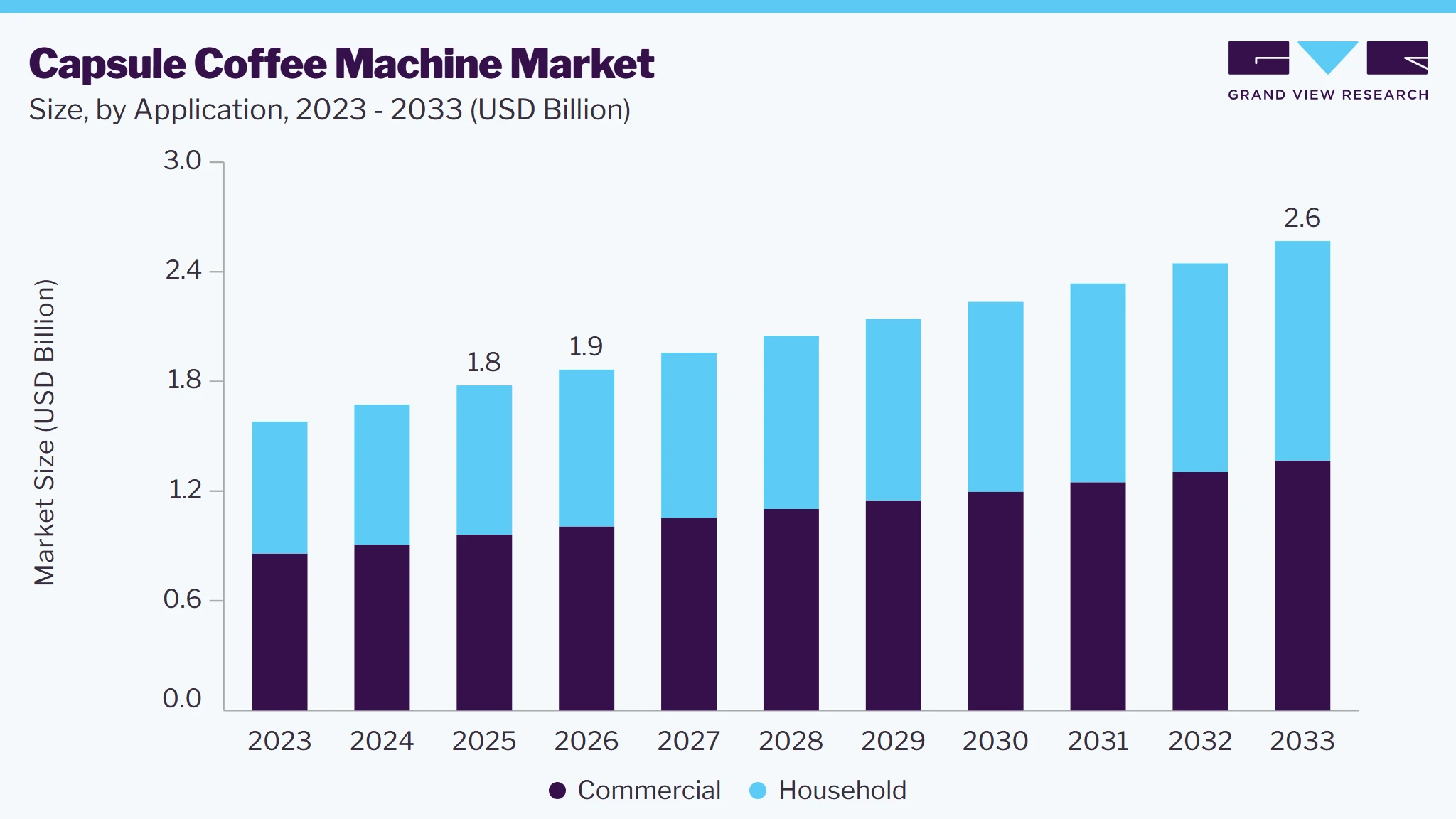
The global capsule coffee machine market size was estimated at USD 1.8 billion in 2025 and is projected to grow from USD 1.9 billion in 2026 to USD 2.6 billion by 2033, growing at a CAGR of 4.7% from 2026 to 2033. Europe dominated the capsule coffee machine market with the largest revenue share of 32.4% in 2025. The market growth can be credited to the increasing demand for convenience and efficiency in coffee preparation.
 Source: Grand View Research, IR Documents, Primary Interviews, Paid DatabasesTo learn more about this report,
 Download Free Sample Report
 Key Market Trends & Insights
- By application: Commercial segment led the market with the largest revenue share of 54.1% in 2025.
Regional Highlights
- Largest regional market: Europe (32.4% revenue share, 2025)
- Fastest-growing regional market: Asia Pacific (highest CAGR, 2026-2033)
- By country: U.S. held the largest share in the North America region in 2025
Market Size & Forecast
- Market size in 2025: USD 1.8 Billion
- Estimated market size in 2026: USD 1.9 Billion
- Projected market size by 2033: USD 2.6 Billion
- CAGR (2026-2033): 4.7%
Three ways to get this report
Buy it, customize it, or ask a question.Ask an Analyst
Analyst response in 1 business day
- AccessReport author, directly
- Reply timeWithin 1 working day
- No sales callDirect answer only
- FormatEmail reply
- CostFree, no cost
Get the Full Report
What the study covers
- FormatsPDF · Excel · Dashboard
- Timeline2026–2033 annual, 2025 base
- Coverage20+ countries, 5 regions
- Companies10+ key players profiled
Customize the Report
20% free customization
- IncludeCountries, segments, points
- TailorTo your product definition
- ExtendDeeper competitor detail
- OrA fully bespoke study
- Turnaround5–10 working days
Capsule coffee machines offer a quick and easy way to brew a perfect cup of coffee with minimal effort, which makes them highly popular among consumers. The market has benefited from the rising trend of home brewing, as more people seek to replicate the café experience in their own homes. Moreover, leading manufacturers' continuous innovation and product development have contributed to market growth. Companies have introduced new features and designs to enhance the user experience, such as smart connectivity, customizable brewing options, and compact, space-saving models. These advancements have attracted a broader consumer base and driven sales.In addition, the expansion of organized retailing and the availability of capsule coffee machines on various distribution channels have played a crucial role in market growth. Online platforms and e-commerce have made it easier for consumers to access a wide range of products, including capsule coffee machines, leading to increased sales. The growing coffee culture in regions including North America and Europe has also boosted the demand for these machines.
 To learn more about this report, Download Free Sample Report
 Increased consumption of coffee in Asian countries is one of the key factors driving the growth. In addition, the launch of new products, such as green and organic coffee, is anticipated to result in major consumption, thus contributing to market growth. Growing consumer awareness related to the health benefits of coffee, such as protection against liver cancer, type 2 diabetes, and heart failure, is likely to result in higher coffee consumption, and subsequently contribute to growth in demand for coffee machines.
The rapid rise in the amount of coffee intake is the major factor driving the industry’s growth. This is due to an increased demand for specialty beverages, including coffee, in recent decades due to a rising number of affluent consumers and an expanding palate for gourmet variants. According to the National Coffee Association (NCA), in the U.S., over 62.0% of the total population consumes coffee every day. Consumers prefer coffee machines over hand-made coffee due to high demand and the desire for gourmet coffee variants. This trend has resulted in a significant increase in coffee machine sales. According to an NCA report, out of the total coffee consumed in the U.S., nearly 60.0% is gourmet.
Coffee machines reduce the time and effort required to prepare coffee in coffeehouses and office cafeterias. The advent of coffee capsules that offer enhanced tasting coffee and the introduction of smart coffee machines integrated with Bluetooth, Wi-Fi, voice assistance, etc., which can be accessed, operated, and controlled through smartphones from anywhere inside the house, are the most recent advancements in the market. The rising demand for such smart coffee machines by consumers due to their high convenience is expected to significantly aid in expanding the global coffee machine industry during the forecast period.
Convenience stores are popular coffee-buying locations among coffee enthusiasts. Their viability is determined by their quick service and automated machines that serve high-quality coffee. While coffee shops cater to a specific demographic of coffee enthusiasts, other food services and retail channels cater to a broader range of customers with varying levels of expertise. Market participants are expected to benefit greatly from penetration in these avenues.
In the U.S., the consumption of coffee has been rising over the past few years. According to the data released by the International Coffee Organization in 2021, coffee consumption in the U.S. has grown by 1.2% in the past five years, driving the demand for coffee machines in the country. Changing consumer lifestyles and the growing coffee culture drive the demand for coffee machines. The shift in consumer preferences toward specialty coffee, such as artisanal and gourmet blends, drives the demand for various types of coffee machines, including espresso machines and drip coffee makers. Consumers are also discovering various types and flavors of coffee, further driving product demand.
Technological innovations have dramatically changed coffee machines. Coffee machine manufacturers now include innovative features like smartphone connectivity, touchscreen interface, and voice control. These developments improve the user experience and make coffee brewing more flexible and convenient. In addition, consumers looking for quick and hassle-free brewing methods prefer modern brewing technologies like pod-based brewers and capsule coffee machines.
The coffee machine market has grown significantly due to the e-commerce platform. Online shoppers can now easily find many coffee makers, accessories, and related products. Sales of coffee machines through online channels have increased due to the ease of online purchasing, competitive pricing, and the availability of user ratings and suggestions.
Market Dynamics
The capsule coffee machine is expanding as consumers increasingly shift toward fast, consistent, and low-effort coffee preparation, particularly in urban households and office environments where time efficiency is a priority. These machines use sealed single-serve capsules that standardize brewing, reducing variability while offering a wide range of coffee styles, from espresso and lungo to flavored and specialty blends, without requiring barista-level skill. Product differentiation is increasingly driven by machine ecosystem compatibility (closed vs. open capsule systems), energy-efficient heating technologies, compact designs suited for smaller living spaces, and enhanced user controls, such as customizable cup size, strength adjustment, and integrated milk systems. In addition, growth is supported by the rising penetration of premium coffee culture in emerging markets and by strong brand ecosystems that lock users into recurring capsule purchases.
A major growth driver is the rapid expansion of subscription-based capsule delivery ecosystems offered by leading machine manufacturers. Brands are increasingly locking consumers into proprietary systems that pair machines with automatic capsule replenishment, ensuring consistent usage. This model strengthens customer retention, reduces churn, and stabilizes long-term demand for capsules, directly supporting sustained machine adoption across households and offices.
These subscription ecosystems also enable companies to collect usage data and optimize flavor recommendations, pricing tiers, and personalized bundles. Consumers benefit from convenience and uninterrupted supply, while manufacturers secure predictable revenue streams beyond one-time machine sales. This recurring consumption loop is significantly reinforcing the installed base of capsule coffee machines globally.
A key restraint for the capsule coffee machine market is intensifying environmental scrutiny around single-use capsule waste, particularly aluminum and plastic-based pods that are difficult to recycle at scale. Municipal waste systems in several developed markets are increasingly under pressure, prompting stricter packaging regulations and extended producer responsibility (EPR) frameworks. This is raising compliance costs for manufacturers while forcing them to redesign capsule materials and collection systems. However, recycling participation remains inconsistent due to consumer inconvenience and fragmented take-back infrastructure. As sustainability expectations rise, brands face a structural tension between maintaining proprietary closed-loop systems and meeting regulatory and ESG-driven demands, which can slow adoption in environmentally conscious segments.
A major opportunity lies in the rapid penetration of emerging urban middle-class populations, particularly in the Asia-Pacific and parts of Latin America, where coffee consumption is shifting from instant formats to premium brewed experiences. Rising disposable incomes, expanding café culture, and exposure to global coffee trends are driving first-time adoption of home coffee machines rather than replacement demand. Capsule systems are well-positioned here because they remove skill barriers and deliver consistent results without requiring equipment knowledge. Additionally, localized flavor capsules and affordable entry-level machines are enabling manufacturers to tailor offerings to price-sensitive consumers, unlocking large, untapped household volumes in high-density urban markets where convenience is a dominant purchase driver.
Analyst Perspective
The capsule coffee machine market is shifting toward ecosystem-driven consumption, where value is increasingly captured through recurring capsule usage rather than one-time machine sales. Growth is concentrated in urban households, dual-income professionals, and office environments, replacing café dependency with in-home and workplace convenience. Commercial uptake in SMEs, hospitality chains, and co-working spaces is driven by standardized beverage quality and low operational complexity. Competitive advantage is moving toward players that combine closed-loop capsule systems, subscription replenishment, and smart machine integration, while managing cost pressures from consumables and sustainability concerns around waste management and recycling infrastructure.
Application Insights
Based on application, the commercial segment led the market with the largest revenue share of 54.1% in 2025, owing to the surging demand for convenience and efficient preparation within commercial settings such as cafes, restaurants, and hotels. Capsule coffee machines offer a quick and easy way to brew a perfect cup of coffee with minimal effort, making them ideal for businesses that aim to provide high-quality coffee to their customers while maintaining operational efficiency. Additionally, the rising trend of specialty coffee culture has propelled businesses to offer a wider range of coffee options. Capsule coffee machines allow these establishments to offer a variety of coffee flavors and types without the need for extensive training or complicated brewing equipment.
The household application is anticipated to grow over the forecast period. The projected growth is due to the increasing demand for convenience and efficiency in coffee preparation at home. Modern households have increasingly sought quick, convenient ways to enjoy quality coffee at home. Capsule coffee machines provide a hassle-free, single-serve option, appealing to consumers seeking efficiency in their daily routines. Moreover, with the increasing number of people leading busy lives, capsule coffee machines have gained traction as they provide quick and consistent coffee experiences without time commitment. This demand for time-saving solutions is particularly strong among working professionals and families.
Regional Insights
Europe Capsule Coffee Machine Market Trends
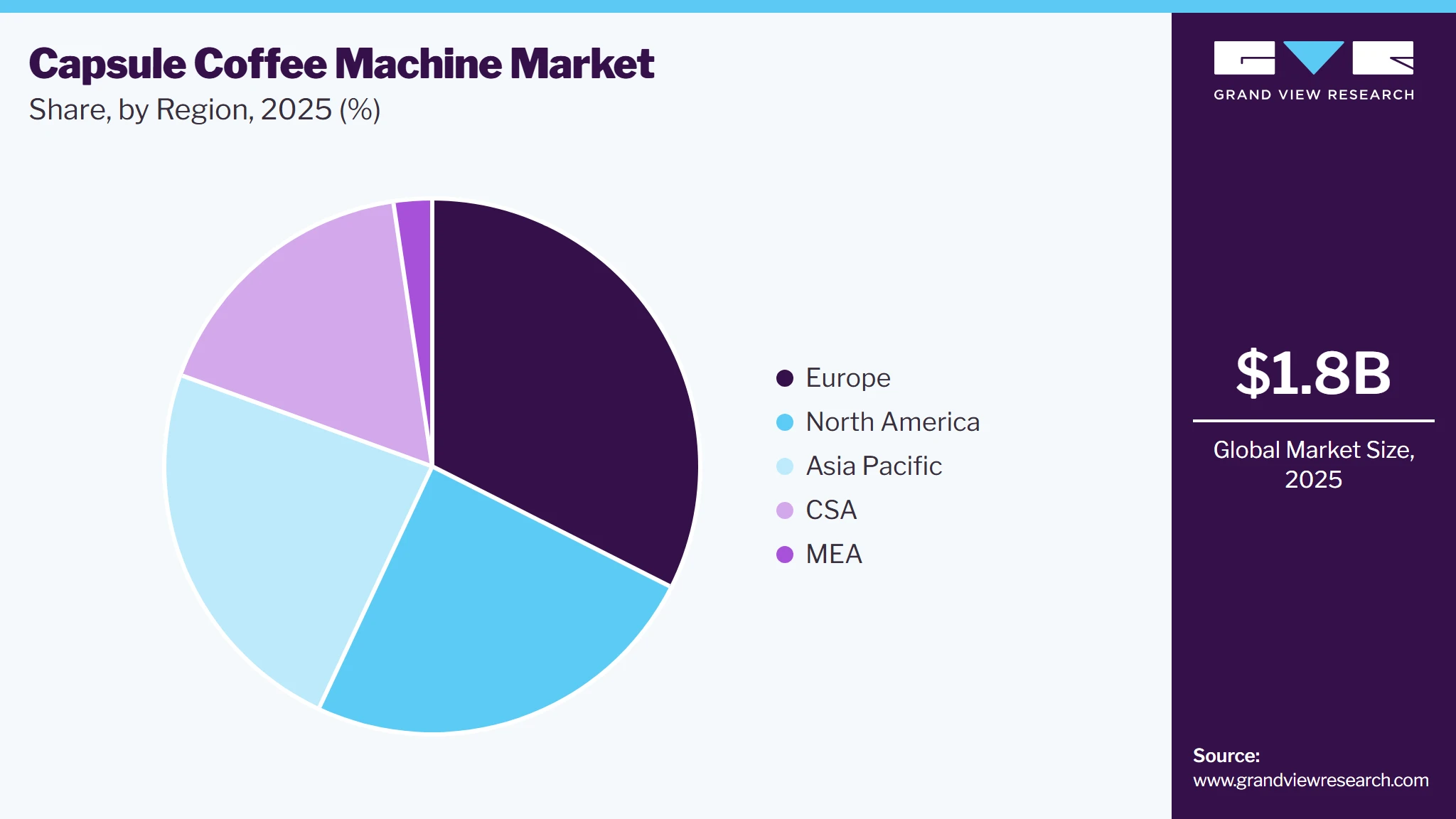
Europe dominated the capsule coffee machine market with the largest revenue share of 32.4% in 2025. Consumers in the region have increasingly prioritized convenience in their coffee routines, with capsule coffee machines offering a quick, mess-free solution for high-quality coffee at home. This appeal to convenience has been particularly strong for busy households and individuals with fast-paced lifestyles. Furthermore, the trend towards premium and artisanal coffee in Europe has been a major growth driver as capsule machines allow users to explore a wide range of flavors and specialty blends.
 To learn more about this report, Download Free Sample Report
 North America Capsule Coffee Machine Market Trends
The North America capsule coffee machine market registered 24.6% of the market share in 2024. Consumers have increasingly prioritized convenience, and capsule coffee machines offer a quick, easy way to prepare coffee without the need for grinding, measuring, and cleaning. This has majorly appealed to time-pressed individuals and households who are willing to invest in these machines to enjoy a coffee shop experience at home.
U.S. Capsule Coffee Machine Market Trends
The capsule coffee machine market in the U.S. held the largest share in the North America region in 2025 U.S. consumers have increasingly valued convenience, and capsule coffee machines offer a mess-free way to enjoy quality coffee at home. Single-serve capabilities make these machines particularly appealing to busy individuals and families looking to save time.
Asia Pacific Capsule Coffee Machine Market Trends
The Asia Pacific capsule coffee machine market held 23.3% of the global revenue share in 2024. Traditionally tea-drinking countries such as Japan, China, and India have experienced a rise in coffee culture, particularly among the younger generations and urban professionals. Capsule coffee machines make it easy for consumers to enjoy premium coffee at home, aligning with this trend. Moreover, with the rising disposable incomes, consumers have become increasingly willing to invest in lifestyle-enhancing appliances, including capsule coffee machines.
Key Capsule Coffee Machine Company Insights
The global capsule coffee machine market is highly competitive. Key market players include Keurig Dr Pepper, Nestlé, Dualit, JACOBS DOUWE EGBERTS. Market players are undertaking strategies such as product launches, mergers, and acquisitions to increase their product lines.
-
Keurig Dr Pepper is a leading beverage company that offers a diverse portfolio of over 125 owned, licensed, and partner brands, including popular beverages such as Dr Pepper, Snapple, 7UP, and Green Mountain Coffee. Keurig Dr Pepper is known for its innovative single-serve K-Cup pods, which revolutionized the coffee industry, and its extensive range of hot and cold beverages.
-
Nestlé is a Swiss multinational food and beverage company with a vast portfolio of products that include Nescafé, KitKat, Gerber, and Purina, among many others. Nestlé operates in more than 190 countries and has a strong presence in both developed and emerging markets.
Key Capsule Coffee Machine Companies:
The following are the leading companies in the capsule coffee machine market. These companies collectively hold the largest market share and dictate industry trends.
- Keurig Dr Pepper
- Nestlé
- Dualit
- JACOBS DOUWE EGBERTS
- Philips N.V.
- Dunkin’ Brands
- Luigi Lavazza SPA and its Affiliates
- illycaffè S.p.A.
Competitive Benchmarking
Category
Operating Strategies
Competitive Edge
Weakness
Established Players (Nestlé; Keurig Dr. Pepper; JACOBS DOUWE EGBERTS; Luigi Lavazza S.p.A. and its Affiliates; illycaffè S.p.A.)
- Expand capsule ecosystems through proprietary machines, premium coffee blends, and subscription-based replenishment models. Strengthening closed-loop systems, retail penetration, and B2B partnerships across offices, hospitality chains, and foodservice channels. Invest in smart machines, sustainability initiatives, and regional product customization.
- Strong brand equity, large installed machine base, vertically integrated capsule ecosystems, and extensive global distribution networks. High recurring revenue from consumables and strong customer retention via locked-in systems.
- High dependency on proprietary capsules limits flexibility. Elevated pricing may restrict penetration in price-sensitive markets. Sustainability concerns include challenges with waste and recycling infrastructure.
Emerging Players (Philips N.V.; Dualit; Dunkin’ Brands)
- Focus on open-system or semi-open capsule machines, value-oriented pricing, and product strategies driven by compatibility. Leverage e-commerce, retail partnerships, and co-branded capsule offerings to expand reach. Target entry-level and mid-tier consumers with simplified machine designs and affordability-focused positioning.
- Focus on specialized categories such as luxury capsule coffee machines, customizable modular solutions, sustainable materials, and outdoor kitchen furnishings. Utilize direct-to-consumer channels, e-commerce platforms, and design-led marketing strategies to target specific customer segments.
- Competitive pricing, flexibility through open-system compatibility, and strong appliance manufacturing capabilities (Philips N.V., Dualit). Brand leverage in foodservice and retail coffee ecosystems (Dunkin’ Brands).
Recent Developments
- In April 2024, Nestlé announced that NESPRESSO, with its extensive range of coffees, is expected to be launched in India by 2024. The featured NESPRESSO machines and coffees are expected to be available to serve professional and domestic consumers.
- In March 2024, Keurig Dr Pepper announced that it aims to launch the Keurig brewer with QuickChill Technology. This technology brews hot extracting flavor and flash-chilling the drink to a refreshing temperature in precisely three minutes.
Capsule Coffee Machine Market Report Scope
Report Attribute
Details
Market size in 2025
USD 1.8 billion
Estimated market size in 2026
USD 1.9 billion
Projected market size by 2033
USD 2.6 billion
Growth rate
CAGR of 4.7% from 2026 to 2033
Base year for estimation
2025
Historical data
2021 - 2024
Forecast period
2026 - 2033
Quantitative units
Revenue in USD million/billion and CAGR from 2026 to 2033
Report coverage
Revenue forecast, company ranking, competitive landscape, growth factors, and trends
Segments covered
Application, region
Regional scope
North America; Europe; Asia Pacific; Latin America; MEA
Country scope
U.S.; Canada; Mexico; Germany; UK; France; Italy; Spain; China; Japan; India; Australia; South Korea; Brazil; South Africa
Key companies profiled
Keurig Dr Pepper; Nestlé; Dualit; JACOBS DOUWE EGBERTS; Philips N.V.; Dunkin’ Brands; Luigi Lavazza SPA and its Affiliates; illycaffè S.p.A.
Customization scope
Free report customization (equivalent to up to 8 analysts' working days) with purchase. Addition or alteration to country, regional & segment scope.
Pricing and purchase options
Avail customized purchase options to meet your exact research needs. Explore purchase options
Global Capsule Coffee Machine Market Report Segmentation
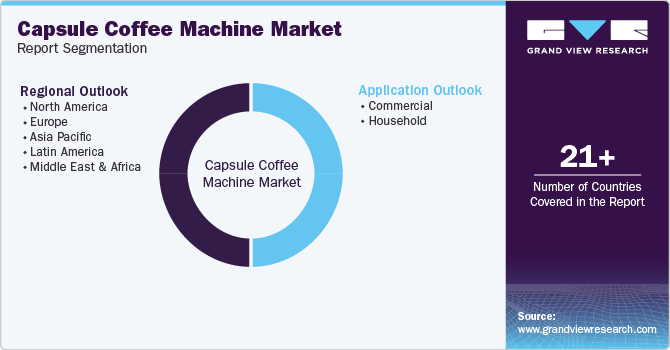
This report forecasts revenue growth at global, regional, and country levels and provides an analysis of the latest industry trends in each of the sub-segments from 2021 to 2033. For this study, Grand View Research has segmented the global capsule coffee machine market report based on application, and region:
 To learn more about this report, Download Free Sample Report
 -
Application Outlook (Revenue, USD Million, 2021 - 2033)
-
Commercial
-
Household
-
-
Regional Outlook (Revenue, USD Million, 2021 - 2033)
-
North America
-
U.S.
-
Canada
-
Mexico
-
-
Europe
-
Germany
-
UK
-
France
-
Spain
-
Italy
-
-
Asia Pacific
-
China
-
Japan
-
India
-
Australia
-
South Korea
-
-
Latin America
-
Brazil
-
-
Middle East and Africa (MEA)
-
South Africa
-
-
Research Methodology
Segment Definition
Segment - Application
Revenue capture definition
Commercial
As the largest application segment, revenue is generated through the sale of capsule coffee machines to commercial establishments such as offices, co-working spaces, hotels, cafés, retail stores, and institutional environments. These machines are deployed to provide quick, consistent, and low-maintenance beverage solutions for employees, guests, and customers. The segment includes high-capacity machines, multi-beverage systems, and durable units designed for frequent usage and reduced operational downtime. Workplace automation, employee welfare initiatives, and the need for efficient self-service coffee solutions in high-traffic environments drive demand.
Household
Revenue is generated through the sale of capsule coffee machines to residential consumers for personal use in home kitchens and private living spaces. This segment includes compact single-serve machines, mid-range automated brewers, and premium smart coffee systems designed for everyday at-home coffee preparation. Demand is driven by convenience, lifestyle upgrade, and the replacement of traditional instant or manual brewing methods. Sales are primarily influenced by consumer preferences for café-style beverages, product aesthetics, ease of use, and capsule variety ecosystems that support recurring consumption.
Estimation Model
Name
Focus Question
Description
Household & Commercial Base Layer
Who has potential to use capsule coffee machines?
Identifies high coffee-consuming households, urban apartment residents, and premium lifestyle consumers. Also includes offices, hotels, cafés, convenience stores, and small hospitality units like multifamily complexes and serviced apartments for shared deployment.
Purchasing Power Layer
Who can afford a coffee capsule machine?
Applies income segmentation across developed and emerging markets. Identifies urban middle-to-high income consumers, dual-income households, premium offices, SME budgets, hospitality chains, and corporate spending on capsule systems and consumables.
Adoption Layer
Who actively adopts and uses capsule coffee machines?
Applies behavioral adoption drivers, including coffee consumption frequency and preference for café-style beverages at home. Considers time-constrained lifestyles among remote workers and hospitality operators who prioritize speed, consistency, and convenience over manual brewing systems.
Revenue Generation Layer
How much revenue is generated?
Multiplies active users by machine price and recurring capsule consumption to estimate market value. Revenue is driven by hardware sales, high-margin consumables, subscriptions, ecosystem lock-in, and premium upgrades.
Delivered Customizations
This report has been delivered with the following In-depth customizations
Client Request
Customization Delivered
Value Adds
Capsule Coffee Machine Sustainability, Materials & Environmental Impact Analysis
Detailed assessment of sustainability trends across capsule materials (aluminum, plastic, compostable), machine manufacturing materials, and lifecycle environmental impact. Evaluation of recycling infrastructure, circular economy initiatives, and regulatory pressure on single-use capsule waste across key regions. Analysis of brand sustainability positioning and eco-certification adoption.
Identify sustainability-driven differentiation opportunities. Support ESG compliance and eco-design strategy development. Benchmark recyclability and environmental performance across competing capsule systems and brands.
Smart Technology Integration & Connected Coffee Machine Feature Analysis
Comprehensive evaluation of IoT-enabled capsule coffee machines, including app-based controls, personalization algorithms, brewing optimization features, and smart home ecosystem integration. Analysis of adoption trends across premium vs. mass-market segments and regional technology penetration rates. Assessment of firmware upgrades and data-driven consumption personalization trends.
Identify high-growth smart appliance segments. Support product innovation and feature prioritization roadmaps. Benchmark digital differentiation strategies across leading manufacturers.
Capsule Coffee Machine Distribution Channel & E-Commerce Penetration Analysis
Detailed breakdown of distribution channels including offline retail, specialty stores, direct-to-consumer platforms, and online marketplaces. Evaluation of e-commerce penetration trends, subscription-based capsule delivery models, and omnichannel retail strategies by region. Analysis of consumer purchase behavior shifts toward digital platforms and brand-owned ecosystems.
Identify fastest-growing sales channels and digital disruption trends. Support go-to-market and channel optimization strategies. Benchmark competitive advantage in direct-to-consumer and subscription models.
Frequently Asked Questions About This Report
The global capsule coffee machine market size was valued at USD 1.8 billion in 2025 and is estimated to reach USD 1.9 billion in 2026.
The global capsule coffee machine market is expected to grow at a CAGR of 4.7% from 2026 to 2033, reaching USD 2.6 billion by 2033.
Commercial capsule coffee machines held the largest share, accounting for a share of around 54.1% in 2025,
Some key players operating in the global capsule coffee machine market include Keurig Green Mountain, Inc.; Nestlé Nespresso SA; Dualit Limited; Jacobs Douwe Egberts Pro; Starbucks Corporation; Dunkin Brands; LUIGI LAVAZZA SPA; Koninklijke Philips N.V.; and illycaffè S.p.A.
Key factors that are driving the capsule coffee machine market growth include prevalent usage of single-serve coffee, especially in the countries of North America and Europe, simple operation features, lighter volume, and is cheaper as compared to the conventional machines.
Europe dominated with a 32.4% revenue share in 2025.
Asia Pacific is the fastest-growing region over the forecast period.
About the Author(s)
Electronic & Electrical Research Team
Consumer Goods · Electronic & ElectricalThis report was authored by the electronic & electrical research team at Grand View Research - comprising two research analysts, one senior research analyst, and one industry expert - with specialized expertise in the electronic & electrical segment of the consumer goods industry. All findings are based on proprietary consumer goods databases, executive interviews, and regulatory analysis, subject to internal peer review prior to publication.
Last Updated:
Speak to Analyst

Customize this report to your needs - add regions, segments, or data points, with 20% free customization.
Or view our licence options:


ISO 9001:2015 & 27001:2022 Certified
We are GDPR and CCPA compliant! Your transaction & personal information is safe and secure. For more details, please read our privacy policy.


